How Long Does It Take Soybeans to Grow? 100 to 150 Days
Seed tag maturity numbers rarely match the calendar in a cold spring. Planting date, latitude, and weather all change how long it takes soybeans to grow from seed to harvest. This guide gives measured day counts for every stage, plus the regional ranges behind them.
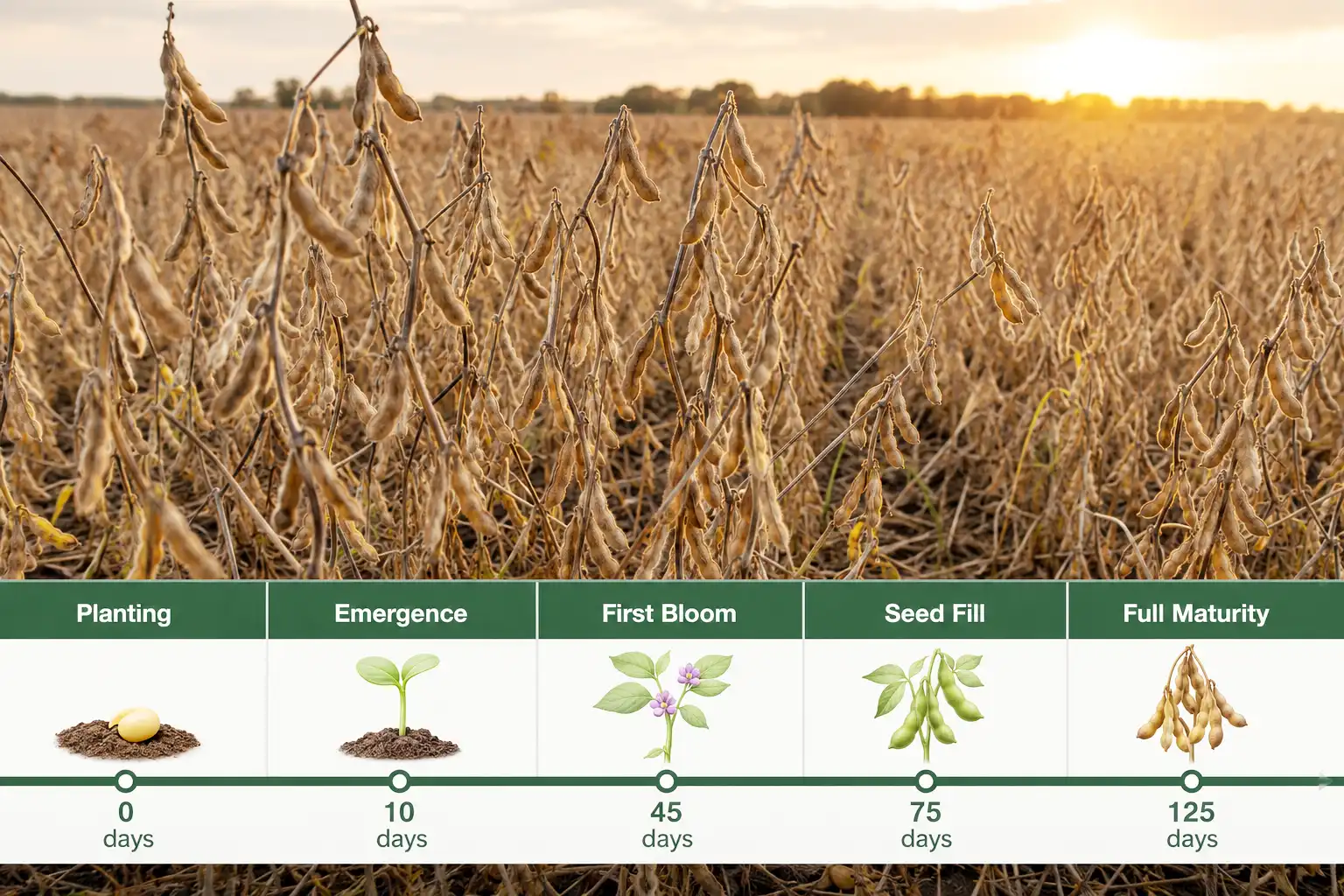
How long it takes soybeans to grow depends on maturity group. Most fields run 100 to 150 days from planting to harvest. Full season Midwest crops finish near 120 to 140 days, while late plantings compress to about 85 days.
How Long Does It Take Soybeans to Grow From Planting to Harvest?
Most soybean fields need 100 to 150 days from planting to a combine pass. The USDA Economic Research Service reports that most US soybeans go in the ground in May and early June. Harvest then runs through late September and October. That works out to roughly four to five months.
Northern trial data shows why the low end is rarely reached in field production. NDSU Extension tracked a very early variety (0.0 to 0.5 relative maturity) at Carrington, North Dakota. Planting to full maturity averaged about 123 days. Drydown then adds another five to ten days. So even the shortest season groups usually run past 125 days when planted into cool spring soil.
The number on a seed tag is a relative maturity rating, not a count of calendar days. It ranks one variety against others at the same latitude. Because emergence alone can take three weeks in cold ground, actual days from planting often exceed the rating.
Soybeans also read day length rather than heat alone. They are a short day crop, so flowering starts as days shorten after the solstice. Move the same variety south and it flowers sooner, which shortens the season. Push it north and the same genetics stretch out.
Soybean Growth Timeline by Stage
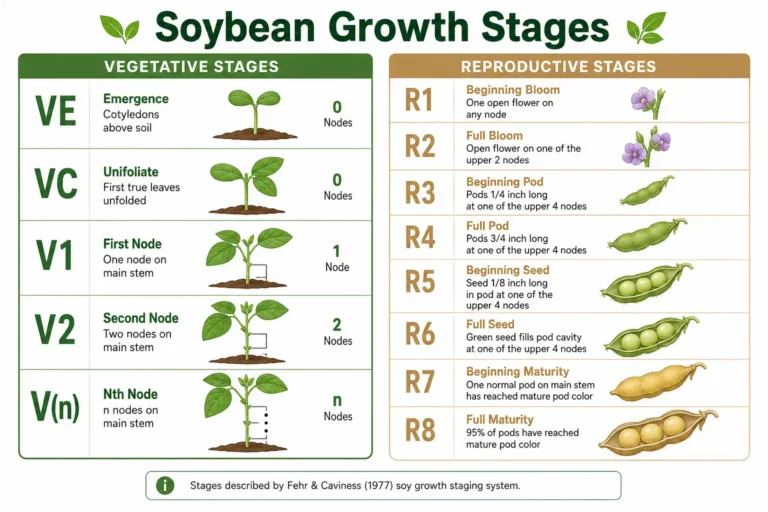
Soybean development splits into vegetative stages (V) and reproductive stages (R). Extension services nationwide use the Fehr and Caviness staging scale. NDSU Extension publishes average day counts between each stage, and those numbers give a workable planning calendar.
| Stage interval | Average days | Range in days |
|---|---|---|
| V1 to V2 | 5 | 3 to 10 |
| V2 to V3 | 5 | 3 to 10 |
| V3 to V4 | 5 | 3 to 8 |
| V4 to V5 | 5 | 3 to 8 |
| Each node past V5 | 3 | 2 to 5 |
| R1 to R2 (bloom) | 3 | 0 to 7 |
| R2 to R3 (pods begin) | 10 | 5 to 15 |
| R3 to R4 (full pod) | 9 | 5 to 15 |
| R4 to R5 (seed begins) | 9 | 4 to 26 |
| R5 to R6 (full seed) | 15 | 11 to 20 |
| R6 to R7 (first mature pod) | 18 | 9 to 30 |
| R7 to R8 (full maturity) | 9 | 7 to 18 |
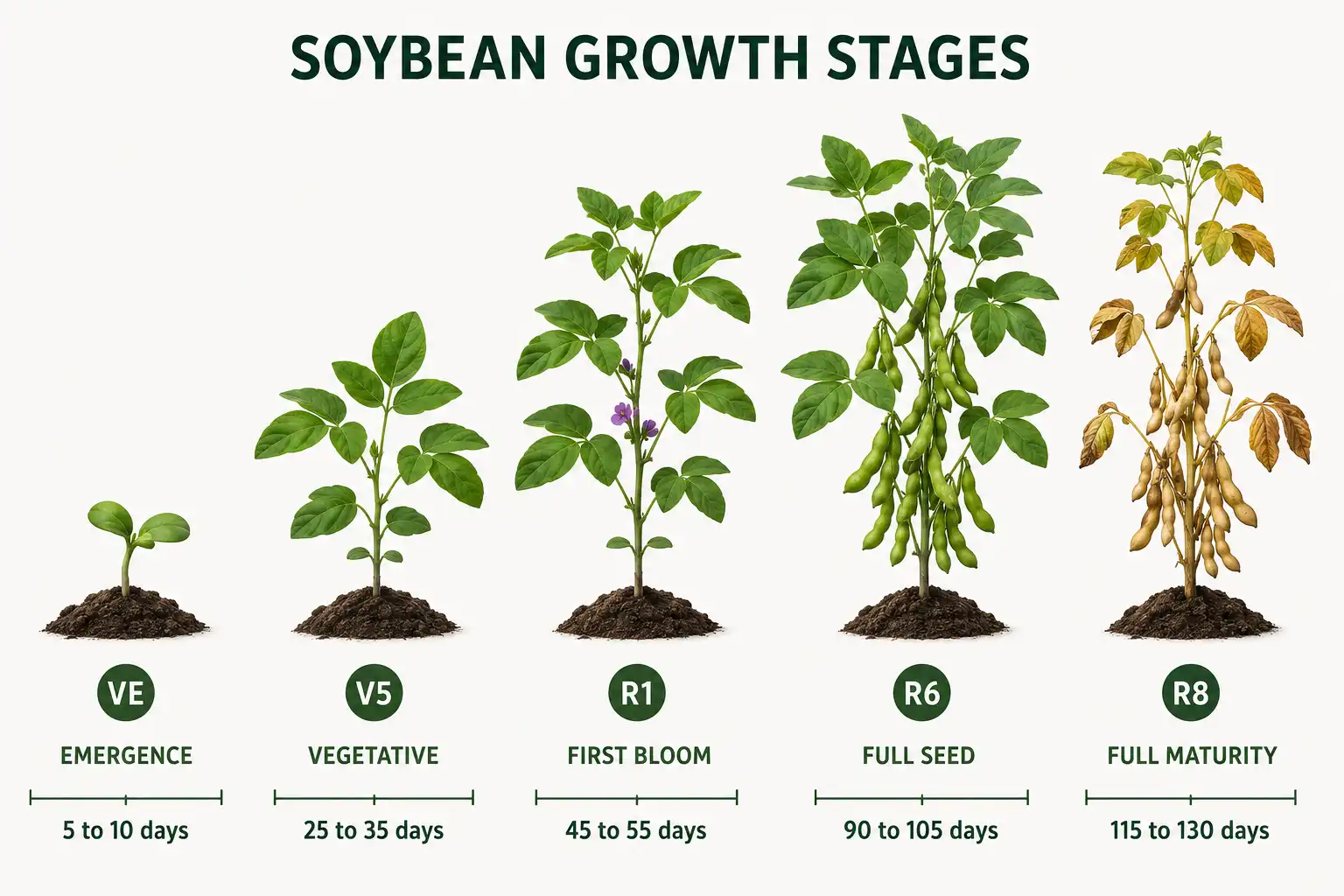
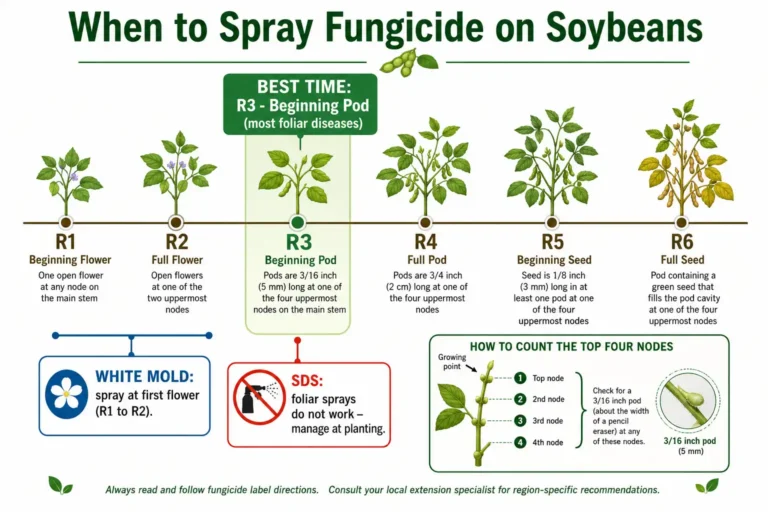
Add those intervals together and reproductive development alone accounts for roughly 70 days. Emergence and vegetative growth carry the rest. Reading those markers is the same skill behind staging soybeans for spray decisions.
How long do soybeans take to germinate and emerge?
Emergence takes about five to ten days in warm soil and up to three weeks in cold soil. Iowa State University Extension puts the ideal germination temperature at 77 degrees F. Soybeans still germinate at 50 degrees F, but three week emergence is common at that temperature.
SDSU Extension recommends a three day average soil temperature of 55 degrees F or higher for uniform germination. Planting below that threshold works, though stands turn ragged and seedling diseases get a longer window. For the seed side of that window, see the detail on soybean germination and what slows it down.
How long is the vegetative stage?
Vegetative growth runs about four to six weeks from emergence to first bloom. NDSU Extension reports a new V stage every three to five days through V5. After V5, nodes appear every two to three days until shortly after R5.
That node count matters more than the calendar. Each node is a potential pod site, so a longer vegetative window before flowering builds a bigger frame. Early planting buys those extra nodes, which is the main reason it pays.
When do soybeans flower and set pods?
Flowering (R1) starts roughly six to eight weeks after planting. Pod set then carries through R4 over another three to four weeks. Most northern varieties (groups 00 through IV) have an indeterminate habit, so vegetative growth continues while flowers open.
Heat, moisture, and day length all steer how many of those flowers hold. Stress at R3 and R4 drops pods rather than delaying the calendar. So a short season can still mean a light crop.
How long does seed fill and maturity take?
Seed fill and maturation (R5 through R8) take about five to seven weeks. University of Wisconsin Extension puts R6 to R7 at 15 to 18 days on average. R7 to R8 adds roughly nine more.
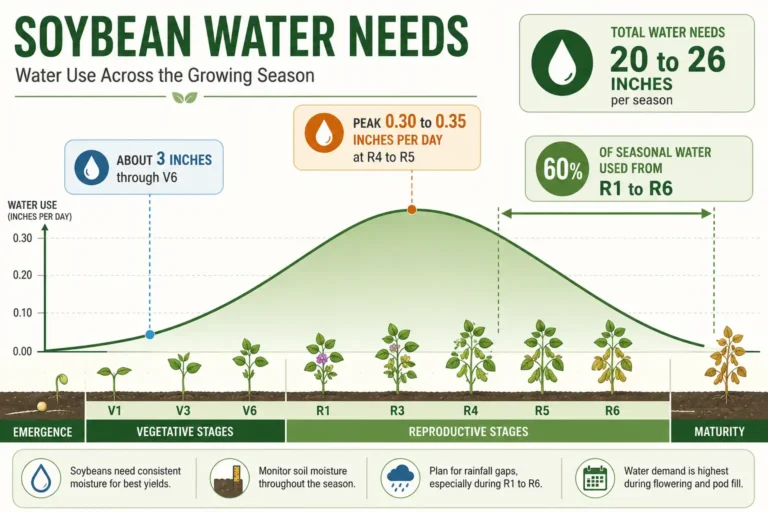
Pods fill first, then leaves yellow and drop. Water demand peaks in this stretch, so a dry August shortens the timeline and the yield together. Planning irrigation around soybean water needs protects the seed size set during these weeks.
How long after maturity until harvest?
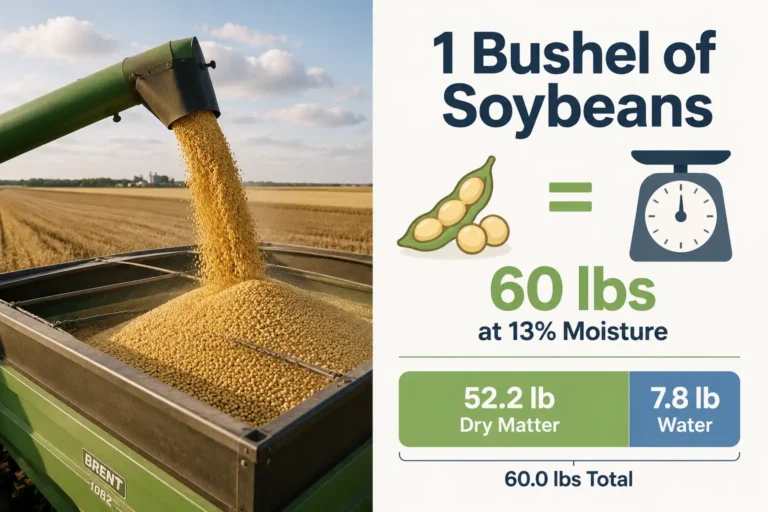
Plan on five to twelve days of drying weather after full maturity. NDSU Extension identifies 13 percent as the optimal harvest moisture for limiting mechanical damage. Below 11 percent, shatter losses climb sharply.
That drying window is weather driven, not stage driven. A warm, breezy week can drop moisture in under a week. Cool, damp conditions stretch it out, and repeated wetting cycles make pods brittle.
How Maturity Group Changes the Season Length
Maturity group sets season length more than any other single choice. SDSU Extension describes groups running from 00 for the shortest seasons through IX for the longest. Group 00 goes into North Dakota and Minnesota, while group IX suits the Deep South.
University of Wisconsin Extension mapped seven adaptation zones using a decade of variety trial data.
| Region | Best adapted maturity group |
|---|---|
| North of 47 degrees latitude: most of North Dakota, northwest South Dakota, northern Minnesota | MG 0 |
| Central and northern South Dakota, central Minnesota, northern Wisconsin and Michigan, all of New York | MG 1 |
| Southern Michigan, Wisconsin, Minnesota and South Dakota, northern Iowa and Nebraska | MG 2 |
| Southern Nebraska and Iowa, central Illinois, central and northern Indiana, all of Ohio and Pennsylvania, northern Missouri and Kansas | MG 3 |
| Southern Kansas, Missouri, Illinois and Indiana, all of Oklahoma and Kentucky | MG 4 |
| Mid-South, roughly 28 to 39 degrees latitude | MG 5 |
| Southern Georgia and South Carolina | MG 6 |
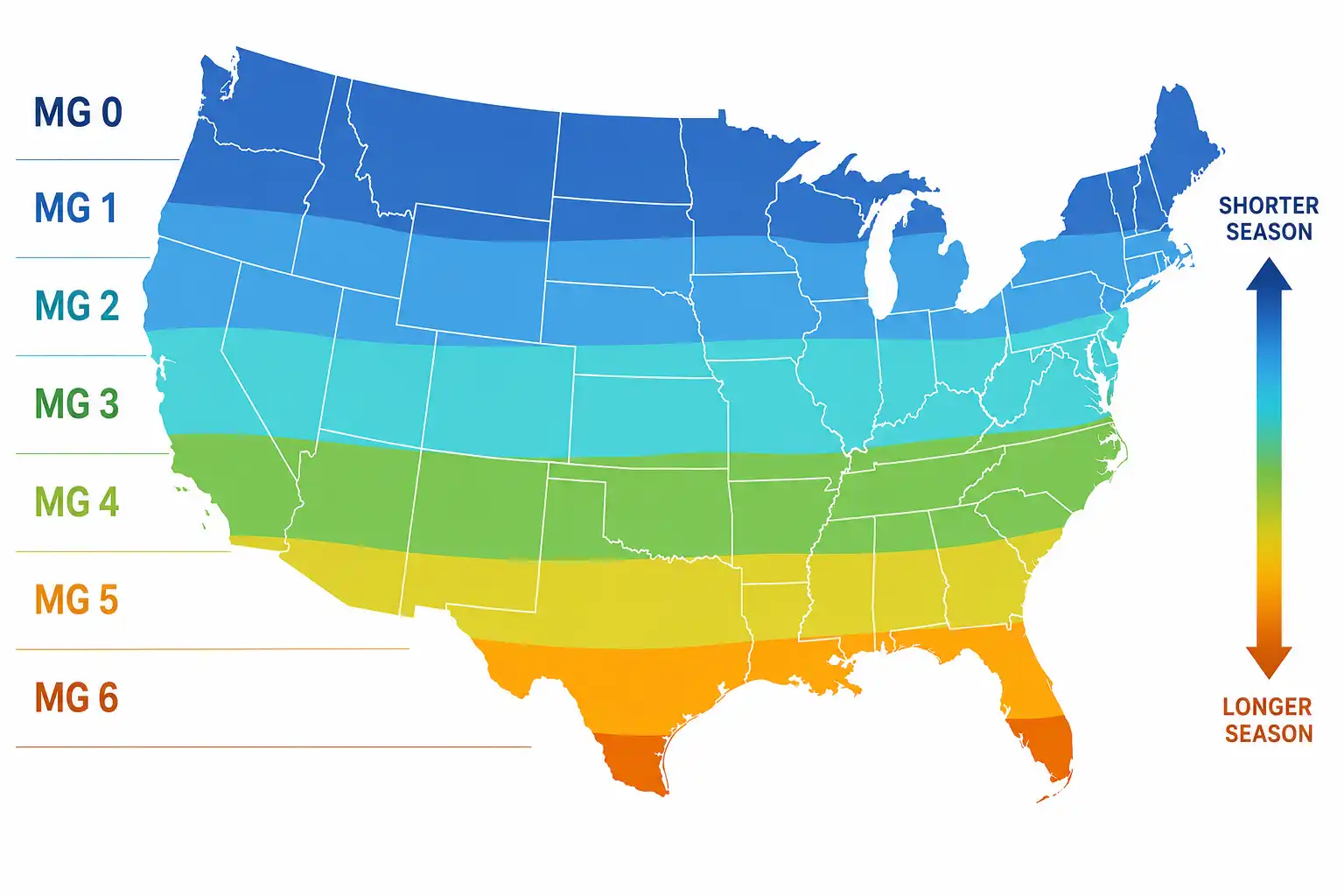
K-State Research and Extension recommends groups II through V across Kansas, varying by part of the state. A common risk strategy adds a half group either side of that core choice. Spreading maturity that way widens the weather window for flowering and harvest.
Photoperiod explains the pattern. A group V variety needs shorter days to trigger bloom. So it flowers and matures later at a northern latitude. The same seed finishes faster in Mississippi than in Iowa.
What Changes the Number of Days?
Does planting date change days to maturity?
Yes, and the effect is large. Later planting shortens the season, since the crop reaches bloom on shorter days. It usually trims yield at the same time.
K-State Research and Extension puts the Kansas penalty near 0.3 bushel per acre for each day past mid April. Mid April plantings reach 80 to 90 bushels per acre, while mid July plantings land near 50. Iowa State University Extension recommends the last week of April for the southern two thirds of Iowa. The northern third moves to the first week of May. Matching your soybean planting window to local guidance sets the whole calendar.
How much do temperature and moisture change the timeline?
Warm weather speeds development, and cool weather slows it. Soybeans respond to heat accumulation, though day length carries more weight for them than for corn.
Drought during seed fill (R5 and R6) forces an early shutdown. Seeds stay small, leaves drop sooner, and the crop hits R8 ahead of schedule with fewer bushels. Cool, cloudy stretches do the reverse and push maturity later into frost risk.
How Long Do Soybeans Take to Grow in a Garden?
Garden soybeans picked green as edamame take about 70 to 85 days. SDSU Extension puts edamame harvest at ten to twelve weeks after planting. That lands at R6, when pods are full sized and bright green.
The harvest window is narrow. Pods on one plant mature within a few days of each other, and quality falls off once leaves start yellowing. Timing edamame is a different call from field harvest, and the guidance on harvesting edamame covers the visual cues. Dry seed for storage needs the full season, so plan on 100 days or more.
How Do You Know Soybeans Have Finished Growing?
Soybeans have finished growing at R8, when 95 percent of pods have turned their mature tan or brown color. K-State Research and Extension uses that same threshold. Leaves may still hang on the plant at full maturity.
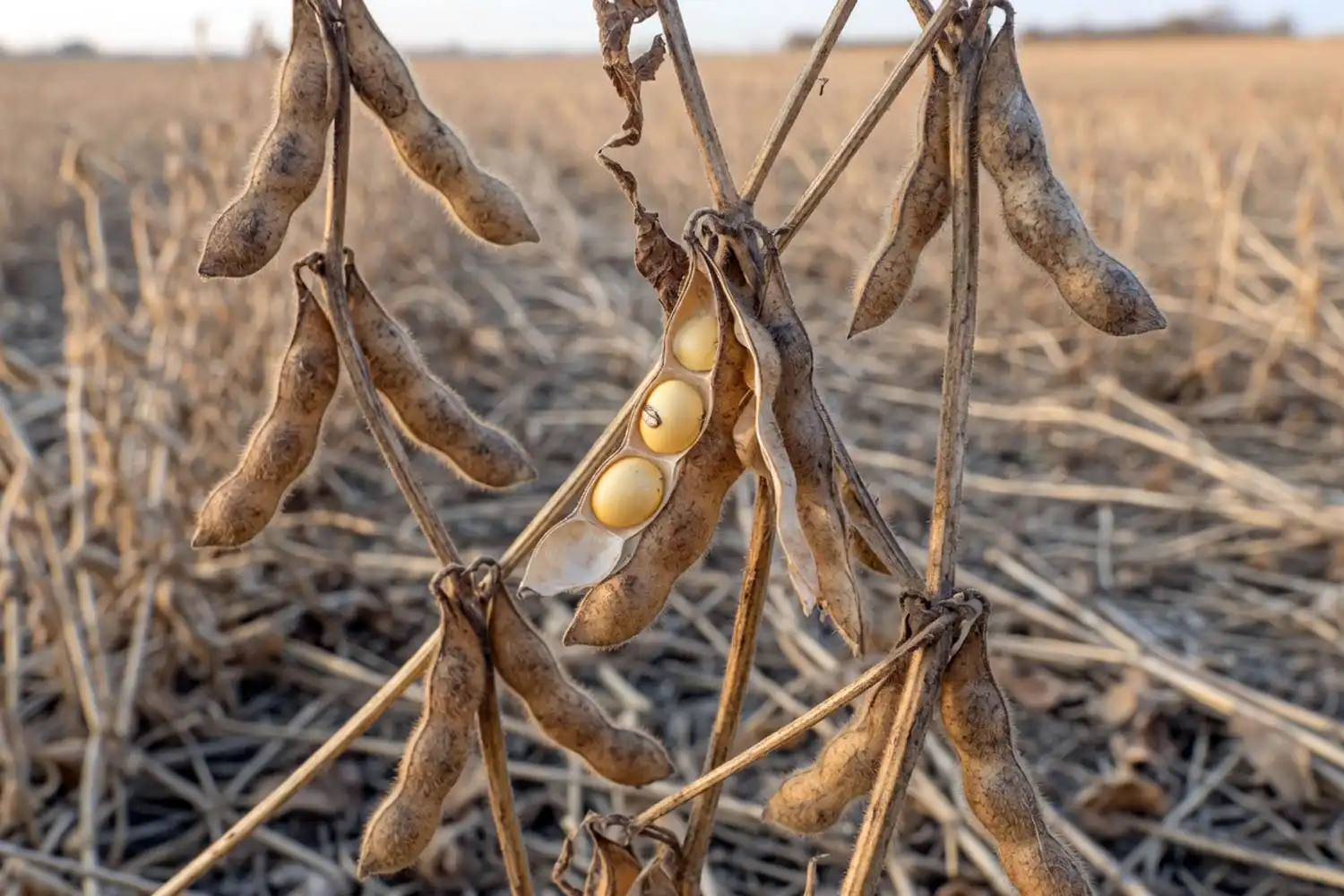
R8 marks the end of growth, not the start of harvest. Seed moisture at that point still sits well above the target. Check moisture with a meter rather than by eye, since pods dry and rewet several points overnight. The guidance on soybean harvest timing walks through the field checks in order.
Why Soybeans Run Longer or Shorter Than the Tag Says
Several things pull the season away from the printed rating:
- Cold, wet planting conditions. Emergence stretches toward three weeks, so calendar days grow without adding nodes or yield.
- Late planting. The crop rushes through its stages on shorter days, cutting total days but also cutting bushels.
- Drought at R5 or R6. Seed fill shuts down early, pulling maturity forward and shrinking seed size.
- Wrong maturity group for the latitude. Too long a group risks frost before R8, while too short a group leaves growing season unused.
- Green stems at maturity. Pods can reach full color while some stems and leaves stay green, which delays the combine even though growth has stopped.
- Replanting. A June replant resets the clock on shorter days, so expect a compressed season and a lower ceiling.
FAQs on Soybeans Growing Time
How many days from planting to harvest for soybeans?
Can soybeans finish in 90 days?
Do soybeans grow faster in hot weather?
How long before soybeans emerge?
Planning the Season Around These Numbers
Pick the maturity group your latitude supports. Plant once a three day soil average holds 55 degrees F, then count on 100 to 150 days. Reproductive stages account for roughly 70 of those days. Your main lever is how early the crop reaches first bloom with a full frame of nodes. After R8, let the weather set the harvest date and watch moisture rather than the calendar.