Best Garden Seeder for 2026: 8 Push and Hand Models Compared
Hand-dropping seed down a long row wastes seed and leaves gaps. For one seed at a set depth, you need the best garden seeder. Which one depends on your seed size, row length, and seedbed. This guide compares eight models.
The best garden seeder for most home rows is the EarthWay 1001-B. Its standard plate kit spans sweet corn down to beet seed. The Hoss Garden Seeder adds a rolling coulter for residue. Chapin’s 8701B carries 1.5 liters.
The 8 Best Garden Seeders at a Glance
| Preview |
#1
Best Overall
|
#2
Editor Pick
|
#3
Best Value
|
#4
Best Budget
|
#5
|
#6
|
#7
|
#8
|
| Title | EarthWay 1001-B | Chapin 8701G | Chapin 8701B | Agri-Fab 45-0640 | Hoss Garden Seeder | John Deere 3 lb | Berry and Bird widger | Gostur dispenser |
| Price |
$150.32 – 09.02.2026 See Latest Price |
$139.68 – 09.02.2026 See Latest Price |
$139.36 – 09.02.2026 See Latest Price |
$99.99 – 09.02.2026 See Latest Price |
$409.99 – 09.02.2026 See Latest Price |
$149.99 – 09.02.2026 See Latest Price |
$15.99 – 09.02.2026 See Latest Price |
$5.99 – 09.02.2026 See Latest Price |
| Overall Score | ||||||||
| Metering | Vertical plate | Vertical plate | Vertical plate | Vertical plate | Horizontal plate | Vertical plate | Hand placement | Hand dial outlet |
| Plates included | Standard kit: corn, radish, carrot, bean, pea, beet | 6 plates, up to 20 seed types | 6 plates, up to 20 seed types | 7 plates, up to 20 seed types | 6 pre-drilled, 4 optional, blanks | 7 plates, up to 20 seed types | None | None |
| Hopper | Open poly | 1.5 liters | 1.5 liters | 3 pounds | Removable | 3 pounds | None | Palm reservoir |
| Best fit | Medium to large seed on tilled beds | Long rows with fewer refills | Same unit, red frame | A first push seeder, small plots | Residue, loose or heavy soil | Deere livery on the Agri-Fab platform | Raised beds and transplant work | Seed trays and fine seed |
How a Garden Seeder Works
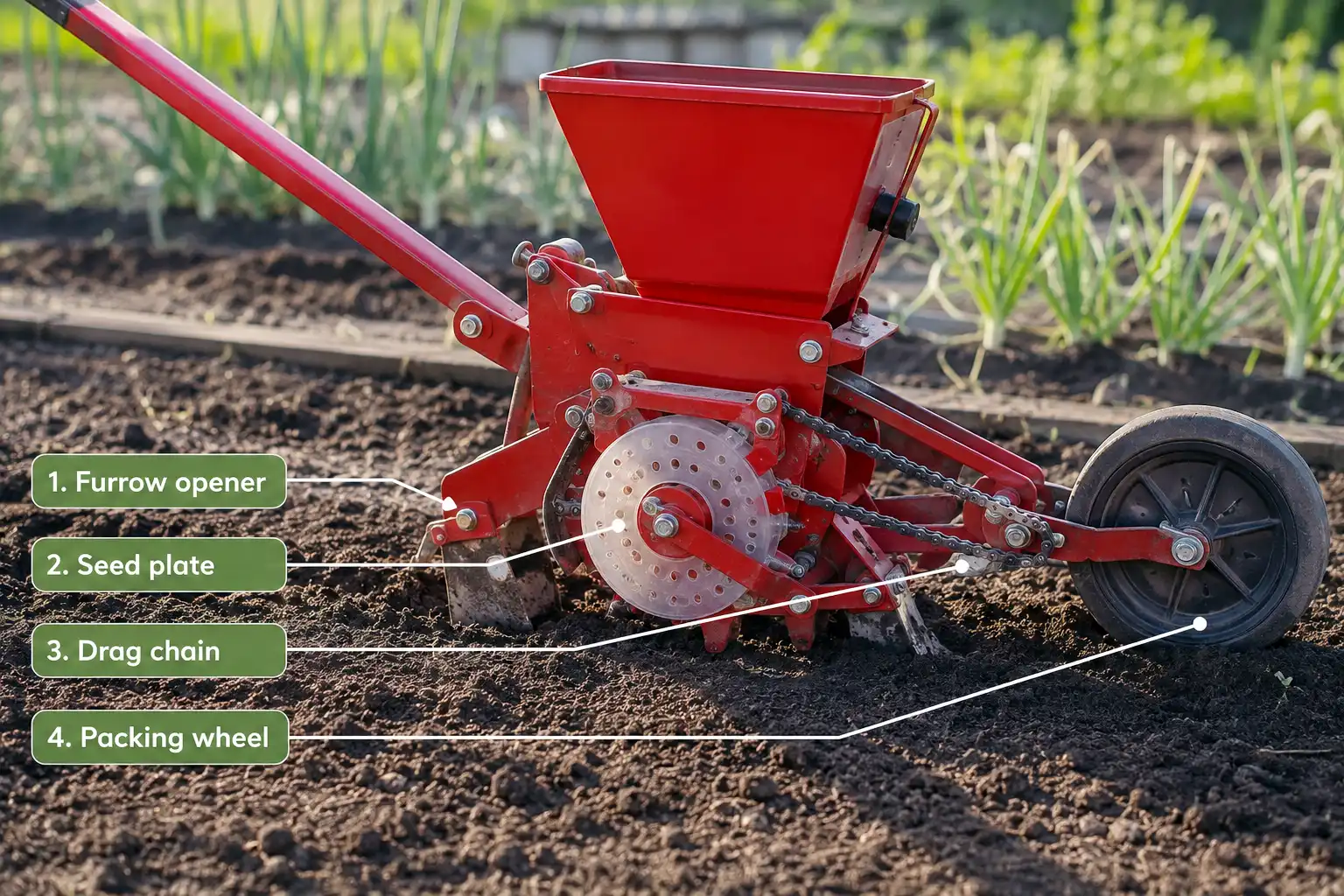
A garden seeder opens a furrow, drops metered seed, then covers and packs the row. One pass does all four jobs. The front wheel drives a belt or chain. That belt turns a notched seed plate inside the hopper. Each notch carries one seed to a drop point. Behind it, a drag chain pulls soil back over the furrow. Then the rear wheel firms it, which gives the seed-to-soil contact germination needs.
Seed spacing comes from the plate, not from a speed dial. EarthWay’s assembly instructions give the numbers. The 1001-B chassis travels 36 inches per revolution of the seed plate. So a six-notch plate drops seed every 6 inches. Hoss uses the same arithmetic on horizontal plates. Its instruction sheet says to divide travel per revolution by notch count.
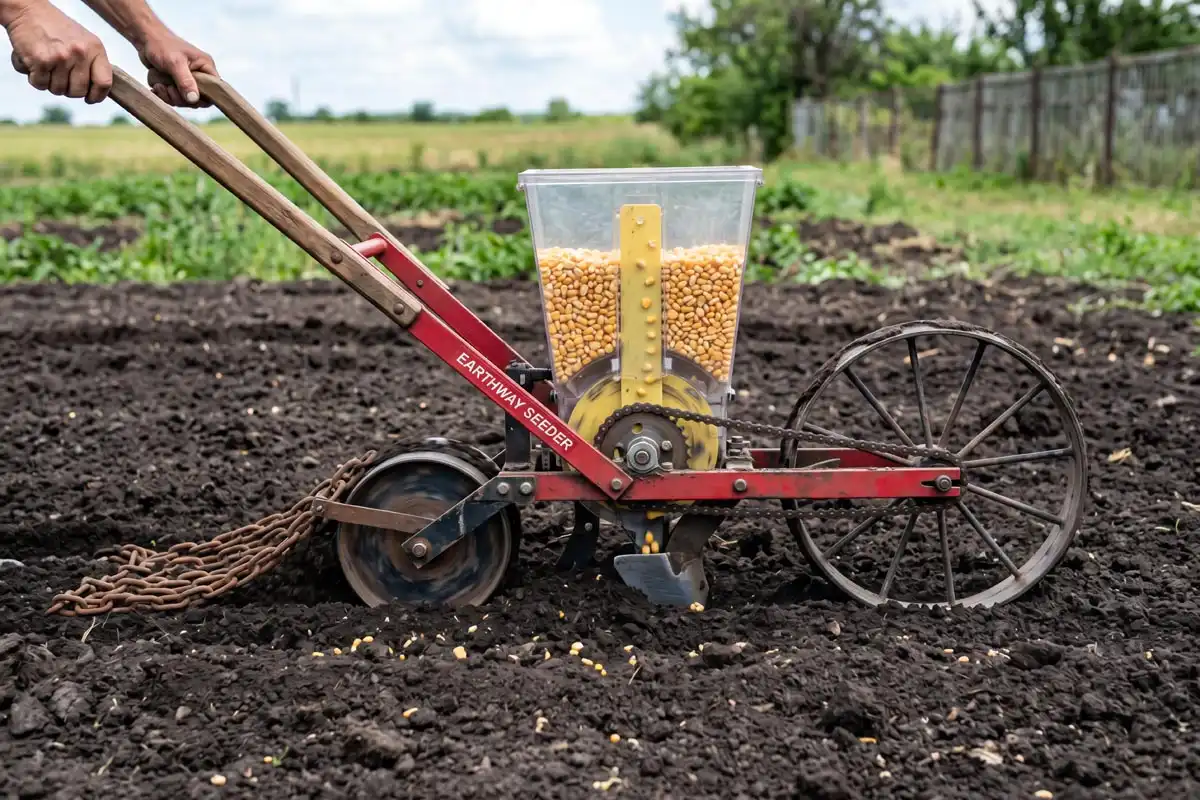
Plate metering has a documented ceiling. According to NC State Extension, plate seeders struggle to singulate seed that is not round. The long fall from hopper to soil also causes seed scatter. So a push seeder gives you a good average spacing rather than a perfectly even one. That trade still pays. NC State Extension reports yield gains of 20 to 50 percent from precision seeding. Even spacing gives each plant its full share of room.
The 6 Best Garden Seeders for Row Planting
These six walk-behind seeders run on two wheels and meter seed from a plate.
1. EarthWay 1001-B Precision Garden Seeder
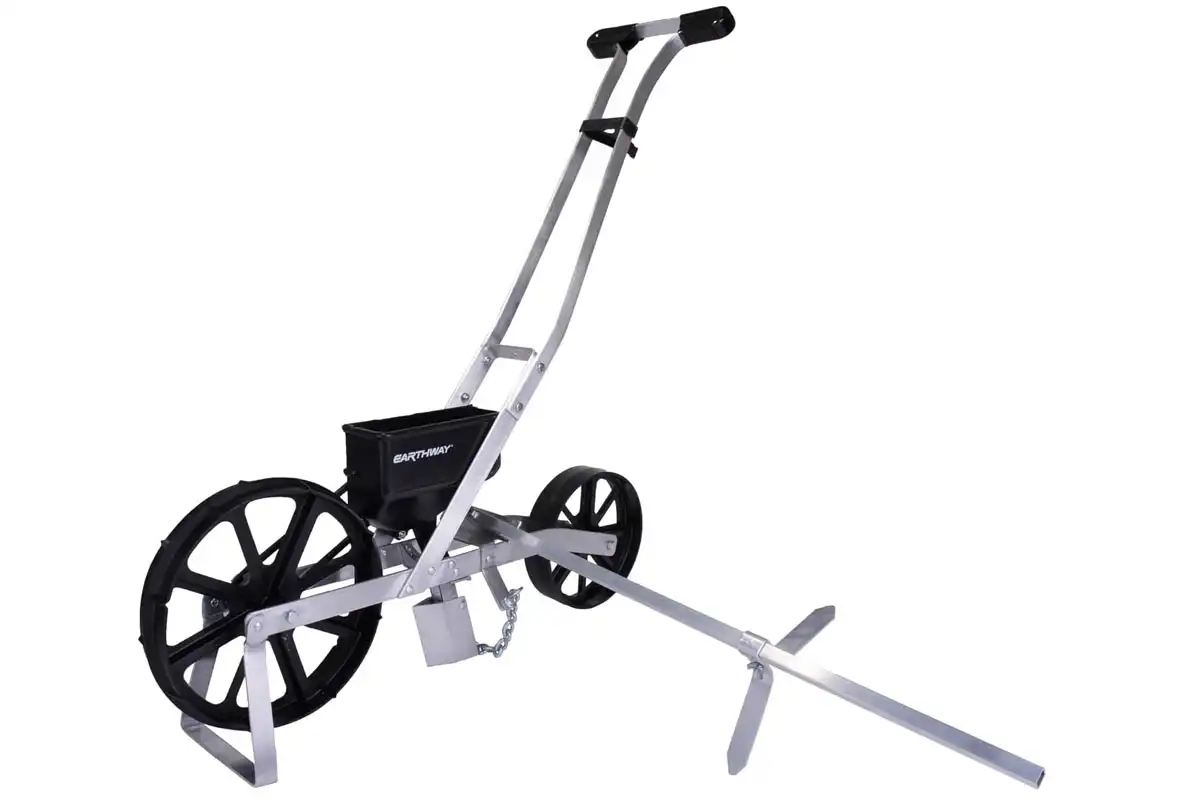
EarthWay Products builds this plate-metered row planter in Bristol, Indiana. Its assembly instructions list a standard plate kit: sweet corn, radish, carrot, bean, pea, and beet. An optional kit adds broccoli, cucumber, popcorn, lima bean, and a blank plate you drill yourself. Best for medium and large seed on a tilled seedbed.
PROS
- Standard kit covers common crops
- Depth graduated on seed chute
- Row marker set at 30 inches
- Blank plate allows custom spacing
CONS
- Small seed clumps in humidity
Specifications
- Travel: 36 inches per plate revolution
- Depth: graduated in inches and millimeters
- Plate sets: standard kit plus optional six-plate kit
- Warranty: one year limited
Quality: serviceable, with parts and plate sets still sold separately.
Owner evidence: buyer feedback on EarthWay’s own product listing reports skips and doubles on the pea plate. Gaps in beet rows come up often too.
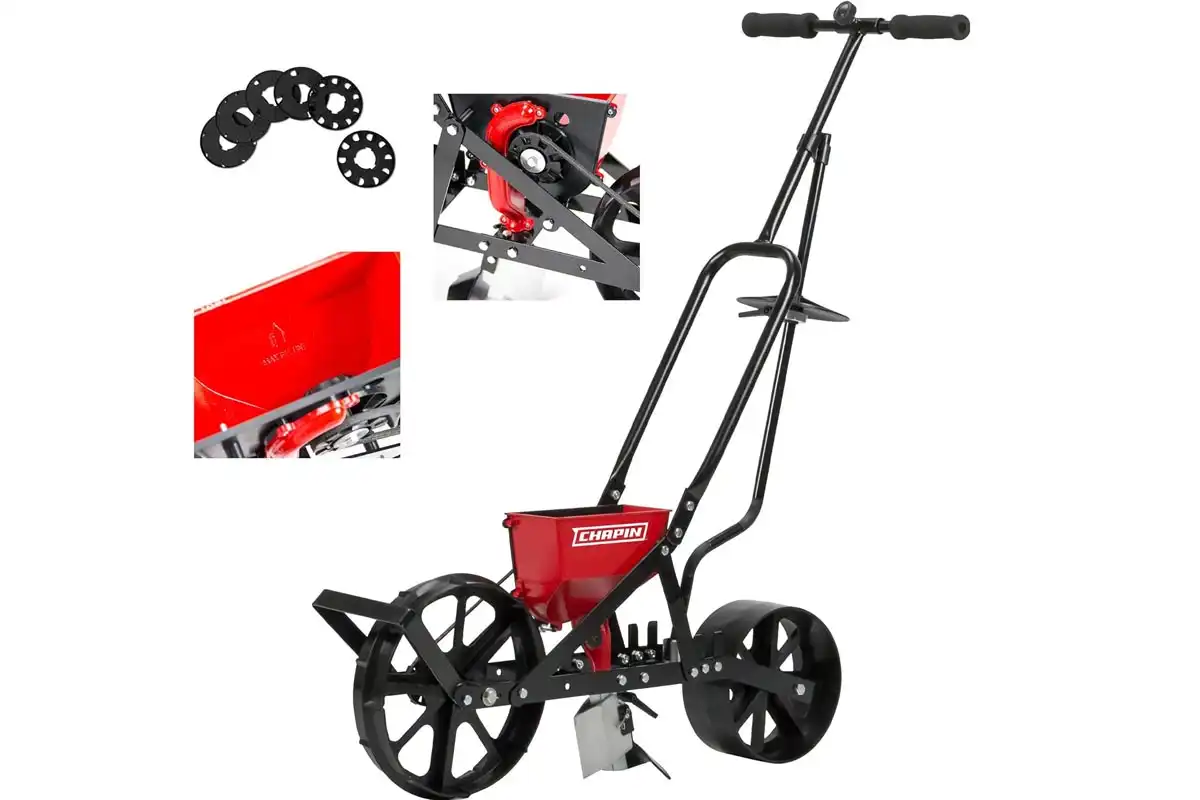
2. Chapin 8701G Garden Push Seeder
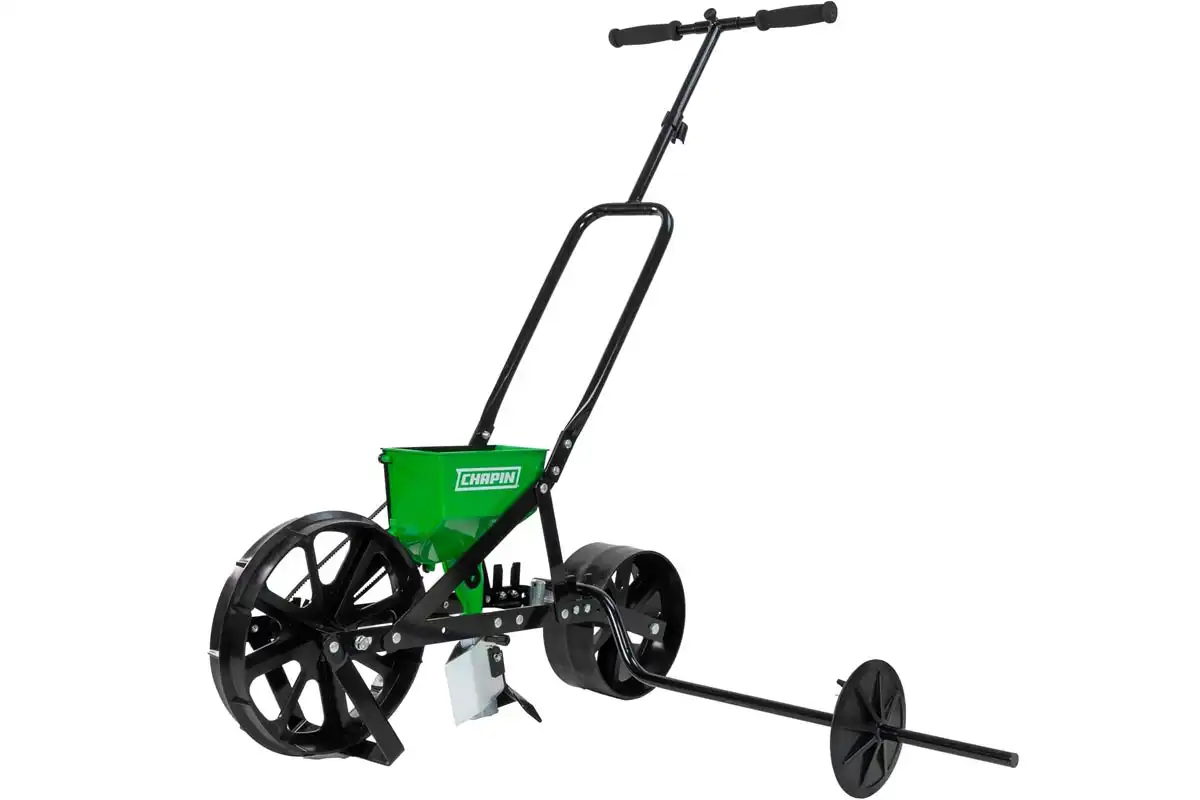
Chapin International engineers this seeder in Batavia, New York. Company documentation lists a 1.5 liter poly hopper on a powder-coated steel frame. A zinc plow blade opens the row. Then a wide rear wheel replaces and pats the soil. A rotating row marker sets the next row up to 30 inches out.
PROS
- Larger hopper cuts refills
- Zinc plow blade opens cleanly
- Cushioned grips ease long rows
- Kickstand holds it upright
CONS
- Heavier than aluminum-frame seeders at nearly 15 lbs
Specifications
- Hopper: 1.5 liters, rust-resistant poly
- Plates: 6 interchangeable, up to 20 seed types
- Row marker: adjustable, up to 30 inches
- Warranty: one year limited
Quality: solid, with US-based technical support listed by the manufacturer.
Owner evidence: buyers point to hopper capacity as the reason they chose this over 3-pound units.
3. Chapin 8701B Garden Push Seeder
The 8701B is the red-frame version of the same Chapin push seeder. Chapin lists both under one model designation. Hopper capacity, plate count, plow blade, and warranty all match. So pick on availability or color, not on capability.
PROS
- Same platform as 8701G
- Rotating marker locks row width
- Wide rear wheel packs seed
- Protective plate case included
CONS
- No functional gain over 8701G
Specifications
- Hopper: 1.5 liters, rust-resistant poly
- Plates: 6 interchangeable, up to 20 seed types
- Frame: powder-coated steel, zinc plow blade
- Warranty: one year limited
Quality: solid, matching the 8701G point for point.
Owner evidence: owner comments on the two finishes read the same way, which supports treating them as one seeder.
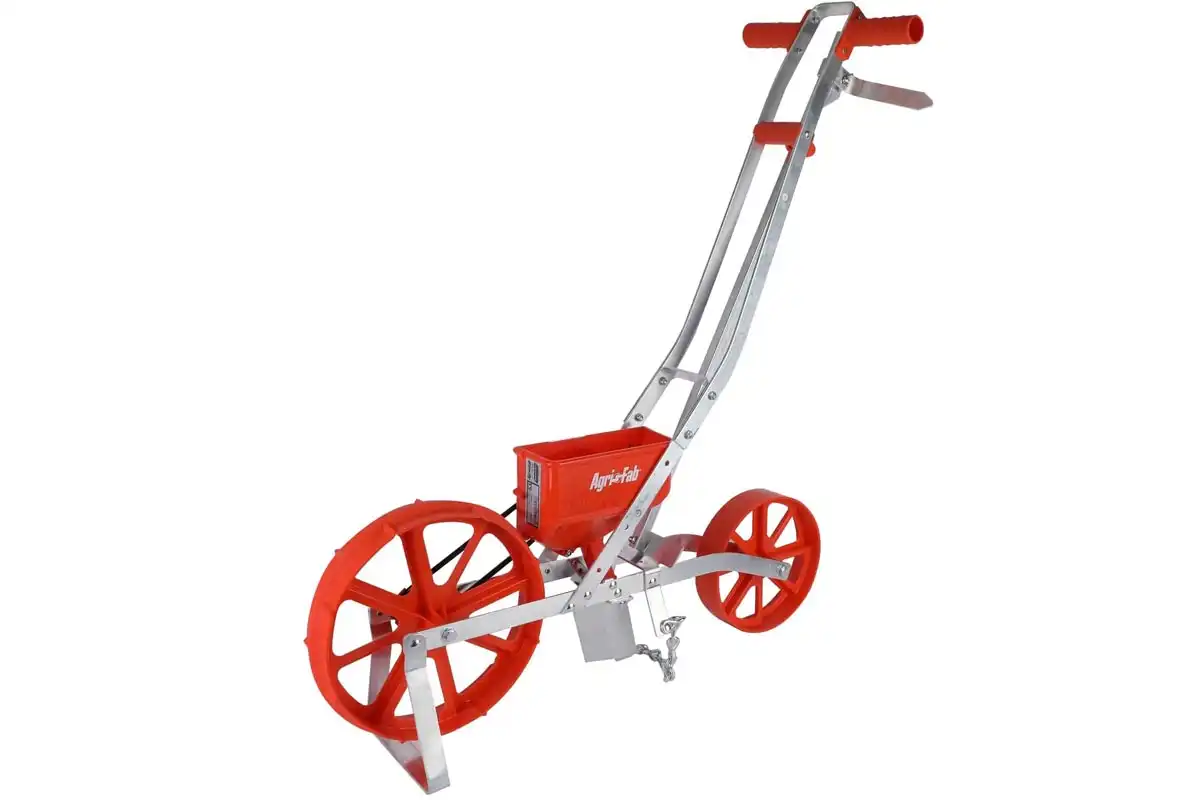
4. Agri-Fab 45-0640 Push Garden Seeder
Agri-Fab builds this orange push seeder in Sullivan, Illinois. Its specification sheet lists seven plates for up to 20 seed types. The sheet also lists a 3-pound poly hopper, an aluminum frame, and a rust-resistant plow blade. Still, Agri-Fab lists the unit at 15 pounds. The aluminum frame does not make it light.
PROS
- Seven plates out of box
- Adjustable row marker included
- Simple assembly, few fasteners
- Rust-resistant plow blade
CONS
- Small hopper needs frequent refills
Specifications
- Hopper: 3 pounds, poly
- Plates: 7 interchangeable, up to 20 seed types
- Dimensions: 30.75 by 8.5 by 30 inches
- Weight: 15 pounds
Quality: entry-level, adequate for prepared beds under a quarter acre.
Owner evidence: buyer reports focus on quick assembly rather than long-term durability.
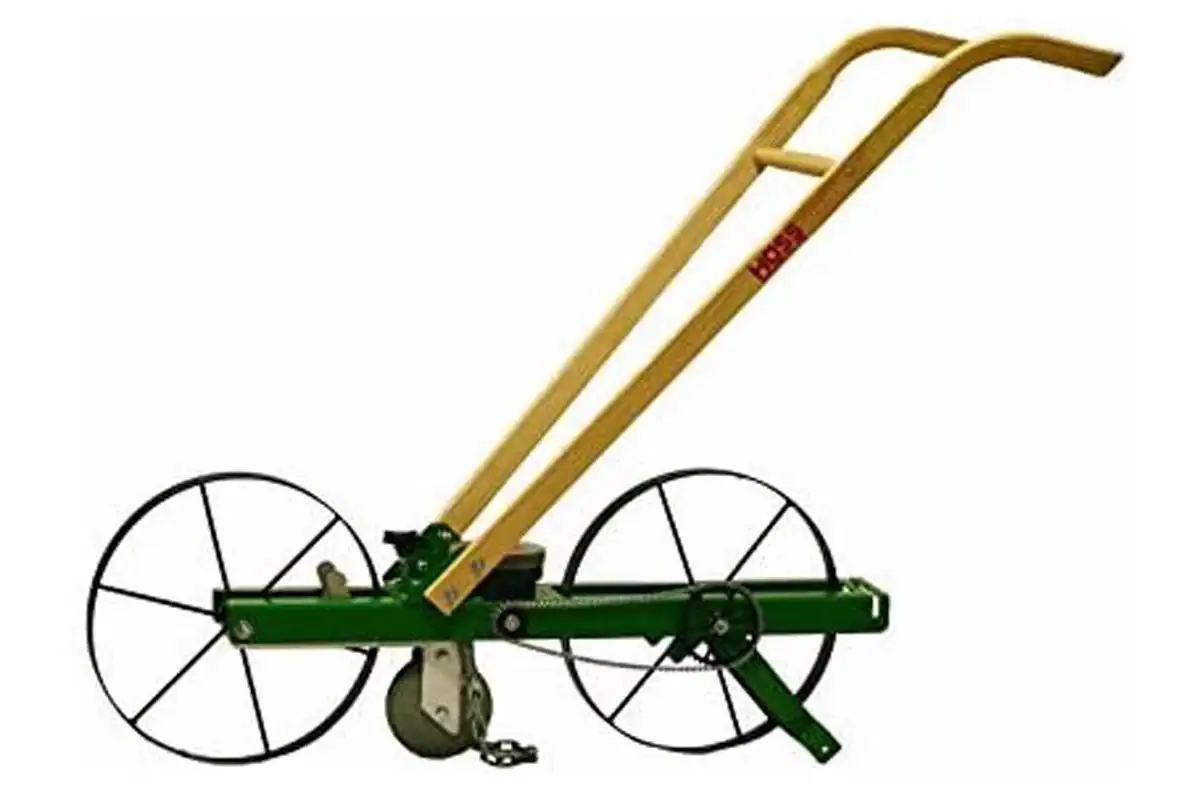
5. Hoss Garden Seeder
Hoss Tools builds this walk-behind in the United States. It carries Amish-crafted hardwood handles, 15-inch steel wheels, and a powder-coated steel frame. A double-disk rolling coulter acts as the furrow opener instead of a fixed blade. Hoss states it works in soils carrying cover crop residue. It also handles freshly tilled, fluffy ground where a plow blade pushes trash.
PROS
- Rolling coulter cuts residue
- Depth knob in quarter-inch steps
- Removable hopper empties cleanly
- Blank plates and drill template
CONS
- Highest cost in this group
- Row marker sold separately
Specifications
- Depth: 1/4 inch to 1 1/2 inches
- Plates: 6 pre-drilled, 4 optional, blanks available
- Wheels: 15-inch steel
- Frame: powder-coated steel, hardwood handles
Quality: the sturdiest build here, and the only unit with a coulter opener.
Owner evidence: owner comments on the manufacturer’s listing cite seeding time cut from days to hours. Multi-season use without failure comes up too.
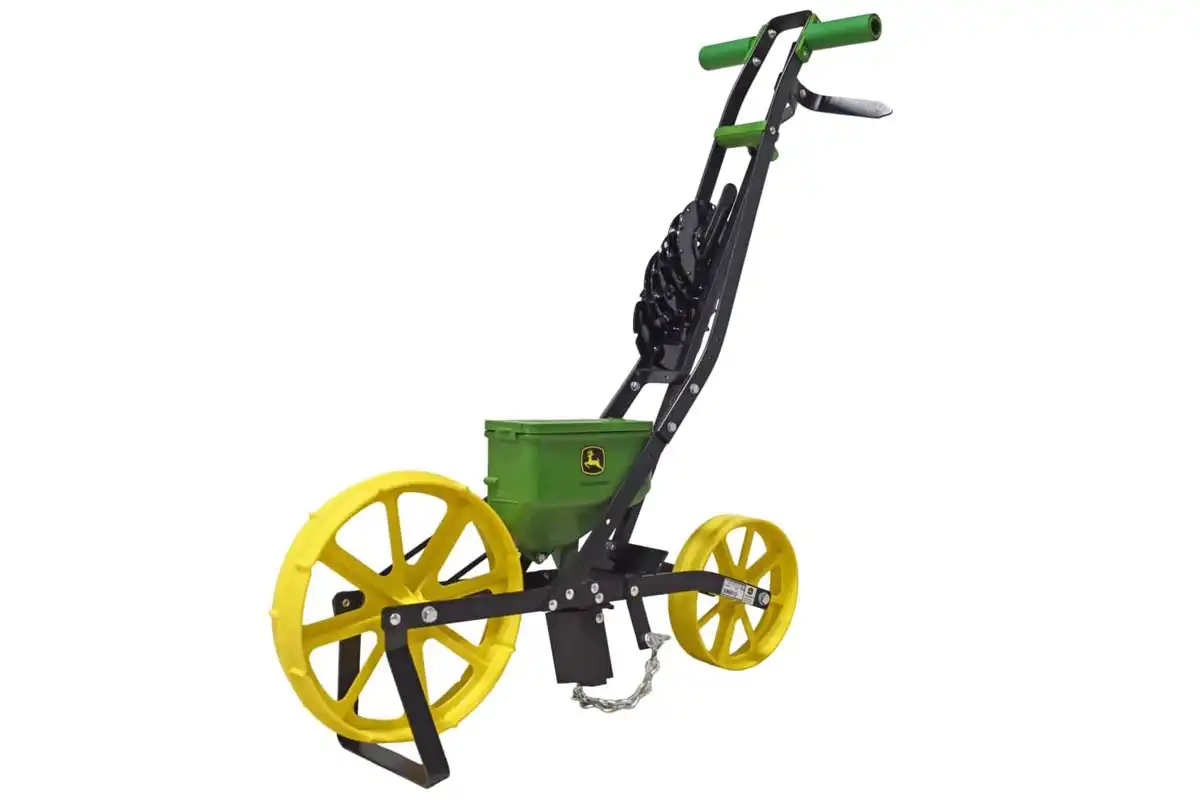
6. John Deere 3 lb Garden Seeder
Agri-Fab builds this unit as model 45-0640-JD under the John Deere brand. Agri-Fab’s own product pages list both versions at 15 pounds. Both carry a 3-pound hopper and seven plates. So expect the Agri-Fab platform in green paint rather than a separate design.
PROS
- Seven plates, 20 seed types
- Rust-resistant plow blade
- Adjustable row marker fitted
- Familiar parts and support
CONS
- No mechanical gain over 45-0640
Specifications
- Model: Agri-Fab 45-0640-JD
- Hopper: 3 pounds, poly
- Plates: 7 interchangeable, up to 20 seed types
- Weight: 15 pounds
Quality: entry-level, identical in function to the orange version.
Owner evidence: buyer comments treat this as the Agri-Fab unit, and parts cross-reference accordingly.
Hand Seeding Tools for Beds and Trays
Push seeders need a row. For a 4-foot bed, a tray, or a gap repair, a hand tool does the work with no setup.
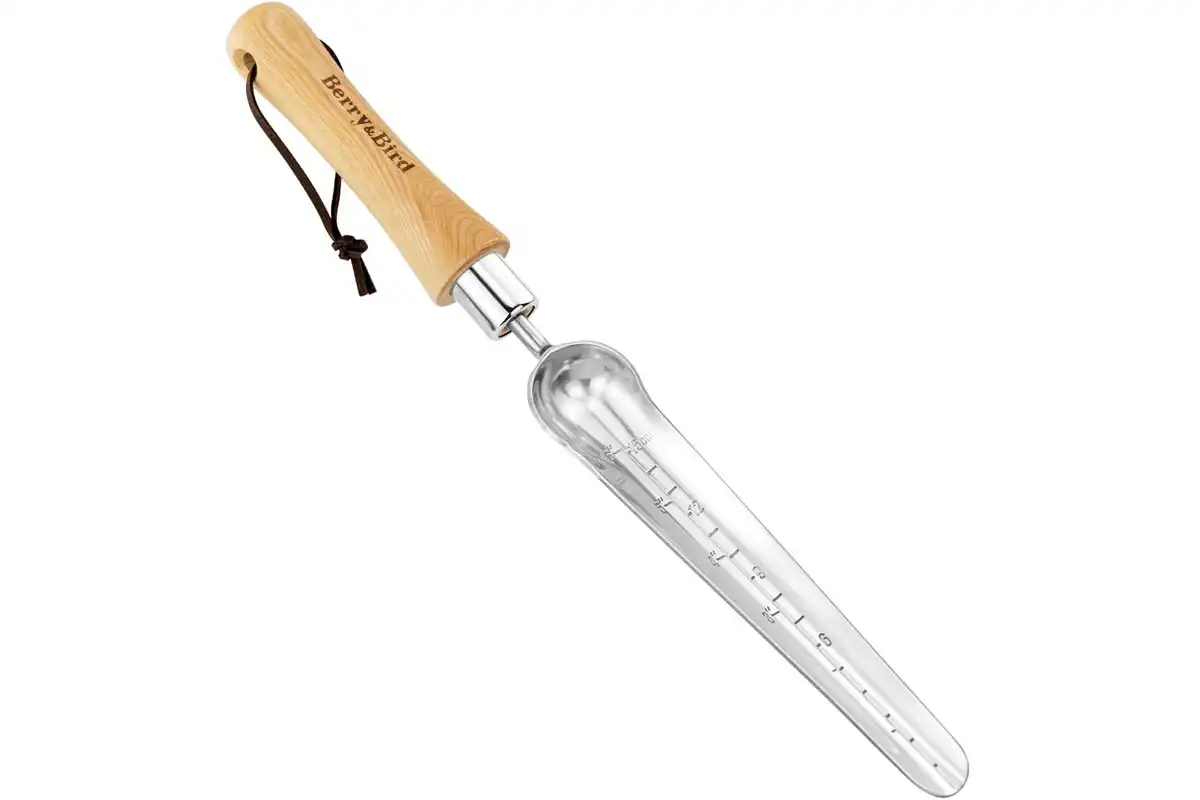
7. Berry and Bird Seeding Widger
A widger is a narrow spoon-shaped blade. It lifts seedlings and places single seeds without disturbing neighbors. This one carries depth marks on the blade. So you can hold a steady 1/4 or 1/2 inch without guessing. Best for bed edges, transplant work, and filling skips.
PROS
- Depth marks on blade
- Stainless blade resists rust
- Light for one-handed work
- Fits tight bed spacing
CONS
- Wood handle needs occasional oiling
Specifications
- Length: 13.7 inches
- Weight: 0.4 pound
- Blade: stainless steel with depth markings
- Handle: certified hardwood
Quality: well finished for a hand tool at this level.
Owner evidence: buyers cite the depth marks as the feature separating it from a plain dibber.
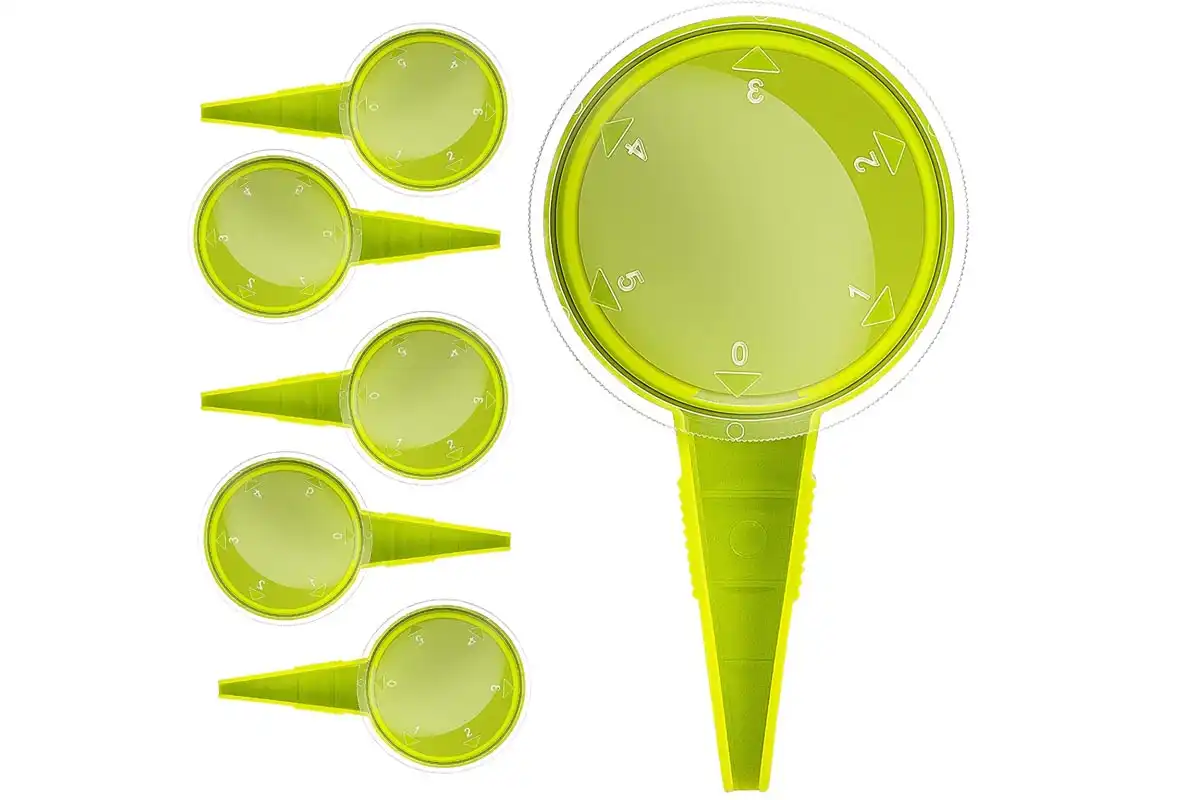
8. Gostur Hand Seed Dispenser
This is a six-pack of palm-sized dial dispensers with five outlet sizes. You load one variety per unit. Turn the lid to match the outlet to your seed, then tap seed into cells. Best for tray sowing and fine seed such as lettuce or brassicas.
PROS
- Five outlet sizes fitted
- Six units preload varieties
- Lid turns without binding
- Fits fine seed cleanly
CONS
- Not for in-ground rows
Specifications
- Pack: 6 dispensers
- Each unit: 4.92 by 2.68 by 0.59 inches
- Weight: about 6 ounces per set
- Outlets: 5 settings
Quality: basic plastic, built as a consumable.
Owner evidence: buyers use these mainly for tray sowing rather than field work.
What Seed Sizes Push Seeders Actually Handle
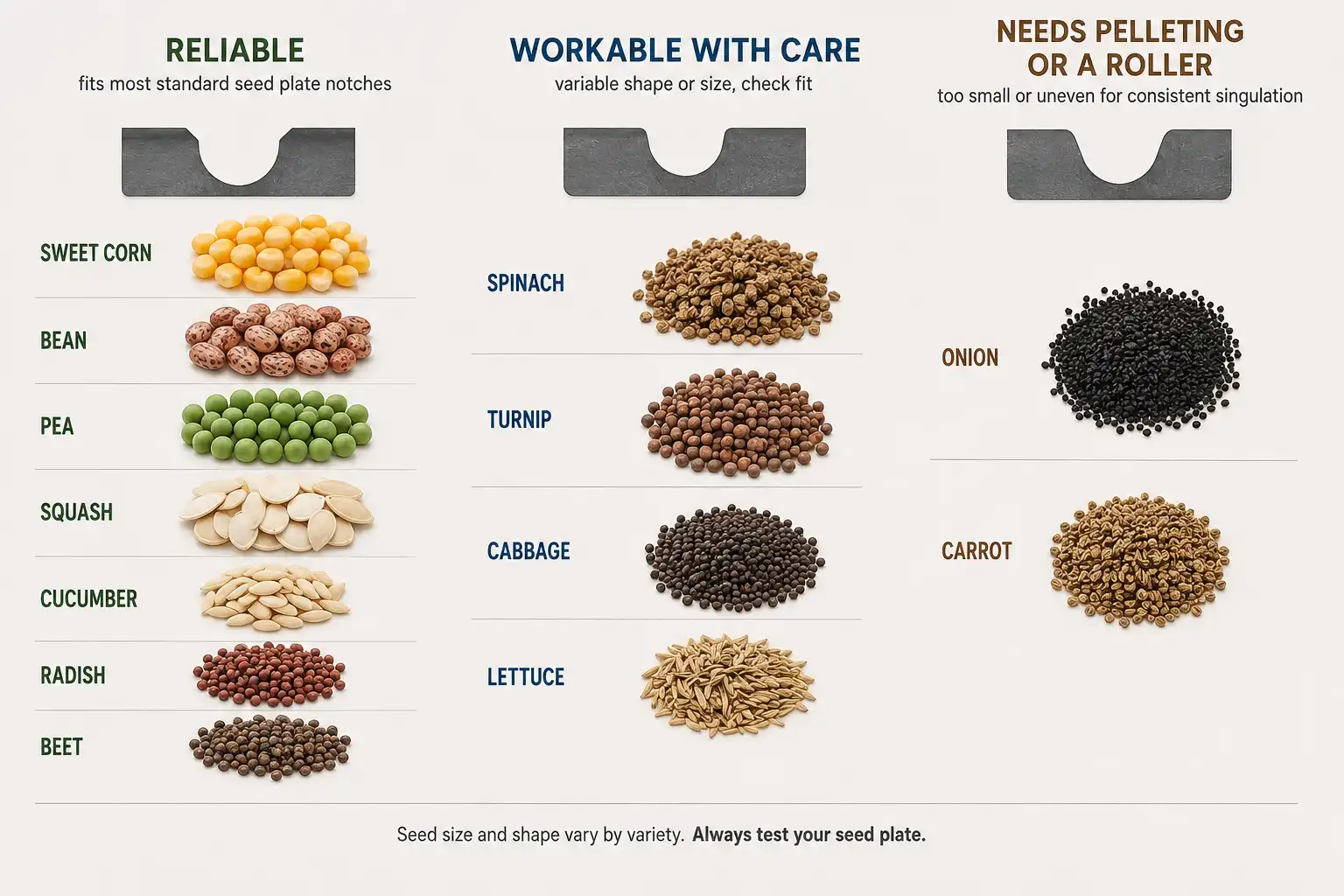
Push seeders handle medium and large seed reliably and fine seed poorly. That is not a brand problem. It is how plate metering works, and an extension trial put numbers on it.
Researchers at UGA Extension compared an EarthWay 1001-B against a Jang roller seeder. The trial ran at the Vidalia Onion and Vegetable Research Center in Lyons, Georgia. Stand counts per 18 inches of row showed no statistical difference for beans, sweet corn, squash, or cucumber. Onion told a different story. The roller seeder averaged 21.5 plants while the plate seeder averaged zero. Carrot produced too thin a stand on either machine to compare.
Earlier work by Parish and Bracy, published in HortTechnology, matched that. They found the plate seeder adequate for home garden and small research work. Average spacing matters there more than even spacing.
Practical reading of that evidence:
- Reliable on a plate seeder: sweet corn, field corn, beans, peas, squash, cucumber, okra, chard, radish, beet
- Workable with care: spinach, turnip, cabbage, lettuce, using the finest plate and a slow pace
- Buy pelleted or use a roller: onion, carrot, and other fine seed
Pelleted seed is the cheapest fix. Coating makes fine seed round and heavy enough for a notch to pick up. Otherwise, getting a full carrot stand from less seed means sowing thick and thinning. Roller metering is the other route.
Types of Garden Seeders and What Each Suits
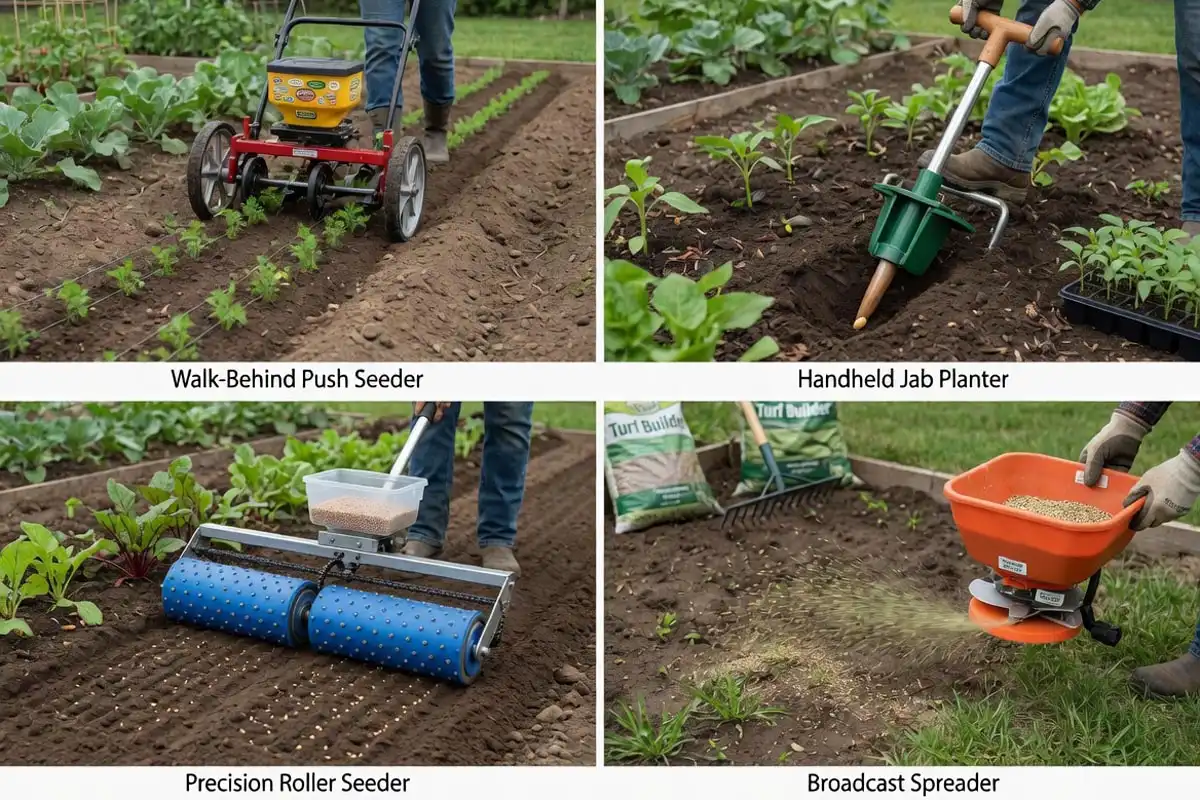
Four tool classes cover home and market rows, and they differ by how each one meters seed.
| Type | How it meters | Handles fine seed | Best use |
|---|---|---|---|
| Plate push seeder | Notched vertical or horizontal plate | Poorly, unless pelleted | Row crops on tilled beds |
| Roller push seeder | Grooved cylinder driven by chain | Well | Market rows, salad greens |
| Jab planter | One seed per stab | No | Melons, squash, filling skips |
| Hand widger or dispenser | Manual placement | Well | Trays, raised beds, repairs |
| Broadcast spreader | Spinning disc, wide pattern | Not applicable | Lawn seed, cover crops |
Roller units meter through a grooved cylinder rather than a plate, which is why NC State Extension groups them separately and notes they suit small, round, or coated seed. Jab planters place one seed per stab, so they work in ground a wheeled unit cannot cross. Broadcast spreaders scatter rather than place, so they belong to lawn and cover crop work, not row vegetables.
How to Choose a Garden Seeder
Match the tool to five things: seed size, row length, seedbed condition, hopper size, and depth control.
Row length and plot size
Push seeders pay off on rows of 25 feet or longer, where row length carries the metering. Below that, setup and cleanup take longer than hand sowing. So a widger or dial dispenser wins on short beds. Above a quarter acre, hopper capacity and frame strength start driving the decision.
Seed size and plate count
Plate count is a proxy for seed range, not for quality. Six or seven plates cover corn through beet on most units. Check whether blank plates exist for your model. A blank plus a drill gives spacing no catalog plate offers. Set your row and in-row targets first. Published spacing targets for common crops help there. Then pick the plate that lands closest.
Seedbed condition
Fixed-blade seeders need clean, worked soil with a fine tilth. A rolling coulter handles residue and loose ground. So if you leave cover crop stubble or run reduced-till beds, that single feature outweighs plate count.
Hopper capacity
Hopper capacity drives refill frequency: a 1.5 liter poly hopper outlasts a 3-pound unit. That matters on 100-foot rows. Still, do not overfill either one. EarthWay’s instructions warn against filling above the center of the seed plate. A heavy seed column presses on the plate and crushes seed.
Depth control
For planting depth, look for a graduated scale, not a friction setting. EarthWay marks its seed chute in inches and millimeters. Hoss uses a knob with quarter-inch tick marks on both sides of the frame. Either way, check depth in soft soil before you commit to the row.
How to Use a Garden Seeder Step by Step
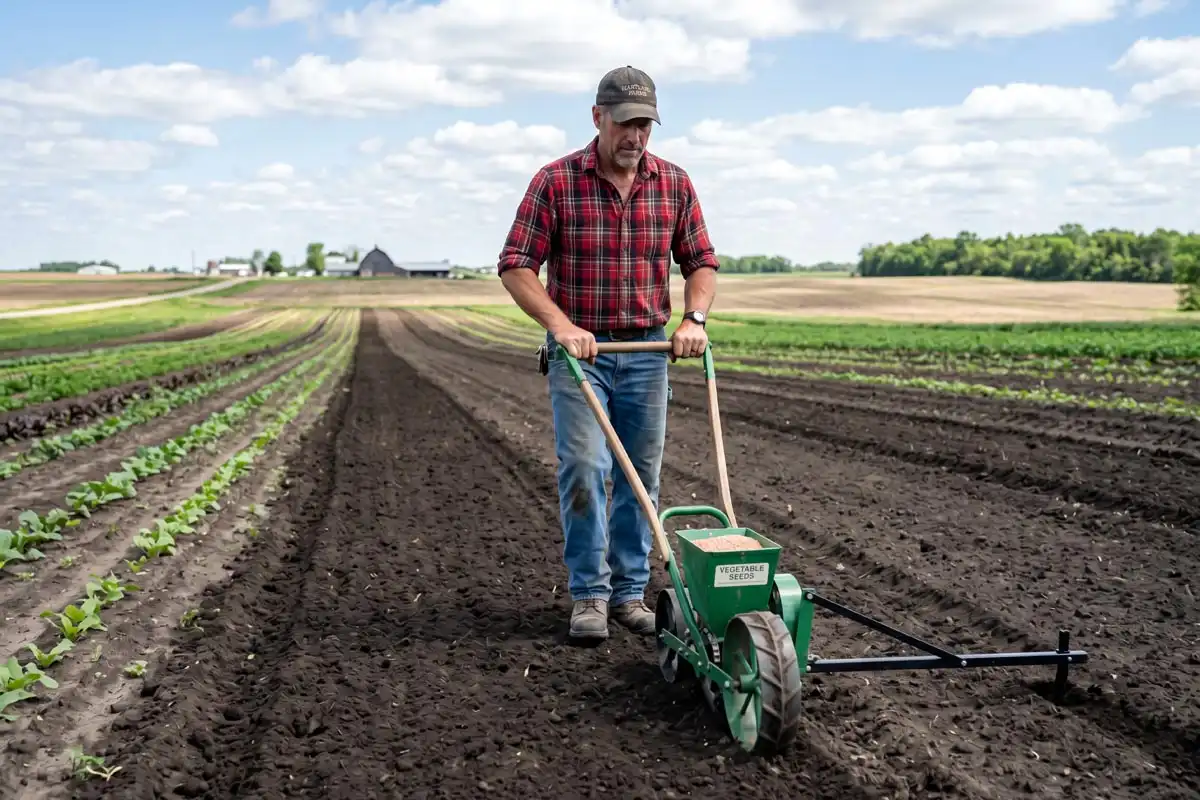
- Till and rake first. EarthWay’s instructions call for tilling to 6 inches or more. University of Minnesota Extension adds that seedbed preparation matters most for small-seeded crops, and that a firm, fine bed beats a fluffy one. Over-packing promotes soil crusting that traps emerging seedlings.
- Check soil moisture. UMN Extension gives a squeeze test. Soil at the right moisture crumbles into small clumps. Soil that holds a molded ball is too wet to work.
- Match the plate to the seed. Compare the plate notch to a single seed. Then dry-run the seeder on a tarp and count the drops per 3 feet.
- Fill the hopper partway. Stay below the center of the seed plate. Fine seed clumps in humid air, so EarthWay recommends washing plates in mild dish detergent and air-drying to cut static.
- Set depth on the graduated scale. Sandy soils take slightly deeper placement than clay, per UMN Extension. Verify in soft soil, then lock the adjustment.
- Stake a string line for the first row. Set the row marker for the next pass. UMN Extension notes that uneven furrow tools produce uneven emergence in small-seeded crops.
- Walk, do not jog. NC State Extension is direct here. Running a seeder above its recommended speed cuts uniformity, scatters seed, and thins the stand.
- Check the row as you go. NC State Extension advises inspecting output every half acre to one acre. At garden scale, scrape back 6 inches of furrow at both ends of each row.
Soil Temperature and Timing Before You Seed
Soil temperature decides whether a well-placed seed emerges. University of Minnesota Extension calls it the most relevant factor for planting timing. Crop groups differ in their floors.
| Crop group | Direct-seed soil temperature | Named source |
|---|---|---|
| Peas, spinach, lettuce, radish | 40 to 50 °F | University of Minnesota Extension |
| Warm-season crops | 50 to 60 °F | University of Minnesota Extension |
| Beans | 60 °F minimum | NDSU Extension |
| Sweet corn, fungicide treated | 55 to 60 °F | NDSU Extension |
| Sweet corn, untreated | 65 °F minimum | NDSU Extension |
NDSU Extension recommends inserting a thermometer 2 inches deep. Average readings across three consecutive days rather than acting on one warm afternoon. A probe thermometer read at seed depth makes that routine quick. Regional timing shifts too. UMN Extension puts Minnesota carrot seeding from mid-April into early June. Sweet corn runs mid-May into mid-June there. Southern growers open those windows weeks earlier.
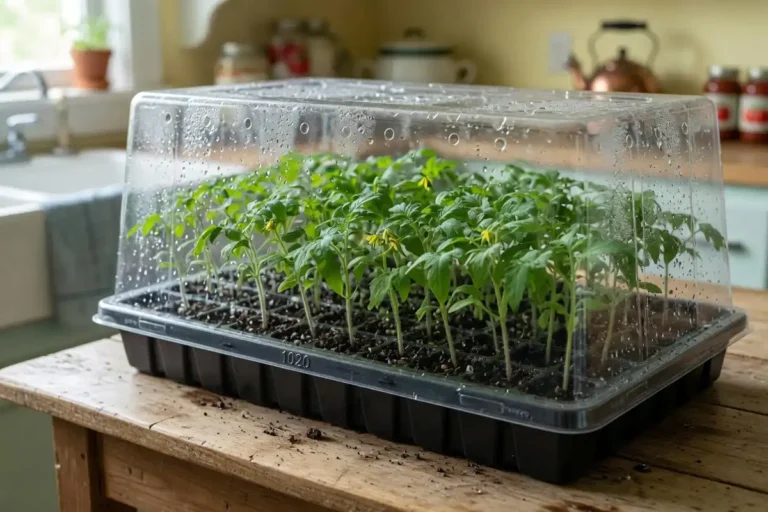
Crops also differ in whether direct seeding applies at all. UMN Extension notes that radish, carrot, and beet do not tolerate transplanting. A seeder is the practical route for those crops. Tomato and pepper belong in trays instead. So the choice between sowing directly rather than raising transplants sets how much use a seeder gets. For tray crops, a set of trays for starting seed indoors beats another plate.
Why Push Seeders Skip or Double Seed
Most skips and doubles trace back to five causes. Four are adjustments rather than defects.
- Plate notch too large. The notch picks up two seeds. Move to the next smaller plate, or fill notches partway with beeswax as EarthWay’s instructions describe.
- Static in the hopper. Fine seed pulls behind the plate and crushes. EarthWay advises washing hopper and plates in mild dish detergent, skipping the rinse, then air-drying.
- Pace too fast. Seed scatters and the plate bounces. Slow to a steady walk, per NC State Extension.
- Cloddy or crusted soil. The opener rides up and seed lands on the surface. Rake to a fine tilth first.
- Irregular seed shape. Beet and chard seed are lobed, so notches miss them. Sow a slightly heavier rate and thin.
Soil moisture drives the last two. A moisture meter reading for the top few inches tells you whether the bed will crumble or smear before you push a single row.
FAQs About Garden Seeders
Are garden seeders worth it?
Can a push seeder plant carrot and onion seed?
Can you use a garden seeder in no-till soil?
How do you set plate spacing?
How fast should you push a garden seeder?
Can a garden seeder plant grass seed?
What to Check Before You Buy
Start with your seed list, not the model list. If corn, beans, peas, squash, and beet dominate your rows, any plate seeder here works. Hopper size and frame strength decide which one. If onion and carrot dominate, budget for pelleted seed or a roller-metered unit. Extension trials show plate metering failing on that seed. Then look at your beds. Fixed-blade openers need clean tilled ground, while a rolling coulter earns its cost in residue. Confirm the plate count on the box, since standard kits change between production runs.