When to Fertilize Carrots for Sweeter, Straighter Roots
Knowing when to fertilize carrots is the difference between long, sweet roots and a bed of forked, hairy duds. Carrots feed lightly and at specific stages. Get the timing right and you grow clean, uniform carrots. Get it wrong and you waste seed and soil.
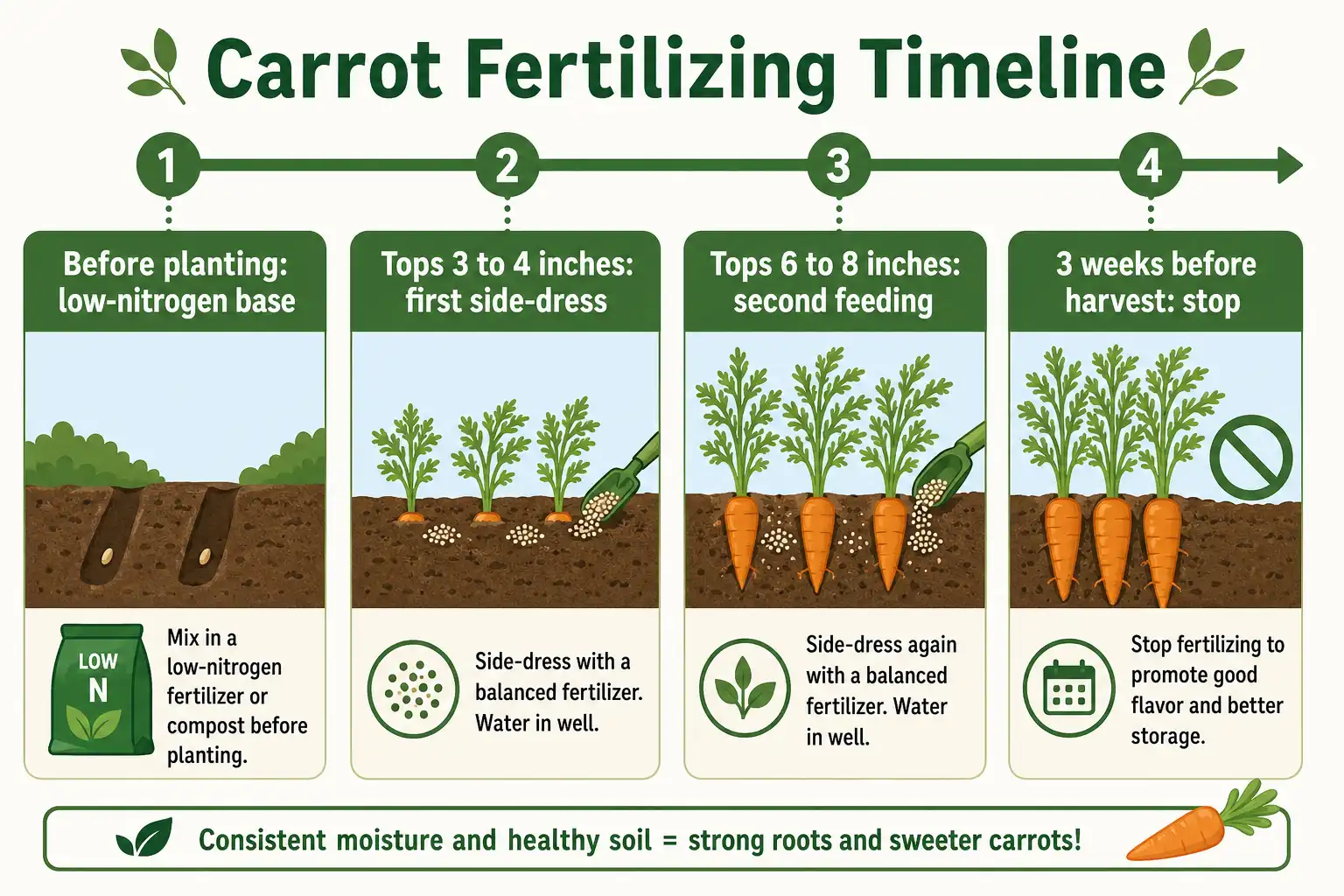
Fertilize carrots at three points: work a low-nitrogen fertilizer into the bed before planting, side-dress lightly when tops reach 3 to 4 inches, then feed again at 6 to 8 inches. Stop feeding about 3 weeks before harvest.
When to Fertilize Carrots: The Full Timeline
Carrots need feeding at three points, not one steady drip. Each one lines up with what the root is doing below the surface.
The first feeding goes in before you plant. You mix a low-nitrogen fertilizer into the bed so young roots find phosphorus and potassium right away. The second feeding is a light side-dressing once the tops reach 3 to 4 inches. The third comes at 6 to 8 inches, about halfway to mature size. After that, you stop, because late feeding pushes leaves, not roots.
That rhythm keeps growth steady without flooding the soil with nitrogen. Too much at once and the plant forks. Too little and the root stays small. Light and timed beats heavy and random every time.
Start With a Soil Test
Test your soil before you add a single pound of fertilizer. A soil test shows your nitrogen, phosphorus, potassium, and pH, so you feed what the bed is actually short on instead of guessing.
Carrots like a pH between 6.0 and 6.8. Below 6.0, nutrients lock up. Push it back up with lime if your test runs acidic. I run a soil test every two to three years on my beds, and more often after a heavy amendment year.
The test also flags texture problems. Carrots want loose, stone-free ground, and the right soil texture for straight carrots matters as much as any fertilizer. Pack or rock in the bed and the root forks no matter how well you feed it.
Feeding Carrots Before You Plant
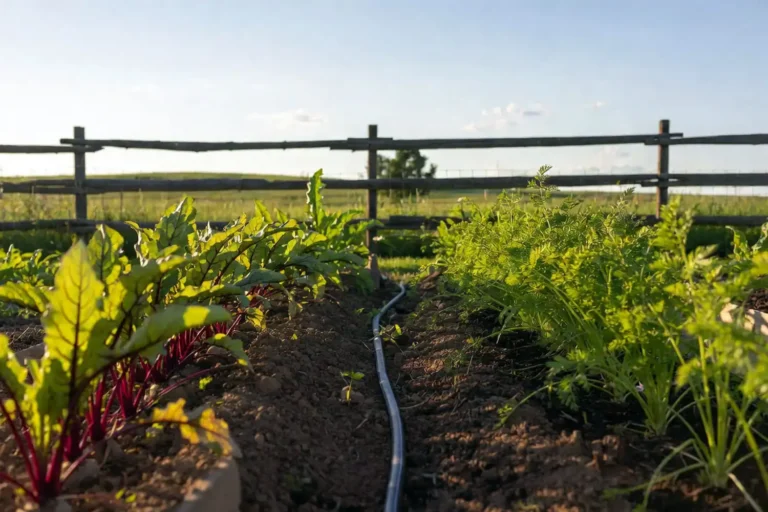
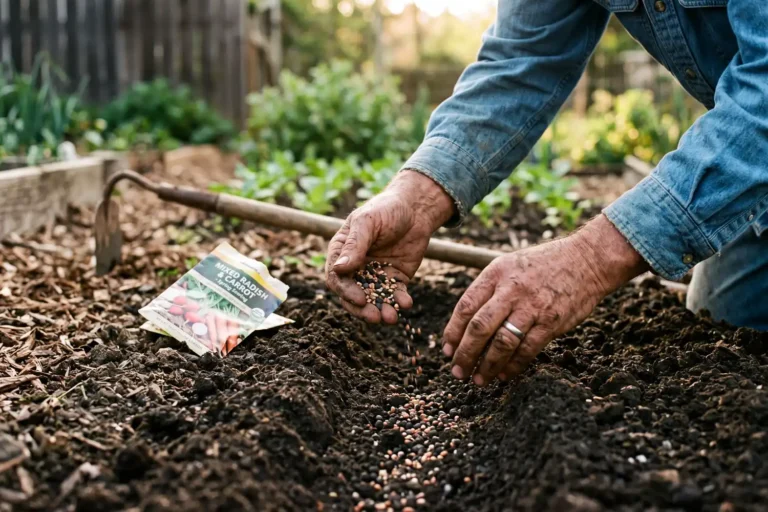
Work a low-nitrogen fertilizer into the top 2 inches of the bed two to three weeks before you sow. Carrots feed lightly, so you want phosphorus and potassium up front and only a little nitrogen. Skip the high-nitrogen blends here. They grow tops, not roots.
Good pre-plant choices are 5-10-10, 6-12-12, or a similar low-first-number formula. Bone meal works too, since it adds phosphorus with almost no nitrogen. Mix it in evenly and rake the bed smooth before planting carrots.
Rates for a Garden Bed
For a home bed with no soil test, a common starting point is 5-10-10 at about 1 to 2 pounds per 100 feet of row, worked into the top couple of inches. If you go by area instead, roughly 2 to 3 pounds of a balanced low-nitrogen blend per 100 square feet covers it. Water the bed after mixing so nutrients settle in.
Rates for a Field
On field ground, base everything on your soil test. Land-grant extension data, including work from K-State Research and Extension and Michigan State, shows a 20-ton carrot crop pulls about 100 pounds of nitrogen, 25 pounds of phosphate, and 100 pounds of potash per acre.
Between soil tests, most growers band roughly 75 pounds of nitrogen per acre, up to 120 on sandy ground. They add about 100 pounds of phosphate and 200 pounds of potash. Split the nitrogen so most of it lands as side-dressings, not all at planting.
First Side-Dressing: When Tops Reach 3 to 4 Inches
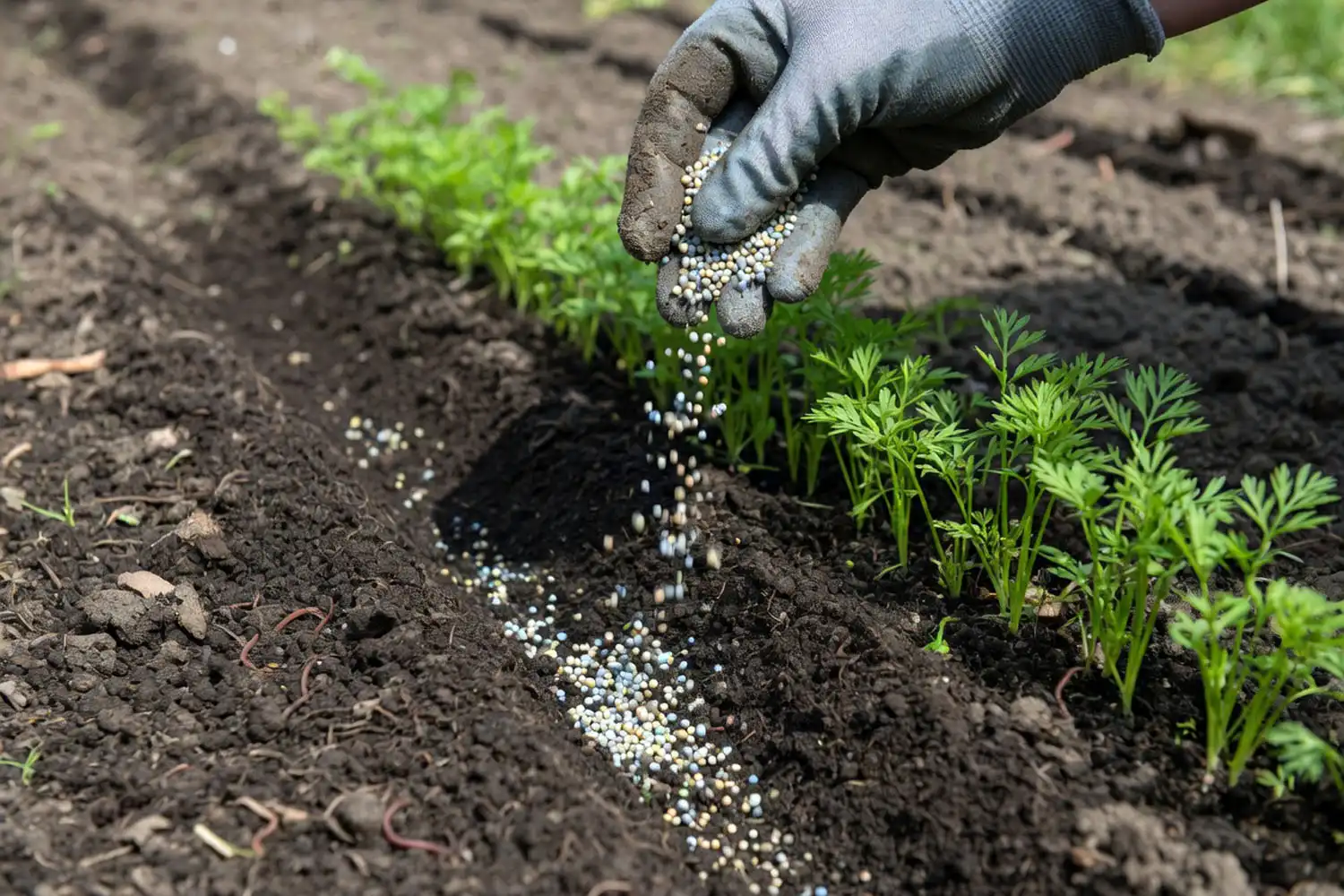
Apply the first side-dressing once carrot tops stand 3 to 4 inches tall, usually about 3 to 4 weeks after the seedlings come up. This is when the plant shifts energy toward the root, and a small nitrogen boost keeps that growth steady.
Band the fertilizer in a shallow line 3 to 4 inches off to the side of the row. In a garden, that is about 2 tablespoons of a nitrogen source per 10 feet of row. Keep the granules off the stems, since dry fertilizer touching the plant burns it. Water it in right after so the nutrients reach the root zone.
Second Side-Dressing at 6 to 8 Inches Tall
Feed carrots a second time when the tops reach 6 to 8 inches, about halfway to mature size. The roots are bulking now, and a light dose of nitrogen and potassium carries them to harvest.
Keep this feeding light, the same banded method, watered in. Heavy nitrogen at this stage splits roots, especially right after a soaking rain or irrigation. Steady moisture matters as much as the feed, so match your watering to how much water carrots need at this stage to avoid cracking and forking.
When Should You Stop Fertilizing Carrots?
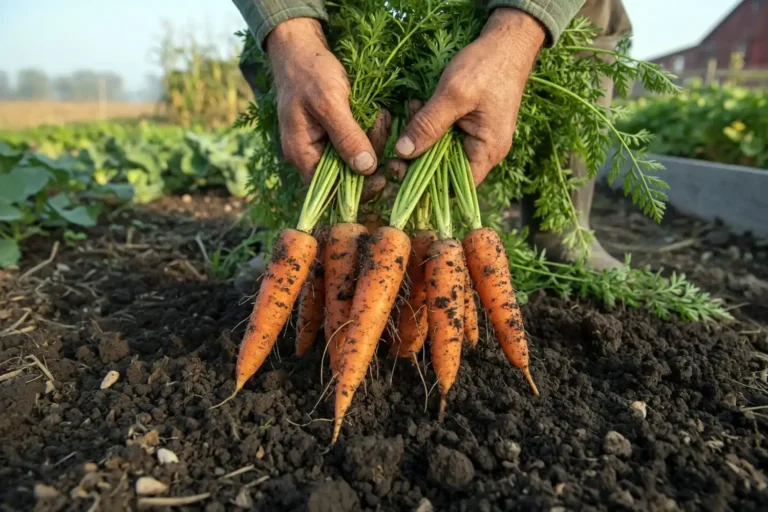
Stop fertilizing carrots about 3 weeks before you plan to harvest. Late nitrogen tells the plant to grow new leaves instead of finishing the root, and it can dull the sweetness you want at pull time.
By this point the root is sizing up on what is already in the soil. Hold off on any feed, keep watering even, and let the carrot finish clean.
What Nutrients Do Carrots Need?
Carrots need three main nutrients: nitrogen for early leaf growth, phosphorus for root development, and potassium for size, sweetness, and skin quality. The trick is the balance. Carrots want far less nitrogen than most vegetables and steady phosphorus and potassium throughout.
Nitrogen builds the green top that feeds the plant, but only early on. Phosphorus drives the taproot and helps it run deep and straight. Potassium firms up the root, improves storage, and lifts the sugar that makes a carrot taste good. If you want the full picture on the three numbers, my breakdown of how NPK fertilizer works walks through each one.
Carrots also use a little boron and magnesium. A balanced compost program usually covers those without a separate product.
Why Too Much Nitrogen Forks and Hairs Your Carrots
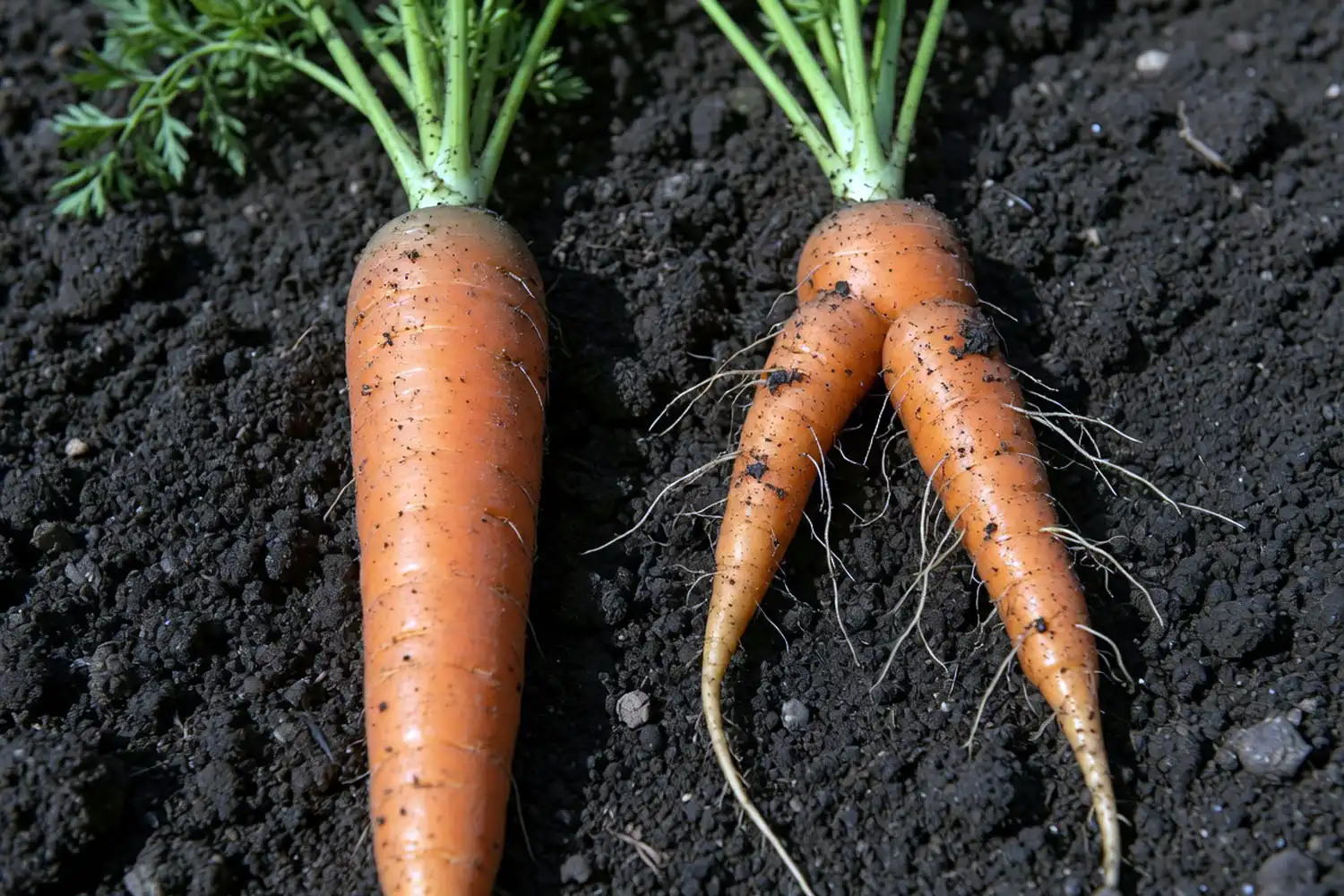
Excess nitrogen pushes the plant to grow leafy tops instead of one clean taproot. The root responds by branching, splitting, and throwing out fine hairy side roots. You end up with carrots that look like they have legs.
This is the most common feeding mistake I see. Fresh manure causes the same trouble, since it dumps nitrogen and salts right where the root is trying to grow. A high first number on the bag, a heavy hand at side-dressing, or manure tilled in this season all lead to the same forked, hairy result.
Organic Ways to Feed Carrots
You can grow excellent carrots on compost and a few low-nitrogen amendments. Work finished compost into the bed before planting for slow, steady nutrients and better soil structure. Two inches mixed into the top 6 inches is plenty.
Bone meal adds phosphorus for root growth. Wood ash adds potassium, but use it sparingly and watch your pH, since ash raises it. The one rule I never break: no fresh manure on carrot ground. If you use manure, compost it fully and apply it months ahead, ideally to the crop that runs before carrots in your rotation.
Fertilizer Mistakes That Cost You a Crop
A few habits ruin more carrot crops than any pest:
- Skipping the soil test. You feed blind and usually overdo nitrogen.
- Using a high-nitrogen blend. Anything like 10-10-10 or higher on the first number grows tops, not roots.
- Fresh manure in the bed. It forks roots and invites rot.
- Feeding too late. Nitrogen in the final weeks costs you sweetness.
- Dry granules on the stems. They burn the plant. Band off to the side and water in.
Fix those five and your carrots come up straighter, sweeter, and more uniform.
What I Watch For in My Own Carrot Beds
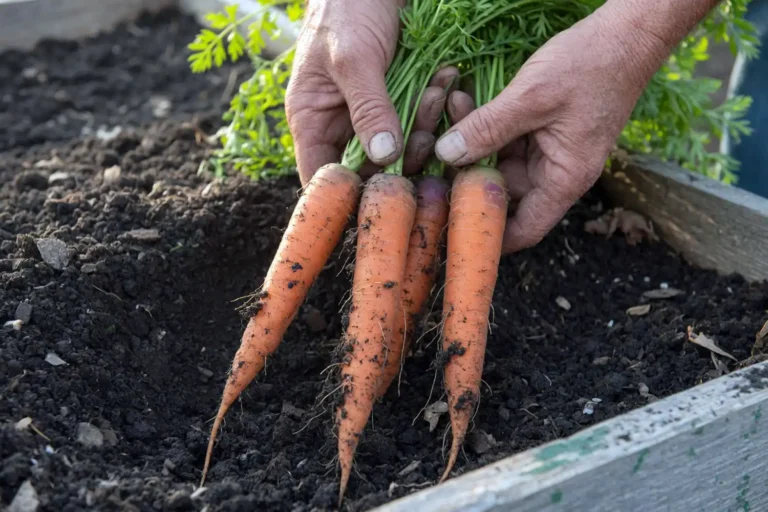
When to fertilize carrots really comes down to feeding light and feeding on time. A low-nitrogen base before planting, a small side-dress at 3 to 4 inches, one more at 6 to 8 inches, then nothing. Let the soil test set your rates, keep nitrogen low, and never rush manure into the bed. Do that and you grow the kind of long, clean carrots that make the whole season worth it.