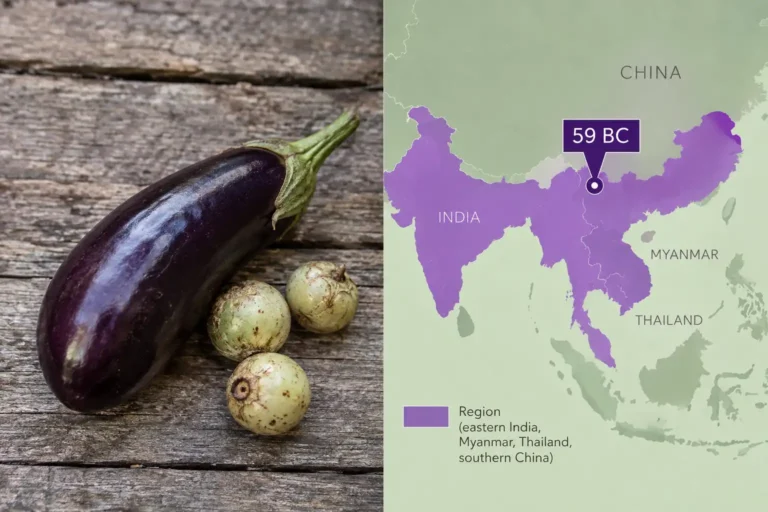
When Is Eggplant in Season? US Harvest Months by Region
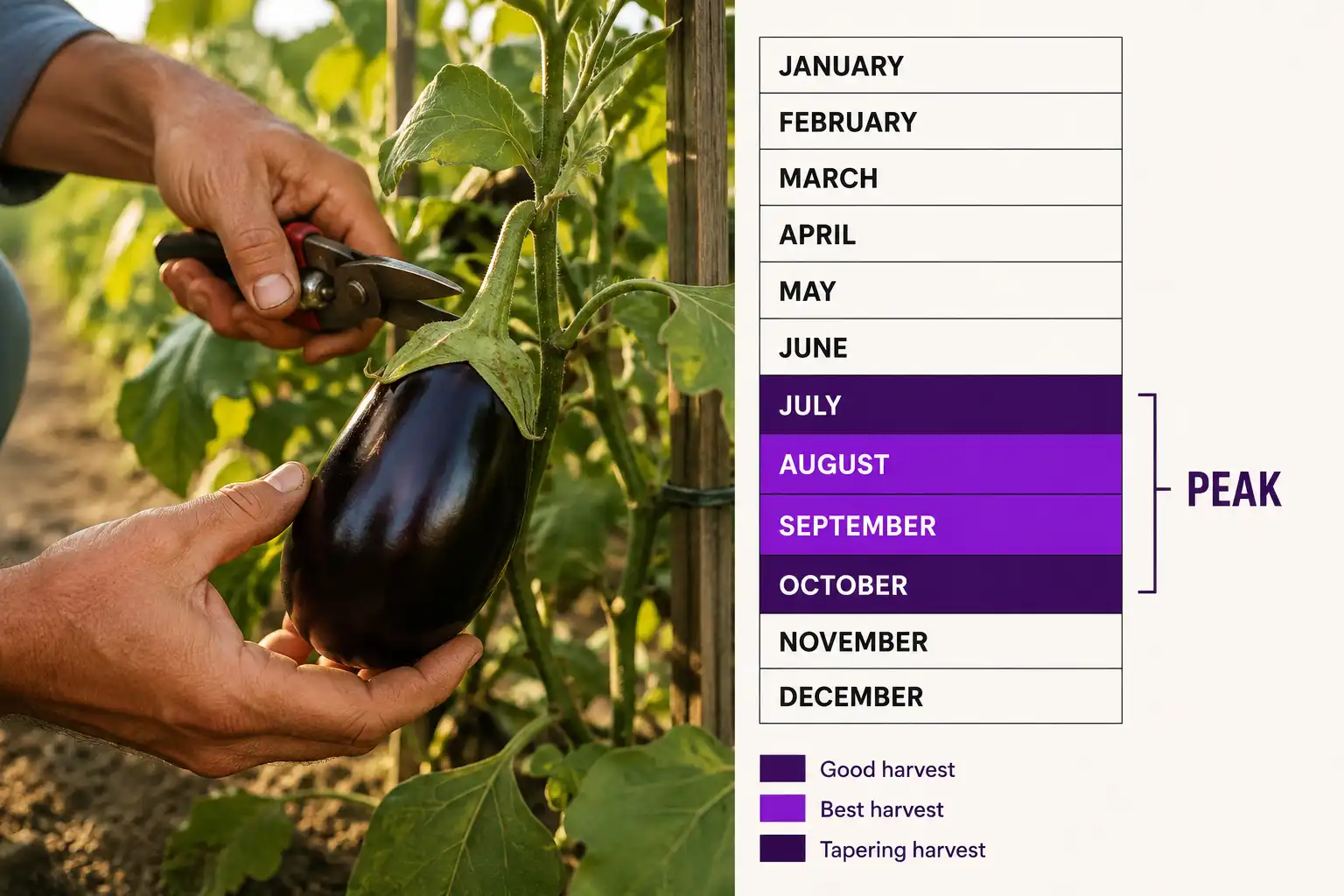
Eggplant season runs on heat, not on a calendar page. Stores stock glossy fruit all year, so shoppers assume quality holds steady. It does not. Eggplant needs warm nights to set fruit. So knowing when is eggplant in season tells you which months actually deliver flavor.
Eggplant is in season from July through October in most of the United States. Supply peaks during August and September. Southern fields start cutting in May. Northern fields quit at first frost, usually the first half of October.
When Is Eggplant in Season Across the United States?
Field harvest opens in the South during May, builds through July, then peaks in August and September. After that, frost shuts down northern production. Florida and imports cover the winter months.
Growers harvest roughly 7,000 acres of eggplant nationally each year. That makes it a specialty vegetable, not a row crop. New Jersey leads in harvested acres, followed by California, Florida, and Georgia. Those four states plus Michigan account for most of the fresh market crop.
Here is how domestic supply moves through the year:
| Month | US field supply | Main sources |
|---|---|---|
| January | Light | South Florida, Mexico, Honduras |
| February | Light | South Florida, Mexico |
| March | Light to moderate | Florida, Mexico, South Texas |
| April | Moderate | Florida (Palm Beach peak), Mexico |
| May | Moderate | Florida, Georgia, California |
| June | Building | Georgia, California, Carolinas |
| July | Strong | New Jersey, Michigan, Midwest, Northeast |
| August | Peak | Nationwide field harvest |
| September | Peak | Nationwide field harvest |
| October | Tapering | New Jersey, California, Georgia fall crop |
| November | Light | Central Florida, California, imports |
| December | Light | South Florida, Mexico, Honduras |
South Florida runs backward compared to the rest of the country. Growers in Palm Beach and Miami-Dade counties harvest from September through July. Their heaviest months land in April and May. Meanwhile the rest of the country sits idle until soil warms.
Read next: Eggplant Plant Look Like
Why Does Eggplant Season Peak in Late Summer?
Eggplant peaks in late summer because it needs sustained heat to set and fill fruit. Growth runs fastest between 70°F and 85°F. Below that range the plant stalls even when it looks healthy.
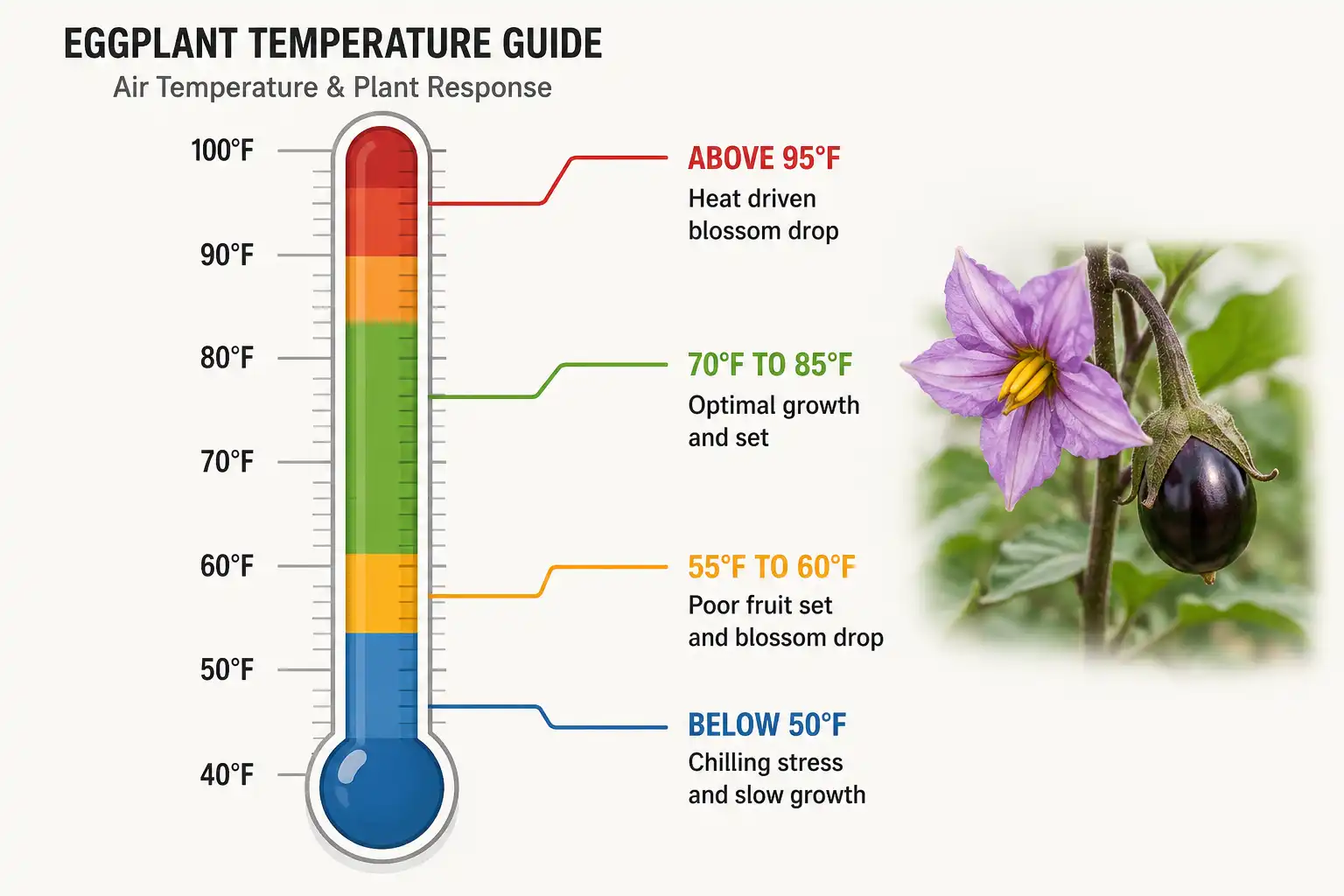
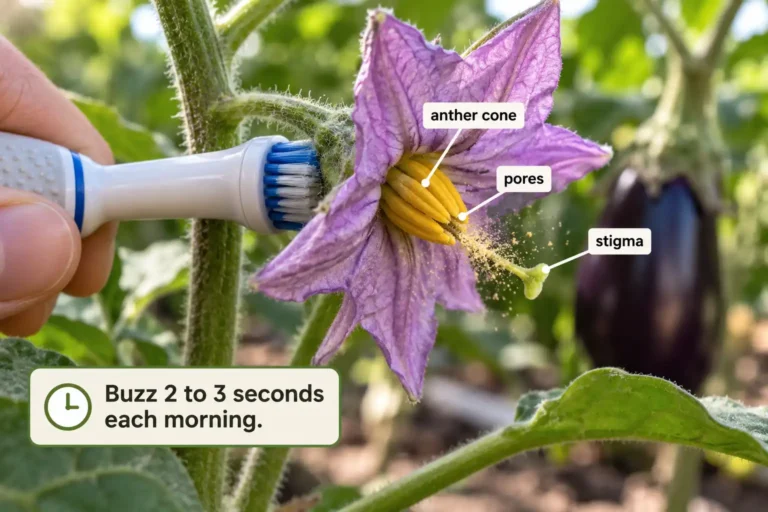
Night temperature drives fruit set more than daytime highs do. Once nights hold at 60°F or warmer, blossoms pollinate and hold. When nights drop into the 50s, flowers abort and drop without setting fruit. That single threshold explains why June plantings in the Corn Belt sit there doing nothing until early July.
Heat cuts the other direction too. Sustained highs above 95°F cause blossom drop, so many fields go through a mid-August pause. Fruit already sized keeps filling, but new set stops until temperatures ease. Then a second flush arrives in September.
Eggplant sits in the nightshade family beside tomato, pepper, and potato. Still, it is the most cold sensitive of that group. Frost at 32°F kills foliage outright, and chilling stress starts below 50°F.
When Is Eggplant in Season by Region?
Regional harvest windows swing by five months or more from Gulf Coast fields to the Upper Midwest. Find your region below. Then count backward from your first frost date to check variety fit.
| Region | Field harvest window | Peak months |
|---|---|---|
| South Florida (zones 10 to 11) | September through July | April and May |
| Deep South and Gulf Coast (zones 8b to 9) | May through November | June and September |
| California valleys | May through October | July through September |
| Desert Southwest and South Texas | June through October, midsummer pause | July and September |
| Mid Atlantic (NJ, PA, MD, VA) | Late June through early October | August and September |
| Southeast Piedmont (GA, NC, SC, TN) | June through October | July through September |
| Midwest and Great Plains (zones 5 to 6) | Mid July through mid October | August and September |
| Northeast and Upper Midwest (zones 3 to 5) | Late July through September | August |
| Pacific Northwest | Late July through September | August and September |
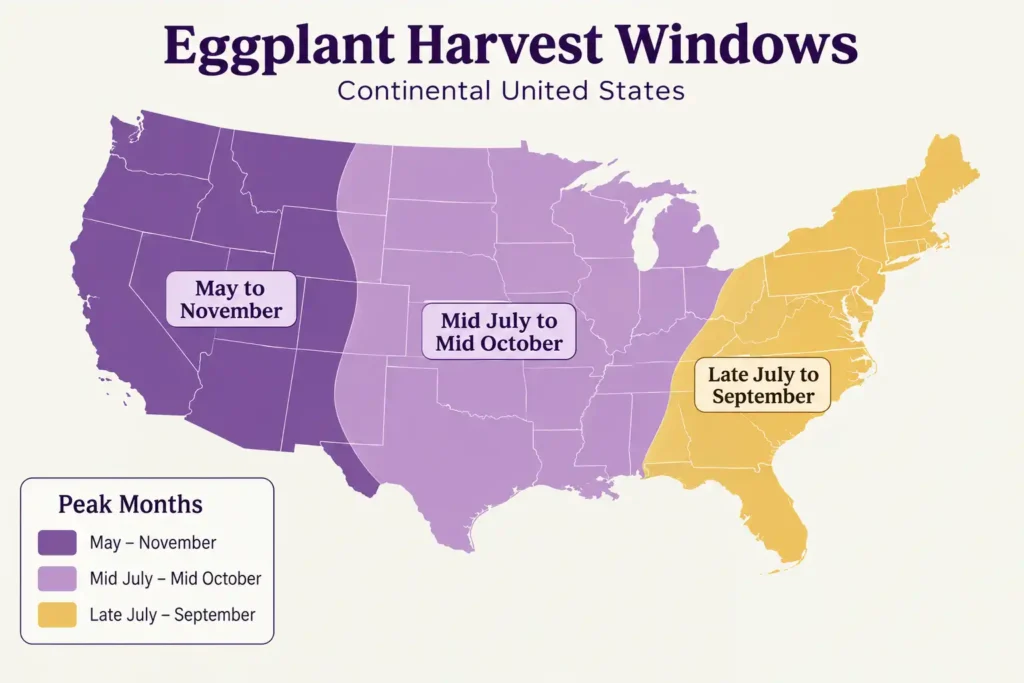
Pacific Northwest growers face the tightest squeeze. Nights there stay cool into July, so fruit set arrives late even though frost holds off until October.
When Does Eggplant Season Start and End
Eggplant season runs from about July 18 through the second week of October. Frost dates bracket it on both ends, and soil temperature sets the start.
Work the schedule this way:
- Seed indoors 8 to 10 weeks before your last frost. For me that lands between February 20 and March 5.
- Hold germination soil near 80°F. Cool mix simply will not sprout eggplant seed.
- Harden off for a week once nights outside reach 60°F.
- Check soil at 4 inches deep before you set plants. Wait for a steady 65°F to 70°F reading.
- Transplant between May 15 and May 25. Nights need to hold above 55°F.
- Expect first pick 55 to 75 days later depending on variety.
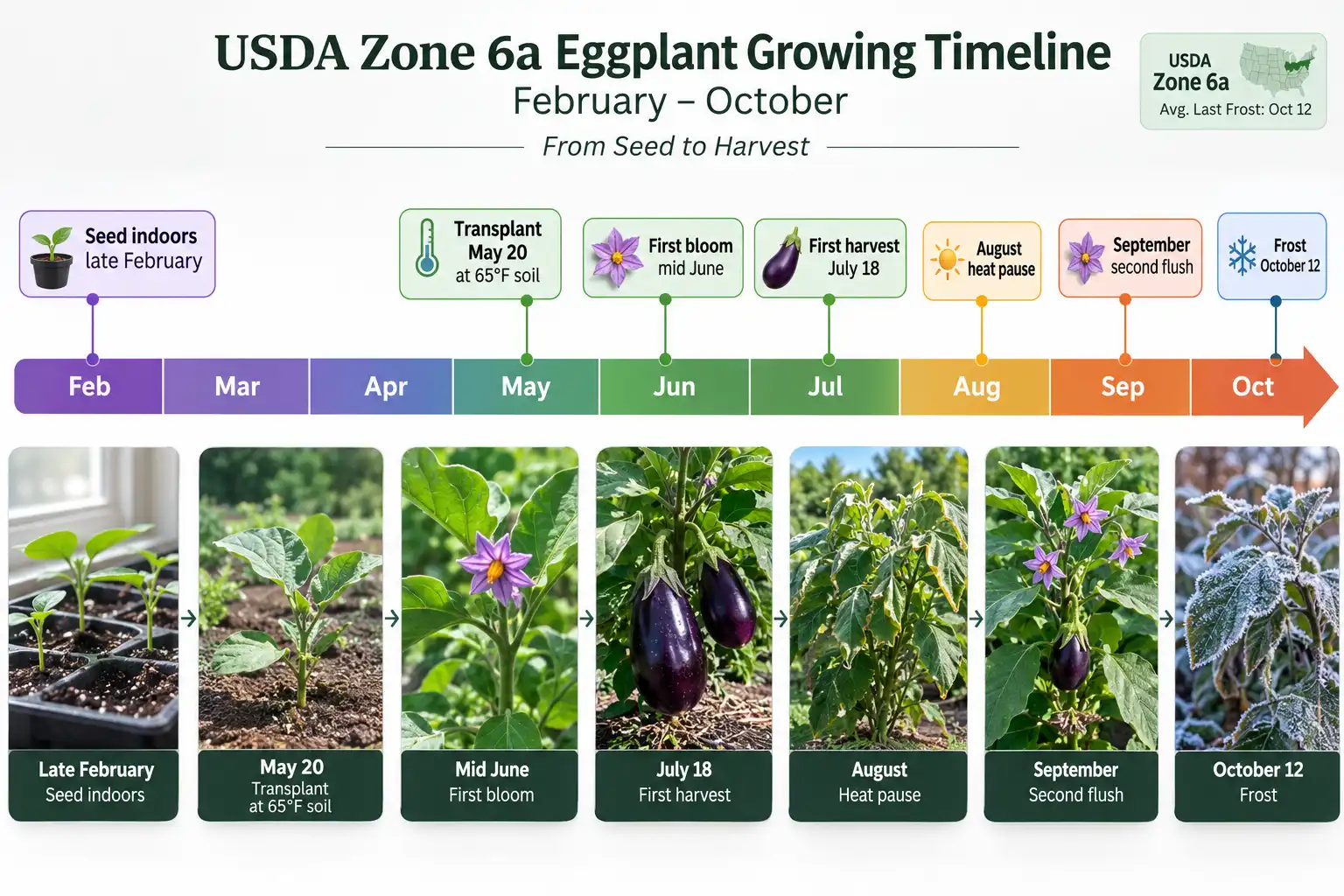
Air temperature will fool you every spring, so take that reading with a soil temperature probe at the same time each morning. Rushing the transplant date costs more than it gains. Cold soil stunts roots for weeks. A plant set May 5 often trails one set May 20. Local eggplant planting dates also shift about two weeks between southern and northern Kansas.
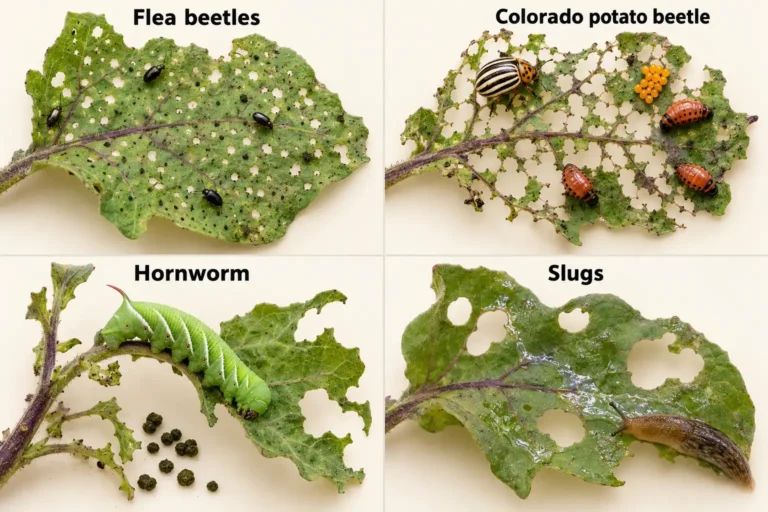
Flea beetles hit hardest in the first three weeks after transplant. Heavy feeding delays first harvest by a full week, so run row cover until bloom starts. Careful companion planting around eggplant helps too, since a trap crop pulls pressure off the young plants.
How Does Variety Choice Change the Harvest Window?
Variety choice moves your first pick by up to five weeks. Days to maturity count from transplant date, not from seeding. So add another 8 to 10 weeks of indoor time when you plan.
| Variety | Type | Days from transplant | Best fit |
|---|---|---|---|
| Patio Baby | Mini | 45 | Containers, shortest seasons |
| Fairy Tale | Striped mini | 49 to 55 | Zones 4 to 6, early market |
| Ichiban | Japanese slender | 50 to 60 | Short seasons, fast flush |
| Hansel | Cluster mini | 55 | Containers, patio |
| Orient Express | Japanese slender | 58 | Cool nights, early sets |
| Nadia | Italian globe | 65 to 70 | Cooler summers, main crop |
| Black Beauty | Globe heirloom | 74 to 85 | Long warm seasons |
| Rosa Bianca | Italian heirloom | 75 to 88 | Zone 7 and south |
Northern growers should lean toward the Japanese slender types. A 58 day Orient Express finishes cleanly in zone 5. An 80 day Black Beauty risks getting cut short by September cold. Growers in zone 7 and south can plant the long season heirlooms and get better texture out of them.
Two plantings work in the Deep South and California. Set the first crop in March for a June harvest. Then set a second crop in July for October and November picking. Time both against local frost data rather than the calendar month.
Why Is Eggplant in Stores Year Round?
Imports and greenhouse production fill the gap when domestic fields go quiet. USDA Agricultural Marketing Service tracks weekly eggplant shipments, and the winter reports look nothing like the summer ones.
Winter supply arrives from several directions.
- Mexico ships by truck across the southern border, the largest single import source.
- Honduras and Guatemala ship by boat, heaviest from January through April.
- Dominican Republic moves specialty types by air.
- Canada and the Netherlands supply greenhouse fruit.
- South Florida covers the domestic side from September through July.
Greenhouse and long haul fruit reaches stores in good shape, yet it gets harvested slightly immature to survive shipping. Field fruit cut at peak gloss beats it on texture nearly every time. US per capita eggplant availability sits near one pound per year. Most of that pound gets eaten outside peak season.
How Do You Spot Peak Season Eggplant?
Skin gloss tells you more than size does. A fruit at peak reflects light sharply and feels heavy for its size. Dull skin means seeds have hardened and bitterness has set in.
Run this check in the field or at the market:
- Look at the shine. Taut, mirror bright skin means peak. A matte finish means past peak.
- Press with your thumb. Illinois Extension puts it plainly: if the flesh dents and springs back, harvest it. Rock hard means immature. A dent that stays means overripe.
- Check the calyx. The green cap should look fresh and firm, not brown or shriveled.
- Weigh it in your hand. Light for its size means the flesh has gone spongy.
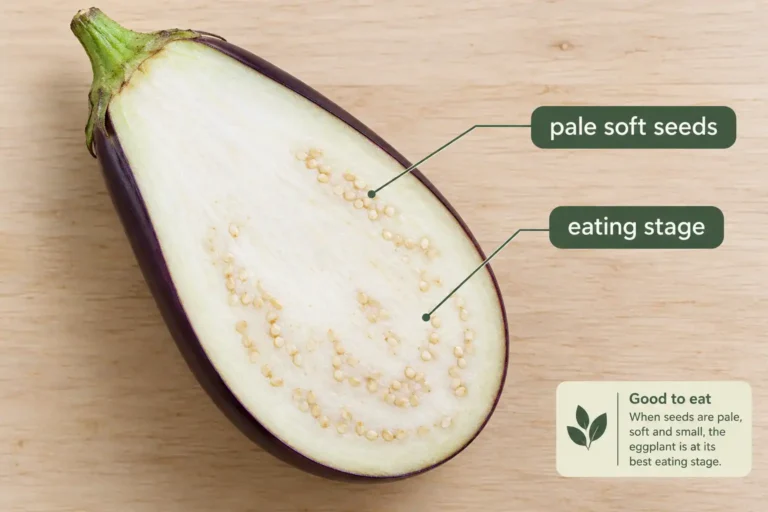
- Cut one open. Pale, soft seeds mean good eating. Brown, hard seeds mean bitter.
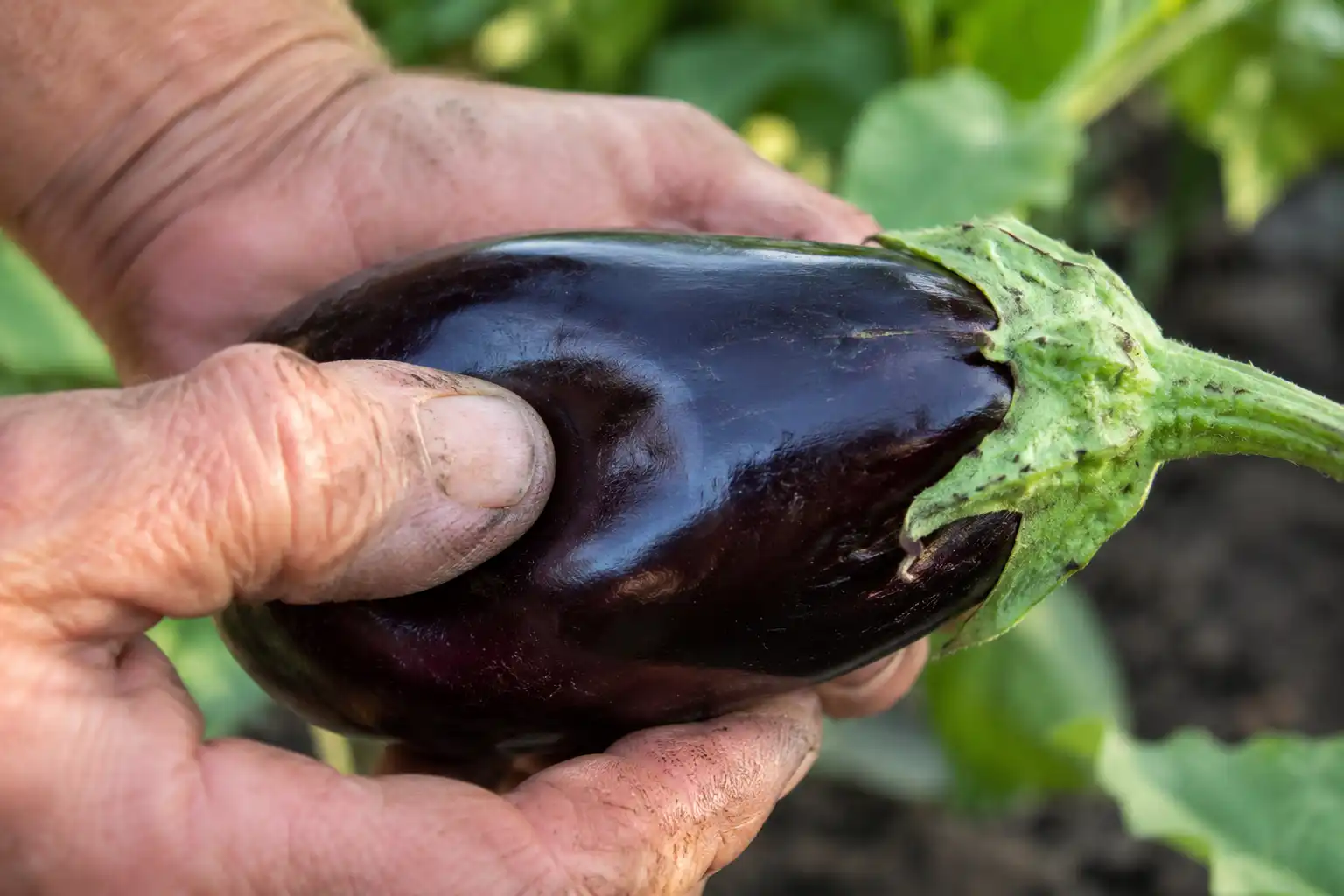
Bitterness comes from solasonine, which builds as seeds mature. So salting an overripe eggplant will not fix it. Picking earlier will.
Cut fruit free with shears, leaving an inch of stem attached. Pulling tears the crown and damages the branch where the next cluster forms. Eggplant bruises fast, so move picked fruit in shallow layers. A wide harvest basket keeps fruit from stacking and compressing.
How Long Does Fresh Eggplant Keep After Harvest?
Fresh eggplant keeps under two weeks at best, and quality slides quickly after that. Hold it at 50°F to 54°F with high humidity for the longest life.
The refrigerator is the common mistake. Eggplant turns chilling sensitive below 50°F. UC Davis postharvest research shows injury within 6 to 8 days at 41°F. Home refrigerators run colder than that. Symptoms show up as surface pitting, bronzing, and browned seeds, then Alternaria decay follows. Chilling damage also stacks up. It can begin in the field on a cold October morning, before you ever pick.
Two more points matter for storage:
- Cool it fast. Pull field heat down to about 50°F soon after harvest to limit water loss.
- Keep it away from ethylene. Above 1 ppm, the calyx drops off and browning accelerates. So store eggplant clear of ripening tomatoes, apples, and bananas.
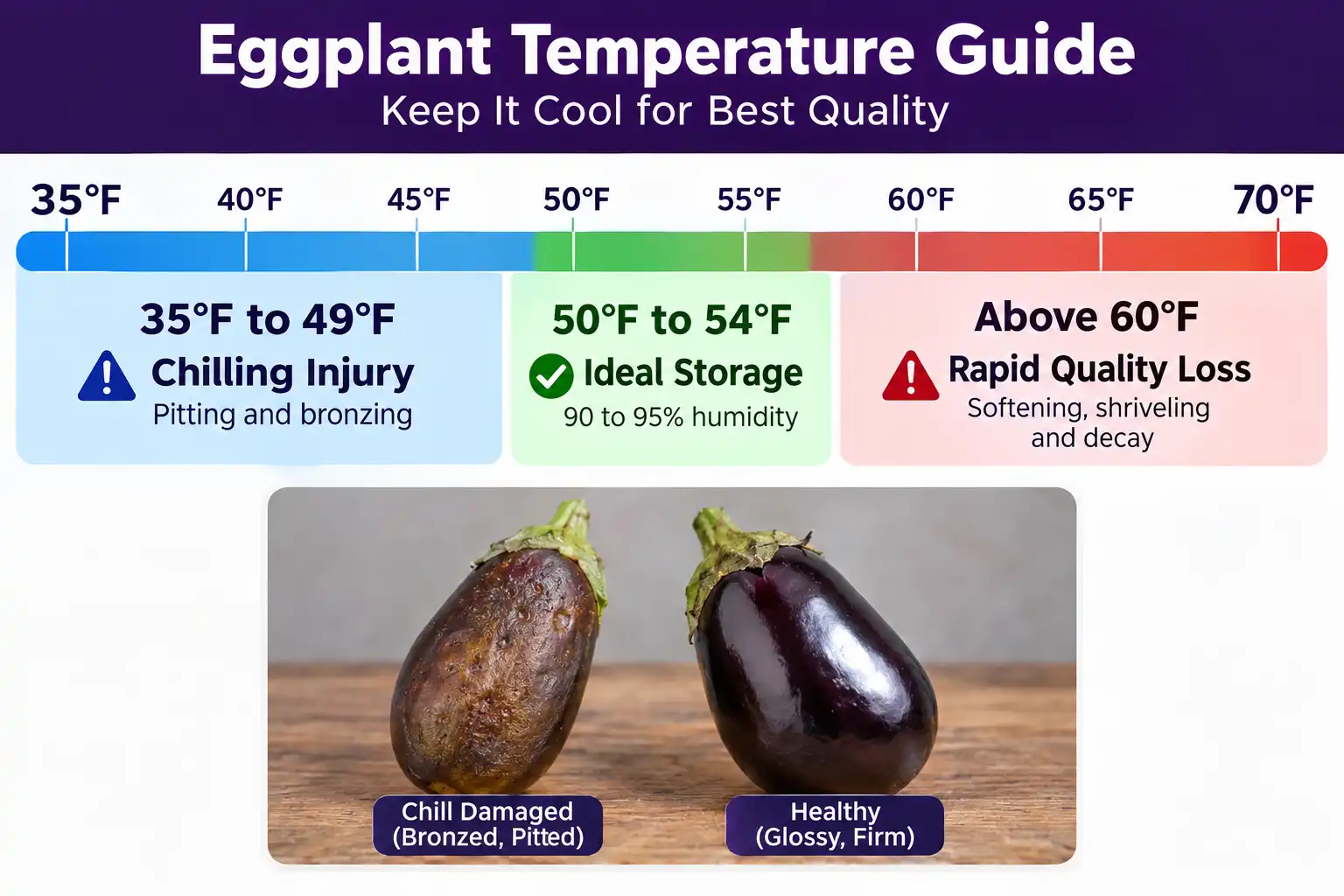
Do not wash before storing, since surface moisture invites mold. Careful handling right after harvest protects eggplant quality as much as the storage temperature does.
How Can You Stretch Eggplant Season Past First Frost?
Season extension buys three to six weeks on the back end. Frost is the hard stop, and every tool below works by keeping the plant above 50°F longer.
- Lay black plastic mulch at transplant. It raises root zone temperature and pushes first harvest earlier by roughly a week.
- Set low tunnels or floating row cover over rows in late September. Remove them during warm afternoons so heat does not build.
- Use a high tunnel if you sell into fall markets. Tunnel eggplant in zone 6 often produces into early November.
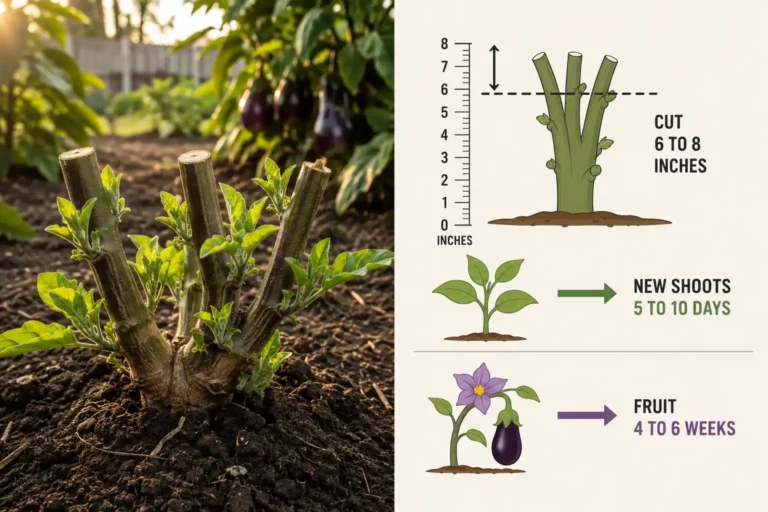
- Prune spent branches in mid August. Cutting back tired growth pushes a stronger September flush.
- Keep irrigation steady through the heat pause. Drought stress during August kills the second flush before it starts.
- Strip the plants clean before the first frost night. Immature fruit will not ripen off the vine, so pick everything usable.
On the front end, a warm spring gains you far less than most growers expect. Soil temperature, not the calendar, controls the start date. Spacing, fertility, and staking then decide how long plants keep setting, so growing eggplant for a long season starts well before September.
When Is the Best Time to Buy Eggplant?
Buy eggplant in August and September. Supply peaks nationally, field fruit dominates the shelf, and prices sit at their annual low. Farmers market fruit picked that morning beats anything shipped.
Watch for these market signals:
- A bright green, unshriveled calyx means the fruit came off the plant recently.
- Local origin labels through August and September mean short transit and better texture.
- Steep summer discounts usually mean a regional glut, which is good news for texture.
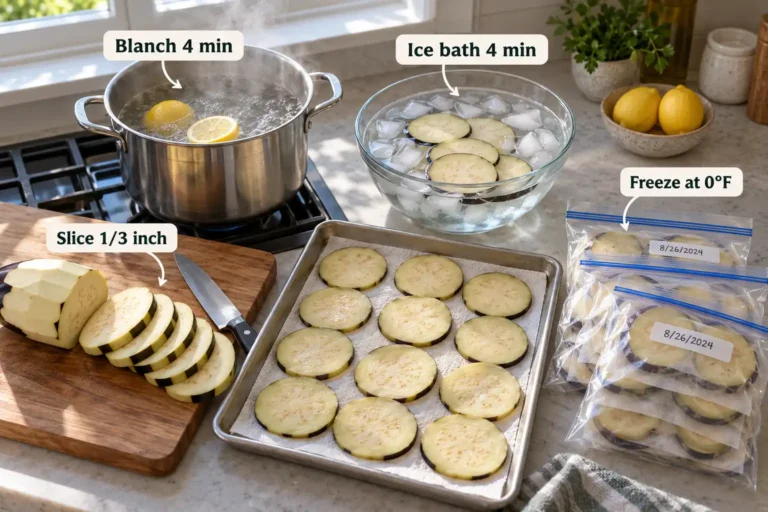
Peak season is also when preserving pays. Eggplant does not can well on its own because of low acid, so freeze it instead. Grill or roast slices first, cool them, then pack and freeze. That holds texture far better than freezing raw slices.
Final Words about Eggplant Harvest Season
Eggplant season is short, and it hinges on two numbers: 65°F soil at transplant and 60°F nights at bloom. Hit both and you pick from mid July into October. Miss them and the plants sit idle through the best weeks of summer.
If you shop rather than grow, mark August and September. That is when field fruit reaches the shelf at peak gloss and lowest price. Every other month leans on Florida, greenhouse production, or imports, and the texture shows it.