Where Did Eggplant Originate? Tracing the Crop From Wild Asia
Eggplant sits in the nightshade family beside tomatoes and potatoes, yet it came from a very different place. So where did eggplant originate? The answer shapes how you start it, when you set it out, and how much heat you need.
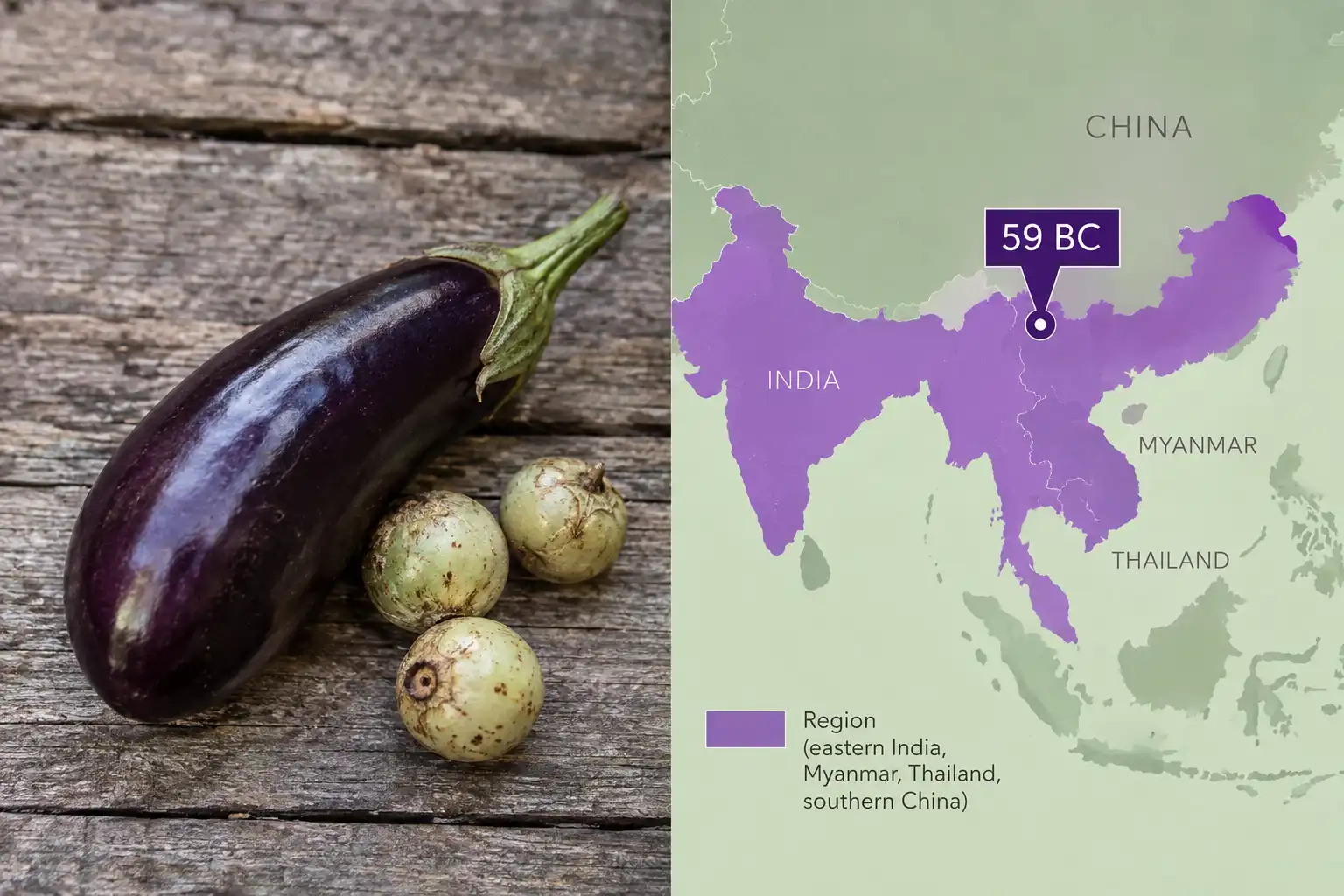
Eggplant originated in tropical Asia, across the belt running from eastern India through Myanmar into southern China. Its wild ancestor is Solanum insanum. Chinese records confirm eggplant cultivation by 59 BC, which makes it one of Asia’s oldest domesticated vegetables.
Where Did Eggplant Originate?
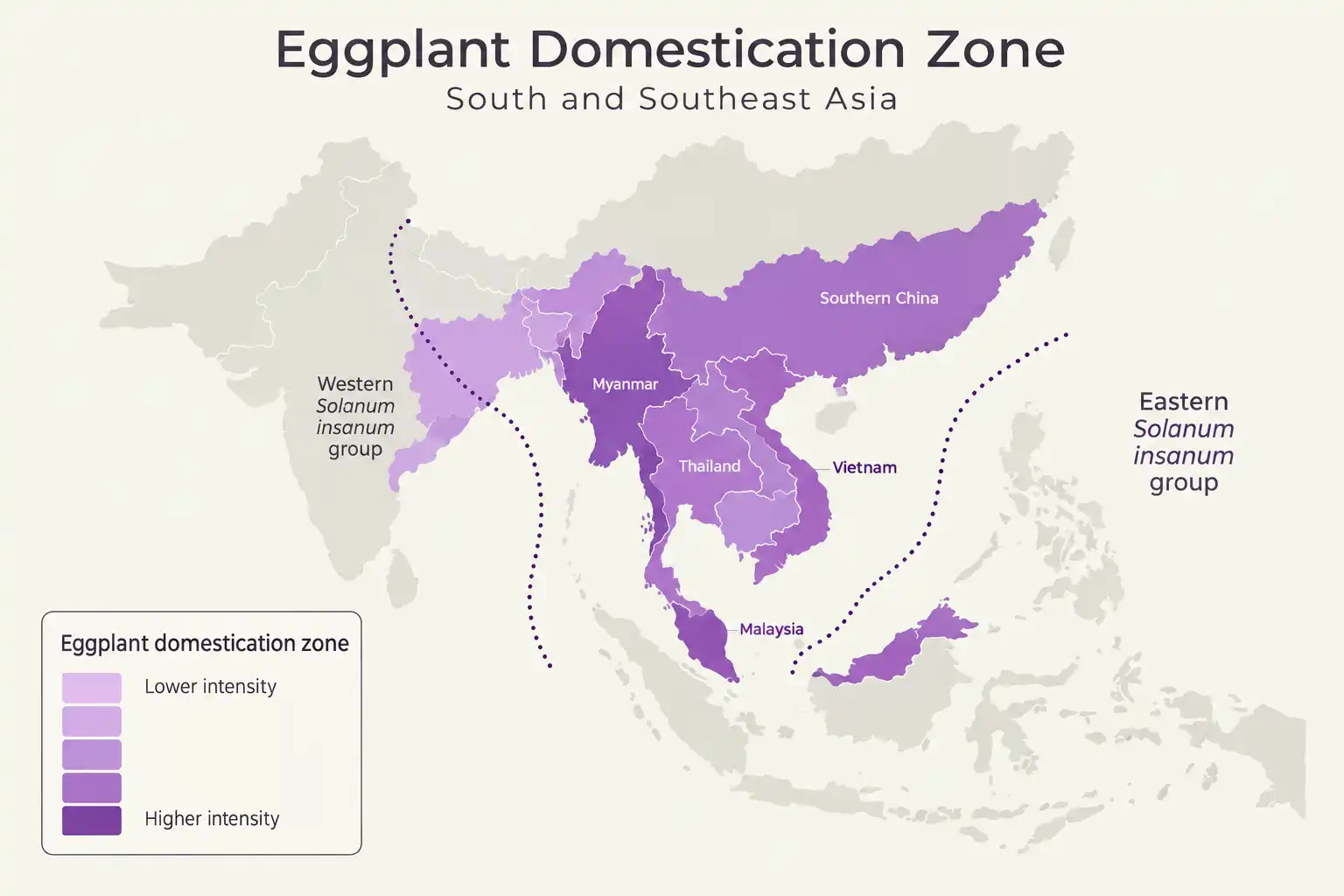
Eggplant originated in tropical Asia. Genomic work points to the zone stretching from eastern India through Myanmar and Thailand into southern China. That belt still holds the widest diversity of both wild and cultivated forms.
Botanists call the crop Solanum melongena. It belongs to Solanaceae, the same family as tomatoes, potatoes, and peppers. But unlike those three, eggplant is an Old World crop. Tomatoes and potatoes came out of the Americas, while eggplant never reached this hemisphere until European ships carried it here.
One wrinkle matters. The broader group eggplant belongs to, called the Eggplant clade, actually traces back to Africa. Phylogenomic studies place the cradle of that clade around Somalia and the Middle East. From there, a single dispersal event carried the lineage into tropical Asia. Once in Asia, it produced the wild species that farmers eventually turned into a crop. So the family roots sit in Africa, while the vegetable itself came together in Asia.
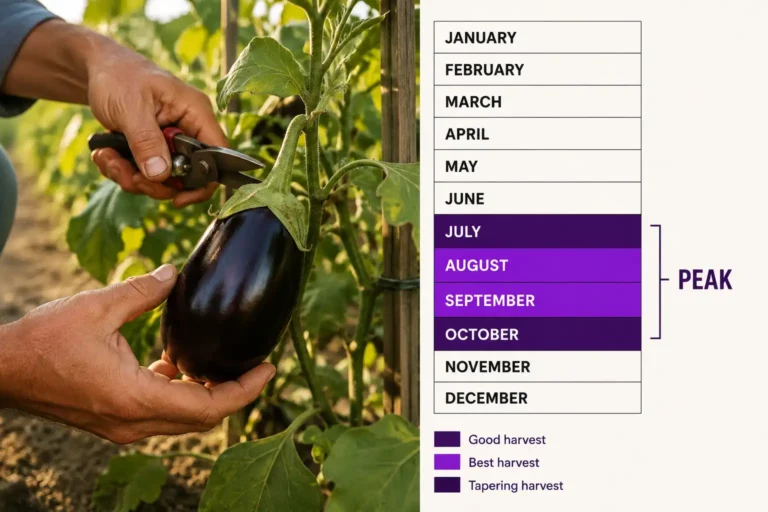
Read more: Eggplant Harvest Season
What Is the Wild Ancestor of Eggplant?
The wild ancestor of eggplant is Solanum insanum, a prickly shrub native to south and southeast Asia plus Madagascar and Mauritius. Genome-scale SNP analysis confirms it as the direct progenitor.
Solanum insanum looks nothing like a market eggplant. It carries small round fruit, sharp spines along stems and leaves, and bitter flesh. Then centuries of selection changed all three traits.
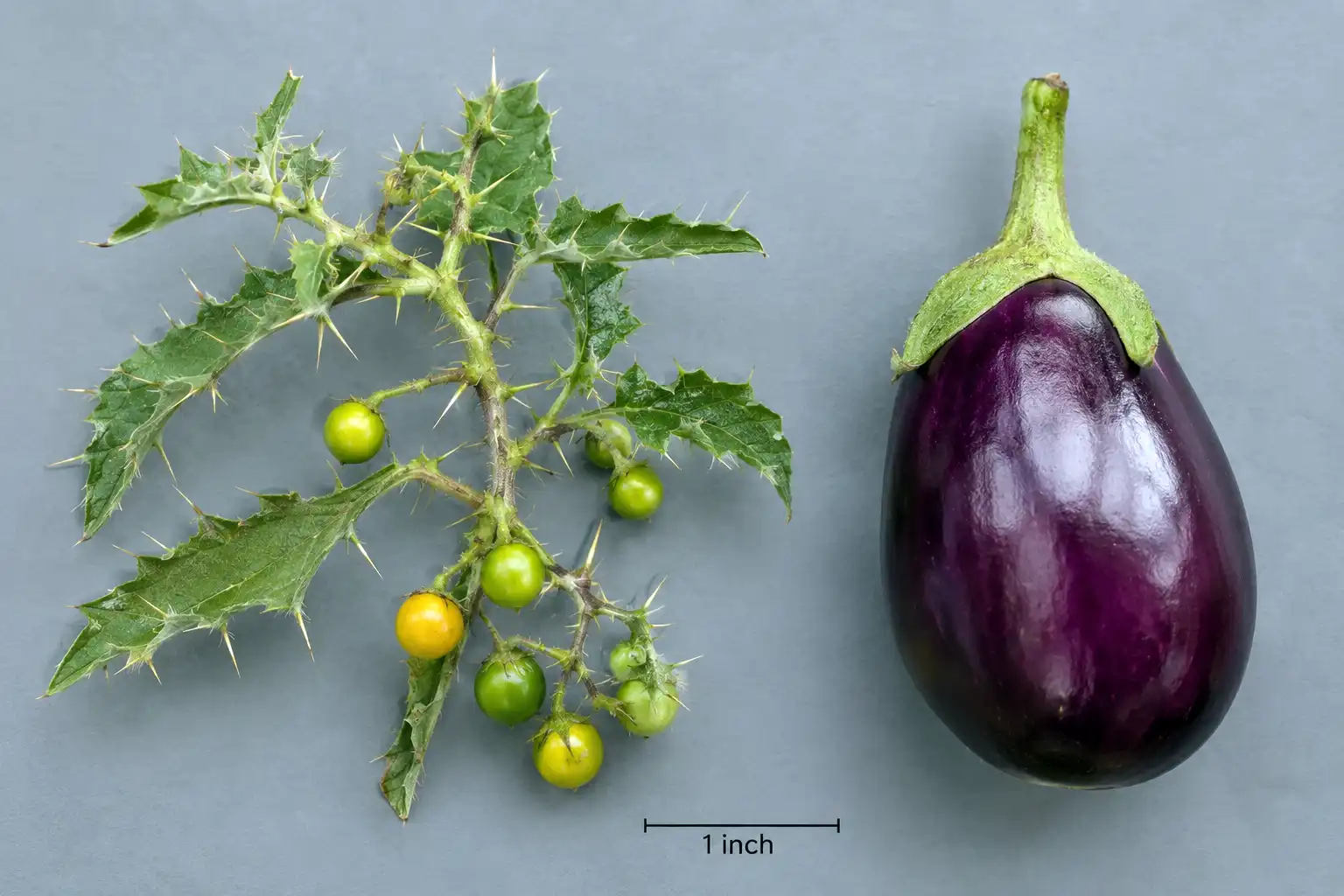
Researchers split Solanum insanum into two geographic groups. An eastern group covers Malaysia, Thailand, and Vietnam. A western group covers India, Sri Lanka, and Madagascar. Current genomic evidence ties domesticated eggplant to the eastern group. Some Indian plants once filed as wild turned out to be feral escapes from cultivation instead.
Domestication also cost the crop diversity. Sequence work shows early cultivated types lost close to half the genetic variation held by the wild species. Landraces then dropped another 10 percent on top of that.
Was Eggplant Domesticated in India or Southern China?
Probably both, and more than once. Researchers have argued over India versus southern China for decades, and current evidence favors several separate domestication events rather than one origin point.
Two facts drive that reading. First, both regions hold written records of eggplant use going back roughly 2,000 years. Second, both still carry highly diverse landraces along with populations of candidate wild progenitors.
Gene flow muddies the picture further. Cultivated eggplant and Solanum insanum still cross freely where they grow near each other. So crop genes leak into wild stands, and wild genes leak back. That two-way exchange has run for centuries, which makes any single birthplace hard to pin down.
Nikolai Vavilov spotted the pattern long before sequencing existed. He recorded that some varieties looked Indian in form, while spinier and more bitter types looked Chinese. Modern genomics has largely backed up that field observation.
When Was Eggplant First Grown as a Crop?
The earliest firmly dated record of eggplant cultivation comes from 59 BC in China. A work called Tong Yue, written by Wang Bao, tells readers to separate and transplant eggplant and scallion seedlings at the spring equinox. That single line proves eggplant was already a garden crop on the Chengdu Plain, not a wild plant gathered from nearby ground.
Chinese texts then track the crop’s improvement in unusual detail. The Qimin Yaoshu, a sixth-century farming manual, described eggplant fruit as no bigger than a slingshot pellet. By the 1200s, writers compared fruit size to a teacup roughly four inches across.
| Date | What the record shows |
|---|---|
| 59 BC | Tong Yue names eggplant seedling transplanting on the Chengdu Plain |
| 6th century AD | Qimin Yaoshu describes fruit the size of a slingshot pellet |
| 1069 | Tu Jing Bencao carries the first known eggplant drawing, round and spineless |
| 1220 | Lüchanyan Bencao adds a color drawing from Zhejiang Province |
| 1200s | Fruit described as teacup sized, near four inches wide |
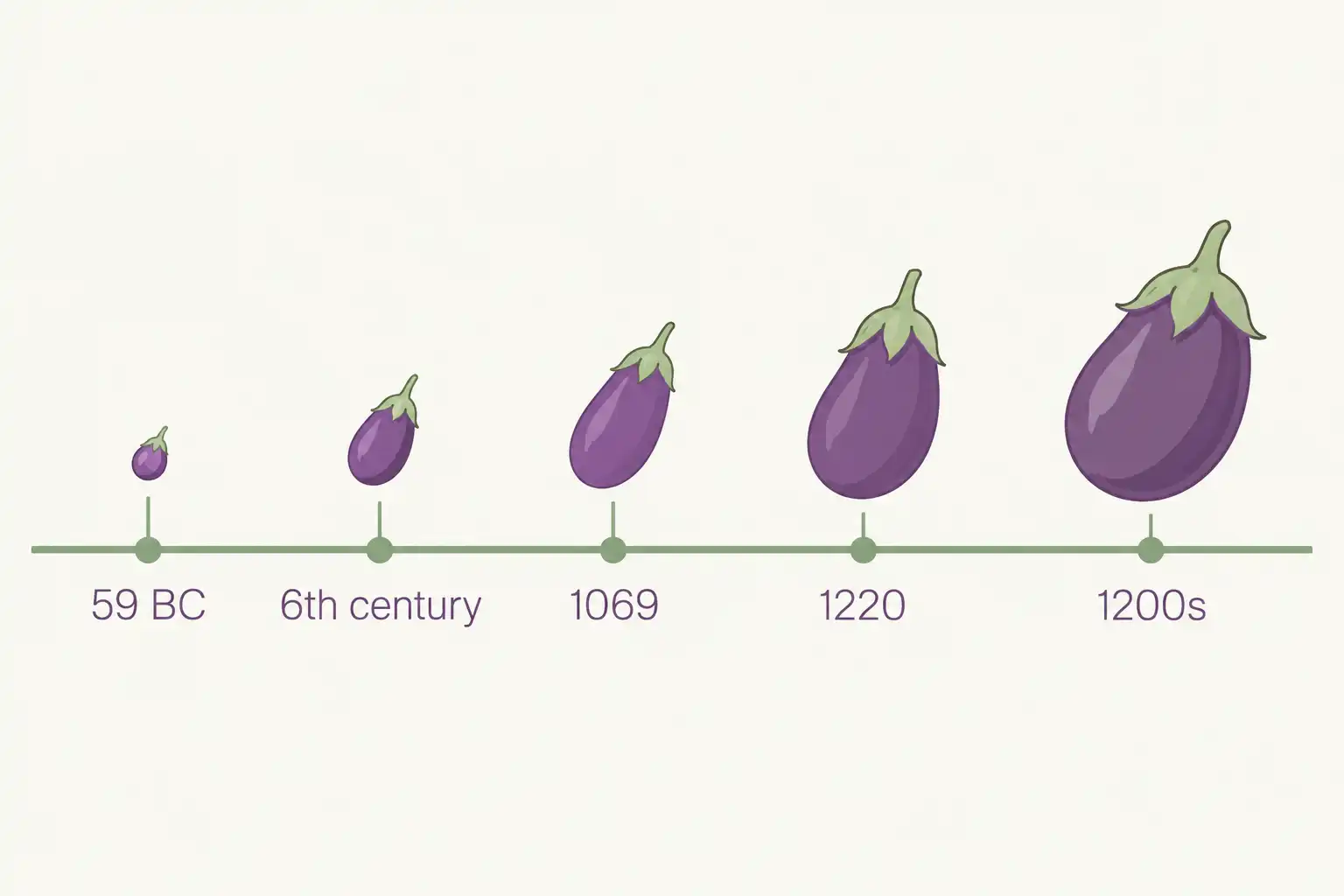
Selection ran on three traits at once: size, shape, and taste. Fruit grew larger, shapes multiplied, and flavor shifted from harsh toward what those writers called sweetish. By the early 11th century, cultivation covered China and the crop had split into many named cultivars.
India’s written record runs old too, though the dating stays looser. Sanskrit sources reference the crop as vatingana. That name later traveled west and produced most of the European words for eggplant.
How Did Eggplant Spread From Asia to Europe?
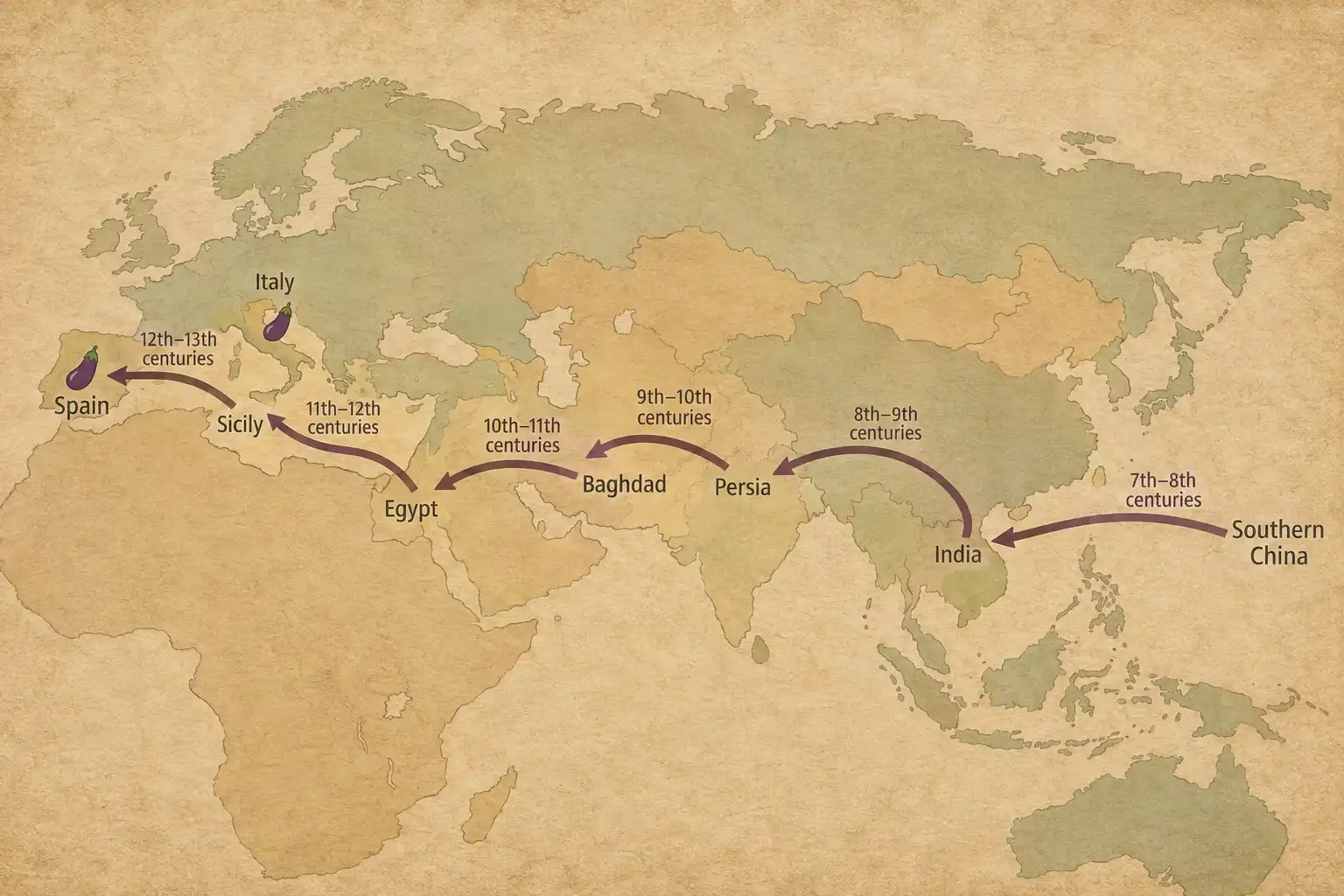
Persian and Arab traders carried eggplant west, mostly between the ninth and twelfth centuries. Persian cooks took to it first. After the Arab conquest of Persia in the seventh century, kitchens in Baghdad absorbed Persian dishes and spread them across the growing Islamic world.
Spain received the crop along that route. Sicily and southern Italy followed. Europe’s first written eggplant records appear in fourteenth-century northern Italian copies of an eleventh-century Arabic health manual, the Tacuinum Sanitatis. Those illustrated pages show eggplants under cultivation and at harvest.
Northern Europe stayed suspicious for a long stretch. Eggplant’s nightshade relatives include belladonna and jimsonweed, both genuinely poisonous. Italians called the fruit melanzana, which sounded close to mela insana, or mad apple. So the crop picked up a reputation for causing insanity. Growers in the warm south kept planting it anyway, because it produced well there.
Why Is It Called Eggplant in the United States?
The name comes from small white cultivars shaped like hen eggs. Eighteenth-century European growers raised those types, and English speakers in North America met them first. So American English settled on eggplant, while most of Europe kept the older Sanskrit-derived name.
That older name traveled a long chain. Sanskrit vatingana became Persian badingan, then Arabic al-badhinjan. Spanish dropped the article and made berenjena. Catalan kept it as alberginia. French reshaped that into aubergine, which British English later borrowed. South Asian and South African English use brinjal, which arrived through Portuguese beringela.
When Did Eggplant Reach American Farms?
Eggplant reached American gardens in the early 1800s. Thomas Jefferson grew both white and purple types at Monticello in 1812, using seed from France. By 1825, eastern seed catalogs listed both.
Early catalogs pushed the white type as an ornamental rather than food. That old fear of nightshades carried straight over from medieval Europe. Mary Randolph did publish an eggplant recipe in The Virginia House-Wife in 1824, so some cooks clearly used it, but adoption stayed slow for decades.
Real demand arrived with immigration. Italian and Chinese families settling here through the late 1800s and early 1900s already cooked eggplant regularly. Their kitchens pulled the crop out of the flower border and into commercial vegetable production.
Are African Eggplants the Same Species?
No. Africa produced two separate eggplant crops from different wild ancestors. Both matter in sub-Saharan agriculture, and neither one is Solanum melongena.
Scarlet eggplant (Solanum aethiopicum) descends from the wild species Solanum anguivi. Growers raise four cultivar groups: Gilo and Kumba for fruit, Shum for leaves, and Aculeatum as an ornamental. Scarlet eggplant ranks among the five most important vegetables across Central and West Africa.
Gboma eggplant (Solanum macrocarpon) descends from Solanum dasyphyllum. Its flattened fruit runs one to four inches across, white or green at market maturity. Farmers cut its leaves too and cook them like spinach.
All three cultivated eggplants sit in the same subgenus, Leptostemonum, so breeders can cross them. That matters for disease resistance work, because the African species carry traits worth moving into common eggplant.
Where Is Eggplant Grown Today?
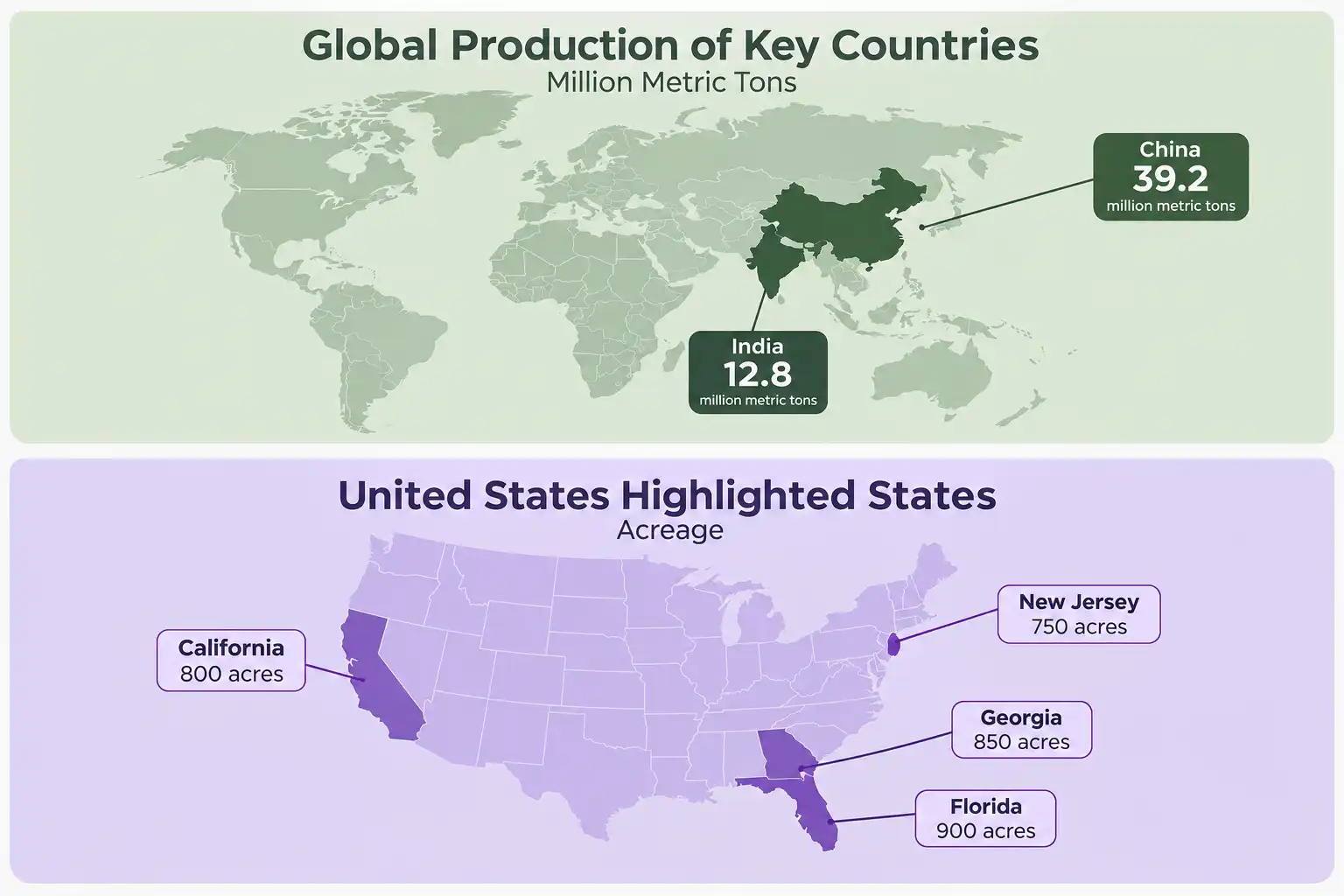
Asia still dominates, turning out more than 90 percent of the world crop. China leads by a wide margin, then India. Global output reached roughly 61 million metric tons in 2023 according to FAO figures.
| Country | 2023 output (million metric tons) | Share of world total |
|---|---|---|
| China | 39.2 | About 64 percent |
| India | 12.8 | About 21 percent |
| Egypt | 1.9 | About 3 percent |
| Turkey | 0.8 | About 1 percent |
| Indonesia | 0.7 | About 1 percent |
US production stays small next to those numbers. Fewer than 7,000 acres go into eggplant nationally. New Jersey, California, Georgia, and Florida trade the top spot year to year, each running roughly 700 to 900 harvested acres. The 2022 Census of Agriculture counted 342 New Jersey farms growing it. Yields average near 25,000 pounds per acre.
Sandy loam soils and warm summers explain that short state list. Southern New Jersey has both. Florida and Georgia bring longer warm seasons, so growers there can run spring and fall crops.
How Eggplant’s Tropical Origin Changes Your Field Plan
Tropical origin means eggplant wants more heat than almost anything else in a northern rotation. It runs more cold sensitive than tomatoes and peppers, though all three share the same family. So every planting decision follows from that history.
Timing drives the whole crop. Getting eggplant planting timing right in a short-summer state means counting backward from your last frost date, then confirming with actual soil readings. Starting eggplant from seed indoors is the only workable route north of the Gulf states, since direct seeding burns too much of the season.
Here is the sequence in zone 6a:
- Sow seed indoors 8 to 10 weeks before your last frost date. Germination moves fastest at 70 to 90°F.
- Grow the transplants at 65 to 75°F by day and 60 to 70°F at night.
- Lay black plastic mulch about two weeks ahead of transplanting to pull soil temperature up.
- Wait until soil hits 70°F at 4 inches deep before you set anything out.
- Transplant only once night temperatures hold above 60°F.
- Harden off across 10 to 14 days first.
Step four is where people lose the crop. Reading bed temperature with a thermometer built for soil beats guessing from the calendar, because a warm week in April can fool you badly. Cold below 50°F injures plants outright. Fruit set fails when nights drop under 60°F. Frost kills them. Those thresholds trace straight back to tropical ancestry, and no variety escapes them fully.
Rotation deserves attention too. Eggplant shares Verticillium wilt, Colorado potato beetle, and flea beetles with tomatoes and potatoes. So rotation planning across your fields should keep at least three years between nightshade crops on the same ground.
Final Words on Eggplant Origin
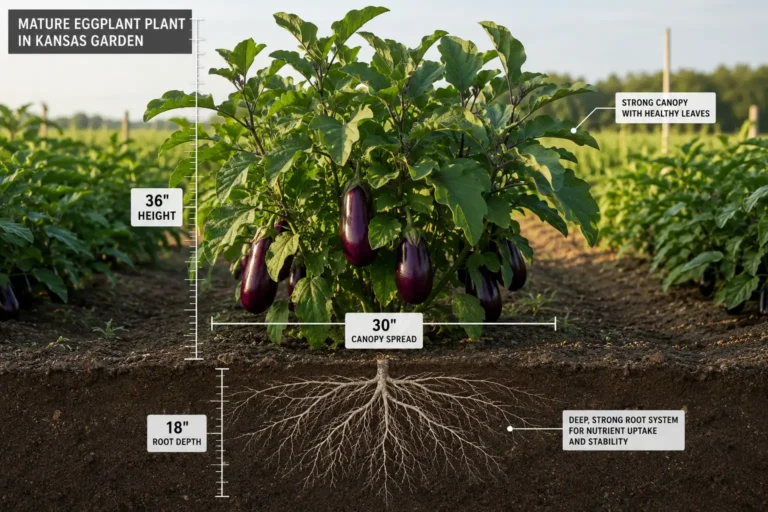
Eggplant came out of tropical Asia, and that one fact sets the rules every season. Kansas hands me plenty of midsummer heat, but the shoulders of the season stay tight. Start seed early indoors, warm the ground with plastic, and refuse to transplant until nights stay above 60°F.
Treat the crop like what it actually is: a warm-climate perennial grown as an annual in country it never evolved for. Do that, and growing eggplant through a full season turns predictable instead of risky.