How Many Onions Per Square Foot? Spacing by Bulb Size
Bed space runs out fast, so the count in each square matters more than the variety on the label. Crowded plants still grow, but they finish as thin, small bulbs. How many onions per square foot you set decides the size you pull in July.
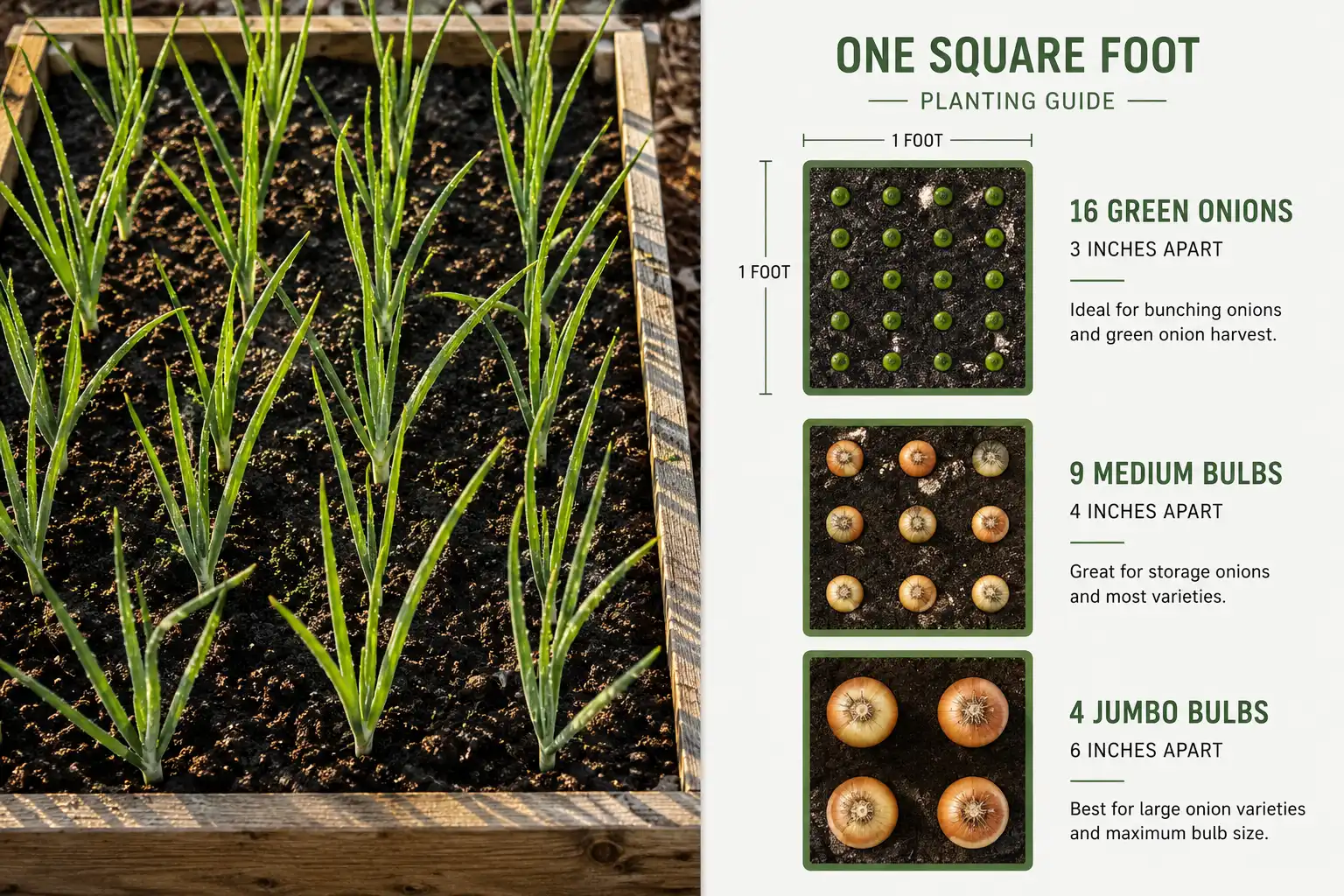
Plant 9 onions per square foot for medium bulbs, set on a 4 inch grid. Cut that to 4 per square foot at 6 inch spacing for jumbo storage onions. Green onions go 16 per square.
How Many Onions Per Square Foot by Bulb Size
Nine is the working number for most beds. A 4 inch grid holds nine plants, and it finishes bulbs in the 2 to 3 inch range. That size covers everyday kitchen use. If you want rings wide enough for a burger, then drop to four or five per square.
Onion size classes come straight from USDA grade standards under 7 CFR 51.2836. Medium runs 2 to 3 1/4 inches. Large or jumbo starts at 3 inches. Colossal starts at 3 3/4 inches. So match your grid to the class you actually want.
| Grid spacing | Onions per square foot | Bulb diameter at harvest | USDA size class |
|---|---|---|---|
| 2 inches | 36 | pulled green, no bulb | none |
| 3 inches | 16 | 1 to 2 inches | boilers and picklers |
| 4 inches | 9 | 2 to 3 1/4 inches | medium |
| 5 inches | 5 | 2 3/4 to 3 1/2 inches | medium to jumbo |
| 6 inches | 4 | 3 inches and up | large or jumbo |
| 8 inches | 2 | 3 3/4 inches and up | colossal |
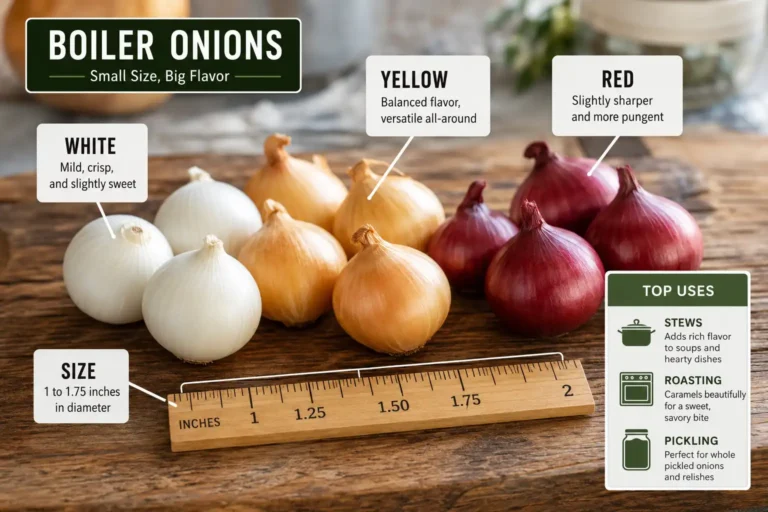
Small bulbs from a tight grid still sell and still store. In fact, they land right in the boiler onion sizes that packers ask for, which run 1 to 1 7/8 inches. So a dense square is not a failure. It is a different target.
Learn more: How to Grow Onions in a 5 Gallon Bucket
Do Sets, Transplants, and Seed Use the Same Count?
Yes, final spacing is identical for all three. Only the starting method changes. Sets and transplants go straight to their final grid position. Seed gets sown heavier, then thinned down to the same count once tops reach 2 to 4 inches.
The Math Behind an Onion Grid
Divide 144 by the square of your spacing. One square foot holds 144 square inches, so a 4 inch grid gives 144 divided by 16, which equals 9 plants.
Run the same math for any spacing:
- 2 inch grid: 144 divided by 4 equals 36 plants
- 3 inch grid: 144 divided by 9 equals 16 plants
- 4 inch grid: 144 divided by 16 equals 9 plants
- 6 inch grid: 144 divided by 36 equals 4 plants
- 8 inch grid: 144 divided by 64 equals 2 plants
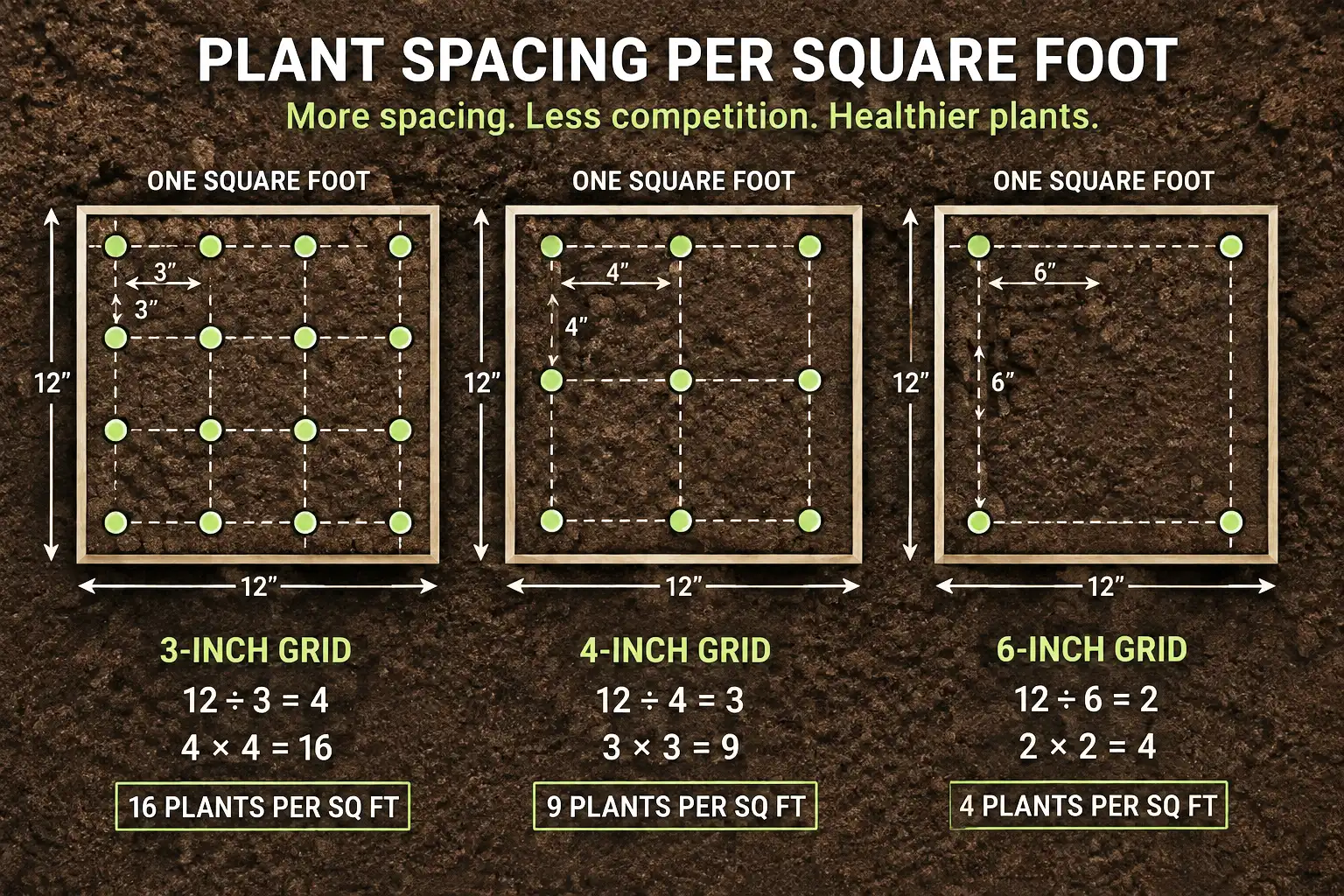
Five inch spacing works out to 5.76, so you plant five and leave the slack. Always round down. Rounding up steals the room you just measured. The same arithmetic drives spacing rules for other crops, which is why one grid board covers most of the garden.
Why Crowded Onions Finish Small
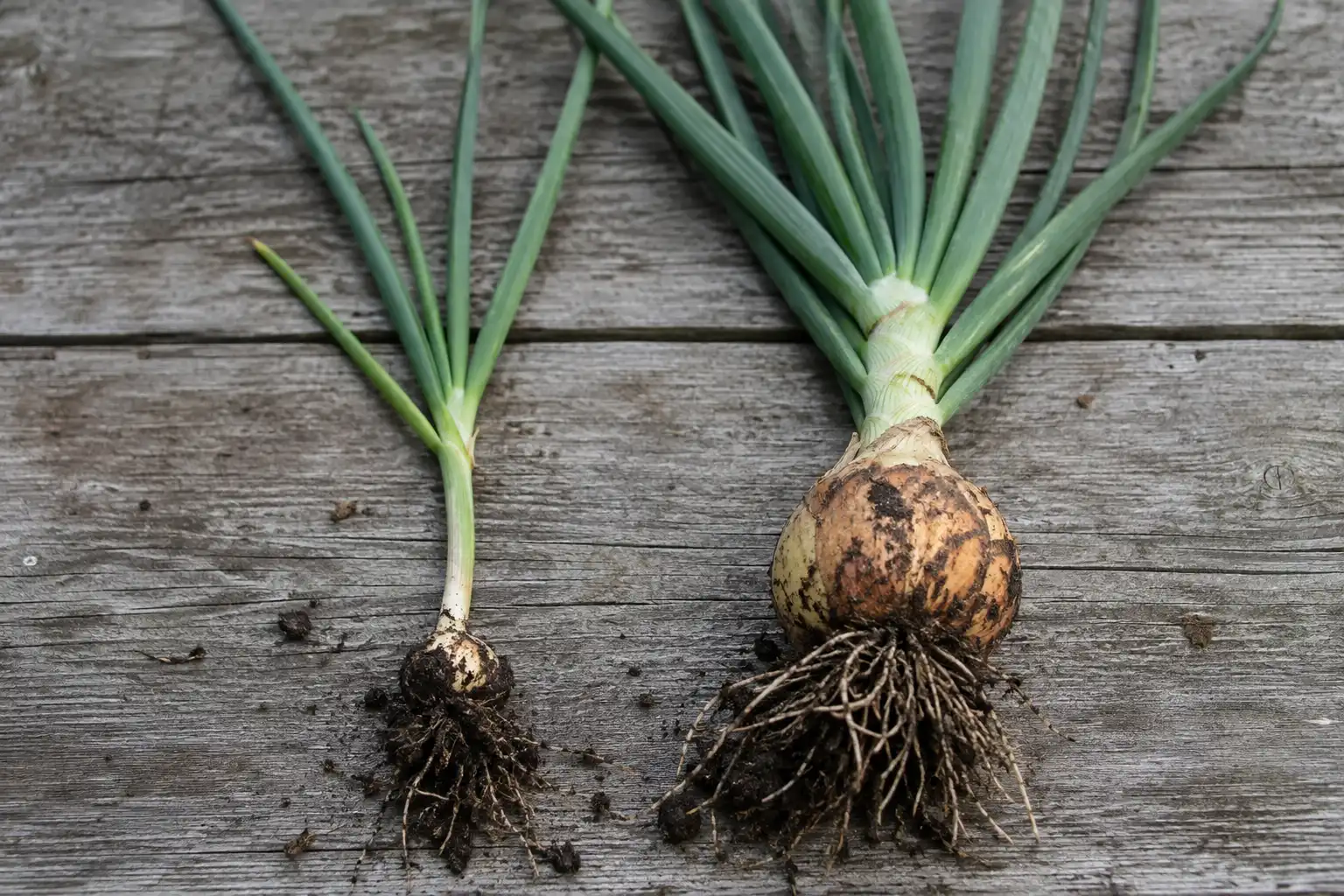
Onions build bulbs out of leaves, so fewer leaves means a smaller bulb. Each healthy leaf lays down one ring inside the bulb. Nebraska Extension puts it plainly: more leaf growth equals bigger bulbs at harvest.
Crowding cuts leaf count two ways. First, neighbors shade each other once tops pass 8 or 10 inches. Second, roots run out of room. NC State Extension notes that onions draw most of their water from the top 6 to 8 inches of soil. That is a thin slice of ground to share.
Onion roots are also sparse, with few root hairs. So they cannot chase moisture sideways the way corn or soybean roots do. Pack the grid tight, and every plant competes inside that same shallow layer.
Does Planting More Onions Per Square Foot Raise Total Yield?
Yes, total weight climbs as density climbs. Average bulb size falls at the same time.
Polish field trials on direct sown onions measured both effects. Marketable yield rose from 20.5 tons per hectare at roughly 2 plants per square foot. At about 7 plants, it reached 32.8 tons. Meanwhile, yield of large bulbs peaked at the lower densities.
A separate density and irrigation study found the same pattern. Higher density trimmed average bulb size by 12 percent. Still, it lifted marketable bulb counts by 21 to 33 percent.
So pick your density by what you want out of the bed:
- Most total pounds: 7 to 9 plants per square foot
- Most jumbo and colossal bulbs: 2 to 4 plants per square foot
- Early, uniform mid size bulbs: 9 plants per square foot
- Scallions all season: 16 or more plants per square foot
Dense stands also finish earlier. That helps in Kansas, because bulbs need to size up before July heat shuts growth down.
How Many Green Onions Per Square Foot
Sixteen to 36 green onions fit in a square foot, since you pull them before bulbing starts. Illinois Extension recommends setting green onion sets close enough to touch. Crowding never becomes a problem, because harvest comes first.
A 3 inch grid gives 16 and stays easy to weed. Push to a 2 inch grid for 36 if you cut scallions young. For a rolling supply, sow or set one new square every three weeks through spring.
Grid Planting Compared With Row Planting
A grid fits roughly four times what a single row fits in the same footprint. Standard row spacing runs 12 to 18 inches, with plants 4 inches apart in the row. K-State Research and Extension puts rows as close as 15 inches for garden onions.
Do the math on that layout. Each plant claims 4 inches by 15 inches, which is 60 square inches. That works out to 2.4 plants per square foot. A 4 by 4 inch grid holds nine in the same space.
University of Maryland Extension calls the grid version wide row or block planting. Their guide lists 4 by 4 inch equidistant spacing. The catch is access. So keep beds no wider than 4 feet, and you can reach the middle without stepping in.
Run the same footprint logic for lettuce plants in a square foot, and the arithmetic never changes.
Does the Same Count Work in Containers?
Yes, the grid count carries over, but you also hold that spacing back from the rim. A 12 inch pot is one square foot of surface, yet the outer inch dries too fast to finish a bulb. Plan on seven or eight medium onions there instead of nine. Depth matters too, so give containers at least 8 inches of loose mix.
How to Set an Onion Grid Step by Step
- Test and amend first. Onions want a pH near 6.0 to 7.0 with loose soil. Pull a sample before you shape the bed.
- Loosen the top 8 inches. Sparse onion roots cannot push through compaction.
- Mark the grid. Use a board notched at 4 inches, or press a template into the surface.
- Set plants at the intersections. Offset positions waste less space than aligned lines.
- Plant 1 to 1 1/2 inches deep. Set transplants at their original soil line, and never bury the neck.
- Water in gently, then mulch. One inch of clean straw holds surface moisture between rains.
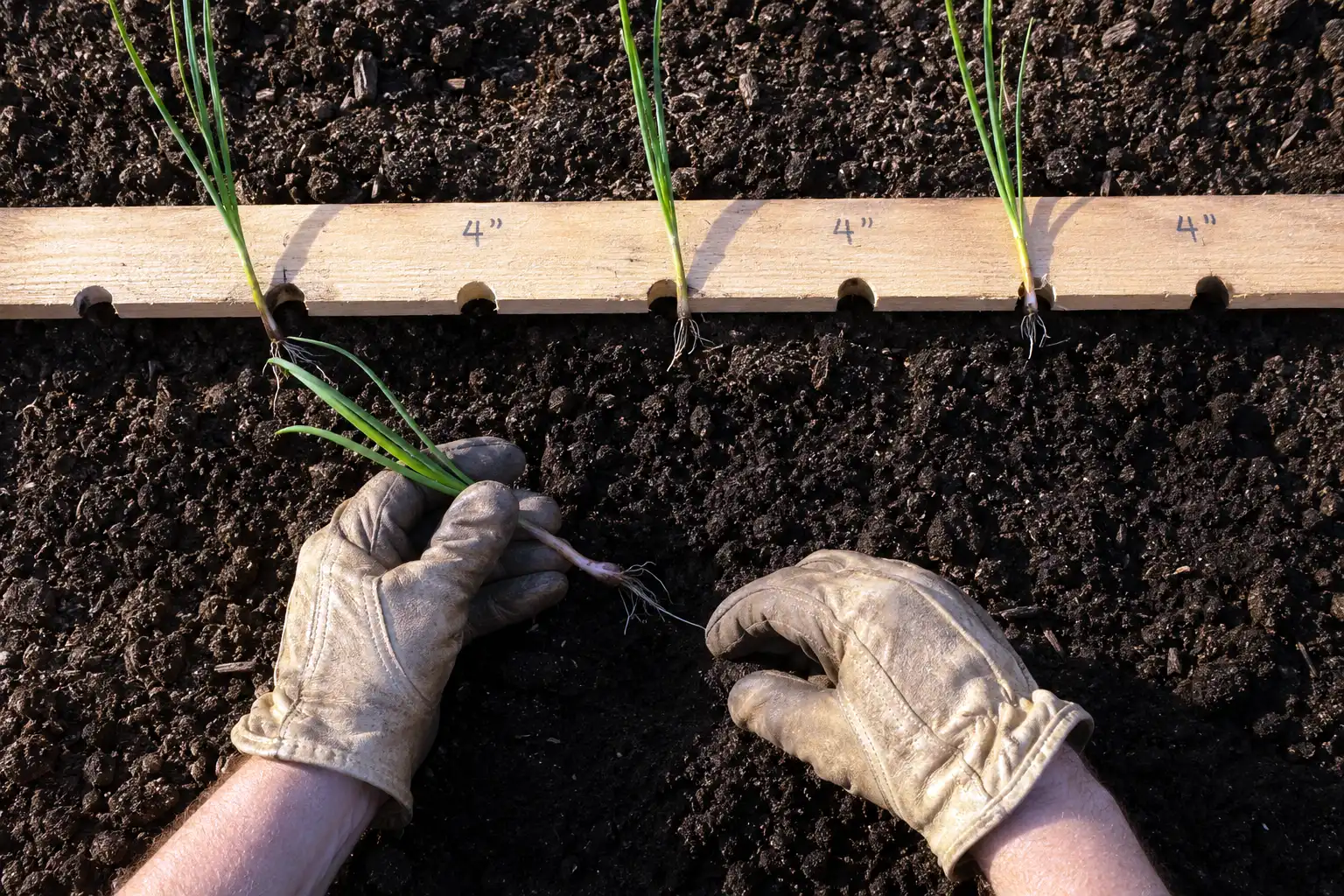
If you are moving seedlings out of a flat, the usual rules for transplanting onions apply the same way inside a grid.
Thinning Down to Your Final Count
Sow heavier than your target, then thin to the grid. Utah State University Extension advises thinning to 3 or 4 inches before plants begin to bulb. Wait past that point, and the competition already cost you leaf count.
Thin once tops reach 2 to 4 inches tall. Pull the weakest plants, then eat them as scallions the same night. If you are growing onions from seed, plan on thinning twice.
Illinois Extension offers a second route at 2 inch spacing. Harvest every other plant green, and the rest get the room to finish as bulbs. That trick pulls two crops out of one square.
Feeding and Watering a Dense Onion Bed
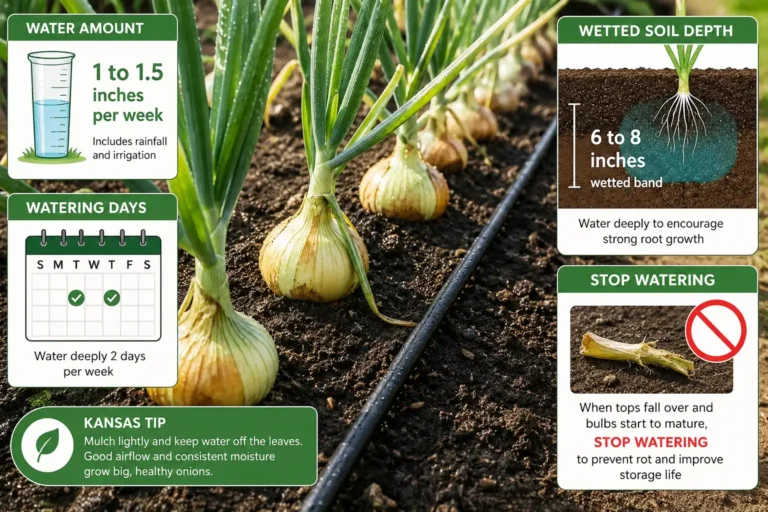
Higher density raises demand for both water and nitrogen. K-State Research and Extension calls for 1 to 1 1/2 inches of water per week when rain falls short. At 16 plants per square foot, aim for the top of that range.
Side-dress twice during the season. K-State suggests urea at 0.25 to 0.5 pound per 25 feet of row. Utah State Extension lists 1/2 pound of 21-0-0 per 100 square feet in mid May, then again in late June.
Do not overdo the nitrogen. Too much builds thick necks that never cure, plus soft bulbs that rot in storage. Rule here: feed hard through leaf growth, then stop once bulbs start to swell. Comparing fertilizer options for onions before the first side-dress saves guesswork later.
Weed Control Gets Harder as Density Climbs
A tight grid shades soil sooner, but it also takes away your hoe room. NC State Extension flags the first 6 to 8 weeks after emergence as the critical window. Weed pressure during that stretch causes permanent yield loss, even if you clean the bed later.
At 4 inch spacing, hand weeding is the only realistic option. So mulch early and pull small. Onions compete poorly because of slow emergence and a shallow root system.
Spacing Mistakes That Cost You Bulb Size
- Setting sets 1 inch apart and leaving them. Sets look tiny, yet bulbs need room to widen at the shoulder.
- Copying the row number from a seed packet into a grid. Row spacing and plant spacing are separate figures. Use the plant number only.
- Skipping the thin. Weak seedlings never catch up, but they still drink and feed.
- Running a grid too tight for the variety. Kansas gardens do best with intermediate day types like Candy, Red Candy Apple, or Super Star. Those size up well at 4 inches.
- Burying the neck. Deep planting builds thick necks that cure poorly at any spacing.
- Letting tops flop in wind. Once tops break over, growth stops, and no extra spacing recovers it.
How Much Bed Space Your Onion Crop Needs
Work backward from what you eat. Three onions a week comes to about 150 a year. At nine per square foot, that is roughly 17 square feet of bed.
Weight tells the same story from the other direction:
| Grid | Plants per square foot | Typical bulb weight | Yield per square foot |
|---|---|---|---|
| 3 inch | 16 | 2 oz | 2 lb |
| 4 inch | 9 | 6 oz | 3.4 lb |
| 6 inch | 4 | 12 oz | 3 lb |
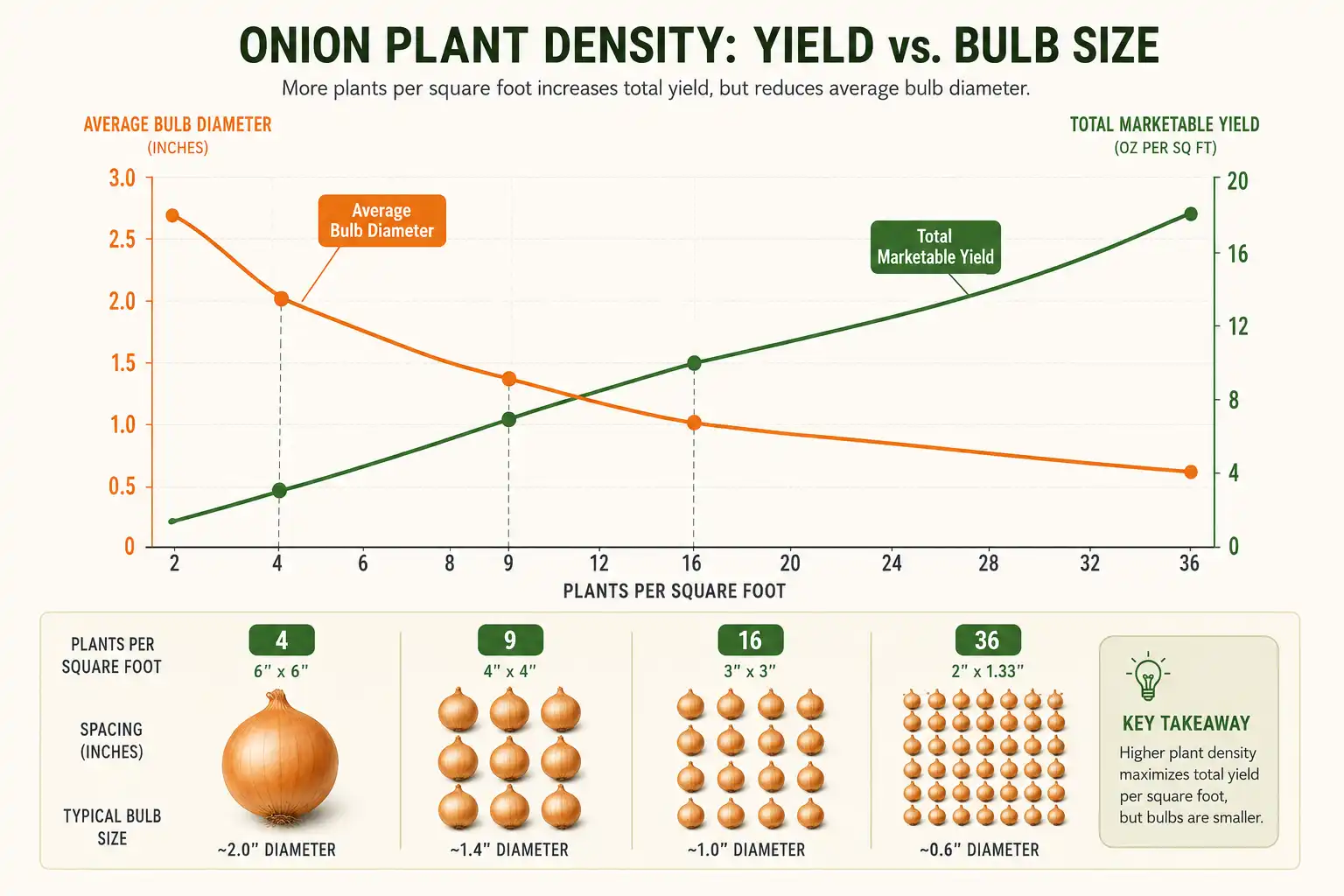
Notice how close those totals sit. That is the real trade. You are choosing bulb size, not total weight.
Bottom Lines
Run two grids side by side. One square in four goes to 3 inch spacing for scallions, and the rest sits at 4 inches for medium storage bulbs. To grow a few jumbos, a single square can be thinned down to four plants at 6 inches. The grid sets the ceiling on bulb size. Water and nitrogen decide whether the plants reach it.