How to Grow Sweet Onions That Size Up Instead of Bolting
Sweet onions taste mild because they carry less sulfur, not more sugar. Most growers lose that mildness by picking the wrong variety for their latitude. So knowing how to grow sweet onions starts with day length, then follows through on water, feeding, and curing.
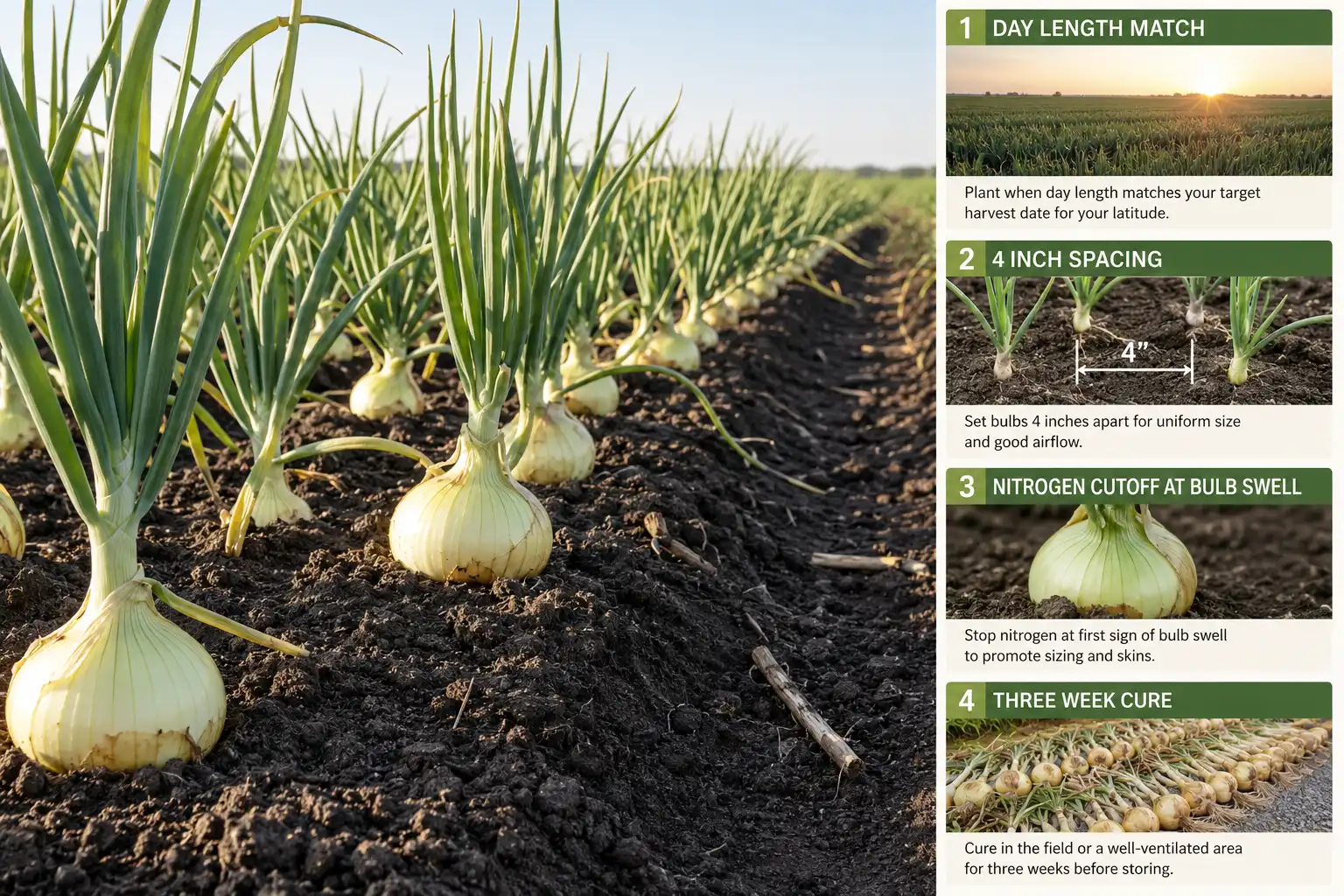
Sweet onions come down to five moves. Match the variety to your latitude and transplant early. Space 4 inches apart, stop nitrogen at bulb swell, then cure three weeks. That is how to grow sweet onions.
What Actually Makes an Onion Sweet
Sweet onions hold fewer sulfur compounds than storage types. Sugar content barely differs. Slice one open and an enzyme called alliinase splits those sulfur compounds apart. The sharp byproducts sting your eyes and burn your tongue. Fewer compounds, milder bite.
Breeders score this with a pyruvic acid test. New Mexico State University puts the line at 5 micromoles of pyruvic acid per milliliter of juice. Below that, an onion counts as sweet.
Genetics carries most of the load. Researchers grew identical onion clones at several sites. Variety explained about 81 percent of the pungency difference. Location explained only 11 percent. So the packet matters more than the field.
Soil sulfur still shifts things at the edges. Low-sulfur sandy ground built the reputation of the Vidalia onion region in Georgia. Even so, you cannot starve a pungent variety into sweetness.
One detail surprises people. Stress raises pungency. Penn State’s onion recommendations warn that any stunting or stress on Sweet Spanish types makes them sharp. Steady water and steady feeding are flavor tools here, not just yield tools.
Read next: How To Plant Spring Onions
Match Day Length to Your Latitude First
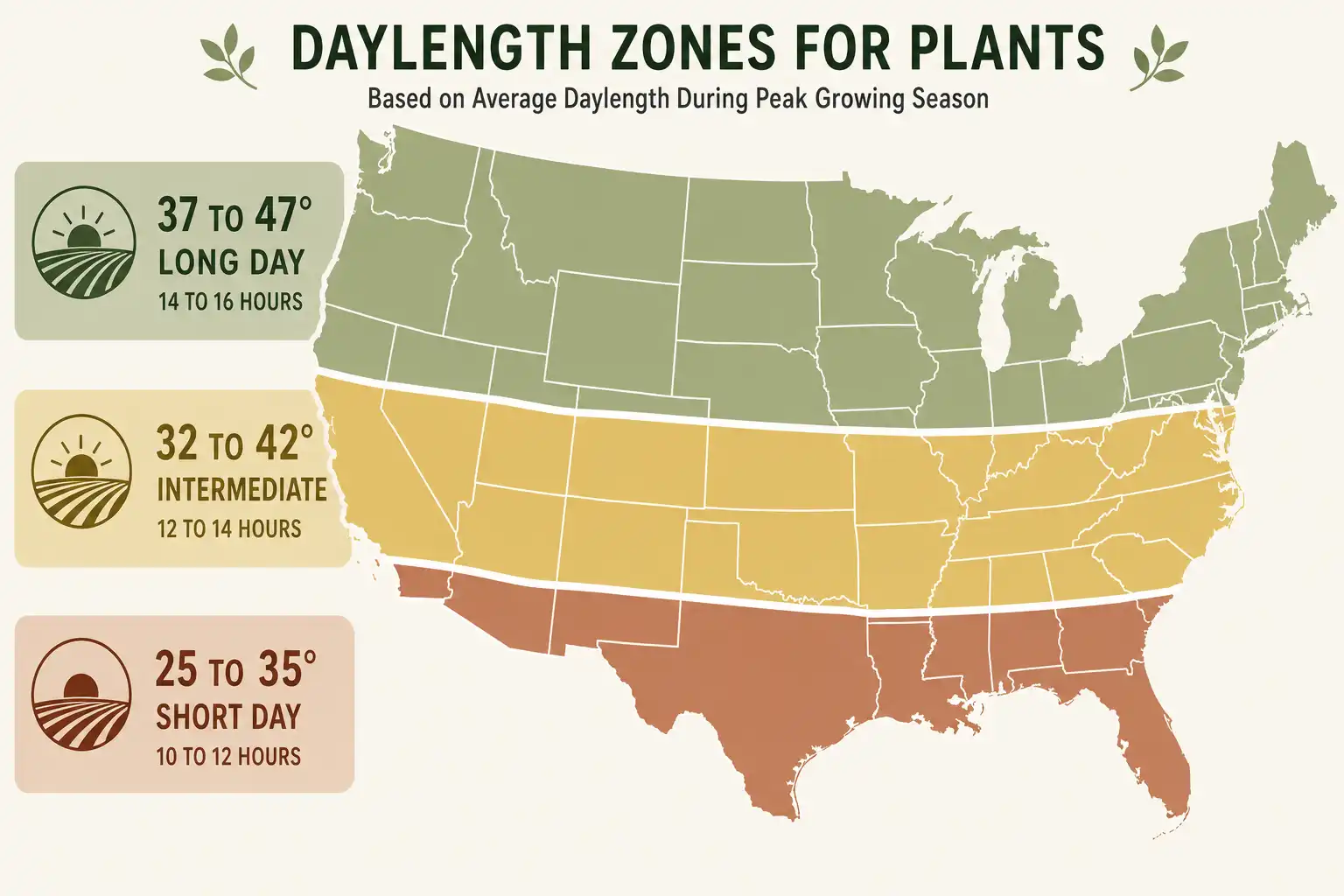
Onions bulb on day length, not on a calendar date. Every variety has a trigger. Once daylight hits that number of hours, the plant quits making leaves and starts filling the bulb.
Three groups split the country:
- Short-day: bulbs at 10 to 12 hours of daylight. Suited to latitudes 25 to 35 degrees.
- Intermediate-day (day-neutral): bulbs at 12 to 14 hours. Suited to 32 to 42 degrees.
- Long-day: bulbs at 14 to 16 hours. Suited to 37 to 47 degrees.
The rough dividing line runs near the 35th parallel.
Bulb size hangs on this choice. Each leaf a plant builds before bulbing becomes one ring in the finished onion. Plant a short-day variety in Nebraska and it bulbs in May on four or five leaves. You dig golf balls. Nebraska Extension says it plainly: short-day onions grown up north start bulbing too soon and give disappointingly small bulbs.
Topeka sits near 39 degrees north. K-State Research and Extension calls intermediate-day varieties the best fit for all of Kansas. A few long-day types also work in northern counties. That is the recommended planting approach, and it’s why the bulbs finish big.
Sweet Onion Varieties Worth Planting
| Variety | Day length | Size potential | Days to harvest | Storage | Why like it |
|---|---|---|---|---|---|
| Candy F1 | Intermediate | Up to 6 in | 85 to 100 | About 3 months | Widest adaptation, pink root resistance |
| Super Star F1 | Intermediate | 5 to 6 in | About 100 | 1 to 2 months | White flesh, very mild |
| Sierra Blanca | Intermediate | 5 to 6 in | About 100 | 1 to 2 months | Uniform white globes |
| Walla Walla | Long | Up to 6 in | About 90 | About 1 month | Sweetest long-day type |
| Ailsa Craig | Long | 1 to 2 lb | 100 to 110 | 3 to 4 months | Best keeper among sweets |
| Texas 1015Y | Short | 4 to 6 in | 105 to 115 | 2 to 3 months | Gulf South standard |
Candy F1 sits at the top of that list for good reason. Because it bulbs in the 12 to 14 hour window, growers from Michigan down to north Texas can finish it. Our write-up on the Candy onion hybrid covers flavor, shape, and regional fit.
Buy fresh seed each season. Onion seed drops off hard after a year. Old packets germinate thin, so you get gaps you cannot fill later.
Seed, Sets, or Transplants
Skip sets for sweet onions. Sets are small bulbs from cold storage. Many arrive partly vernalized, so they throw a seed stalk instead of a bulb. Most sets also ship without a day length listed, which means you never know what you planted.
Seed gives you the widest variety choice and the lowest bolting risk. K-State recommends starting onion seed indoors in mid to late January. That gives roughly six to eight weeks before a late March transplant date. Sow a half inch apart and germinate at 75 to 80°F. Drop to 60 to 65°F once seedlings reach 1 to 2 inches. This full walkthrough on starting onions from seed indoors covers trays, light, and trimming.
Mail-order transplants work well if your January slipped away. Order the smallest bunches you can find. Big transplants bolt.
Aim for stems between pencil-lead and pencil width on planting day. That is the target K-State uses, and it keeps plants under the size where cold triggers flowering.
When to Plant Sweet Onions
Set sweet onion transplants as soon as the ground works, generally four to six weeks before your average last frost. In eastern and central Kansas that lands in mid to late March. Young onions shrug off light frost, so early beats late.
Southern growers run the opposite calendar. Short-day transplants go in from October through February for a spring harvest. Texas A&M even named 1015Y after its October 15 seeding date.
Two walls bracket the window:
- Heat closes it. Once soil runs 85 to 90°F, tops die back and bulbs stop sizing. Every week you plant late is a week of leaf growth you never get back.
- Cold with oversized plants opens the bolting door. Small plants tolerate a cold snap. Pencil-thick plants read it as winter.
Bed Prep That Pays Off
Onions run a shallow, inefficient root system. Most feeder roots stay in the top 6 to 8 inches. So they cannot chase water the way corn roots do. Bed prep therefore does more work than any single input later.
Here is the sequence:
- Pick full sun. Eight hours minimum. Shade costs you leaves, and leaves become rings.
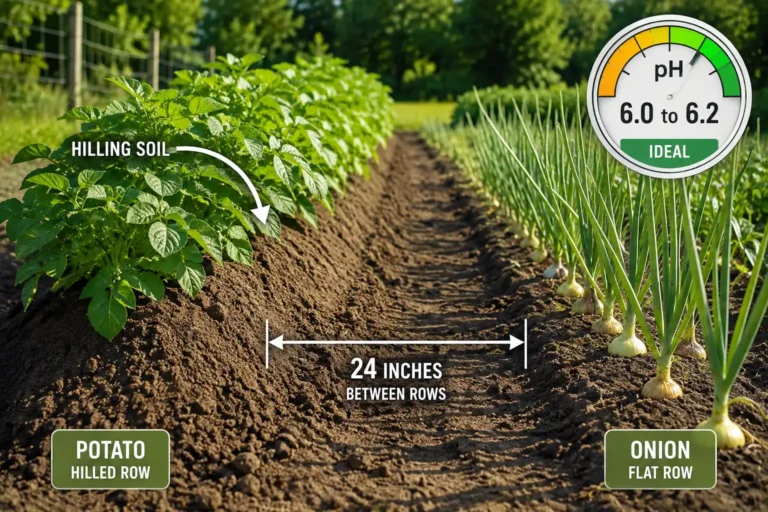
- Test the soil. Target pH 6.0 to 6.8. A home soil test kit tells you pH and phosphorus before you buy a single bag. Penn State bases its onion rates on that annual test.
- Work in compost. Two to three inches of finished compost improves both water holding and drainage.
- Loosen deep. Break the top 8 to 10 inches. Compaction flattens bulbs and forks the roots.
- Band phosphorus near the row. Cold spring soils tie up phosphorus, and shallow onion roots need it close.
Skip fresh manure. It carries weed seed and can drive late nitrogen that softens bulbs at exactly the wrong time.
How to Grow Sweet Onions Step by Step
- Choose by day length, then by flavor. Latitude decides which group works. Flavor decides which variety inside that group.
- Start seed 6 to 8 weeks before your transplant date. Trim tops back to 4 inches when they flop, since that thickens the stem.
- Harden off for 7 to 10 days. Increase sun and wind gradually before field day.
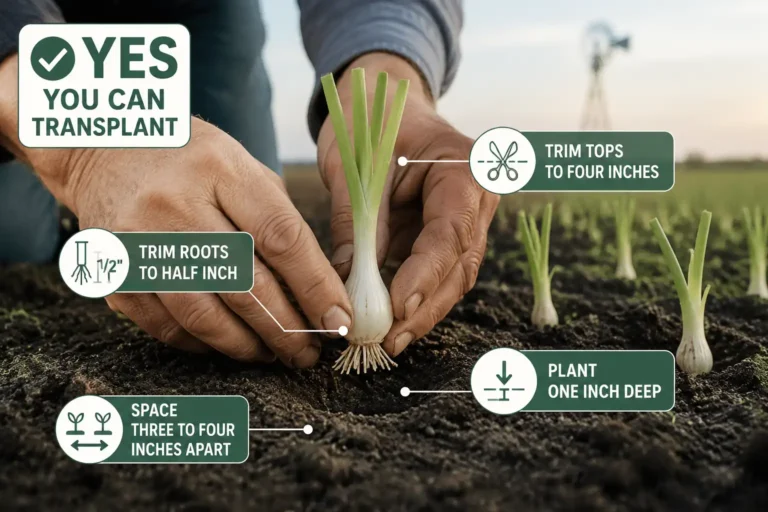
- Trim roots to a half inch and tops to 4 inches. K-State recommends this at transplant, and it speeds establishment.
- Set plants 1 to 1.5 inches deep. Deeper than that and bulbs stay small and elongated.
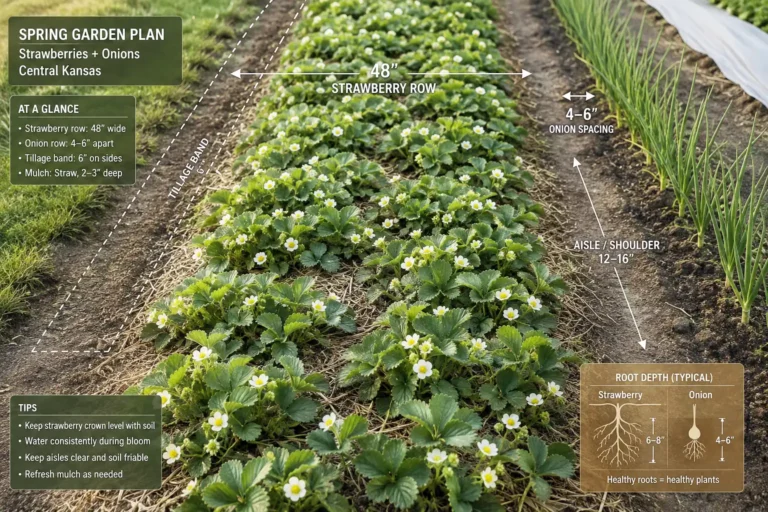
- Space 4 inches apart in rows 12 to 16 inches wide. Wider in-row spacing means bigger bulbs.
- Water in immediately. Firm the soil around each stem so roots meet moisture the same day.
- Mulch after the soil warms. Straw or grass clippings hold moisture and smother the weeds that steal onion yield.
- Feed on schedule until bulbs swell. Then stop, which is cover below.
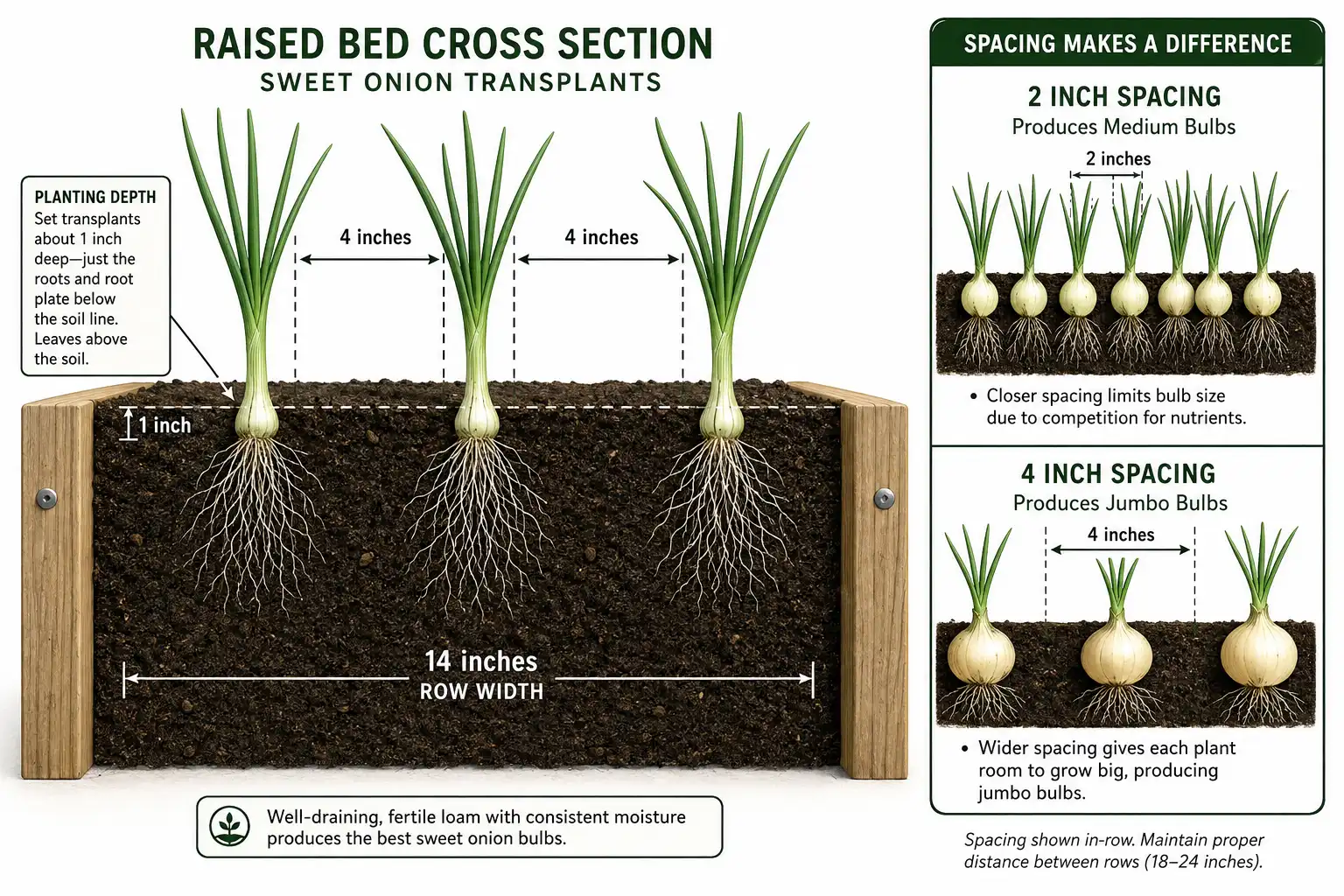
Spacing and Final Bulb Size
Spacing decides size more than fertilizer does. K-State lists 2 to 4 inches in the row with rows 12 to 16 inches apart. Pick the number that matches the bulb you want:
- 2 inches: medium bulbs, highest total pounds per bed
- 4 inches: jumbo bulbs, the default for sweets
- 6 inches: maximum single-bulb size for show or slicing
So how big do sweet onions actually get? A well-grown intermediate-day sweet onion finishes 4 to 6 inches across at roughly 12 to 16 ounces. Candy tops out near 6 inches. Ailsa Craig routinely hits 1 to 2 pounds, and growers pull three-pounders in a good year. Texas 1015Y averages a pound in its home range.
Nothing in that list happens by accident. Bulb diameter tracks leaf count at bulb initiation, so anything that costs you early leaves costs you inches later. For bed growers, the guide of onion plants per square foot shows how the math changes.
Water and Nitrogen Timing
Sweet onions need steady water and a hard nitrogen cutoff. Both affect flavor, not just size.
Water. Give at least 1 inch per week, then push to 1.5 inches during bulb swell in hot weather. Light and frequent beats heavy and rare, because those shallow roots cannot reach a deep reserve. Swings between dry and soaked split bulbs and crack the outer scales. Once bulbing starts, drip beats overhead sprinklers, since wet foliage feeds bacterial soft rot and sour skin.
Nitrogen. Build leaves early and stop cold at bulb initiation:
| Stage | Action |
|---|---|
| At planting | Balanced starter worked into the row |
| 3 weeks after transplant | First light nitrogen side-dress |
| Every 2 to 3 weeks after | Repeat while leaves are still forming |
| Bulb swell begins | Stop nitrogen completely |
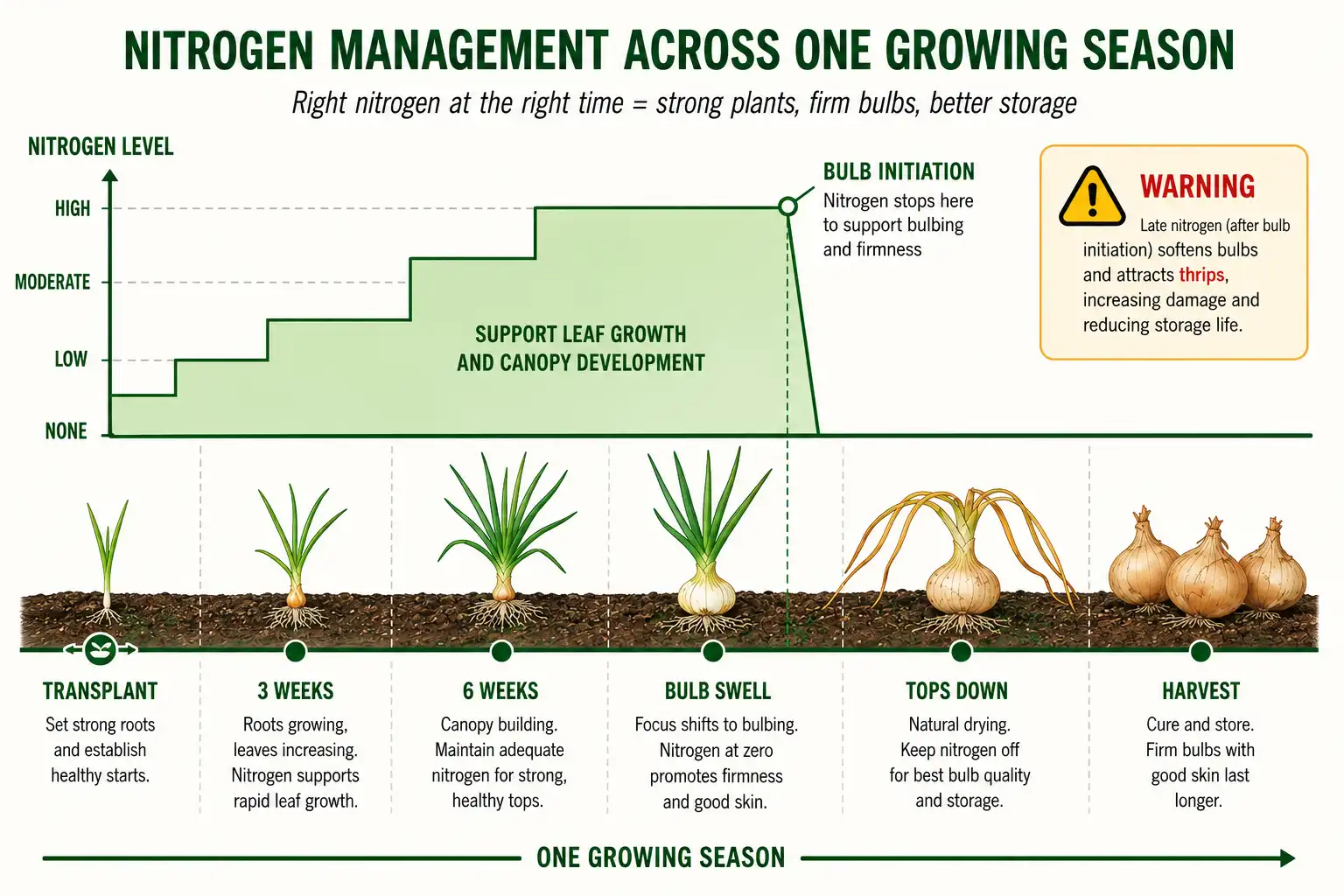
New Mexico State University advises cutting nitrogen four to six weeks before harvest. Late nitrogen delays maturity, softens bulbs, and wrecks storage life. Worse, UC IPM reports that heavy nitrogen draws onion thrips and raises iris yellow spot severity. Picking the right fertilizer for onion beds matters, but timing the last application matters more.
Thrips, Weeds, and Disease
Weeds cost more sweet onion yield than any pest. Upright tubular leaves cast almost no shade, so pigweed and foxtail win fast. Cultivate shallow and often. Deep hoeing near the row prunes feeder roots and stunts the crop, which also sharpens flavor.
Onion thrips hide in the neck where leaves meet the bulb. Scout the newest leaves, not the old ones. The Pacific Northwest handbook uses roughly 20 thrips per plant at midseason as a treatment point. Young plants need a much lower number. Beyond feeding scars, thrips vector iris yellow spot virus, and that virus shrinks bulbs outright.
Onion maggot hits early plantings in cool wet springs. Rotation and clean residue handle most of it, since volunteer onions and culls host the next generation.
Disease shows up mostly at the wrong end of the season:
- Botrytis neck rot: invisible in the field, then it collapses necks in storage
- Pink root: stunts roots in warm soil, though Candy carries resistance
- Downy mildew and purple blotch: thrive in long leaf wetness periods
Rotate three to four years out of alliums. Space for airflow. Water at the ground, never over the top.
Why Sweet Onions Bolt and How to Stop It
Bolting comes from cold, not from day length. University of Missouri researchers explain the trigger. Three to four weeks below 50°F reads as winter to the plant. It then shifts into flowering mode the next spring.
Plant size decides whether the cold registers at all. A seedling thinner than a pencil, roughly under three-eighths of an inch, cannot sense vernalization yet. Once the stem passes that thickness, a long cold snap sets the seed stalk.
Four things keep it from happening:
- Transplant while plants are pencil-lead to pencil width. Small is safe.
- Buy small sets or skip sets entirely. Anything over three-quarters of an inch carries real risk.
- Devernalize suspect sets. Missouri Extension notes that holding cold-stored sets above 80°F for two to three weeks can reverse the signal.
- Cover during a late cold snap. Row cover steadies soil temperature after establishment.
If a plant bolts anyway, pull it and eat it fresh. A bolted onion never fills a proper bulb, and the woody flower stalk rots in storage.
When to Harvest Sweet Onions
Harvest when 50 to 80 percent of the tops fall over on their own and the necks feel soft. That flop is the plant shutting down, so it beats any calendar date.
Work through it in this order:
- Stop irrigating once tops start going down. Dry soil tightens skins.
- Wait for a dry day. Wet bulbs invite rot before curing even begins.
- Lift, do not yank. Loosen with a fork if soil is tight, then pull by hand.
- Brush off soil. Never wash. Water at this stage is the enemy of storage.
- Leave tops attached for now, since they feed the curing process.
Do not knock tops over yourself to speed things up. That old trick shortens storage life by breaking the neck before it seals naturally. Do not let mature bulbs sit in wet ground either. Extended wet weather in the last four to six weeks feeds Aspergillus and Penicillium rots.
Curing and Storing Sweet Onions
Cure sweet onions two to three weeks at 75 to 80°F in shade with steady airflow. Curing dries the outer scales into a papery wrapper and seals the neck. That wrapper is the only barrier against neck rot.
Field curing works in dry weather. Lay bulbs right in the row. Shingle the tops of one row over the bulbs of the next so shoulders do not sunscald. Otherwise move them to a slatted rack in an open shed with a box fan running.
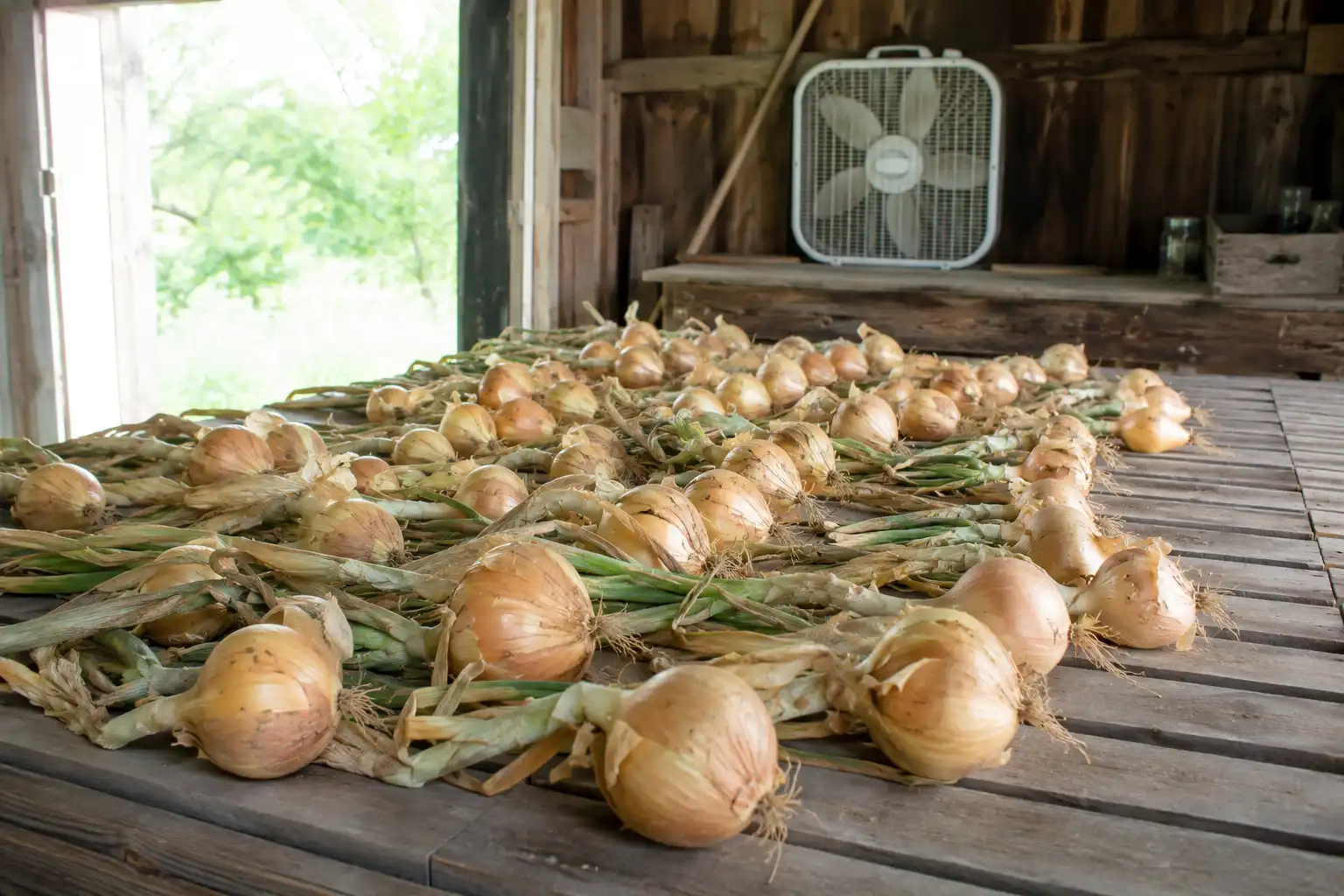
You know curing finished when the neck is tight, the skins rustle, and the roots are dry and wiry. Then clip tops about 1 inch above the shoulder, never flush.
Store at 32 to 40°F with 65 to 70 percent humidity in mesh bags or shallow crates. Commercial packers force-dry with heated air near 98°F. UGA Extension credits that practice with cutting neck rot.
Be realistic about shelf life. Sweet onions run high in moisture and low in the sulfur compounds that preserve a bulb. So most keep 1 to 3 months. Pungent storage types keep 6 to 10. Sort thick-necked and bruised bulbs into a “use first” crate. One rotting onion takes its neighbors with it.
Sweet Onion Problems and Fixes
| What you see | Cause | Fix next season |
|---|---|---|
| Golf-ball bulbs | Wrong day length group for your latitude | Match variety to latitude before anything else |
| Seed stalk instead of bulb | Cold below 50°F on oversized plants | Transplant smaller, avoid large sets |
| Two bulbs fused together | Cold shock at transplant or oversized sets | Plant smaller stock, delay a week in a cold spring |
| Split or cracked outer scales | Dry then soaked cycles during sizing | Even moisture through the final six weeks |
| Sharper flavor than expected | Stress, stunting, or late nitrogen | Steady water, cut nitrogen at bulb swell |
| Soft necks in storage | Neck rot from short curing | Cure the full two to three weeks, clip 1 inch above the shoulder |
| Silvery leaf scarring | Onion thrips feeding | Scout new leaves early, avoid excess nitrogen |
Final Thoughts on Sweet Onion Growing
Start with one intermediate-day variety and grow it well rather than trialing six. Order seed in December, sow in January, and set pencil-thin plants in late March at 4 inches apart. From there, water steadily, feed until the bulbs swell, and then leave the nitrogen bag alone.
Harvest when the tops go down on their own, cure the full two to three weeks, and eat the thick-necked ones first. Do that once and the day length rule stops feeling technical. It just becomes how you pick a packet.