How to Fertilize Onions: Timing, Placement, and Rates
An onion bulb is just stacked leaves. Every leaf the plant makes before bulbing becomes a ring. So how to fertilize onions comes down to feeding hard and early, then cutting nitrogen at the right moment. Placement and timing matter more than the bag you buy.
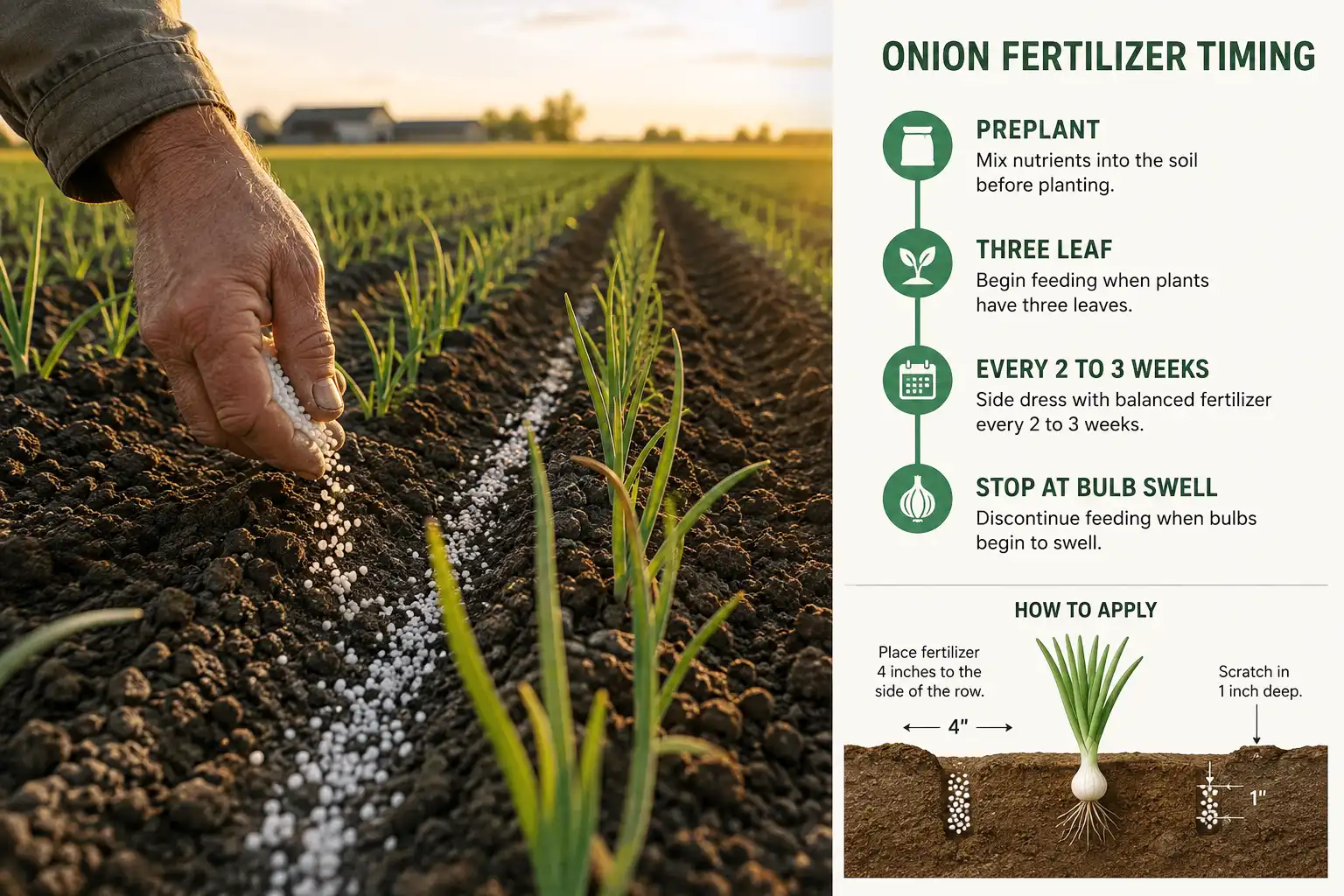
The core of how to fertilize onions is timing. Work phosphorus and potassium in before planting. Then side-dress nitrogen 4 to 6 inches from the row every 2 to 3 weeks. Stop at bulb swell.
What to Check Before the First Fertilizer Goes Down
Pull a soil test and read the pH line first. Onions feed from a shallow root zone. Most water and nutrient uptake happens in the top 6 to 8 inches. That means surface fertility runs the whole crop.
Three numbers decide your program:
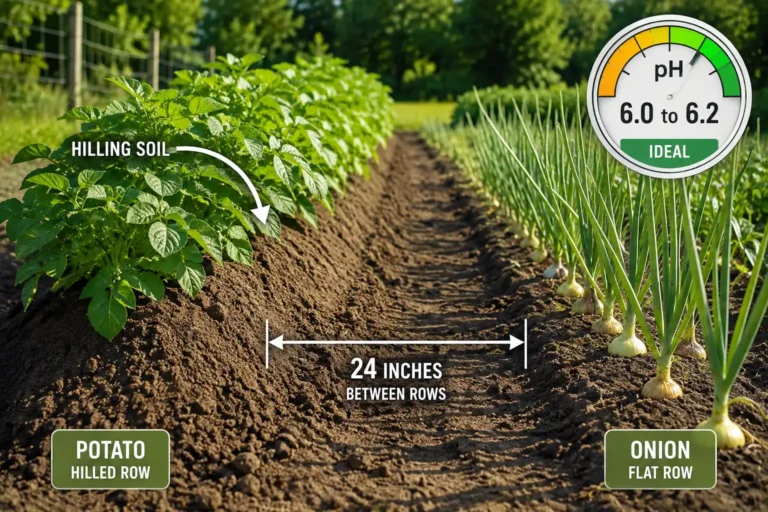
- pH. Target 6.0 to 6.5. Below 5.8, onion roots stall and phosphorus locks up. Liming is done the fall before, not the spring of, because ag lime needs months to react. K-State Research and Extension sets lime rates from a buffer pH reading, not from soil pH alone.
- Soil test P and K. These go down once, preplant. Onions cannot chase deep phosphorus with a limited root system, so the test number sets the rate.
- Organic matter. High organic matter ground mineralizes nitrogen all summer. Ignore that and you overshoot.
Never sampled the bed? One of the soil test kits on hand returns pH and base nutrients in a few days. Guessing costs more than the test.
Onion roots also carry low tolerance for salt. Heavy fertilizer near seed or transplant roots kills them outright. That is why placement gets its own section below.
How to Fertilize Onions at Planting
Put phosphorus and potassium in the bed before planting. Then band a starter below the seed line. Nitrogen at planting stays light. Only 30 to 40 percent of your season total belongs preplant. Early onions grow slowly, and nitrate leaches out of a shallow root zone.
Preplant broadcast and incorporate:
- Broadcast your soil test P and K rate over the bed.
- Disk or rake it into the top 3 to 4 inches. Deeper than that wastes it.
- For gardens, 2 to 3 pounds of a balanced granular per 100 square feet covers a typical medium test soil.
- For field acres, target 120 to 150 pounds of total seasonal nitrogen, with 40 to 50 pounds preplant.
Band the starter phosphorus:
Texas A&M work showed onions respond strongly to phosphorus banded 2 to 3 inches below the seed. Cold spring soil slows root growth. So a concentrated band sits right where the first roots reach. Open a trench 3 inches deep. Drop about a half cup of a phosphorus source per 10 feet of row. Cover it with soil, then plant above it.
Skip the band and early growth lags. Ring count is set before bulbing, so a slow start shows up as a small onion in August. Still deciding on products and analyses? Our article on picking the right fertilizer for onions covers the nutrient side.
How to Fertilize Onion Plants After They Emerge
Side-dress nitrogen beside the row, never on the plants. Wait until roots establish. That means roughly three weeks after emergence, or once transplants show 4 to 5 leaves. Feeding earlier burns roots and buys nothing.
Here is the method on every planting:
- Measure out. Set the band 4 to 6 inches from the plant line. Closer than 3 inches risks salt injury on those shallow roots.
- Lay a narrow band. Dribble granules in a strip, not a broadcast scatter. A concentrated band moves down into the root zone. Scattered granules feed weeds.
- Scratch it in. Work granules 1 inch deep with a hand hoe or wheel hoe. Surface granules sit dry and volatilize, especially urea.
- Water it in. Run a half inch of irrigation the same day. Dry fertilizer does nothing.
- Keep leaves clean. Brush granules off the tops. Fertilizer resting in a leaf axil scorches tissue.
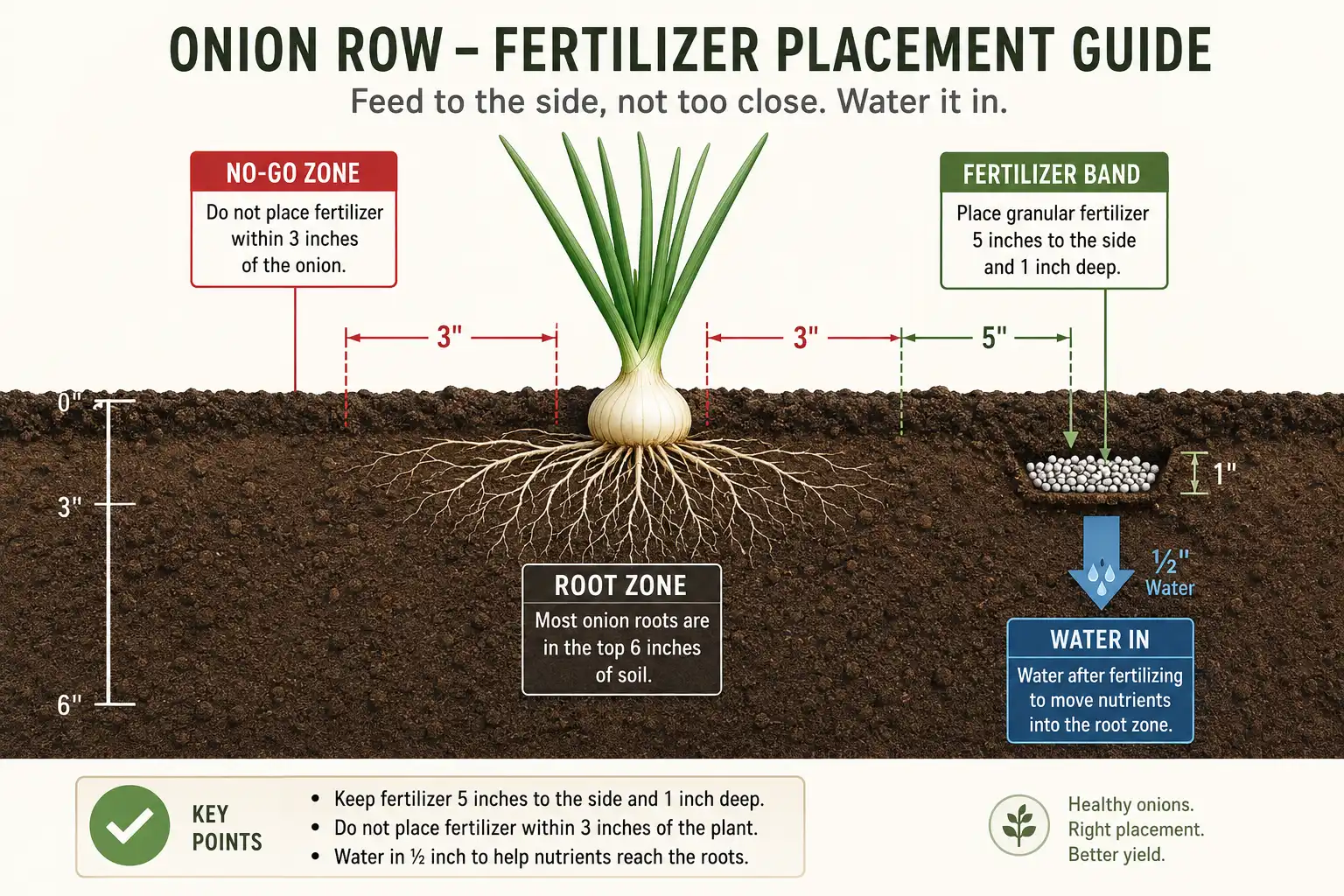
For rate, University of Minnesota Extension suggests urea at a quarter to a half pound per 25 feet of row. Straight urea 46-0-0 works on neutral ground. On alkaline soil, switching to ammonium sulfate at 21-0-0 is the typical adjustment. It drops pH slightly and adds sulfur too.
Onions pull moisture from a thin layer, so feeding and irrigation run together. Our article on watering onions on a steady schedule explain why a dry stretch after side-dressing wastes the application.
How Often to Fertilize Onions Through the Season
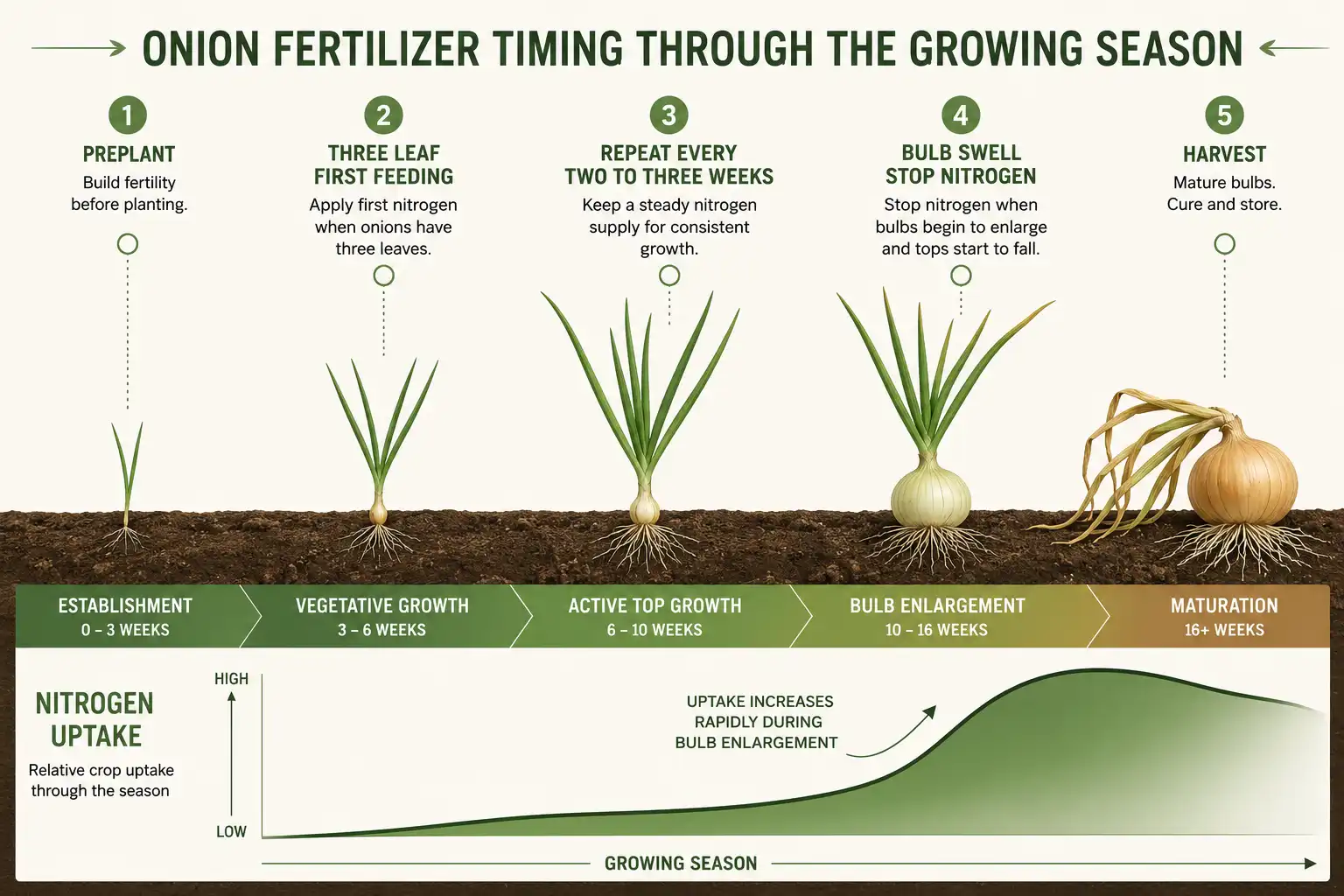
Feed every 2 to 3 weeks from establishment until bulbs begin to swell. Most onion crops take two to four side-dressings, and no more. Nutrient demand is not flat, though. Onions grow slowly until the three leaf stage. After that, roughly 70 percent of nitrogen and phosphorus uptake happens while bulbs enlarge.
That uptake curve is why cadence beats a single big dose:
| Stage | Timing | What goes down |
|---|---|---|
| Preplant | 7 to 10 days before planting | Full P and K, 30 to 40 percent of season N |
| Emergence to 2 leaves | Weeks 1 to 3 | Nothing. Roots too small |
| 3 to 5 leaves | About 3 weeks after emergence | First N side-dress |
| Rapid leaf growth | Every 2 to 3 weeks after | Second and third N side-dress |
| Bulb initiation | Bulb shoulders visible | Last light feeding, then stop |
| Bulbing to harvest | Final 3 to 4 weeks | No nitrogen |
How Often to Fertilize Onion Plants Grown from Seed
Direct seeded onions need one extra feeding compared to sets or transplants. Seedlings spend six to eight weeks reaching the three leaf stage. So they sit longer before bulbing starts. Run four light side-dressings on seeded rows and three on transplants.
Split applications also cut loss. Sandy Great Plains ground leaches nitrate fast. A single heavy shot in May is largely gone by June.
When Should You Stop Feeding Onions?
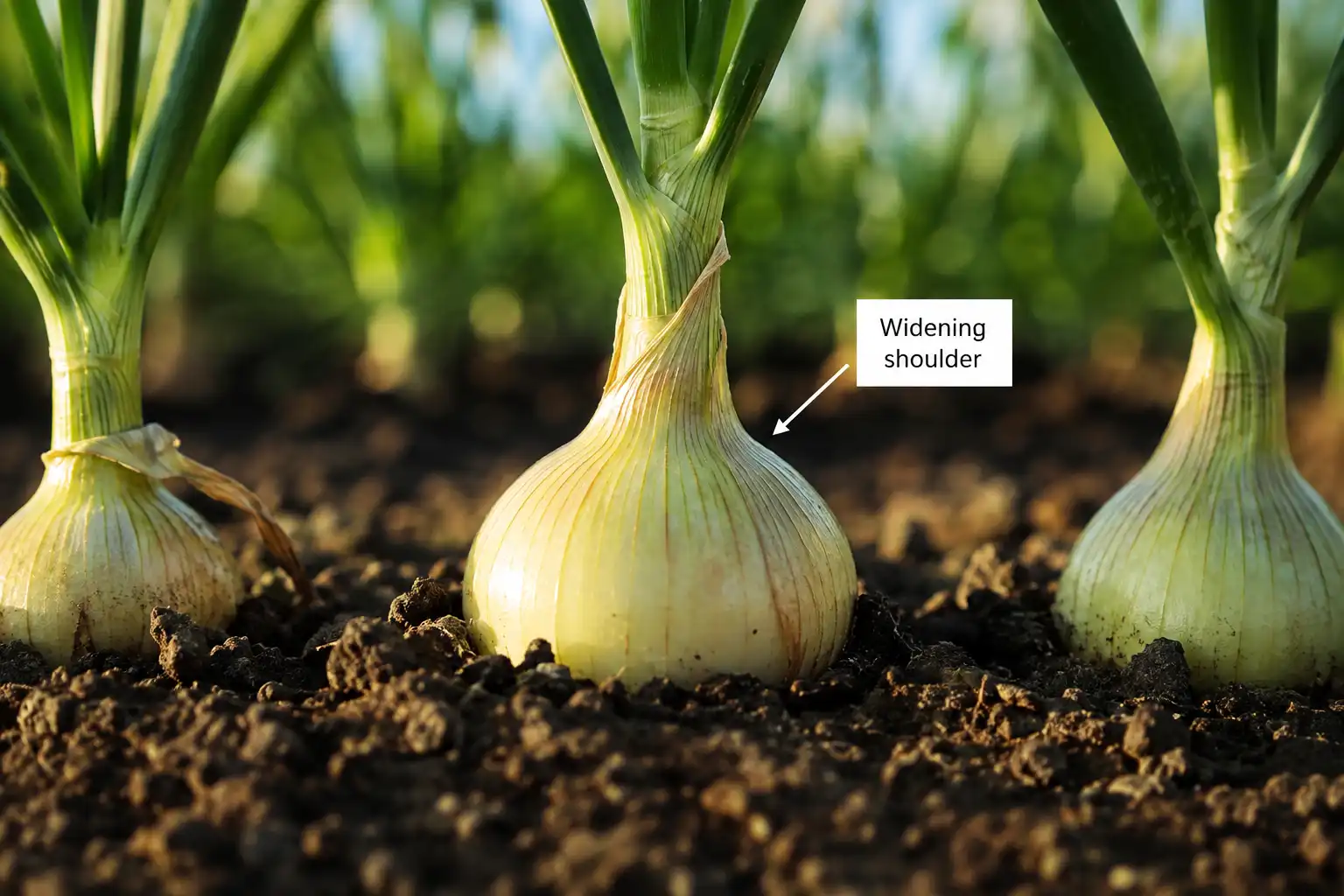
Stop nitrogen the moment bulbs start swelling. Look for two signals. The base widens past the neck, and bulb shoulders push up through the soil surface. From that point the plant moves sugar into storage tissue instead of building leaves.
Late nitrogen causes real damage:
- Thick necks. The neck stays green and soft, so bulbs never seal properly during curing.
- Delayed maturity. Tops keep growing while you wait to harvest, pushing you into hot weather.
- Storage rot. Soft, high moisture bulbs break down in the crib within weeks.
- Doubles and splits. Surge growth after a stall encourages split centers.
New Mexico State University advises cutting nitrogen at least four to six weeks before harvest. Michigan State draws a calendar line and tells growers to quit nitrogen after July 15. In zone 6a, long day onions hit bulb initiation in mid to late June. So the last feeding lands early that month.
Water follows the same rule. Once tops start to tip, back irrigation off so skins cure tight in the field.
How to Fertilize Onions in Containers and Raised Beds
Switch to a diluted liquid feed on a shorter interval. Container mix holds few nutrients and drains hard, so every watering flushes some out. Granular side-dressing in a bucket also concentrates salts against a small root ball.
What works in pots and beds:
- Raised beds. Treat them like garden rows, but expect faster drainage. Side-dress every 2 weeks instead of 3.
- Containers. Feed a soluble fertilizer at half label strength every 7 to 10 days once plants reach 4 leaves.
- Fertigation. Around 100 ppm nitrogen suits young plants, then 150 to 200 ppm while bulbs expand.
- Same stop rule. Cut nitrogen at bulb swell, container or not.
Bed depth matters more than volume here. Onions need loose soil in the top 6 inches. Compacted bed corners produce small bulbs no matter how you feed. Our article of fertilizer options for onion beds sorts the granular and soluble products by how they apply.
Does Sulfur Fertilizer Change Onion Flavor?
Sulfur raises pungency, but only where soil sulfur is short. Onion sharpness comes from sulfur compounds. Older work by Granberry and Randle showed pungency climbing as sulfur fertility climbed. Variety drives the effect as much as fertility, though.
Here is the honest limit on that idea. A 2025 Midwest Vegetable Trial Report from southern Minnesota tested gypsum on fine textured, high sulfur soil across eight varieties. Added sulfur did not raise yield. It also did not change pungency or soluble solids. Yield actually ran slightly lower.
So the working rule:
- Sandy or low sulfur ground. Include 20 to 30 pounds of sulfur per acre, usually as ammonium sulfate. Expect firmer, sharper, longer storing bulbs.
- Heavy or high organic matter ground. Skip the extra sulfur. Your soil test S will tell you.
- Chasing mild flavor. Pick the variety first. Growers selling mild bulbs rely on genetics and low sulfur soils, which is why raising sweet onion varieties depends more on cultivar choice than on any feeding trick.
Sulfur also feeds yield on deficient soil, so this is not purely a flavor question.
What If Onion Plants Look Pale or Stalled?
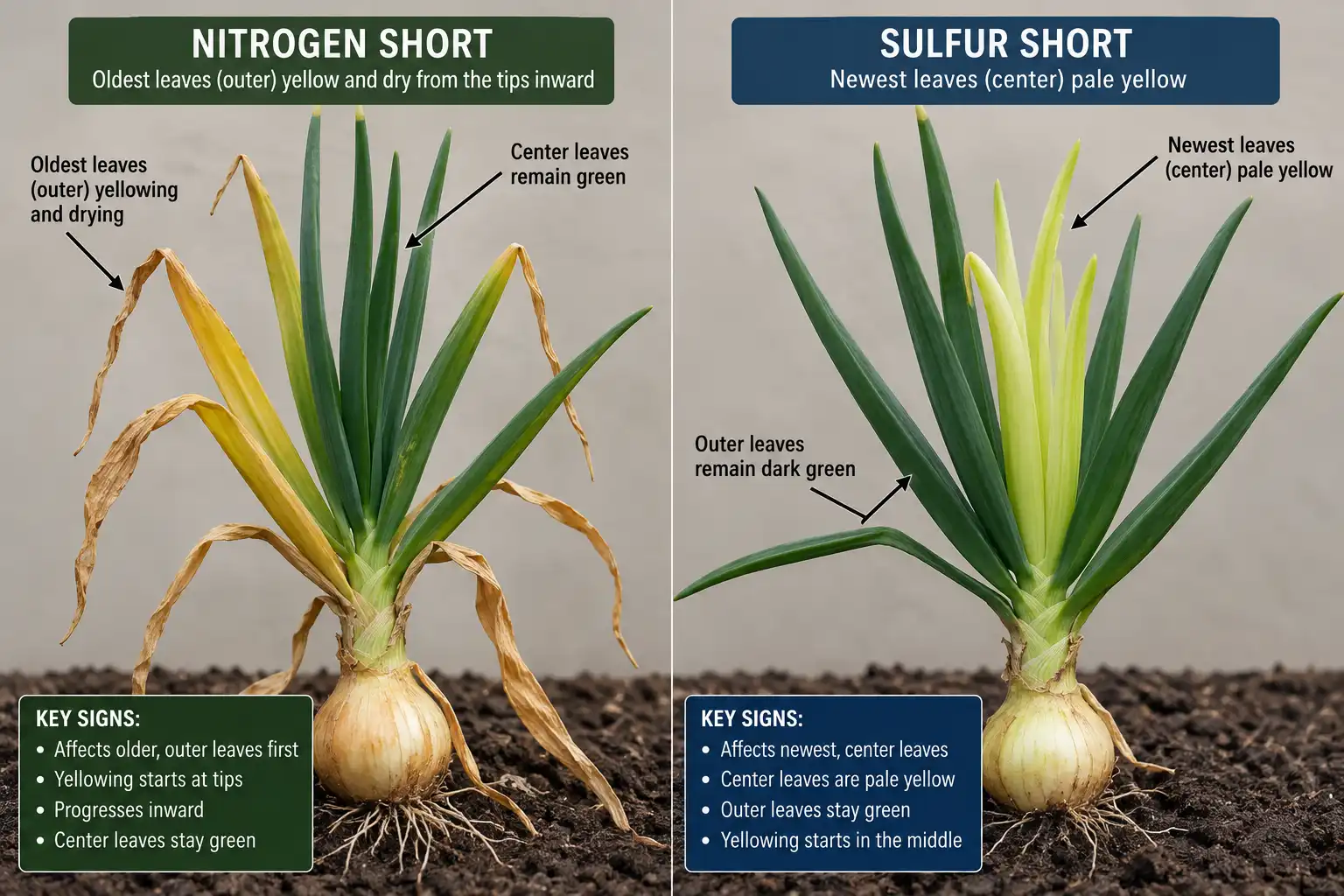
Diagnose before you feed, because pale tops have several causes. A nitrogen shortage shows on the oldest outer leaves first, and they fade from the tips inward. Sulfur shortage does the opposite and yellows the youngest center leaves.
Run through this order:
- Check moisture at 4 inches. Dry soil stops uptake even when nutrients sit there. Water first, then judge color after two days.
- Check pH. Below 5.8, adding fertilizer will not fix yellowing.
- Check the calendar. Yellowing tops after bulb initiation is normal maturity, not hunger.
- Then feed. If growth truly stalled before bulbing, apply a light nitrogen side-dress and water it in.
Skip foliar nitrogen as a main tool. Onion leaves carry a waxy surface and little leaf area early on. So a foliar pass supplements a soil application rather than replacing it.
Application Mistakes That Shrink Bulbs
Most onion fertility problems trace back to how the material went down, not what was in the bag. These are the ones most:
- Broadcasting instead of banding. Scattered granules feed pigweed between rows.
- Placing granules too close. Inside 3 inches, salt injury prunes roots.
- Skipping the water-in. Surface urea can lose a large share of its nitrogen to the air within days.
- Hilling soil over bulbs. Onions push up as they size. Burying shoulders restricts bulbs and holds moisture against the neck.
- Using weed and feed products. The herbicide in lawn fertilizer kills onions.
- Feeding past bulb initiation. This single mistake ruins more storage crops than any deficiency.
- One heavy dose instead of splits. Leaching takes it, and salt spikes hurt emergence.
Bottom Lines
Lime in fall, soil test in late winter, then P and K worked into the top 3 inches before planting. First nitrogen side-dress about three weeks after emergence, banded 5 inches out, scratched in, watered the same day. Repeat every 2 to 3 weeks. Last feeding by mid June. After that, nothing but water until the tops tip. Onions reward steady, well placed nitrogen and punish late nitrogen, so treat bulb swell as a hard stop.