How to Fertilize Tomato Seedlings: Timing, Rates, and Strength
Seed starting mix holds almost no plant food. Tomato seedlings burn through their seed reserves in about two weeks, then stall out. Knowing how to fertilize tomato seedlings at the right strength keeps them stocky instead of soft. Feed too early and you get weak stems.
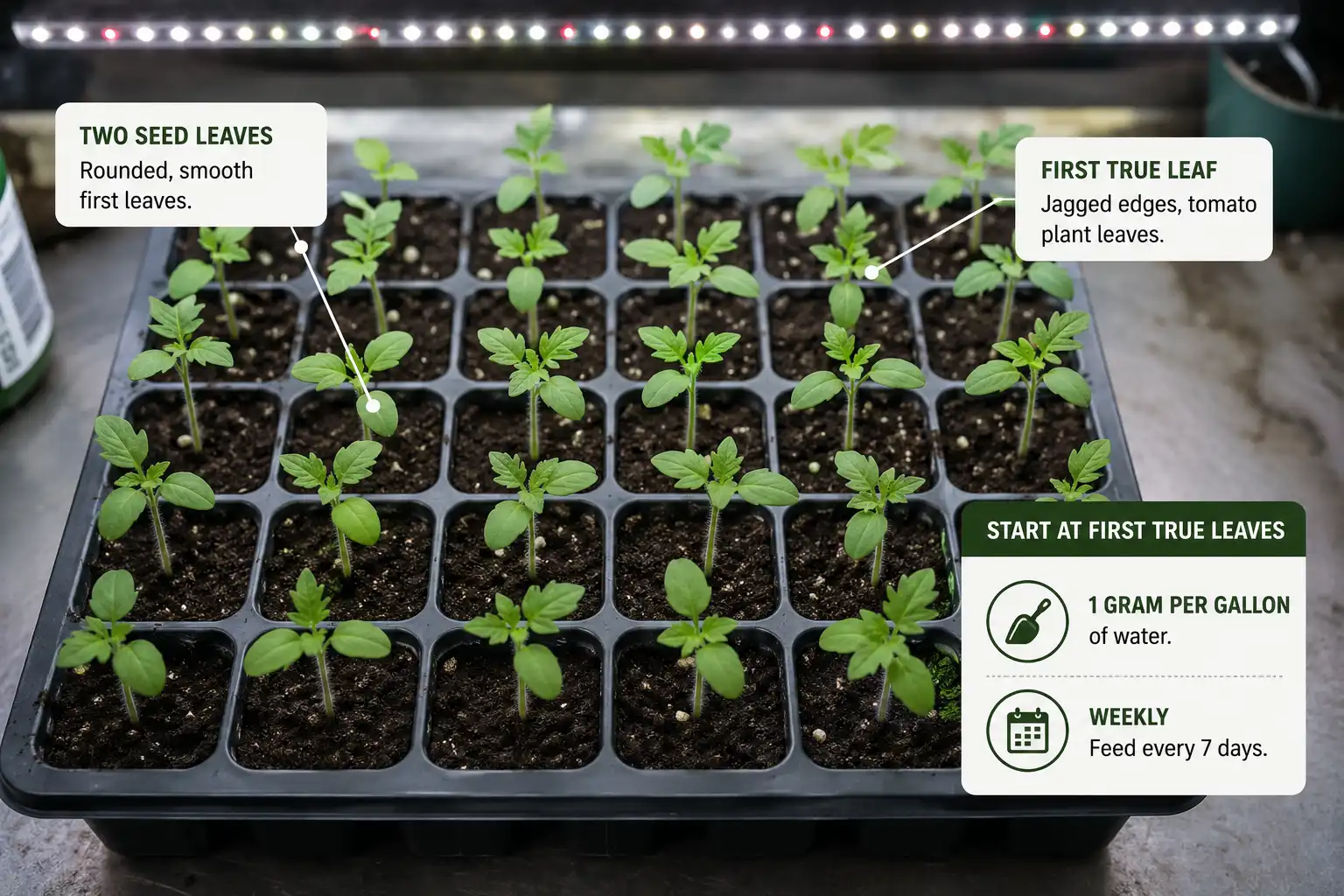
Fertilize tomato seedlings once the first true leaves open fully, roughly two to three weeks after germination. Then use a soluble balanced grade at quarter strength, near 50 ppm nitrogen, weekly. Bottom water it in.
Learn more: How to fertilize potted tomatoes
When Should You Start Fertilizing Tomato Seedlings?
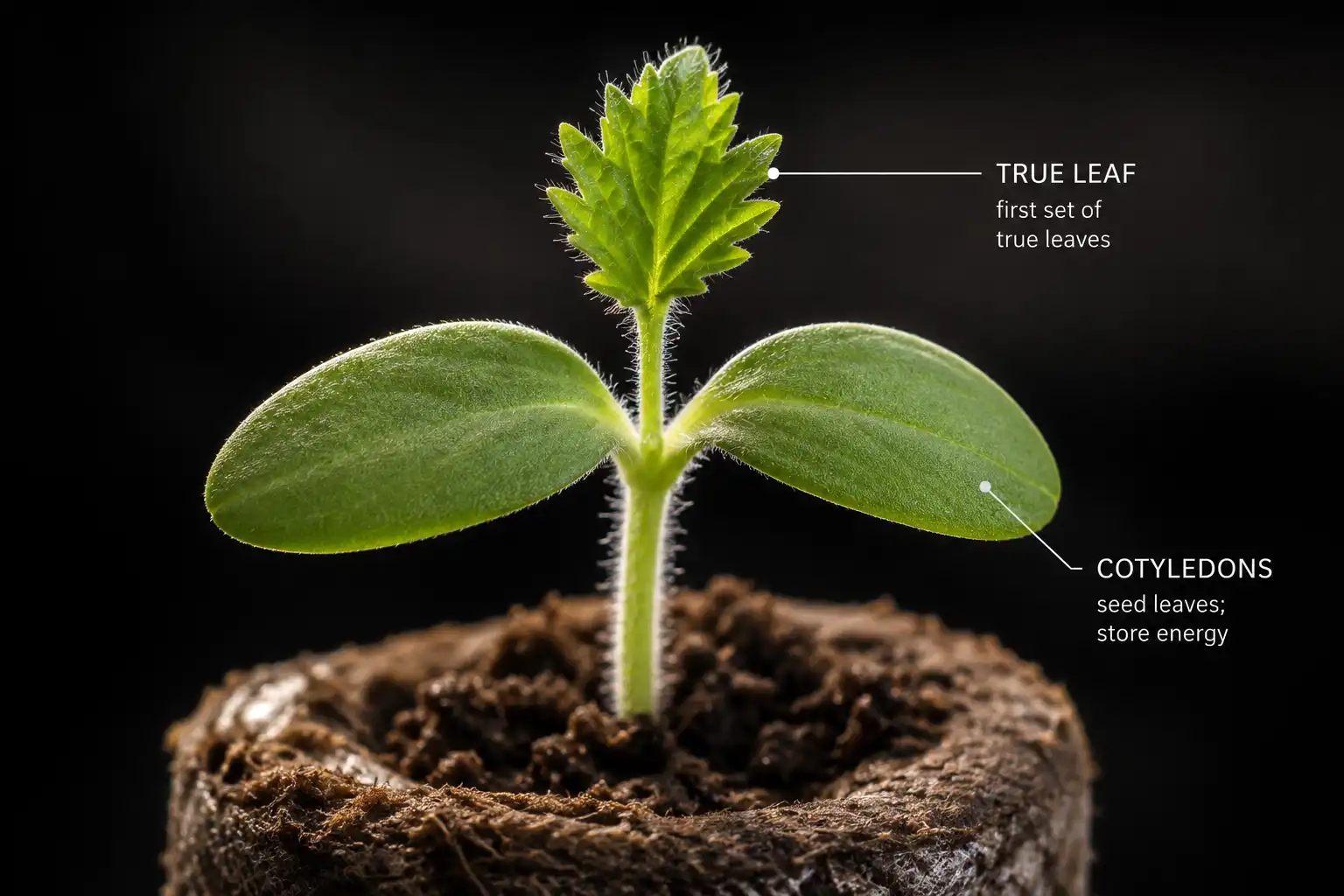
Start once the first true leaves open fully, not before. Until then the seed supplies everything the sprout needs. So added salts just sit in the root zone and pull water back out.
True leaves look nothing like the first pair. The two rounded seed leaves, called cotyledons, come up smooth and oval. After those, the first jagged leaf pushes out and looks like a small tomato leaf. That leaf is the signal. At that point roots have spread through the plug and photosynthesis is carrying the plant.
Timing runs about two to three weeks from sowing at 75°F media temperature. Cooler trays run slower. So watch the leaves, not the calendar.
Alabama Cooperative Extension System holds the same line for greenhouse transplant production. Growers there skip fertilizer until true leaves emerge. After that, 50 to 100 ppm nitrogen from a complete soluble grade becomes the working range.
One caution before you mix anything. Check the bag first, because a charged potting mix can feed a seedling three weeks on its own.
Does Your Seed Starting Mix Already Contain Fertilizer?
Most true seed starting mixes carry almost nothing, and that is deliberate. Peat, coir, vermiculite, and perlite give clean drainage and a low disease load, but they hold no meaningful nutrient charge. Lean media also cuts damping off risk. Fewer salts and less organic matter mean fewer problems at the soil line.
Potting mixes are different. Many carry a starter charge that feeds seedlings for two to three weeks. Read the bag. If you see a guaranteed analysis printed on the label, nutrients are in there. If the ingredient panel lists only peat, bark, coir, and aggregates, the mix is lean.
Compost based blends sit in between and vary the most. Maine Organic Farmers and Gardeners flags two problems worth knowing. First, a high carbon to nitrogen ratio locks up nitrogen. So the compost should test between 15:1 and 18:1. Second, some composts run high in soluble salts, which blocks water uptake and stalls germination outright.
Here is how to sort it out. Sowing into a lean starting mix calls for feeding at first true leaves. Sowing into a charged potting mix calls for holding off another week or two and watching color instead. Either way, keep the plan tied to what the bag says rather than a fixed date.
The indoor stage covers more than feeding. Our walkthrough on starting tomatoes from seed handles sowing depth, media temperature, and thinning.
What Fertilizer Works Best for Tomato Seedlings?
A balanced water soluble grade works best, applied dilute. Alabama Cooperative Extension System names 20-20-20 and 20-10-20 as transplant standards. Both dissolve clean without clogging a watering can.
Nitrogen concentration matters more than the other two numbers at this stage. UMass Amherst makes this point in the New England Vegetable Management Guide. Nitrogen affects transplant growth more than phosphorus or potassium does. So set your rate by nitrogen and let the rest follow.
| Product type | Working rate | Notes |
|---|---|---|
| Soluble 20-20-20 or 20-10-20 | 1 g per gallon = about 50 ppm N | The standard transplant rate |
| Same, pushed up | 2 g per gallon = about 100 ppm N | Top of the safe range for plugs |
| Home all purpose crystals | Quarter of the label rate | Labels often land near 400 ppm N |
| Fish emulsion 2-4-2 or 2-3-1 | Half the label rate | Ammonium heavy, use with care |
| Kelp or seaweed extract | Label rate | Mild, low salt, mostly micronutrients |
| Worm casting tea | 1 part tea to 3 parts water | Gentle but variable in strength |
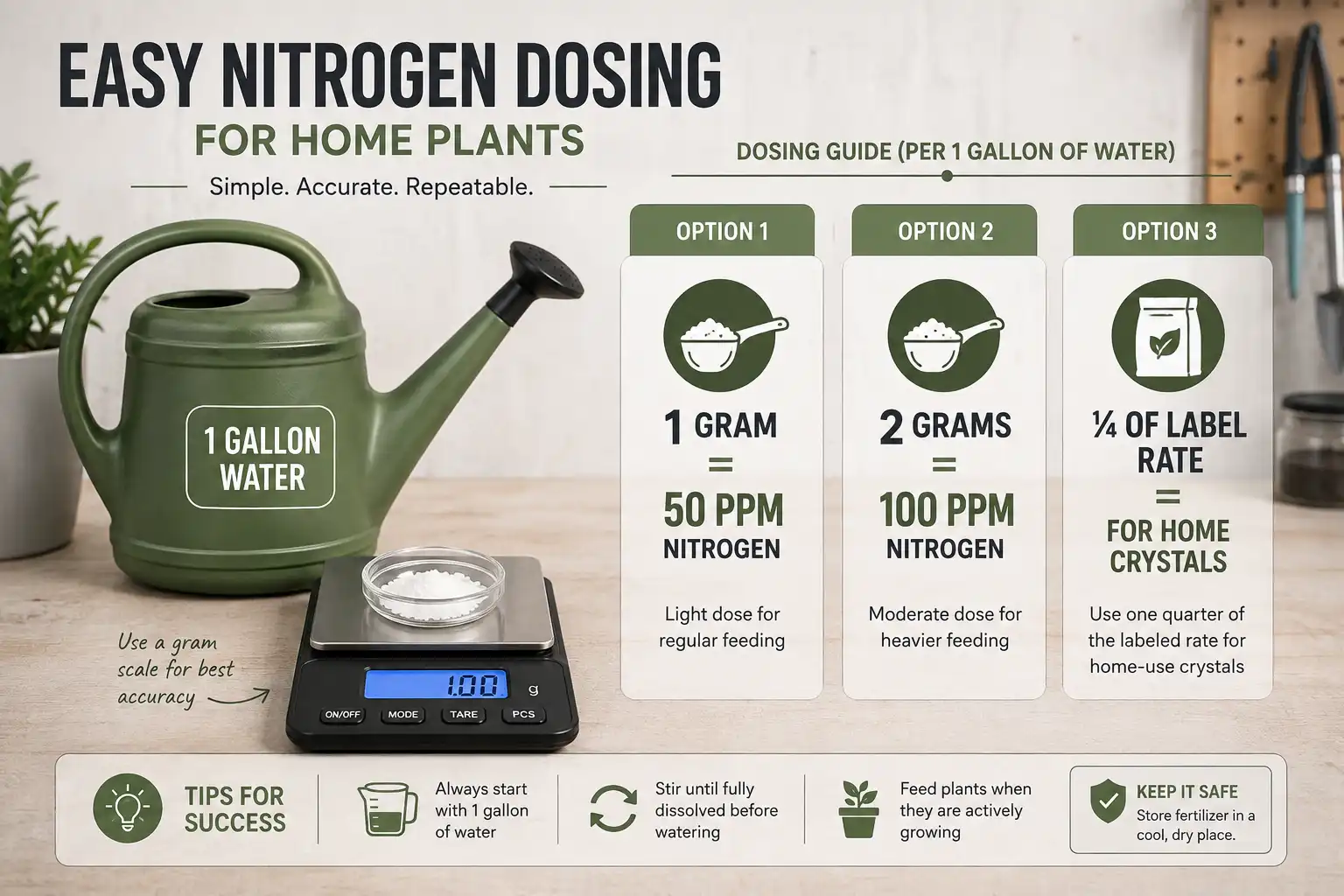
Two grams per gallon is the ceiling to work under. Above that, salts climb faster than tiny roots can use them.
Skip the high phosphorus bloom boosters. Grades like 10-52-10 exist for direct seeded field starter bands, not for plug trays, and the salt load runs high. For the reasoning behind these numbers, this article on 20-20-20 fertilizer blends walks through where each grade fits.
Organic growers should know one wrinkle. UMass notes that most fish fertilizers carry ammonium nitrogen, which sensitive transplants like tomato, pepper, and eggplant tolerate poorly. So cut fish products harder than the label says.
How Often to Fertilize Tomato Seedlings?
Feed once a week at quarter strength, or every 10 to 14 days at half strength. Both land in the same nitrogen range over a month. Weekly at low strength gives steadier growth, so that is what.
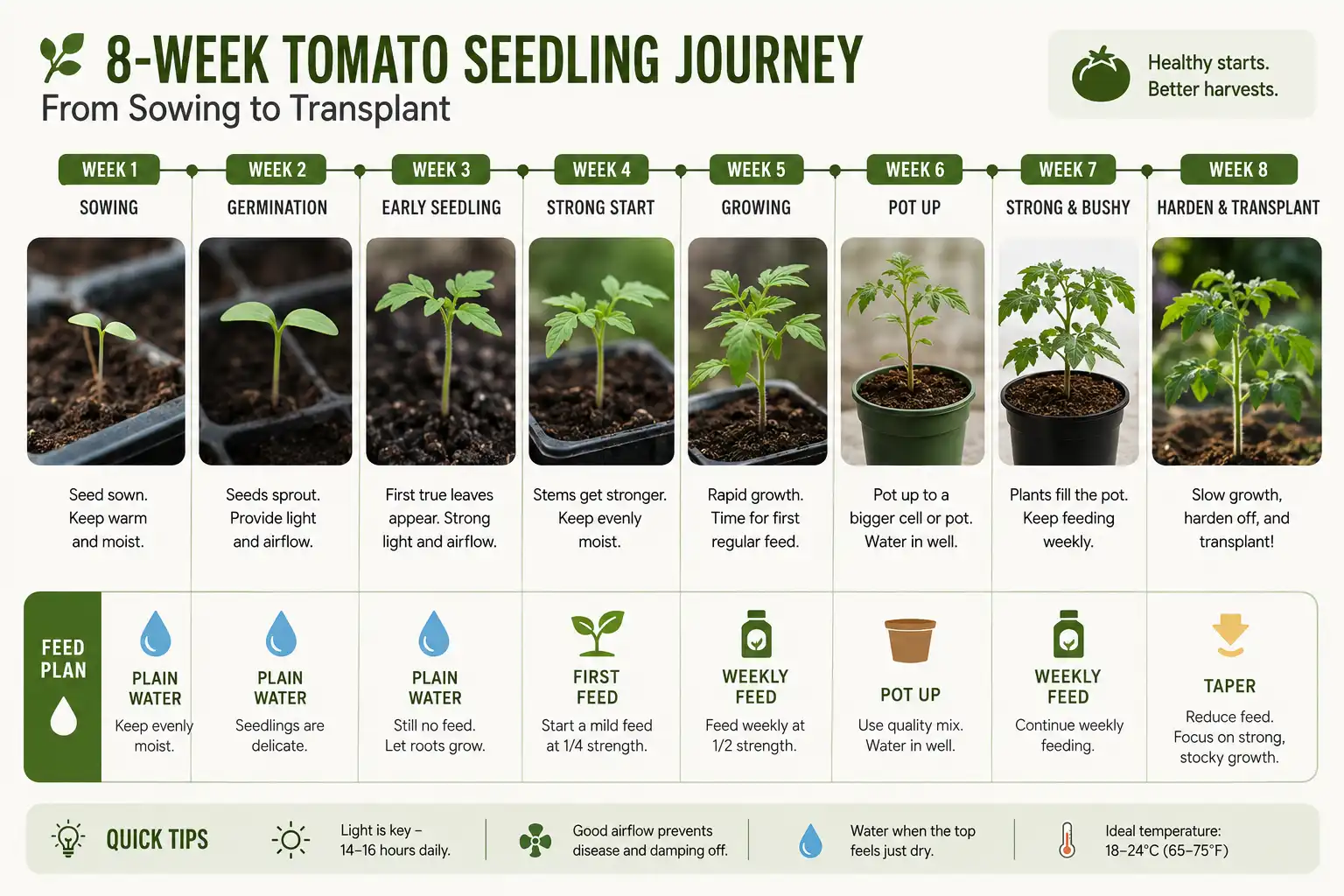
Plain water goes on between feedings, whenever the media surface lightens in color. Then every fifth or sixth watering, use plain water even on feeding day. Alabama Extension recommends that flush to keep salts from stacking up in the plug, and it works.
| Week from sowing | Stage | What to apply |
|---|---|---|
| 1 | Germination to cotyledons | Plain water only |
| 2 | First true leaf forming | Plain water only |
| 3 | First true leaves open | First feed, 1 g per gallon |
| 4 | Two to three true leaf sets | 1 g per gallon, weekly |
| 5 | Pot up to 3 or 4 inch pots | Fresh mix, then feed after a week |
| 6 | Rapid growth | 1 to 2 g per gallon, weekly |
| 7 | Hardening off begins | Cut back to half the usual rate. |
| 8 | Transplant | Dilute starter solution in the hole |
Commercial plug houses run hotter than this. Iowa State horticulture guidance starts tomato transplants near 150 ppm nitrogen in week three. Then week four steps up to 200 ppm, applied two or three times weekly under fertigation. That schedule assumes daily monitoring and heavy leaching. Home trays and small greenhouse benches do not get that, so the lower weekly rate carries less risk.
Bottom watering beats top watering for feeding. Solution reaches roots that way without soaking leaves, which cuts both burn and disease risk.
How Do You Fertilize Tomato Seedlings Step by Step?
Work through these five steps and the tray stays even. Skipping the scale is where most trouble starts.
- Confirm the stage. Look for the first true leaves fully open, past the two rounded seed leaves.
- Weigh the fertilizer. Put 1 gram of 20-20-20 into 1 gallon of room temperature water. A cheap kitchen gram scale removes the guesswork, since a quarter teaspoon of soluble powder runs anywhere from 1.0 to 1.5 grams depending on the product.
- Stir until clear. Undissolved crystals settle in the pan and burn whatever root touches them. So mix until the solution runs clear.
- Bottom water it in. Pour the solution into a shallow tray, set the cells in, wait five to ten minutes, then pour off the excess. Never leave trays standing in solution.
- Follow with plain water. Water plain between feedings, and skip the fertilizer entirely every fifth or sixth watering.
Use room temperature water, not cold water straight from the tap. Cold water chills the plug, and cold roots take up phosphorus poorly. That single habit prevents most of the purple leaf issues reported in March.
One more thing on water quality. If your well runs hard or high in sodium, that salt adds to whatever you mix in. UMass reports that most vegetable seedlings tolerate soluble salts only up to about 1.0 mS/cm. So hard water pushes you toward the lower end of the rate range, not the upper.
What Does Overfeeding Look Like on Tomato Seedlings?
Overfed seedlings stretch tall and soft, and leaf edges turn crisp and brown. Both show up within a week of a heavy dose. Salt injury hits fine root tips first. So the top growth looks off before anything shows at the surface.
Watch for these signs:
- Crisp brown leaf margins on the oldest leaves, working inward.
- Long gaps between leaf sets with a thin, pale, floppy stem.
- White crust on the media surface or around the cell rim.
- Green algae film across the top of the plug, which means too much water plus too much feed.
- Wilting in wet media, which points at roots, not thirst.
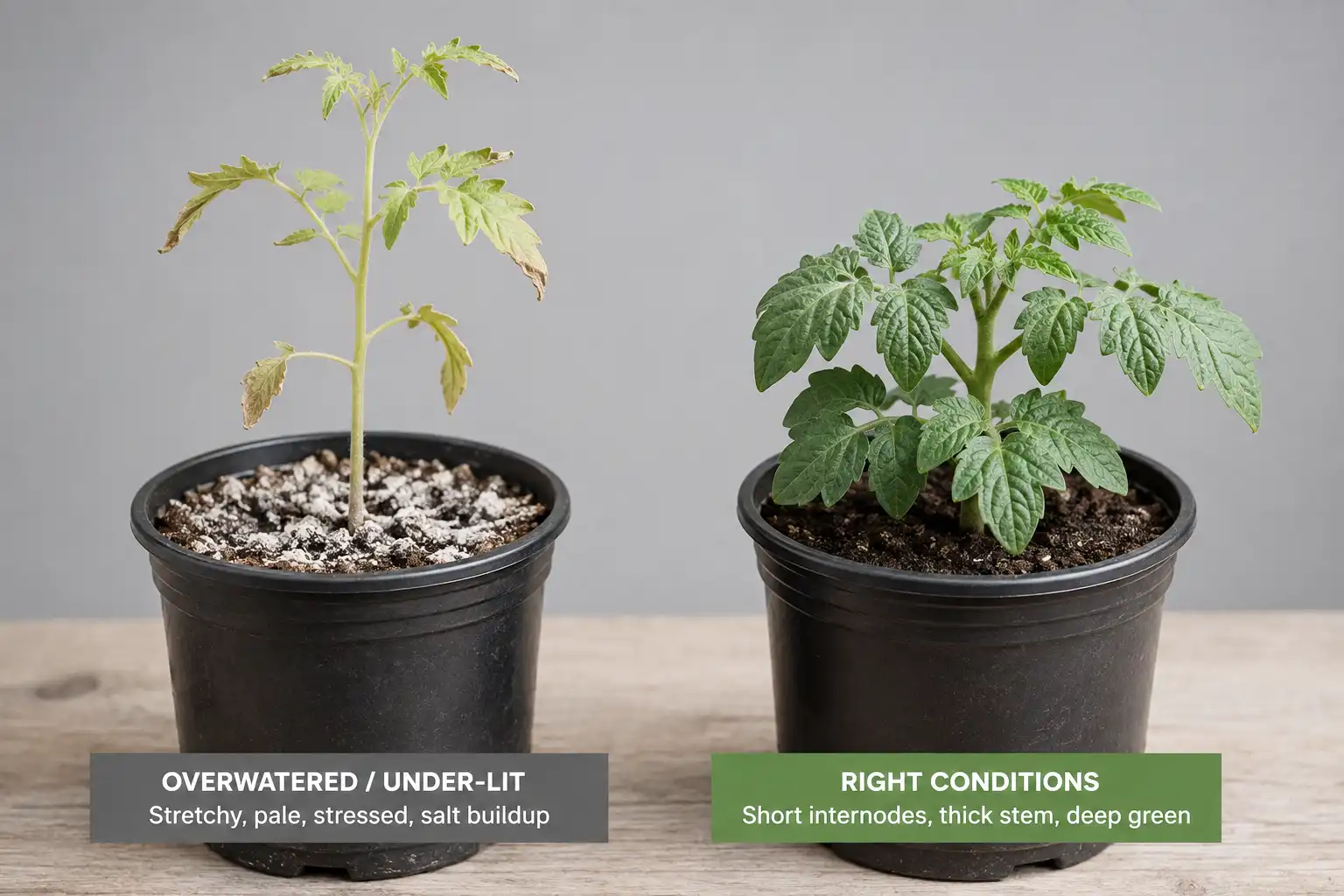
UMass Amherst reports that tomato transplants stretch under excess water, excess nitrogen, high temperature, or low light. All four push the same result, so check your light before you blame the fertilizer. Weak light stretches seedlings faster than any feeding mistake, which is why a proper shelf setup pays for itself. This roundup of grow lights for seedling shelves covers the intensity and hang height that keep plants short.
Excess nitrogen also raises disease pressure. NC State notes that heavy nitrogen fertility encourages damping off. UConn adds that Pythium and Rhizoctonia can later cause wire stem on tomato and pepper. That shows up as a twisted, constricted stem at the soil line. Our notes on damping off in seedling trays go deeper on sanitation and airflow.
If you suspect a burn, flush first. Run plain water through each cell two or three times, then drain fully. Wait a full week before feeding again at half your previous rate.
What Does a Nutrient Shortage Look Like?
Pale, even yellowing that starts on the lowest leaves means nitrogen is short. Color drains from the oldest tissue first because the plant moves what nitrogen it has toward new growth. Growth height slows at the same time.
| Symptom | Likely cause | What to do |
|---|---|---|
| Uniform pale yellow, lowest leaves first | Nitrogen short | Begin or resume weekly feeding |
| Purple leaf undersides and veins, slow growth | Cold root zone, sometimes phosphorus | Warm the media first, then feed |
| Yellow between green veins on middle leaves | Magnesium short | Epsom salt at 1 teaspoon per gallon, once |
| Small dark leaves, no new growth | Root bound or waterlogged | Pot up and check drainage |
| No response to feeding at all | Salt buildup or nitrogen lockup | Flush the cells, check media pH |
Purple undersides deserve a second look before you reach for fertilizer. Texas A&M AgriLife notes that phosphorus deficiency shows as purpling of leaves and veins. But cool root zone temperatures cause it far more often than any fertility shortage. Tomato roots simply stop pulling phosphorus from cold media. So warm the bench and water with tepid water first. If purple color holds after a week of warm roots, then treat it as a fertility issue.
Media pH sets the whole system. UMass recommends holding soilless mixes near 5.8 to 6.0 for sensitive crops. Below that range, iron and manganese climb toward toxic levels. Above it, iron and phosphorus tie up. A cheap pH pen and a saturated media sample catch drift early.
Should You Feed After Potting Up?
Wait about a week after potting up, then resume the weekly schedule. Fresh potting mix usually carries its own charge. Also, disturbed roots need a few days before they take up much.
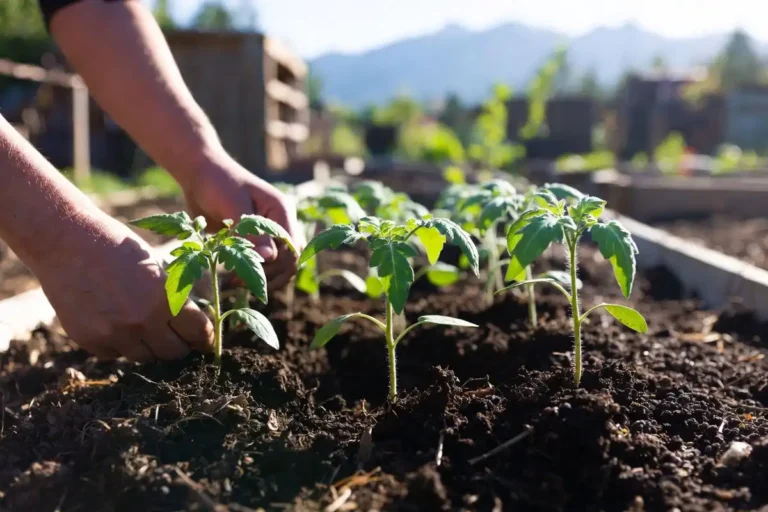
Pot up when seedlings hold two to three sets of true leaves. Move them from cells into 3 or 4 inch pots. UNH Extension describes the target transplant as stocky and under six inches tall. It should stand about as broad as it is high, with thick straight stems and deep green leaves. That shape is what you are steering toward with every feeding decision.
Potting up also fixes problems that feeding cannot. Root bound plugs stall no matter how you water them. So does a plug that never drained well. If growth stopped and the roots circle the bottom, move the plant before you mix another dose.
Kansas timing works out to sowing in mid March for a mid May transplant. That fits USDA hardiness zone 6a around Topeka. Seven to eight weeks indoors leaves room for one pot up. Warmer zones shift earlier, but the interval holds.
Do You Keep Feeding During Hardening Off?
Cut back, but do not stop cold. South Dakota State University Extension advises reducing water and fertilizer gradually while hardening off. But it warns against cutting either far enough to injure plants. Half your usual rate through that stretch works well.
The reason is simple. Hardening off slows growth on purpose so tissue firms up before field conditions hit. Heavy nitrogen fights that directly by pushing soft new leaves that scorch outdoors. So the taper is part of the conditioning, not a separate step.
Reducing feed also holds plants back when weather stalls your planting date. Lower temperature plus less water plus less fertilizer keeps height in check for another week or two. That trick saves a lot of leggy transplants in a cold Kansas spring.
Practice does vary here. Some growers withhold fertilizer completely during hardening. Cornell researchers have even questioned how much hardening changes field performance for tomatoes. Tapering off is the better approach rather than stopping outright. A plant that goes hungry for two weeks establishes slower than one that stayed steady.
Then on transplant day, water each plant in with a dilute starter solution. This full guide to hardening off tomato transplants covers the outdoor schedule. From there, fertilizing tomatoes in the ground picks up the rates and timing through harvest.
Bottom Lines
Plain water for two weeks. First feed when true leaves open, at 1 gram of 20-20-20 per gallon, bottom watered. Weekly after that, with a plain water flush every fifth or sixth pass. Half rate once trays move outside.
Stocky beats tall every time. A short, thick stemmed plant with deep green leaves sets fruit sooner than a stretched one. The tall plant looks more impressive on the shelf in April. It rarely finishes ahead.