How to Fertilize Grape Vines: Rates, Timing, and Placement
Most vines that disappoint their owners got too much fertilizer, not too little. Grapes carry a light nutrient load. So how to fertilize grape vines comes down to reading the vine first and spreading second. Rate, timing, and placement matter more than the bag.
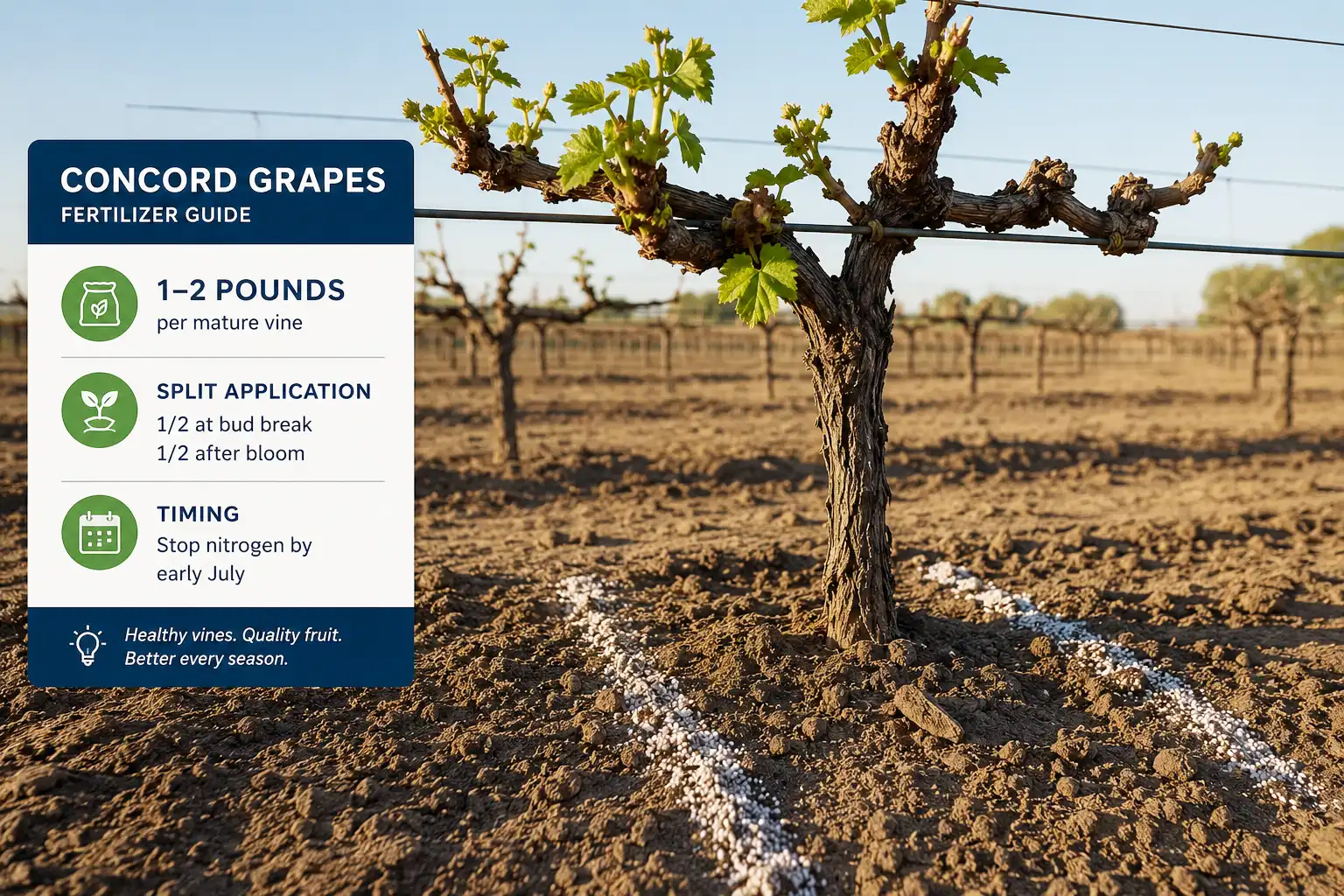
Fertilize grape vines with 1 to 2 pounds of a balanced granular blend per mature vine at bud break. Band it 12 to 18 inches out from the trunk. Water it in, then stop all nitrogen by early July.
Do Grape Vines Actually Need Fertilizer Every Year?
No. Plenty of established vines on decent ground skip nitrogen for a year or two and fruit better for it. Grapes pull only about 2.9 pounds of nitrogen per ton of fruit. That is light next to corn or wheat. Soil organic matter covers a good share of it on its own. Each 1 percent of organic matter releases roughly 5 to 20 pounds of nitrogen per acre each season.
So the first job is reading the vine, not filling the spreader. A vine short on nitrogen shows uniform pale green leaves and thin canes. Also, the canopy still has not filled the trellis by August. A vine with plenty runs the opposite way. Look for dark green leaves, shoots past the top wire in late summer, and internodes stretching over 6 inches.
Two numbers keep me honest here. Dormant prunings run about 0.2 to 0.4 pounds per linear foot of row. Canes measure at least pencil thick at the middle. You get the clearest read while pruning grape vines in late winter. The weight of one year old wood tells you exactly what last season’s fertility did.
Excess nitrogen costs real money. The canopy shades its own clusters, Brix drops, ripening slides late, and berries soften up for Botrytis. Worse, the wood keeps growing into fall instead of hardening off, which sets up winter injury.
How Do You Test Before You Fertilize Grapes?
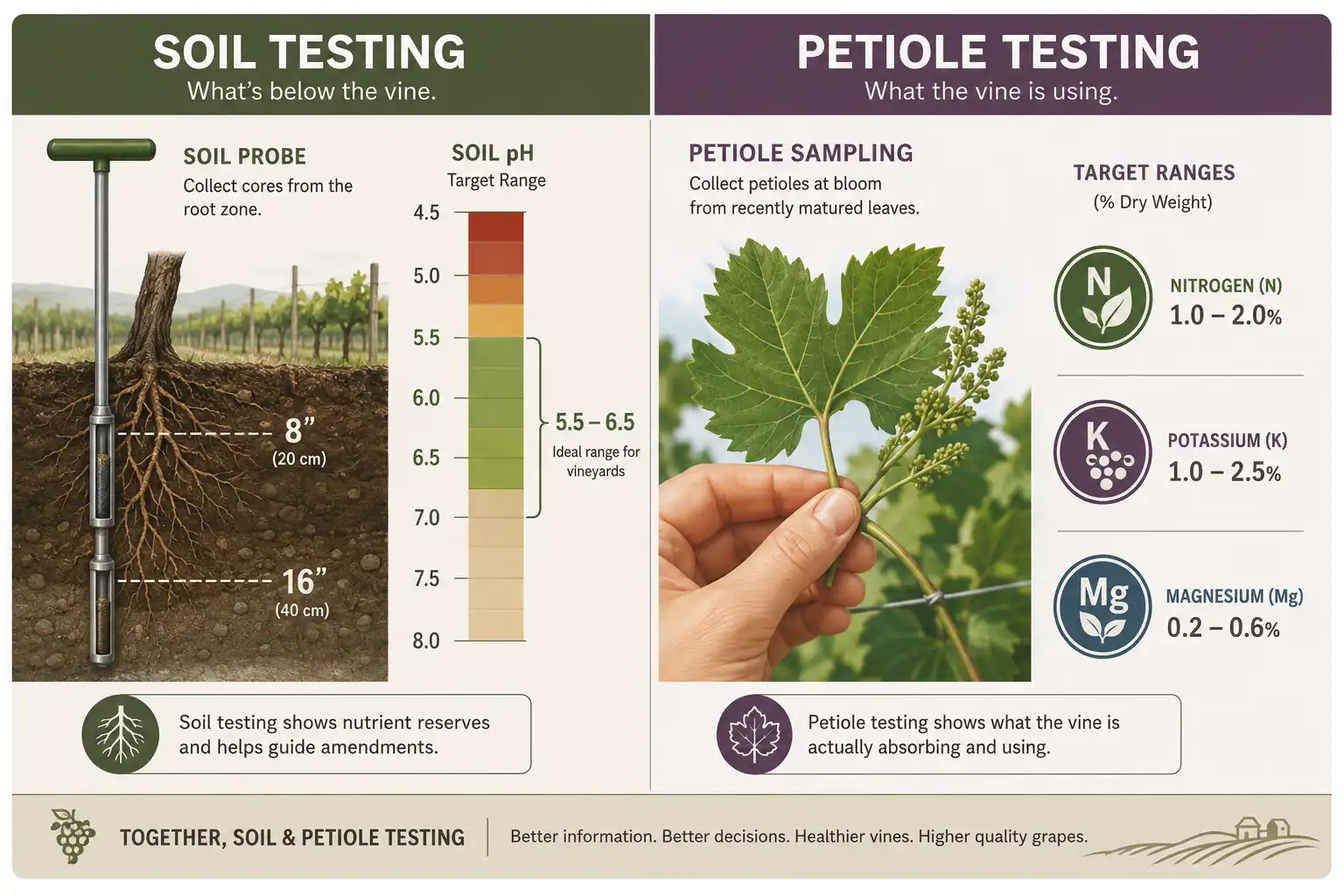
Run a soil test before planting, then repeat it every three to five years. Once vines bear fruit, add petiole analysis every year. Soil tests handle pH, organic matter, phosphorus, potassium, and magnesium. Petiole tests handle nitrogen and the micronutrients, because soil nitrogen tests tell you almost nothing useful in a vineyard.
Sample the soil at two depths, 0 to 8 inches and 8 to 16 inches. Work a Z pattern across the block. Pull those cores under the vine row, not out in the middles where the cover crop grows. A mail in soil test kit handles a backyard planting fine. Still, a state lab gives you the full nutrient panel plus a written recommendation. Samples typically go to the K-State soil testing lab.
What Soil pH Do Grape Vines Need?
Grapes want slightly acidic soil, roughly 5.5 to 7.0, and most extension programs target 5.5 to 6.5. Below 4.5 you start losing magnesium and potassium. Above 7.0 the micronutrients tie up, so iron and zinc go short even when the soil holds plenty.
Correct pH before you plant. Grape roots run deep, so surface lime moves too slowly to fix much afterward. If magnesium also tests low, use dolomitic limestone and cover both at once. Muscadines prefer the tighter range of 6.0 to 6.5.
When Should You Take a Petiole Sample?
Sample at full bloom or at veraison, then stick with that timing every year so results compare. Pull 40 to 60 petioles from the youngest fully expanded leaf opposite the first cluster. Triple rinse them to strip spray residue, air dry, and ship. Bloom samples read boron and zinc well but potassium poorly. Mid August samples read potassium and magnesium best.
Target petiole ranges:
- Nitrogen: 1.8 to 2.2 percent at bloom, 0.8 to 1.0 percent in mid August
- Potassium: 1.1 to 2.0 percent in mid August
- Magnesium: 0.2 to 0.5 percent in mid August
Sample each variety separately, and keep blocks of different age or rootstock apart.
What Fertilizer Is Best for Grape Vines?
A balanced granular blend suits young vines. Mature vines on ground that already tests adequate in phosphorus and potassium do better on straight nitrogen. That single choice saves money and prevents a slow buildup you cannot pull back out.
For backyard rows and small plantings, a 10-10-10 blend remains the standard recommendation from Illinois and Connecticut extension programs. Once your soil test shows phosphorus and potassium above optimum, switch. Grapes find enough phosphorus even at very low test levels, and documented deficiency shows up only below pH 4.0.
Then feed nitrogen alone. Per mature vine:
- 46-0-0 urea at 2 to 3 ounces
- Ammonium nitrate (33-0-0 or 34-0-0) at 4 to 8 ounces
- Blood meal at 8 ounces for an organic program
Urea volatilizes off a dry surface, so spread it on bare soil right before rain. Ammonium nitrate acidifies the soil. Offsetting each pound of nitrogen takes about 1.8 pounds of lime.
Potassium matters on sandy ground under 3 percent organic matter, since those soils hold almost nothing. Potassium sulfate works well. Sul-po-mag covers potassium and magnesium together when both run short. Go easy either way, because heavy potassium suppresses magnesium uptake.
Compost fits a grape program, but timing rules apply. Spread it during dormancy or just before bud break. Midsummer compost releases nitrogen exactly when you want the vine slowing down. Skip fresh manure around young vines entirely.
How to Fertilize Grape Vines Step by Step
- Read the vine. Check shoot length, cane thickness, and leaf color before you decide anything.
- Pull your numbers. Use the current soil test for pH, potassium, and magnesium, plus last season’s petiole results for nitrogen.
- Pick material and rate by vine age. Young vines take ounces. Mature vines take a pound or two.
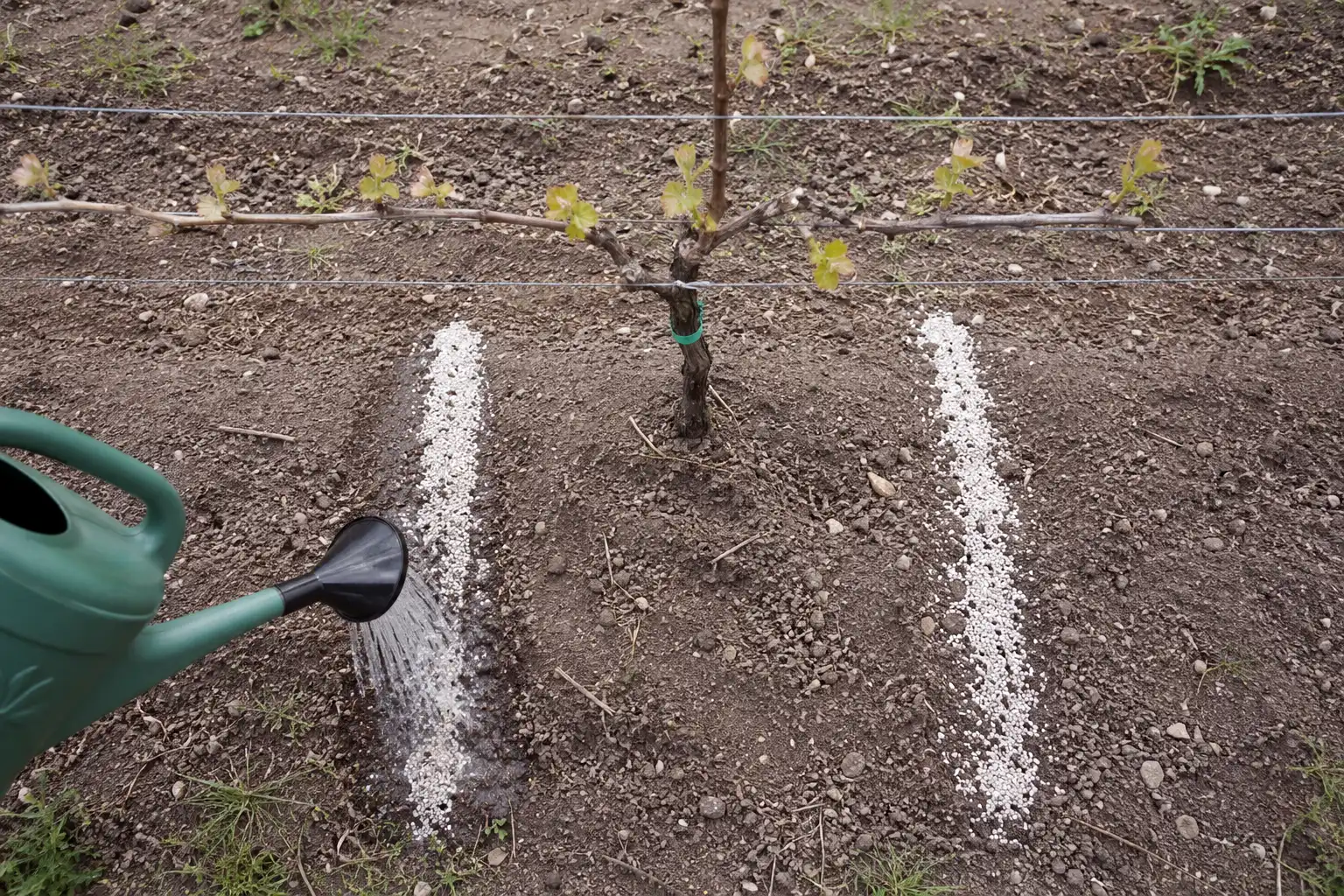
- Mark the band. Stay 12 inches out on first year vines, then widen to a 3 to 6 foot band under mature vines as the roots spread.
- Spread evenly. Run two strips parallel to the row, or make a complete circle around a single vine. Never pile granules against the trunk.
- Keep it off the leaves. Granular fertilizer sitting on wet foliage burns tissue.
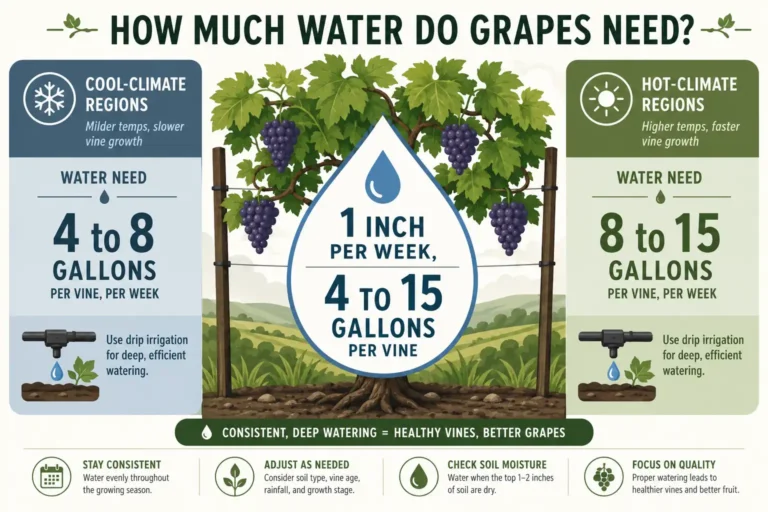
- Water it in. Apply half an inch to an inch right away so nutrients reach feeder roots instead of drying on the surface. Watering grapes well matters just as much through the rest of the season.
- Write it down. Log the date, material, and rate. Next year’s decision depends on this year’s record.
How Often to Fertilize Grape Vines?
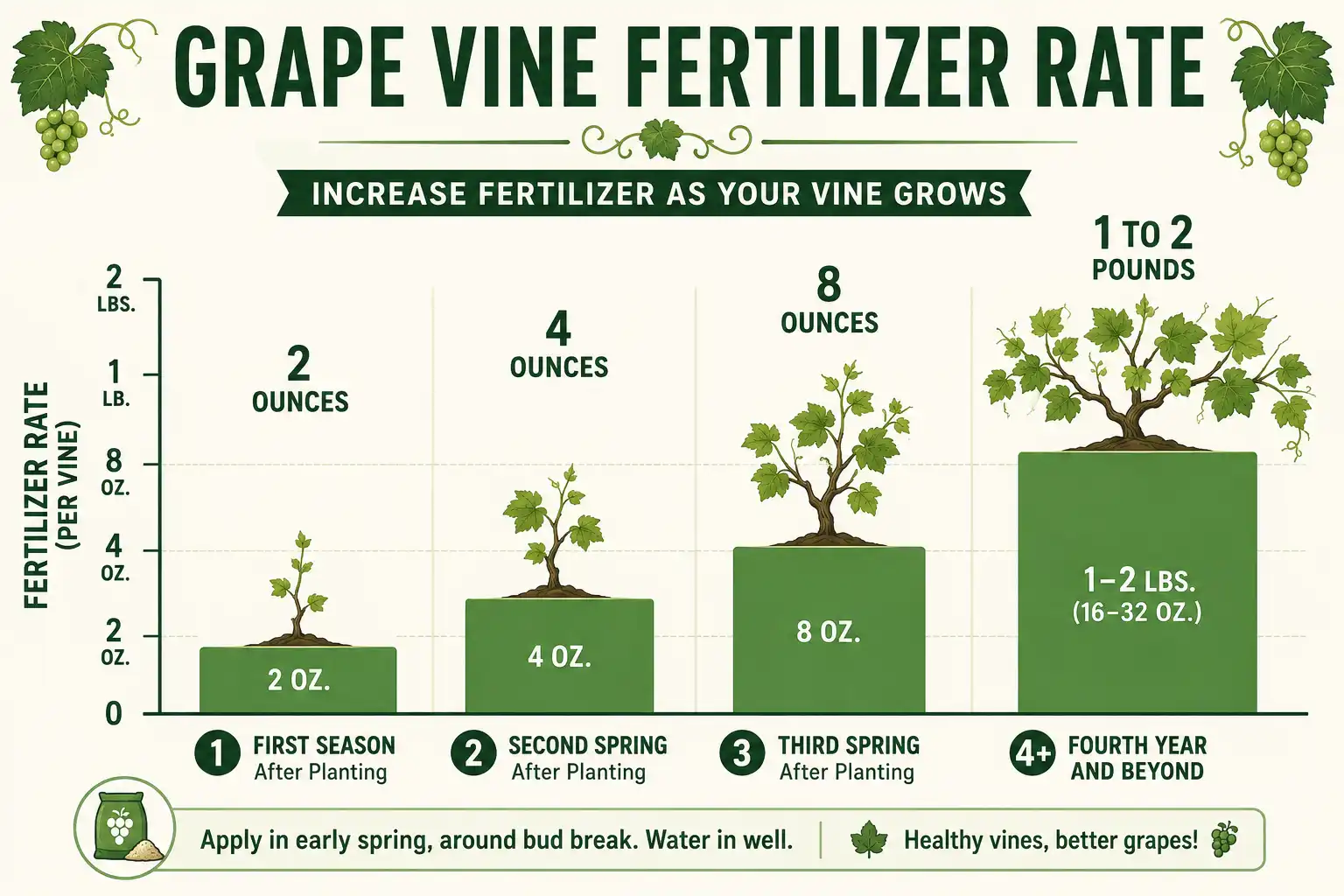
Once a year covers most mature vines, and only sandy or low vigor sites need a second pass. When growers ask how often to fertilize grapes, the honest answer depends on soil type more than calendar habit. Heavy Kansas silt loam holds nutrients well, so one application at bud break does the work. Sand leaks, so split the rate in half and apply at bud break and again just after bloom.
| Vine age | Timing | Rate per vine |
|---|---|---|
| First season | 2 to 3 weeks after planting | 2 oz balanced blend, kept a foot from the vine |
| Second spring | Before buds swell | 4 oz balanced blend |
| Third spring | Before buds swell | 8 oz balanced blend |
| Fourth year and older | Bud break, optional second feeding after bloom | 1 to 2 lb balanced blend, or 4 to 8 oz of 33-0-0 |
Commercial blocks work off actual nitrogen per acre instead of per vine. The Midwest Grape Production Guide puts the range at 40 to 80 pounds of actual nitrogen per acre per year. Use the low end on vigorous sites and the high end where vines struggle. Eastern guides start lower, around 30 to 50 pounds. Convert to product before you load the spreader. 40 pounds of actual nitrogen takes about 87 pounds of urea, or 118 pounds of 34-0-0. On drip, run small shots of 1 to 3 pounds of actual nitrogen instead, since fertigation lands the nutrient right in the root zone.
When Should You Stop Fertilizing Grapes for the Year?
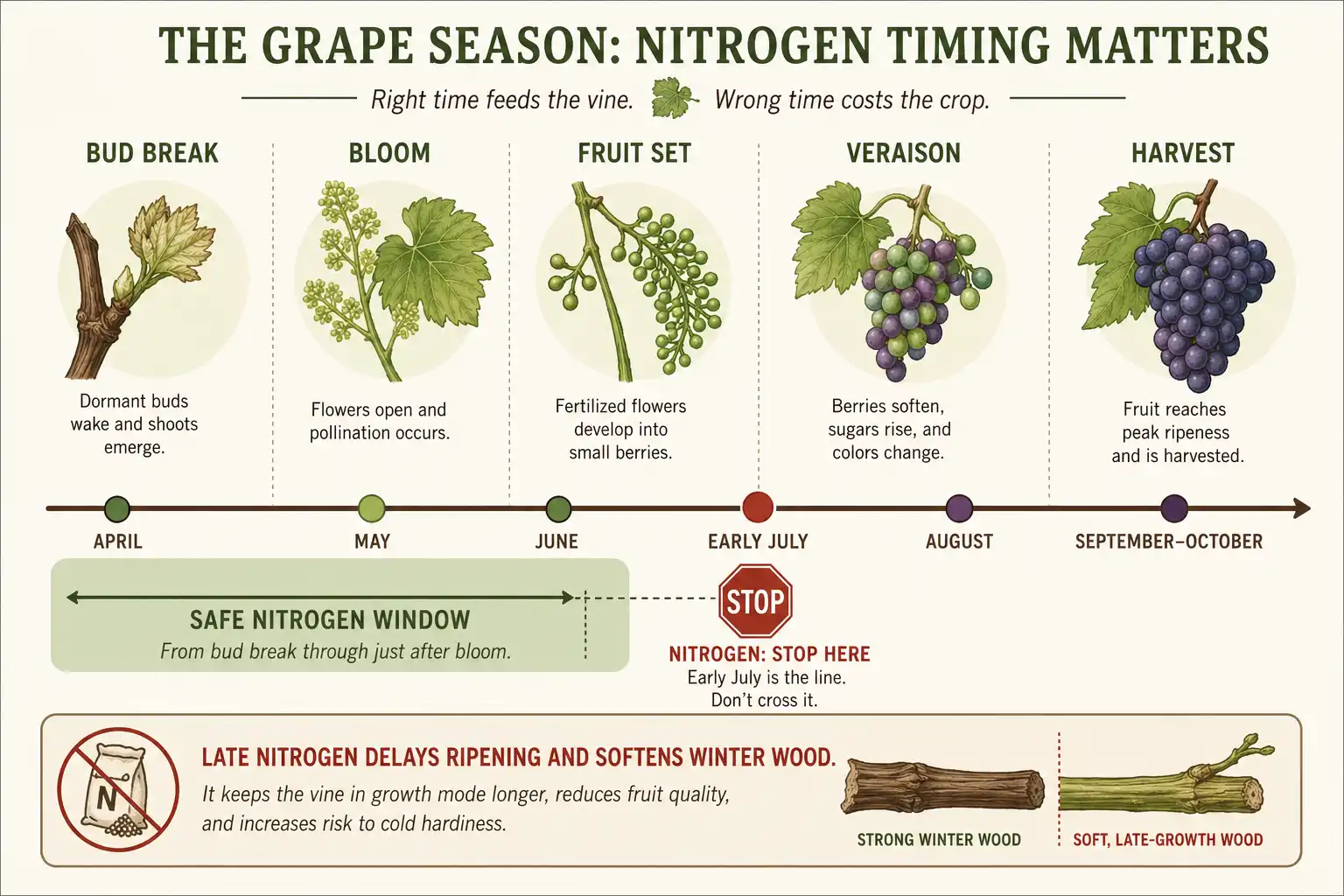
Stop nitrogen by roughly July 4, and never push past veraison. That date is the easiest rule to follow and the one most home growers miss.
Late nitrogen keeps shoots growing when the vine needs to shift energy into ripening fruit and hardening wood. The result shows up two ways. Fruit ripens late with lower sugar, and canes head into winter soft. In USDA zone 6a, the first hard freeze lands in late October. That leaves August and September for canes to lignify. Nitrogen applied in August steals that window.
Potassium, magnesium, and lime follow different rules. Apply those any time, including fall, since none of them drive shoot growth. Compost goes on during dormancy or right at bud break.
How Do You Fertilize Grape Plants in Pots?
Feed potted vines lightly and often, because container mix carries almost no nutrient reserve. Every watering flushes some of it out the bottom. A half strength balanced soluble fertilizer every two to three weeks from bud break through late June works well. A controlled release granular worked into the top inch in spring does the same job with less labor.
Flush the pot with plain water every month or so to move accumulated salts down and out. Potted grape vines also dry out fast, and dry mix concentrates fertilizer salts against the roots. So water first, then feed.
The July cutoff still applies. Stop feeding, keep watering, and let the canes firm up before cold weather arrives.
How Do You Correct Nutrient Deficiencies in Grape Vines?
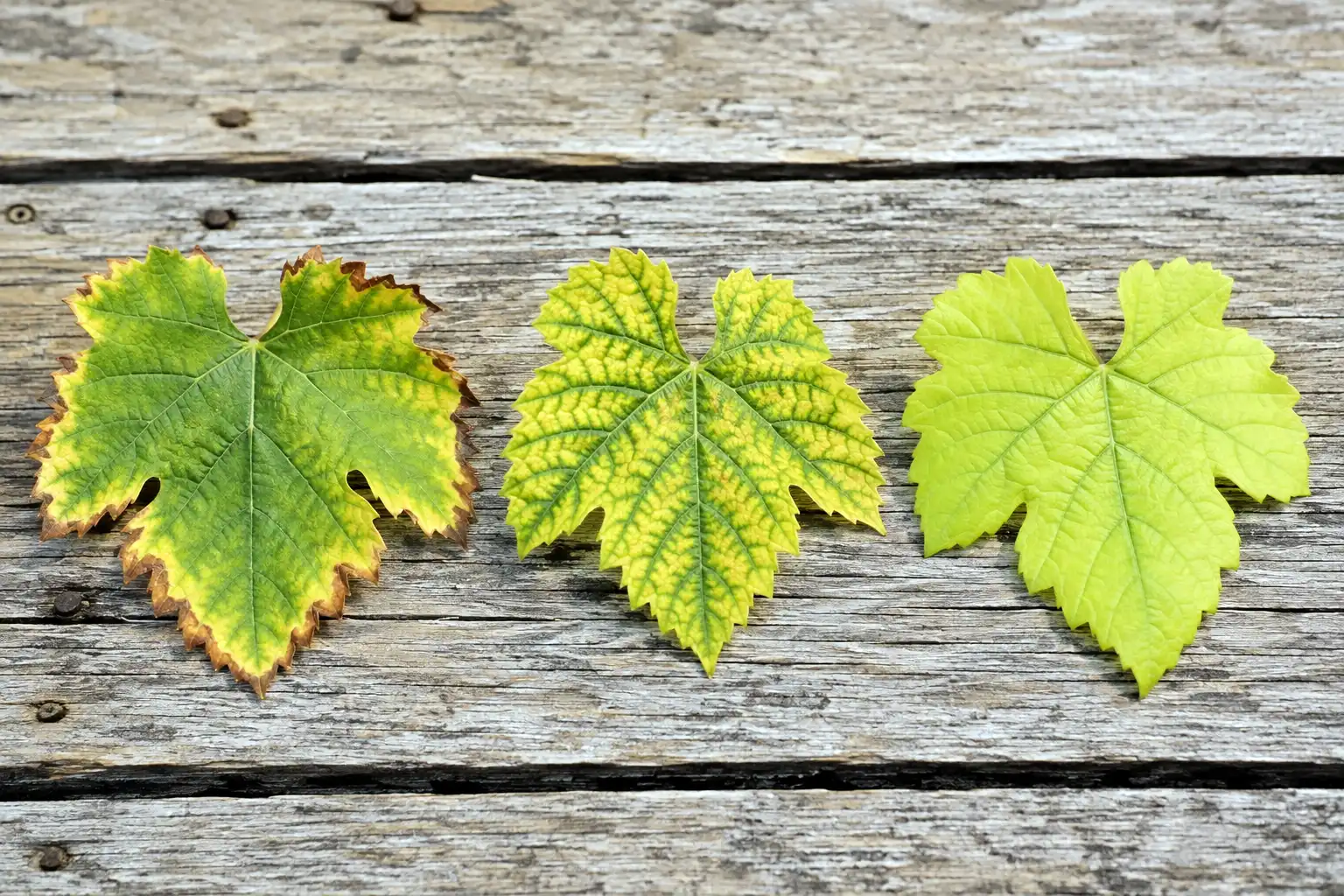
Match the leaf symptom to the nutrient, then confirm it with a petiole test. Correct with either a soil or foliar application. Foliar sprays act fast but fade quickly. Soil applications take longer and last longer.
| Symptom | Likely nutrient | Correction |
|---|---|---|
| Uniform pale green leaves, thin canes, trellis unfilled by August | Nitrogen | 30 to 50 lb actual N per acre next spring, split at bud break and after bloom |
| Leaf margins yellow then die, starting mid cane in early summer | Potassium | Potassium sulfate per soil test; common on sand under 3 percent organic matter |
| Yellow patches between veins on older lower leaves after midseason | Magnesium | Epsom salts foliar at 5 to 10 lb per acre, two or three sprays two weeks apart after bloom |
| Poor fruit set, shot berries, misshapen young leaves | Boron | Light foliar spray near bloom; soil borax about every third year |
| Stunted shoots, small leaves, straggly clusters | Zinc | Foliar zinc a week before bloom or at full bloom |
| Yellowing between veins on the youngest leaves | Iron | Chelated iron foliar; usually a high pH problem, not a supply problem |
Boron deserves extra care. The gap between deficient and toxic runs narrow, so follow the label rate exactly and never guess. Magnesium also goes short on high potassium soils even when magnesium tests fine, because the two compete for uptake.
Do Muscadines Need a Different Program?
Yes. Muscadines take noticeably more fertilizer than bunch grapes, and they carry a higher magnesium requirement. The UGA Extension home program runs like this:
- Year 1: half a pound of balanced blend once the soil settles, then 2 ounces of ammonium nitrate in late May and again in early July, broadcast over a 2 foot circle
- Year 2: same timing, double the rates, widen the circle to 4 feet
- Year 3: 2 pounds of balanced blend in March plus 1 pound in May, over a 6 foot circle
- Established vines: 3 to 5 pounds of balanced blend in March, plus half a pound of ammonium nitrate around June 1
Check pH every three years and lime with dolomitic limestone so magnesium comes along with the calcium. NC State adds two useful limits. Skip fertilizer after the first week of July, and spread compost only during dormancy or early spring. Keep manure, sawdust, and cottonseed meal away from young muscadines completely.
What Goes Wrong When You Fertilize a Grape Vine?
Three misses cause most of the damage: too much nitrogen, fertilizer applied too late, and granules dumped against the trunk. The rest of this list reflects mistakes commonly repeated by growers.
- Feeding first season vines heavily. NC State notes young vines suffer more often than they benefit from first year fertilizer. Establish roots first.
- Reaching for a complete blend when only nitrogen runs short. Phosphorus and potassium then build up with nowhere to go.
- Fertilizer against the trunk. Grape feeder roots sit shallow, so concentrated salt burns them.
- Feeding hard during drought. Salt injury climbs fast once soil moisture drops. Cut the rate, or wait for rain.
- Spreading across the row middles. The cover crop eats it. Band under the vine row instead.
- Adding nitrogen to fix pale leaves that are not short on nitrogen. Wet feet, nematodes, crown gall, and an overcropped vine all cause pale foliage.
That last one costs the most. Testing beats guessing every season.
Final Thoughts on Fertilizing Grape Vines
In USDA zone 6a, soil is typically tested every three years, with petiole samples pulled at bloom. Most seasons, mature vines need nothing but a light nitrogen shot at bud break. Some years they get nothing at all, and the fruit comes in cleaner for it. Start by weighing your prunings this winter. That one number tells you more than any bag label.