How to Fertilize Corn: A Stage by Stage Plan for Higher Yields
Corn pulls more nutrients off a field than anything else. Get the timing wrong and you pay for fertilizer the crop never uses. Knowing how to fertilize corn comes down to four decisions. What to apply, where to place it, when to go, and how many trips.
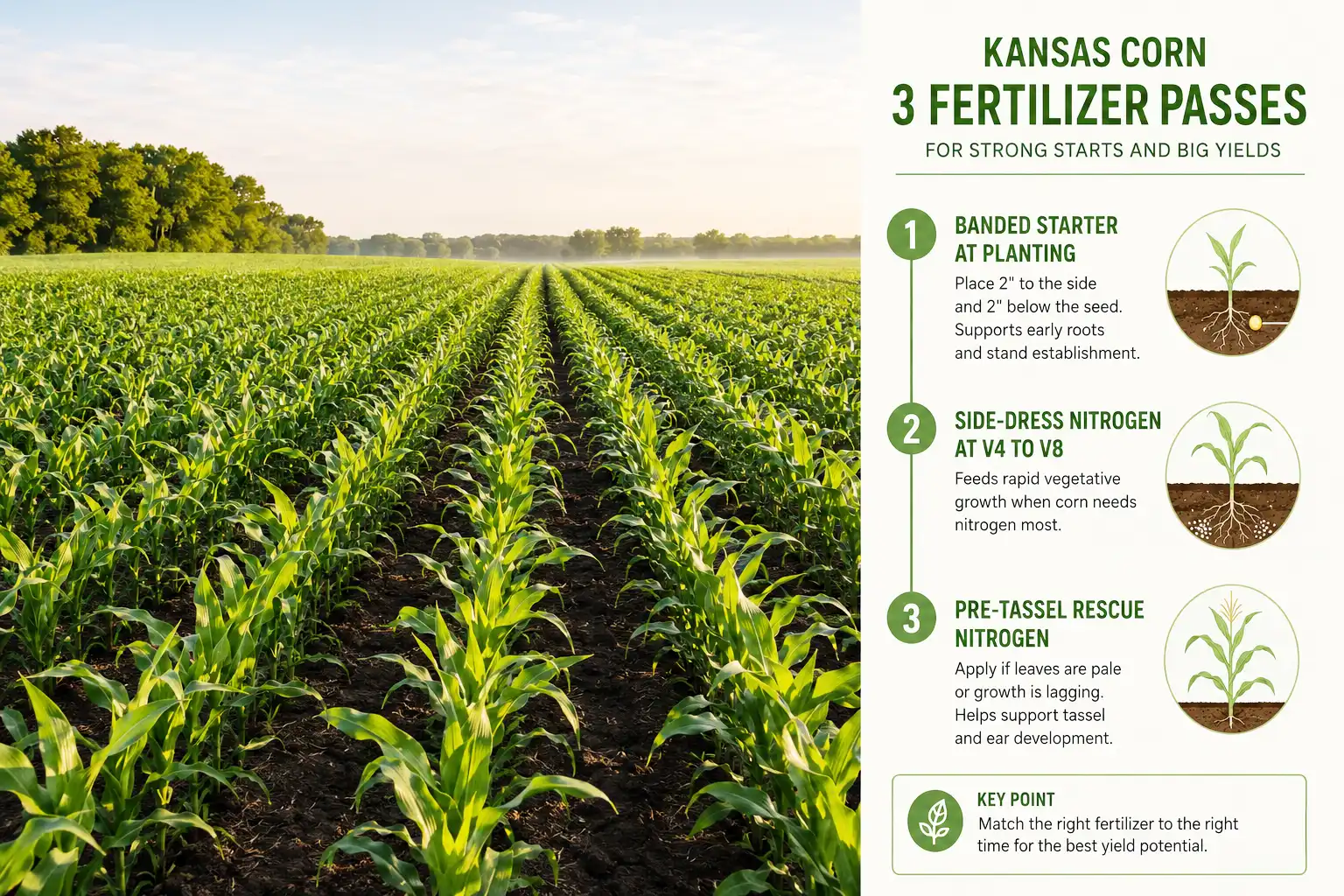
Fertilizing corn breaks into three passes. Band starter phosphorus at planting. Side-dress most of your nitrogen from V4 to V8. Add a rescue shot only if tissue tests show a shortfall.
What Should You Settle Before You Fertilize Corn?
Settle three things first: soil test numbers, soil pH, and a yield goal you can actually hit.
Pull soil cores 6 to 8 inches deep and sample each field on its own. Check phosphorus, potassium, pH, organic matter, sulfur, and zinc every other year on ground. Grid or zone sampling pays off if your fields vary.
Read pH before anything else. Corn performs best between 6.0 and 6.8. Below 5.8, roots take up phosphorus poorly, so ag lime does more for you than another ton of dry fertilizer. Lime also needs months to react, which is why it typically goes down in fall.
Then set a yield goal off your own five-year average, not the best field in the county. From there, subtract credits. Soybeans ahead of corn leave roughly 30 to 40 pounds of nitrogen behind most years, and manure adds more. Skip that step and you overspend.
If you have not tested lately, a mail-in soil testing kit costs less than one acre of wasted nitrogen. K-State Research and Extension and your county NRCS office will both help you read the report.
Once the numbers are in hand, work out your per acre corn fertilizer rate before you price product. Rate first, then product, then placement. That order keeps you from buying a blend that does not match the field.
How and When to Fertilize Corn Across the Season
Corn takes up nutrients on a curve, not evenly. Before V6 it uses less than 12% of its season-long nitrogen. Between V6 and tasseling it takes up roughly 60%, and another quarter comes in after tassel during ear fill. Match your passes to that curve.
| Timing | Stage | What goes on | Why then |
|---|---|---|---|
| Fall or early spring | Preplant | Lime, phosphorus, potassium, part of N | Slow reactors need lead time |
| Planting | VE | Banded starter N and P | Cold soil limits early P uptake |
| 3 to 5 weeks after emergence | V4 to V8 | Bulk of nitrogen plus sulfur | Sits ready before peak demand |
| Pre-tassel | V10 to VT | Rescue nitrogen only | Recovers deficient corn, smaller return |
| Silking onward | R1 to R3 | Fertigation only | Grain fill still pulls nitrogen |
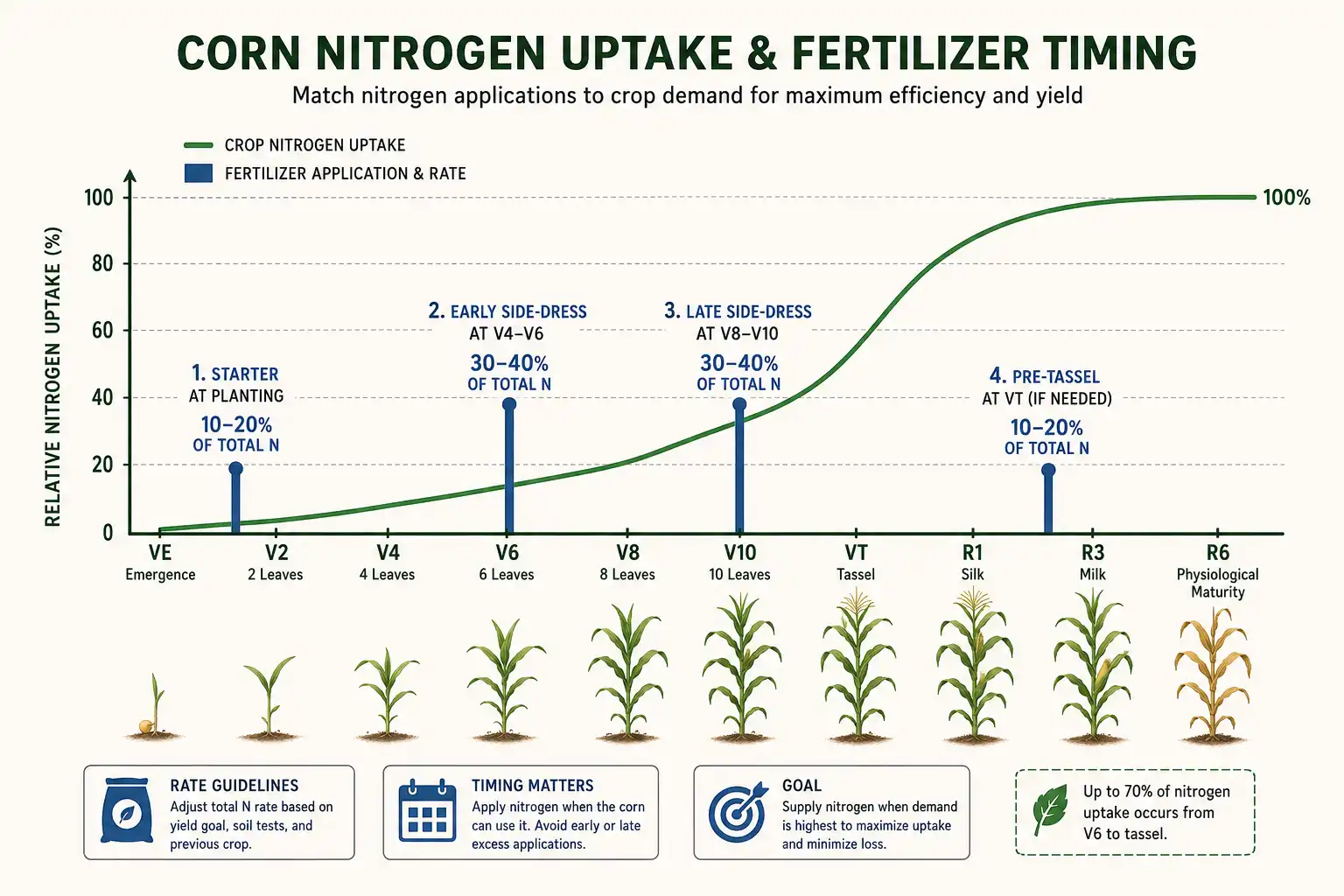
Aim your main side-dress at V4 to V6 even though peak demand starts later. That cushion covers a rainy week or a broken applicator. University of Minnesota work found V4 to V8 the best window. V12 timing gave up yield, because the crop already went hungry.
Phosphorus and potassium behave differently. Both stay put in most soils, so fall or spring preplant works fine. Nitrogen and sulfur move with water. Hold most of both until the crop is up and growing.
How to Apply Fertilizer to Corn: Placement Options
Placement decides how much of your fertilizer the crop actually reaches. Five methods cover nearly every corn acre in the country.
- Broadcast and incorporate. Spread dry P and K, then work it in. Cheapest per acre, and fine for immobile nutrients.
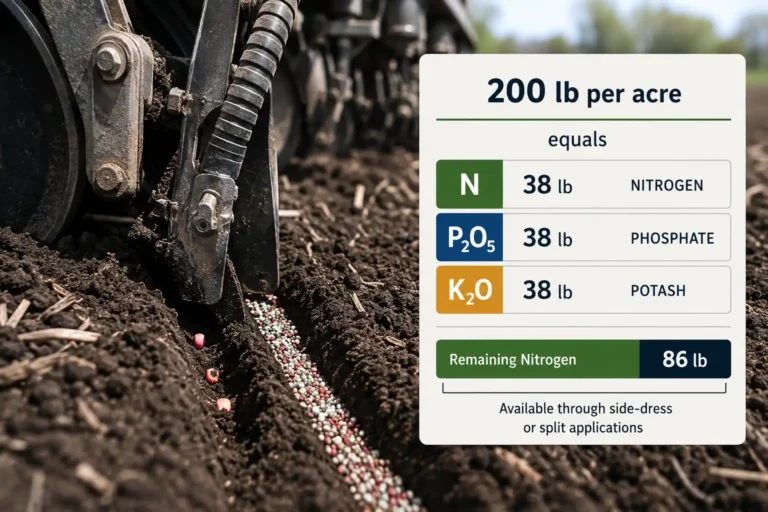
- 2×2 band. Place fertilizer 2 to 3 inches beside and 2 to 3 inches below the seed. K-State trials show you can run a full nitrogen rate safely here.
- 2×0 surface dribble. Band beside the row on the surface at planting. Results run close to 2×2, and it suits no-till with row cleaners.
- In-furrow pop-up. Fertilizer rides with the seed. Keep N plus K2O under 6 to 8 pounds per acre on 30-inch rows, or salt injury cuts your stand.
- Injected or coulter applied. Knife anhydrous ammonia or inject UAN below the surface. Loss stays low because the nitrogen never sits on top.
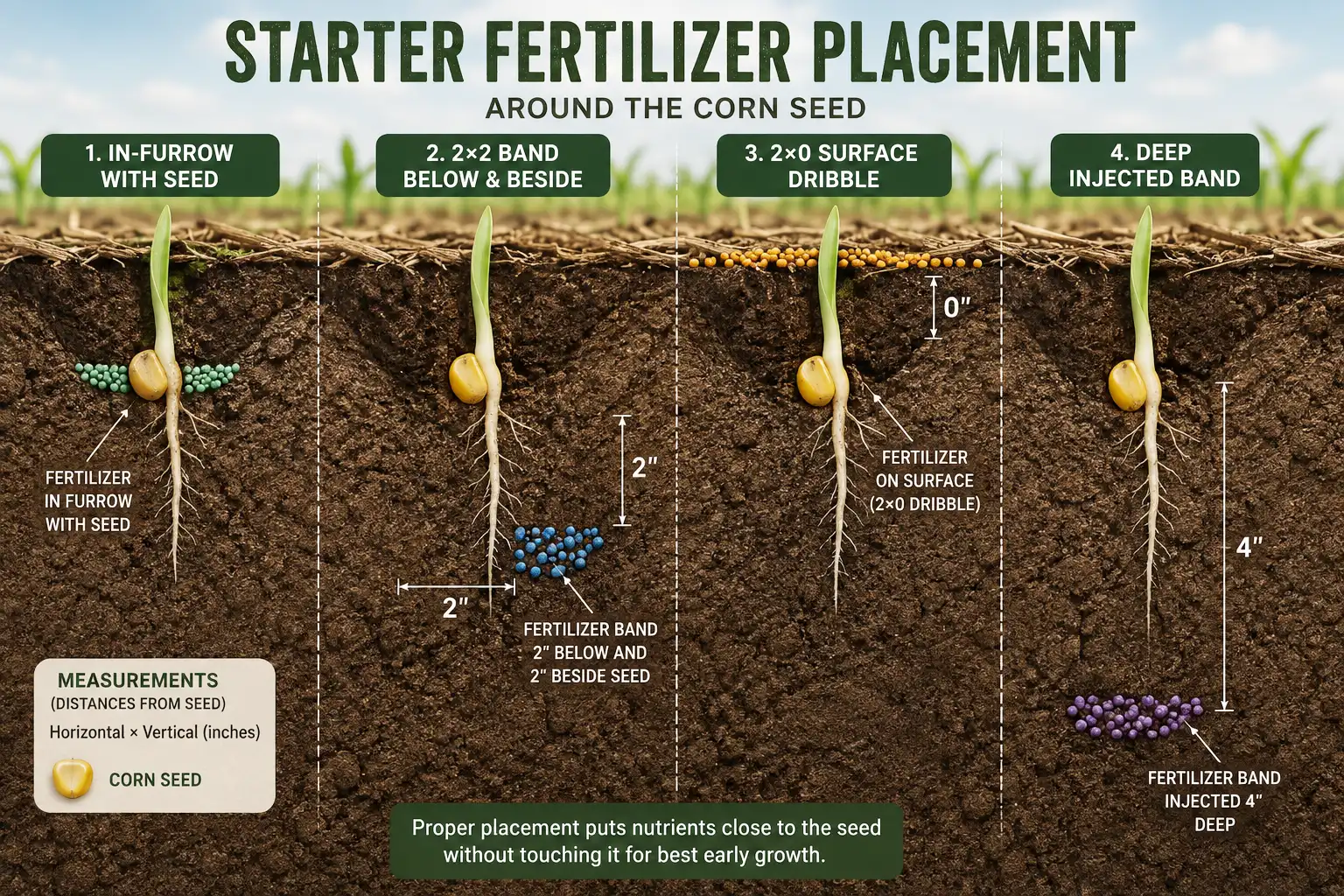
Never put urea or UAN in the furrow, whatever the rate. Urea converts to ammonia, and ammonia kills seedlings. Ammonium thiosulfate carries a high salt load too, so keep it out of seed contact.
Your equipment sets the ceiling here. A well-calibrated dry spreader handles broadcast work, while banding takes planter attachments or a side-dress bar. Compare fertilizer choices for corn against what your planter can actually deliver before you order.
How to Fertilize Corn After Planting
After planting, your main job is the nitrogen side-dress between V4 and V8. Corn stands 8 to 18 inches tall then, and a high-clearance rig still clears it easily.
Run a side-dress bar with knives or coulters and place UAN 4 to 6 inches beside the row. Injecting beats surface dribbling because you cut volatilization to almost nothing. Roots will find it either way, since the corn root system spreads fast at that stage.
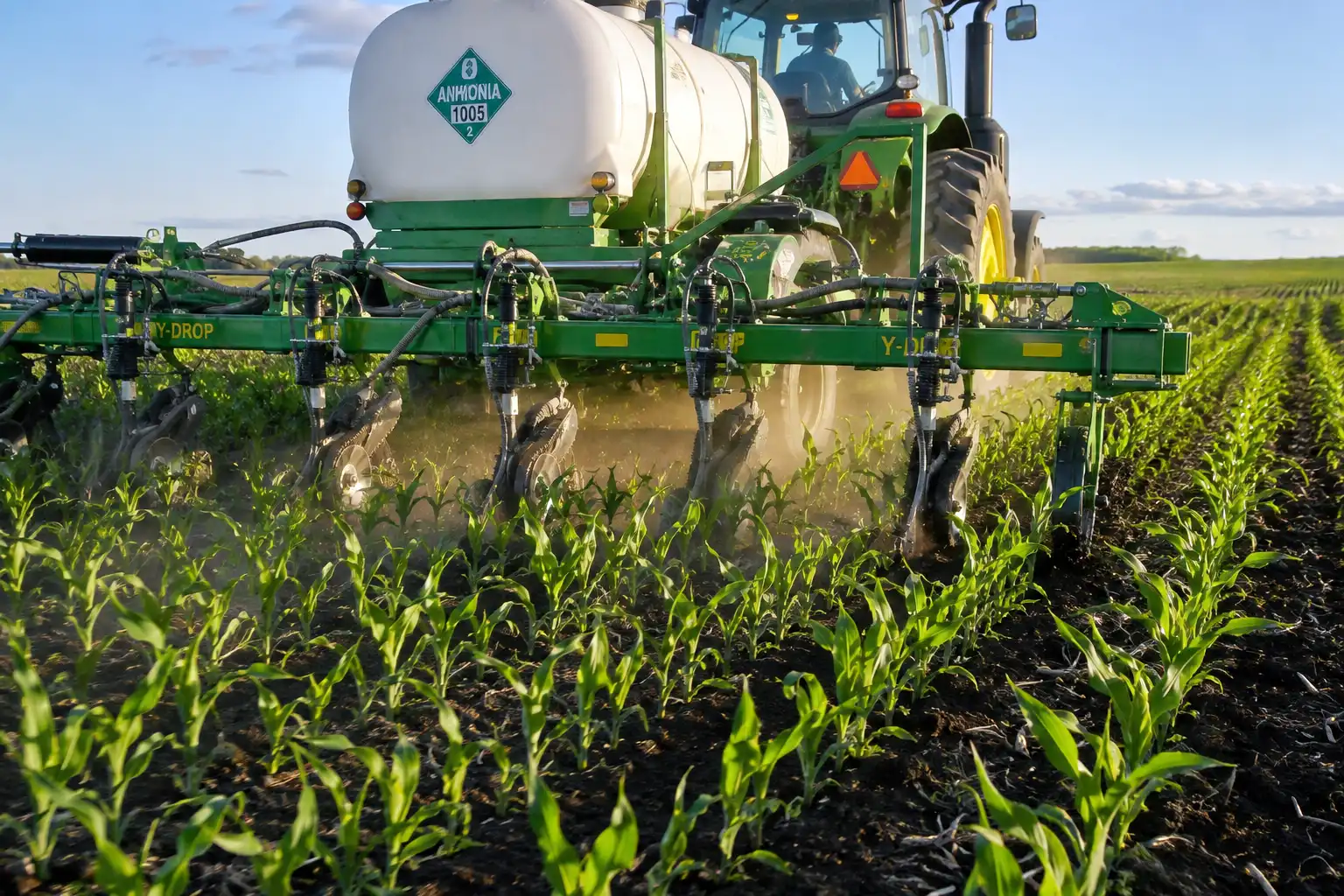
Broadcasting dry urea works, but only with care. Surface-applied urea fertilizer at 46-0-0 can lose double-digit percentages of its nitrogen to the air within days. Two habits fix most of that:
- Apply within 24 hours of a forecast rain of a quarter inch or more.
- Treat the urea with an NBPT urease inhibitor at a full label rate.
Even treated urea needs moisture inside about 10 days. Dry stretches are common in the Great Plains. So it helps to use injected UAN instead of top-dressed urea most seasons.
Sulfur pairs well with this trip. Blend ammonium thiosulfate into your UAN, or run ammonium sulfate with dry nitrogen. Both put sulfate sulfur right where the crop needs it during rapid growth.
Watch your growth stage, not the calendar. Warm springs push corn through V4 fast, so scout weekly once the crop emerges.
How Often to Fertilize Corn in One Season
Two or three trips suit most corn acres. One pass works on heavy soils in dry regions, while four or more fits irrigated sand.
Here is how to sort it:
- Single pass: All nitrogen preplant or at planting. Simple and cheap, but a wet June can strip it.
- Two passes: Starter at planting plus one side-dress at V4 to V8. This covers the majority of Corn Belt and Great Plains acres.
- Three passes: Starter, side-dress, then Y-drops or fertigation before tassel. Worth it on irrigated ground and sandy fields.
Corn-on-corn changes the math. Heavy residue ties up nitrogen early, so push a bigger share to preplant or planting. Corn after soybeans tolerates a smaller starter and a heavier side-dress.
Splitting spreads your risk, not just your cost. Nitrogen sitting in warm wet soil leaches or denitrifies, and you cannot get it back. Splitting also lets you adjust mid-season if stand counts or rainfall change your yield outlook.
Phosphorus and potassium do not need splitting. One application per year covers both, and many farmers apply enough for two crops at once.
How to Fertilize Corn Plants in a Garden or Small Plot
For garden corn, work a complete fertilizer into the soil before planting, then side-dress nitrogen twice as the plants grow.
Follow this sequence:
- Before planting: Work in 25 pounds of 10-10-10 per 1,000 square feet, or 6 pounds per 100 feet of row. Compost helps too, but hold it to about 1 inch worked into the top 6 inches.
- At 8 to 12 inches tall: Side-dress 1 pound of a high-nitrogen product such as 27-3-3 per 100 feet of row. K-State horticulture uses this rate.
- At first tassel or silk: Repeat that same rate to carry ear fill.
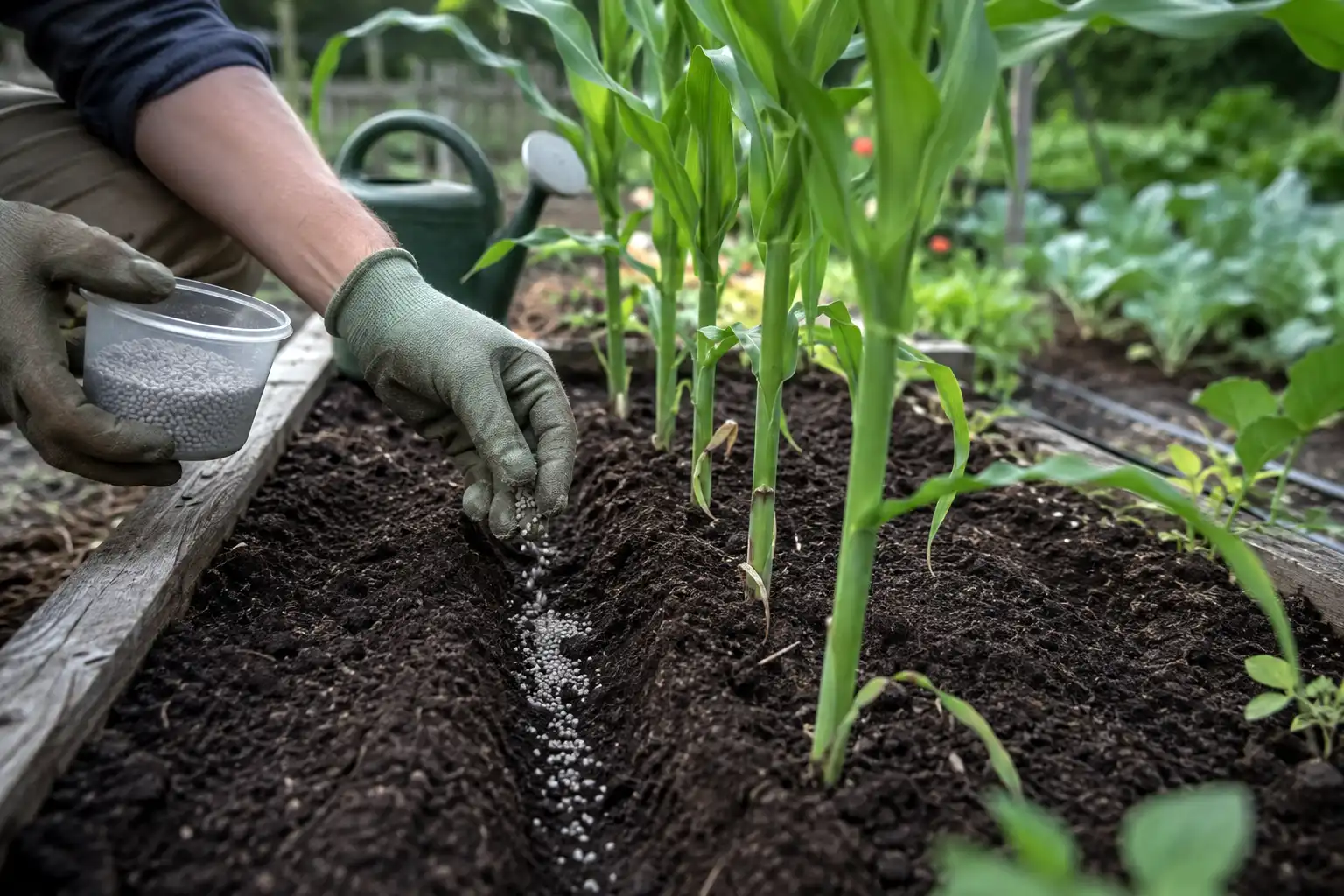
Place granules 3 to 6 inches out from the stalks, scratch them in, then water. Fertilizer touching leaves or stems burns tissue. Skip any product labeled weed and feed, because the herbicide will kill your corn.
Sandy soil or heavy rain calls for a third feeding. Otherwise twice per season is plenty for garden corn plants.
Container corn needs more frequent attention. Feed every two to three weeks with a diluted liquid product, since watering flushes nutrients straight through the pot.
How to Fertilize Field Corn Versus Sweet Corn
Field corn and sweet corn follow the same nutrient curve, but the scale and the finish differ.
Field corn runs on per-acre programs, growth-stage timing, and machinery. You measure in bushels and pounds of actual nitrogen. Sweet corn runs shorter, and you pick it green. It needs a lighter final feeding too, because you harvest at the milk stage instead of black layer.
Sweet corn also sits in smaller blocks where a late nitrogen shot is easy. Field corn at V12 is hard to reach without a high-clearance rig. Growing a sweet corn patch instead? Our guide on feeding sweet corn through the season breaks that three-stage plan down further.
One rule holds for both. Phosphorus early builds roots, nitrogen mid-season builds yield, and potassium builds stalk strength. Shorting potassium shows up at harvest as lodged corn, not as pale leaves.
Does Your Corn Field Need Sulfur, Zinc, or Lime?
Many corn fields do, and sulfur has become the most common shortfall in the last decade. Cleaner air means far less sulfur falls out of the sky than it once did, while higher yields remove more.
- Sulfur: Apply 15 pounds per acre on fine-textured soil and 25 pounds on coarse soil when a deficiency shows. Use sulfate forms such as ammonium sulfate, gypsum, or ammonium thiosulfate. Elemental sulfur takes months to convert, so it only works as maintenance.
- Zinc: Deficiency hits sandy, eroded, or high-pH soils hardest. Apply 1 to 2 pounds of actual zinc as starter, or 5 to 10 pounds broadcast. Zinc sulfate runs about 33% zinc, so 3 to 6 pounds of material covers the starter rate.
- Lime: Below pH 5.8, lime first. No fertilizer program fixes an acid soil.
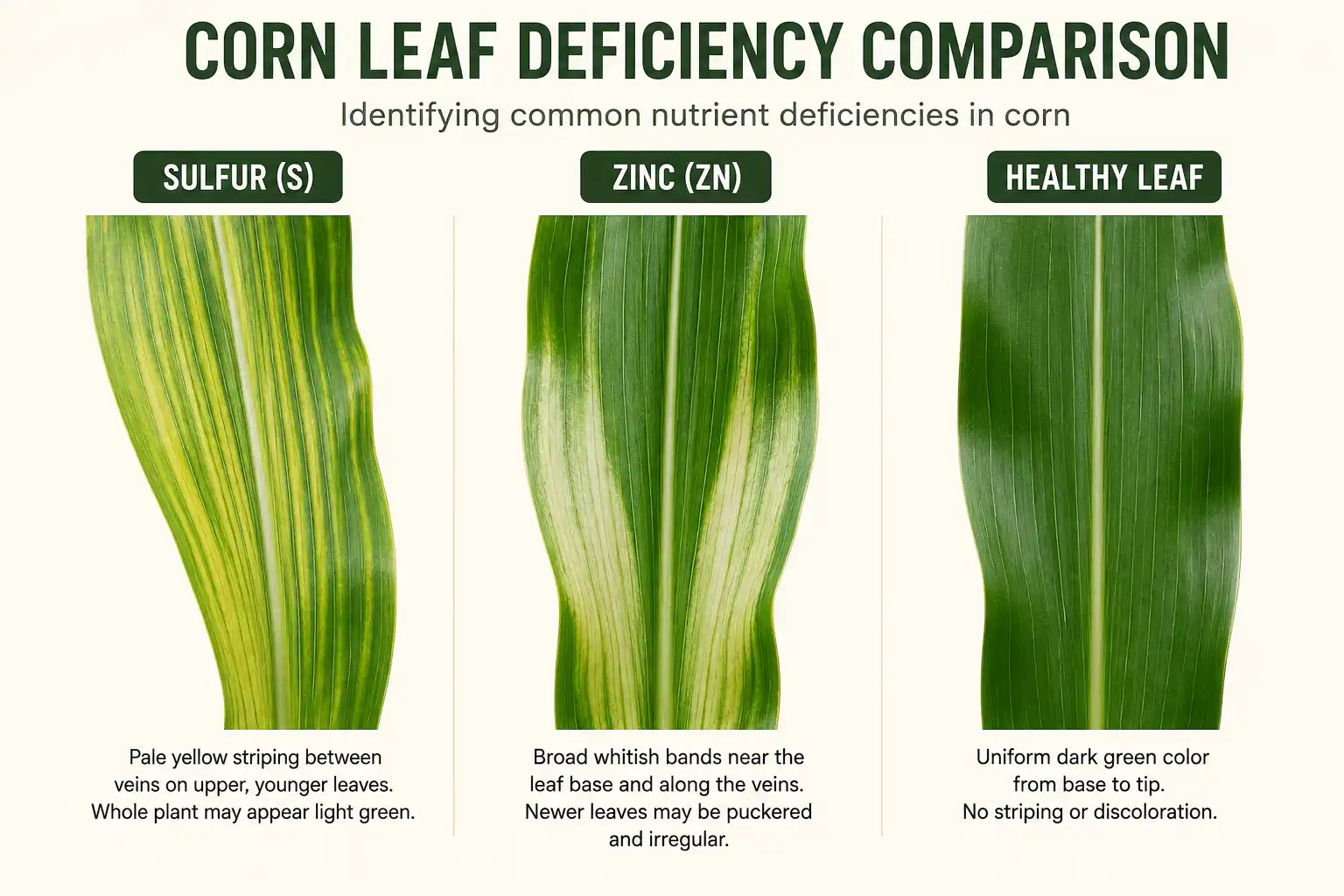
Sulfur deficiency looks like pale yellow striping on the newest upper leaves. Zinc deficiency shows broad whitish stripes near the base of young leaves plus stunted plants. Nitrogen shortage works the opposite direction, starting on the lowest leaves.
Watch your spreader pattern with sulfur products. Ammonium sulfate and gypsum do not throw as far as potash, so a spinner spreader can streak the field. Pre-blended products like MESZ solve that problem in a single pass.
How Do You Know If Corn Needs More Fertilizer?
Read the plant, then confirm with a tissue test. Corn tells you plenty before yield suffers, if you look at the right leaves.
Nitrogen shortage starts at the bottom of the plant. Lower leaves fade from the tip back along the midrib in a V shape. The whole field looks light green. Potassium shortage yellows and scorches the lower leaf margins from the tip inward. Phosphorus shortage shows purple on young plants, though cold soil causes that too.
For a tissue test, timing decides what you sample:
- V5 to V6: Cut whole plants an inch above the ground for phosphorus and potassium.
- Silking (R1): Pull 15 to 20 ear leaves, the leaf opposite and below the ear, before silks brown.
- Any time, diagnostic: Sample a good area and a bad area of the same field and compare.
Ear leaf nitrogen belongs between 2.75% and 3.50% at tassel. Sitting near 3.0% at V10 is a warning sign, because tissue concentration drops as the plant bulks up.
Rescue nitrogen still pays if you catch it early. Purdue work recovered significant yield with applications as late as V13 to V15. Past tassel the return shrinks fast, and 30 to 60 pounds per acre is the practical ceiling. Confirm how much nitrogen corn needs before you commit to a rescue trip.
Fertilizer Mistakes That Cost Corn Yield
Four errors show up on this ground and neighboring ground more than any others.
- Skipping the soil test. You cannot credit what you never measured. Two years of guessing costs more than a decade of tests.
- Broadcasting urea ahead of a dry spell. Nitrogen leaves as ammonia gas, and no rain means no recovery.
- Overloading the seed furrow. More starter is not better. Past 6 to 8 pounds of N plus K2O, you trade stand for early color.
- Waiting too long to side-dress. Corn starved at V6 never fully recovers, even with heavy nitrogen at V12.
One more worth naming: chasing early color. Dark green corn at V4 looks good and means little. Yield gets set from V10 through grain fill, so put your nitrogen where it counts.
FAQs About Fertilizing Corn
How often should you fertilize corn plants in a garden?
Can you fertilize corn after it tassels?
What is the best nitrogen source for corn?
Should you put fertilizer in the hole when planting corn?
Does corn need fertilizer every year?
How to Run a Corn Fertility Plan in Kansas
Test soil in fall, lime when pH slips under 6.0, and apply phosphorus and potassium ahead of the planter. At planting, a light starter is banded in a 2×2, never in the furrow. Then the bulk of the nitrogen is injected with sulfur at V5. A rescue rate is also kept budgeted, in case June turns wet. Start with the soil test and the growth stages. Everything else follows from those two.