How to Calculate Corn Yield by Ear Before You Harvest
A good corn yield estimate weeks before harvest tells you how much storage, drying, and trucking to line up. Learning how to calculate corn yield by ear gives you that number. A few ear counts and simple math, no combine required.
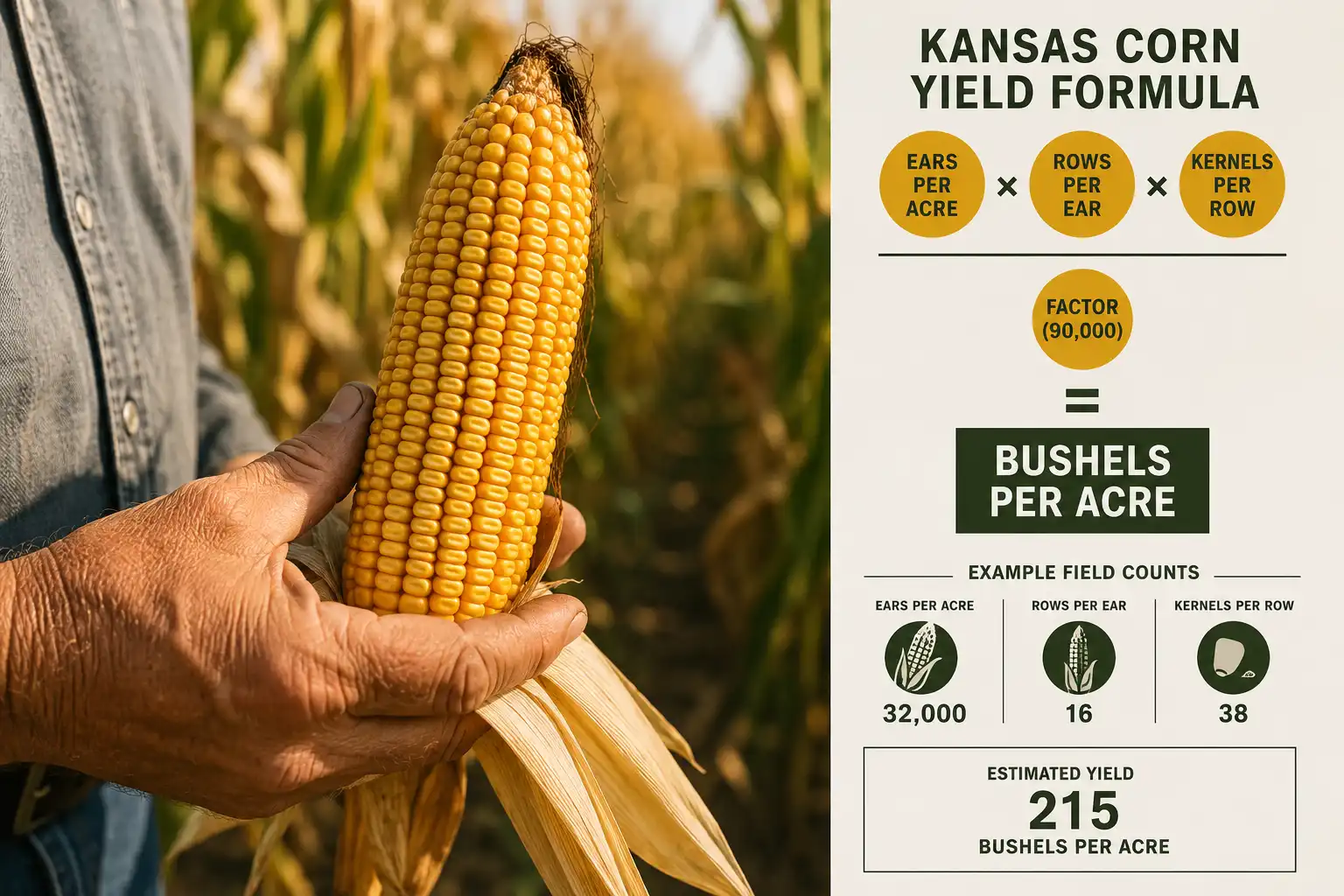
To calculate corn yield by ear, multiply ears in 1/1000 acre by average kernel rows and average kernels per row, then divide by a kernel weight factor (80 to 85). The result is estimated bushels per acre.
How Do You Calculate Corn Yield by Ear?
You calculate corn yield by ear by counting ears and kernels, then dividing by a weight factor. That gives you bushels per acre.
Here is the exact formula in the field:
Yield (bu/acre) = (Ears in 1/1000 acre × Avg kernel rows × Avg kernels per row) ÷ Kernel weight factor
This is the Yield Component Method. The University of Illinois first developed it. The method estimates how many kernels sit on an acre, then converts that kernel count into a market bushel. A corn bushel always weighs 56 pounds at 15.5% moisture. So the factor stands in for average kernel weight until the grain reaches black layer.
Three of the four numbers come easy right in the field. Kernel weight is the tricky one, because it keeps changing until the crop matures. So the method gives you a strong estimate, not a guarantee.
Know more: How Much Corn Can You Grow Per Acre? (Yield Guide)
What Do You Need Before You Start?
You need three things: the right timing, a tape measure, and a way to record counts. Timing matters most, so nail that first.
- Timing: Wait until at least the milk stage (R3), once kernels set and you can count them. Your estimate tightens as the crop nears black layer (R6).
- Tape measure or marked rope: You will measure a set length of row at each spot.
- Notepad or phone: Track ear counts, kernel rows, and kernels per row so you can average them later.
Pick a field and hybrid you know well. Then walk in past the end rows before you count, since border plants never represent the field.
Step 1: How Do You Count Ears in 1/1000th of an Acre?
Count every harvestable ear in a length of row that equals 1/1000 acre. The length depends on your row spacing, because narrower rows pack more feet of row into the same ground.
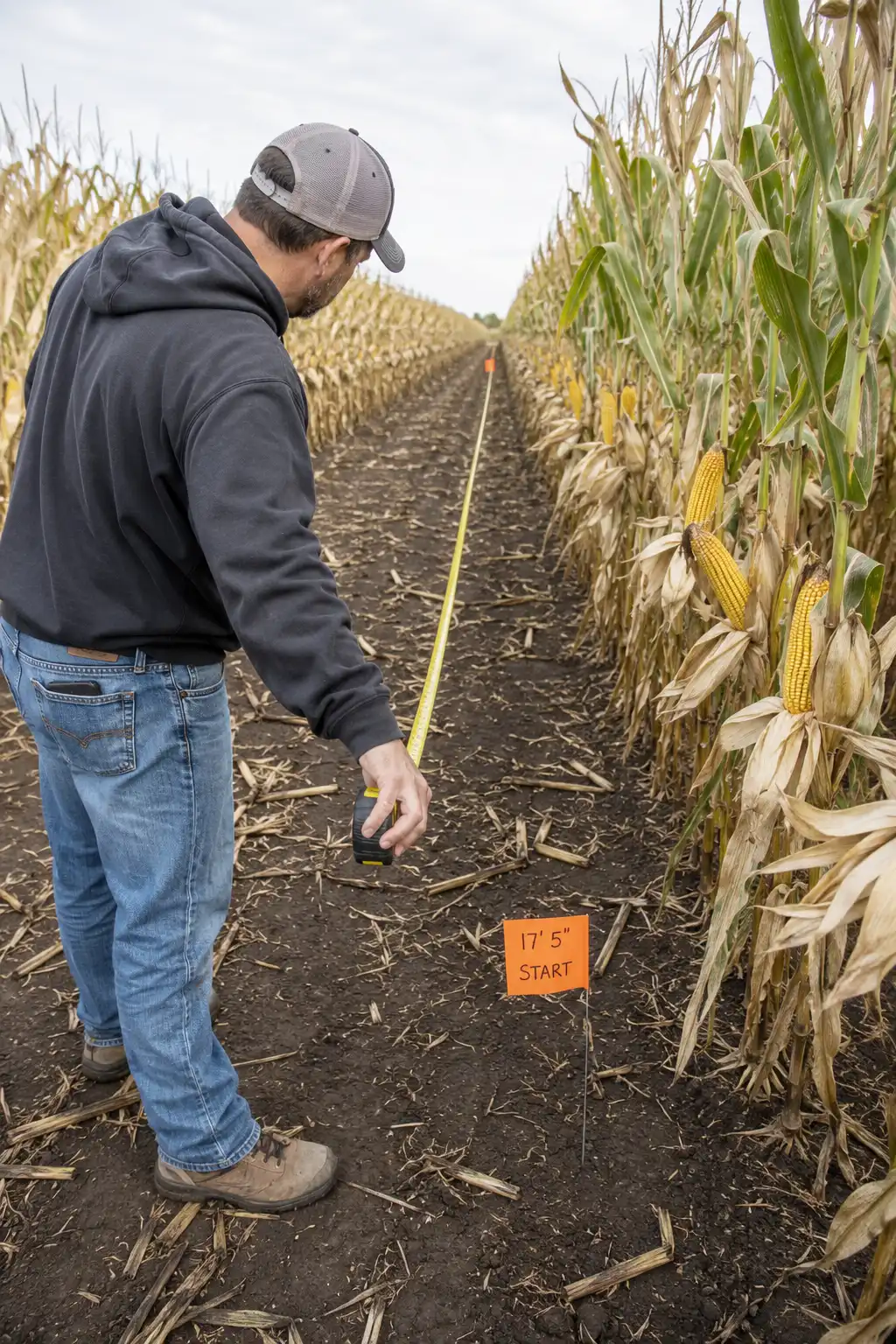
Here are the row lengths to measure for one thousandth of an acre:
| Row spacing | Length of row to measure |
|---|---|
| 15 inches | 34 ft 10 in |
| 20 inches | 26 ft 2 in |
| 30 inches | 17 ft 5 in |
| 36 inches | 14 ft 6 in |
| 38 inches | 13 ft 9 in |
For any spacing, the math stays simple: divide 43.56 by your row width in feet. A 30-inch row runs 2.5 feet wide, so 43.56 ÷ 2.5 gives 17.4 feet, which rounds to 17 ft 5 in.
Now stretch your tape down one row, mark the start and end, and count every ear that will make grain. Skip nubbins and dropped ears that a combine would leave behind. On strong stands you usually see close to one ear per plant. Still, how many ears grow on a stalk shifts with population and stress.
Step 2: How Do You Count Kernel Rows and Kernels per Row?
Pick every fifth ear from your sample. Then count the kernel rows around each ear and the kernels down one row. Average both numbers across the ears you check.
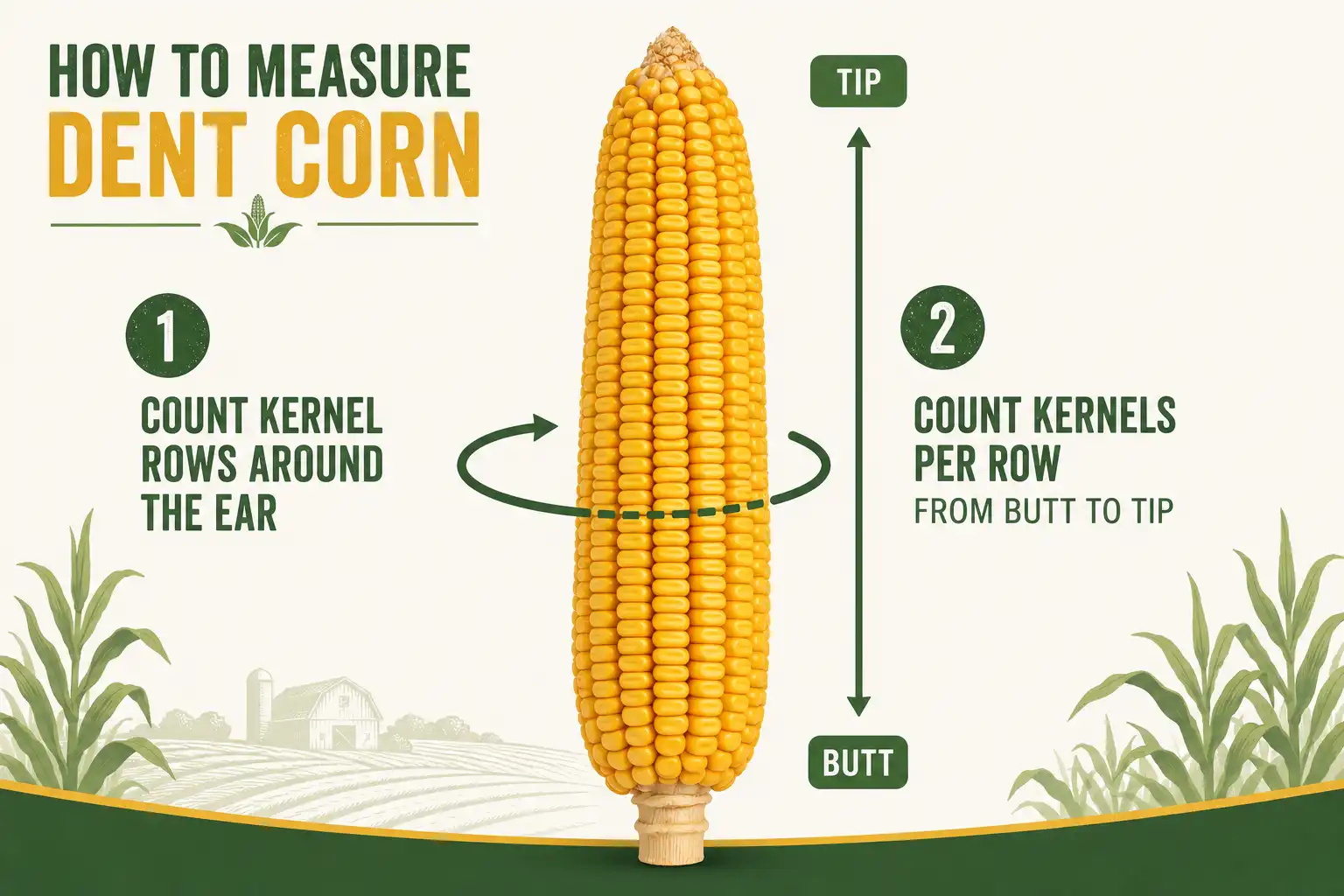
Take two counts on each sampled ear:
- Kernel rows: Count the rows that circle the ear. Dent corn usually runs 14 to 18 rows, and that number is almost always even.
- Kernels per row: Count the kernels along one full-length row from butt to tip. Do not count kernels smaller than half a normal kernel, since those often abort or shell out light.
Next, multiply rows by kernels per row to get kernels per ear. A typical ear lands between 450 and 650 kernels, but your own count is what matters here. If you want a feel for the range, look at how the kernels on a single cob add up. They vary a lot across different ears.
Step 3: Which Kernel Weight Factor Should You Use?
Use 80 to 85 as your default kernel weight factor, which reflects modern hybrids. Growers often call this number the fudge factor, and it represents thousands of kernels in a 56-pound bushel.
Older guides used 90 (90,000 kernels per bushel). Kernels have grown larger as genetics improved. So Bob Nielsen at Purdue University now points growers toward 80 to 85, about 85,000 kernels per bushel. Actual counts range widely, from under 65,000 to over 100,000 kernels per bushel, depending on hybrid and weather.
Match the factor to what you see on the ear:
- Large, deep, heavy kernels (good grain fill): use 75 to 80.
- Average kernels: use 85 to 90.
- Small, shallow kernels (drought or stress): use 95 to 105.
A smart move is to run the math three times, with a low, medium, and high factor. That way you get a yield range instead of one shaky number. The factor is the only spot where kernel size enters. After all, the weight of a corn bushel stays fixed at 56 pounds.
A Worked Example
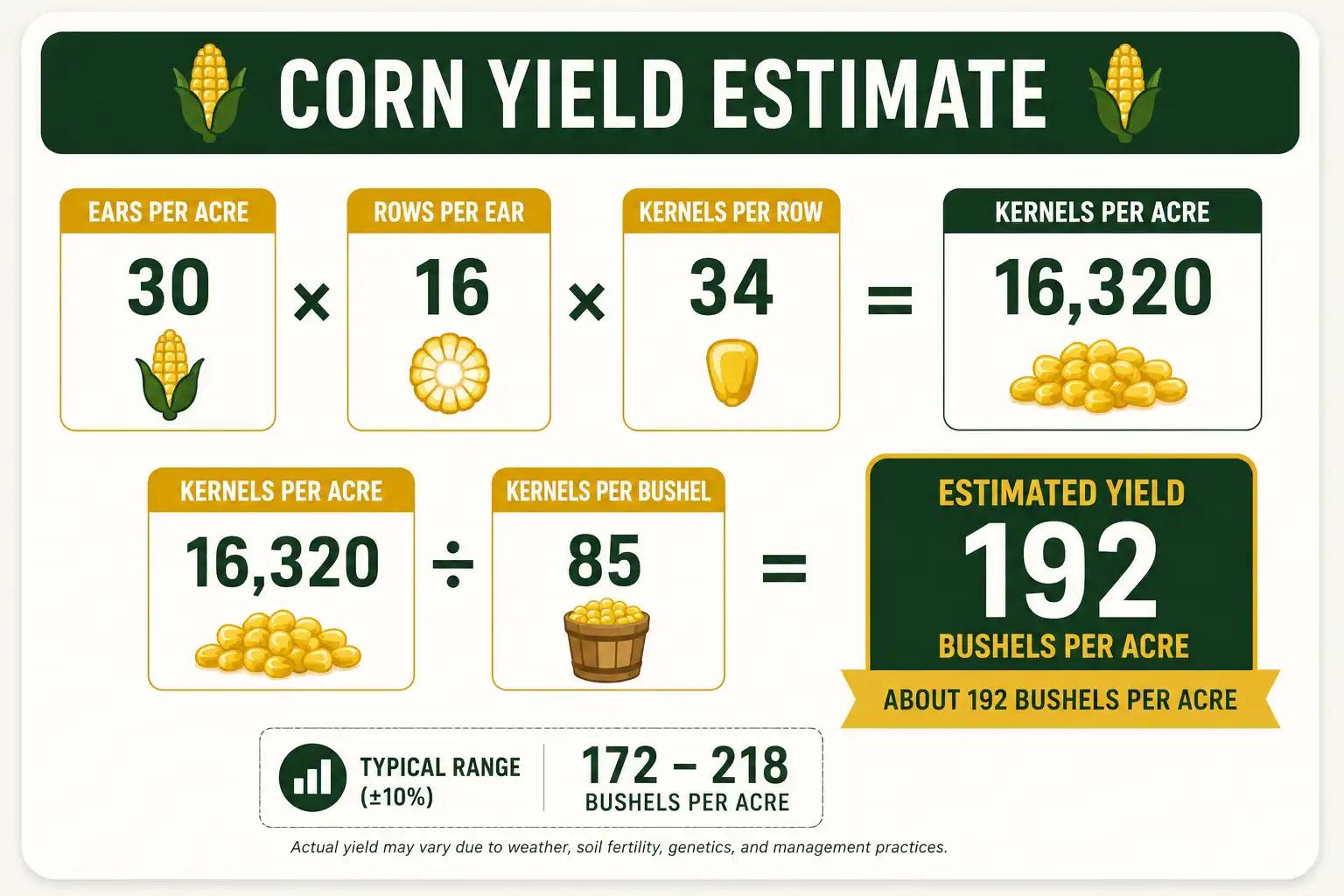
Say a measured 17 ft 5 in of a 30-inch row contains 30 ears. On every fifth ear, an average of 16 kernel rows and 34 kernels per row is tallied.
Here is the math:
- Kernels per ear: 16 × 34 = 544
- Plug into the formula: (30 × 16 × 34) ÷ 85
- Result: 16,320 ÷ 85 = about 192 bushels per acre
Now run it with a factor of 75 and you get 218 bu/acre. Run it with 95 and you drop to 172 bu/acre. That spread, roughly 172 to 218, is your honest range for the spot. The true number settles inside it once the kernels finish filling.
How Many Spots Should You Sample?
Sample at least three representative spots, and add more if the field looks uneven. One count never speaks for a whole field.
Walk to different areas that reflect the bulk of your acres. Skip the end rows, the border rows, and any odd patches. That means a drowned-out low spot or a lush waterway, unless it covers a big share of the field. Then average the yield estimates from all your spots for the field number. On variable ground, five or six spots beat three every time.
When Is the Best Time to Estimate Corn Yield?
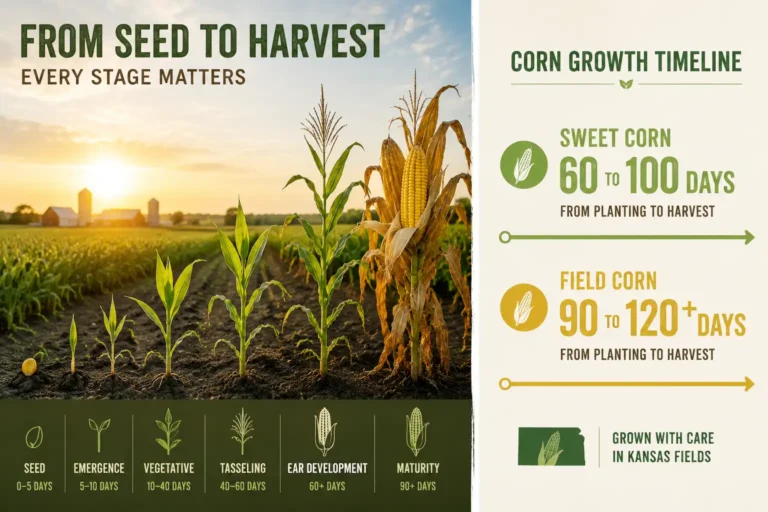
Estimate any time from the milk stage (R3) onward, but trust the number more as the crop nears maturity. Early counts can miss late kernel abortion, so they run less reliable.
Kernel number locks in first. After that, kernel weight builds through the dough (R4) and dent (R5) stages. The closer you sample to black layer (R6), the less the factor has to guess. Here run a first pass around dough stage for planning, then a firmer check near dent. Strong pollination sets the kernel count you are counting. So planting corn in blocks for better pollination pays off in these numbers too.
How Accurate Is the Ear Count Method?
The ear count method gives a ballpark, usually within about 20 bushels of final yield. It leans high in poor grain-fill years and low in excellent ones.
The formula assumes an average kernel weight that the season may not deliver. When a dry spell shrinks kernels during grain fill, the method overestimates. The kernels themselves then weigh less than the factor expects. In a strong finish with heavy kernels, it underestimates instead. So treat every result as a planning figure for storage, drying, and marketing, not a guaranteed scale ticket.
The Ear Weight Method: A More Accurate Late-Season Option
Use the ear weight method after black layer for a tighter estimate. Since it weighs actual ears instead of assuming kernel weight, it usually beats the ear count method. That edge shows up late in the season.
The steps run close to the first method. Measure 1/1000 acre, count harvestable ears, then weigh every fifth ear and average the weight. The formula still carries a small factor for shellout percentage, because grain moisture and cob weight vary. This method only works once the grain reaches physiological maturity, around 30% to 35% moisture. If you want a feel for the weights, check what a corn ear weighs at harvest moisture. That lets you sanity-check your average.
Bottom Lines
Count ears and kernels every year before the combine rolls. A solid estimate tells me how much bin space, propane, and trucking to line up. Take three or more spots. Use a factor that matches your kernel size. Then run a low-to-high range instead of one number. Do that, and you walk into harvest with a plan instead of a guess. On the Great Plains, that same habit of measuring before acting keeps overall yields climbing. It pays off season after season.