How Many Pounds of Corn Seed Per Acre? (2026 Field Guide)
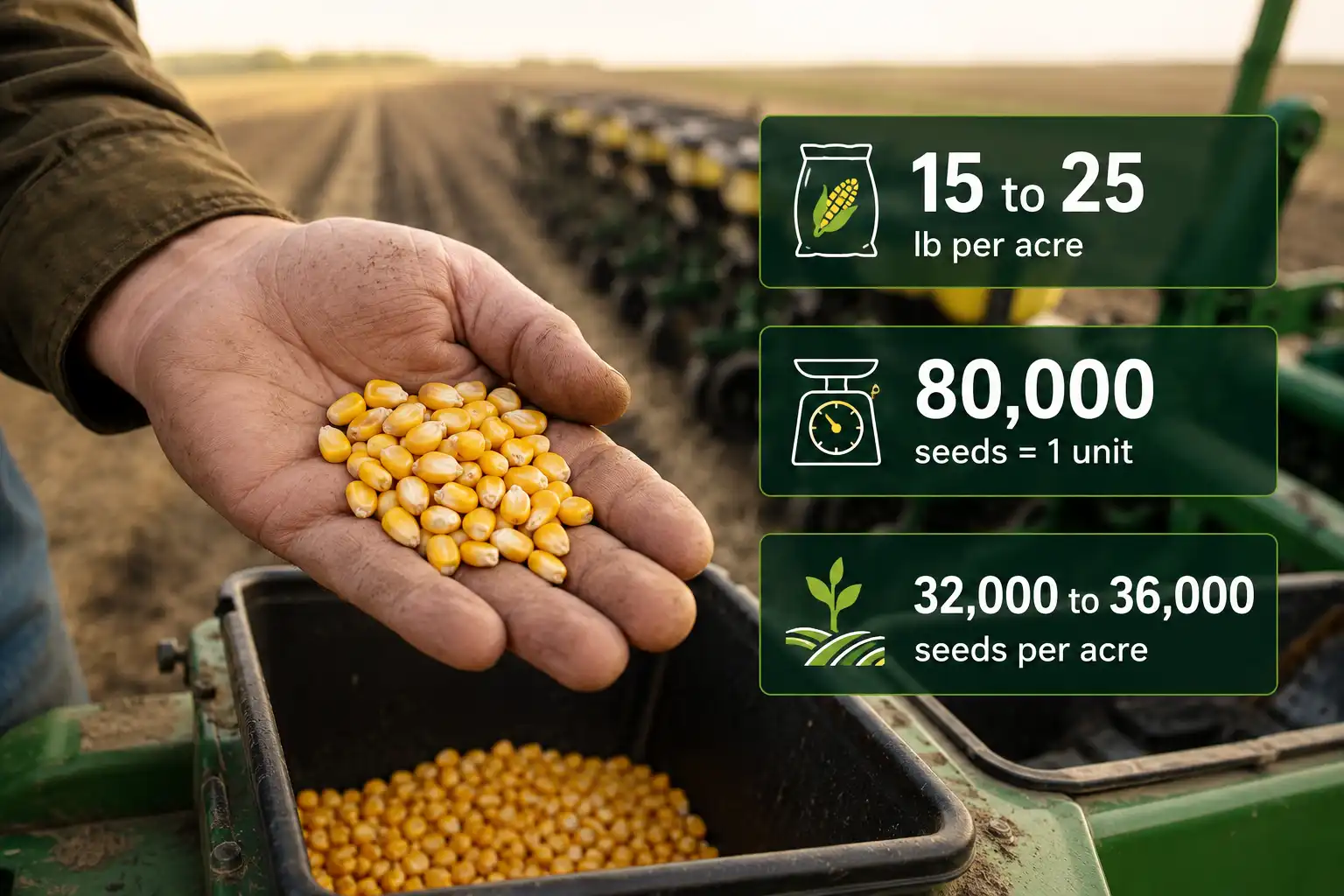
The pounds of corn seed per acre you need depends on one thing most charts skip: seed size. Seed companies sell corn by count, not weight, so two bags with the same count can weigh very differently.
Plan on roughly 15 to 25 pounds of corn seed per acre for grain, usually near 18 pounds. The exact weight depends on seed size, since an 80,000-seed unit weighs 35 to 59 pounds. Buy by count, not weight.
Why Corn Seed Is Sold by Count, Not by the Pound
Seed companies sell corn by seed count because seed weight changes with kernel size and shape. A standard unit holds 80,000 seeds. That number stays fixed. But the weight does not.
A small flat seed and a large round seed both grow the same plant. They just weigh different amounts. So that same 80,000-seed unit can run anywhere from about 35 pounds up to 59 pounds.
K-State backs this up. Their crop planting guidance notes that pounds per acre has little meaning for corn. Seed size varies too much from lot to lot, so the weight is never fixed. Order by the pound and you never really know how many plants you put in the ground. Order by count and you control your population directly. That is why a single bag of seed corn lists both the seed count and the seeds per pound right on the tag.
How Many Pounds of Corn Seed Per Acre (Field Corn)
For grain corn, you will plant about 15 to 25 pounds per acre, with most seed lots landing near 18 pounds at a normal rate. The range comes straight from seed size. Here is how it shakes out at a typical seeding rate of 34,000 seeds per acre.
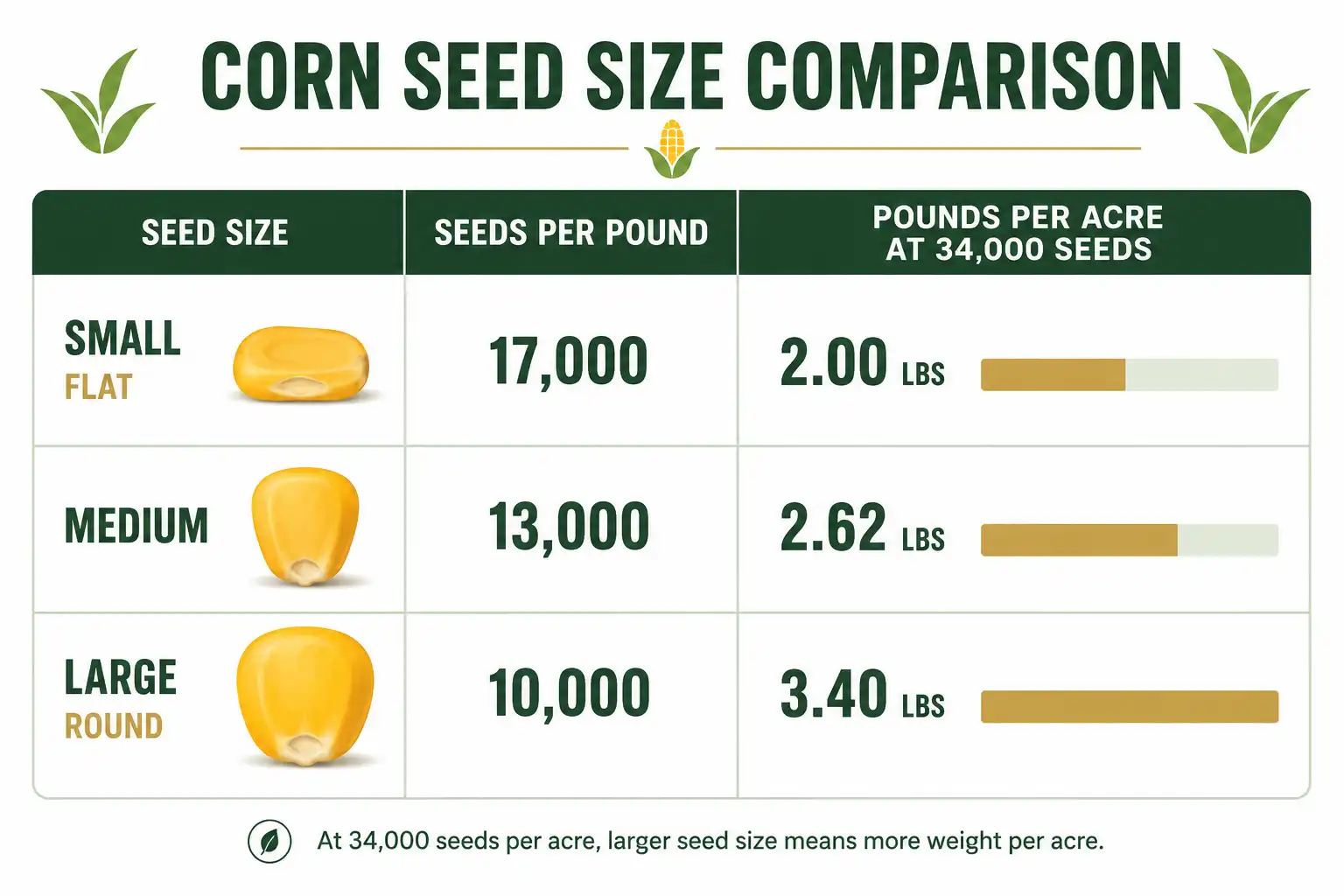
| Seed size | Seeds per pound | Weight at 34,000 seeds per acre |
|---|---|---|
| Small flats | about 2,300 | about 15 lb |
| Medium flats or rounds | about 1,800 | about 19 lb |
| Large rounds | about 1,350 | about 25 lb |
So two growers planting the same population can buy very different weights. That is normal. Plant count is what matters in the field, not the pounds in the box. On high-yield irrigated ground, where some farmers push 36,000 seeds and up, your weight climbs a little. On thin dryland ground with lower populations, it drops well under 15 pounds.
How to Convert Seeds Per Acre to Pounds
To convert, divide your seeds per acre by the seeds per pound printed on the tag. The formula stays simple: pounds per acre equals seeds per acre divided by seeds per pound.
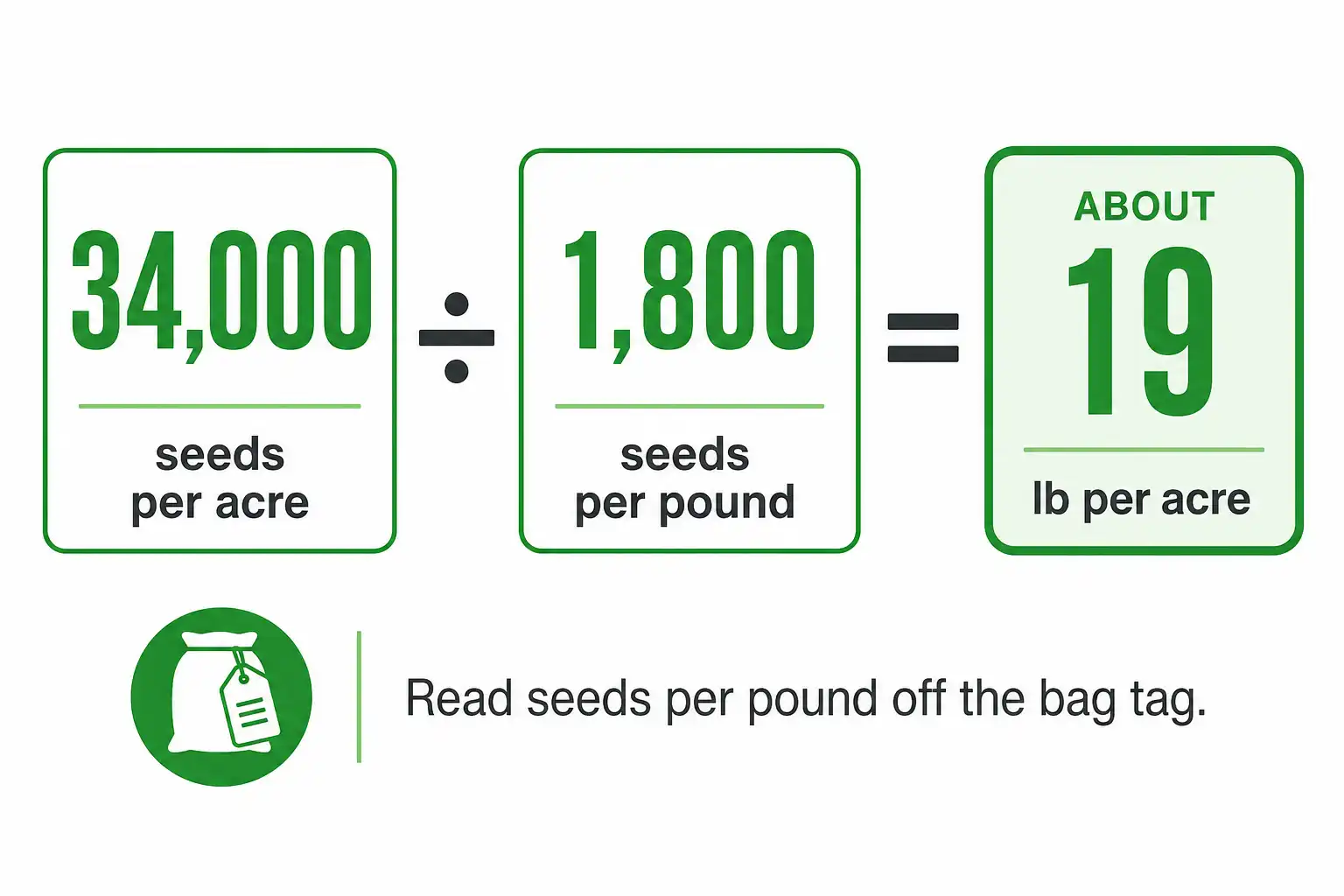
Say your tag reads 1,800 seeds per pound. You want 34,000 seeds per acre. Divide 34,000 by 1,800 and you get about 19 pounds per acre. For 100 acres, that works out to around 1,900 pounds, or about 43 units of 80,000 seeds.
So always pull the seeds-per-pound number off the actual bag. Do not guess. It shifts from lot to lot, even within the same hybrid.
What Plant Population Should You Aim For?
Aim for a final stand of about 30,000 to 36,000 plants per acre across most of the Corn Belt. That is the harvest population. Your seeding rate sits a little higher to cover seed that does not make it. Most rate tables assume that 85 to 95 percent of seeds become plants.
University trials line up on this range. Iowa State, Purdue, and the University of Minnesota all point to a sweet spot near 32,000 to 35,000 plants per acre on productive ground. Push past that and yield gains flatten while seed cost keeps climbing. Population is one of the biggest levers for boosting your yield, but only up to a point. Getting your plant spacing even matters just as much as the rate itself.
Dryland vs. Irrigated Corn
Dryland fields take lower populations than irrigated ones, because water sets the ceiling. Here on dryland ground in Kansas, run lower than a farmer in central Iowa. K-State recommends final stands that drop as you move west into drier country.
Western dryland fields often sit near 16,000 to 22,000 plants per acre. Irrigated fields climb back up to 30,000 to 36,000. Pounds per acre on dryland can fall to 10 to 13 pounds. Under a pivot, it climbs back toward 18 to 22. Same seed, very different rate.
How Many Pounds of Sweet Corn Seed Per Acre?
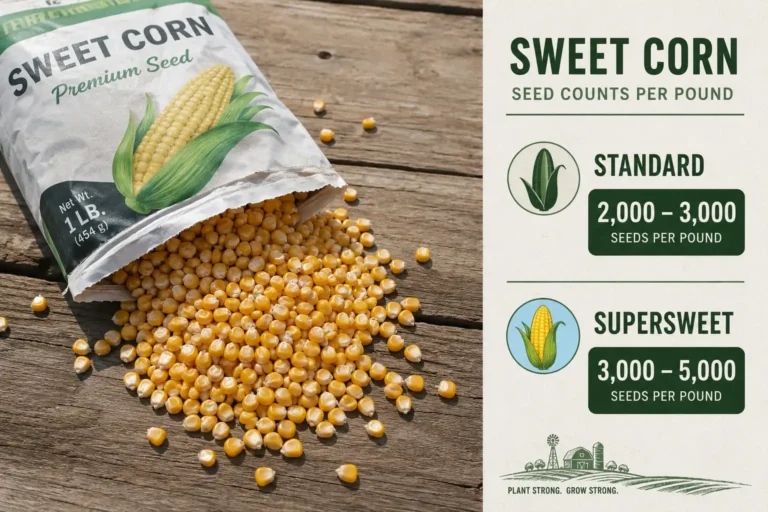
Sweet corn runs about 10 to 15 pounds of seed per acre, lower than field corn. Sweet corn goes in thinner and the seed weighs less. Extension guides from Missouri and Penn State both put the rate near 10 to 15 pounds per acre. Final stands land around 14,000 to 24,000 plants per acre.
Supersweet types, the sh2 varieties, carry smaller and lighter seed than the older sugary types. So your weight per acre often runs on the low end. That is also why planting corn in blocks of several short rows instead of one long row is recommended, giving the ears far better pollination.
Figuring Seed for a Small Plot or Partial Acre
For a small plot, scale the per-acre rate down to your row feet. Most home and market growers do not plant a full acre. So skip the pounds and count seeds by the row instead.
Drop one seed every 6 to 8 inches in rows 30 inches apart for field corn. For sweet corn, one seed every 8 to 12 inches works well. That puts you right in the target population without weighing anything. If you still want a weight, a quarter acre of field corn needs only about 4 to 6 pounds. A 100-foot row holds roughly 100 to 150 seeds at sweet corn spacing.
Dialing In Your Real Seeding Rate
Set your real rate by starting with target population, then adjusting for germination and field conditions. Three things move your number off the table value.
First, germination. Check the tag. If germination reads 95 percent, divide your target by 0.95 to get the seeding rate. So a 34,000 target becomes about 35,800 seeds per acre.
Second, field emergence. Cold, wet, or crusted soil kills some seedlings. No-till and heavy residue cut emergence too. So bump your rate 1 to 2 percent in those fields.
Third, seed age. Old seed germinates weaker. Fresh seed is worth the money, especially for sweet corn, which loses vigor fast in storage. It pays to know how long corn seed stays viable before you plant carryover bags.
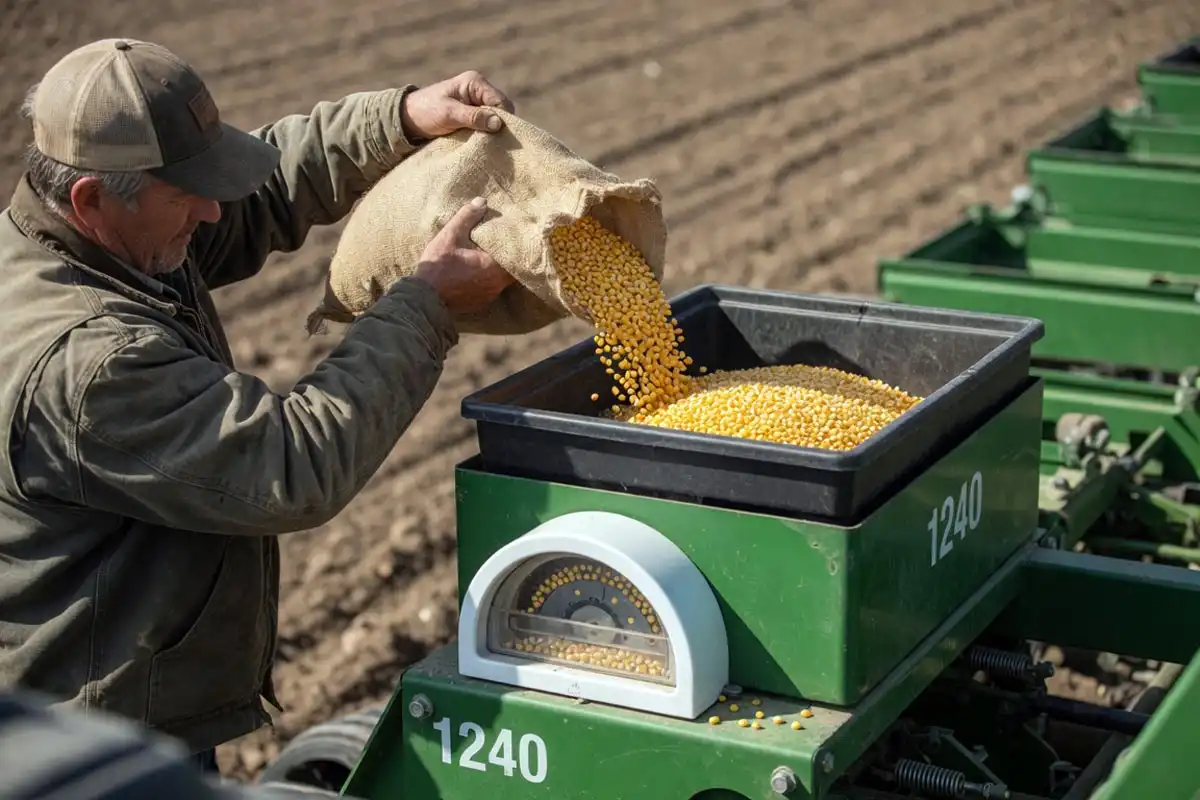
Then calibrate. Run your planter on a hard surface or a few test rows. Check the actual seed drop and spacing before you cover real ground. A seed meter that is off by a little adds up fast across a whole field.
What This Looks Like on Kansas Fields
On dryland ground, planting by count lets seed size sort out the pounds. Most years that means 10 to 14 pounds per acre at these populations. Under irrigation it would run higher. The takeaway holds for any field: set your plant population first, read the seeds per pound off the bag, and let the weight fall where it lands. Count grows a crop, not pounds.