How Many Pounds in a Bushel of Soybeans? (2026 Guide)
Every soybean check cashed starts with one number. If you sell, haul, or figure yield, you need to know how many pounds in a bushel of soybeans. Here is the standard, why it exists, and how moisture changes what you actually get paid.
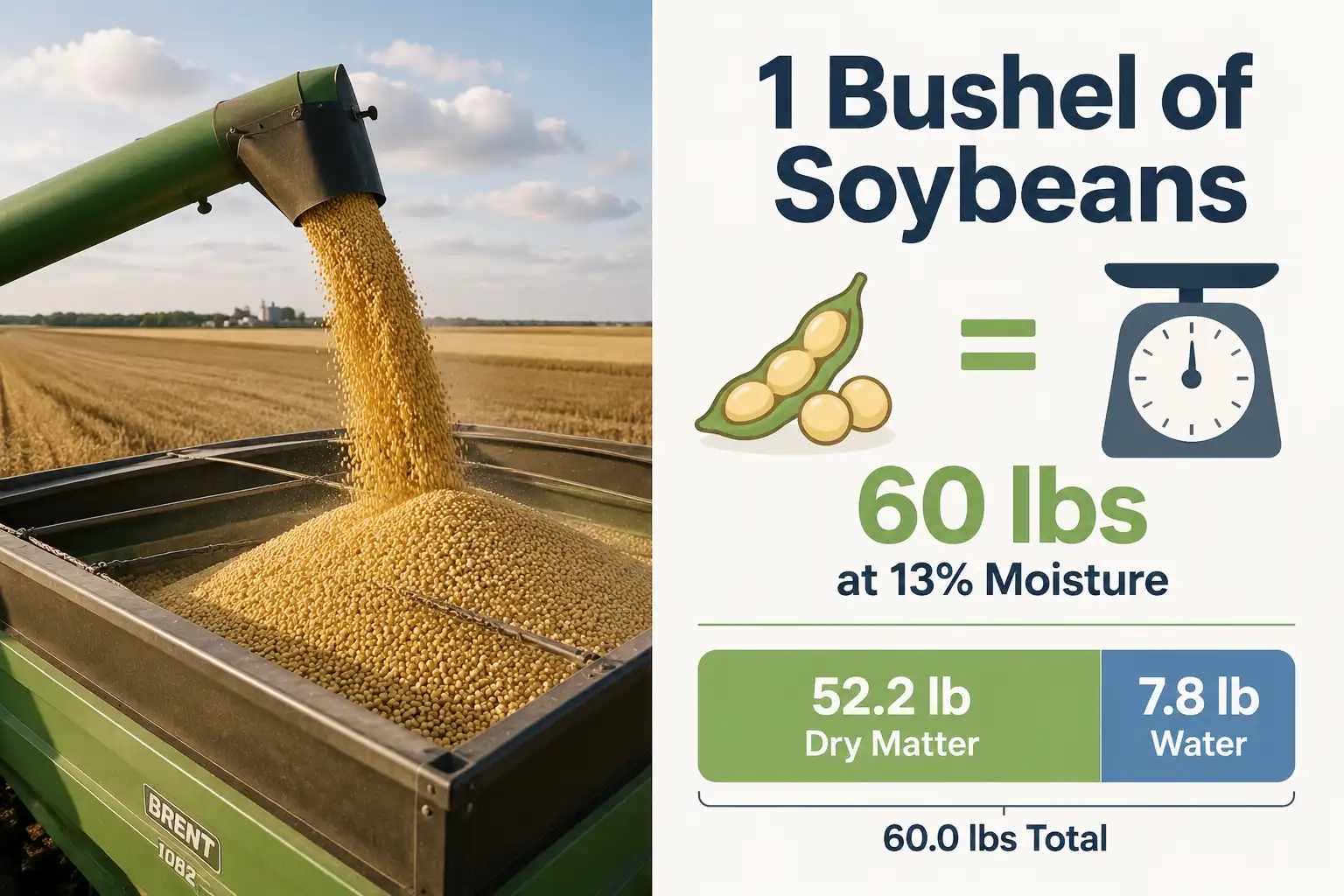
A bushel of soybeans weighs 60 pounds at 13% moisture. That is the USDA standard every elevator uses. Beans wetter than 13% get docked for moisture. Beans drier than 13% still count as 60 pounds per bushel.
Why Is a Bushel of Soybeans 60 Pounds?
A bushel of soybeans is 60 pounds because the USDA assigned that weight as the trading standard. A bushel started as a volume measure, about 1.24 cubic feet. Weighing a truck beats measuring volume, so the grain trade converted every crop to a standard weight. Soybeans and wheat landed at 60 pounds. Corn landed at 56.
That 60-pound figure assumes 13% moisture. Break it down and you get 52.2 pounds of dry matter and 7.8 pounds of water. The dry matter is what the crusher actually wants. The moisture standard keeps every load comparable near Topeka to any field in the Corn Belt.
How Moisture Changes the Pounds in a Bushel of Soybeans
Moisture changes the payable weight, not the 60-pound definition. The elevator always divides your net weight by 60 to get bushels. What moisture changes is how much of that weight they pay you for.
Above 13% moisture: the elevator applies shrink. Most buyers dock 0.7% to 0.8% of the load weight for every half point over 13%. A 50,000-pound load at 15% moisture loses roughly 1,500 pounds on paper before they calculate bushels. Some buyers charge a drying fee on top of the shrink.
Below 13% moisture: you get no bonus. The buyer still counts 60 pounds as a bushel. In effect, you replace water you could have sold with extra beans. Nebraska Extension figures beans delivered at 11% instead of 13% give away about 1.35 pounds of beans per bushel. On a 60-bushel crop, that adds up fast.
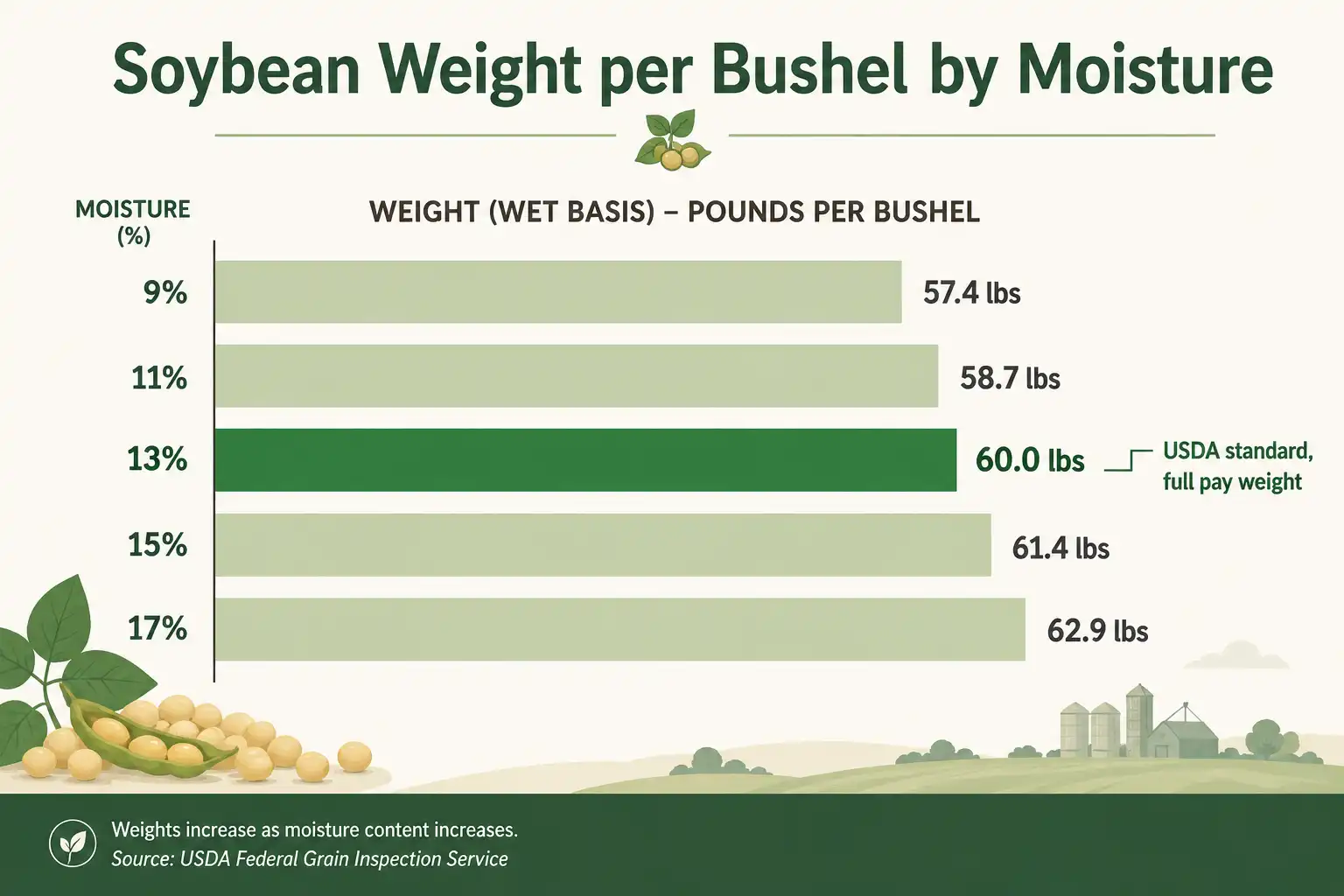
So the sweet spot is delivering as close to 13% as you can. Start cutting around 14% to 15%, then let the field finish near 13%. Getting there means timing soybean harvest around weather windows instead of waiting for bone-dry pods. A handheld grain moisture tester pays for itself in one season by showing when the field hits that window.
Is Test Weight the Same as the 60-Pound Standard?
No. Test weight and the 60-pound bushel are two different numbers. The 60-pound figure is the accounting standard used to convert scale weight into bushels. Test weight is the actual density of your beans, measured by weighing a quart sample at the probe.
Healthy, well-filled soybeans usually test between 56 and 60 pounds per cubic bushel. Your check is still figured at 60 pounds per bushel either way. Test weight only costs you money when it drops low. Most elevators start discounting loads that test below 54 pounds. Low readings usually point to drought stress, frost damage, or repeated wetting after dry-down. Low test weight also means the same tonnage fills more bin space, which matters when storing soybeans through winter.
How Does the Elevator Turn Your Load Into Bushels?
The elevator weighs your truck full, weighs it empty, and divides the difference by 60. That is the whole formula: net pounds ÷ 60 = bushels.
Here is a real-world example from typical hauls. A semi grossing out with 55,000 pounds of beans on board delivers 916.7 bushels (55,000 ÷ 60). If those beans probe at 14% moisture, the buyer shrinks the weight first, then divides. At a typical 0.75% dock per half point, 14% moisture trims about 825 pounds. That leaves 54,175 pounds, or 902.9 payable bushels. Two moisture points can move a load by 25 bushels or more.
Run that same math backward when you estimate yield. Weigh wagon pounds ÷ 60 ÷ acres gives your true bushels per acre. That is the honest way to compare your fields against average soybean yields per acre in your county.
How Do Soybeans Compare to Other Crops?
Every grain has its own USDA bushel weight, and they are not interchangeable. Soybeans share the 60-pound mark with wheat, but most other crops come in lighter.
| Crop | Pounds per Bushel | Standard Moisture |
|---|---|---|
| Soybeans | 60 lbs | 13% |
| Wheat | 60 lbs | 13.5% |
| Shelled corn | 56 lbs | 15.5% |
| Grain sorghum (milo) | 56 lbs | 14% |
| Barley | 48 lbs | 14.5% |
| Oats | 32 lbs | 14% |
The differences trip people up when they switch crops. A bin rated for 10,000 bushels of beans holds a different tonnage of corn at its 56-pound bushel weight.
Handy Soybean Weight Conversions
These are the conversions most often at the scale house and the grain bin:
- 1 bushel = 60 pounds = 27.2 kilograms
- 1 metric ton = about 36.74 bushels
- 1 short ton (2,000 lbs) = 33.3 bushels
- A 5-gallon bucket holds roughly 40 pounds of beans, about two-thirds of a bushel
- A hopper-bottom semi hauling 55,000 pounds carries about 917 bushels
- A 300-bushel grain cart holds about 18,000 pounds of beans
Keep in mind that seed beans are sold by weight or seed count, not bushels. When figuring planting rates, work from pounds of soybean seed per acre and your variety’s seeds per pound. Seed size varies a lot between varieties.
Bottom Line
The 60-pound bushel is fixed. Your paycheck is not. Deliver at 13% moisture and you get paid for every pound the field grew. Deliver at 10% and you gave away free water weight. Deliver at 16% and the shrink eats you alive. Hitting that 13% window pays better than most people think. It costs nothing but attention at harvest.