How to Fertilize Lettuce: Rates, Timing, and Placement
Lettuce grows fast and roots shallow, so it runs short on nitrogen sooner than most garden crops. Learning how to fertilize lettuce comes down to timing, placement, and small doses. Get those three right, and you cut tender leaves instead of tough, bitter ones.
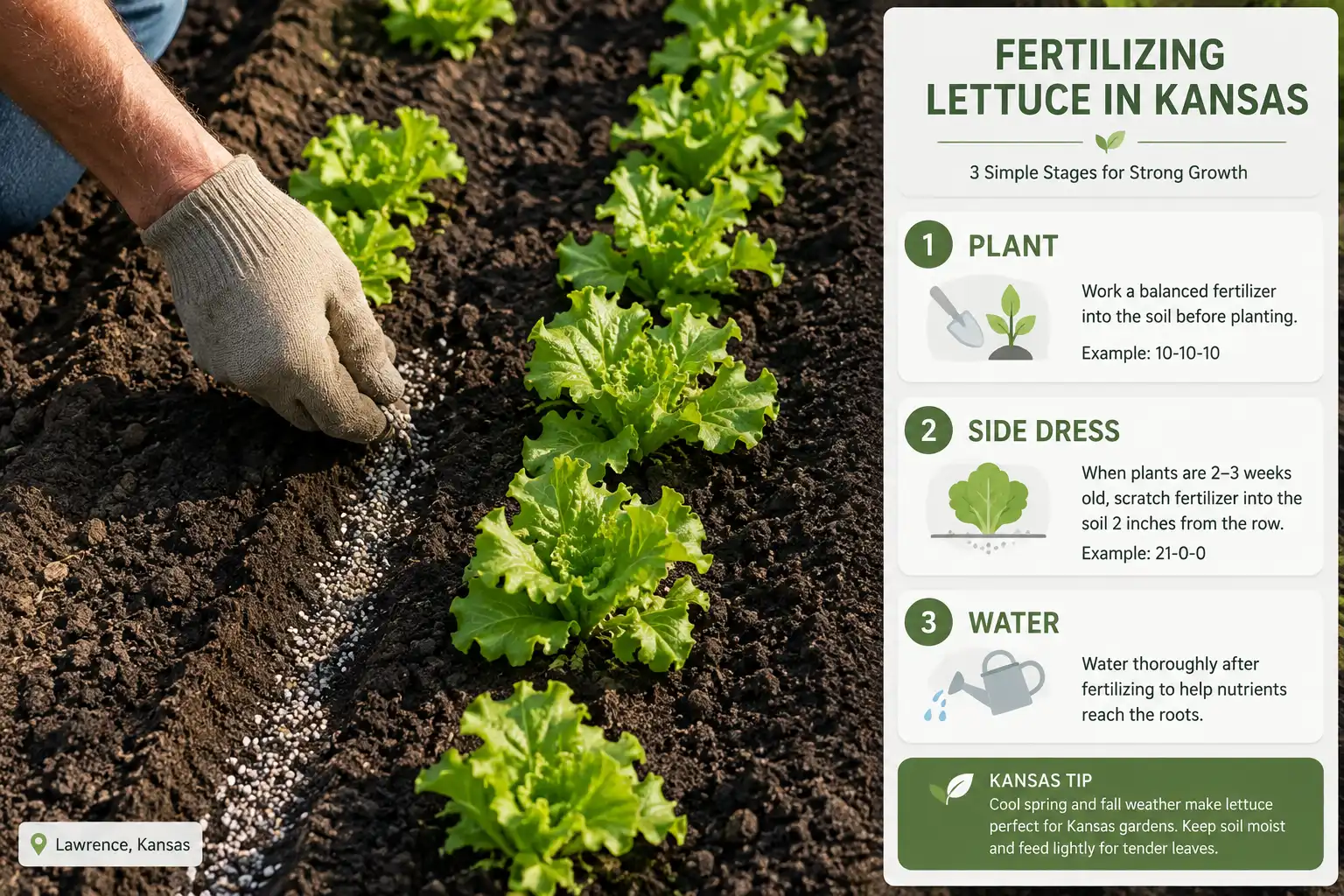
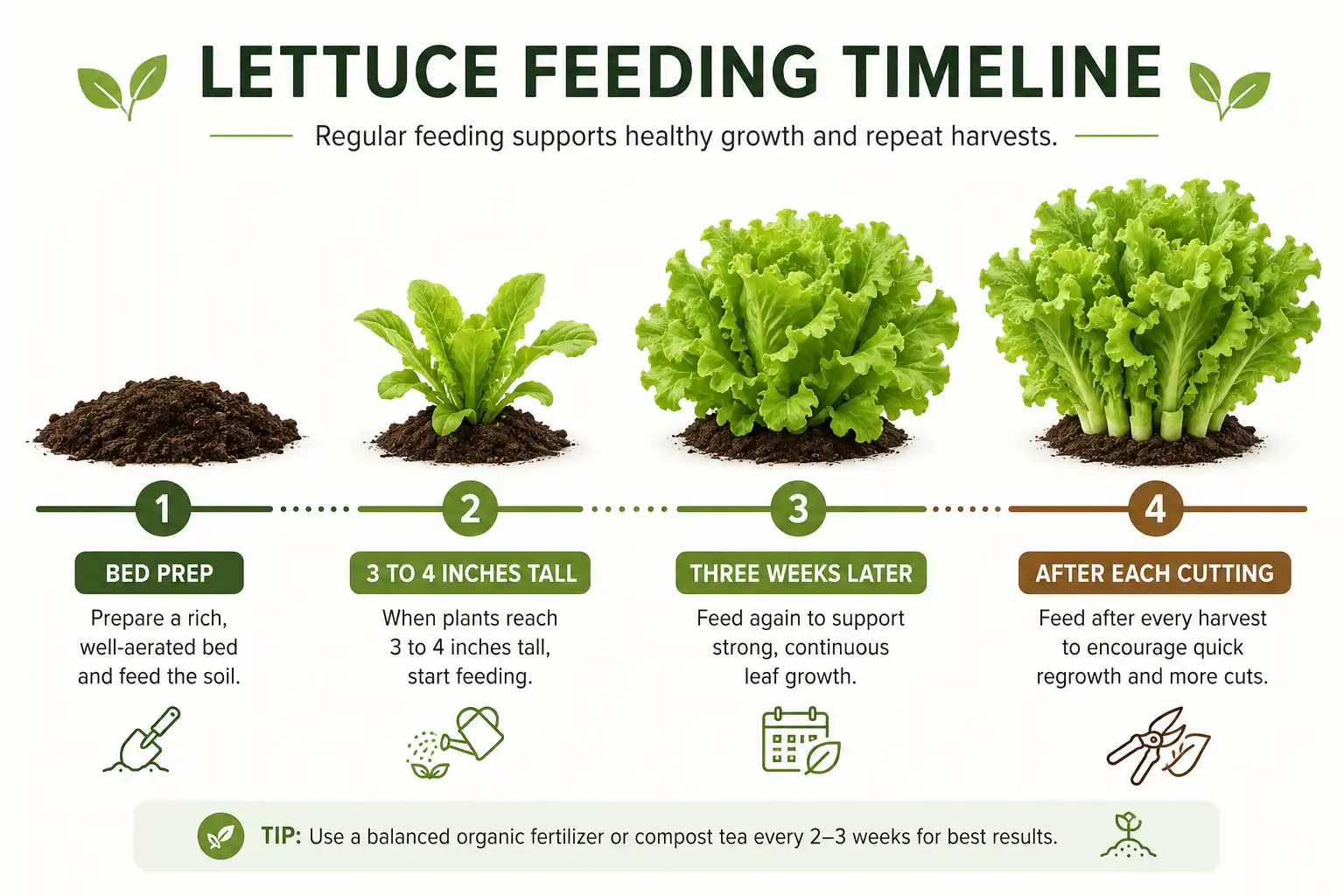
Fertilize lettuce twice at minimum. Work compost and a balanced starter into the bed before planting. Then sidedress nitrogen once plants reach 3 to 4 inches tall, and repeat lightly every three weeks.
What Nutrients Does Lettuce Need Most?
Nitrogen drives leaf growth, but a lettuce crop removes more potassium than nitrogen. A 16,000 pound per acre crop removes about 70 pounds of nitrogen and 110 pounds of potassium. Phosphorus and calcium removal runs near 15 pounds each. So nitrogen gets the attention, while potassium quietly does heavy work in the background.
Timing matters as much as the total. Lettuce takes up nitrogen slowly at first. Then uptake jumps to roughly 3 pounds per acre per day once heads begin folding. Head types pull about 80 percent of their season-long nitrogen in the final four weeks. That is why one preplant application rarely carries a crop to harvest.
Soil pH sits under all of it. Lettuce performs best between 6.0 and 6.8, and 6.5. Below 6.0, phosphorus and molybdenum tie up. Above 7.0, iron and manganese get harder to reach. Lime in fall if your test calls for it, because lime needs months of moisture to react.
Roots stay shallow too. Most feeding roots live in the top 8 to 12 inches of soil. So fertilizer has to sit in that zone, not below it.
How to Fertilize Lettuce Before Planting
Start with a soil test, then fix pH and build phosphorus and potassium before seed goes down. A test costs a few dollars and ends the guessing. Pull samples in fall for spring beds. Home soil test kits give you a fast pH and nutrient read. A lab test through K-State Research and Extension returns firmer numbers.
Without a test, these preplant rates work on garden ground:
- 2 pounds of balanced granular per 100 square feet, worked into the top 4 inches
- 1 inch of finished compost spread and tilled in, no deeper
- No extra phosphorus on beds that have grown vegetables for years, since many soils already hold plenty
Here is the order:
- Spread compost and work it into the top 4 to 6 inches.
- Broadcast the granular fertilizer and rake it in evenly.
- Firm and level the seedbed, because lettuce seed sits only 1/8 to 1/4 inch deep.
- Water the bed before seeding so the soil settles.
Two products stay off the beds. Fresh manure carries pathogens and weed seed, so use only manure that has composted a full season. Weed-and-feed lawn products kill vegetables outright, and they never come near the garden.
On field ground, band phosphorus 2 to 3 inches below and to the side of the seed row. Phosphorus applied later in the season does far less good.
How to Fertilize Lettuce Plants After They Come Up
Sidedress nitrogen once plants stand 3 to 4 inches tall. That usually falls four weeks after transplanting, or right at thinning. Either way, the timing catches the crop as growth speeds up.
Garden rates that hold up in the field:
- 1 pound of balanced granular per 25 feet of row
- 1/4 cup of ammonium sulfate (21-0-0) per 10 feet of row
- 1 to 2 pounds of mixed fertilizer per 100 feet of row
Here is the method:
- Scratch a shallow furrow 2 to 3 inches out from the plant row.
- Drop fertilizer in an even band along that furrow.
- Cover the band with soil.
- Water it in the same day, deep enough to carry nitrogen into the root zone.
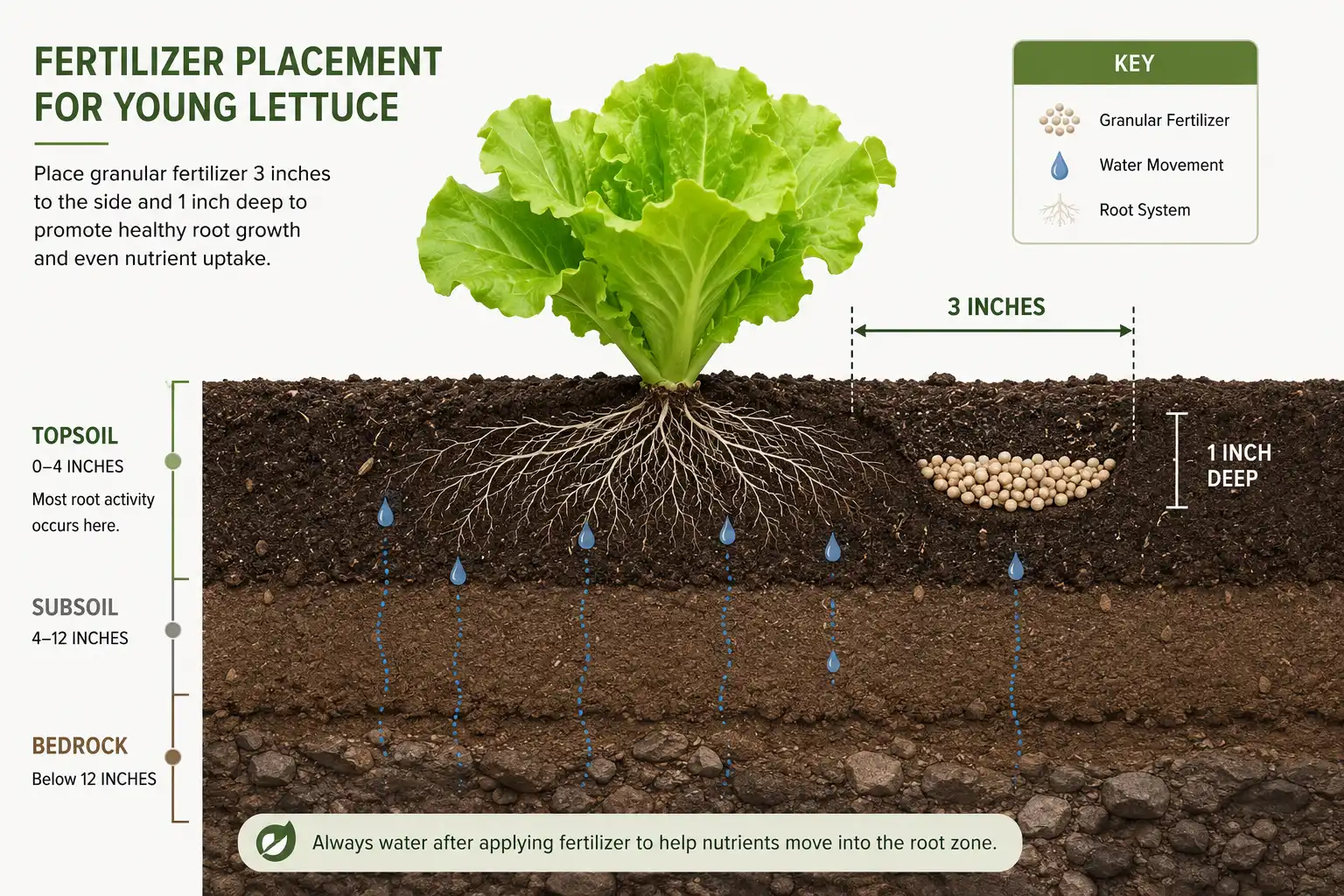
Placement is where most gardeners lose lettuce. Fertilizer salts against a young stem burn roots fast. Keep the band 2 to 3 inches out at least. On heavy clay, give it the full 3 inches. Root burn shows up even at that spacing on tight ground.
Never dump granular on the crown or over wet leaves. Also skip foliar feeding on heads you plan to cut soon, since residue gets trapped in the folds.
How Often to Fertilize Lettuce Through the Season
Feed lettuce every three to four weeks in the ground, and every one to two weeks in containers. Lettuce runs a short cycle, so light and frequent beats heavy and rare.
| Growing situation | Feeding schedule | What to reach for |
|---|---|---|
| Garden bed with compost | Preplant, then at 3 to 4 inches, then every 3 to 4 weeks | Balanced granular, then straight nitrogen |
| Sandy soil or wet springs | Same timing, smaller doses, one extra pass | Ammonium sulfate or urea |
| Containers | Half strength liquid every 7 to 14 days | Fish emulsion or balanced liquid |
| Cut and come again beds | Light feed after each major cutting | Liquid nitrogen or blood meal |
| Field scale rows | Preplant, then 1 to 2 sidedress passes | Urea, ammonium sulfate, calcium nitrate |
Stop nitrogen about two weeks before your last cut on leaf types. Late nitrogen pushes soft growth that wilts quickly after harvest.
How Often to Feed Lettuce in Pots and Raised Beds
Feed pots more often, because every watering flushes nutrients out the drain holes. A compost-rich mix usually carries lettuce planted in pots through the first three weeks. After that, half-strength liquid every 7 to 14 days keeps growth steady. Flush the pot with plain water once a month to clear salt buildup.
Raised beds sit between pots and field ground. They drain faster than open ground but hold more than a container. Feed raised beds every three weeks and let leaf color tell me whether to adjust.
What Is the Best Fertilizer for Lettuce?
Any nitrogen-forward product works if the rate and timing are right. No single bag beats the rest.
For preplant, one granular pass handles the job. A balanced 10-10-10 blend covers nitrogen, phosphate, and potash in one pass, which suits gardeners who have not tested recently. On tested ground, match the numbers to what the report asks for instead.
For sidedressing, straight nitrogen sources give you control:
- Urea (46-0-0): highest analysis and cheapest per pound of nitrogen, but it needs watering in quickly to limit loss to the air
- Ammonium sulfate (21-0-0): adds sulfur and acidifies slightly, useful where pH runs above 7.0
- Calcium nitrate (15.5-0-0): gentle nitrate nitrogen plus calcium, common on quality-sensitive plantings
Go easy with ammonium-heavy products on light or sandy soil. Too much ammonium nitrogen stunts young plants and thins the stand. For the rate math per 100 square feet, see our notes on urea at 46-0-0.
Organic sources suit lettuce well, since steady release matches a short crop:
- Blood meal (about 12-0-0): fast organic nitrogen
- Alfalfa meal: slower release plus organic matter
- Feather meal: slow and long lasting
- Fish emulsion: quick liquid boost for pots and new transplants
- Finished compost: builds the base and keeps tissue nitrate lower than soluble salts do
One warning on blood and feather meal. Dogs dig for them. Cover the band with soil and water it in within the hour.
What Are the Nitrogen Rates for Field Lettuce?
Plan on 80 to 120 pounds of nitrogen per acre for head types. Split that across preplant and one or two sidedress passes. Leaf types need less, because they finish sooner.
A common split looks like this:
- 30 to 50 pounds of nitrogen per acre preplant
- The rest across one or two sidedress passes during early to mid season
- First sidedress after thinning and cultivation
- Second sidedress about 14 days later, near early head formation
On organic muck soils, recommendations drop to 60 to 90 pounds per acre. Mineralization supplies part of the crop’s need there.
A pre-sidedress soil nitrate test saves real money. Salinas Valley research found no yield response above 20 ppm nitrate in the top foot. Below that, add only enough to reach 20 ppm. Roughly 4 pounds of nitrogen per acre raises soil nitrate by about 1 ppm. So a 15 ppm reading calls for about 20 pounds per acre, not a full pass.
Watch salt levels as well. Lettuce carries moderately low salt tolerance. Yield slips once soil solution conductivity passes 1.3 dS/m, and poor germination plus small heads follow.
How Can You Tell If Lettuce Needs Fertilizer?
Pale green color plus slow growth is the first signal, and nitrogen is usually the cause. Nitrogen moves inside the plant, so the oldest bottom leaves fade first. They yellow, then die early. Leaf size runs smaller than it should as well.
Other shortages look different:
- Phosphorus: dull green plants, stunted growth, purple or red along older leaf margins and stems
- Potassium: small dead spots and browning along the margins of older leaves
- Sulfur: even yellowing that starts mid-plant instead of at the bottom
- Calcium: brown necrosis on the youngest inner leaves, never the old ones
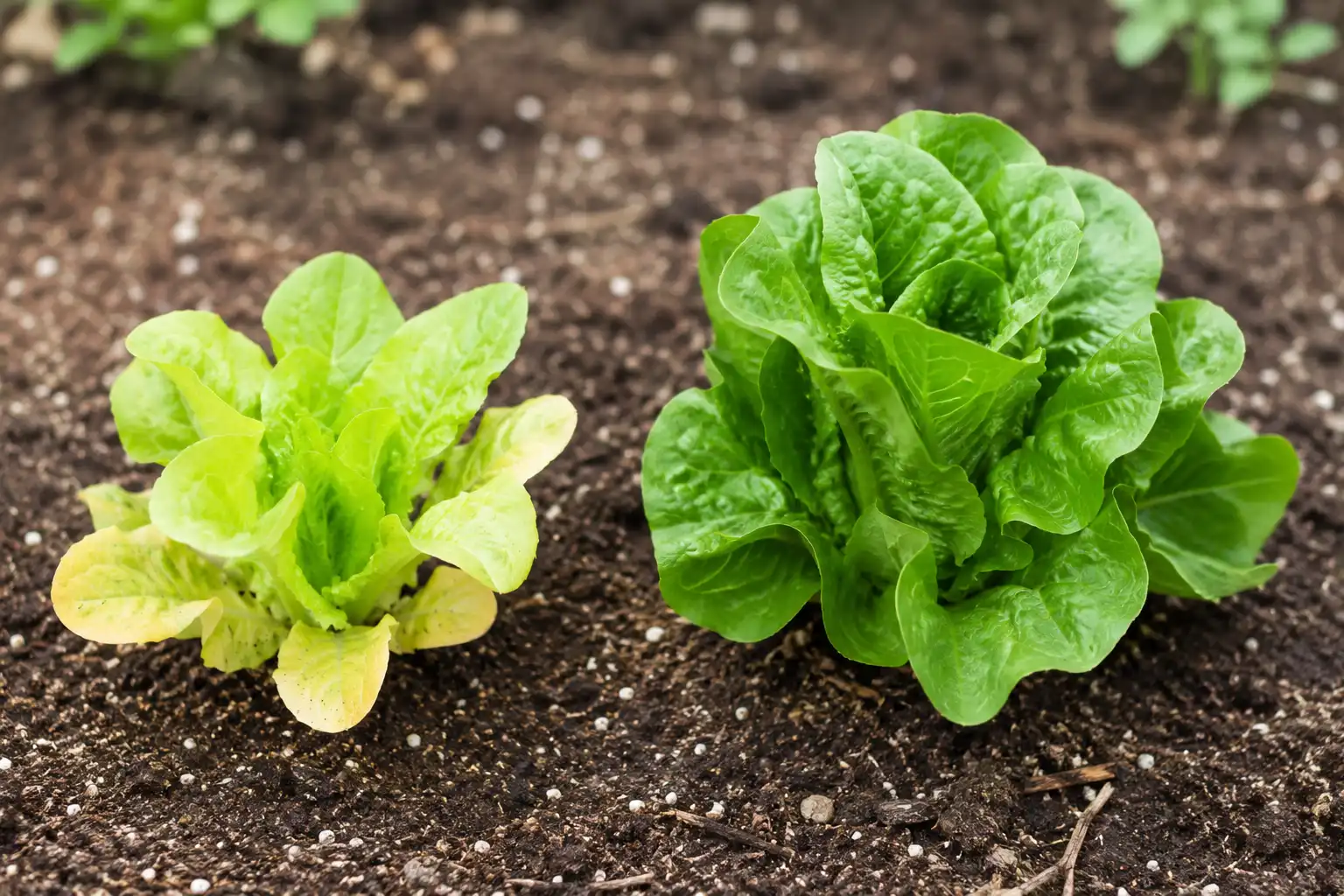
Sulfur fools people most often, because the yellowing mimics nitrogen. So check which leaves went first. Bottom leaves point to nitrogen. Middle leaves point to sulfur.
Color tells you something is wrong. It does not tell you how much to add. Confirm with a soil nitrate test, or pull a tissue sample. For tissue testing, collect the youngest wrapper leaf from at least 20 healthy plants. Sample uneven areas separately.
What Happens If You Over-Fertilize Lettuce?
Too much nitrogen gives you soft, watery leaves that store poorly and rot faster. Growth looks impressive for a week. Quality does not hold up.
The problems stack:
- Higher susceptibility to gray mold (Botrytis cinerea) and lettuce drop (Sclerotinia)
- Shorter shelf life after cutting
- Higher nitrate levels in the leaves, since lettuce stores nitrate readily
- Yield loss at truly excessive rates
- Nitrate leaching down toward groundwater
- Salt burn where bands sit too close to plants
Compost-based fertility produces lower leaf nitrate than heavy soluble blends at the same nitrogen level. So it helps to use compost for the base and use soluble nitrogen only as a correction.
Under-feeding costs you too, and gardeners forget that side of it. Nitrogen-short lettuce grows slowly, bolts earlier, and turns bitter lettuce on you at the cutting board. Starved plants also mature small and tough.
If you overdid it in a container, flush with plain water two or three times. In a bed, stop nitrogen and let normal irrigation move the excess past the root zone.
Will Fertilizer Fix Lettuce Tipburn?
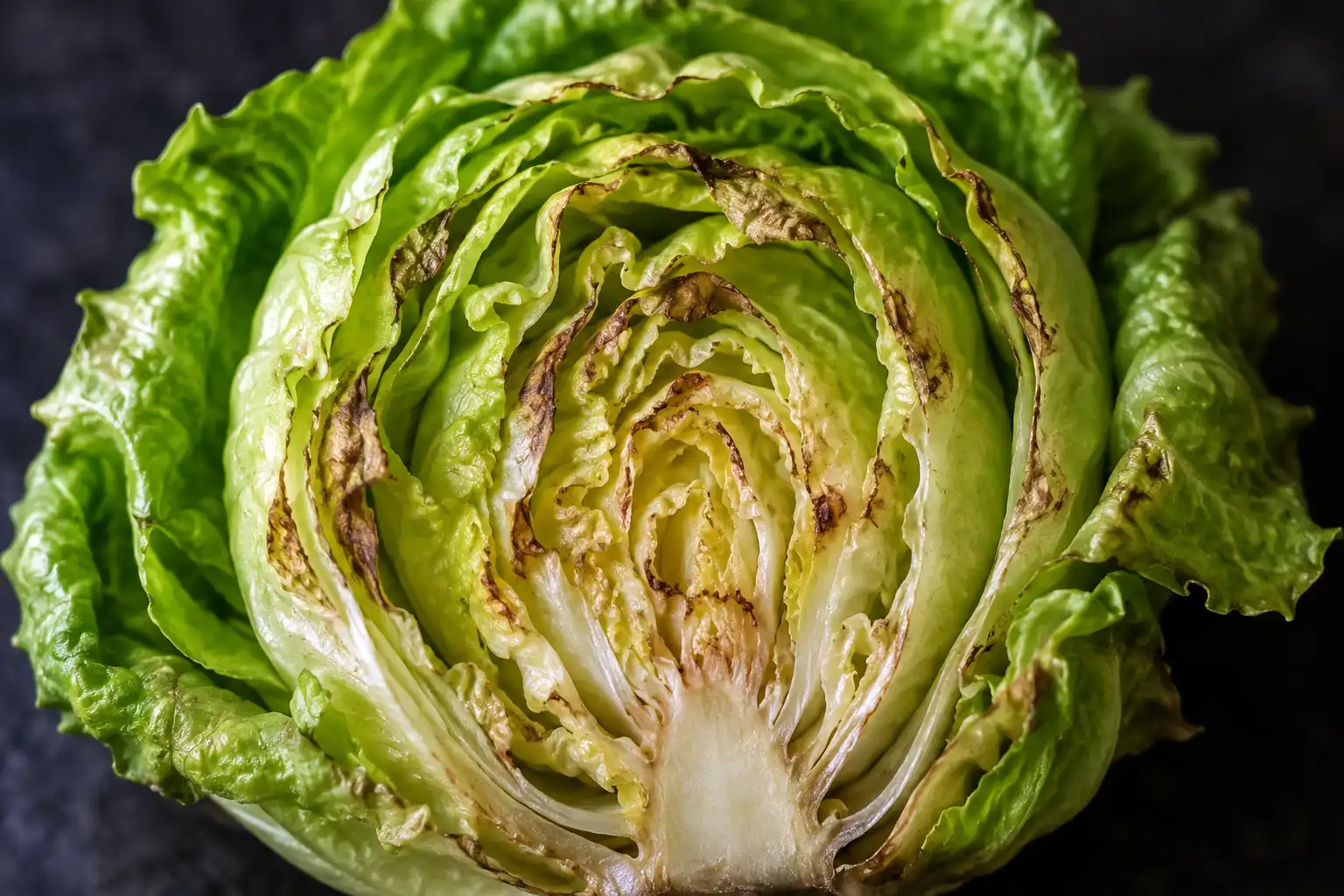
Usually not, and this is where growers waste money. Tipburn is a calcium shortage inside the fast-growing inner leaves, not a shortage of calcium in your soil.
Calcium travels with the water a plant pulls through itself. Inner leaves sit enclosed, so they transpire very little. They come up short even when soil calcium tests fine. Fog, high humidity, still air, and water stress all worsen it. Fast growth worsens it further, because demand outruns delivery.
Two practical results follow. First, adding calcium to the soil rarely helps. Second, foliar calcium sprays give mixed results on head types, since spray cannot reach the inner leaves in time.
What actually cuts tipburn:
- Steady soil moisture, without swings between soaked and dry
- Easing off nitrogen during the fastest growth stage
- Tipburn-tolerant cultivars
- Better air movement in tunnels and greenhouses
Hold moisture steady and calcium keeps moving. Our notes on weekly water lettuce needs cover the amounts through a Kansas summer.
Final Words on Fertilizing Lettuce
Compost goes down in fall. A balanced granular goes in at bed prep in March. Sidedress nitrogen once plants hit 3 to 4 inches. Run another light pass three weeks later if leaf color dulls. That covers the whole program for zone 6a ground.
Two habits matter more than the numbers on the bag. Keep the band 2 to 3 inches off the plants, and water it in the same day. The rest is small adjustment based on what the leaves show you.