Can Onions and Potatoes Be Planted Together in One Bed? (2026)
Both crops go in the ground the same week in Kansas, so gardeners want to share one bed. But can onions and potatoes be planted together without hurting either crop? The answer depends less on the plants themselves and more on how you hill potatoes.
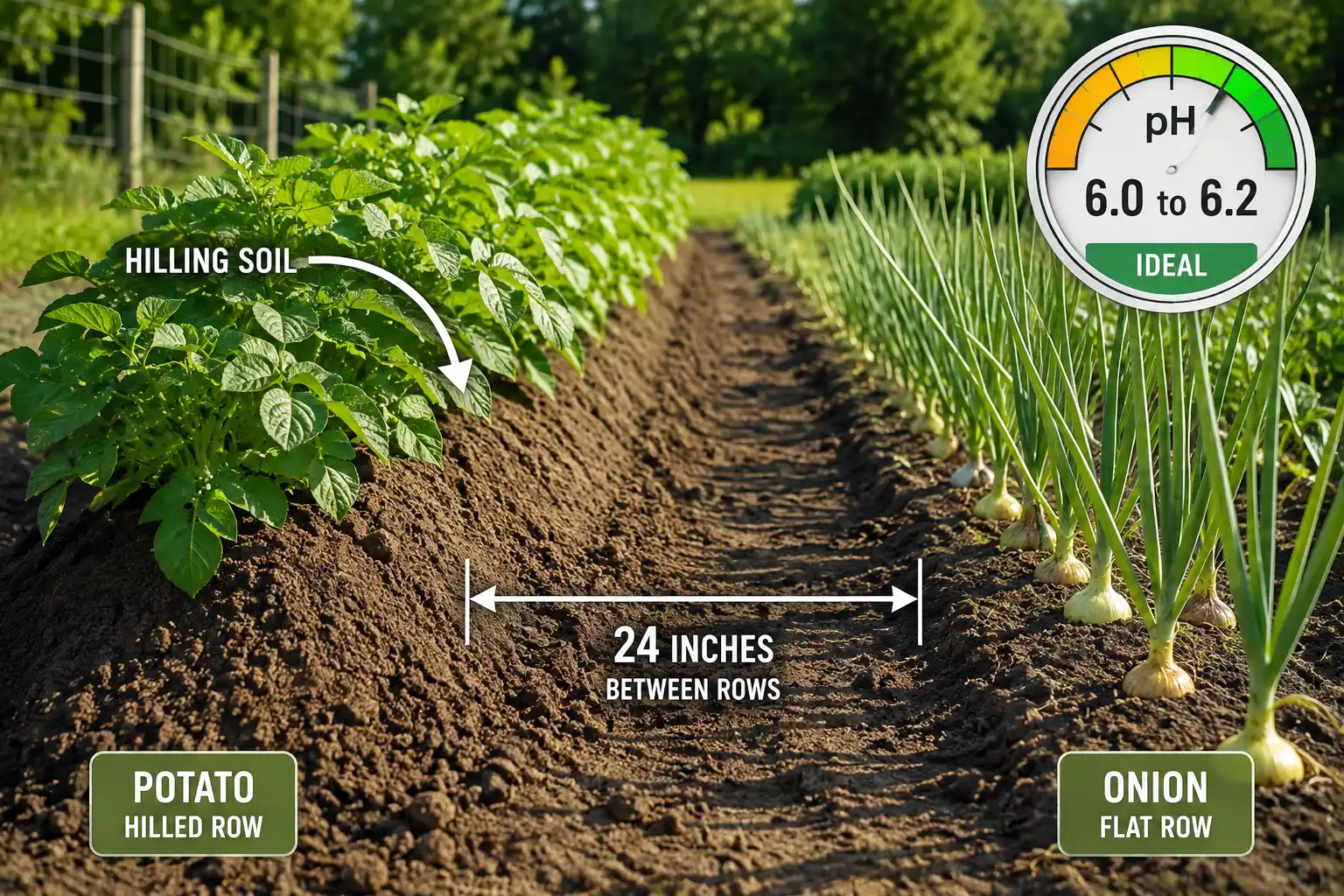
Yes, onions and potatoes can be planted together in the same garden, but keep them in separate rows. Interplanting fails because hilling soil onto potato stems buries shallow onion bulbs. Set the rows at least 24 inches apart.
Can Onions and Potatoes Be Planted Together in the Same Bed?
They can share a garden, yet they should never share a row. Onions and potatoes carry no chemical grudge against each other. Neither crop poisons the other. Neither one hosts a disease that jumps across families. So the problem is mechanical and managerial, not botanical.
Four conflicts show up once you mix them in one row.
- Hilling. Potatoes need soil pulled up around the stems. Onions rot when you bury the bulb.
- Soil pH. Potato growers push pH down to fight scab. Onions suffer below 6.0.
- Light and root space. Potato foliage reaches 2 to 3 feet and shades everything beside it.
- Late-season water. Potatoes want steady moisture while onions want a dry-down.
Keep the two crops in parallel rows and every one of those conflicts disappears. That layout also matches how most Kansas growers already run a spring plot. Potatoes take the wide rows, onions take a tight block, and each crop gets its own schedule.
Why Hilling Potatoes Ruins Interplanted Onions
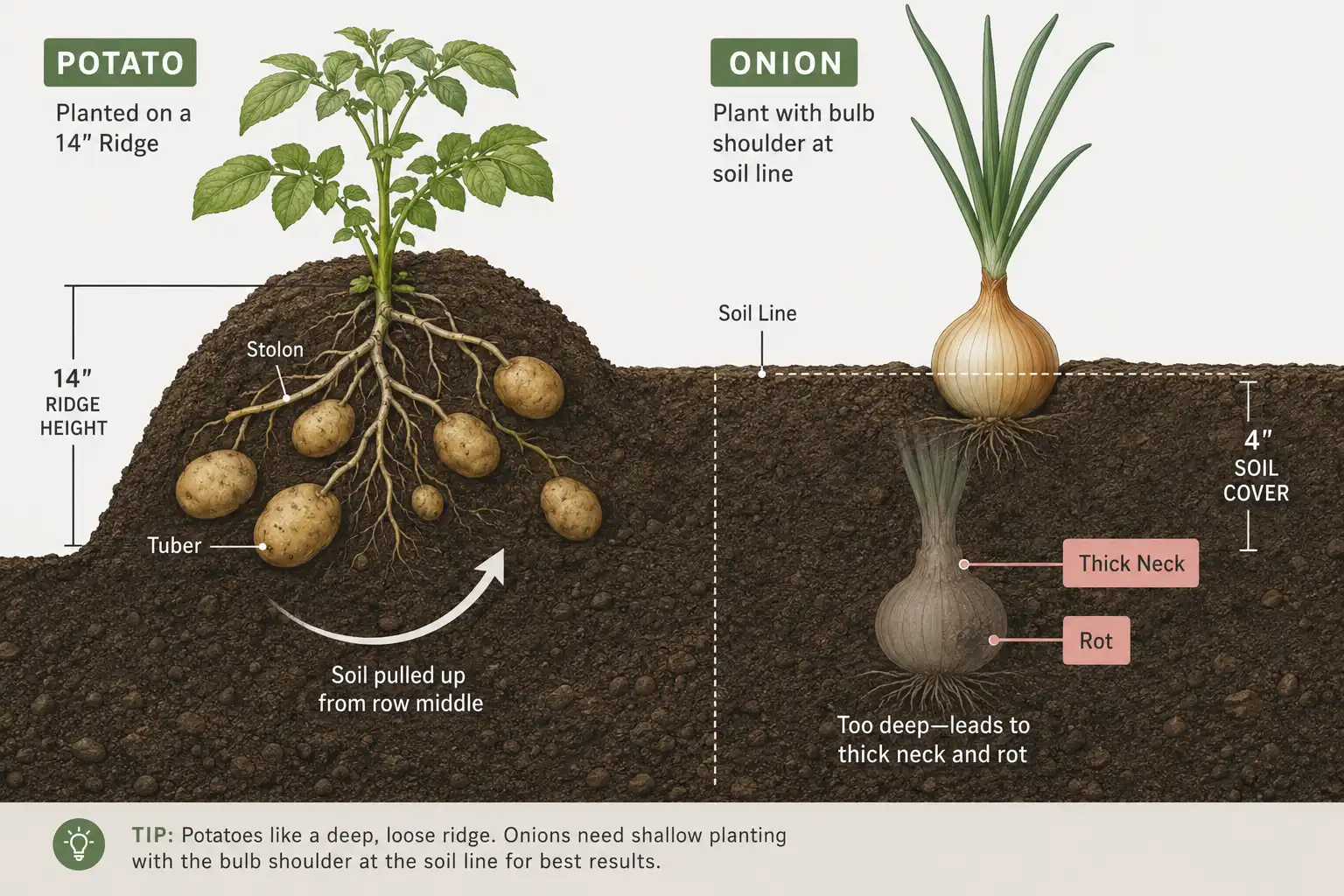
Hilling is the single reason interplanting fails. Tubers form on stolons off the buried portion of the stem, so more buried stem means more potatoes. Sunlight on a shallow tuber turns it green and triggers solanine. That makes the potato inedible, which is why hilling is not optional.
The first pass comes when plants stand 6 to 10 inches tall. You pull loose soil from the row middles up against the stems. Only the top few inches of foliage stay showing. Then you repeat every two to three weeks until flowering. By the end you have a ridge 12 to 18 inches tall. All of that soil comes from the strip beside the row.
Onions want the opposite treatment. Set transplants about 1 inch deep. Then let the bulb shoulders sit at or just above the soil surface as the bulb swells. Cover that neck with soil and three things go wrong. Moisture collects against the neck and invites Botrytis neck rot. The neck thickens instead of tightening. Skins stay soft, so the bulb never cures for storage.
Any onion planted within reach of a hoe during hilling ends up buried. The conflict gets obvious once you see how hilling a potato row actually works. So plan for it in March, not in July.
The Soil pH Conflict Between Onions and Potatoes
The two crops want different soil pH, and that gap matters more than most companion charts admit. Onions grow best between pH 6.0 and 6.8. Alliums also react badly to acid soil. UMass Extension flags them as pH sensitive. NC State Extension puts the bulb onion target at 6.0 to 6.5.
Potatoes tell a different story. Common scab, caused by Streptomyces scabies, drops off sharply at pH 5.2 or lower. Severity then climbs steadily as pH rises from 5.2 toward 8.0. Growers chasing clean skins often acidify to 5.0 or 5.2 with elemental sulfur. Onions in that soil hit weak nutrient availability and stunted roots.
So you pick one target and manage around it. In practice, garden ground is typically held near 6.0 to 6.2. That keeps onions productive and still sits at the low end of the scab range. Two habits cover the rest:
- Plant scab-tolerant potato varieties instead of chasing pH downward.
- Keep soil moisture steady through tuber initiation, since dry soil during those four to six weeks raises scab sharply.
Guessing at pH wastes a season. Pull samples from each side of the plot before spring. Then run them through a reliable soil test kit or your county extension lab.
| Factor | Onions | Potatoes |
|---|---|---|
| Target soil pH | 6.0 to 6.8 | 5.2 to 6.5 |
| pH for scab suppression | not applicable | 5.2 or lower |
| Rooting depth | most roots in top 12 inches | 12 to 24 inches |
| Row spacing | 12 to 18 inches | 30 to 36 inches |
| In-row spacing | 4 to 6 inches | 8 to 12 inches |
| Planting depth | about 1 inch | 1 to 2 inches, then hilled |
How to Lay Out Onions and Potatoes in the Same Garden
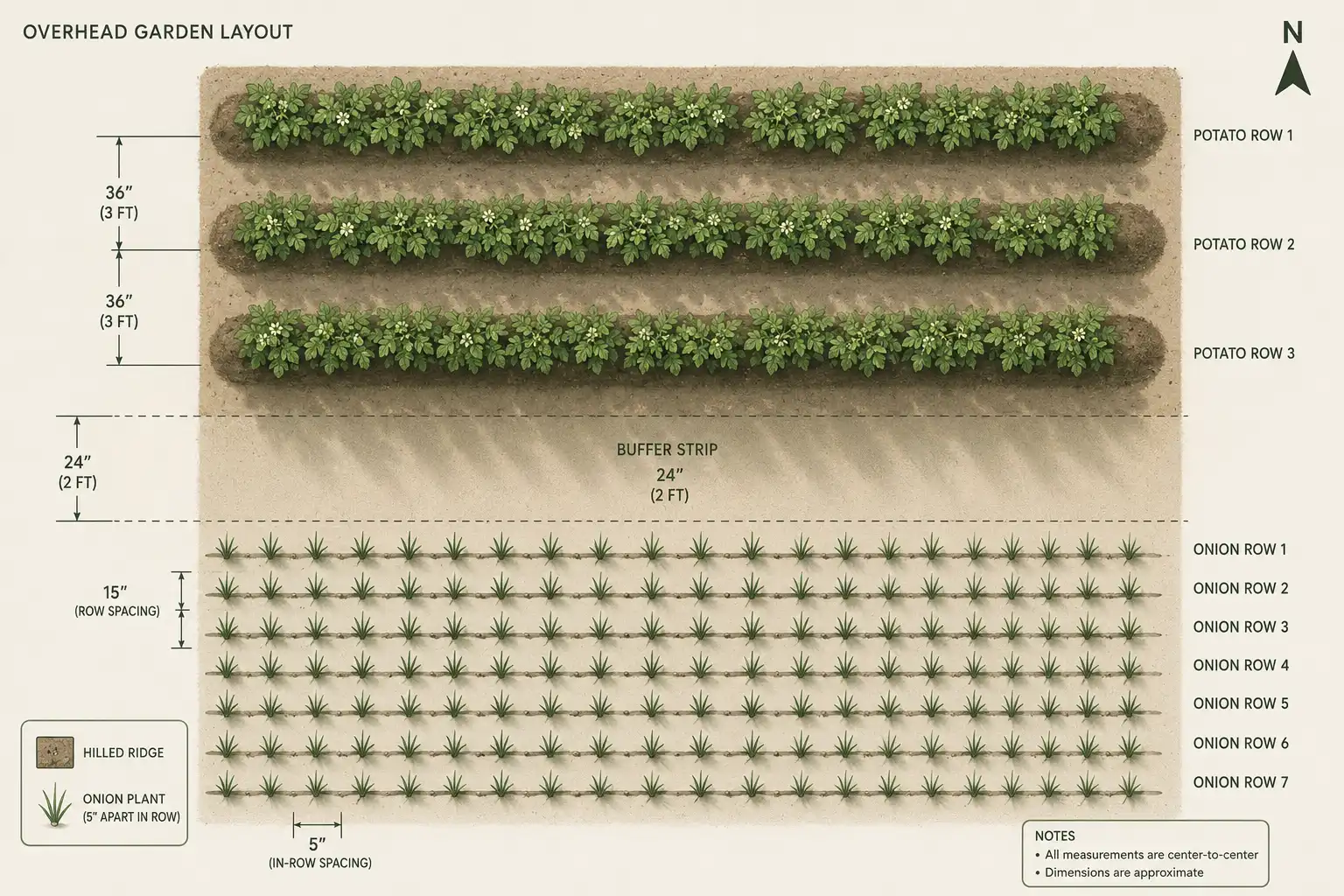
Run the two crops as separate blocks with a buffer strip between them. Here is the layout.
- Put potatoes on the north side. Vines reach 2 to 3 feet, and onions need full sun to bulb. Shade during bulb initiation shrinks the crop.
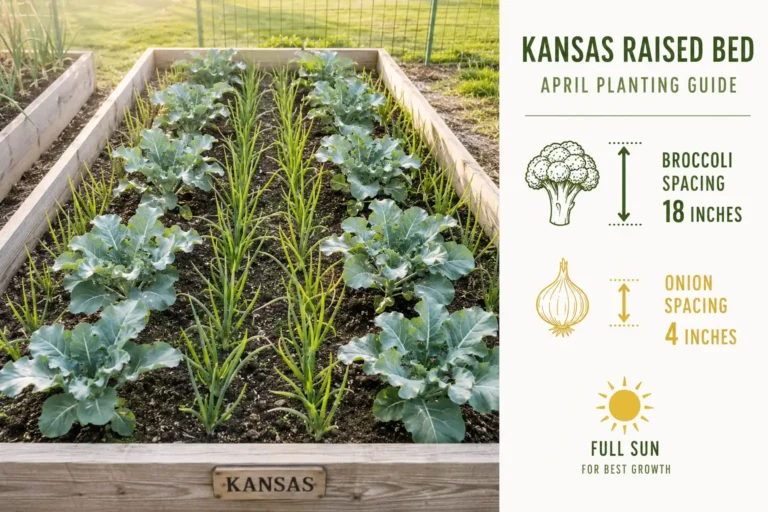
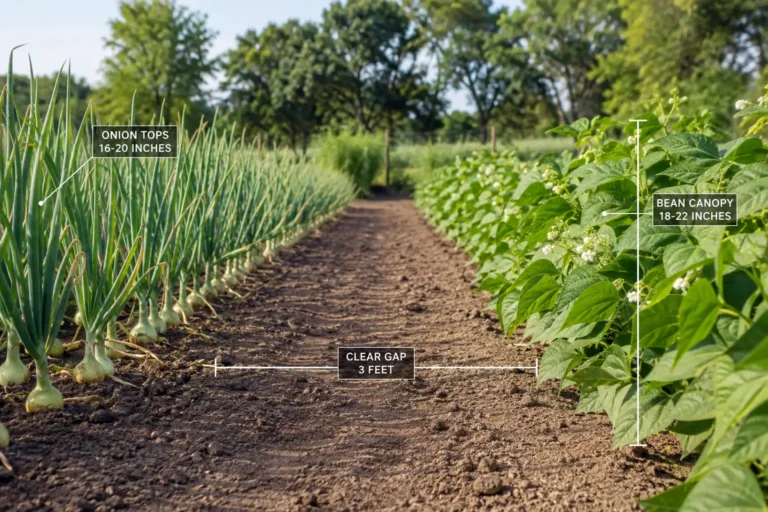
- Leave 24 to 30 inches between the outer potato row and the first onion row. That strip feeds the hilling soil, so nothing gets scraped out from under the onions.
- Space potato rows 30 to 36 inches apart, with seed pieces 8 to 12 inches apart in the row.
- Block the onions tight. Rows 12 to 18 inches apart, plants 4 to 6 inches apart in the row.
- Never sandwich onions between two potato rows. You lose the buffer on both sides and you shade the bed twice a day.
- Split the irrigation. Separate drip zones or hand watering, because the two crops diverge in July.
Onions compete poorly for water, nutrients, and light their whole life. Their roots are shallow and sparsely branched. So a neighbor with a deep root system wins every time. Tight in-row spacing helps, though crowding cuts leaf count and leaf count sets bulb size. Work out how many onion plants per square foot your bed supports before you set transplants.
Water and Fertilizer Timing Pull in Opposite Directions
The two crops need water and nitrogen on opposite schedules once midsummer arrives. That timing split is the second strongest reason to keep them apart.
Potatoes need consistent moisture through tuber initiation and bulking. Letting the soil dry during that window costs yield and raises scab. Nitrogen goes on at planting and again at hilling. UMN Extension pairs a side-dress with each hilling pass.
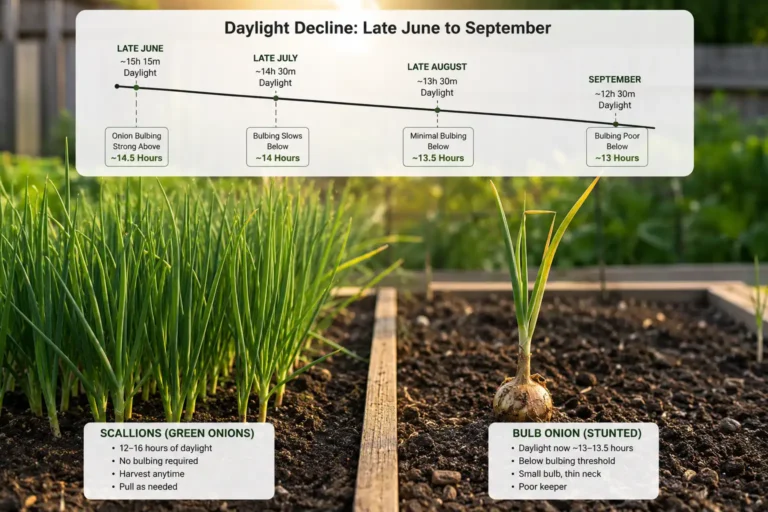
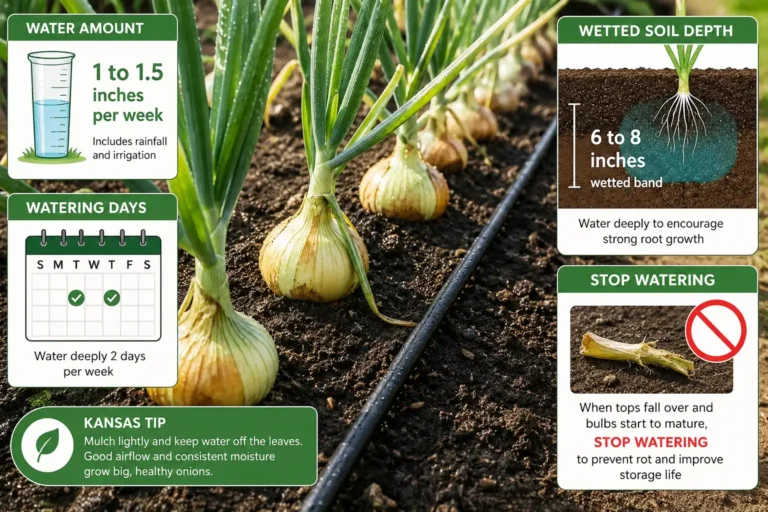
Onions run a different curve. Nitrogen fuels leaf growth up through bulb initiation, then it has to stop. Late nitrogen pushes soft necks and thick tops instead of bulb fill. Water follows the same logic. Once tops start to lodge, cut irrigation off. Extra water during that stretch delays curing and sets up storage rot.
Put both crops on one drip line and July forces a bad compromise. You either underwater potatoes during bulking or you keep onions wet while they should dry down. Either way one crop pays. Separate zones solve it cleanly, and a hand-watered onion block works fine in a small plot.
Shared Pests and Diseases Worth Watching
Wireworms are the main pest the two crops actually share. They are click beetle larvae, and they live in the soil two to six years. They bore round holes into tubers and feed on onion roots and developing bulbs. Host lists from Clemson Extension and the University of Wisconsin include both crops, along with corn, carrots, and lettuce.
Damage runs worst one to four years after breaking sod or grass. So avoid planting either crop into recently turned pasture. Bait testing before spring tells you what you are working with. Good drainage helps too, since wireworms favor damp ground.
The bigger diseases stay in their own lanes. Colorado potato beetle, early blight, and late blight all target the nightshade family, so onions are safe from them. Onion root maggot and white rot hit alliums only, so potatoes are safe in return. That separation is a real benefit of growing the two side by side instead of doubling up on one family.
Do Onions Repel Potato Pests?
No, and this is where companion planting charts oversell. UMN Extension notes that little research supports onion or marigold repellency claims. Multiple studies have also disproven marigold protection against Colorado potato beetle. Research does show onion reducing cabbage worm pressure in cabbage. So onions earn their reputation alongside brassicas, not alongside potatoes.
Plan your pest control on scouting and rotation instead. Ring the potato patch with a trap crop if you like. But a row of onions will not keep beetles off the vines.
Which Crop Comes Out of the Ground First
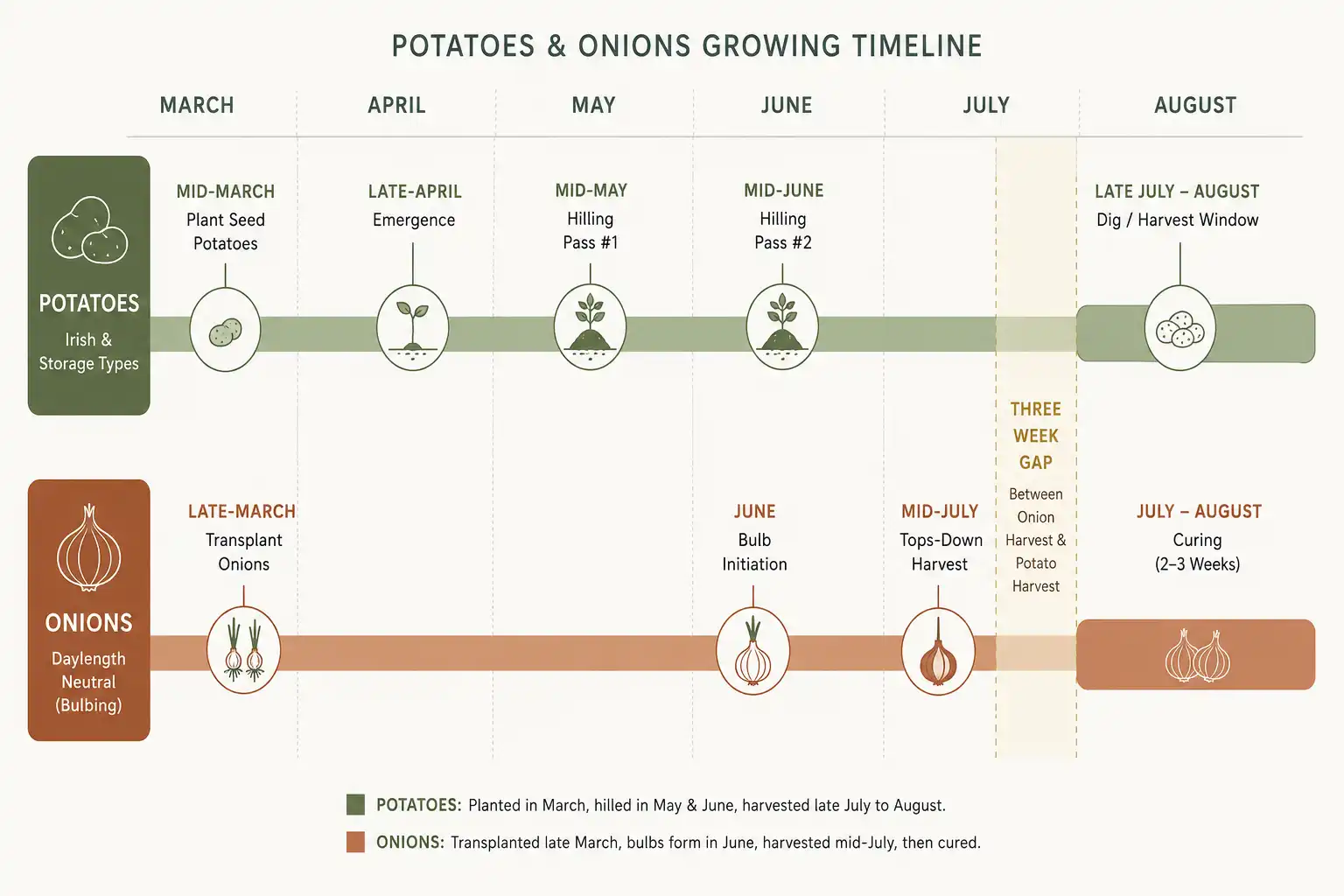
Onions clear the bed weeks before storage potatoes do, and that gap favors adjacent rows. K-State Research and Extension puts potato planting at mid to late March once soil hits 45°F. Onion transplants go out in late March across eastern and central Kansas. From there the two crops separate fast.
Onions finish when half to three quarters of the tops lodge. That lands mid-July. Cut water at the first wave of flopping, then lift the bulbs. Cure them two to four weeks in a warm airy shed. Storage potatoes stay put until the vines die back, often late July into August.
Harvest the onions first. Digging potatoes throws soil and pulls a fork through the row. Curing bulbs sitting nearby pick up bruises and dirt. An empty onion strip also gives you somewhere to stand. Vine death and skin set tell you more than the calendar does, so watch those signals for digging potatoes at the right time. Getting the onion and potato planting dates right in March sets this whole sequence up.
Why You Should Never Store Onions and Potatoes Together
Their storage needs point in opposite directions, and each crop shortens the other’s shelf life. Onions release ethylene, which pushes tubers into sprouting. Potatoes give off moisture, which softens onions and feeds mold at the neck. Iowa State Extension gives both crops a five to eight month storage life, but only under separate conditions.
| Condition | Onions | Potatoes |
|---|---|---|
| Curing | 2 to 4 weeks, warm and airy | 2 weeks at 50 to 60°F |
| Storage temperature | 32 to 40°F | 40°F |
| Relative humidity | 65 to 70% | 90 to 95% |
| Light | dark, well ventilated | dark, no light exposure |
| Storage life | 5 to 8 months | 5 to 8 months |
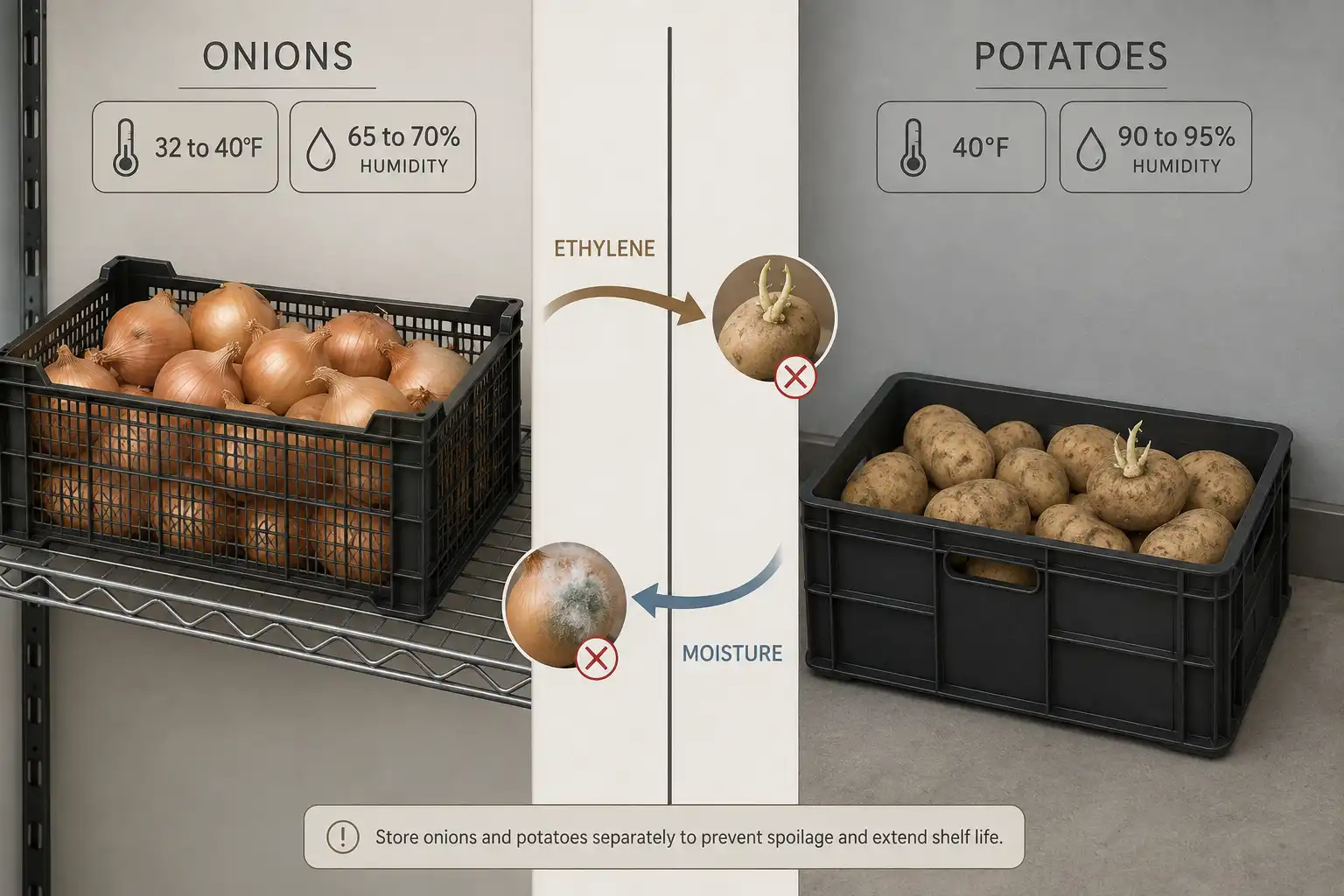
Look at the humidity gap. Onions want 65 to 70% while potatoes want 90 to 95%. No single room satisfies both, so pick separate spaces or accept losses on one crop. Keep onions in mesh bags or open crates on a high shelf. Keep potatoes in solid dark crates near the floor, where air stays cooler and damper.
Two more rules save a lot of produce. Hold potatoes above 40°F, because colder storage turns starch to sugar. That gives the tubers a sweet taste. Keep light off them too, since exposure greens the skin and builds solanine.
Better Neighbors for Each Crop
Once you separate the rows, fill the space around each block with a crop that helps. Onions pair well with lettuce, carrots, beets, and brassicas, where research does show some pest benefit. Keep them away from peas and beans, which growers consistently report as poor allium neighbors.
Potatoes do fine beside beans, corn, and peas. Keep them well clear of tomatoes, peppers, and eggplant. Those three share early blight and late blight with potatoes.
Rotation matters more than any pairing. Give potato ground three to four years before another nightshade. That break also cuts scab and wireworm pressure. Thinking through the crops to avoid after potatoes is worth as much as any companion chart.
Bottom Lines
Onions and potatoes make good neighbors and terrible roommates. Both go in during the second half of March, so plan the layout before either one hits the soil. Potatoes take the north side in wide rows. Then a 24 inch buffer, then a tight onion block on the south. Hold pH near 6.0 to 6.2 and split the irrigation by July. Pull the onions in mid-July, then dig potatoes once the vines die. Store them in separate rooms and both crops will feed you into winter.