Are Oats a Grain? Whole Grain, Gluten, and Grain-Free
Oats sit in the cereal aisle beside wheat and rice, yet the box never explains what they actually are. Grocery shoppers, gluten-free eaters, and paleo dieters all land on the same question. So are oats a grain, and what does that answer change on your plate?
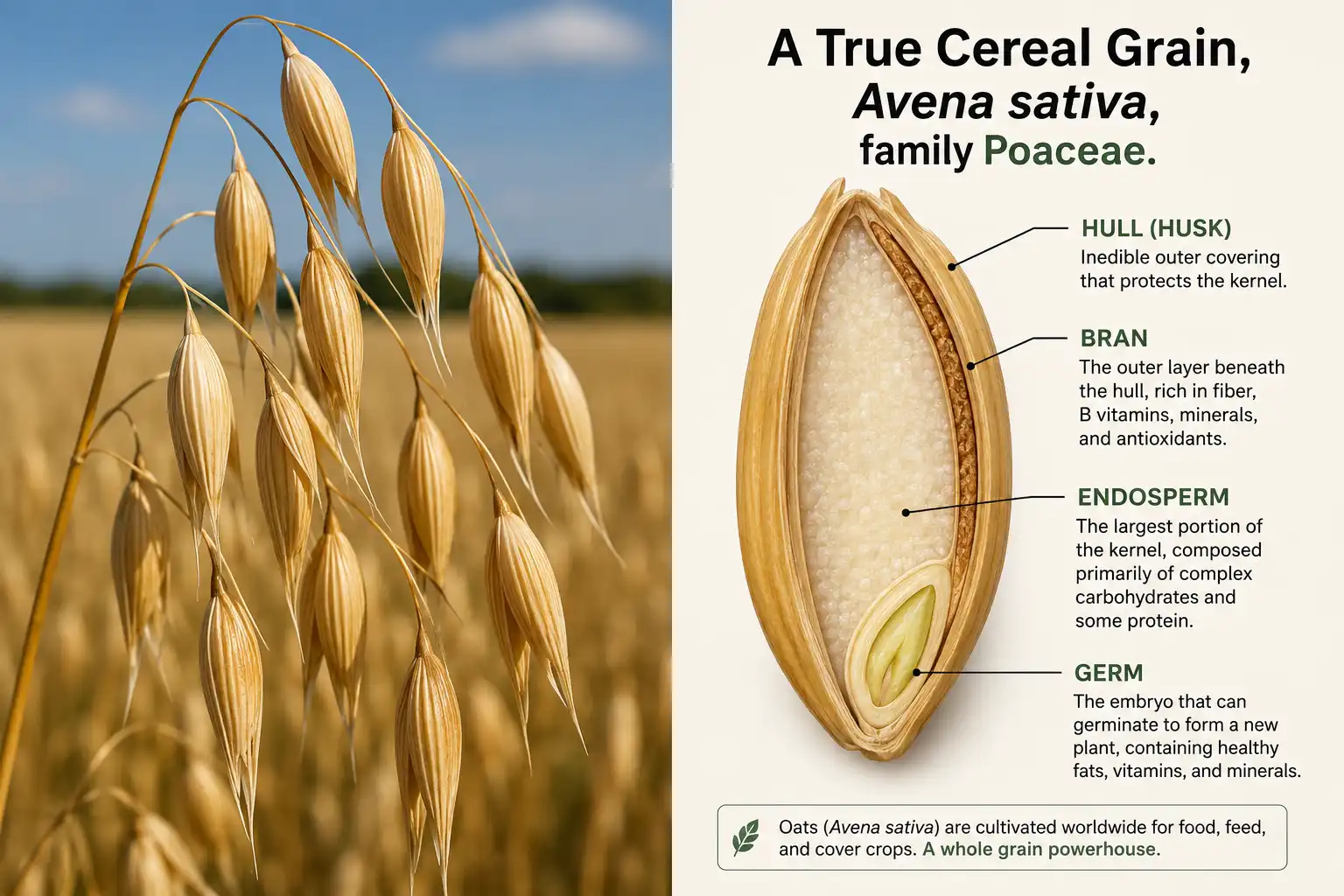
Yes, oats are a grain. Oats are a true cereal grain, the seed of the annual grass Avena sativa in the Poaceae family. Wheat, barley, rye, corn, and rice all share that family.
Are Oats a Grain, a Seed, or Both?
Both. An oat kernel is the seed of the oat plant, and every cereal grain is a seed.
Botanists call that seed a caryopsis. It is a dry, one-seeded fruit whose seed coat fuses to the fruit wall. Corn kernels, wheat berries, and rice grains share the same structure. So “grain” and “seed” are not competing labels. One describes the botany, and the other describes how growers use it.
The word grain also carries three working meanings. Oats clear all three.
| Meaning of “grain” | What it requires | Do oats qualify? |
|---|---|---|
| Botanical | A caryopsis produced by a grass in the family Poaceae | Yes |
| Culinary and nutritional | An edible starchy seed cooked and eaten as a cereal | Yes |
| Commercial and legal | Coverage under the Official U.S. Standards for Grain | Yes, 7 CFR Part 810 |
Still, not every edible seed earns the title. Peanuts grow inside a pod on a legume. So whether peanuts count as grains comes down to plant family, not size or starch.
What Kind of Grain Are Oats?
Oats are a cool-season cereal grain, grouped with the small grains next to wheat, barley, and rye.
The crop is Avena sativa, an annual grass. It runs 2 to 5 feet tall. Spring-seeded oats finish in roughly 90 to 120 days. Worldwide, oats rank sixth in cereal production behind corn, wheat, rice, barley, and sorghum.
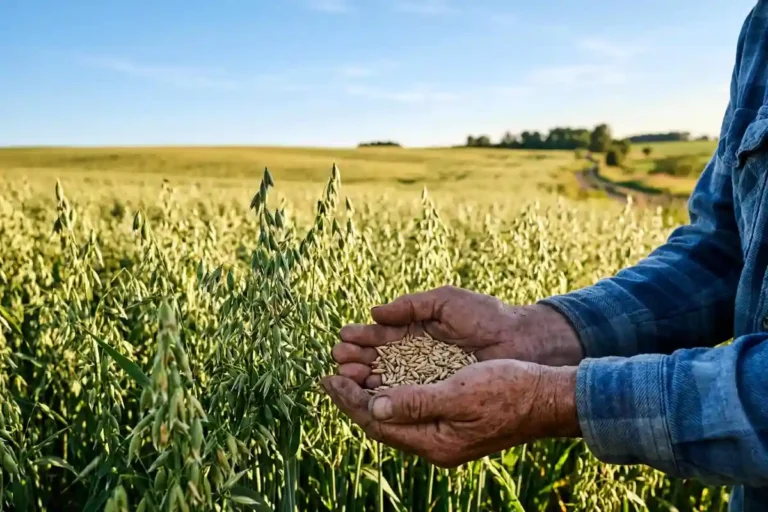
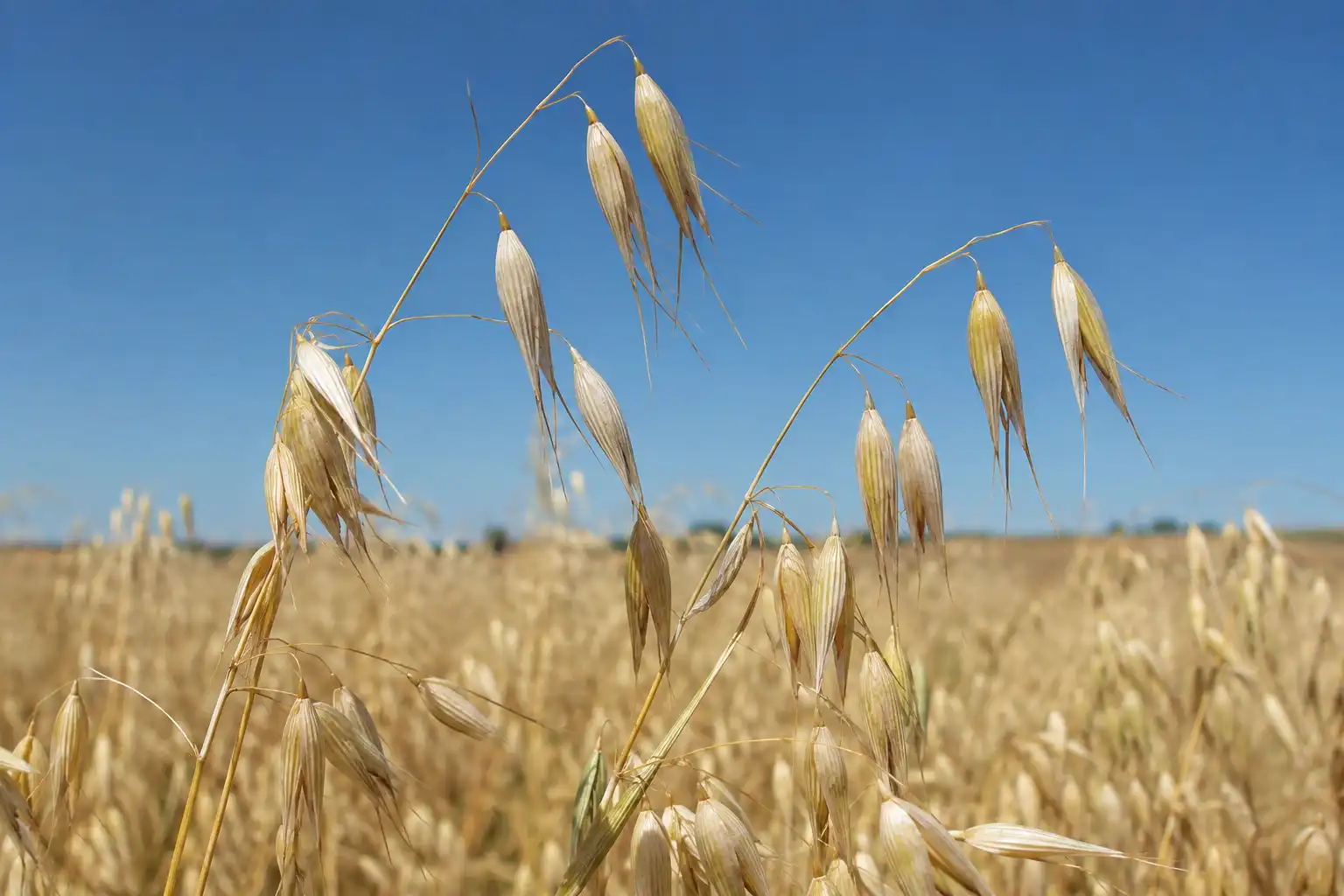
One field difference sets oats apart from the other small grains. Wheat and barley carry a tight spike. Oats carry an open, branching panicle, and the spikelets dangle on thin stems. Once you know what oat plants look like at heading, you never mistake the two again.
Oats also came late to domestication. They first showed up as a weed inside wheat and barley fields. Early growers then kept them as a crop of their own. That history explains where oats come from, and why oats tolerate cool, wet, acid ground that wheat dislikes.
Two forms exist today:
- Hulled oats (Avena sativa). The hull stays on the kernel after threshing. Nearly every US acre is hulled.
- Hulless or naked oats (Avena nuda). The hull falls away at threshing. Yields run lower, so these serve niche feed and food buyers.
What Is Inside an Oat Kernel
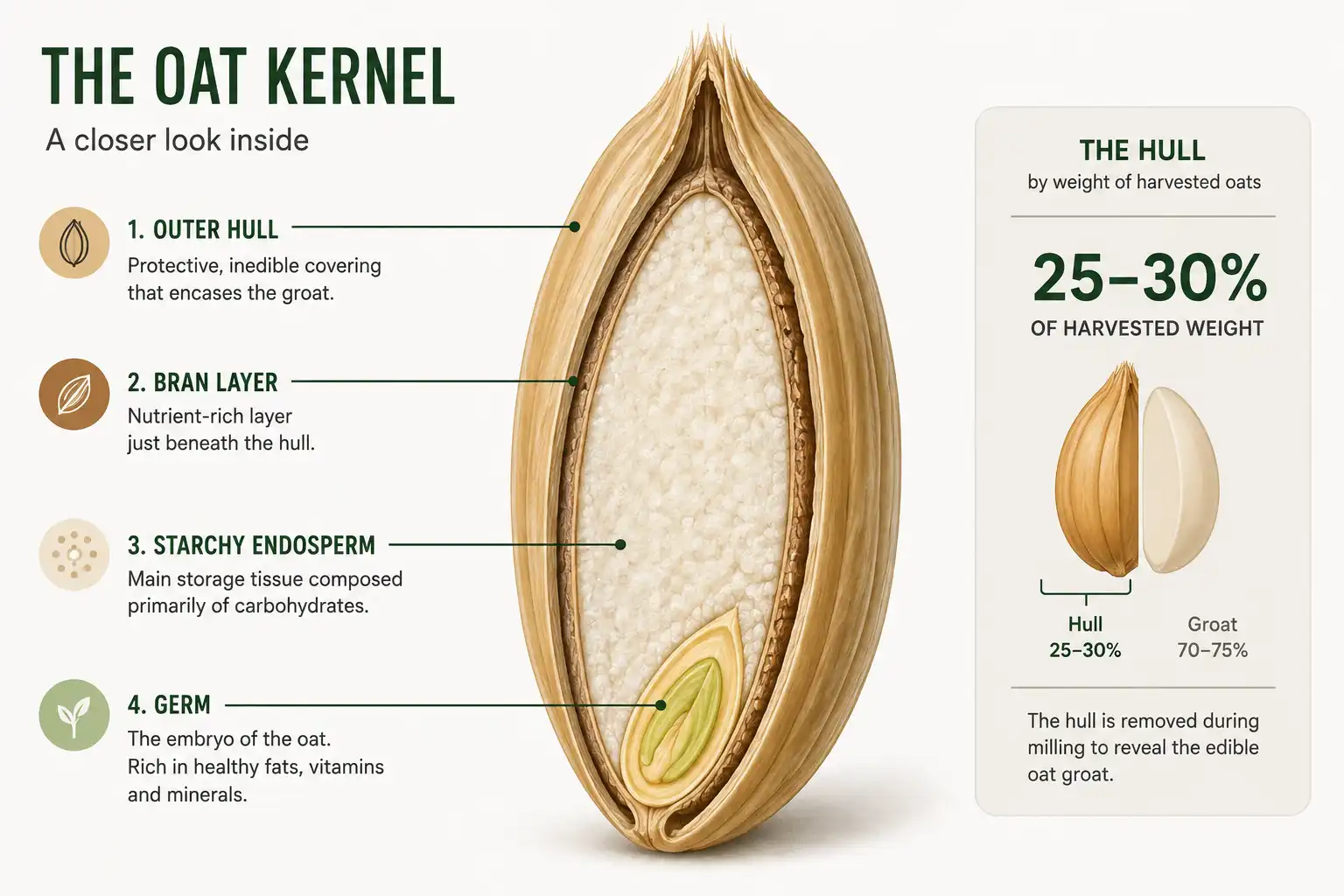
An oat kernel has two layers: an outer hull, and the groat sitting inside it.
The hull is the lemma and palea, two tough bracts that wrap the seed. Oats do not thresh free of them. That single trait separates oats from wheat. The hull also runs about 25 to 30 percent of harvested weight, and it carries almost no food value.
Strip the hull and you have the groat. The groat holds the three parts that define a whole grain.
| Kernel part | What it is | Why it matters |
|---|---|---|
| Hull | Fibrous outer bracts, removed at the mill | Roughage and fuel, not human food |
| Bran | Outer layer of the groat | Carries most of the beta-glucan soluble fiber |
| Endosperm | Starchy center | Supplies most of the calories and starch |
| Germ | Embryo at the base of the kernel | Holds the oil, the vitamin E, and most of the fat |
Millers do not grind oats the way they grind wheat. Instead they kiln the groats to stop the enzymes, then steam and flake or cut them. The bran and germ stay attached the whole time.
Are Oats a Whole Grain?
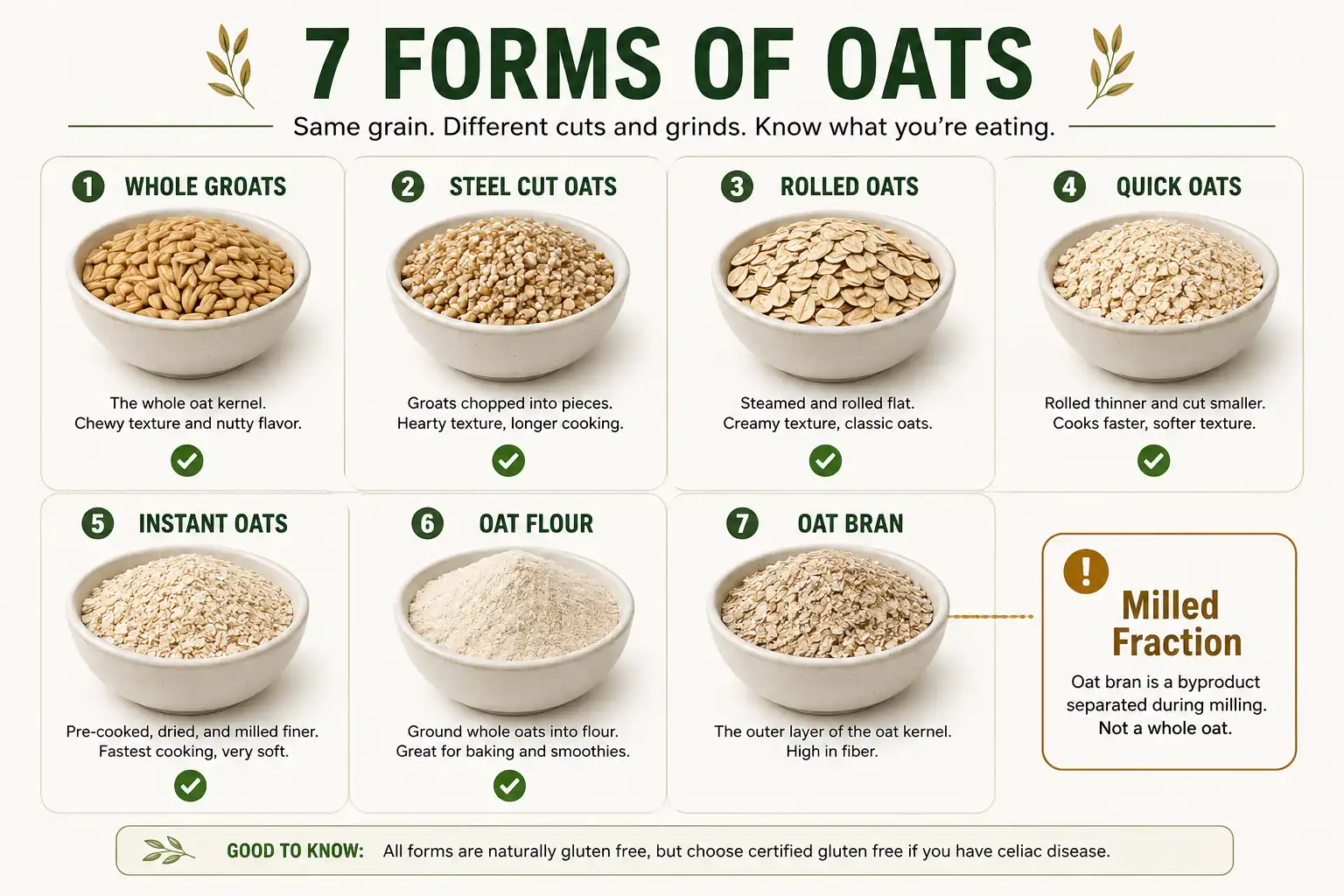
Yes. Rolled oats, steel cut oats, quick oats, instant oats, and oat flour all keep the bran, germ, and endosperm. So every one of them counts as whole grain.
That is unusual among cereals. Wheat becomes white flour once millers strip off the bran and germ. Oats rarely get that treatment, because the standard mill process flattens or cuts the whole groat instead of separating it.
Cutting and rolling change particle size and cook time. They do not change composition. Instant oats cook fast because the flake is thin and pre-steamed, not because part of the kernel came out. Blood sugar response runs higher on instant oats, but whole grain status holds either way.
| Oat form | How millers make it | Whole grain? |
|---|---|---|
| Oat groats | Hull removed, kernel left intact | Yes |
| Steel cut (Irish) oats | Groats cut into two or three pieces | Yes |
| Rolled (old fashioned) oats | Groats steamed, then flattened | Yes |
| Quick oats | Groats cut smaller, then rolled thin | Yes |
| Instant oats | Rolled very thin, pre-cooked, dried | Yes |
| Oat flour | Groats ground fine | Yes |
| Oat bran | Bran layer separated from the groat | No, it is a milled fraction |
The full sequence from field to flake shows up in how oats are made into the product on the shelf.
How Much Oatmeal Counts as a Whole Grain Serving?
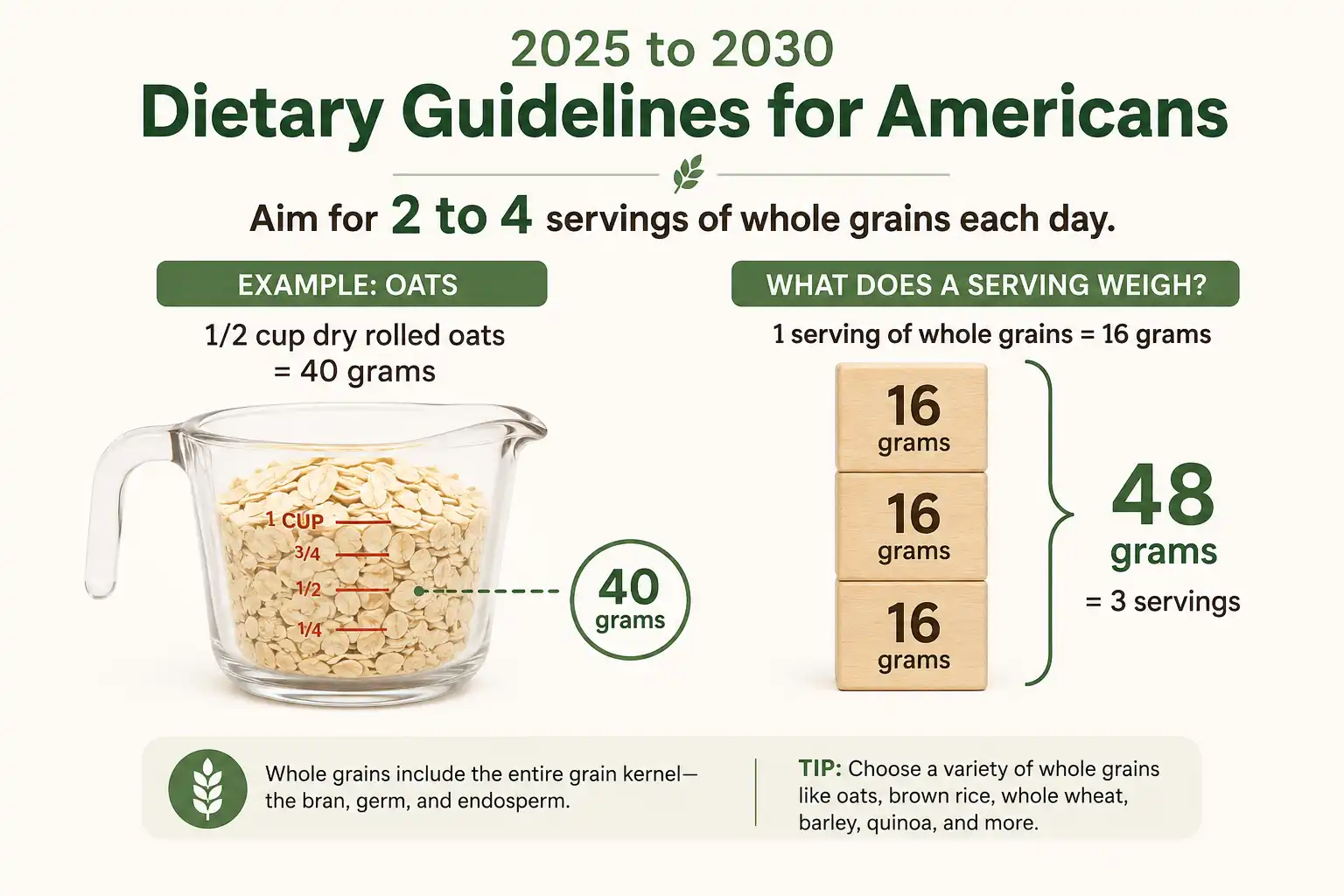
A half cup of dry rolled oats, about 40 grams, covers most of a full day’s whole grain target on its own.
The 2025-2030 Dietary Guidelines for Americans landed in January 2026 with a stronger whole grain message than the previous edition. They tell adults to prioritize fiber-rich whole grains and to aim for 2 to 4 servings a day.
Here is the math most labels skip:
- One whole grain serving means at least 16 grams of whole grain ingredients.
- Three servings a day, or 48 grams, is the intake tied to measurable health benefits.
- Dry rolled oats are 100 percent whole grain, so 40 grams of oats equals 40 grams of whole grain.
That means one ordinary bowl of oatmeal gets you close to the daily target before you eat anything else. Watch the packet size, though. A single instant packet often runs 28 grams or less.
What One Serving of Oats Delivers
A half cup of dry rolled oats runs about 150 calories with 4 grams of fiber, and roughly half of that fiber is beta-glucan.
| Nutrient | Per ½ cup dry rolled oats (40 g) |
|---|---|
| Calories | About 150 |
| Protein | About 5 g |
| Total carbohydrate | About 27 g |
| Dietary fiber | About 4 g |
| Beta-glucan (soluble) | About 1.5 to 2 g |
| Fat | About 3 g |
Beta-glucan is what separates oats from other cereals. Whole oats carry roughly 3 to 6 percent beta-glucan by weight, and the bran layer holds most of it. Federal rules require oat bran to test at 5.5 percent beta-glucan or higher before it can use the name.
FDA authorized a heart disease claim for that fiber in 1997 under 21 CFR 101.81. The claim requires 3 grams of beta-glucan per day. A qualifying food must supply at least 0.75 grams per serving. Reaching 3 grams takes roughly 60 grams of dry oats daily, or about three-quarters of a cup.
Oats also produce avenanthramides, antioxidant compounds found in no other cereal. Groat protein runs 12 to 17 percent, higher than most cereals.
Do Oats Contain Gluten?
No. Oats do not carry the gluten proteins that wheat, barley, and rye carry.
Wheat gluten forms from gliadin and glutenin. The main oat storage protein is avenin, and its structure differs enough that most people with celiac disease tolerate it. A small share still react to avenin itself, so several strict certification programs leave oats out.
Cross contact is the real problem, not the plant. Oats rotate with wheat and barley on the same ground. They also ride the same drills, combines, trucks, and elevator legs. Any one of those steps can move wheat kernels into an oat load.
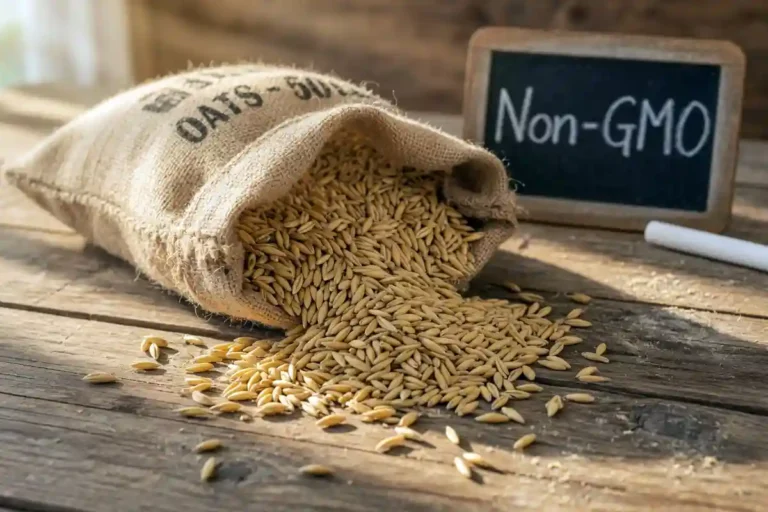
FDA covers this under 21 CFR 101.91. Oats are not a gluten-containing grain under that rule. So an oat product can carry a gluten-free label once the finished food tests below 20 parts per million. Purity protocol oats go further, with dedicated seed, dedicated equipment, and testing at every step.
If you grow oats for a gluten-free buyer, expect questions first. They will ask about rotation history, drill cleanout, and combine cleanout before they take a load.
Are Oats Allowed on a Grain-Free or Paleo Diet?
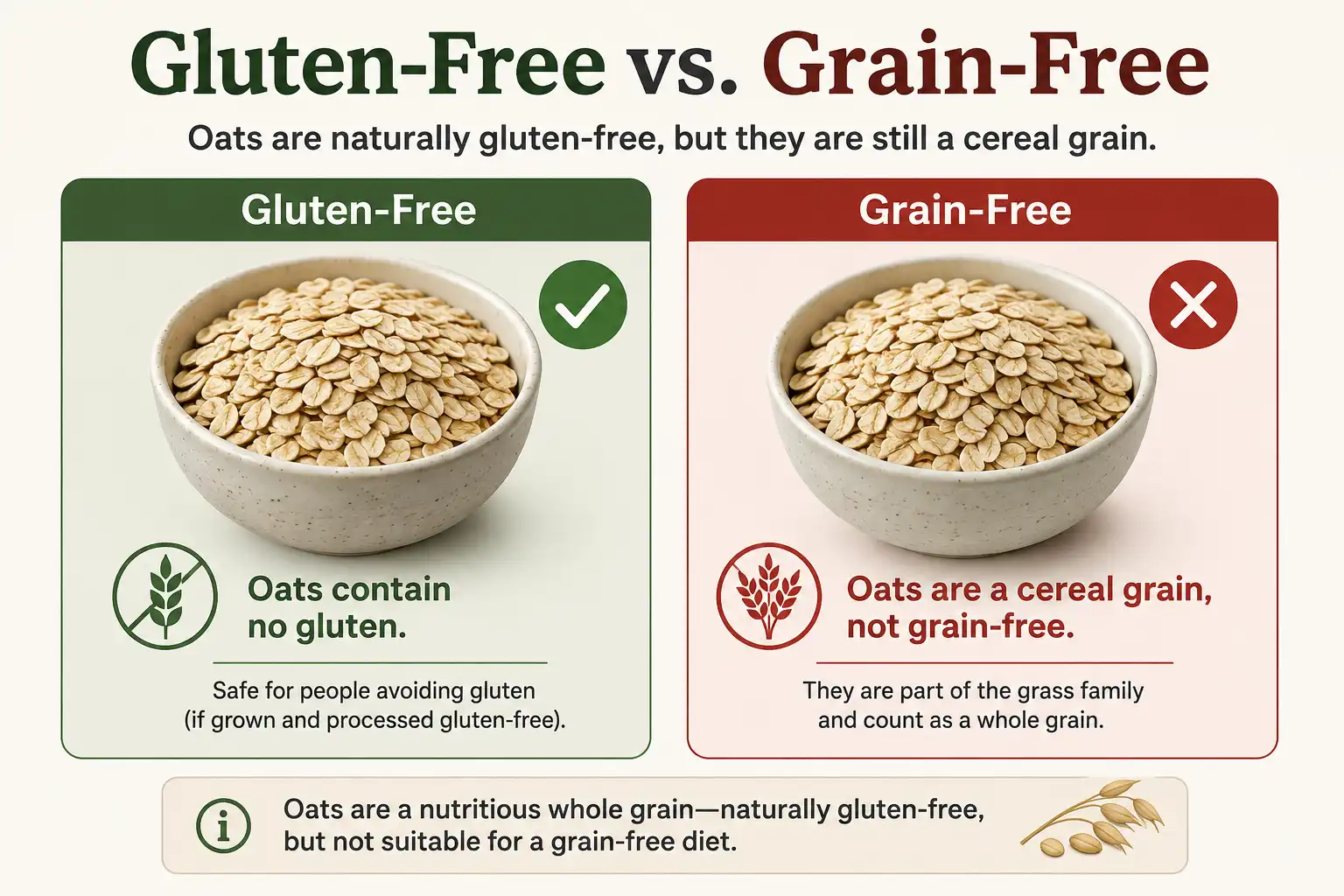
No. Grain-free and paleo plans both exclude oats, because oats are a true cereal grain.
This trips up more people than any other part of the question. Gluten-free and grain-free are not the same standard, and oats pass one test while failing the other.
| Diet or label | Are oats allowed? | Why |
|---|---|---|
| Gluten-free | Yes, if tested under 20 ppm | Oats carry no gluten proteins |
| Grain-free | No | Oats are a cereal grain |
| Paleo | No | Paleo excludes all cereal grains and legumes |
| Whole30 | No | Grains sit on the excluded list |
| Strict keto | Rarely | About 27 g carbohydrate per ½ cup dry |
| Vegan | Yes | Oats are a plant food |
The same split shows up in the pet food aisle. Grain-free dog foods leave oats out, while plenty of gluten-free formulas include them. Read the front label carefully, since the two claims look similar and mean different things.
Oats vs Other Grains and Pseudocereals
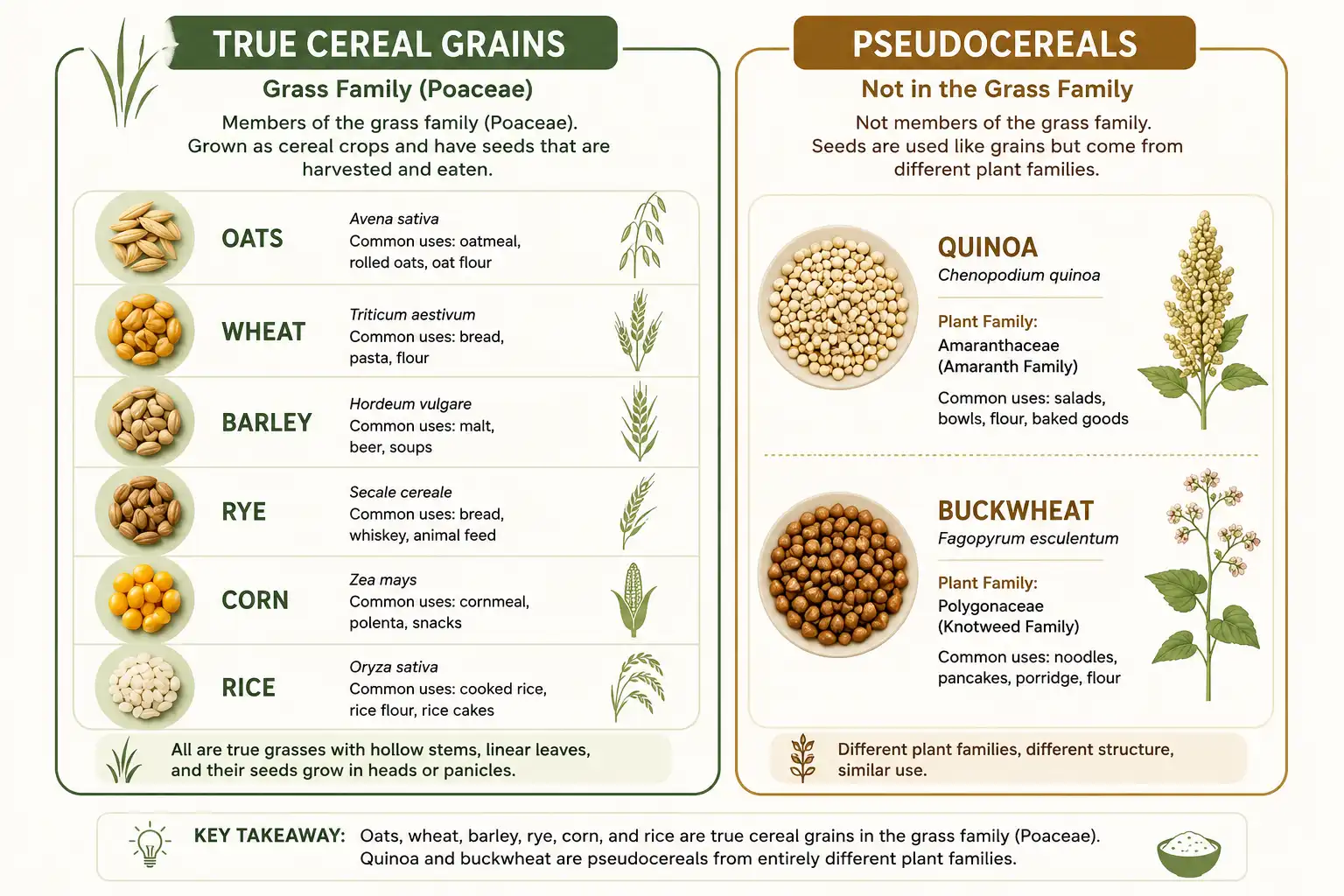
Oats are a true cereal. Quinoa and buckwheat are not.
A true cereal comes from the grass family. Pseudocereals come from other plant families, though people cook them like grains anyway. Quinoa sits in Amaranthaceae with beets and spinach. Buckwheat sits in Polygonaceae alongside rhubarb.
| Crop | Plant family | True cereal grain? | Standard bushel weight | Gluten proteins |
|---|---|---|---|---|
| Oats | Poaceae | Yes | 32 lb | No |
| Wheat | Poaceae | Yes | 60 lb | Yes |
| Barley | Poaceae | Yes | 48 lb | Yes |
| Rye | Poaceae | Yes | 56 lb | Yes |
| Corn | Poaceae | Yes | 56 lb | No |
| Rice (rough) | Poaceae | Yes | 45 lb | No |
| Quinoa | Amaranthaceae | No, pseudocereal | No USDA grain standard | No |
| Buckwheat | Polygonaceae | No, pseudocereal | No USDA grain standard | No |
The bushel column shows why oats look light in the bin. Hull volume drives that number, not poor grain quality. Feeders and food buyers weigh that trade differently. That gap sits at the center of the argument over wheat or oats on a given acre.
Most US Oat Acres Never Become Grain
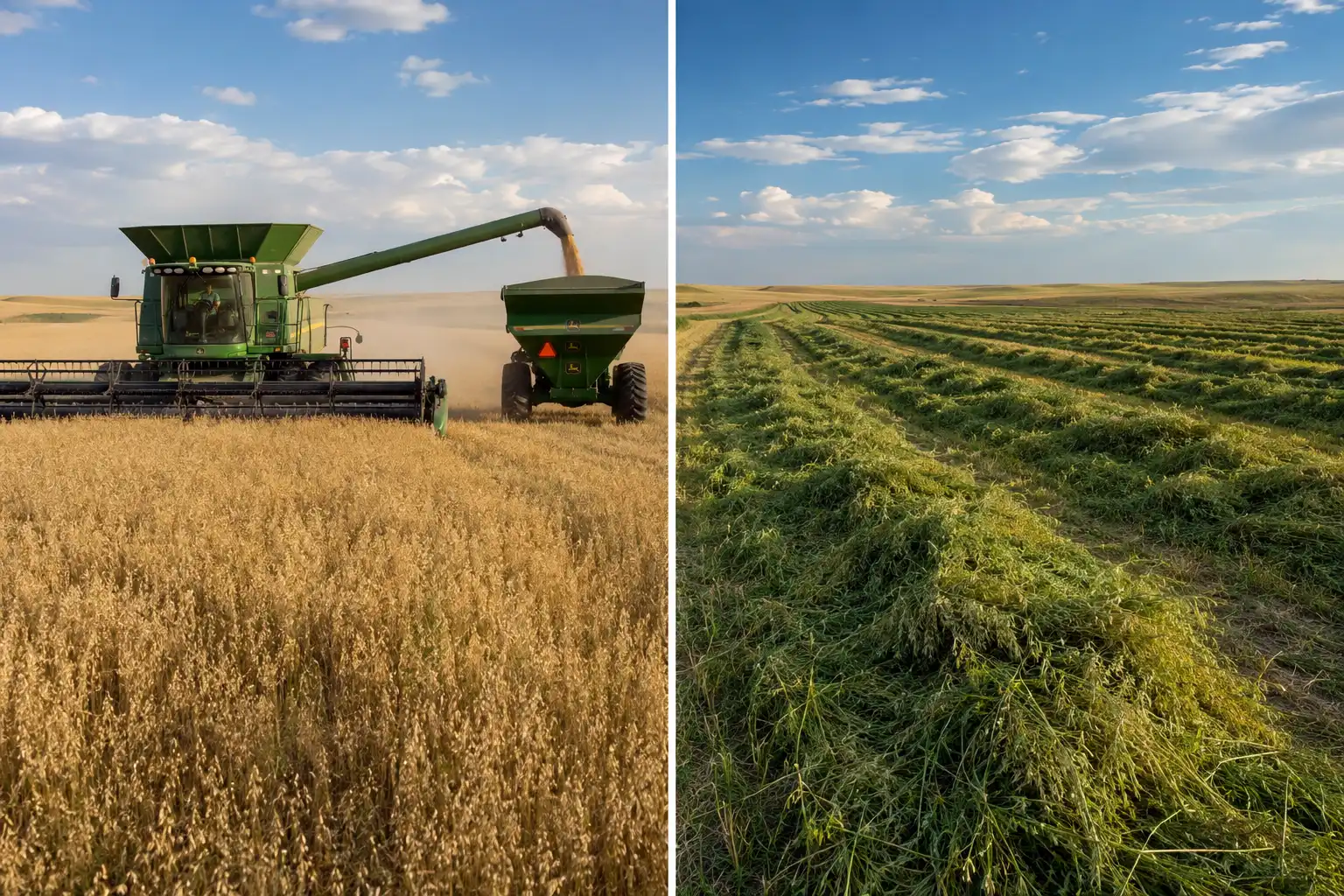
Oats work as a grain crop and a forage crop, and forage claims more acres than grain does.
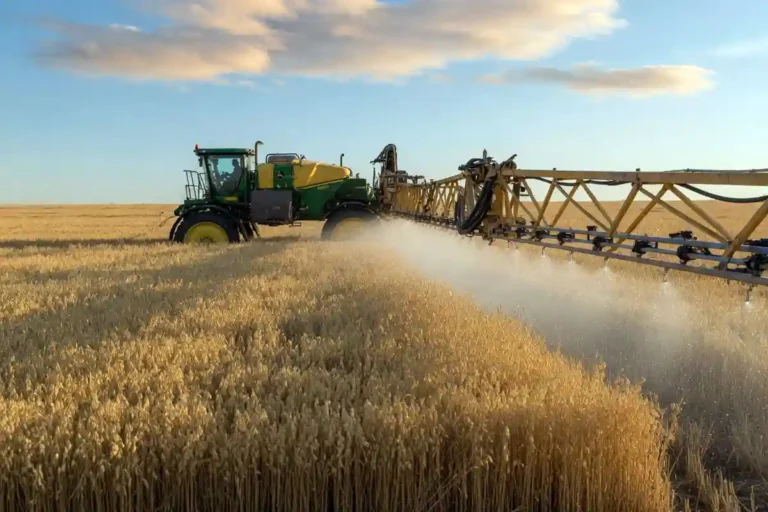
USDA NASS counted 2.37 million acres of oats seeded in 2025. Only 944,000 of those acres reached grain harvest. The rest went to hay, silage, grazing, cover crop stands, and nurse crop seedings under new alfalfa. Grain production finished at 69.6 million bushels on a 73.8 bushel average yield.
The 2026 crop tightened further. NASS forecast 63.2 million bushels in July 2026, down 9 percent from 2025. Only 877,000 acres are headed for grain harvest.
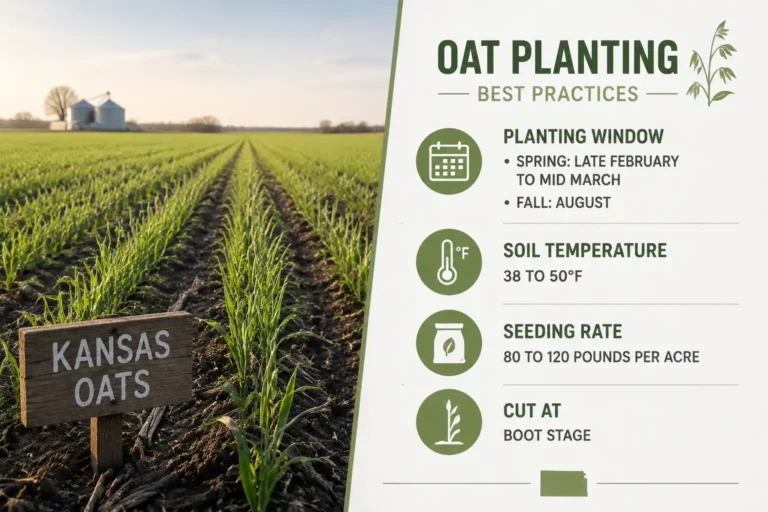
In Kansas, oats can be managed both ways. Spring oats go in as a nurse crop over new alfalfa. Part of that stand is then cut for hay at the boot stage. Whatever is left standing goes to grain, and the straw pays its own way afterward.
That split is why oat acreage figures confuse people. The crop is a grain by every definition, but most of it leaves the field as feed.
How USDA Grades Oats as a Grain
USDA grades oats under the Official U.S. Standards for Grain, the same rulebook that covers corn, wheat, and soybeans. The Federal Grain Inspection Service runs it, and oats sit in 7 CFR Part 810, Subpart G.
| Grade | Min test weight (lb/bu) | Min sound oats (%) | Max heat-damaged (%) | Max foreign material (%) | Max wild oats (%) |
|---|---|---|---|---|---|
| U.S. No. 1 | 36.0 | 97.0 | 0.1 | 2.0 | 2.0 |
| U.S. No. 2 | 33.0 | 94.0 | 0.3 | 3.0 | 3.0 |
| U.S. No. 3 | 30.0 | 90.0 | 1.0 | 4.0 | 5.0 |
| U.S. No. 4 | 27.0 | 80.0 | 3.0 | 5.0 | 10.0 |
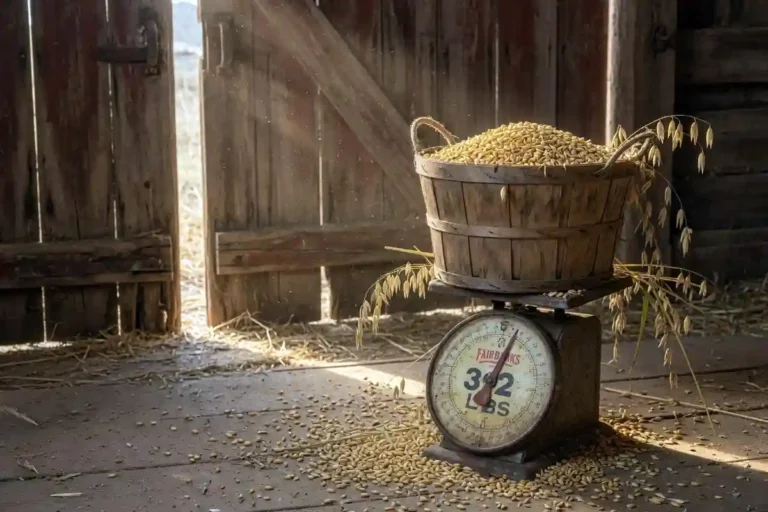
Two numbers trip growers up every year. The legal bushel weight for oats is 32 pounds, but U.S. No. 1 oats need a 36 pound test weight. The 32 pound figure converts pounds to bushels on your ticket. It is not a grade floor. Before you argue price, check what a bushel of oats weighs and how your elevator handles the conversion.
Two special grades come up often. FGIS calls oats testing 38.0 to 39.9 pounds heavy oats. Anything at 40 pounds or more grades as extra heavy oats.
FAQs
Is oatmeal a grain?
Are oats a grass?
Are oats a carb?
Is oat milk a whole grain?
Are oats a legume?
Are wild oats the same crop?
Are steel cut oats healthier than rolled oats?
The Bottom Lines
Oats are a grain botanically, nutritionally, and legally under federal grading. That triple answer settles the label question. The practical takeaways are simpler. One bowl of oatmeal nearly covers your daily whole grain target. Gluten-free eaters can usually keep oats, but grain-free and paleo eaters cannot. Growers should remember that most US oat acres still leave the field as hay rather than grain.