When to Harvest Oats: Moisture Targets by Growth Stage
Oat grain hits maximum dry weight well before it is dry enough to combine. That gap is where yield and test weight slip away. Knowing when to harvest oats comes down to two checks: growth stage and kernel moisture.
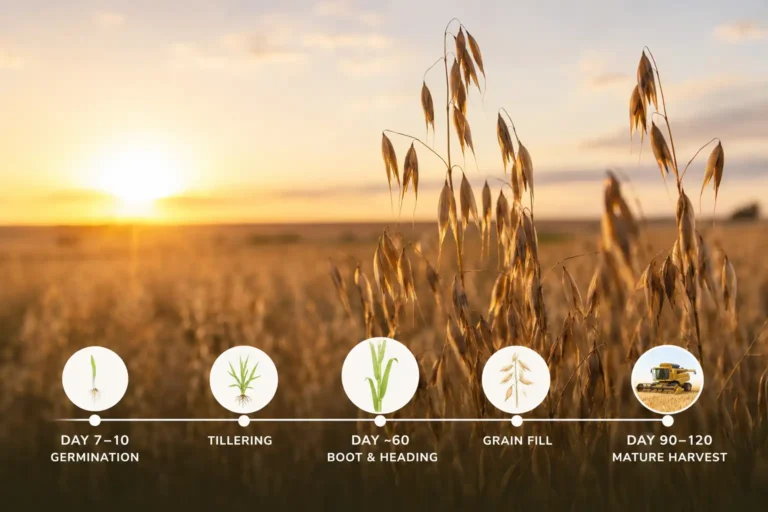
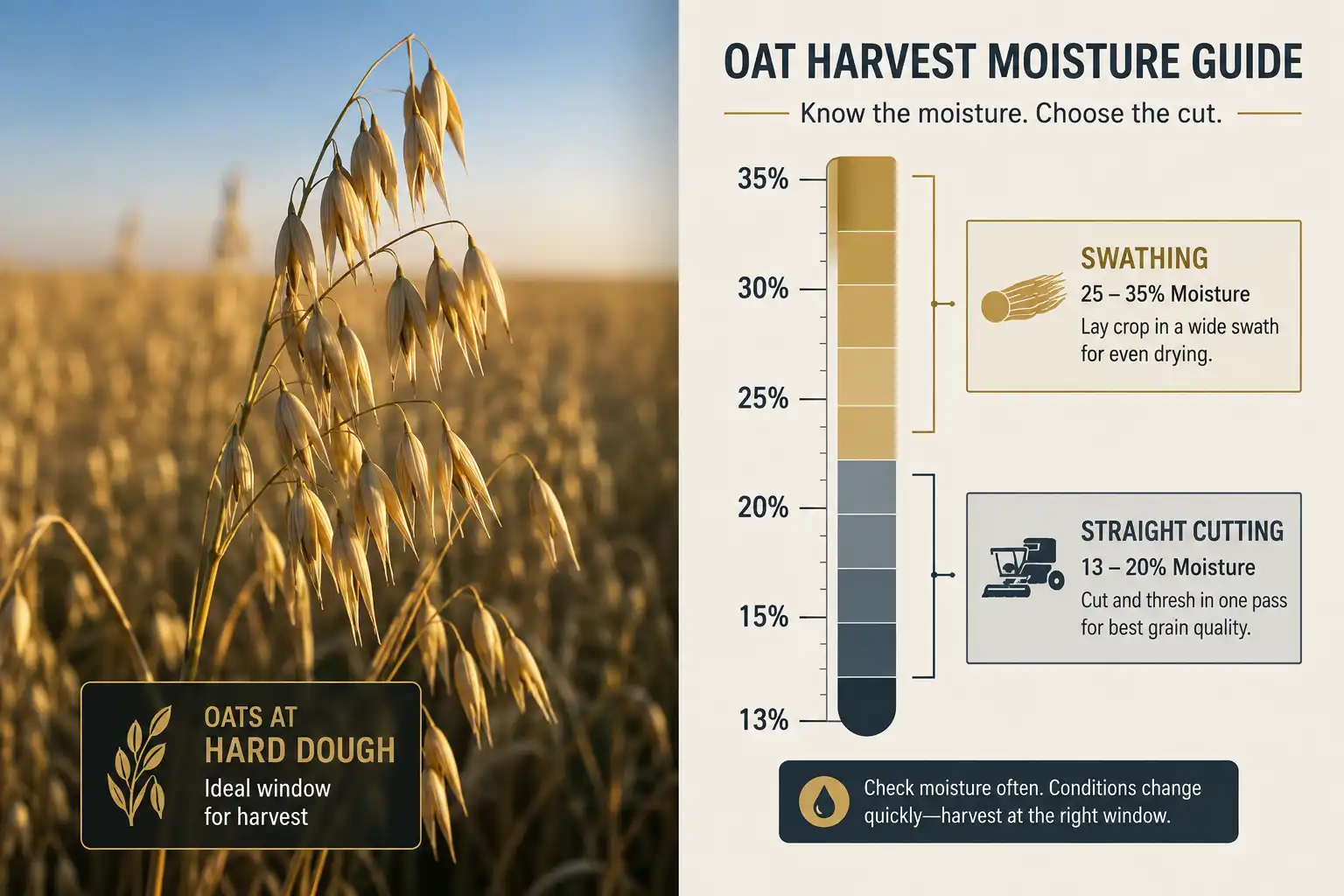
When to harvest oats comes down to moisture. Swathe at 30 to 35 percent kernel moisture, right at physiological maturity. Straight cut standing grain at 13 to 14 percent. Hard dough is the trigger stage.
What Growth Stage Signals Oats Are Ready for Grain Harvest?
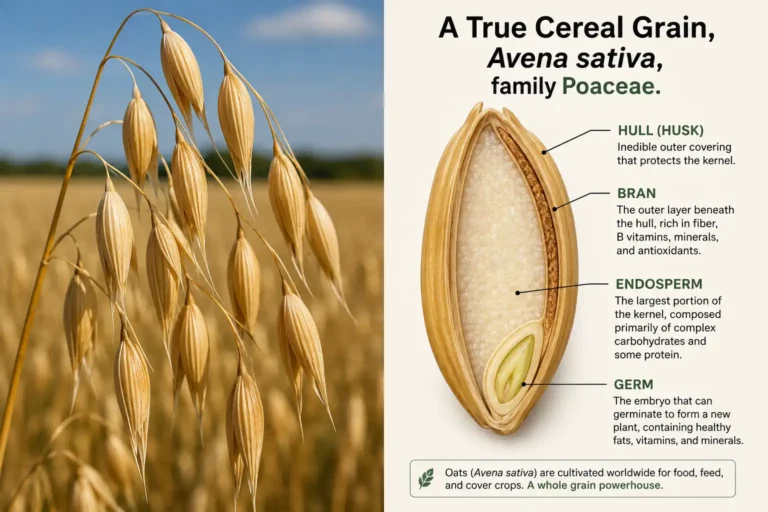
Hard dough signals grain readiness, because that stage marks physiological maturity. According to North Dakota State University, hard dough occurs at 30 to 35 percent kernel moisture. Once a small grain crop passes that point, it stops moving dry matter into the kernel. Waiting longer therefore adds nothing to yield. It only trades weather risk for drydown.
University of Minnesota Extension puts kernel moisture at physiological maturity between 20 and 40 percent. That range covers wheat, barley, and oat. Variety and heat during grain fill move the number inside the band. So growth stage matters more than any single meter reading.
| Growth stage | Kernel check | Grain moisture | What it means |
|---|---|---|---|
| Milk | Thin white liquid squeezes out | Above 40 percent | Forage stage. Grain is not filled |
| Soft dough | Pasty and soft, no liquid | Above 35 percent | Hay and haylage window |
| Hard dough | Dents under a thumbnail, will not split | 30 to 35 percent | Physiological maturity. Swathing starts |
| Kernel hard | Cracks clean, hull strips off easily | Roughly 20 to 30 percent | Drying down, still too wet to bin |
| Harvest ripe | Straw tan throughout, panicle brittle | 13 to 14 percent | Straight cut window |
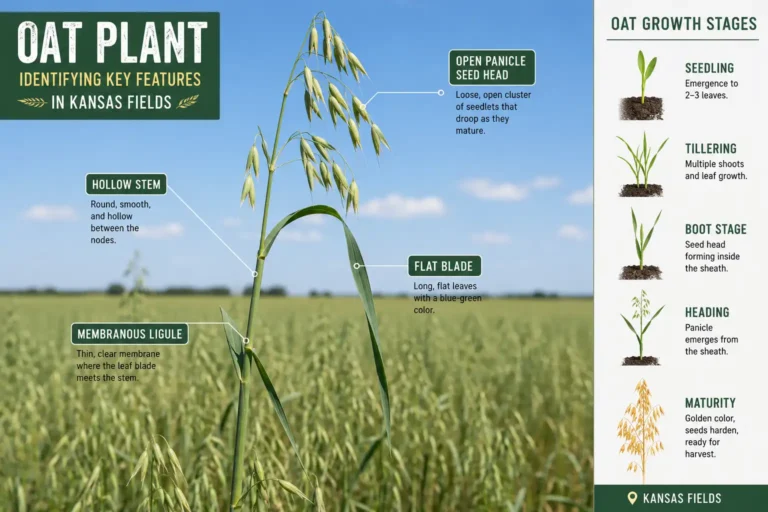
Oats flower from the top of the panicle downward, so the bottom kernels finish last. Always judge the crop on those lower kernels rather than the tip.
When to Harvest Oats by Moisture Target
Two moisture targets cover grain harvest, and your method sets which one applies. Swathing starts at 30 to 35 percent. Straight cutting waits for 13 to 14 percent in the standing crop.
Those numbers are not interchangeable. Swathed oats still dry in the windrow before the pickup head runs. They enter the bin at the same 13 to 14 percent a straight cut crop does. Confirm the reading with a grain moisture tester rather than by feel. A thumbnail check cannot separate 16 percent from 13 percent.
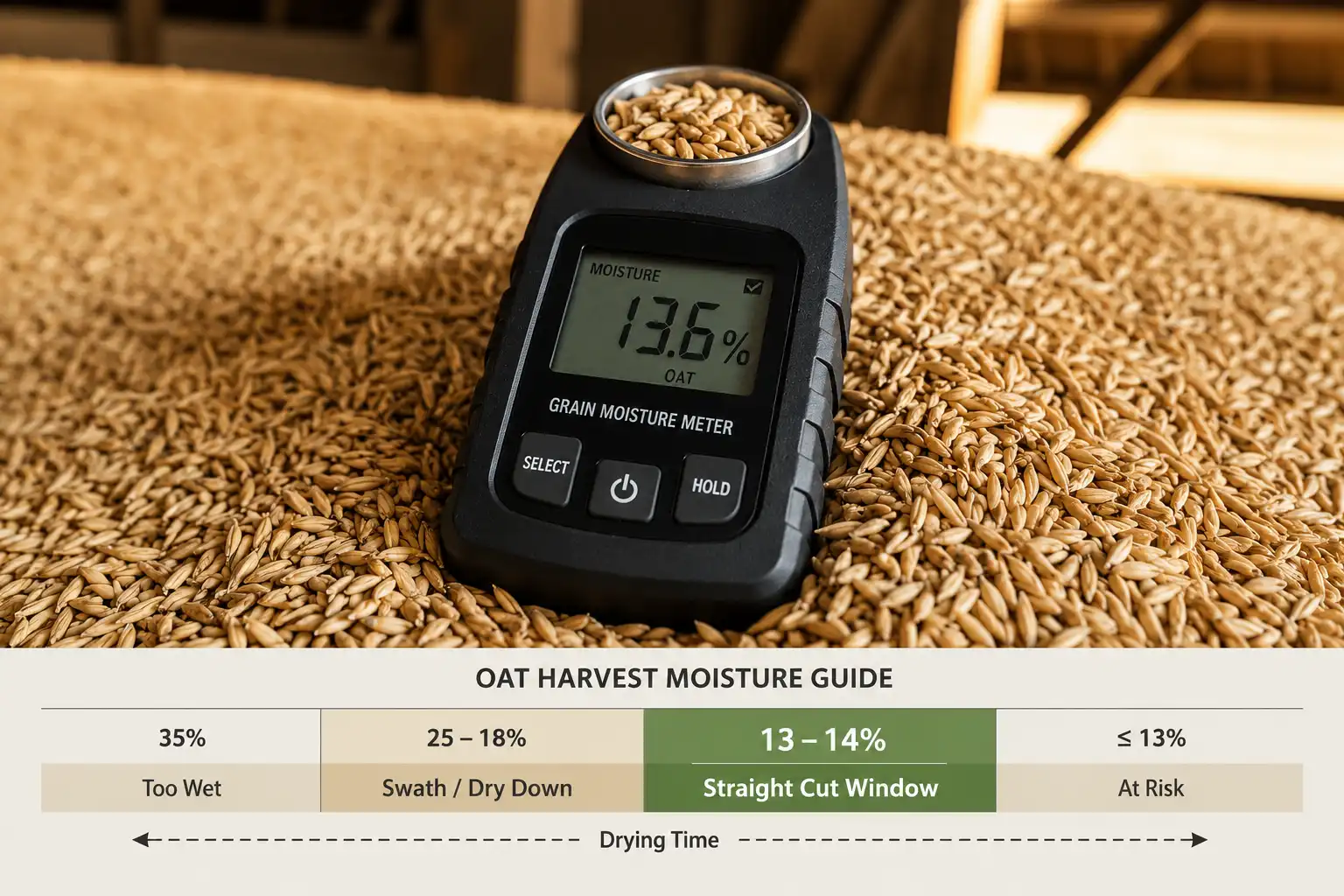
Pull kernels from at least five spots before committing. Field edges and high ground ripen first, while low pockets and weedy strips run several days behind.
How Do You Confirm Physiological Maturity in the Field?
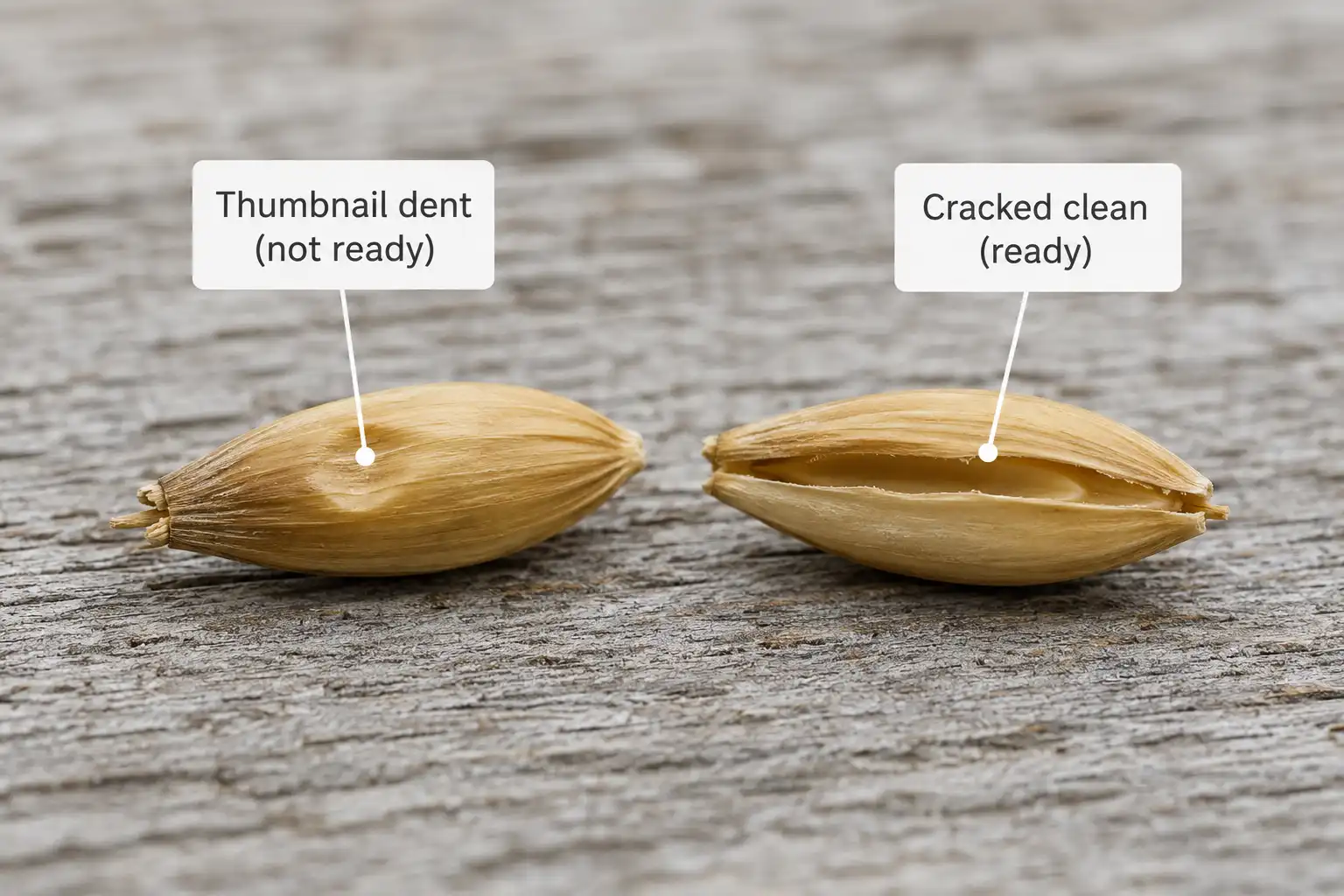
Two visual checks confirm it, and University of Minnesota Extension recommends both. First, look for loss of green in the kernel and a dark layer of pigment along the crease. Second, check the uppermost internode just below the head, called the peduncle. Once that peduncle turns very light green or yellow, flow to the head has stopped. Grain fill has ended.
Kernels in the same head do not mature on the same day, so expect a spread. That spread is exactly why sampling beats eyeballing.
When Does Oat Harvest Happen in Your Region?
Spring oats come off from early July through early September, moving north with the calendar. USDA NASS publishes usual harvesting dates by state. In that handbook, the most active range covers when 15 to 85 percent of the crop comes off.
| State (spring oats) | Most active harvest |
|---|---|
| Nebraska | July 10 to July 30 |
| Illinois | July 14 to August 7 |
| Kansas | July 15 to August 1 |
| Iowa | July 17 to August 5 |
| South Dakota | July 21 to August 15 |
| Pennsylvania | July 25 to August 20 |
| Minnesota | July 26 to August 24 |
| Wisconsin | July 28 to August 24 |
| New York | August 4 to August 24 |
| North Dakota | August 5 to September 5 |
| Montana | August 15 to September 9 |
Fall sown oats in the South run far earlier, because the crop overwinters and fills grain in spring.
| State (fall sown oats) | Most active harvest |
|---|---|
| Texas | May 23 to June 22 |
| Alabama | May 25 to June 25 |
| Georgia | June 1 to June 22 |
| South Carolina | June 3 to June 20 |
| North Carolina | June 10 to June 30 |
| California | July 15 to September 1 |
Seeding date drives most of the spread inside a state. SDSU Extension puts optimum oat seeding in South Dakota from late March to late April, moving south to north. That five week planting spread carries straight through to harvest. For season length, see how long oats take from seeding to maturity under different planting dates.
Should You Swathe or Straight Cut?
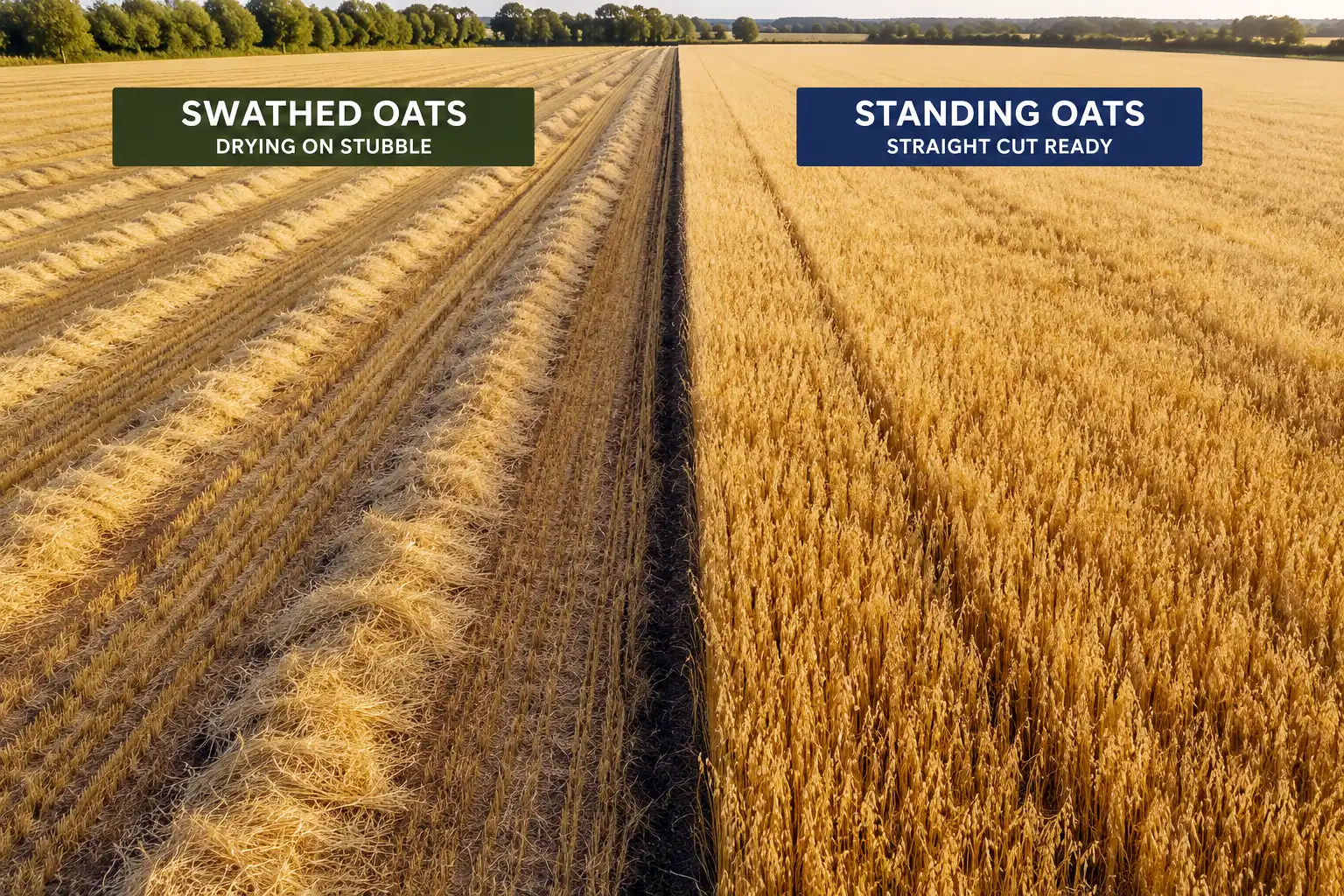
Swathe an uneven, weedy, or lodged stand, and straight cut a clean even one. The choice moves your harvest date by roughly a week.
| Factor | Swathing | Straight cutting |
|---|---|---|
| Cutting moisture | 30 to 35 percent | 13 to 14 percent |
| Field passes | Two | One |
| Uneven ripening | Evens it out | Makes it worse |
| Hail exposure | Lower once cut | Higher while standing |
| Rain after cutting | Sprouting risk in the swath | Crop dries faster standing |
University of Minnesota Extension reports that swathing speeds and evens crop drydown. A cut crop also takes less hail damage. The tradeoff is sprouting. Grain sitting in a heavy swath through rain or dew runs a higher risk of pre-harvest sprouting. Standing grain sheds water and dries faster. Modern varieties hold up better standing, so growers now straight cut most wheat and barley.
Timing within the day matters too. Swathing in early morning or late evening, with dew still on the crop, reduces shatter loss. After the crop comes down, harvesting oats out of the windrow follows normal threshing rules.
What Goes Wrong When Oat Harvest Timing Slips?
Cutting early costs test weight, and cutting late costs bushels on the ground. Both show up in the check.
Too early. Swathing before physiological maturity produces yield loss, test weight loss, and green kernels. Losses get worse the earlier you cut. University of Minnesota Extension cites NDSU research in spring wheat and durum. Swathing at 45 percent moisture cut test weight by 1 to 2 pounds. Grain yield fell about 10 percent.
Too late. Swathing after physiological maturity raises shattering risk, though it does not hurt grain quality. Standing oats left past ripe face the same problem. Weathering and bleaching also pull the sample down a grade.
Test weight is where late timing shows up first. USDA grain standards set minimum test weights by grade. US No.1 oats need 36.0 pounds per bushel, No.2 needs 33.0, No.3 needs 30.0, and No.4 needs 27.0. The legal bushel stays fixed at 32 pounds, a separate number for payment math. That difference trips up first time sellers. Check what a bushel of oats weighs before you haul.
Crown rust deserves a mention here. University of Minnesota lists it as a major limiting factor in state oat production. A rusted or lodged crop ripens unevenly. Scout those fields separately and expect to swathe rather than straight cut.
What Moisture Do Oats Need Going Into the Bin?
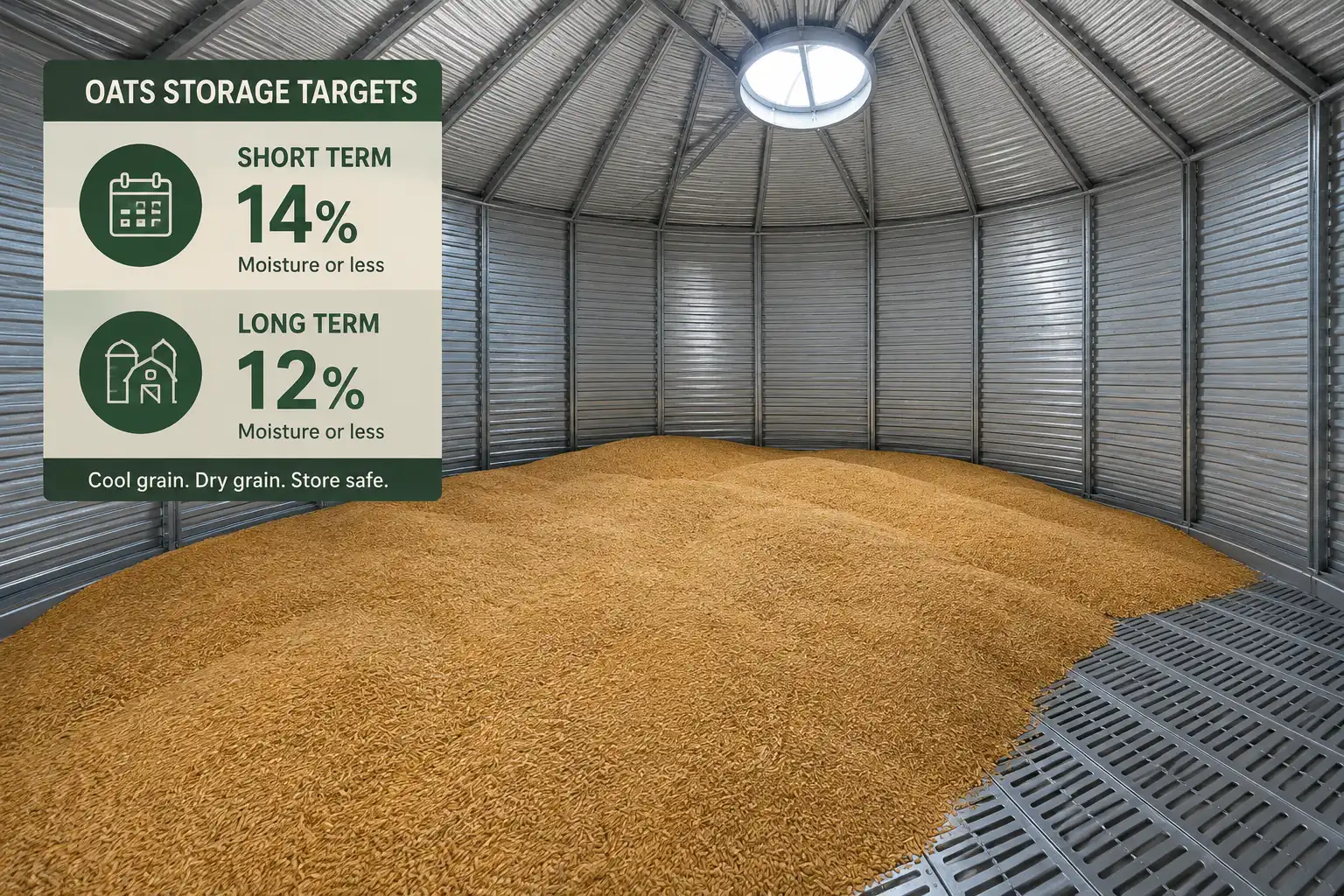
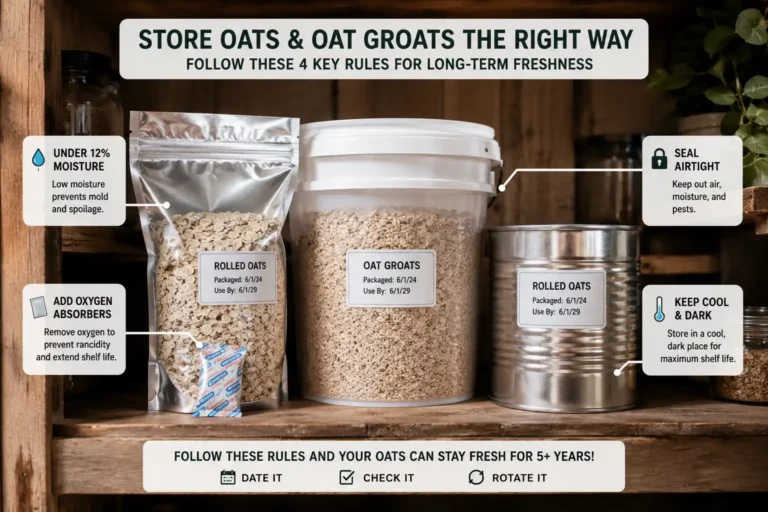
Dry oats to at least 14 percent before storage and to 12 percent for long term storage, per NDSU. Anything wetter heats in the bin.
Cooling matters as much as the moisture reading. University of Minnesota Extension advises checking stored grain every seven to 14 days. That applies whenever grain or outdoor temperatures run above roughly 50 degrees F. Pull samples from more than one depth, since the top center heats first. Longer holding periods call for tighter control. The guide to storing oats so they stay fresh covers the off season.
When to Cut Oats for Forage Instead of Grain
Cut much earlier for forage, because feed value peaks long before grain does. NDSU recommends the soft dough stage for oats fed to a cow calf herd. That stage maximizes digestible dry matter per acre.
Quality and tonnage pull against each other. University of Minnesota research found crude protein and digestibility highest at boot stage. Yet forage yield at boot runs only 38 to 42 percent of dough stage yield. Growers targeting hay work from cutting oats for hay at the milk to soft dough window. The grain moisture targets above do not apply.
FAQs About Oat Harvest Timing
Can you harvest oats after rain?
How many days after planting are oats ready?
Does harvest timing change oat test weight?
How long can ripe oats stand in the field?
Why do oats lodge before harvest?
What to Check Before the Combine Rolls
Confirm hard dough on the lower kernels, then confirm the number with a meter. Swathe at 30 to 35 percent on uneven or weedy fields. Straight cut at 13 to 14 percent when the stand is clean and the forecast holds. Then dry to 12 percent before the bin sits through winter.