Are Oats Wheat? Field, Bushel, and Label Differences
Walk past an oat field and a wheat field in June and both look like grass turning gold. That is why people ask are oats wheat. The two crops sit in separate genera, and the gap shows up from the combine to the cereal box.
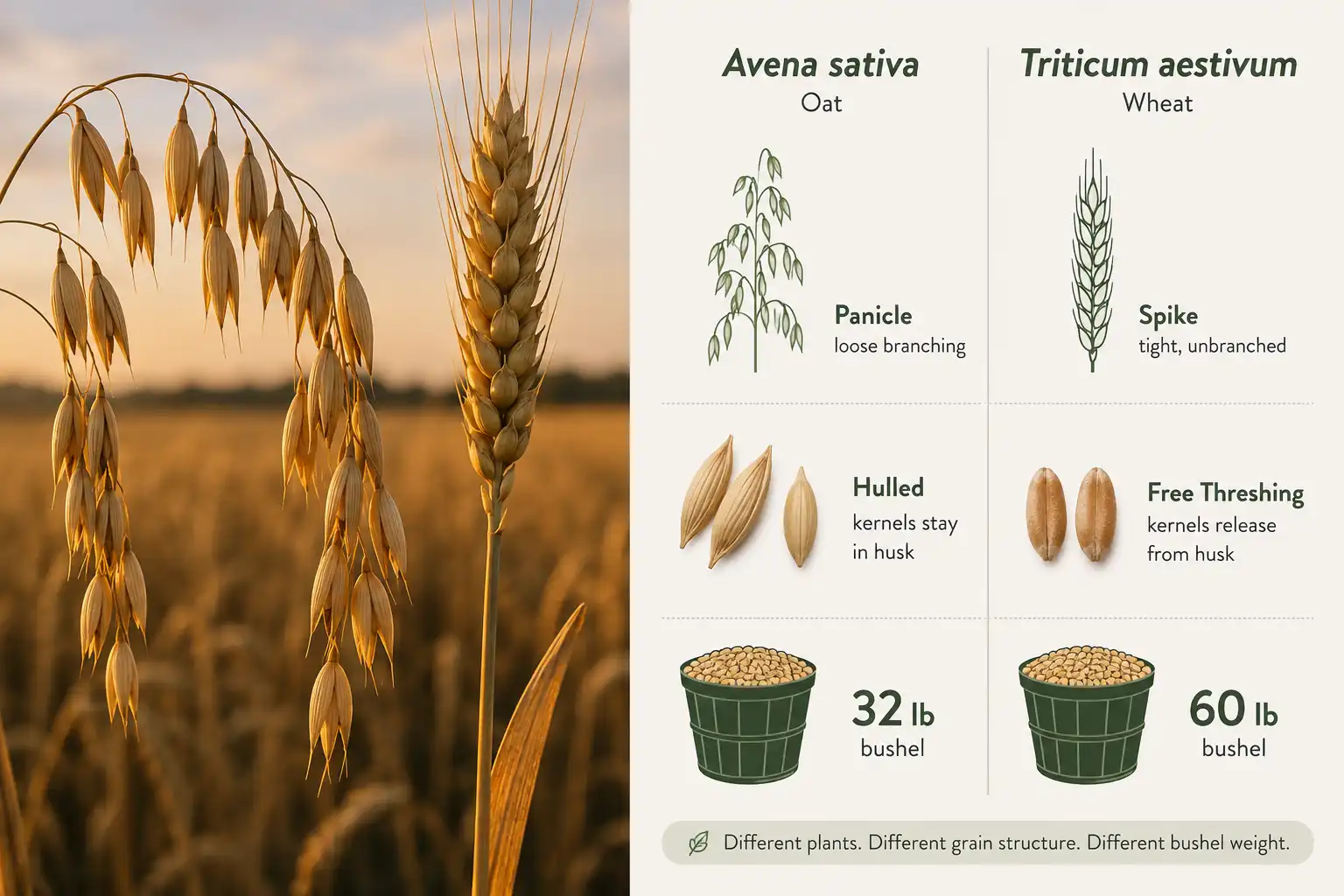
Oats are not wheat. Oats belong to the genus Avena and wheat belongs to Triticum, two separate genera in the grass family. The plants cannot cross, and pure oat grain carries none of the gluten proteins found in wheat.
Learn more: Are Oats a Grain or Seed
Are Oats and Wheat the Same Plant?
No, oats and wheat are two different species that only share a plant family. Both sit in Poaceae, the grass family, along with corn, rice, and sorghum. After that, they split.
Cultivated oats are Avena sativa. Bread wheat is Triticum aestivum, and durum wheat is Triticum durum. The two genera sit in different tribes as well. Wheat shares its tribe with barley and rye. That makes those two closer cousins to wheat than oats will ever be.
Here is the part that surprises people. Bread wheat and cultivated oats both carry 42 chromosomes. The genomes behind those chromosomes differ. So the plants do not cross in a field or in a breeding program. An oat plant next to a wheat plant stays an oat plant, and its seed comes back as oats.
That botany also settles the grain question, since both crops produce a cereal grain from a grass. If you want the full breakdown of how oats classify as a grain, that sits in its own guide.
How to Tell Oats From Wheat in the Field
Check the seed head first, then check the leaf collar. Those two spots settle it almost every time.
| Trait | Oats | Wheat |
|---|---|---|
| Seed head | Open branching panicle, spikelets hang on thin stalks | Tight spike, spikelets sit flat against a central stem |
| Auricles at the collar | None at all | Short, hairy, clasping the stem |
| Ligule | Prominent and membranous | Present but shorter |
| Leaf twist | Counterclockwise | Clockwise |
| Awns | Usually absent or short and bent | Often long and stiff, or awnless in some classes |
| Leaf look | Waxy, blue green, very upright | Greener, flatter, more spread |
| Mature field color | Pale, light straw | Deeper gold to amber |
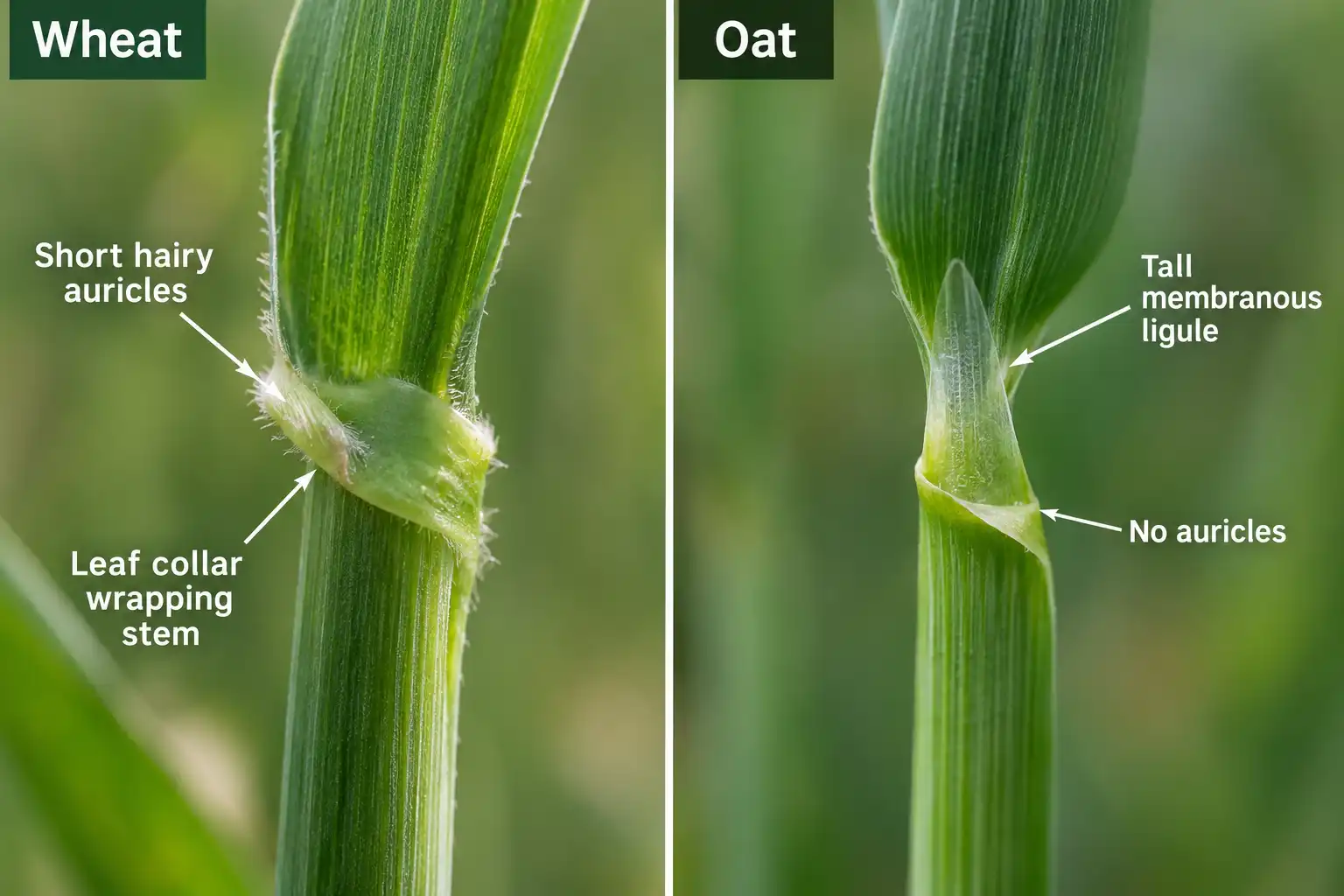
The auricle check works before heading, which is when the two crops look most alike. USDA NRCS plant identification guides and Texas A&M AgriLife both use missing auricles as the marker for oats. Run a thumb across the collar. If nothing wraps the stem, you are standing in oats.
After heading, no check is needed. Wheat holds its grain tight against one central stem. Oats fan out and hang. Anyone walking a field can learn how an oat plant looks at each stage in an afternoon.
Why People Mix Up Oats and Wheat
Both crops move through a farm the same way, so the confusion is earned. Plant both with the same drill. Cut both with the same combine and the same header. Both go into the same bins and both sell by the bushel.
Language adds to it. Plenty of folks use the word wheat for any small grain. It works like calling every soft drink a Coke. Oat straw and wheat straw look nearly identical in a bale once the heads are gone.
Then there is the grocery aisle. Granola, oat bread, and oat based cereals frequently list wheat flour as a second ingredient. Somebody eats an oat product, reacts to the wheat in it, and blames the oats.
Farmers ask a sharper version of the same question when they are picking a crop for a field. That answer sits in a side by side look at wheat and oats covering yield, feed value, and season fit.
Do Oats Contain Wheat Gluten?
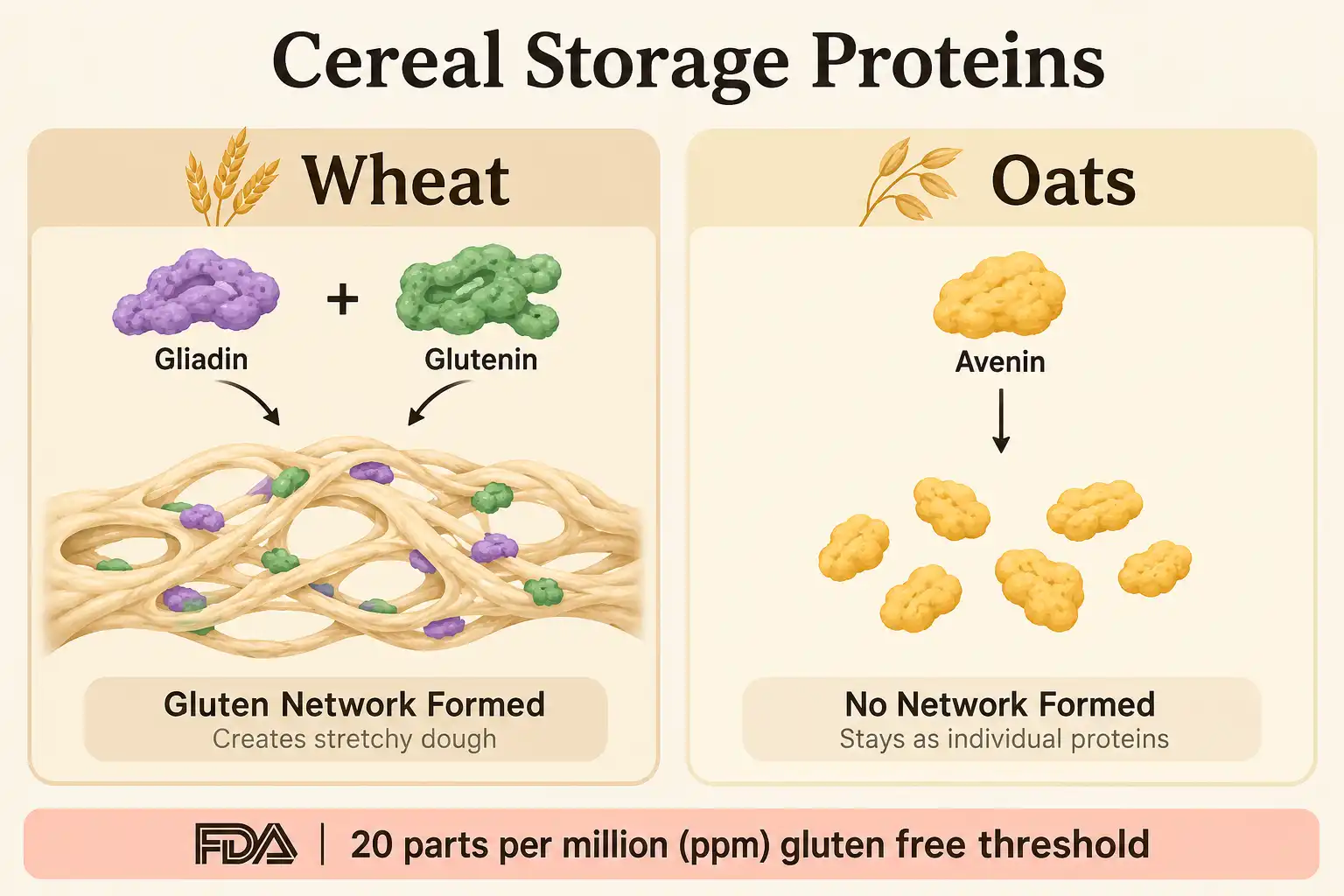
No, pure oats carry no wheat gluten. Wheat gluten forms from two protein groups, gliadin and glutenin. Add water and work the dough, and those two link into the stretchy network that traps gas in bread.
Oats carry a storage protein called avenin instead. Avenin is a smaller share of total protein than gliadin is in wheat. It also lacks the sequences that drive the celiac immune response. Research summarized by the Celiac Disease Foundation and Beyond Celiac supports that point.
Two practical notes follow from it.
First, a small share of people with celiac disease still react to avenin itself. That group needs to work with a doctor or a registered dietitian rather than a farm blog.
Second, wheat allergy is a separate condition. It is an immune response to wheat proteins, so oats are not the trigger. Cross contact still matters, because most oats on a shelf have shared equipment with wheat somewhere along the line.
Under the FDA gluten free labeling rule, any food with that claim must test below 20 parts per million. Oats are allowed in those foods. Plain rolled oats with no gluten free claim frequently test above that limit.
How Wheat Ends Up in a Load of Oats
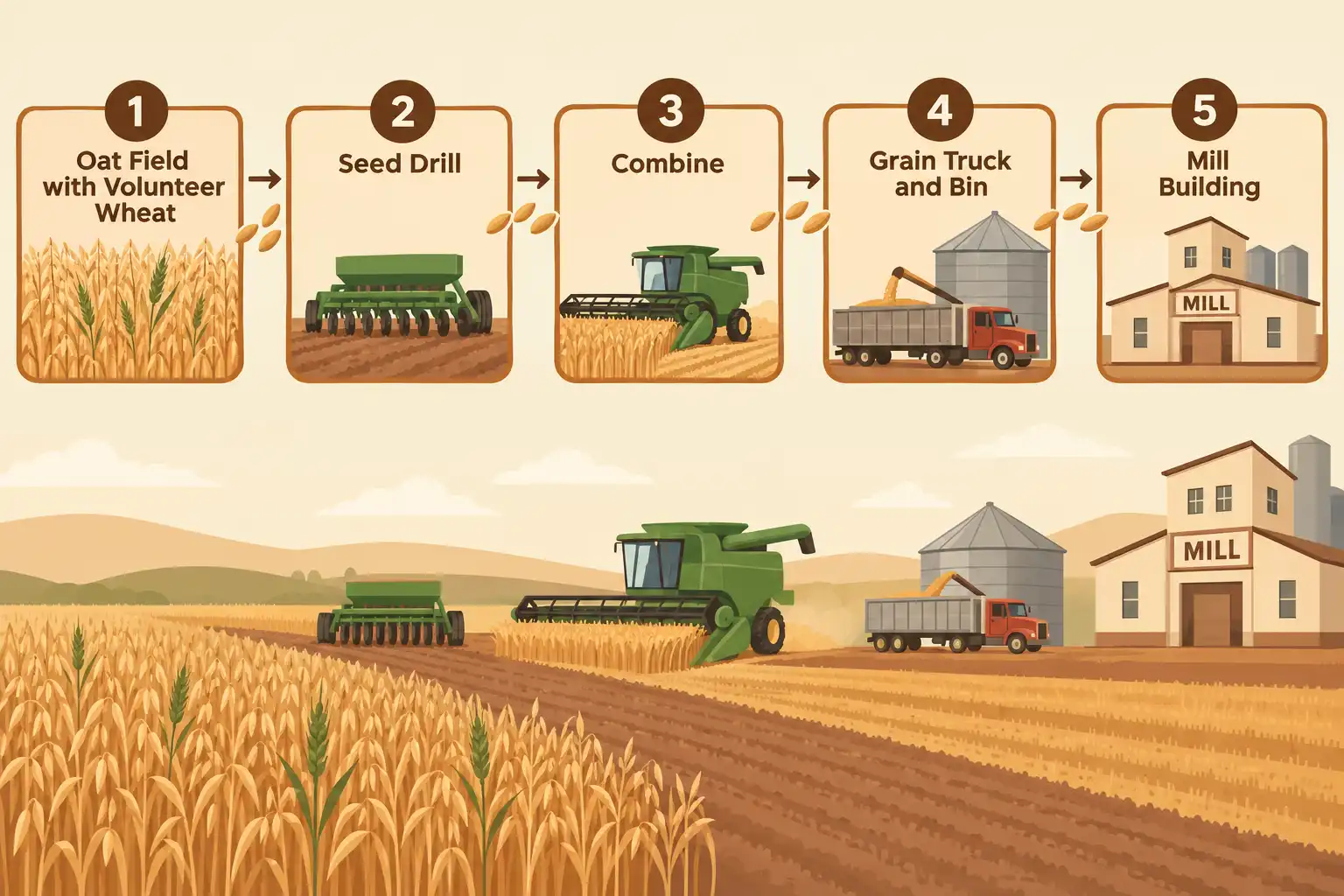
Wheat gets into oats through shared ground and shared iron, not through the plant itself. Every step from seeding to milling is a chance for a few wheat kernels to ride along.
The usual paths:
- Volunteer wheat. Last year’s shattered wheat sprouts in this year’s oat field and heads out with the crop.
- Seed carryover. A drill that ran wheat still holds kernels in the box, the meters, and the hoses.
- The combine. Wheat sits in the rock trap, the clean grain elevator, the return auger, and the header pan.
- Handling. Truck beds, augers, dump pits, and bin floors all hold a cup or two of the last crop.
- The mill. Shared lines and shared legs move small amounts of wheat dust into oat product.
Purity protocol oats exist to close every one of those gaps. Growers commit to field history with no wheat, barley, or rye for a set number of years. They also use certified seed, dedicated or fully cleaned equipment, and separate storage. Testing happens at several steps. That effort is why purity protocol oats cost more.
Before switching crops, blow out the combine with an air compressor. Run twenty bushels through and dump them separately. It takes an afternoon and it saves an argument at the elevator.
A Bushel of Oats Is Not a Bushel of Wheat
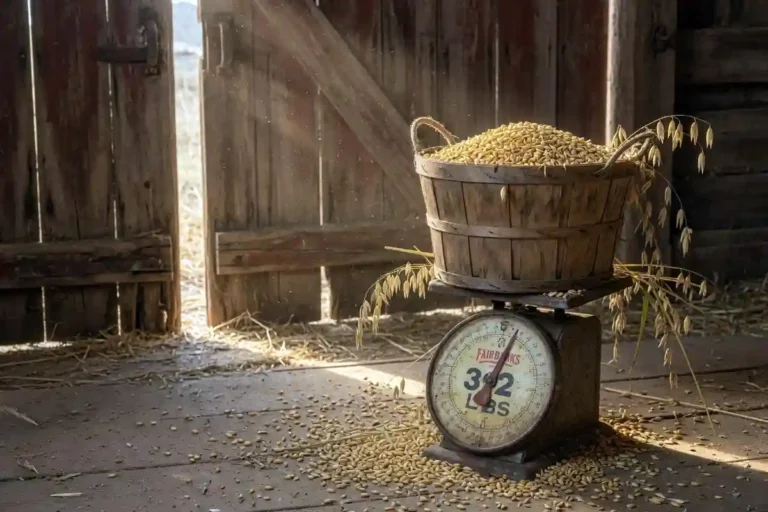
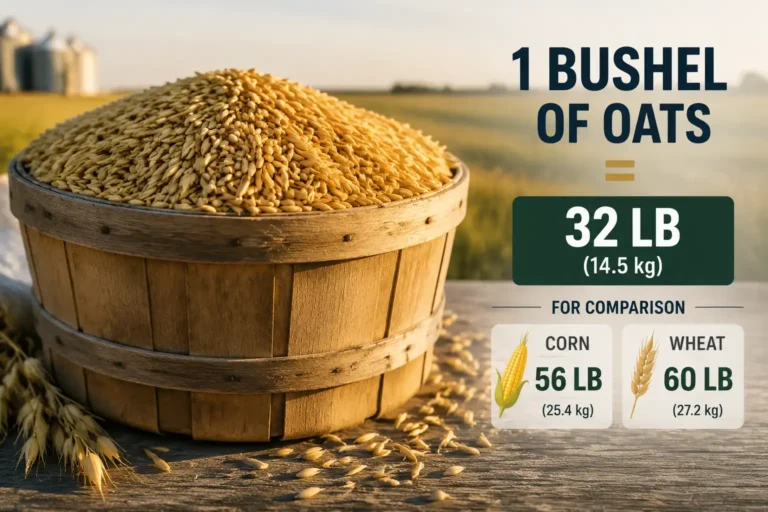
The two crops use different bushel weights, so the numbers never compare directly. USDA sets a bushel of oats at 32 pounds and a bushel of wheat at 60 pounds.
That gap comes from the hull. Oats thresh out of the field still wearing a tough hull. University of Minnesota Extension puts that hull at 25 to 30 percent of oat weight. Wheat is free threshing. Its chaff blows out the back of the combine, and the bare kernel goes in the tank.
Grade minimums follow the same split. U.S. No. 1 oats need a test weight of at least 36 pounds per bushel. U.S. No. 1 hard red spring wheat needs 58. Anyone hauling grain should know how oat bushel weight gets set before the first load crosses the scale.
Run the 2025 national averages through that math and the point lands hard.
| Crop | 2025 US average yield | Legal bushel weight | Pounds per acre |
|---|---|---|---|
| Oats | 73.8 bu/acre | 32 lb | 2,362 lb |
| All wheat | 53.3 bu/acre | 60 lb | 3,198 lb |
Oats win on bushels and lose on pounds. Anyone quoting bushel yields across the two crops is comparing two different units.
Oats and Wheat Do Not Share a Calendar
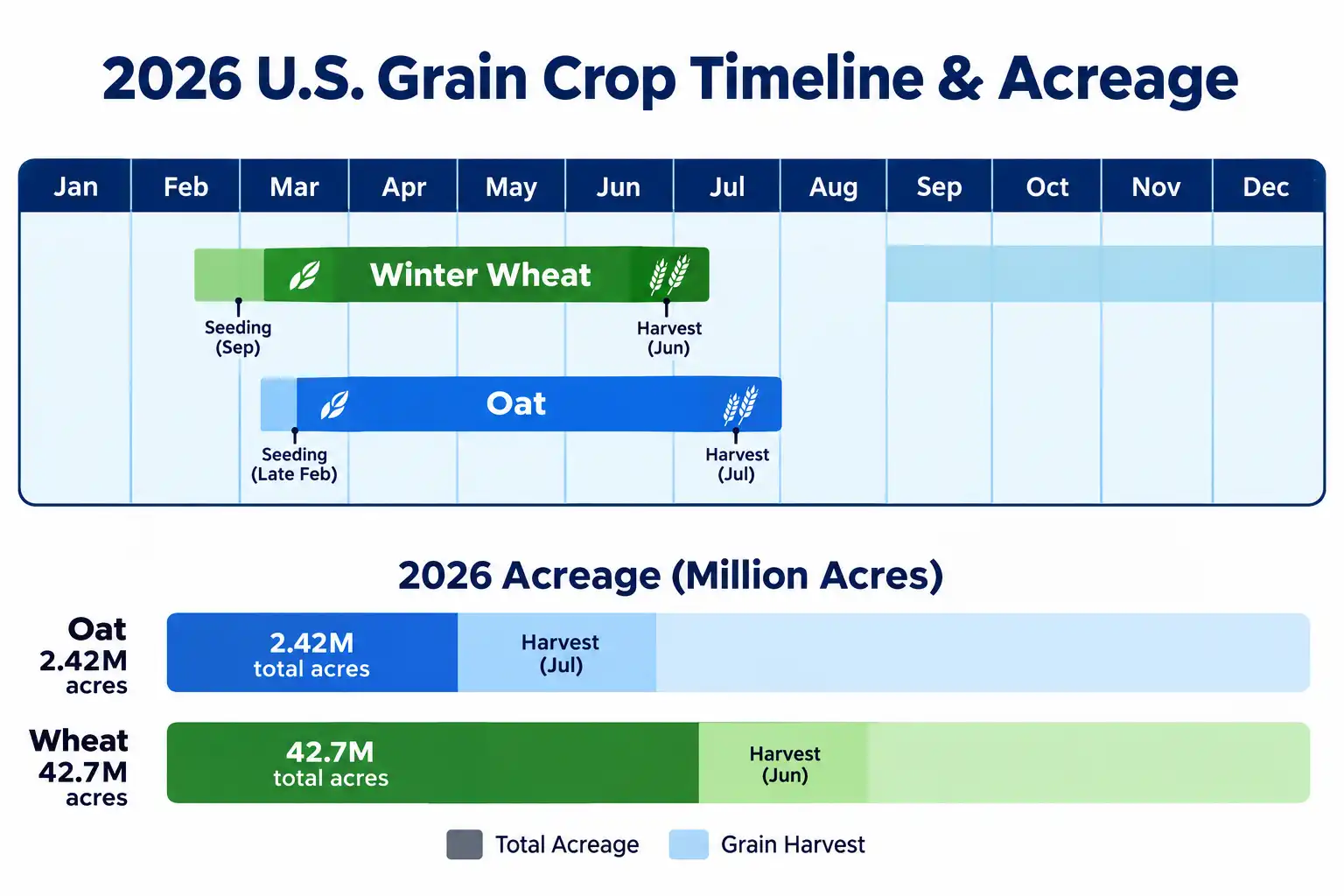
The two crops go in the ground at opposite ends of the year in Kansas. Drill winter wheat in September and October. It sits through the cold, and it needs that chill to head out the next spring. Harvest runs through June.
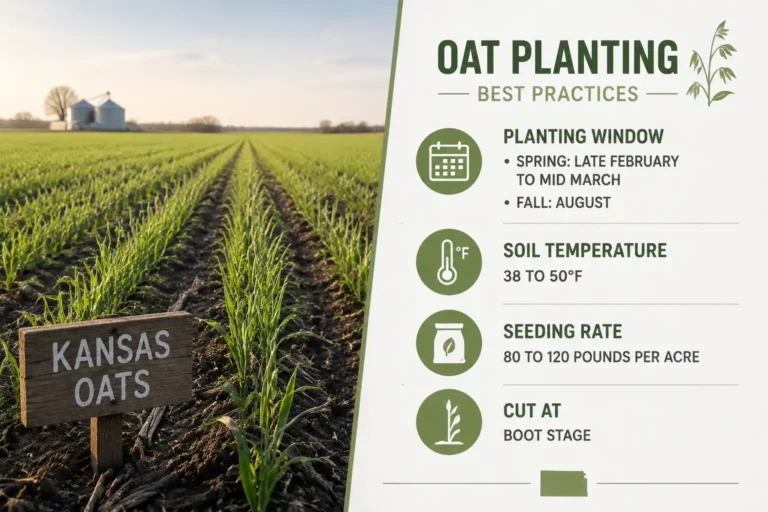
Oats have almost no winter hardiness in zone 6a. Oats are typically seeded in late February or early March, as soon as the ground will carry the drill. Oats want cool weather and finish before real Kansas heat sets in. Seeding rate and depth decide the stand. Both are covered in this guide to planting oats for a strong stand. Fall seeded ground follows a different clock, and the winter wheat planting window drives most of that decision.
Acreage tells the rest of the story. USDA NASS put 2026 oat plantings at 2.42 million acres. Only 877,000 of those acres will get harvested for grain. The rest gets cut for hay, grazed, or left as cover. All wheat came in at 42.7 million acres planted and 32.1 million harvested.
Kansas ran 145,000 oat acres in 2026 against 6.9 million wheat acres. Around 40,000 of those oat acres will make grain. Oats here are mostly a forage and nurse crop. Wheat pays the note.
Diseases That Hit One Crop and Not the Other
Crown rust settles the species question better than any chart. Crown rust, caused by Puccinia coronata f. sp. avenae, is the most damaging oat disease across much of the country. SDSU Extension and University of Georgia Extension both state plainly that wheat, barley, and rye are not susceptible to it.
The reverse holds too. Wheat leaf rust and stripe rust do not move into an oat stand. Buckthorn serves as the alternate host for crown rust, while barberry does that job for wheat stem rust.
Pathogens do not read seed tags. They pick hosts by species, and they sort oats from wheat every season. That is also why oats work as a rotational break in ground that has grown wheat on wheat too long.
Can Oat Flour Replace Wheat Flour?
Not one for one in yeast bread. Oat flour brings no gluten network, so the dough cannot hold the gas the yeast makes. The loaf comes out dense, flat, and crumbly.
Sensible swaps by product:
- Yeast bread: replace 25 to 30 percent of the wheat flour with oat flour and keep the rest as wheat.
- Cookies, muffins, pancakes, quick breads: oat flour handles half or more, since those recipes lean on eggs, fat, and chemical leavening.
- Thickening gravy or soup: oat flour works fine.
- Pasta: wheat flour, and durum specifically, has no real oat substitute.
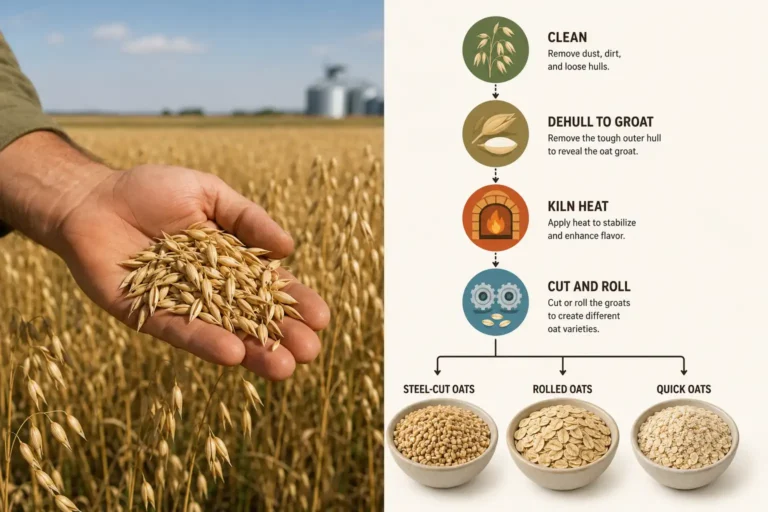
Whole kernels differ too. Wheat berries cook up chewy straight from the bag. Oat groats have to lose their hull at a mill first. They also finish softer and creamier. Steel cut oats are groats chopped into pieces. Rolled oats are groats steamed and flattened. None of those steps involves wheat.
How to Check an Oat Product for Wheat
Read the label in this order. It takes about fifteen seconds.
- Scan the ingredient list for wheat flour, whole wheat flour, wheat starch, wheat bran, or wheat germ.
- Read the contains statement. US labels must declare wheat as a major food allergen, so it will be spelled out.
- Watch for malt. Barley malt and malt flavoring bring gluten from barley, not wheat.
- Look for a gluten free claim. That claim means the finished food tests below 20 parts per million under FDA rules.
- Go one step further for celiac disease. Certified gluten free marks and purity protocol oats carry tighter controls than the baseline rule.
A one ingredient bag of rolled oats can still carry wheat from cross contact. The single ingredient line tells you what went into the bag on purpose, not what rode along.
Frequently Asked Questions
Is oatmeal wheat?
Are oats and wheat related?
Can wheat and oats cross-pollinate?
Is oat bran the same as wheat bran?
Do oats have gluten?
Final Verdict
Oats and wheat share a family, a drill, and a combine, and that is where it stops. Check the head for a panicle instead of a spike. Check the collar for missing auricles. And check the bushel weight before you compare yields. Check the label before you trust a bag of oats. Those four checks answer the question every time.