How Long Does It Take for Oats to Grow? Full Field Timeline
Oats move fast for a cereal grain. So how long does it take for oats to grow? Most spring oats run from seed to harvest in about three to four months, though variety and weather shift that.
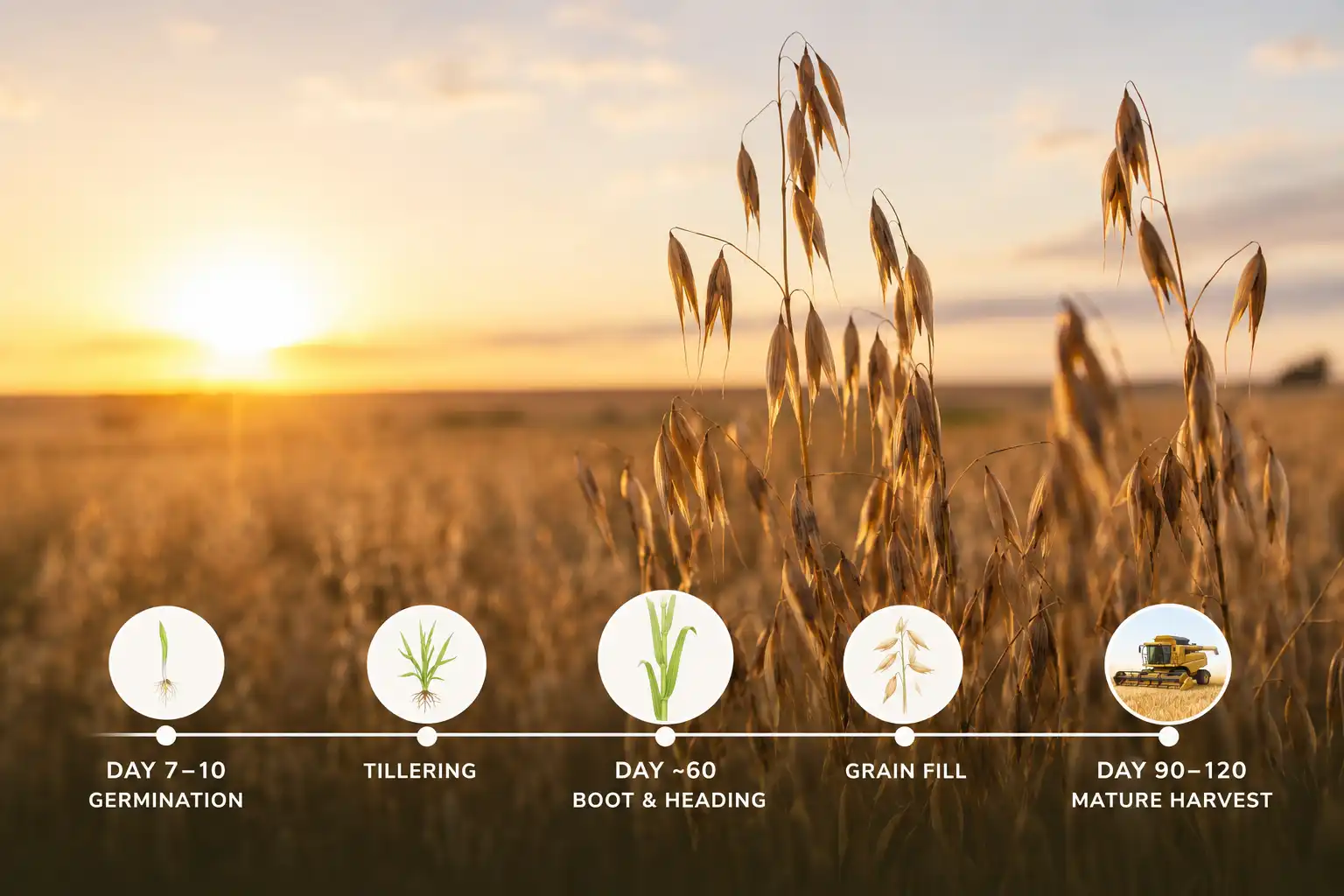
Oats take 90 to 120 days to grow from planting to grain harvest. That is the short answer to how long does it take for oats to grow. Spring oats emerge in about a week and ripen by late summer.
How Long Does It Take for Oats to Grow From Seed to Harvest?
Most spring oats grow from seed to grain harvest in 90 to 120 days. That is roughly three to four months in the field. The clock starts at planting and ends when the kernels turn hard and the straw goes golden.
Drill spring oats in early March. By late June or early July, the grain is ready. Winter oats work on a different calendar, and cover that below.
Oats (Avena sativa) are a cool-season cereal. So they push hard in spring, then slow in summer heat. They finish before the worst July heat hits the Great Plains. That short, fast cycle is why they work well as a cover crop and a forage bridge.
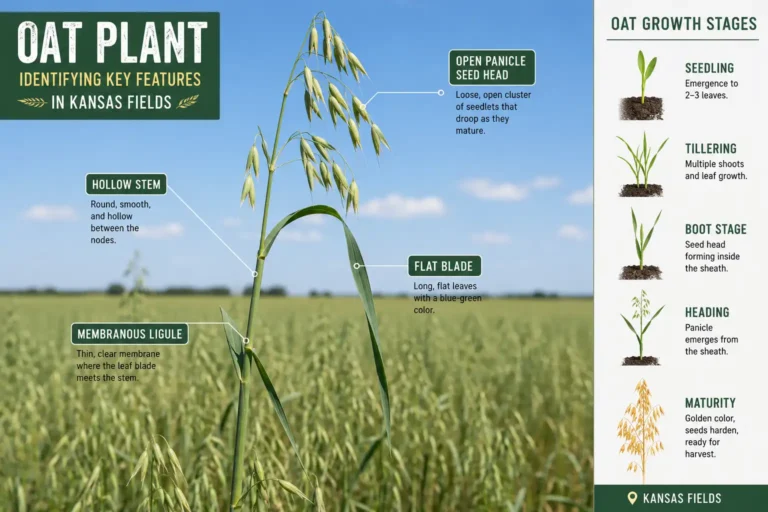
The full timeline breaks into five stages. Each one takes a predictable slice of the season:
- Germination and emergence: days 0 to 10
- Tillering and vegetative growth: weeks 2 to 6
- Stem elongation and boot: weeks 6 to 9
- Heading and flowering: around day 60 to 72
- Grain fill and ripening: day 70 to 120
Those windows overlap a little, because plants in one field never move in perfect lockstep. Still, the totals hold across most seasons.
How Fast Do Oats Germinate and Emerge?
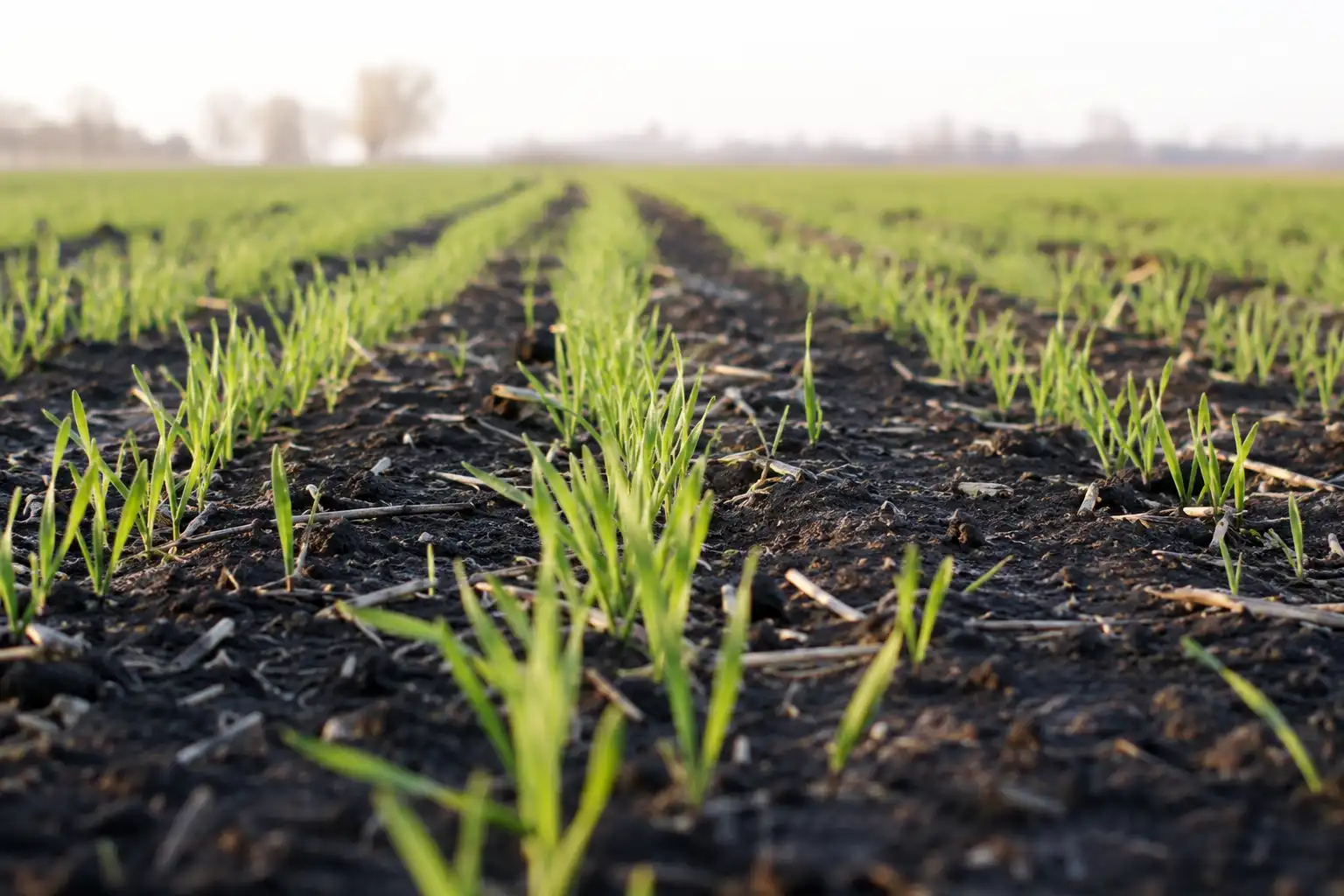
Oats germinate in 7 to 10 days when soil sits above 45°F. Cold ground stretches that out. In a warm, moist seedbed, rows green up in a week.
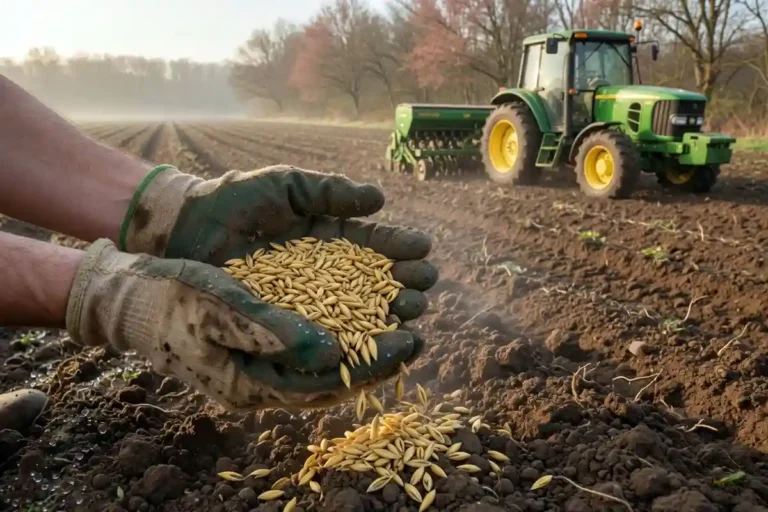
Seed needs moisture and oxygen to sprout. So a firm, shallow seedbed helps, usually half an inch to one inch deep. Plant too deep and the weak oat seedling struggles to reach the surface, especially after a crusting rain.
Soil temperature drives the pace more than anything else. At 44 to 45°F, oats will start, but slowly. Push toward 55°F and up, and emergence speeds up fast. For the finer points on sprout timing, our guide covers how quickly oat seed germinates in a separate piece.
Getting the stand right starts before this. Nail your seeding rate per acre and depth, and the rest of the timeline runs on schedule. Our guide to covers the full setupplanting oats the right way.
How Long Is the Vegetative Stage in Oats?
The vegetative stage runs about 4 to 6 weeks. During this stretch, oats build leaves, roots, and tillers. Tillering matters, because each tiller can carry its own seed head.
Spring oats tiller less than fall-planted small grains. So they lean more on the main stem for yield. That is one reason K-State Research and Extension warns against cutting your seeding rate too thin.
By roughly day 40, the plant shifts into stem elongation. Nodes stack up the stem, and the crop grows 2 to 4 inches a week. Most oats reach 3 to 4 feet tall by the end of the season.
When Do Oats Head Out and Flower?
Oats head out around day 55 to 65 after emergence. First the flag leaf appears, which signals the plant is nearly done growing taller. Then the seed head (the panicle) swells inside the boot and pushes free.
Flowering follows within a few days of heading. Oats self-pollinate, so you do not need bees or wind for a good set. Over 99% of the crop pollinates itself, which keeps grain fill reliable.
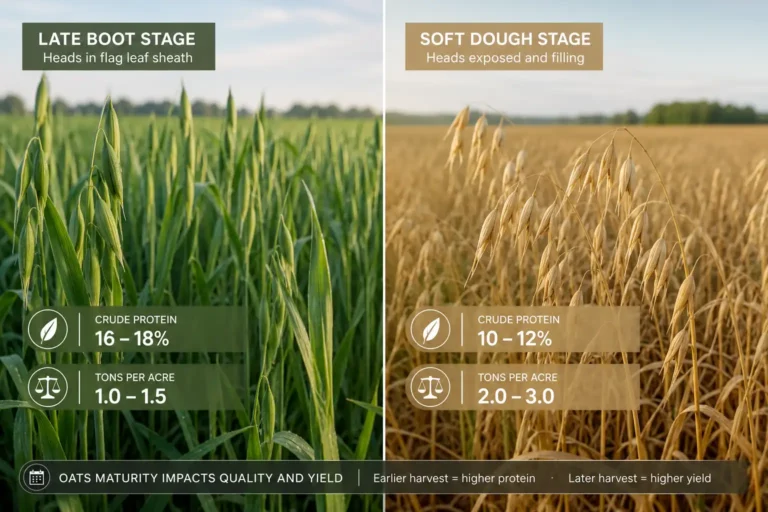
This boot to heading window is also the target for hay. Cut oats at boot to early heading, and you get the best mix of tonnage and quality. The exact timing is laid out in these notes on cutting oats for hay.
How Long Does Grain Fill and Ripening Take?
Grain fill runs 3 to 4 weeks from flowering to mature seed. Kernels move through milk stage, then soft dough, then hard dough. Penn State Extension pegs the milk stage at 55 to 65 days after the plants come up.
After the dough stages, the grain hardens and dries. The panicle turns from green to golden brown. Straw yellows, leaves dry, and the field takes on that ripe oat color.
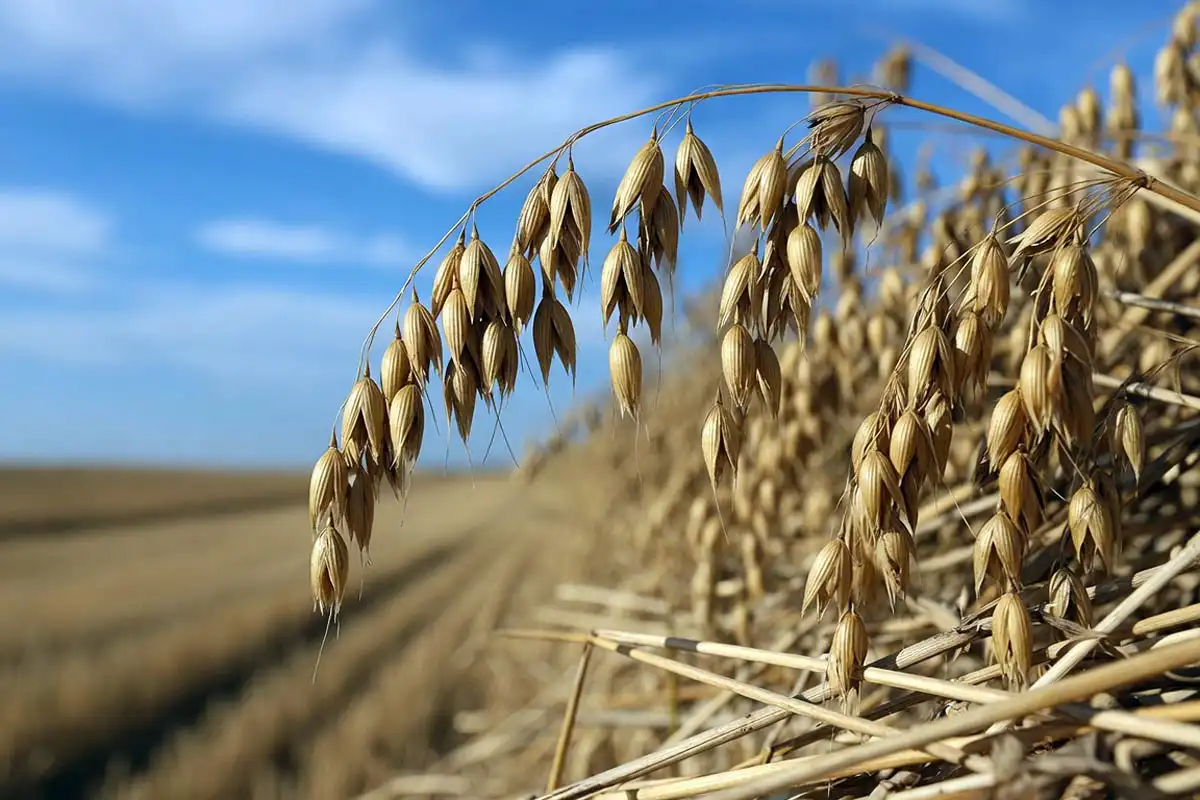
Grain is ready to combine when kernels are firm and moisture drops toward 14%. Some growers swath a little early and let it cure, then thresh. For the harvest call itself, our guide covers knowing when oats are ready in detail.
Do Spring Oats and Winter Oats Grow on the Same Timeline?
No, spring oats and winter oats follow very different calendars. Spring oats finish in 90 to 120 days of active growth. Winter oats sit through cold months, so their calendar time stretches much longer, even though active growing days stay similar.
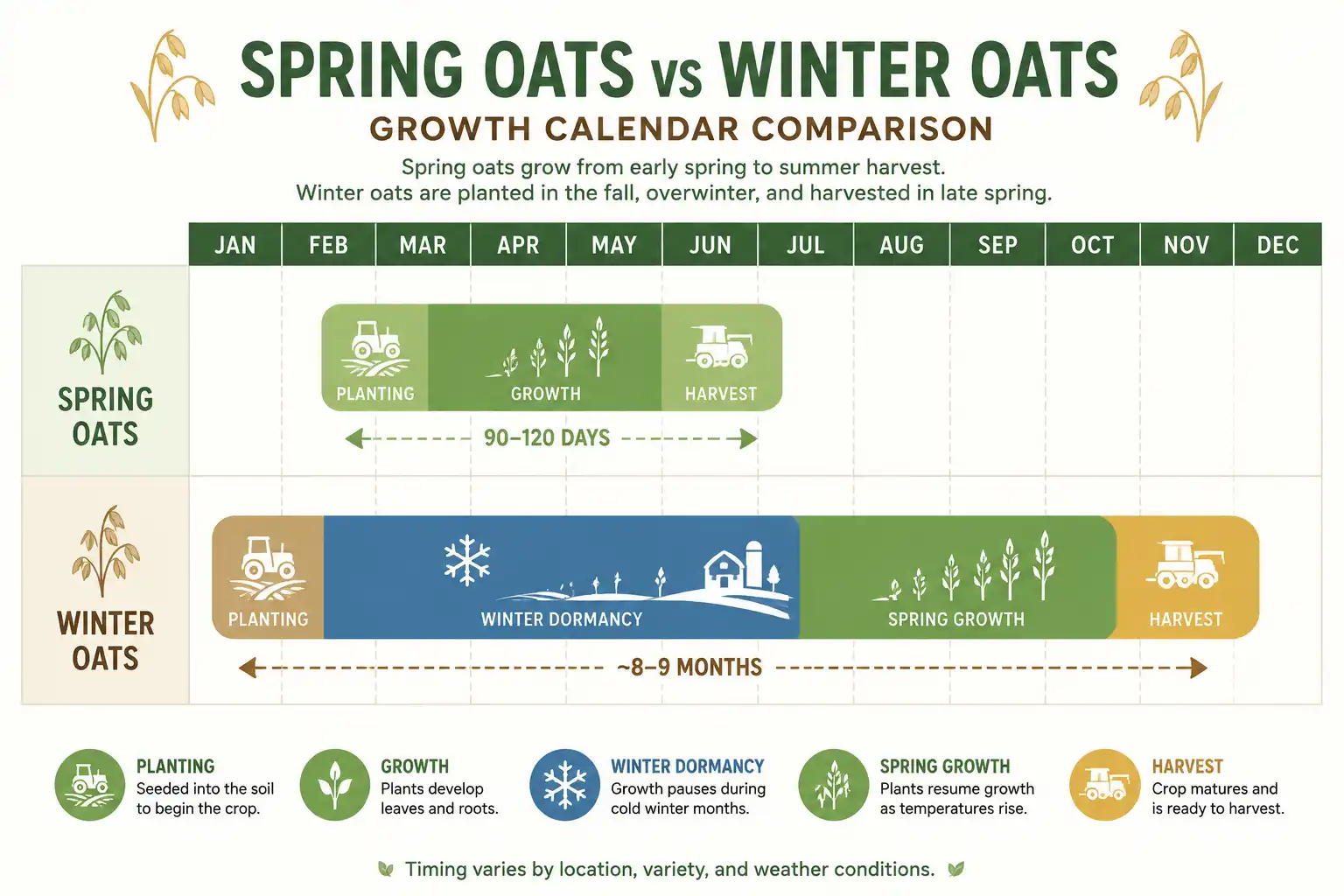
Spring oats go in from late February through mid-March across most of Kansas. They do not need to vernalize, so they head out the same season. That fits the USDA hardiness zone and the short spring window.
Growers plant winter oats in fall in mild-winter regions farther south. They germinate, go semi-dormant over winter, then finish in late spring or early summer. In the Great Plains, true winter oats usually winterkill, so spring types are the better fit.
How Long Until Oats Are Ready for Hay or Grazing?
Oats reach grazing height in 6 to 8 weeks after planting. That is far faster than the grain timeline. Cattle can start once plants hit 6 to 8 inches and roots anchor well.
For hay, the window is boot to early heading, usually 55 to 70 days in. For silage, growers wait for late milk through early dough. Each use pulls the crop off the field earlier than a grain harvest would.
That speed is why spring oats make such a good forage bridge in April and May. One acre can carry a 750-pound animal for about 60 days at a reasonable stocking rate.
What Slows Oats Down or Speeds Them Up?
Temperature has the biggest effect on oat growth. Warm soil speeds germination, while cool spring air favors steady vegetative growth. Extreme summer heat during grain fill cuts the cycle short and drops test weight.
Planting date matters just as much. Early planting means a longer vegetative stage and better grain. Late planting shortens everything, and it can hurt yield.
A few other factors shift the timeline:
- Variety: early and late cultivars can differ by a week or more
- Moisture: dry soil slows emergence and stresses grain fill
- Soil fertility: adequate nitrogen keeps growth on pace
- Growing degree days: oats track heat accumulation, not just calendar days
Because oats respond to heat units, the same variety can finish faster in a warm year than a cool one. So scout the field, rather than trust the calendar alone.
Last Words
Plan on 90 to 120 days for oat grain, 6 to 8 weeks for grazing, and boot stage for hay. Spring oats reward early planting into cool, moist soil. Scout for the flag leaf near day 60, then watch the panicle turn golden. Once kernels go hard and moisture nears 14%, it is combine time.