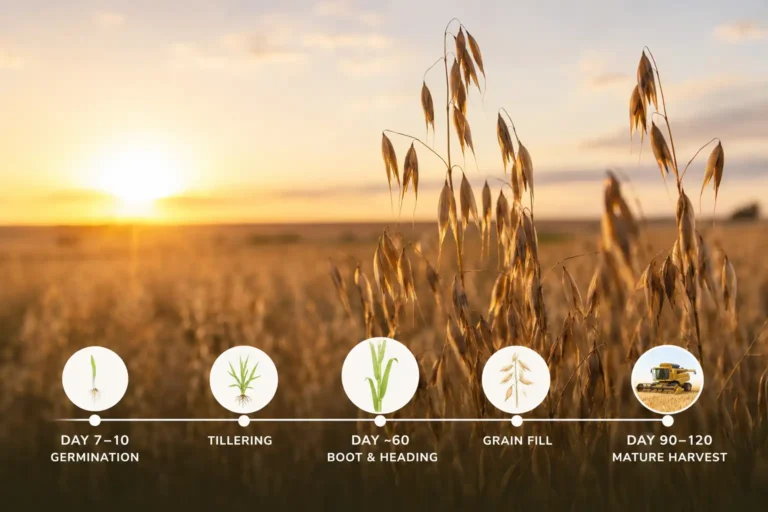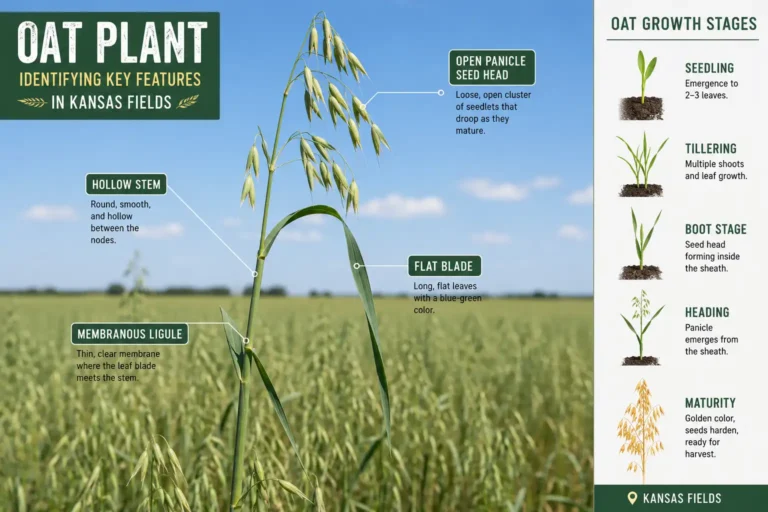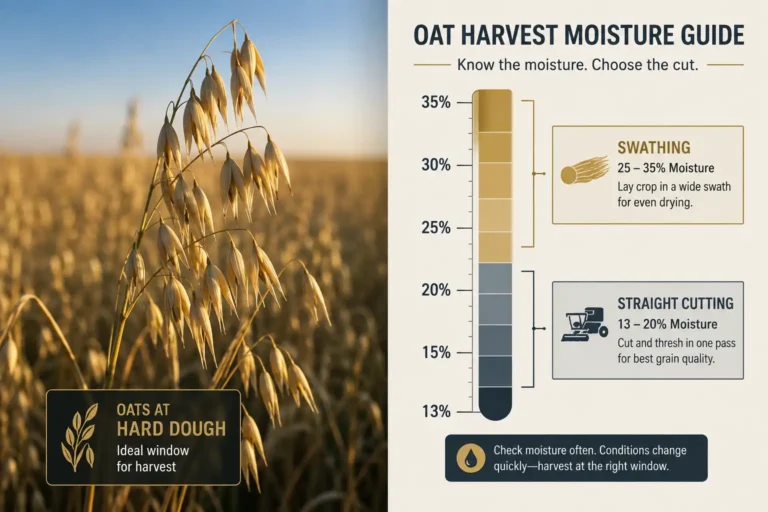
How Long Does It Take Oats to Germinate? 7 to 10 Days at 50°F
Patchy oat stands usually trace back to seed sitting in cold, dry ground. Soil temperature and moisture set the pace of emergence. How long does it take oats to germinate depends on those two numbers, plus seeding depth.
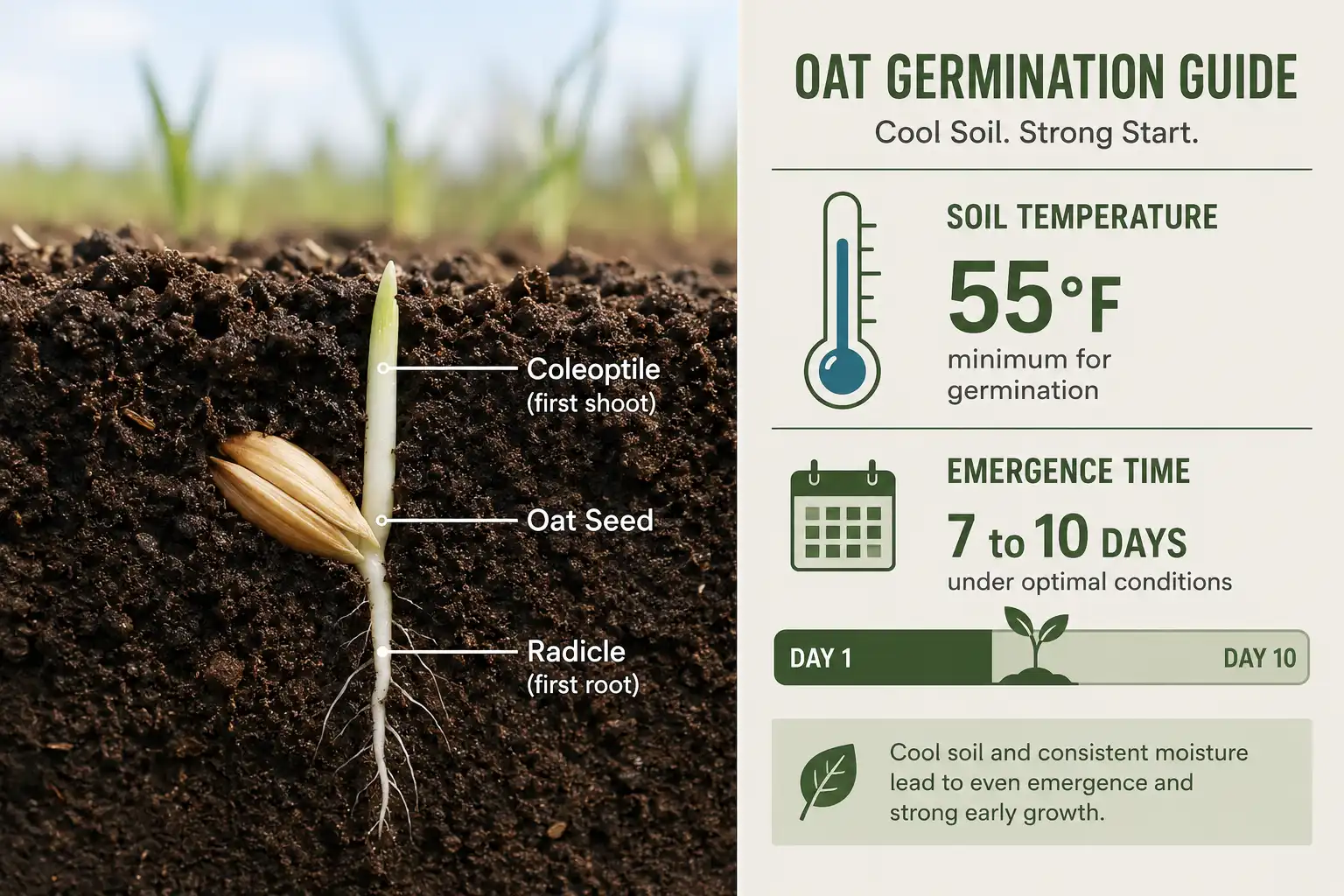
Oats germinate in 7 to 10 days when soil holds between 50°F and 60°F with steady moisture. Germination begins near 35°F to 40°F. Below that, emergence stretches past 3 weeks and seedling disease risk climbs.
What Happens Inside an Oat Seed Before It Sprouts
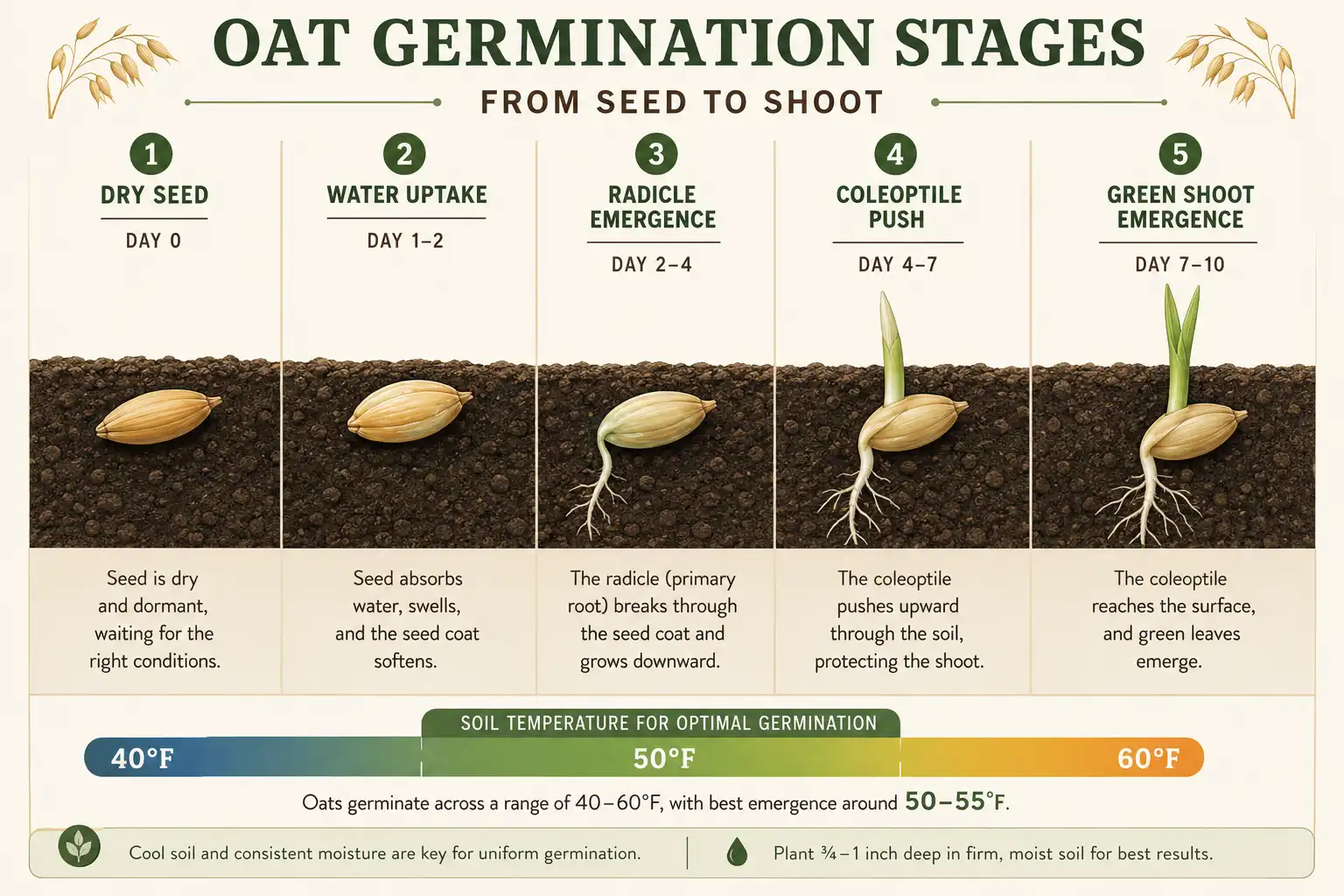
Germination starts with imbibition, the rapid uptake of water through the seed coat. Once that phase begins, the seed cannot return to dormancy, according to University of Minnesota Extension. So a seed that swells and then dries out in the row usually dies there.
The radicle, or first root, breaks out ahead of the shoot. Then the coleoptile stretches upward and carries the first leaf to the surface. NDSU Extension notes that oats emerge through coleoptile elongation, which is exactly why seeding depth carries so much weight.
Oats (Avena sativa) belong to the cool-season cereal group alongside wheat and barley. Their response to soil warmth runs close to wheat. Growers who track wheat germination timing will see the same pattern in oats.
Oat Germination Time by Soil Temperature
Soil temperature at seeding depth predicts emergence better than any other single reading. Air temperature swings too fast to be useful. So take the reading at the 4 inch depth, in the morning, for three days running.
| 4 inch soil temperature | Days to emergence | Stand risk |
|---|---|---|
| Below 35°F | No meaningful germination | Seed sits dormant |
| 35°F to 40°F | 21 days or more | High |
| 41°F to 45°F | 14 to 21 days | High |
| 46°F to 50°F | 10 to 14 days | Moderate |
| 51°F to 60°F | 7 to 10 days | Low |
| Above 60°F | 5 to 7 days | Low |
The middle of that table rests on published thresholds. University of Minnesota Extension reports that spring oats begin germinating in earnest at 40°F. It puts emergence at 8 to 10 days under daytime highs in the 60s with night lows near 40°F. SDSU Extension puts the minimum germination temperature near 35°F, and notes that anything above 40°F speeds both germination and emergence. Penn State Extension sets the same 35°F floor. Soil above 45°F accelerates germination and builds a stronger stand.
The colder rows scale from that same response. Cold soil slows enzyme activity inside the seed, so every step from imbibition to shoot emergence takes longer.
Why Cold Soil Costs More Than Just Time
Slow emergence is not only a scheduling problem. It is a disease problem. Every extra day underground means another day of exposure to soil pathogens before the seedling can defend itself.
University of Minnesota Extension makes the point directly. Drawn-out emergence predisposes small grain seedlings to Pythium damping off and common root rot. Stands thin as a result.
The Pacific Northwest Plant Disease Management Handbook names the pathogens behind oat seed decay and seedling blight. The list covers Bipolaris sorokiniana, Drechslera avenae, Fusarium culmorum, Pythium species, and Rhizoctonia solani. Its cultural control advice runs to one line. Seed when conditions favor rapid germination.
You can forecast this. University of Minnesota Extension points to a growing degree day model for emergence. Spring wheat needs roughly 180 GDD to reach the one leaf stage. Oats and barley need slightly fewer. Nights near freezing with highs near 60°F build about 15 GDD per day. So first leaf lands around 12 days after seeding.
How Deep to Plant Oats for Fast Emergence
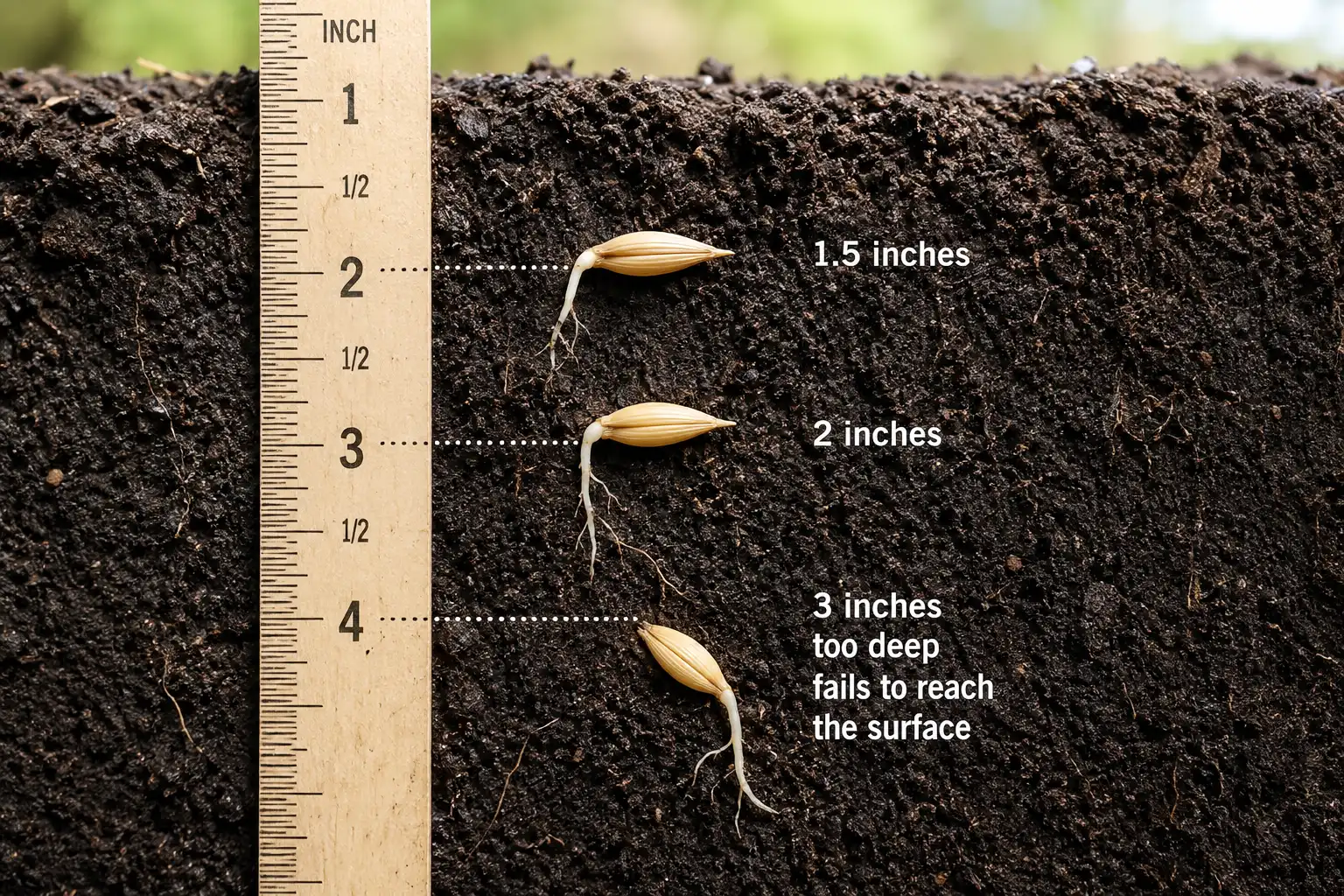
Plant oats 1.5 to 2 inches deep in most conditions. University of Minnesota Extension gives that range for small grains. NDSU Extension puts the oat optimum at 1.5 to 2.5 inches. Both agree on the ceiling. NDSU Extension reports measurable stand reduction as seeding depth approaches 3 inches.
The reason ties back to the coleoptile. University of Minnesota Extension explains the limit. When the coleoptile is shorter than the planting depth, the first leaf never reaches daylight. The seedling then dies below ground. Deep seeding also places the seed in cooler soil, which stretches emergence further.
Shallower placement emerges faster, but only when the top inch actually holds moisture. That is the real trade. Chase moisture down, and you pay in emergence days. Stay shallow in dry ground, and the seed may never imbibe at all. Getting this right is the core of planting oats well in a variable spring.
Moisture and Seedbed Conditions That Speed Germination
A firm seedbed does more for emergence speed than almost anything else you control. Loose, fluffy soil loses moisture fast and breaks seed-to-soil contact. Water then moves into the seed too slowly.
Press wheels or packer wheels behind the drill close that gap. Cloddy ground does the opposite. Where clods sit against the seed, moisture moves through air pockets instead of soil. Emergence then turns uneven across a single pass.
Watch for soil crusting after a hard rain on bare, fine textured ground. A crust can stop a coleoptile cold. A light rotary hoe pass or a gentle rolling breaks the crust without shearing off seedlings, but timing is tight. Move before the shoots reach the surface.
Soil chemistry matters less for speed than temperature and moisture. Still, oats do best in well-drained ground with a pH near 6.0 to 7.0. Running a soil test ahead of seeding confirms pH and flags drainage problems before seed goes in the ground.
When Oats Germinate Fastest by Region
Oat seeding windows across the US follow soil warming, not the calendar. Still, extension guidance gives useful anchors.
| Region | Published seeding guidance | Source |
|---|---|---|
| Northern North Dakota | Before May 15 | NDSU Extension |
| Southern North Dakota | Before the end of April | NDSU Extension |
| South Dakota | Late March in the south to late April in the north | SDSU Extension |
| Minnesota | Once soil reaches 40°F | UMN Extension |
| Ohio | Early April | Penn State Extension summarizing Ohio State research |
| New York | Around April 18 | Penn State Extension summarizing New York research |
Southern fields turn oats around faster because soil is already warm at seeding. In the Corn Belt and Northern Plains, growers seed near the cold end of the range on purpose. Early seeding buys tillering and avoids heat stress during seed fill, and both extension services above flag that trade openly. So a 14 day emergence in early April often beats a 7 day emergence in May.
Sandy loam warms ahead of heavy clay every spring. That usually trims a day or two off emergence in the same county.
Why Your Oats Are Not Germinating
Work through these in order. Most stand failures come from the first three. Beyond those, damping off in young seedlings explains a large share.
| Symptom | Likely cause | What to check |
|---|---|---|
| Nothing up after 14 days | Soil below 45°F | 4 inch soil temperature at 8 a.m. |
| Seed swollen but no root | Seedbed dried after imbibition | Dig 2 inches down and squeeze a handful |
| Rows emerge in patches | Uneven seeding depth | Dig seeds across the drill width |
| Green shoots stall under the surface | Soil crust after rain | Break a crust sample by hand |
| Soft, water soaked seed | Seed rot or seedling blight | Look for brown, mushy tissue |
| Thin stand, seed looks sound | Low germination percentage | Run a germination test |
Old seed deserves particular suspicion. Oat vigor drops with age and with storage moisture. NDSU Extension also notes lower germination in hull-less oat types. Their exposed embryo damages easily during harvest and handling.
How to Test Oat Seed Germination Before You Plant
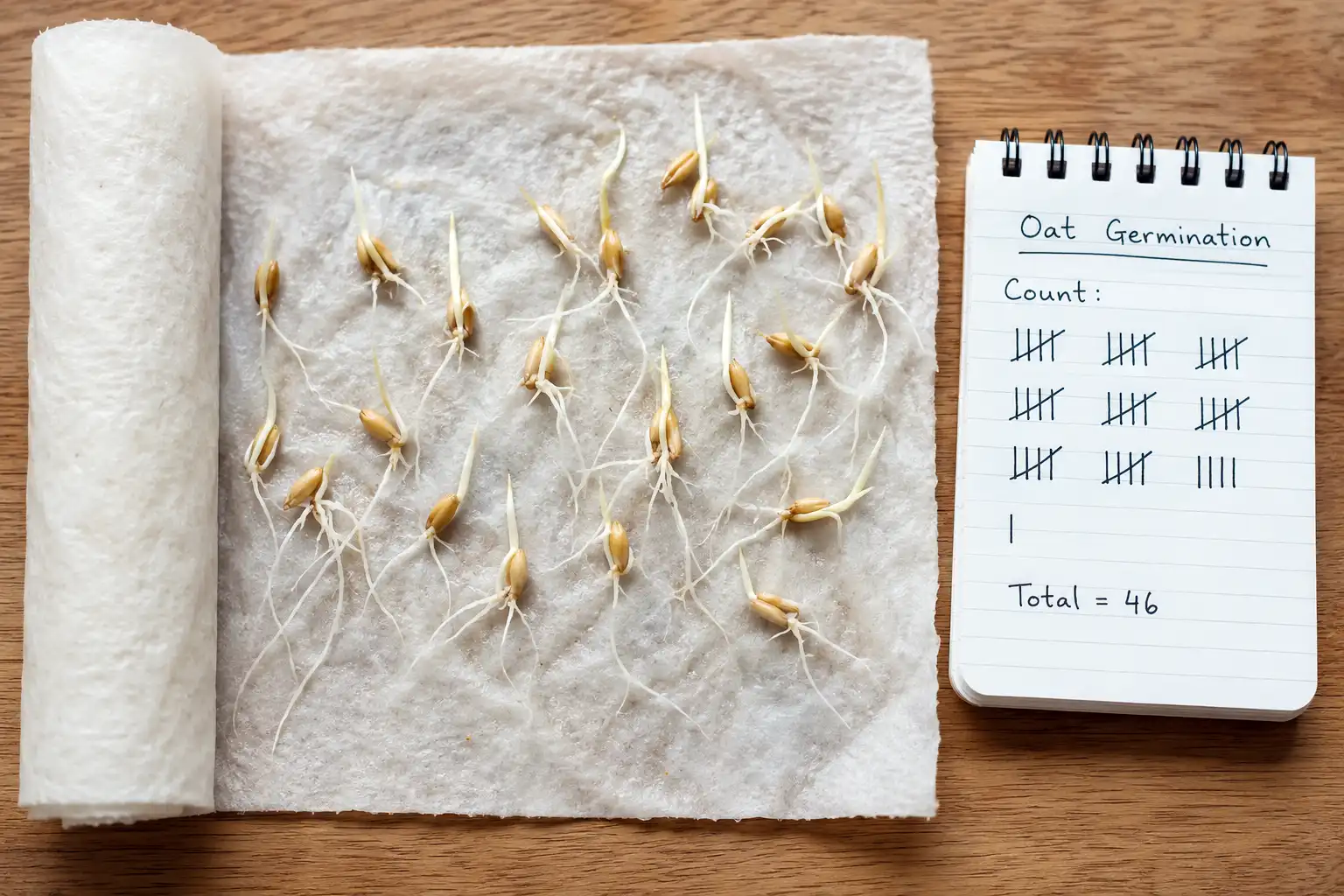
Run this test two weeks before seeding. It takes ten minutes of work and prevents an entire replant.
- Pull 100 seeds at random from several spots in the bin or bag.
- Space them on a damp paper towel, then roll it loosely.
- Seal the roll in a plastic bag and hold it at 65°F to 75°F.
- Open it after 7 days and count only normal sprouts with both a radicle and a coleoptile.
- Divide by 100 to get your germination percentage.
Now adjust. Iowa State University Extension targets 22 to 29 plants per square foot at harvest. That equals 1.0 to 1.3 million plants per acre. The same source puts oat seed counts at 12,000 to 17,000 per pound, against a standardized 32 pound bushel. SDSU Extension puts the desired live stand near 1.2 million plants per acre.
Say your test comes back at 80 percent instead of 95. Raise the rate by roughly a fifth to hold the same stand. Working out oat seeding rate per acre from seed count and germination beats planning in bushels alone.
Certified seed removes most of this guesswork. NDSU Extension notes that certified lots guarantee germination levels, weed seed limits, and genetic identity.
Handling Treated Oat Seed Safely
Treated oat seed carries a fungicide coating and a colored dye that marks it as unfit for food or feed. Wear gloves when loading the drill, then wash your hands before eating. Read the seed treatment label and follow every restriction on it.
Never mix leftover treated seed into grain headed for a market or a feed bunk. Store the remainder in a sealed, labeled container, well away from children, pets, and livestock feed.
FAQs About Oat Germination
Do oats need light to germinate?
Can I soak oat seeds before planting?
Why are my oats not germinating after 10 days?
How deep should oat seeds be planted?
Do oats germinate in cold weather?
Does seed treatment speed up germination?
Key Points to Carry Into the Field
Oat emergence follows soil temperature more than the calendar. Hold 50°F to 60°F with steady moisture and seed at 1.5 to 2 inches. Shoots then break ground in 7 to 10 days. Seed at 40°F and plan on two to three weeks, plus real seedling disease pressure.
Test the seed lot first, then firm the seedbed. Take soil readings at the 4 inch depth rather than trusting air temperature. Once the stand is up, the oat growth timeline from emergence through harvest follows the same weather-driven logic.