15-0-0 Fertilizer: Uses, Rates, and Best Picks for 2026
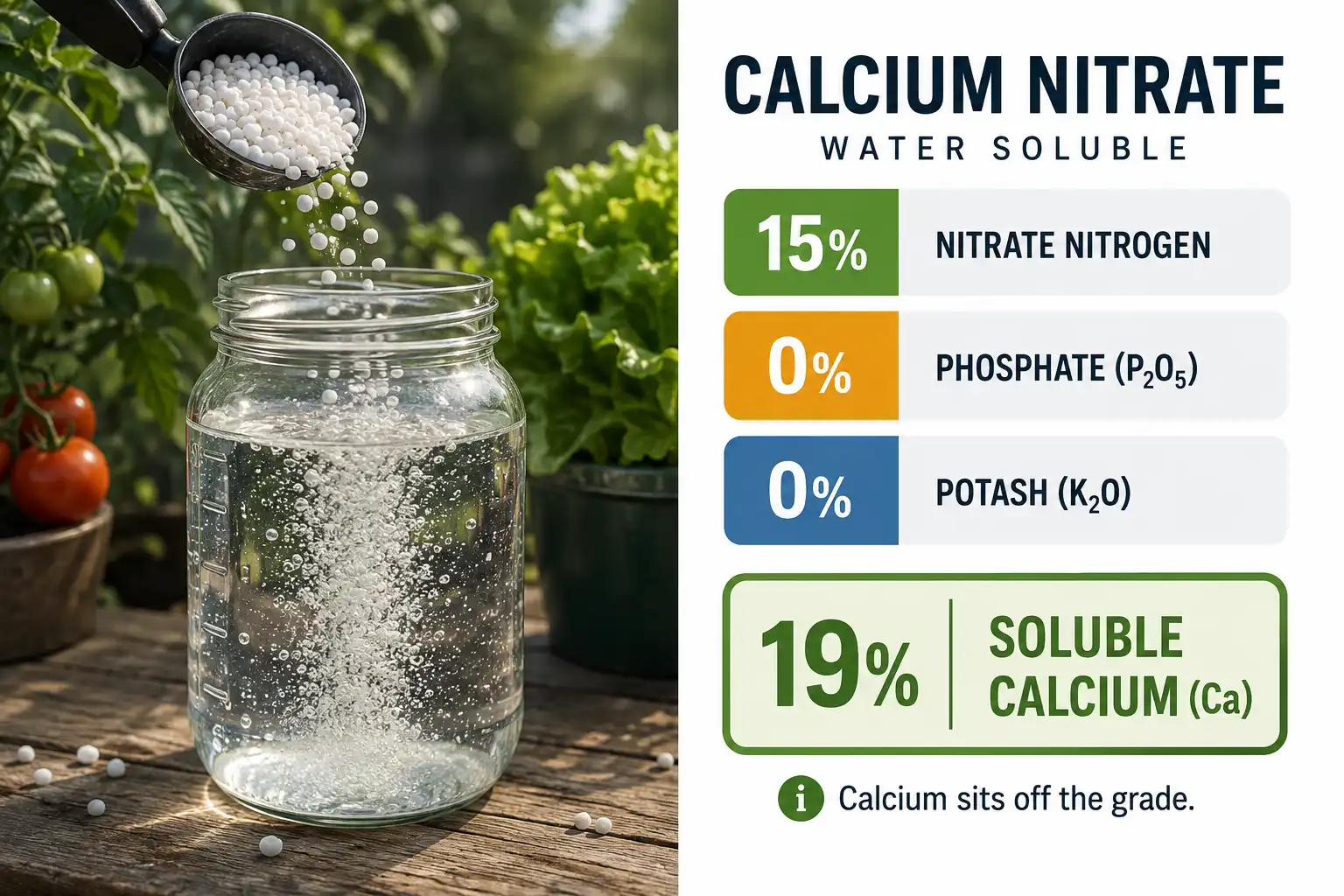
15-0-0 is calcium nitrate. The two zeros mean no phosphorus and no potassium, but the number that matters sits off the label: 18 to 19% calcium. That pairing of nitrate nitrogen with soluble calcium is what makes 15-0-0 fertilizer a greenhouse and drip staple.
15-0-0 fertilizer is calcium nitrate, supplying about 15% nitrate nitrogen and 18 to 19% water soluble calcium. It carries no phosphorus or potassium. Growers use it in hydroponics, greenhouse drip, and vegetable ground where calcium matters.
What Is 15-0-0 Fertilizer?
15-0-0 fertilizer is calcium nitrate, a fully water soluble salt that carries nitrogen and calcium in one product. Manufacturers build it as an ammonium calcium nitrate double salt. That is why some bags read 15-0-0 and others 15.5-0-0. Both sit in the same chemical family, and the calcium runs 18 to 19% by weight either way. Nearly all of the nitrogen arrives as nitrate.
You will find it as prills, granules, crystals, or a fine microprill powder. Hi-Yield labels its version ammonium calcium nitrate 15-0-0, and Jack’s sells a 15-0-0 Part B. YaraLiva is a common brand on 50 pound bags at ag retail. Different names, same salt.
Check the guaranteed analysis before you pay. A handful of liquid products carry a 15-0-0 grade with almost no calcium in them. If the back panel lists no calcium percentage, you are not buying calcium nitrate.
Learn more: 5-5-5 Fertilizer Rates and Timing
What Each Number in 15-0-0 Actually Delivers
Those three numbers report nitrogen, available phosphate, and soluble potash, in that order. Calcium never appears in the grade itself. It shows up further down the label as a secondary nutrient. That is why 15-0-0 undersells what is in the bag.
| Per 100 lb of product | Amount | Notes |
|---|---|---|
| Nitrogen (N) | 15 to 15.5 lb | Almost entirely nitrate form |
| Phosphate (P2O5) | 0 lb | None supplied |
| Potash (K2O) | 0 lb | None supplied |
| Calcium (Ca) | 18 to 19 lb | Listed below the grade |
Run the numbers and the limits show up fast. One pound of nitrogen takes about 6.5 pounds of product. A 25 pound bag holds roughly 3.9 pounds of nitrogen and 4.8 pounds of calcium. This grade delivers more calcium than nitrogen, which tells you what it is really for. A soil test calling for phosphorus or potassium needs a second product. This breakdown of NPK grades for field crops covers how the rest of the numbers work.
Why Nitrate Nitrogen Acts Differently Than Urea
Nitrate nitrogen goes to work the moment it dissolves, because roots absorb the nitrate ion directly. Urea cannot do that. Soil enzymes first convert urea to ammonium, then soil bacteria convert that ammonium to nitrate, and both steps slow down in cool or dry ground. The lag can run a week in a cold Kansas spring.
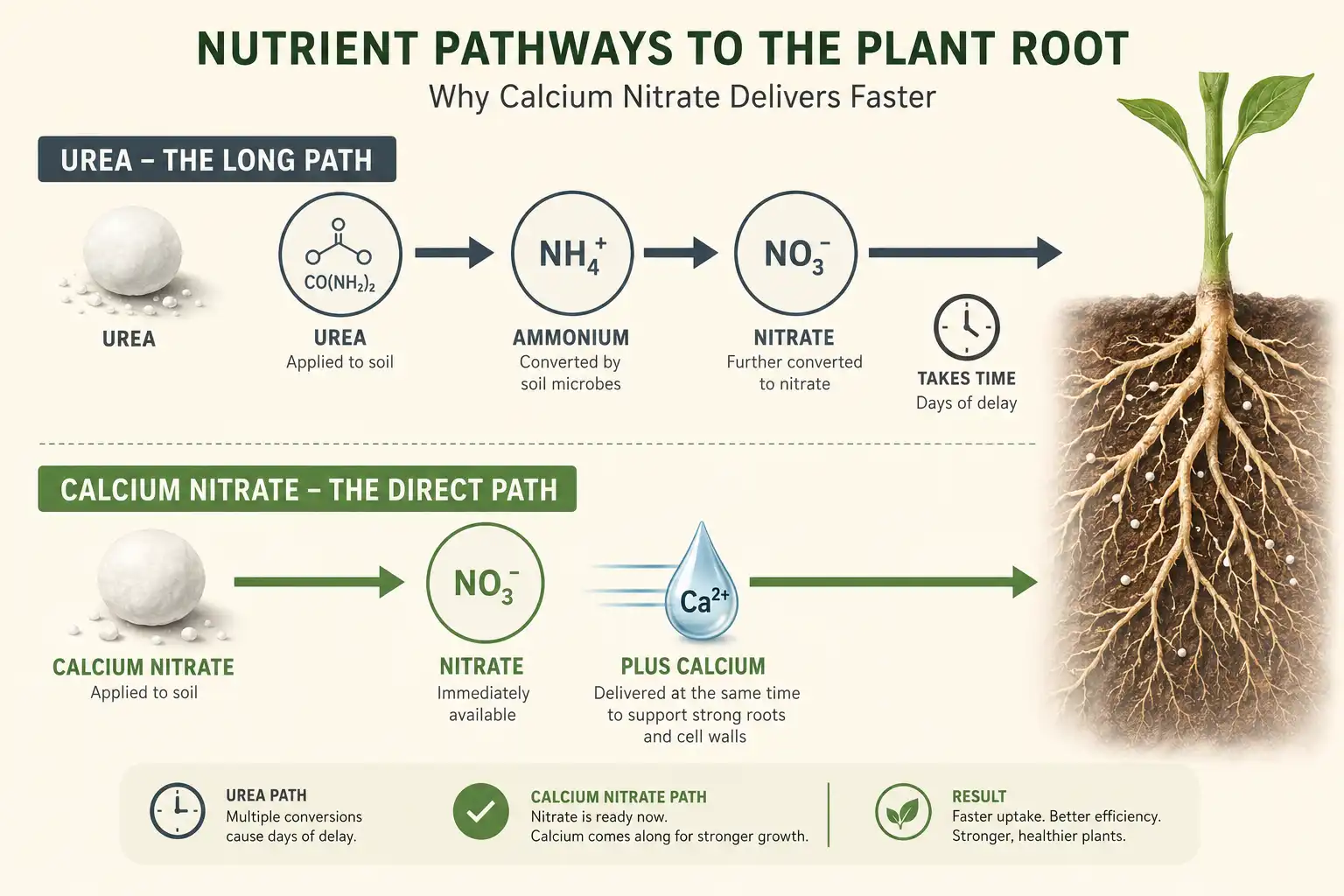
Four practical differences follow from that:
- No volatility loss. Nitrate does not gas off as ammonia. Surface applications hold their nitrogen, unlike broadcast urea on a hot, dry, windy day.
- Full leaching risk. Nitrate travels with water. On sand or under a four inch rain, it drains below the root zone in a hurry.
- No soil acidification. Calcium nitrate carries no ammonium, so nitrification never happens and pH does not drift down. Ammonium sulfate at 21-0-0 does the reverse and pulls pH lower every season.
- Better calcium uptake. Ammonium competes with calcium and magnesium at root uptake sites, while nitrate does not. Oregon State’s 2026 Pacific Northwest handbook says nitrate forms are preferred over ammonium forms wherever tipburn threatens a crop.
That last point is why greenhouse and hydroponic programs pay up for this grade instead of running cheaper nitrogen.
Why 15-0-0 Can Burn Crops at Modest Rates
Calcium nitrate looks mild on a salt index chart and still burns roots. The reason hides in which column you read. Total salt index compares equal weights of product. Partial salt index compares equal weights of nutrient delivered. That second number is what matters when you spread 6.5 pounds of product per pound of nitrogen.
| Nitrogen source | Salt index | Salt index per unit of nutrient |
|---|---|---|
| Calcium nitrate, 15.5% N | 65.0 | 4.19 |
| Ammonium sulfate, 21-0-0 | 88.3 | 3.25 |
| Ammonium nitrate, 34% N | 104.0 | 3.06 |
| Urea, 46-0-0 | 74.4 | 1.62 |
| Anhydrous ammonia, 82% N | 47.1 | 0.57 |
Per pound of nitrogen delivered, calcium nitrate puts more salt in the root zone than urea or ammonium sulfate. So keep dry rates modest, never band it tight against seed, and water it in after any dry application. Heavy needs go on as several small feedings.
What Calcium Does in the Plant
Calcium cross links pectin in cell walls and in the middle lamella, the layer that cements neighboring cells together. Strong cell walls show up in the shed as firmer fruit, less cracking, and produce that holds up through shipping.
The catch is how calcium travels. It moves almost entirely in the xylem, carried upward by the transpiration stream, and once it lands in a leaf it stays there permanently. Calcium cannot move back out through the phloem the way nitrogen and potassium do. Every disappointment growers have with calcium products traces back to that one property.
Does 15-0-0 Fertilizer Stop Blossom End Rot?
Not by itself, and not on most soils. Blossom end rot is a localized calcium shortage inside the fruit, which is a different problem from low calcium in the ground. Clemson Extension notes it appears even when soil calcium tests adequate. UC IPM calls low soil calcium a rare cause of lettuce tipburn.
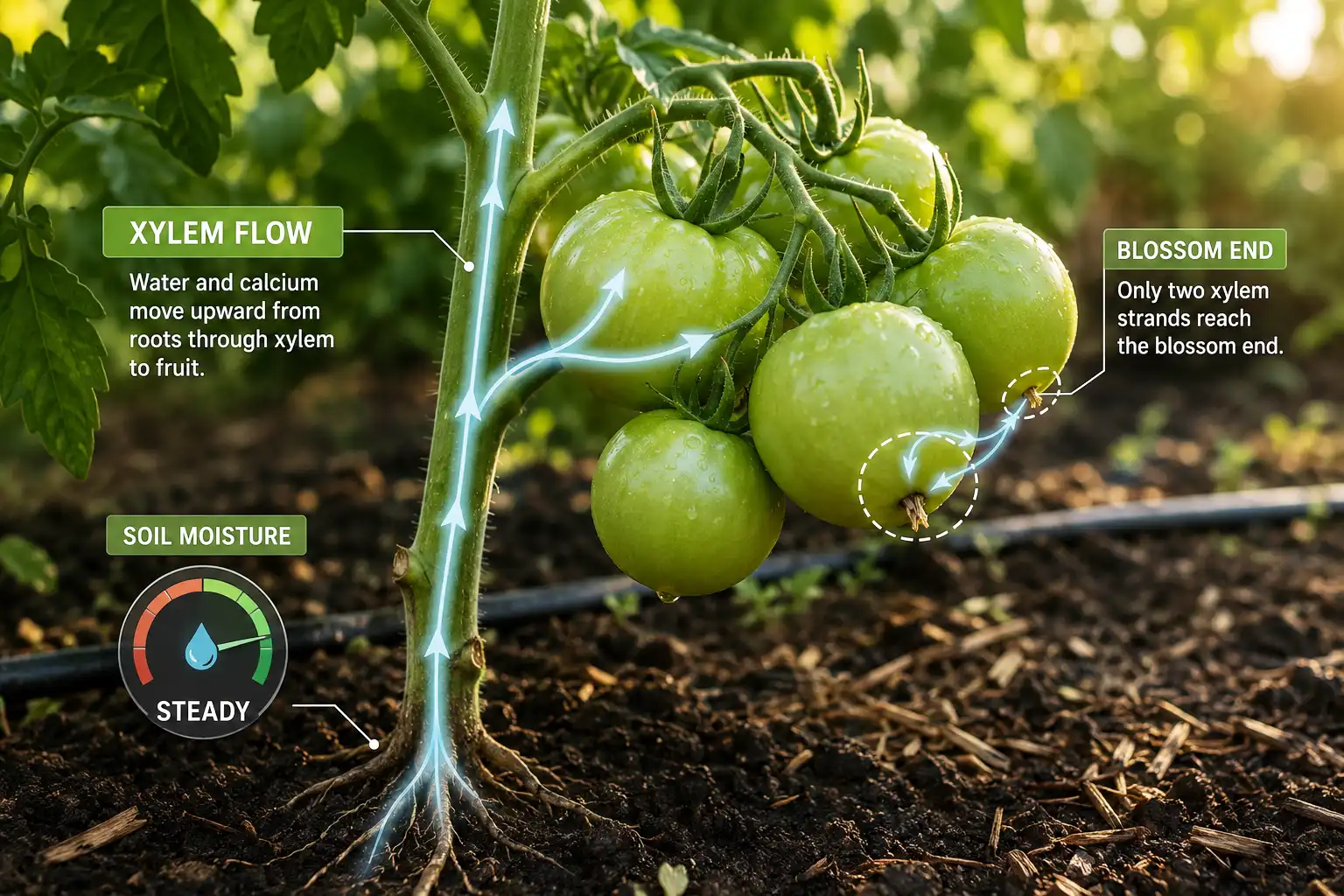
The transport chain fails for reasons no bag can fix:
- Uneven moisture. Dry spells followed by heavy watering interrupt xylem flow, and calcium stops reaching the fruit.
- Too much nitrogen. Oregon State Extension lists excess nitrogen, magnesium, potassium, or sodium as competing causes. Push growth hard and calcium goes to leaves instead of fruit.
- Low transpiration. Humid, still air slows water movement through the plant.
- Root damage. Nematodes, disease, waterlogged ground, or heavy pruning all cut uptake.
Foliar calcium is the biggest waste of money here. UF/IFAS states directly that foliar applications do not reduce blossom end rot, because leaves take up the calcium and then cannot move it into fruit. Fix drip, mulch, and irrigation timing first.
15-0-0 genuinely helps in three cases. A soil test showing low calcium or low base saturation is one. Soilless media, where you supply every nutrient, is another. The third is a heavy fruit load on drip, where calcium arrives with the water.
What About Tipburn in Lettuce and Greens?
Tipburn is the same failure in a leaf instead of a fruit. As a head closes, the inner leaves wrap the growing point in still, saturated air. Transpiration there drops close to zero, so calcium stops arriving at exactly the tissue expanding fastest.
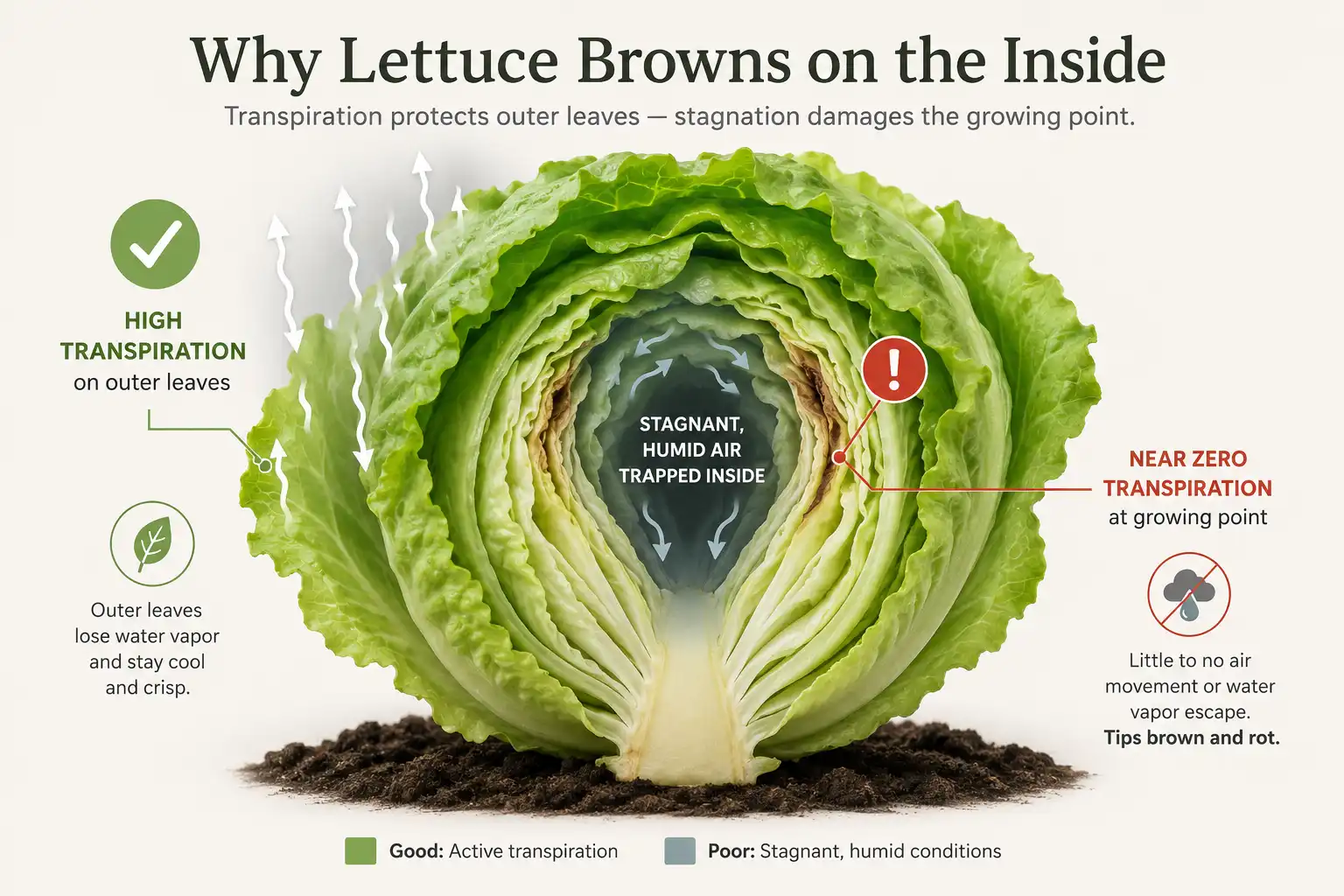
Airflow beats fertilizer every time here:
- Run horizontal air flow fans to break the boundary layer around the canopy
- Vent at night, since saturated night air is when tipburn sets up
- Back off nitrogen as heads approach harvest, because fast growth outruns calcium delivery
- Cut at proper maturity, since overmature heads tipburn worse
- Feed nitrate rather than ammonium nitrogen through the last three weeks
Rate and timing both matter on greens, and our notes on fertilizing lettuce work through the full season program.
The Calcium Window You Cannot Miss
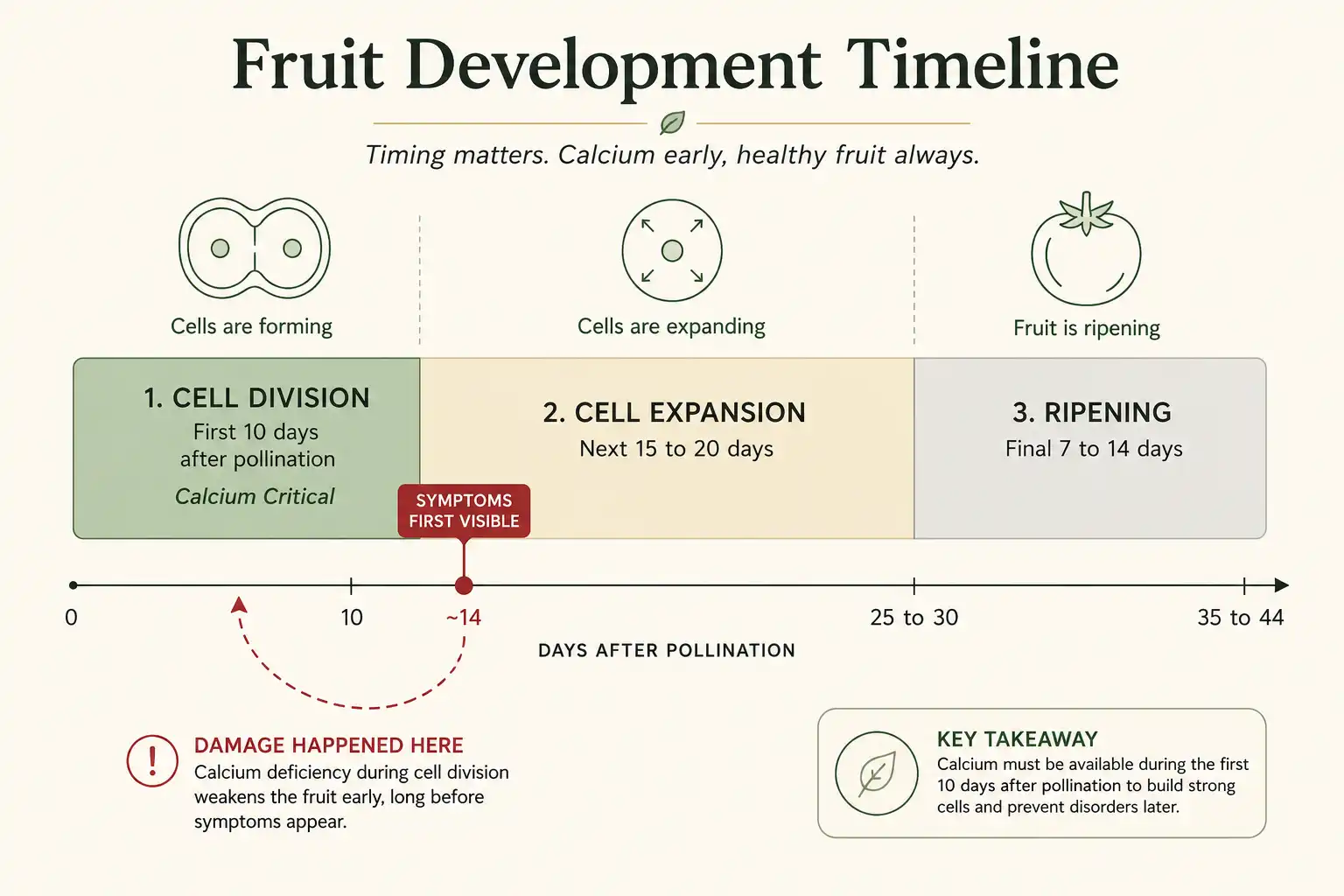
Calcium has to be in place during early cell division, not after symptoms appear. Iowa State Extension makes the timing brutally clear: blossom end rot becomes visible roughly two weeks after the deficiency actually happened. By the time you spot a black bottom on a tomato, the damage was locked in half a month earlier.
That changes how you use the bag. Iowa State adds one condition. Soluble calcium through irrigation helps low calcium soils only when it goes on from the start. Calcium nitrate is a preventive input, never a rescue.
Practical timing by crop:
- Tomatoes and peppers: start calcium at first flower, hold it steady through the first three fruit clusters
- Melons and squash: cover the two weeks after each set, since large fruit run the longest xylem path
- Lettuce and greens: carry calcium through the final three weeks as heads close
- Potatoes: target tuber initiation and early bulking for skin and internal quality
Check Your Water Before You Buy Calcium
Test your irrigation water first, because it may already carry the calcium you are about to pay for. Hardness and alkalinity are different measurements, and hardness is the one that reports calcium and magnesium. Labs express it as ppm calcium carbonate, and you convert with a simple multiplier.
| Water hardness as CaCO3 | Calcium supplied | What it means |
|---|---|---|
| 100 ppm | 40 ppm Ca | Meaningful credit, adjust the feed |
| 150 ppm | 60 ppm Ca | Covers much of a leafy green target |
| 200 ppm | 80 ppm Ca | Cut added calcium substantially |
| 300 ppm | 120 ppm Ca | Most crops need little or no extra |
Multiply hardness in ppm CaCO3 by 0.4 to get ppm calcium. Well water across much of the Great Plains runs hard enough to cover a real share of the program. NC State’s greenhouse guidance says higher hardness is workable as long as you compensate in the fertilizer plan.
There is a second reason to test. Calcium nitrate is a basic fertilizer, so pairing it with high alkalinity water pushes growing media pH up faster than either factor would alone. University of Arkansas greenhouse guidance flags that combination specifically. A soil test kit plus a water analysis costs less than one wasted bag.
Where 15-0-0 Earns Its Keep
| Situation | Why it fits | How to run it |
|---|---|---|
| Hydroponics and soilless media | You supply all calcium | Part B of a two or three part feed |
| Greenhouse tomatoes and peppers | Heavy fruit load, steady demand | 100 to 150 ppm N through drip |
| Leafy greens under humidity | Nitrate form beats ammonium | Continuous low rate feed |
| Cool spring soils | No conversion lag | Early sidedress for quick response |
| Low pH ground | Adds nothing acidifying | Replaces part of the ammonium nitrogen |
| Sandy soil testing low in calcium | Soluble calcium plus nitrogen | Split applications, water in |
Broadacre grain is where it does not belong. For corn, wheat, or milo across the Great Plains, the cost math falls apart completely.
How to Apply 15-0-0 Fertilizer
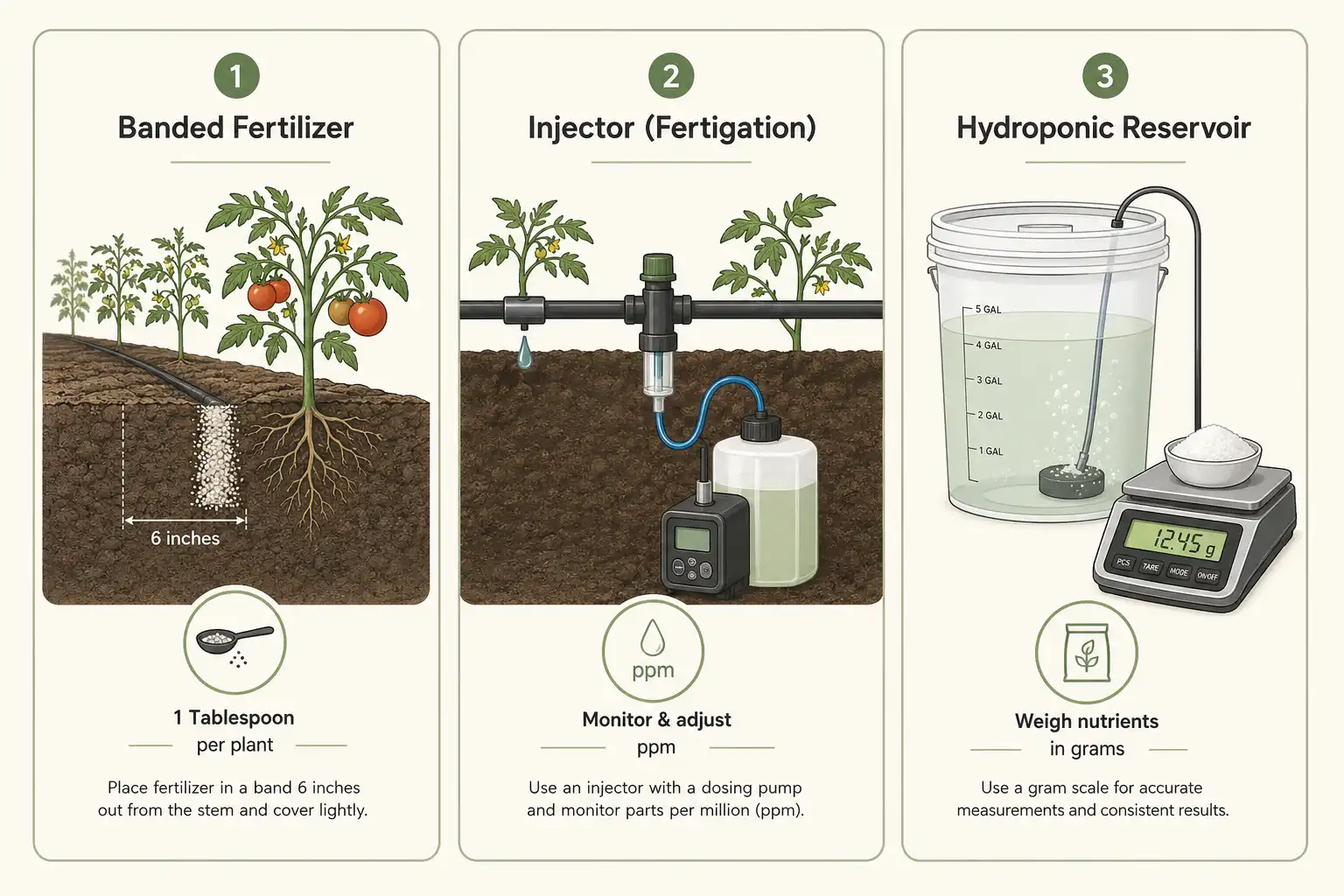
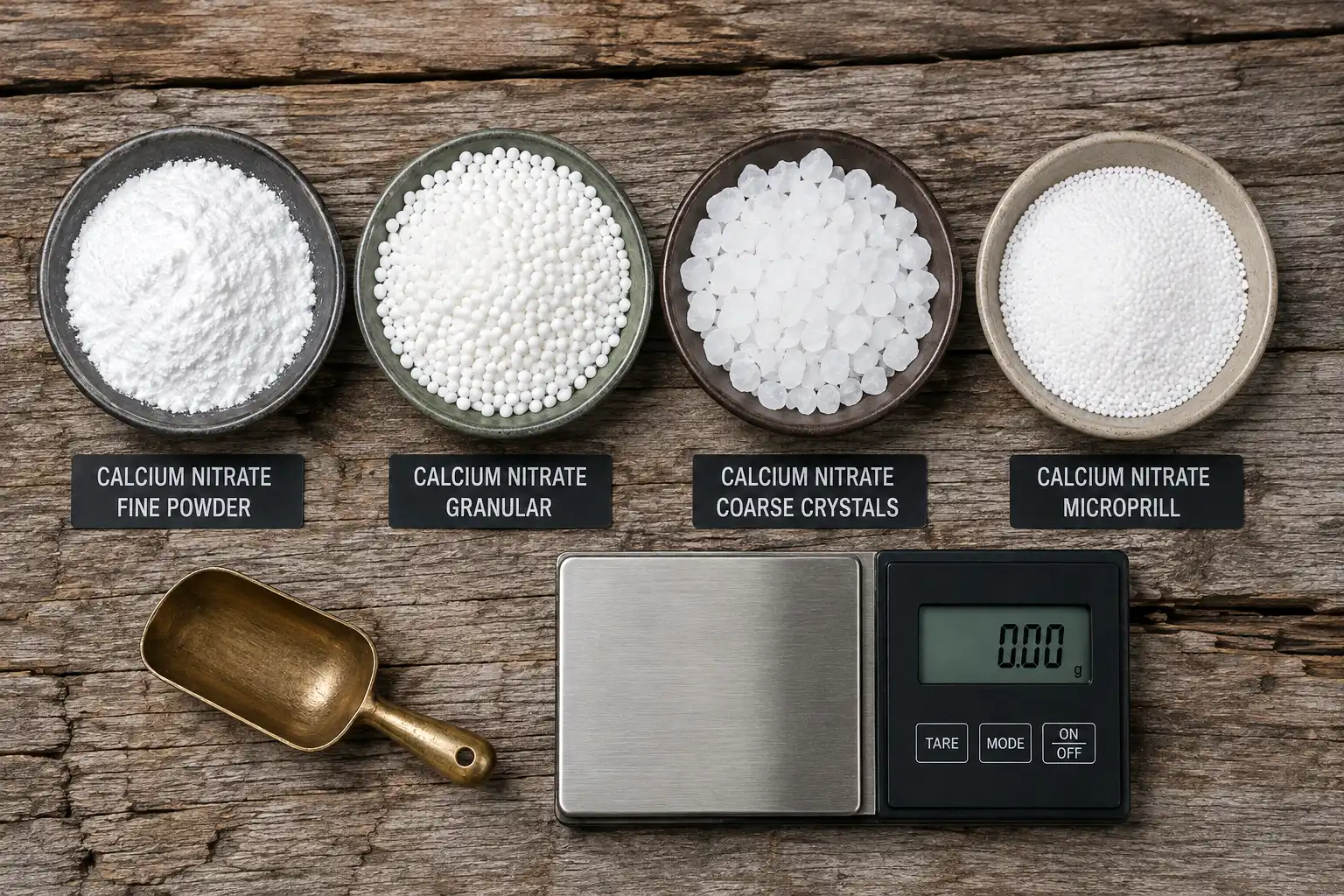
Weigh the product instead of scooping it. Prills, crystals, and microprill all pack differently, so a cup of one is not a cup of another.
Dry Side Dress Rates
Band it beside the row, never against the stem. One level tablespoon per plant suits tomatoes and peppers, placed 4 to 6 inches out from the crown. On row crops, 1 pound per 100 feet of row makes a solid starting rate. Water it in thoroughly afterward so the salt moves down into the root zone rather than sitting against surface roots. Repeat every 2 to 3 weeks through fruit set.
Drip and Fertigation
Continuous feed programs run 100 to 150 ppm nitrogen for fruiting vegetables. Dissolve 8.6 ounces in 100 gallons and you land near 97 ppm nitrogen. About 116 ppm calcium rides along in the same dose. Inject through a dosing pump rather than dumping product into a head tank. Flush the lines when the run finishes.
Hydroponic Reservoir Feeding
Calcium nitrate serves as Part B or Part 3 in nearly every two and three part recipe. A common mix per 5 gallons runs 12 grams of a 4-18-38 base and 6 grams of Epsom salt. Calcium nitrate goes in last at 12 grams. That final dose delivers roughly 98 ppm nitrogen and 120 ppm calcium. Add each part to moving water separately and never let the concentrates meet.
Foliar Sprays and Their Limits
Foliar rates run 1 tablespoon per gallon, sprayed early morning or late evening to avoid leaf burn. A tablespoon per gallon builds a solution near 600 ppm nitrogen, which works as an occasional drench but runs four times too strong for continuous feed. Foliar nitrate does green up a crop quickly. Foliar calcium only reaches tissue you physically wet, so treat leaf sprays as a nitrogen tool and nothing more.
Never Put 15-0-0 in the Same Stock Tank as Sulfates or Phosphates
Calcium ions react with sulfates and phosphates at concentrate strength and drop out as insoluble sludge. Purdue’s vegetable crops team walks through the exact failures. Mix calcium nitrate with a 20-20-20 and you form calcium phosphate. Mix it with Epsom salt or potassium sulfate and you form calcium sulfate, better known as gypsum. Both precipitates plug drip emitters, and no amount of stirring reverses the reaction.
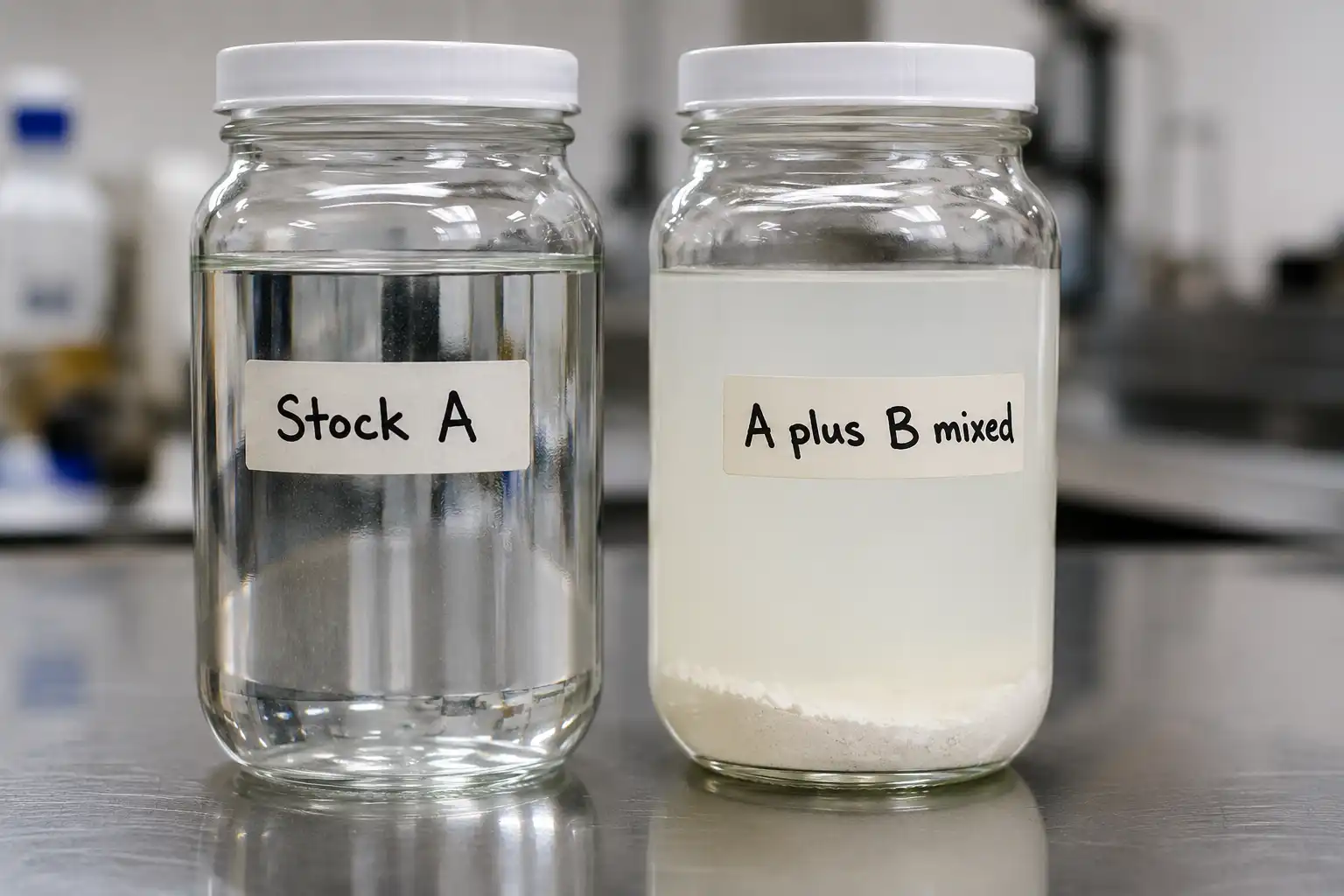
Here is the split:
- Stock A: calcium nitrate, potassium nitrate, chelated iron
- Stock B: phosphates, sulfates, magnesium sulfate, remaining micronutrients
- Never: the two concentrates touching before dilution
Once the injectors dilute both streams into the irrigation line, concentration falls far enough that nothing precipitates. That is the entire reason two part programs exist. Before trusting an unfamiliar combination, run a jar test at full stock strength. Watch it for 12 to 24 hours. Cloudiness that clears with stirring means borderline solubility, while haze that stays means real incompatibility.
15-0-0 vs Other Nitrogen Grades
| Grade | Material | Nitrogen form | Best role |
|---|---|---|---|
| 15-0-0 | Calcium nitrate | Nitrate | Calcium plus quick nitrogen, fertigation |
| 46-0-0 | Urea | Amide | Cheapest dry nitrogen, broadacre |
| 32-0-0 | UAN solution | Half nitrate, half urea | Sidedress and streamer bars |
| 21-0-0 | Ammonium sulfate | Ammonium | Nitrogen plus sulfur, acidifies soil |
| 15-0-15 | Blended | Varies | Nitrogen plus potassium, turf and greens |
Pick by what the crop lacks, not by the first number. If nitrogen is all you need on acres, urea at 46-0-0 wins on cost by a wide margin. So does liquid UAN at 32-0-0. Short on potassium alongside nitrogen? A 15-0-15 blend covers more ground in one pass.
One note on Cal-Mag products, since growers ask whether they replace 15-0-0. Cal-Mag blends supply calcium and magnesium but no sulfur, and that omission is deliberate. Formulators swapped magnesium sulfate out for magnesium nitrate precisely because calcium and sulfate cannot coexist in solution. Cal-Mag is a convenience product built around the same chemistry problem described above.
What 15-0-0 Costs Per Pound of Nitrogen
Retail bag prices hide how little nitrogen you actually receive.
| Product and bag | Price seen | lb N per bag | Cost per lb N |
|---|---|---|---|
| 25 lb calcium nitrate crystals | $53.80 | 3.88 | $13.88 |
| 18 lb calcium nitrate granules | $59.99 | 2.79 | $21.50 |
| 5 lb calcium nitrate microprill | $17.59 | 0.78 | $22.70 |
| Bulk urea, DTN mid July 2026 | sold by the ton | 920 per ton | $0.74 |
| UAN32, DTN mid July 2026 | $465 per ton | 640 per ton | $0.73 |
DTN’s retail survey for mid July 2026 put urea at $0.74 per pound of nitrogen and anhydrous ammonia at $0.59. A garden size bag of calcium nitrate therefore costs 19 to 31 times more per pound of nitrogen, and prices move weekly without that spread ever closing.
Field terms make it plainer. Sidedressing 30 pounds of nitrogen per acre takes about 194 pounds of calcium nitrate. In bagged product that runs over $400, against roughly $22 for the same nitrogen as urea. Buy 15-0-0 for the calcium and the nitrate form, then source bulk nitrogen somewhere else.
4 Best 15-0-0 Fertilizer Products
1. Jack’s Nutrients 15-0-0 Part B Calcium Nitrate, 25 lb
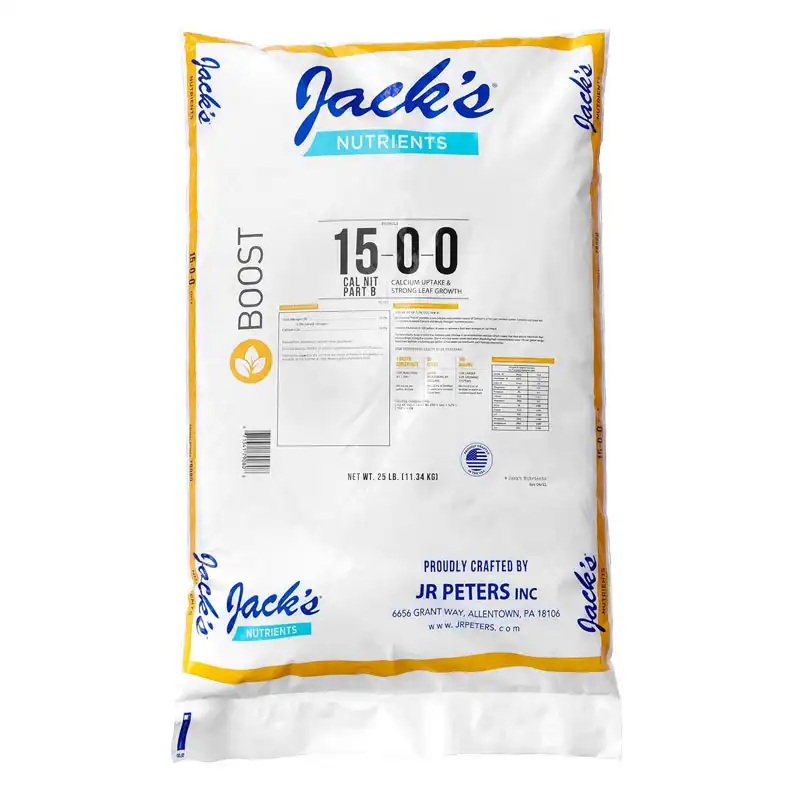
The one in a continuous liquid feed setup. It runs 15% nitrate nitrogen and 18% calcium as a water soluble powder built from ammonium calcium nitrate double salt. The label rate is refreshingly specific: 8.6 ounces per 100 gallons for a 100 ppm nitrogen feed. That dose carries about 116 ppm calcium with it. One 25 pound bag therefore mixes roughly 4,650 gallons of finished feed. It pairs with Jack’s 5-12-26 Part A. Only two macronutrients sit in the bag by design, so micronutrients come separately. Made in Allentown, Pennsylvania, with no plant growth regulators.
Specs:
- Analysis: 15% nitrate N, 18% Ca
- Form: water soluble powder
- Size: 25 lb
- Use: continuous liquid feed, hydroponics
2. Acton Calcium Nitrate 15.5-0-0, 25 lb
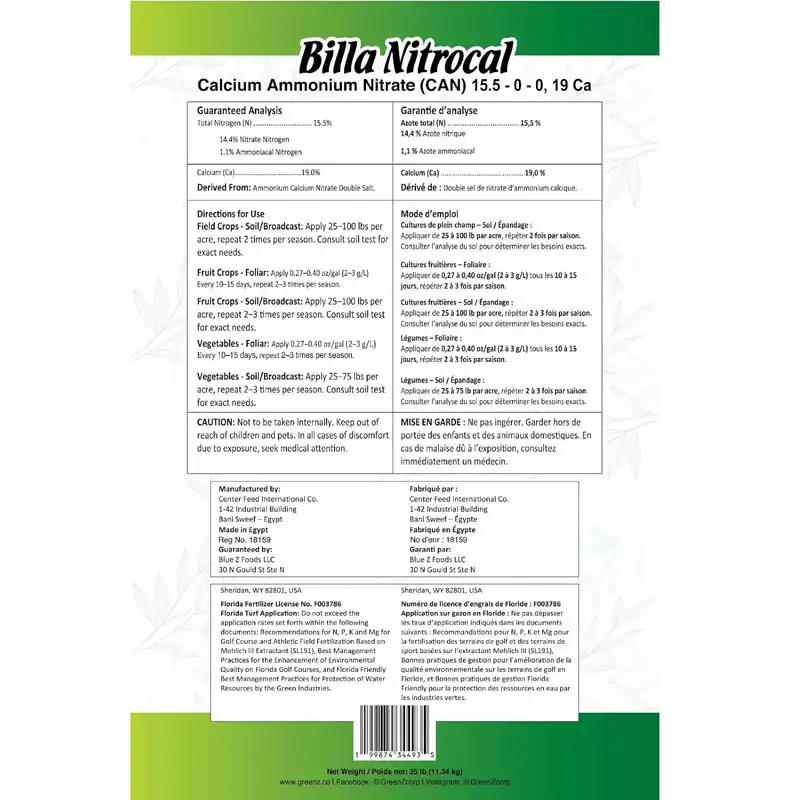
Best value of the four per pound of nutrient. You get 15.5% nitrate nitrogen and 19% soluble calcium as a high purity crystal that leaves almost no insoluble residue. The rate sheet sets it apart. Acton prints separate directions for soil drench, hydroponics at 150 to 200 ppm, foliar spray, and lawn greening. That bag makes about 4,640 gallons of 100 ppm feed, which works out near $11.59 per thousand gallons. Start at the low end of the soil rate. One to two tablespoons per gallon runs strong for a drench. Store it sealed, because the crystals grab moisture and clump.
Specs:
- Analysis: 15.5% nitrate N, 19% Ca
- Form: water soluble crystals
- Size: 25 lb and 5 lb
- Use: soil, drip, foliar, hydroponics
3. Cz Garden Calcium Nitrate 15.5-0-0, 18 lb
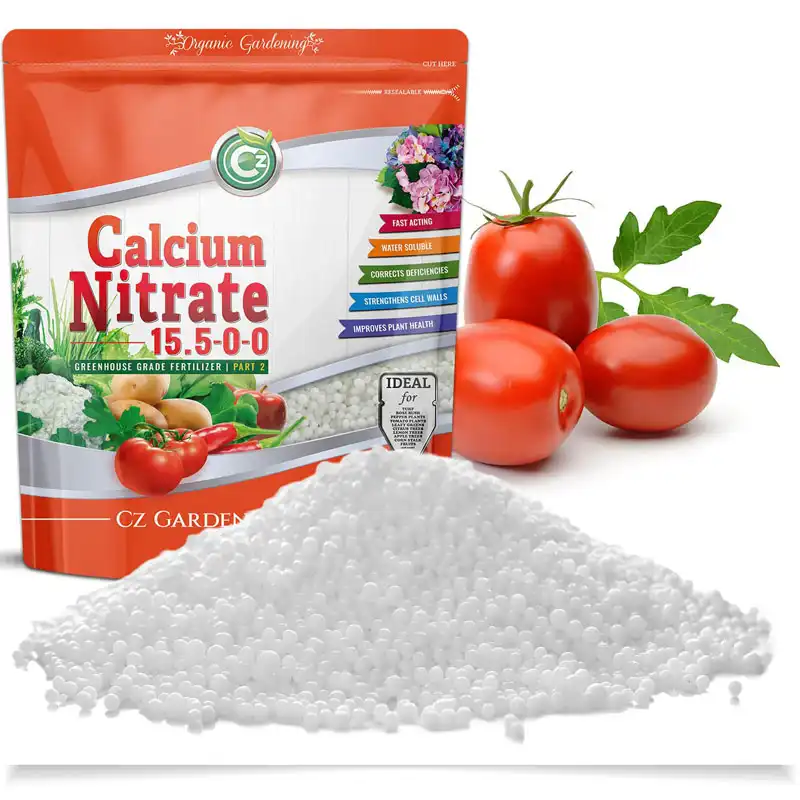
Worth the premium if you run tight drip tape. It carries 15.5% nitrogen and 19% calcium in fully soluble granules. The maker draws a sharp line against cheaper agricultural grade material, which leaves an oily film on emitters and roots. That film genuinely is a nuisance in tape, so the extra purity earns its keep. The resealable heavy pouch also beats a paper sack for storing a salt that pulls moisture from the air. It slots in as Part B or Part 2 across coco, soil, and recirculating systems. The 18 pound pouch makes about 3,340 gallons of feed, or roughly $17.94 per thousand gallons.
Specs:
- Analysis: 15.5% N, 19% Ca
- Form: soluble granules
- Size: 18 lb resealable pouch
- Use: hydroponics, drip, coco, soil
4. PowerGrow Calcium Nitrate 15.5-0-0, 5 lb
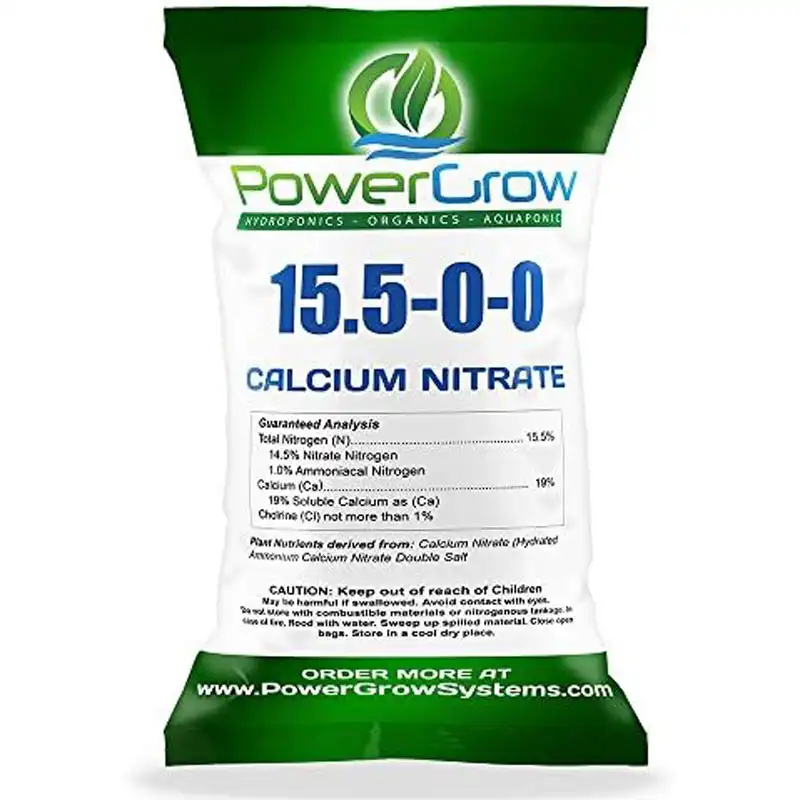
The right size for a garden or a small high tunnel. It runs 15.5% nitrogen and 19% calcium as a microprill. Those tiny beads dissolve in a couple of stirs while coarse granules keep you waiting. PowerGrow prints the reservoir recipe right on the label. It runs 12 grams of 4-18-38, 6 grams of Epsom salt, then 12 grams of calcium nitrate last. That lands near 98 ppm nitrogen and 120 ppm calcium. There is no oil coating to film up lines. Keep it off wet foliage and at least 2 inches from the crown, per the label warning. Five pounds makes about 930 gallons of feed.
Specs:
- Analysis: 15.5% N, 19% Ca
- Form: water soluble microprill
- Size: 5 lb airtight bag
- Use: hydroponics, containers, foliar
Which One Fits Your Setup
| If you are | Buy | Why |
|---|---|---|
| Running continuous liquid feed | Jack’s Part B | Label rate matches a real ppm target |
| Watching cost closely | Acton 25 lb | About $11.59 per thousand gallons |
| On tight drip or tape | Cz Garden | Purity keeps emitters clear |
| Feeding a garden or tunnel | PowerGrow 5 lb | Dissolves fast, no leftover bag |
Tomatoes drive most calcium nitrate sales, and calcium works only as part of a complete program. Our rundown of tomato fertilizer picks covers the phosphorus and potassium side that 15-0-0 leaves out entirely.
Signs You Applied Too Much
- Dark green, thick, curling leaves with thin fruit set. Classic excess nitrogen, and it makes blossom end rot worse by pulling calcium into foliage.
- White crust on soil or media surface. Salt accumulation. Leach with clean water and cut the rate.
- Rising EC in a recirculating reservoir. Dump and rebuild rather than topping off.
- Leaf margin burn without drought. Soluble salt injury at the root, showing up at the leaf edge.
- Climbing media pH in containers. Calcium nitrate is basic, so watch it on alkaline water.
Storing and Handling Calcium Nitrate
Calcium nitrate pulls water straight out of humid air, and an open bag turns into a brick. Seal it tight after every use and store it indoors off a concrete floor, because Kansas humidity in July will ruin a loose sack inside a week.
Every safety data sheet lists this material as an oxidizer, which matters more than most people realize. Keep it away from fuel, oil, solvents, rags, and loose paper, and skip the wooden shelf above the shop bench. Wear gloves and eye protection, since the salt irritates skin and eyes. Keep it away from children, pets, and livestock feed. Do not apply it to wilted or drought stressed plants either. Moisture has to be present to carry the salt away from roots.
One regulatory note for certified growers. Calcium nitrate is synthetic and does not appear on the USDA National Organic Program list of allowed synthetics. Organic operations use gypsum or a calcium carbonate source instead. Clear any input with your certifier before it goes on the ground.
Common Mistakes With Calcium Nitrate
- Treating it as a nitrogen program. At 15% nitrogen it is a calcium product that happens to carry nitrogen. Budget nitrogen elsewhere.
- Applying it after symptoms appear. The shortage happened two weeks earlier. Start at first flower instead.
- Skipping the water test. Hard well water may already supply 60 to 120 ppm calcium.
- Sharing a stock tank with Epsom salt. One mistake costs you a set of emitters.
- Scooping by volume. Prills, crystals, and microprill weigh differently per cup. Use a gram scale.
- Ignoring leaching. Nitrate leaves sandy soil fast, so split the rate instead of front loading it.
- Forgetting micronutrients. Two macronutrients in the bag means iron, manganese, and boron come from somewhere else.
FAQs on 15-0-0 Fertilizer
Is 15-0-0 the same as 15.5-0-0?
How often should I apply 15-0-0?
How fast does 15-0-0 work?
Can I use 15-0-0 on lawns?
Will 15-0-0 raise my soil pH?
Does 15-0-0 fertilizer work in hydroponics?
Can I mix 15-0-0 with Epsom salt?
Is calcium nitrate the same as calcium chloride?
Key Points to Carry Into the Field
Buy 15-0-0 when you need soluble calcium and fast nitrate nitrogen in one pass, then source bulk nitrogen elsewhere. It earns its place in hydroponics, greenhouse fruiting crops, and drip fed vegetables. Test your water before you buy, since hard well water may already cover much of the calcium. Start at first flower rather than at the first black-bottomed tomato, because the shortage that causes blossom end rot happens two weeks before you see it. Keep the bag out of any stock tank holding sulfates or phosphates, and fix irrigation before blaming calcium for anything.