How to Fertilize Potatoes: Rates, Timing, and Placement
Potatoes pull more nutrients from the soil than most crops in a typical rotation. Feed them wrong and you get heavy vines with small tubers underneath. Learning how to fertilize potatoes means matching each application to a growth stage, not dumping a bag in April.
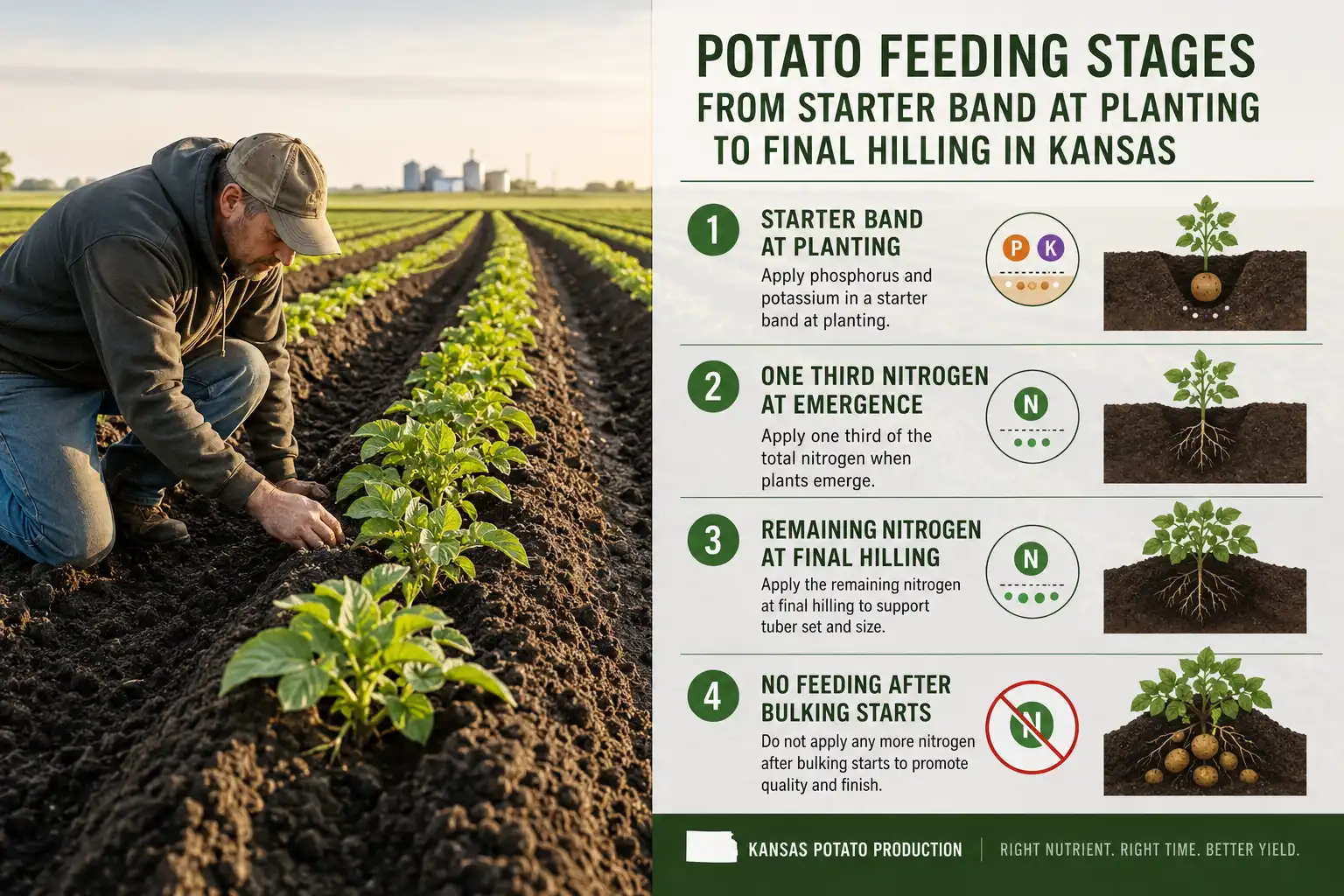
Fertilize potatoes in splits, not all at once. Band starter phosphorus and potassium at planting. Apply a third to half the nitrogen near emergence. Side-dress the rest at final hilling, then stop.
What Nutrients Do Potatoes Need Most?
Potassium and nitrogen lead the list, with phosphorus close behind. A 400 hundredweight crop, about 20 tons per acre, moves roughly 260 pounds of nitrogen into vines and tubers. Potassium runs higher still, near 265 pounds. That order catches plenty of growers off guard.
Peak daily demand matters as much as the season total. During tuber bulking, a heavy crop takes up 4 to 5 pounds of potassium per acre per day. Nitrogen demand runs 3 to 4 pounds. So the soil has to supply a steady stream inside a narrow window.
Phosphorus uptake stays modest, near 80 pounds of P2O5 for that same crop. Still, potatoes respond to more phosphorus than they remove. Early roots work in cold soil where phosphorus barely moves.
Sulfur applications usually run 15 to 25 pounds per acre. Magnesium and calcium demand sits mostly in the vines. Zinc is the micronutrient that comes up short most often in potato ground.
One thing to keep straight before you buy anything. This crop is Solanum tuberosum, the Irish potato. Sweet potatoes are a different species on a different program, and overdoing nitrogen when feeding sweet potatoes costs you root quality.
Why a Soil Test Comes Before the Fertilizer Bag
Because potato rates hang on soil test phosphorus and potassium, and pH decides how much scab you live with. Guessing wastes money on one end and yield on the other.
Sample to 2 feet if you want a nitrate credit. On loam and heavier ground, fall sampling works fine. On sandy loam or coarser soil, wait until early spring. Snowmelt and spring rain push nitrate below the root zone. Potatoes root shallow, with few roots past 2 feet.
pH sits in a tight spot. Nutrient availability peaks near 6.0 to 6.5, but common scab gets worse as pH climbs. So most soil test labs, Penn State among them, set the goal at 6.0. They also drop the limestone recommendation entirely once scab has been a problem. If you do lime, hold it under a ton per acre within six months of planting. Put the rest on after harvest.
Credit your previous crop too. Soybeans, dry edible beans, and other grain legumes leave about 40 pounds of nitrogen per acre. No preplant test will show it. A mail-in soil testing kit returns pH, phosphorus, potassium, and organic matter. That covers most of a potato plan.
How to Fertilize Potatoes at Planting Without Burning the Seed Piece
Band the fertilizer beside and below the seed piece, never touching it. Place it 2 to 3 inches to the side and 2 to 3 inches below. Potato fertility researchers treat that placement as the standard. It feeds early roots while keeping salt off the cut surface.
Put most or all of your phosphorus in that band. Cold April soil slows phosphorus movement, and a seed piece has plenty of work ahead. Dry and liquid products both work here. Orthophosphate and polyphosphate sources perform about the same.
Potassium goes on early as well. Apply half or more preplant, then run the balance through the starter band. In-season potassium lowers tuber specific gravity more than preplant potassium does, so front-load it. At low rates, all of the potassium can ride in that starter band.
Skip nitrate sources at planting on sandy ground, since spring rain leaches them quickly. Ammonium sulfate, DAP, MAP, and 10-34-0 all make better starter nitrogen. One caution: on soils above pH 7, heavy ammonium close to the seed piece can cause ammonia toxicity.
How to Apply Fertilizer to Potatoes in a Garden Row
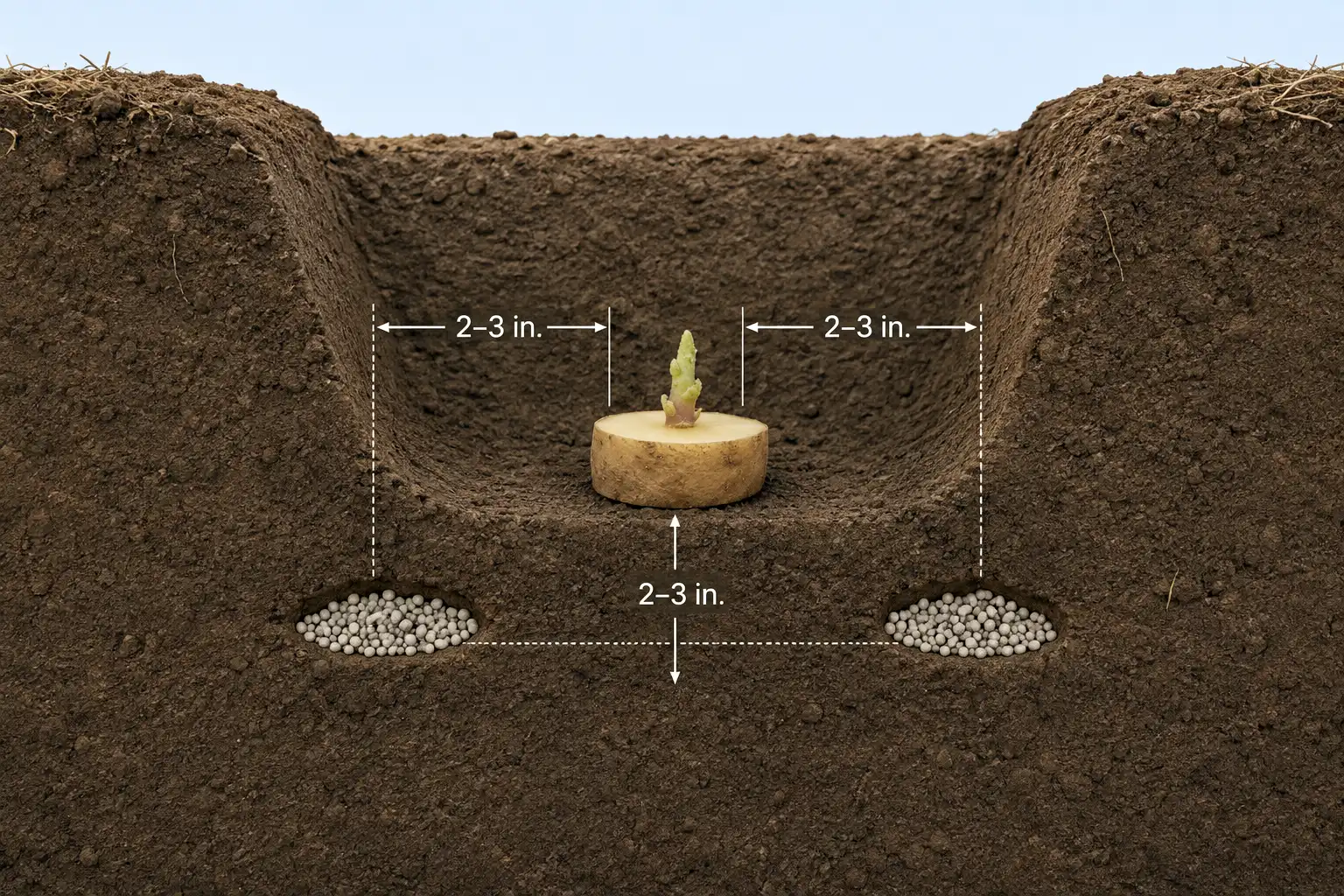
Use 4 to 5 pounds of a balanced grade per 100 feet of row. Band it 2 inches to the side and 2 inches below the seed pieces. For a small plot, 2 to 3 pounds per 100 square feet broadcast during fall tillage does the job. Banding wastes less product and feeds fewer weeds between rows.
How and When to Fertilize Potatoes Through the Season
Three windows carry almost the whole load: planting, emergence, and final hilling. A fourth window opens during bulking, though only if you can fertigate and back the decision with tissue testing.
How Much Nitrogen Goes On Near Emergence
Apply one-third to one-half of the season’s nitrogen as shoots break through. Urea is the common choice here. Incorporate it or irrigate it in within 12 hours, otherwise ammonia volatilization takes a cut. Urea treated with a urease inhibitor buys you more time. Ammonium sulfate costs more per pound of nitrogen. Still, it covers sulfur and acidifies the surface, which helps on scab ground.
Why Final Hilling Is the Last Good Window
Put the remaining nitrogen on at final hilling. After that pass, equipment tears roots and stolons, so you lose the chance to place dry fertilizer safely. The same trip that covers stolons also incorporates the fertilizer. That explains why hilling potato rows matters more than it looks.
Should You Feed During Tuber Bulking?
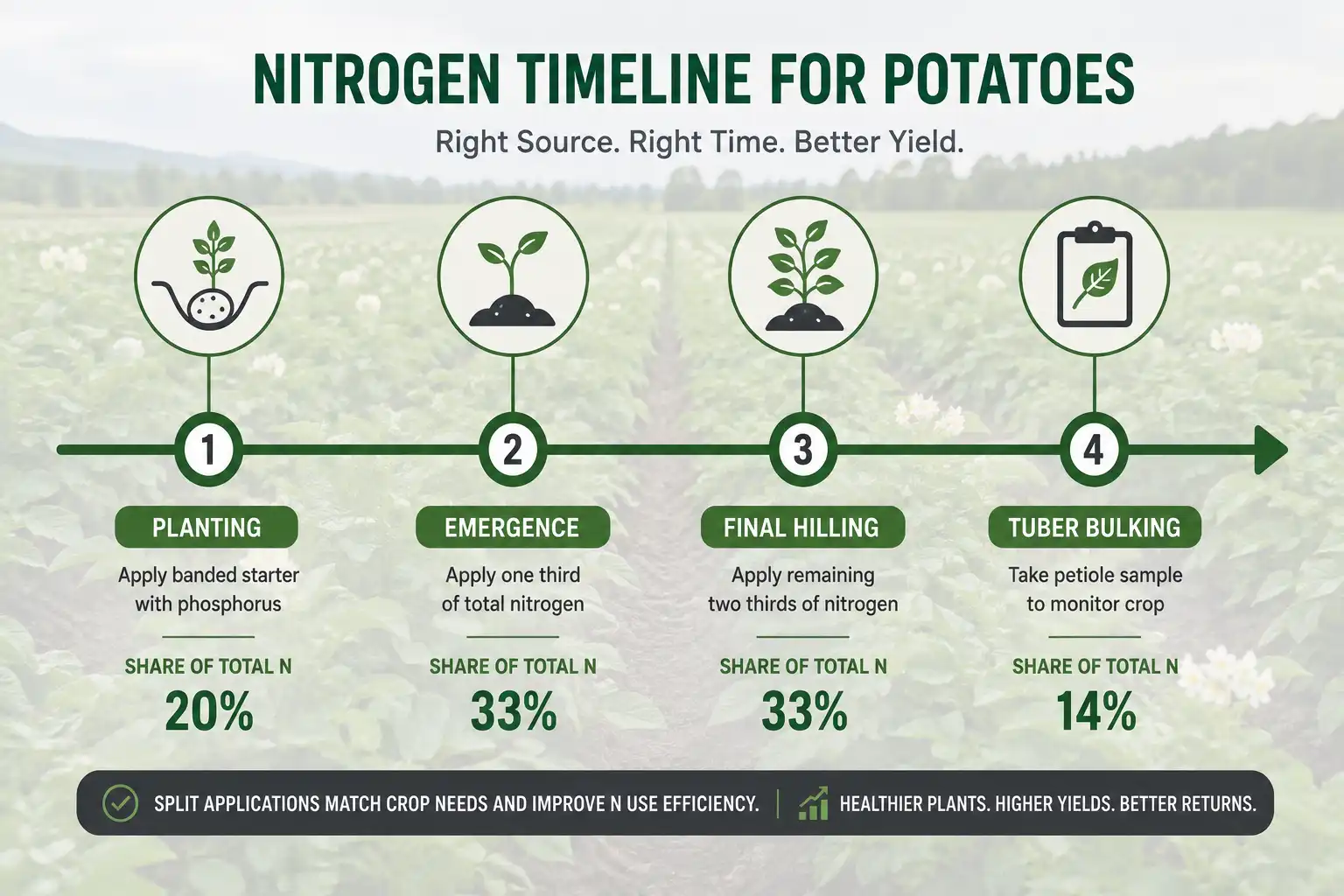
Feed during bulking only when petiole numbers tell you to. The petiole is the leaf stem and midrib of the fourth leaf back from the shoot tip. Pull 40 of them from random plants. Start about a week after final hilling, then wait at least four days after any fertigation.
NDSU sufficiency tables put petiole nitrate nitrogen at 1.1 to 1.5 percent during bulking. Sap nitrate meters give faster feedback. Target ranges for Russet Burbank:
- 1,200 to 1,600 ppm at tuberization
- 800 to 1,199 ppm in early July
- 400 to 799 ppm as vines mature
Readings under range mean feed. Readings over range mean quit.
How Often to Fertilize Potato Plants in Garden Rows
Twice after planting covers most garden situations. Side-dress about four weeks after planting while you hill, then repeat two weeks later.
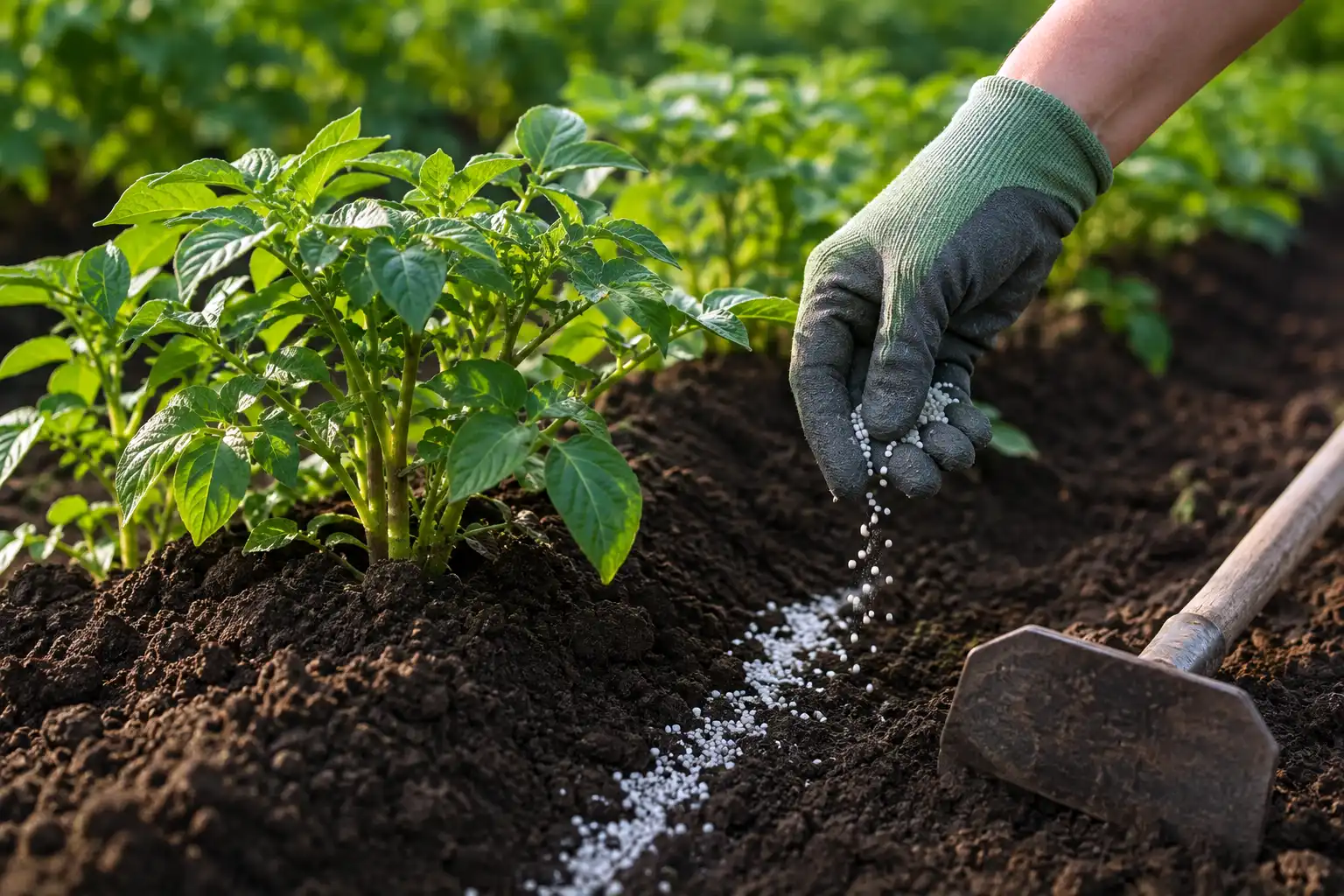
Rates that work at garden scale. These come from K-State Research and Extension and University of Minnesota Extension guidance.
- 0.15 pound of actual nitrogen per 50 feet of row at each pass
- Or 1/2 to 1 pound of a 33-0-0 type product per 100 feet of row
- Or 1 to 2 pounds of all-purpose garden fertilizer per 100 feet of row
- Or about 1 1/2 tablespoons of high-nitrogen fertilizer per plant once tubers set
Sprinkle it in a band 4 to 5 inches out from the stems. Then cover it with hilling soil and water it in. Dry granules left on the surface do nothing for the crop.
Sandy soil changes the math. Nitrogen leaches faster there, so three lighter passes beat two heavy ones. Heavier ground holds nitrogen longer, so two passes usually finish the job.
How Often to Fertilize Potatoes in Containers and Grow Bags
Every one to two weeks with a soluble feed, starting once shoots clear the surface. Potting mix runs out of nutrients around six weeks, and every watering flushes more out the bottom.
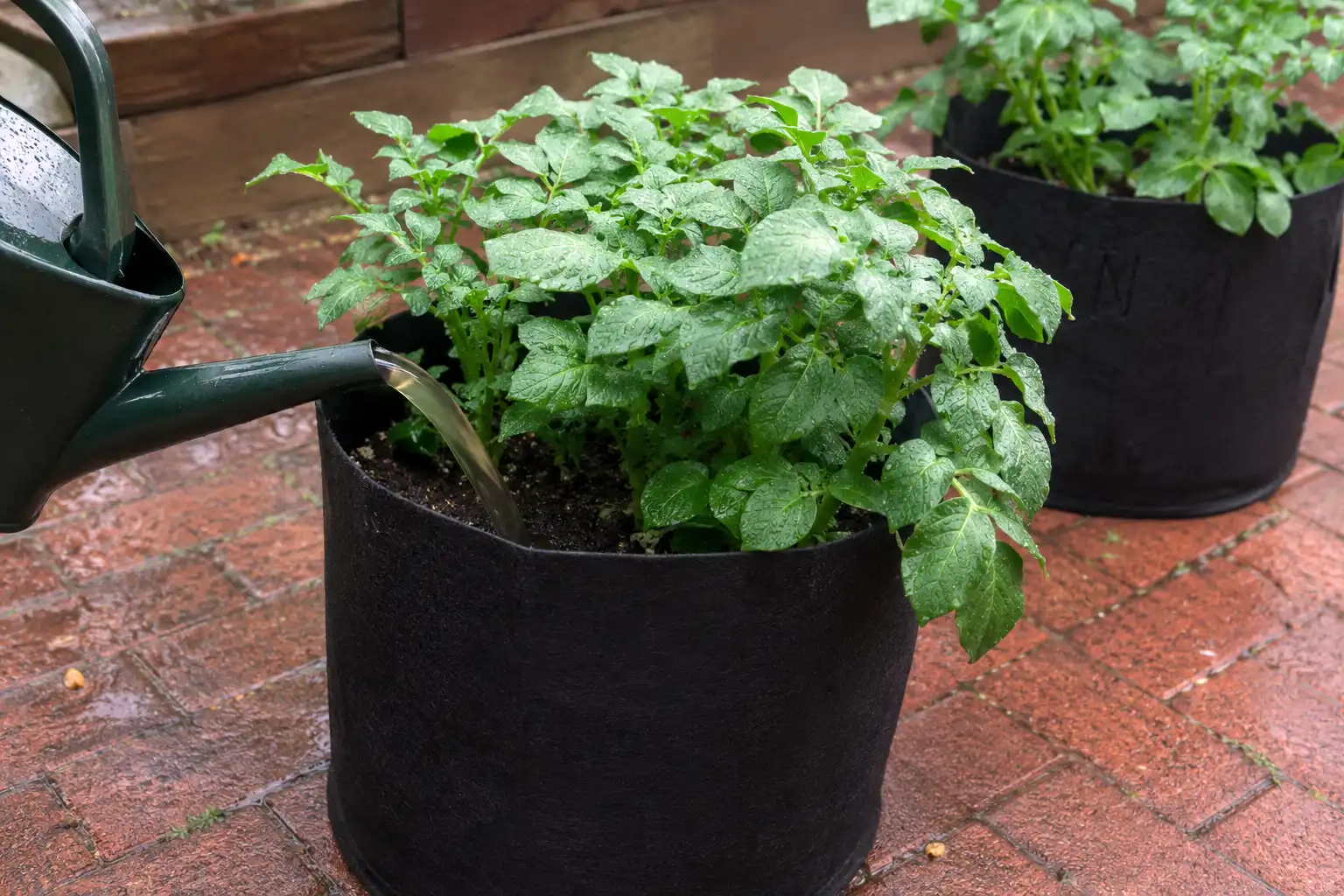
Half strength weekly beats full strength every other week. The plant gets a steadier supply, and you avoid salt spikes in a small root zone. Choose a grade carrying more phosphate and potash than nitrogen. A 5-10-10 blend fits that pattern well.
Mix compost or a slow-release granular into the media before planting so the first three weeks stay covered. Growing potatoes in fabric bags also means checking moisture daily. Dry-then-soaked cycles cause hollow heart no matter how carefully you feed.
When Should You Stop Fertilizing Potatoes?
Stop nitrogen once tubers are bulking and vines have closed the row. Late nitrogen pushes the plant back into vine growth at the tubers’ expense.
That mistake shows up several ways. The crop matures later, so vine kill and digging both slide back. Specific gravity drops, which hurts anything headed for the fryer or long storage. Second growth throws knobs and misshapen tubers. Brown center and hollow heart both turn up more often.
Running short on nitrogen carries its own cost. Underfed plants pick up early blight and verticillium more easily. So the target is adequate nitrogen, not generous nitrogen.
In containers, quit feeding once foliage yellows and starts dying back. That plant has finished moving starch, and more fertilizer only delays skin set.
Which Fertilizer Numbers Work Best for Potatoes?
Use a starter carrying more phosphate and potash than nitrogen, then switch to a straight nitrogen source for side-dressing. That split matches how the crop actually pulls nutrients.
Starter grades that fit: 5-10-10, 8-8-8, 10-10-10, 12-12-12, 3-18-18, DAP (18-46-0), and 10-34-0 in liquid form. Side-dress options include urea (46-0-0), ammonium sulfate, and 32-0-0 solutions.
Potash source deserves a thought. Muriate of potash (0-0-60) costs the least, though its salt index can set back early growth. On ground already high in chloride, switch to potassium sulfate or sulfate of potash magnesia. Either one covers the sulfur requirement too. These potato fertilizer picks break down which products suit garden rows versus field acres.
Avoid one product category entirely. Anything labeled weed and feed carries herbicide, and that herbicide will kill your crop.
Do Potatoes Need Sulfur, Calcium, or Zinc?
Sulfur and zinc are worth planning for. Calcium usually is not, unless storage has cost you tubers before.
Sulfur has no reliable soil test, and deficiencies have grown more common across the northern Plains. So plan on 15 to 25 pounds per acre. If your potash source is potassium sulfate or sul-po-mag, you have already covered that requirement. Keep thiosulfate products away from the seed piece.
Zinc comes up short more than any other micronutrient in potatoes. A DTPA soil test above 1 ppm means no response. Between 0.6 and 1 ppm, a quarter pound of actual zinc as a banded chelate works. Below 0.6 ppm, double that. Boron only matters where a hot-water test reads under 0.4 ppm, which mostly means irrigated sands.
Calcium is more complicated than the label suggests. Tuber calcium depends on transport into the tuber, not on soil supply. So a high soil test does not guarantee good tuber calcium. Split calcium nitrate or gypsum programs have raised tuber calcium in trials. Even so, internal defect results varied by site and by year. Add calcium on high-testing soil only when stored tubers have given you trouble.
How Do You Fertilize Potatoes Organically?
Build the nitrogen supply the season before, then top up with fast-release organic sources. Organic nitrogen releases on the soil’s schedule rather than yours, so front-loading matters more here.
A legume green manure plowed down before harvest supplies 100 to 200 pounds of nitrogen per acre. Expect about two-thirds of what that crop accumulated to reach your potatoes. Clip a measured area before you incorporate it. Then send that material in for total nitrogen, so you know what you have.
Compost and well-aged manure add potassium, micronutrients, and organic matter. Skip fresh manure. It encourages scab and releases nitrogen on no schedule you can predict. Composted material that reached high temperature also brings fewer weed seeds along.
For in-season help, fish emulsion moves fast. Kelp meal, greensand, and bone meal release slowly, so they belong in the preplant plan. Mined potassium sulfate and sul-po-mag both carry organic approval.
One caution for dryland growers. Microbial activity tracks soil moisture, so organic nitrogen release runs uneven in a dry summer. Under irrigation, release stays far more consistent.
How Do Fertilizer Problems Show Up on Potato Plants?
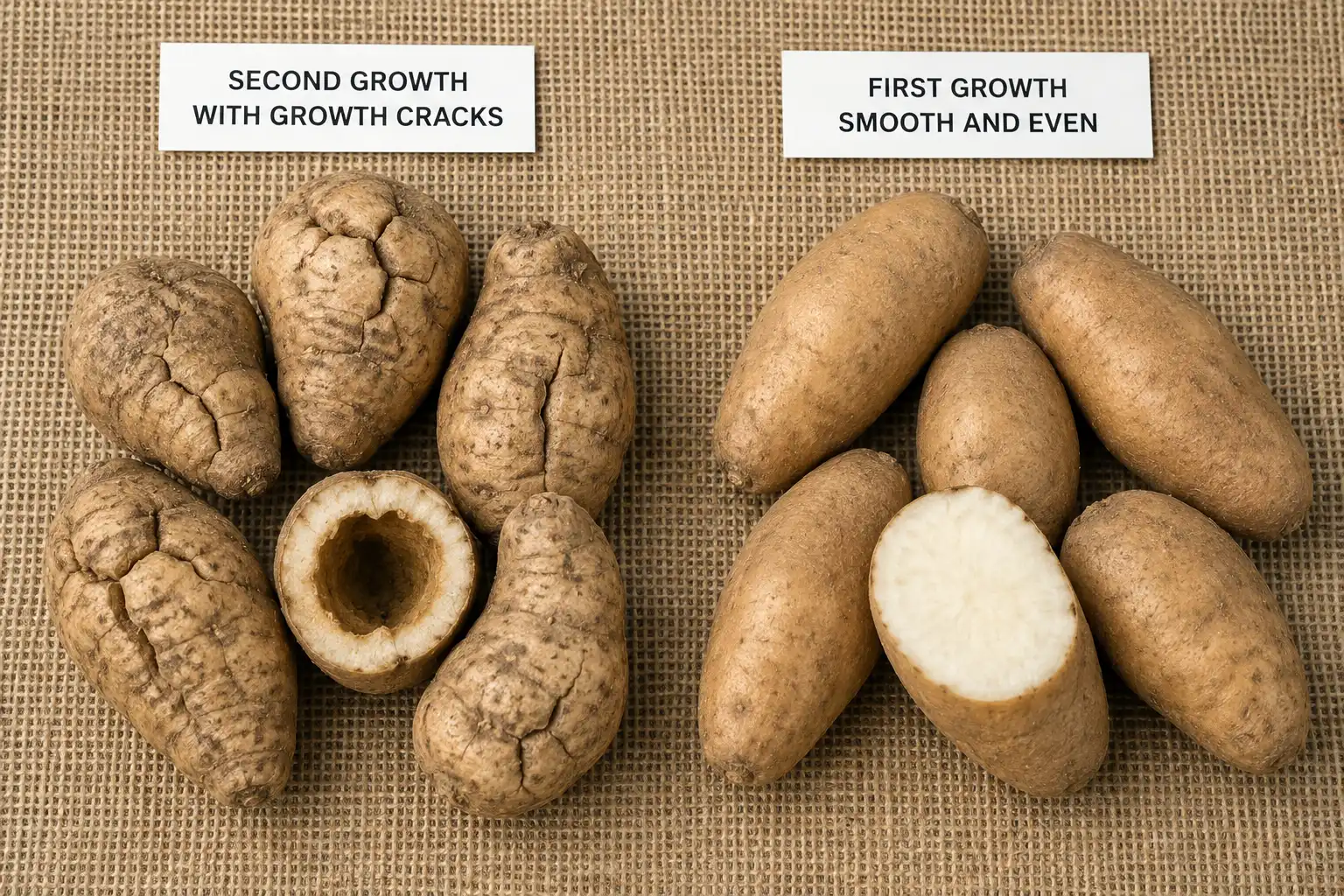
They show up in a fairly predictable order, and leaf position tells you plenty.
Nitrogen shortage pales the lower leaves first. Then the whole plant turns thin and upright before it dies down early. Nitrogen excess does the opposite: dark heavy vines, delayed tuber set, and knobs at harvest.
Potassium shortage bronzes older leaves and scorches their margins. It also shows up after digging as blackspot bruising, since low-potassium tubers bruise easily.
Phosphorus shortage stunts plants and can purple the stems, most often in cold wet spring soil. Magnesium shortage yellows the tissue between veins on older leaves. It turns up on acid sandy ground that has gone unlimed for years.
Tissue testing still beats reading leaves. Whole-leaf analysis gives a better read on total uptake for everything except nitrogen, where petiole nitrate remains the better indicator.
Final Thoughts
Soil testing typically happens every fall. Phosphorus and most of the potassium are then banded at planting. The last two-thirds of the nitrogen waits for emergence and final hilling. In zone 6a, planting typically happens around mid-March. So tubers set while the soil stays cool, and the last nitrogen goes on before June heat. That timing does more for tuber size than any product on the shelf.