When Do You Harvest Wheat: Moisture, Stages, and Timing
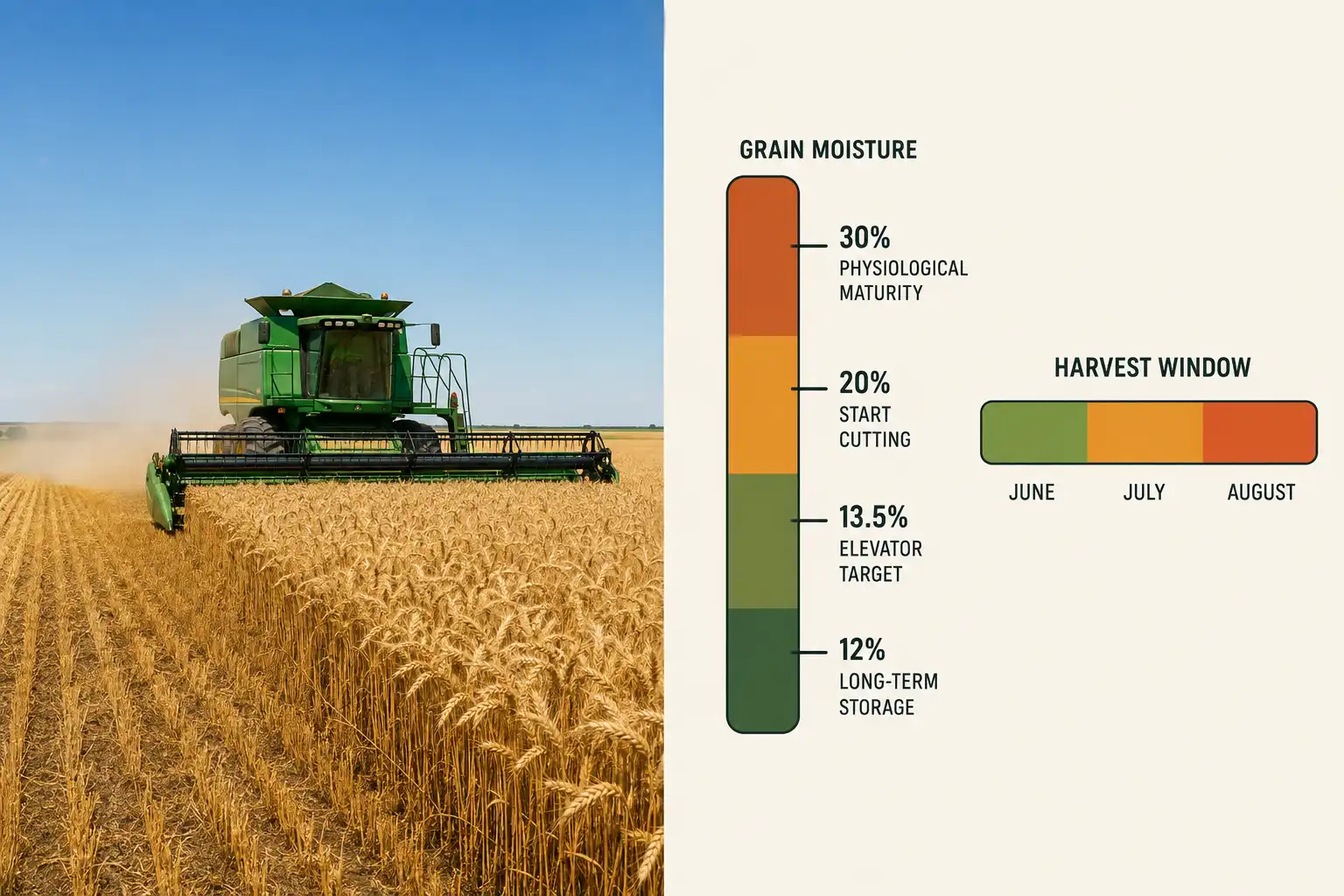
Wheat gives you a short window. Cut it green and the bin heats. Wait too long and rain robs test weight. So when do you harvest wheat? The answer sits in the kernel and the straw, not on the calendar.
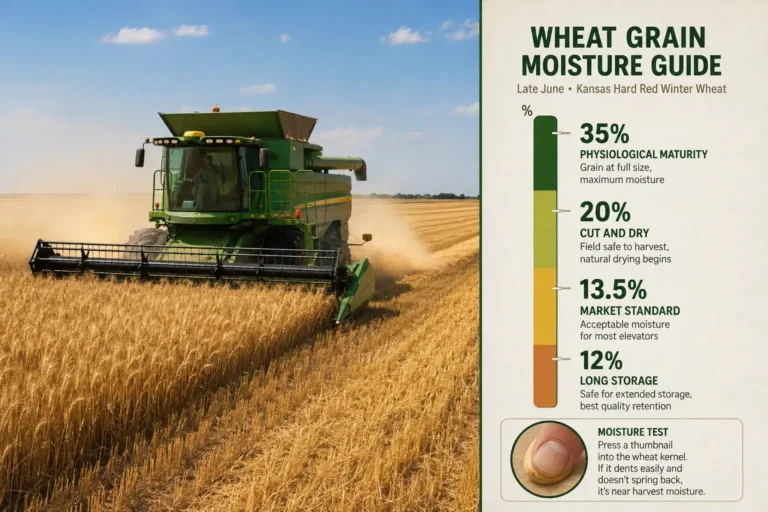
Harvest wheat once grain moisture drops between 20% and 13.5%. That lands in June and July for winter wheat, late July through August for spring wheat. Kernels must be hard, and straw fully golden.
Also know: When Is Wheat Harvested? Timing, Stages, and Moisture Targets
When Do You Harvest Wheat by Region and State?
Winter wheat harvest opens in late May in south Texas and closes in early September in Montana and eastern Washington. Combines follow ripening north at roughly 100 miles per week. Spring wheat comes later, mostly late July through August across the Northern Plains.
Harvest date traces straight back to seeding date. So the winter wheat planting dates you pick in fall set the clock for next summer.
Winter Wheat Harvest Windows
These are the usual ranges USDA tracks by state. Weather shifts them a week or two either direction every year.
| State | Usual harvest window |
|---|---|
| Texas | May 25 to July 7 |
| North Carolina | May 29 to July 25 |
| Oklahoma | June 5 to July 5 |
| Kansas | June 15 to July 25 |
| Missouri | June 15 to July 20 |
| Nebraska | June 26 to August 8 |
| Ohio | July 1 to August 4 |
| South Dakota | July 6 to August 12 |
| North Dakota | July 10 to August 1 |
| Washington | July 15 to September 5 |
| Montana | July 28 to September 8 |
Texas High Plains fields ripen weeks ahead of Kansas fields because Texas wheat planting typically starts in early September.. In northeast Kansas cut the last week of June into the first week of July.
Spring Wheat Harvest Windows
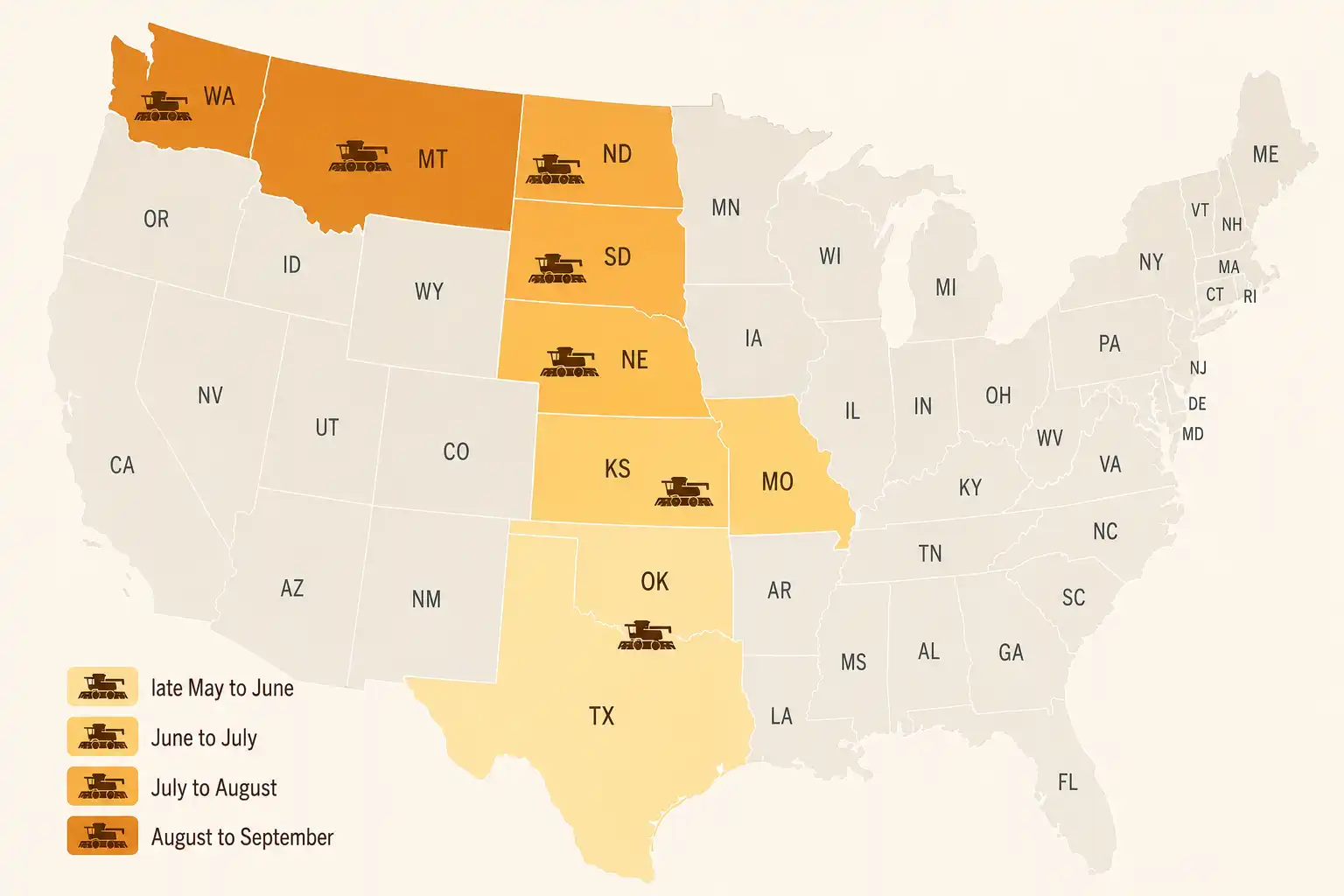
Hard red spring wheat harvest opens in late July in southern South Dakota, then works north. Most of North Dakota and Minnesota cut through August. Montana and the northern tier of North Dakota often finish in early September.
Durum runs a few days behind spring wheat in the same counties.
How Do You Know Wheat Is Ready to Cut?
Wheat is ready to cut when straw turns fully golden and a kernel refuses to dent under your thumbnail. The stem right below the head must also lose every trace of green. Color alone fools people. Run three quick checks before moving a combine into a field.
Check the thinnest, latest part of the field, not the best part. Low spots and replanted strips ripen last. Cut on the average and you leave green kernels in the tank.
The Peduncle Test
Look at the peduncle, the short piece of stem right under the head. Light green means the crop just hit physiological maturity. Brown means water and nutrient flow to the head has already stopped.
Once the peduncle turns, grain fill is finished. Nothing you spray or apply after that point adds yield or protein.
The Thumbnail Test
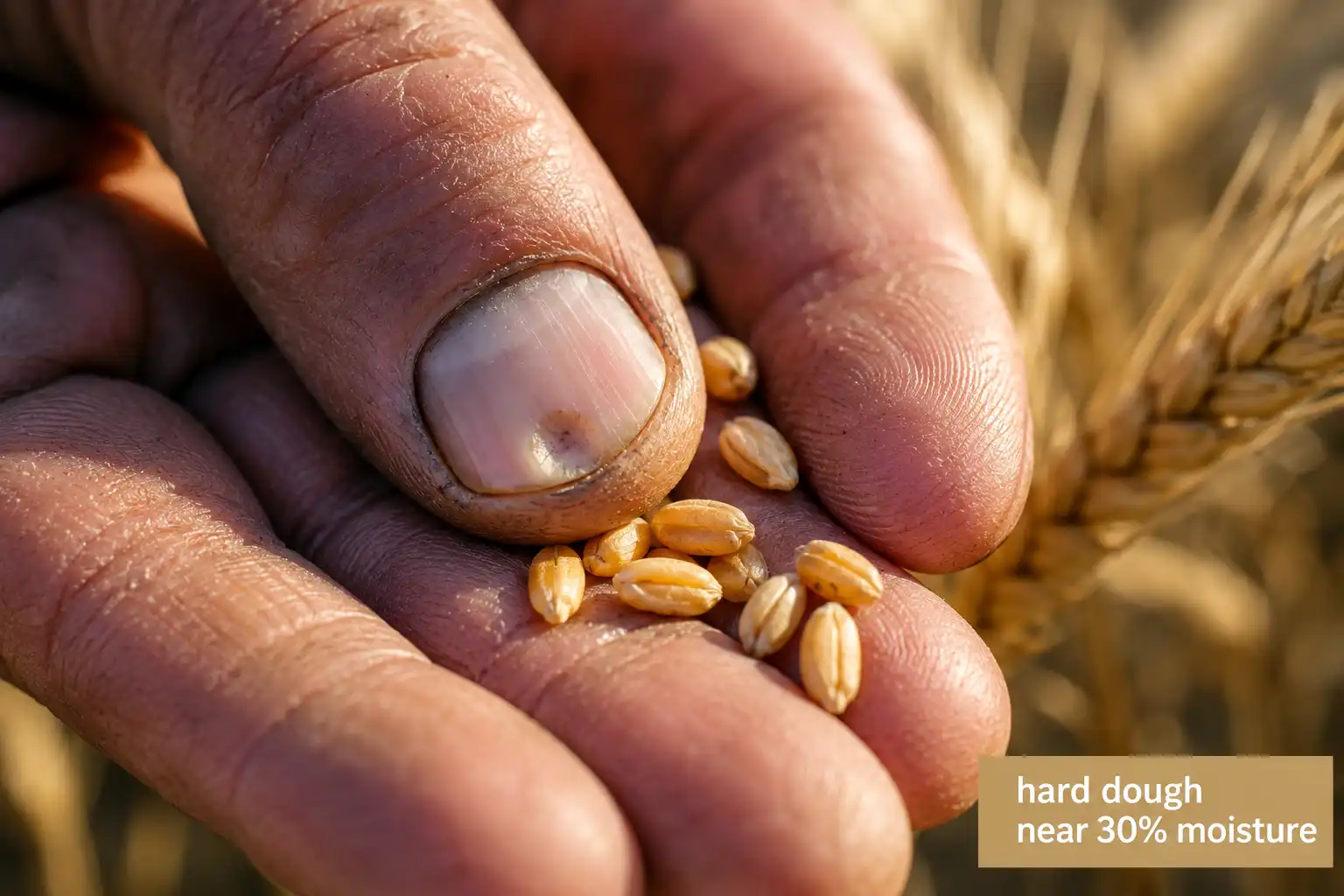
Press a thumbnail into a kernel from the middle of the head. An indent that holds its shape puts the grain near 30% moisture, which is hard dough. A kernel you cannot dent at all sits closer to 20% or below, and that is cutting weather.
Pull 20 kernels from heads across the field, not one head. Uneven fields fool a single sample.
The Pigment Strand Check
Slice kernels in half lengthwise and look in the crease for a dark brown line. That pigment strand darkens right at physiological maturity. When about 75% of your split kernels show it, the field has reached 30% moisture.
Oats and barley respond to the same kernel checks. The rules for oat harvest timing follow nearly the same sequence, just a few weeks earlier.
What Grain Moisture Should Wheat Be at Harvest?
Start cutting wheat at 20% moisture if you have drying or aeration ready. Finish at 13.5% or lower for straight delivery to the elevator. Wheat hits physiological maturity between 30% and 40% moisture. From there it dries about 2 to 2.5 points per day in hot, breezy weather.
| Grain moisture | What it means | What to do |
|---|---|---|
| 30% to 40% | Physiological maturity, grain fill done | Scout daily, prep the combine |
| 20% to 25% | Cutting is possible | Cut only with drying or aeration ready |
| 14% to 20% | Prime harvest range | Run hard, watch the meter |
| 13.5% or less | Elevator standard, no discount | Haul or bin it |
| Below 12% | Overdry | Expect cracked kernels and lost weight |
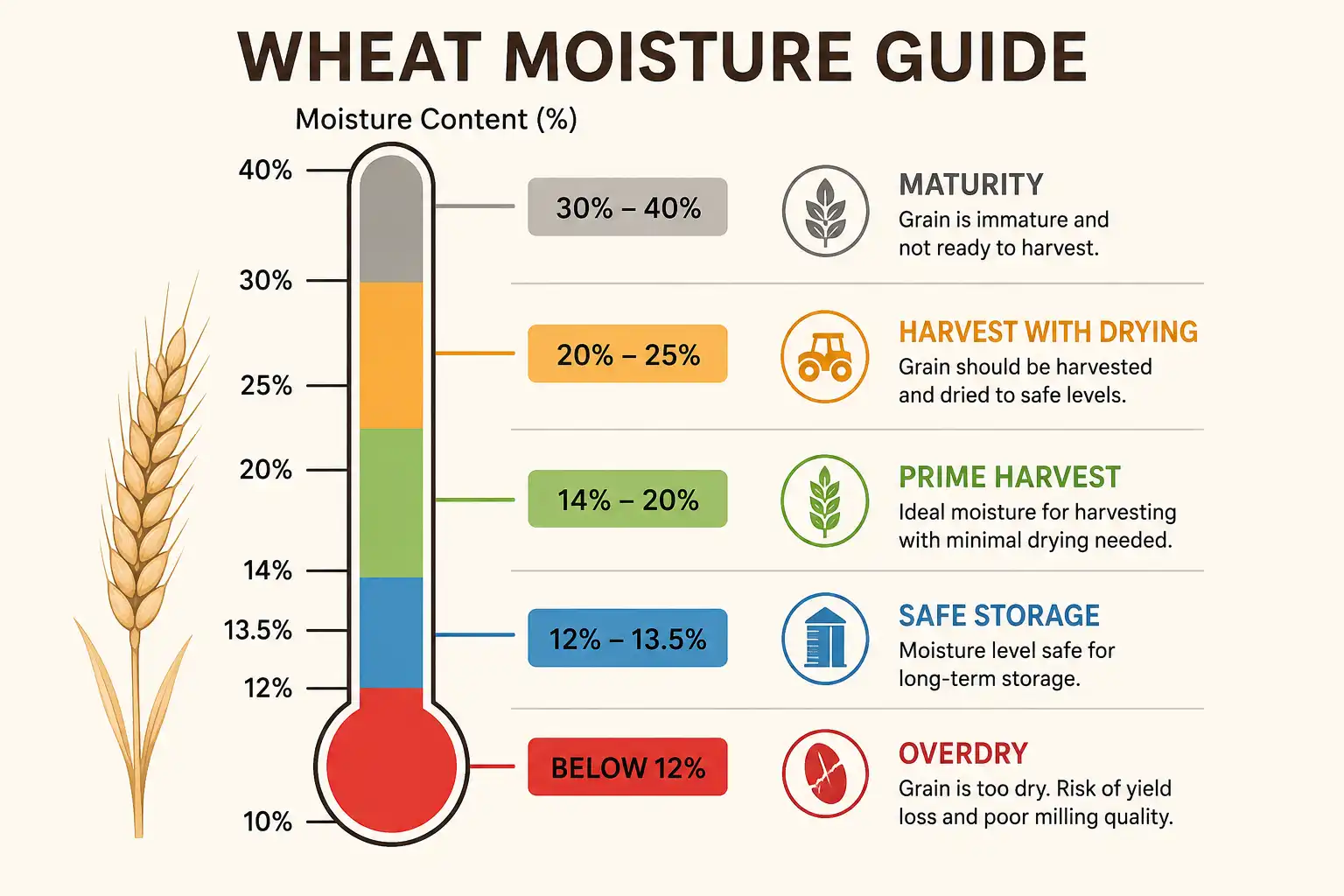
Grain above 13.5% draws a moisture discount at most elevators, plus drying cost. Grain under 12% costs you sellable pounds and cracks more in the auger. Neither end pays.
Cab monitors can drift through a long day, so confirm readings with a handheld unit every few loads. Moisture testers for grain differ in calibration, and a two-point error changes every decision you make that afternoon.
How Long After Heading Is Wheat Ready to Harvest?
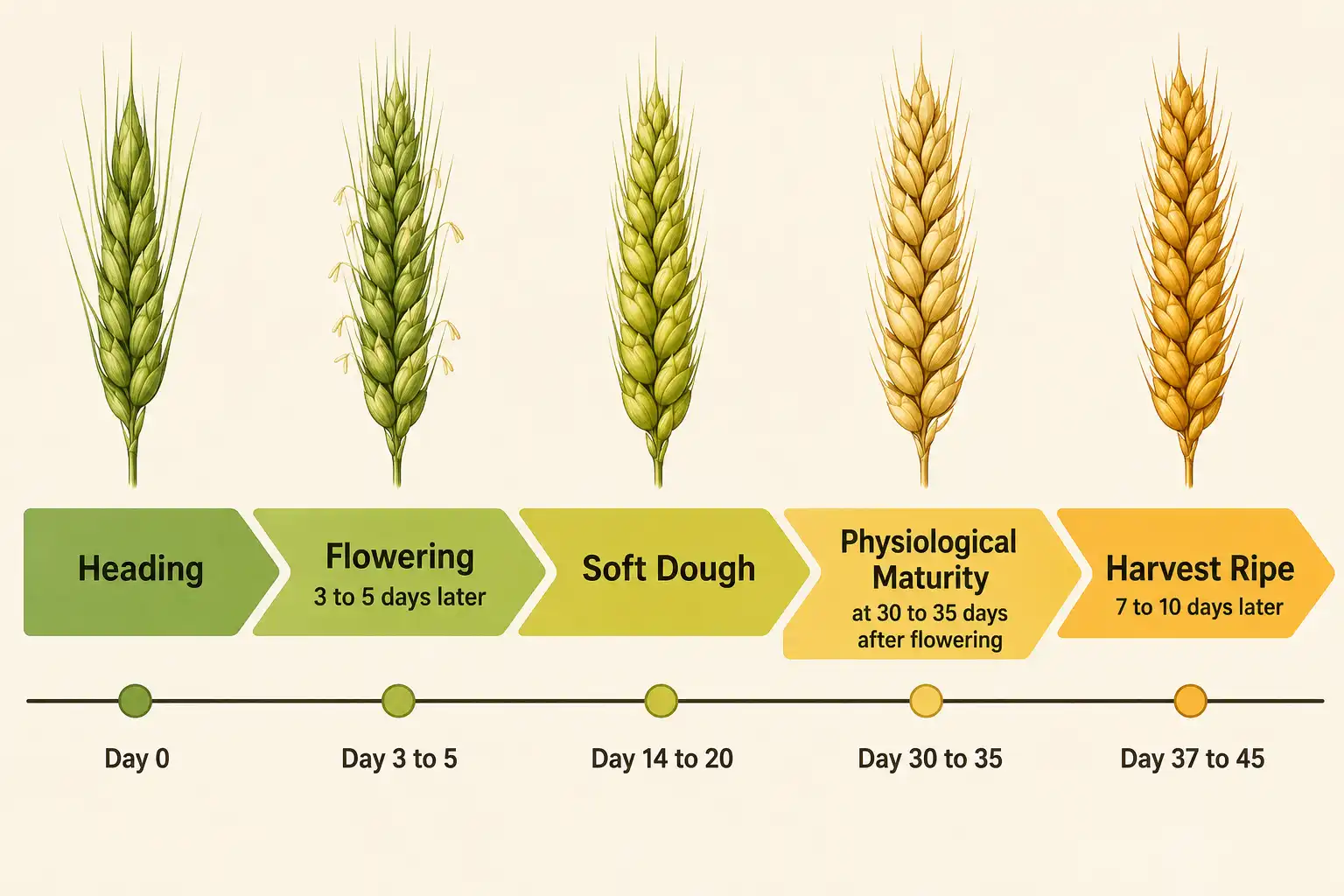
Count roughly 30 to 35 days from flowering to physiological maturity. Then add another 7 to 10 days of dry-down before the header goes in. Heading itself takes 3 to 5 days to reach flowering. So from the day heads push out, figure five to seven weeks to a running combine.
Heat compresses that schedule fast. A stretch of days above 95°F can pull harvest forward by a week and shrink kernels at the same time. Cool, humid stretches push it back, and grain can hold above 20% for two weeks after maturity.
That happened across Kansas in 2026. Growers were test-cutting in late May after a dry, windy spring. Then widespread June rains stalled everything for two weeks, with mature grain standing in the field.
What Growth Stage Marks Harvest Ripe Wheat?
Harvest ripe wheat sits at Feekes 11.4 and Zadoks 92. At that point straw is dead, and a thumbnail leaves no mark at all. Growth stage beats calendar date every time. A hot June and a cool June produce very different crops from the same seeding date.
| Stage | Kernel condition | Approximate moisture |
|---|---|---|
| Feekes 11.1 / Zadoks 85 | Soft dough, dents easily | About 45% |
| Feekes 11.2 / Zadoks 87 | Hard dough, dent holds | About 30% |
| Feekes 11.3 / Zadoks 91 | Hard, difficult to dent | 20% to 25% |
| Feekes 11.4 / Zadoks 92 | Hard, no dent possible, straw dead | 20% or less |
K-State Research and Extension frames ripening as one long loss of moisture. Mature grain holds 30% to 35%, and combine-ripe grain holds 12% to 13%. Every stage above marks a step along that slide. The same logic drives knowing when other crops are ready. Seed condition tells you more than any date on the wall.
What Time of Day Should You Combine Wheat?
Cut wheat from late morning through late evening, once dew burns off the straw. Dew adds moisture to the grain and toughens the straw, which loads the rotor and drops capacity.
Morning readings often run 2 to 3 points higher than the same field at 4 p.m. Test weight also reads lower early because kernels pull in dew overnight. Check the meter at start-up, then again mid-afternoon.
Late-night cutting works when humidity stays low and the crop is bone dry. But once relative humidity climbs, grain moisture climbs with it. Harvest sometimes runs as late as 11 p.m. with the meter creeping past 15% more than once.
Overripe wheat shatters worst in dry afternoon heat. If a field is past ripe, work it in the evening when heads hold together better.
What Happens If You Harvest Wheat Too Early or Too Late?
Cutting early costs you drying money and grain quality. Cutting late costs you test weight, falling number, and grain on the ground. Both mistakes are expensive, but the late one is harder to fix.
Cutting Too Early
- Grain above 20% needs mechanical drying or high-airflow natural air drying.
- Threshing damages soft kernels, and cracked grain stores poorly.
- Immature green kernels count against your grade as damage.
- Natural air drying needs 0.5 cfm per bushel at 16% moisture, 0.75 at 17%, and 1.0 at 18%.
Cutting Too Late
- Rain on ripe wheat triggers preharvest sprouting, which raises alpha-amylase activity.
- A falling number under 300 seconds signals sprout damage and draws price discounts.
- Test weight drops with every wetting cycle. US No. 1 needs 60 pounds per bushel, and No. 2 needs 58.
- Lodging and shatter loss climb, and green weeds regrow through the canopy.
- Fusarium head blight fields build more vomitoxin the longer they stand.
Once wheat hits physiological maturity, the radar deserves as much attention as the moisture meter. Three days of standing rain on ripe grain can cost more than a week of drying fuel.
Should You Use Preharvest Glyphosate or Swathing to Even Out Dry-Down?
Use either one only after the least mature part of the field reaches hard dough. That means less than 30% grain moisture, and it is a label requirement, not a suggestion. Glyphosate labels for wheat also carry a seven-day preharvest interval.
Spraying before 30% moisture backfires. NDSU research in spring and durum wheat tested termination at 45% moisture. Test weight fell 1 to 2 pounds, and yield dropped about 10%. Early application also pushes glyphosate residue past maximum residue limits, which creates marketing problems.
Glyphosate is registered for perennial weed control ahead of harvest, not as a desiccant. It evens dry-down as a side effect. Under adverse drying weather it might buy you two days.
Swathing dries the crop faster and evens out uneven fields. But grain lying in a swath sprouts more readily than standing grain if rain arrives. Most operations now straight-cut instead.
Two rules break: never spray preharvest glyphosate on seed wheat, and always check the contract first. Some millers and buyers restrict it outright.
How Do You Check Harvest Loss While Cutting Wheat?
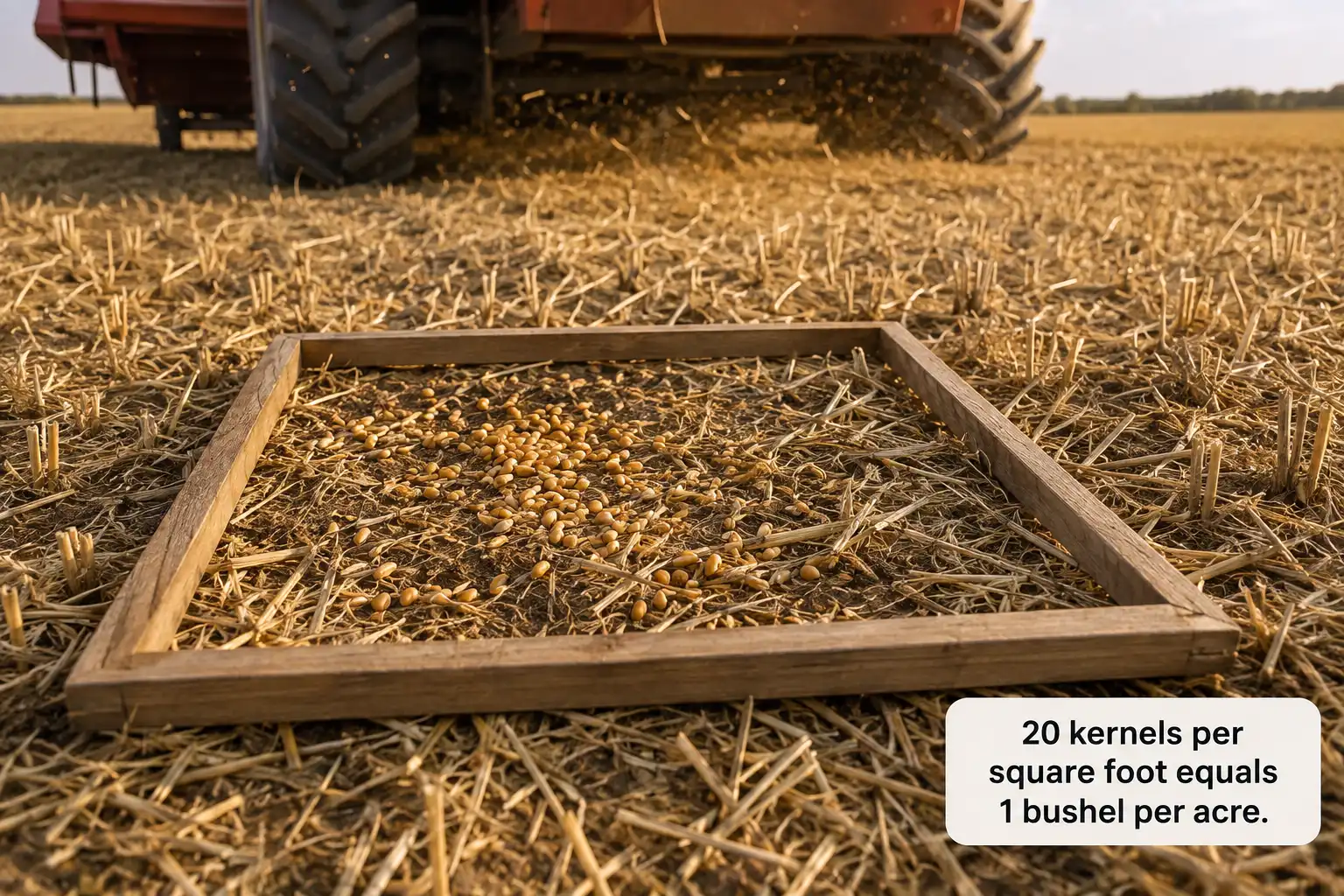
Count kernels inside a one-square-foot frame, because 20 wheat kernels per square foot equals about one bushel per acre. Header loss usually accounts for the biggest share, so measure before you touch a single setting.
- Stop the combine mid-field without clearing it. Back up about 20 feet, then shut off the engine.
- Drop the frame three times in standing wheat ahead of the header. Average those counts for preharvest loss.
- Drop it three times between the standing wheat and the header. Subtract the preharvest count, then divide by 20 for header loss per acre.
- Drop it three times behind the combine between the tires. Subtract the header count from that average.
- Divide the remainder by your spreader factor:
- 80 with no spreader
- 65 with a bat spreader
- 50 with a straw chopper
- 25 with a chopper plus chaff spreader
- Hold total machine loss under 2% of yield in standing wheat.
Small header changes matter more than most people expect. Run reel speed about 25% faster than ground speed, and cut just under the heads when straw stands tall. Then open the sieves until a little trash shows in the tank. A perfectly clean sample often means grain going out the back.
What Moisture Does Wheat Need for Safe Storage?
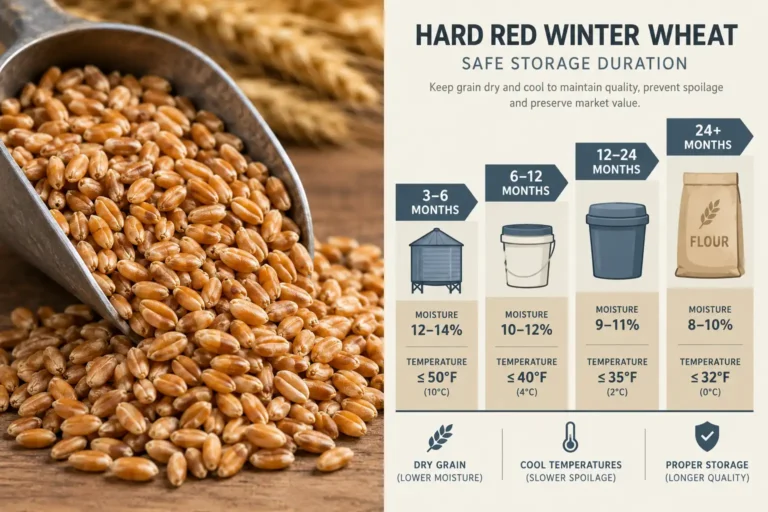
Store wheat at 13% or lower for a few months, and 12% for anything you hold past the following spring. Grain above 12.5% carries real risk regardless of test weight, since mold and insects both need that moisture to work.
Cool the bin with aeration whenever outside air runs 10 to 15°F below grain temperature. Get grain below 50°F as soon as fall air allows. Summer aeration pulls only about half a point of moisture per cooling cycle. So fans cool far better than they dry.
Sprouted grain reads low on a meter, usually by 1 to 1.5 points. Add that back before you decide a bin is safe. A meter showing 10.5% on sprouted wheat is really closer to 12%.
Match your grain storage methods to how long you plan to hold the crop. Short-term binning and carrying grain into next summer call for different moisture targets and different fan hours.
How to Call Harvest Timing on Kansas Wheat
Around mid-June, it’s time to stop watching the calendar and start walking fields. Peduncle brown, no thumbnail dent, and moisture under 20% mean it’s time to harvest. Check loss behind the machine on the first pass and again after any setting change.
Get the moisture right and the rest gets easier. Everything else in wheat harvest, from test weight to bin safety, follows the number on that meter.