How to Grow Wheat From Seed: A Complete Guide for 2026
Wheat is one of the easiest grains to plant, and one of the easiest to lose early. Stand establishment sets your ceiling before the crop ever greens up. This guide covers how to grow wheat from seed, from picking a class to threshing the grain.
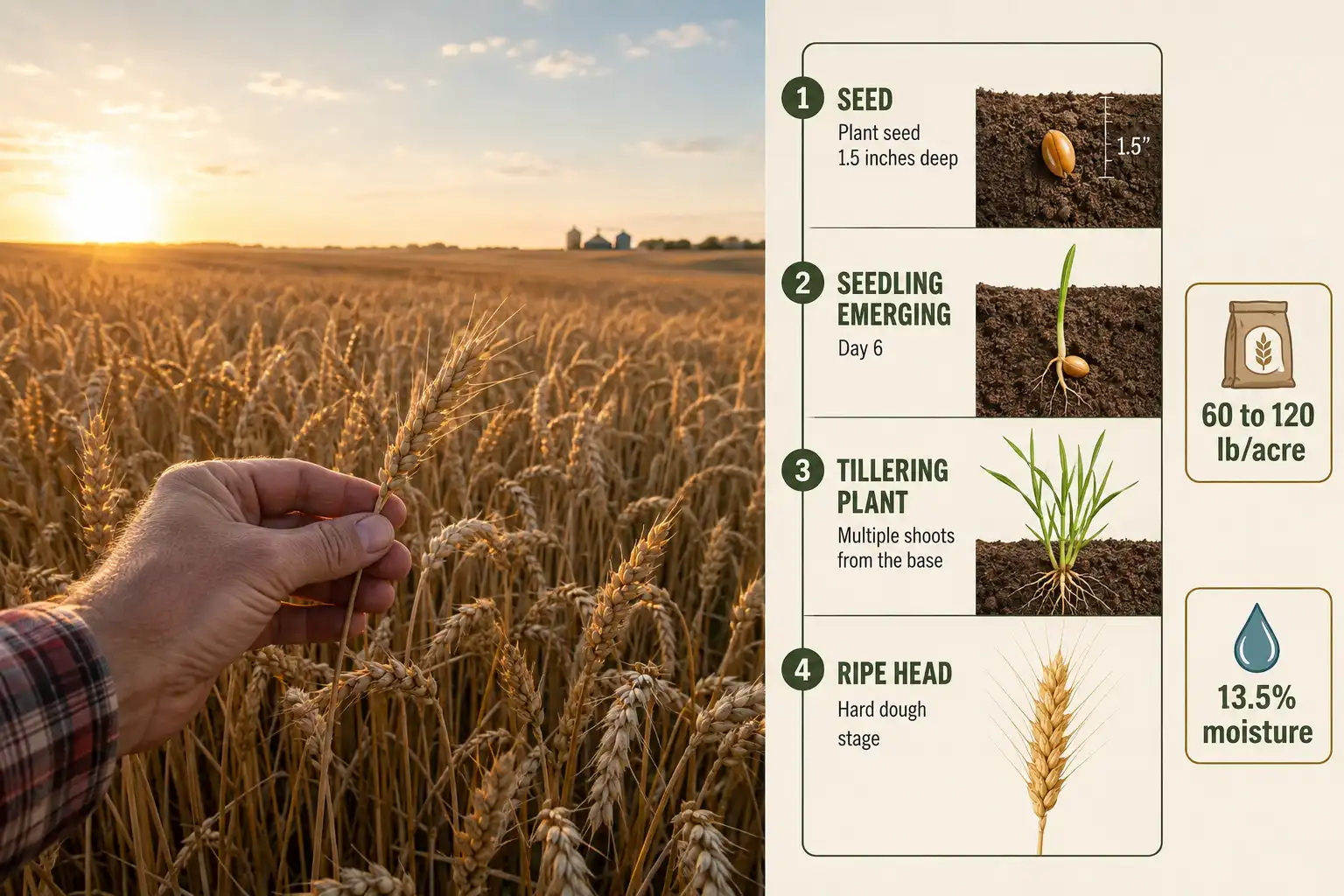
Grow wheat from seed comes down to seed placement. Plant certified seed 1 to 1.5 inches deep in a firm, moist seedbed at 60 to 120 pounds per acre. Wheat emerges in 5 to 7 days.
How to Grow Wheat From Seed: The Full Sequence
Here is the whole crop in order, so you know what is coming before you buy seed.
- Pick your wheat class and type (winter or spring).
- Pull a soil test and correct pH, phosphorus, and potassium.
- Build a firm seedbed and spread residue evenly.
- Plant at the right date for your zone, 1 to 1.5 inches deep.
- Seed at 60 to 120 pounds per acre, adjusted for region and date.
- Apply starter phosphorus and part of your nitrogen at planting.
- Scout fall stands, then topdress nitrogen before jointing.
- Control weeds early, then watch for rust and scab at heading.
- Cut at 13.5 to 20 percent moisture and store at 12 percent.
Winter wheat runs about 9 months from seed to combine. Spring wheat runs closer to 4 months. Everything below follows that same order.
Choose the Right Wheat Seed
Your seed choice locks in your planting date, your harvest date, and your market. So make this call first.
Winter Wheat or Spring Wheat?
Winter wheat needs a cold period to make grain. That process is called vernalization, and it takes 6 to 8 weeks below 48°F. Plant it in fall, and it heads out the following spring. Spring wheat skips that requirement. You plant it once soil hits 40°F and cut it the same summer.
Winter wheat yields more across the Great Plains and the Corn Belt. It also holds soil through winter. Spring wheat suits the northern tier, roughly North Dakota and Minnesota, where fall-planted crowns often winterkill. Run hard red winter wheat because the fall moisture and mild winters fit it.
Which Wheat Class Should You Plant?
Match the class to the buyer, not the seed catalog.
| Class | Best use | Where it grows |
|---|---|---|
| Hard red winter | Bread flour, high protein | Great Plains, Kansas through Texas |
| Hard red spring | Bread and blending flour | North Dakota, Montana, Minnesota |
| Soft red winter | Cakes, crackers, pastry | Eastern and southern states |
| Hard white | Whole wheat bread, noodles | Kansas, Idaho, Colorado |
| Soft white | Pastry, export markets | Pacific Northwest |
| Durum | Pasta semolina | North Dakota, Arizona |
Should You Buy Certified Seed?
Buy certified seed for your first crop. Certified lots come with a germination percentage, a purity test, and a seeds-per-pound count printed on the tag. That number matters, because wheat runs anywhere from 10,000 to 18,000 seeds per pound. Most varieties land near 14,000 to 16,000.
Bin-run seed costs less but carries weed seed, disease, and unknown germination. Grocery store grain is worse. Curious whether planting wheat berries from a food bag actually works? Some sprout. Most disappoint.
Add a fungicide seed treatment either way. It protects against seedling blight and common bunt for a few dollars per acre.
Prepare the Seedbed
Wheat wants a firm, moist seedbed with even residue. Loose ground is the single most common reason a stand comes up thin.
Start with soil testing at least a month before planting. Sample 0 to 6 inches for pH, phosphorus, and potassium. Pull a separate 24-inch core for profile nitrate-N if you want an accurate nitrogen rate.
Target these numbers:
- pH: 6.0 to 7.0 is the sweet spot. Wheat tolerates 5.5 to 7.5, but below 5.5 phosphorus uptake drops and aluminum toxicity starts. Oklahoma State work found emergence gets unreliable under pH 4.9.
- Phosphorus: apply 20 to 40 pounds of P2O5 per acre when the test comes back low or medium.
- Organic matter: anything above 2 percent releases useful nitrogen, so credit it.
Then handle residue. Spread chaff and straw evenly behind the combine on the previous crop, because clumps block seed-to-soil contact. If you drill no-till, set depth off the soil surface and not the residue mat. You want a full inch of actual soil over the seed.
Firm the ground before you plant. A cultipacker or a light roller does the job. Press your boot heel into the seedbed. If it sinks past half an inch, pack it again.
When to Plant Wheat Seed
Plant winter wheat 6 to 8 weeks before your first hard freeze. Plant spring wheat once soil at 2 inches holds above 40°F.
Winter wheat germinates best between 54°F and 77°F. Above 80°F the seed sits idle. High soil heat also shortens the coleoptile, which limits safe planting depth. Below 45°F germination crawls.
Two dates drive fall planting. First, the Hessian fly free date from your state extension service. That lands near late September in northern Kansas, mid-October in the south. Second, the yield ceiling. K-State research shows yield falling up to 3.5 bushels per acre for every day past the recommended window. Regional windows shift a lot, so check the details on planting winter wheat for your zone.
Your target is 4 to 5 leaves and 1 to 2 tillers before dormancy. That crop survives winter. A one-leaf plant going into January usually does not.
How Deep Should You Plant Wheat Seed?
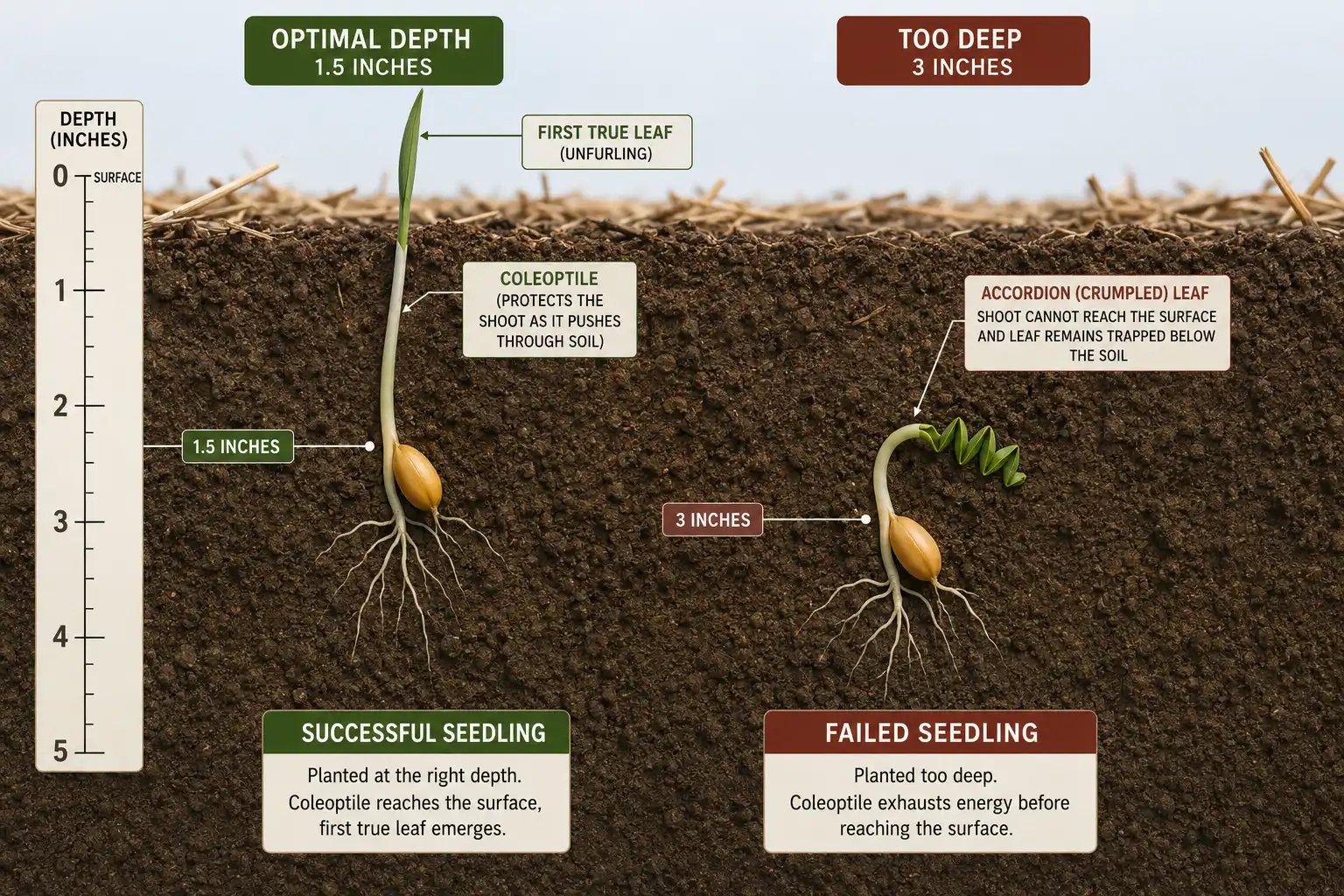
Plant wheat seed 1 to 1.5 inches deep. That depth puts the crown in a protected zone while keeping emergence quick.
The coleoptile decides everything here. It is the pointed sheath that pushes the first true leaf to the surface. Once it stops elongating, the leaf unfurls underground and crumples into an accordion shape. That plant never makes it. Semi-dwarf varieties carry shorter coleoptiles than older tall types, so read the variety tag.
Depth also changes emergence speed. Seed at 0.5 inch needs about 105 growing degree days to break through. At 1 inch it takes 130, and at 2 inches it takes 175. Deeper seed sits longer and picks up more seedling disease.
Here are the rules at the drill.
- Never exceed 2 inches, even chasing moisture.
- Never plant shallower than 0.75 inch in fall, because exposed crowns winterkill.
- Cap sprout-damaged or bin-run seed at 1 inch.
- Check depth in three spots per field, not one.
How Much Wheat Seed Do You Need Per Acre?
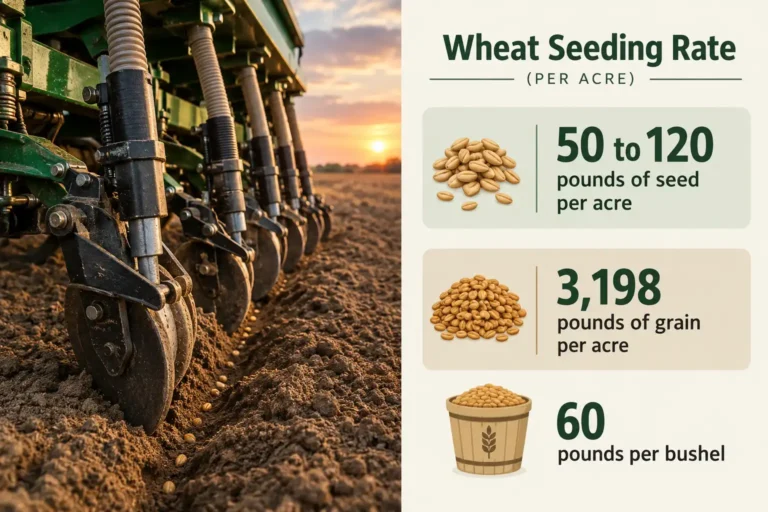
Seed 60 to 120 pounds per acre for grain, with drier regions on the low end and humid regions on the high end. Rate by seeds per acre when you can, since seed size swings by 60 percent between lots.
| Setting | Seeds per acre | Pounds per acre |
|---|---|---|
| Dryland, western Great Plains | 600,000 to 900,000 | 40 to 60 |
| Dryland, central Kansas | 750,000 to 1,125,000 | 50 to 75 |
| Eastern Kansas and Midwest | 1.1 to 1.8 million | 75 to 120 |
| Irrigated | 900,000 to 1,350,000 | 60 to 90 |
| Garden plot | 25 to 30 seeds per sq ft | 0.5 lb per 100 sq ft |
Convert with one line of math. Divide seeds per acre by seeds per pound from the tag. At 900,000 seeds and 16,000 seeds per pound, that is 56 pounds. At 11,000 seeds per pound, the same population needs 82 pounds.
Now adjust:
- Late planting: add 10 to 15 pounds per acre per week in dry western zones, 15 to 20 in eastern zones.
- Double-cropping behind row crops: raise the rate 50 to 100 percent.
- Rough or cloddy seedbed: add 10 percent.
Do not overdo it. K-State caps grain-only rates near 90 to 100 pounds in western Kansas. Central and eastern Kansas top out near 120 to 130. Heavy stands lodge, and they burn spring moisture early. That sets up haying off, where a thick fall canopy runs the profile dry before grain fill.
How to Plant the Seed
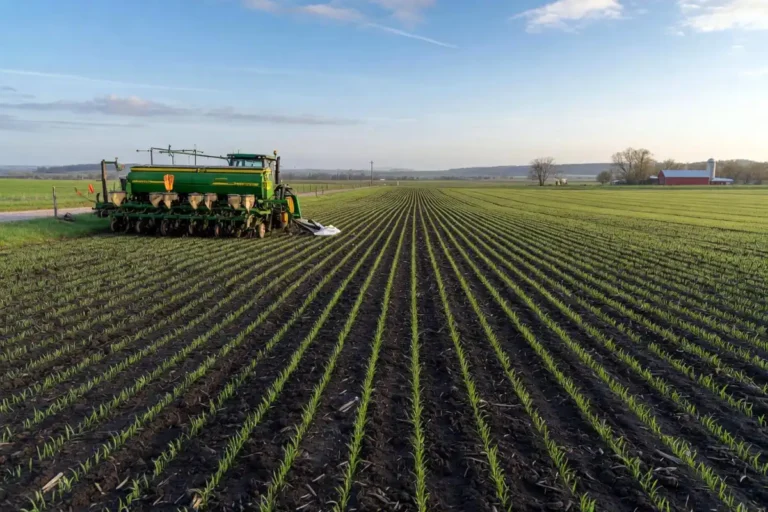
A grain drill on 6 to 7.5 inch rows gives the most even stand. Set it by weight, then calibrate on a tarp before you cover an acre.
Three methods work, ranked by results:
- Drill. Best seed-to-soil contact and consistent depth. Use press wheels.
- Broadcast and incorporate. Spread at 25 percent above your drill rate, then disk lightly or cultipack. Cover the seed a full inch.
- Garden rows. Broadcast by hand over a raked bed, rake seed in, then tamp with the back of the rake.
Calibrate honestly. Fill the drill, mark 100 feet, catch the seed from one run, then weigh it. A drill set for 90 pounds often delivers 75. Small grain seed also bridges in the box when it is damp, so check flow twice on the first pass.
What Happens After You Plant
Wheat moves through predictable stages, and each one has a management window attached.
| Stage | What you see | Timing |
|---|---|---|
| Germination | Root, then coleoptile | 1 to 5 days |
| Emergence | First leaf clears soil | 5 to 7 days |
| Tillering | Side shoots from the crown | Fall, or 3 to 5 weeks after emergence |
| Dormancy | Growth stops, leaves purple | Winter, winter wheat only |
| Green-up | Color returns, spring tillers start | Late winter to early spring |
| Jointing | First node felt above the crown | 6 to 8 weeks before harvest |
| Boot | Head swells inside the flag leaf | 4 to 5 weeks before harvest |
| Heading and flowering | Head emerges, anthers show | Flowering lasts 3 to 5 days |
| Grain fill | Kernel goes milky, then doughy | 25 to 35 days |
| Physiological maturity | Peduncle turns yellow, 40% moisture | About 30 days after flowering |
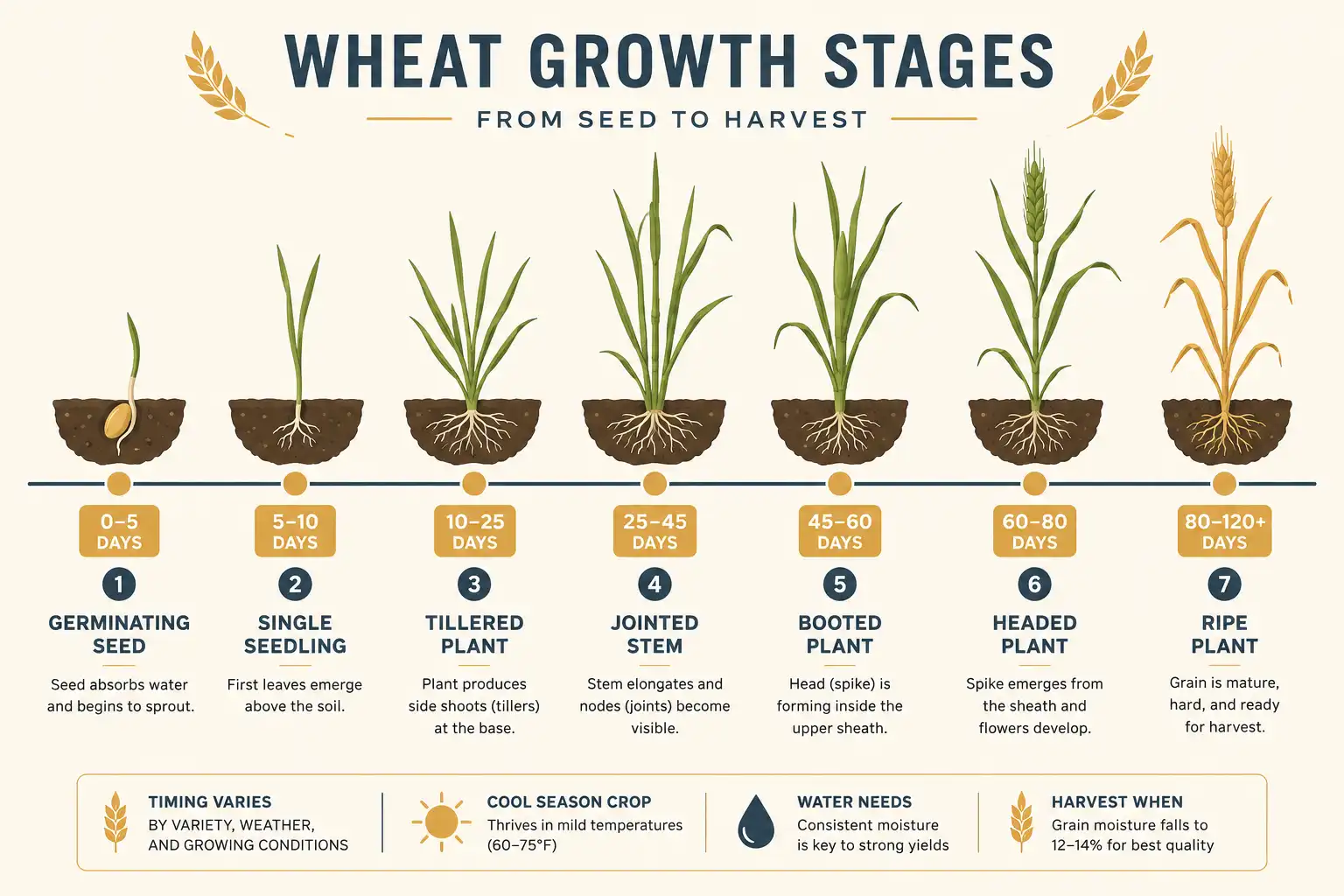
Two stages matter more than the rest. Tillering sets head count, and each fall tiller outproduces a spring tiller. Flowering sets kernel number, and it is also the only window for Fusarium head blight infection.
How to Fertilize Wheat
Base your nitrogen on yield goal, then subtract credits. K-State recommends 2.4 pounds of nitrogen per bushel of yield goal.
Run the math for a 60 bushel goal:
- 60 bu × 2.4 = 144 pounds of N needed
- Subtract profile nitrate-N from your 24-inch test, say 35 pounds
- Subtract a legume or fallow credit if one applies
- Apply the remaining 109 pounds
Split that total. Put 30 to 50 pounds down at planting to drive fall tillering, then topdress the balance. Add 20 pounds extra for no-till into row crop stubble. Behind grain sorghum, add 30 pounds. That residue ties up nitrogen as it breaks down.
Timing beats source. Get topdress nitrogen on after green-up but before jointing, since head size gets set in that window. 46-0-0 urea spreads cheapest per unit. Still, it needs a half inch of rain within a few days to avoid volatility loss. Liquid 28-0-0 works through streamer bars, but a flat fan on green tissue burns leaves.
Phosphorus goes on at planting. In-furrow starter beats broadcast on cold soils, especially for late-drilled acres that need fast fall growth. Keep in-furrow rates under 20 pounds of N plus K2O combined, or the salt injures the seed.
Skip sulfur at your own risk on sandy or high organic matter ground. Wheat pulls 10 to 15 pounds per acre, and deficiency shows as pale young leaves at green-up.
Water and Moisture Needs
Wheat needs roughly 20 to 25 inches of water across the season. Most of it goes between jointing and grain fill.
Dryland growers manage moisture by storing it, not applying it. Standing stubble catches snow, and snow insulates crowns. That is one reason no-till wheat handles February cold better than tilled ground.
For irrigated acres, prioritize these three windows:
- Jointing: stem elongation sets head size.
- Boot to flowering: the crop is most sensitive to stress here, and drought at flowering costs kernels outright.
- Early grain fill: water keeps kernel weight and test weight up.
Cut irrigation once the crop hits soft dough. Late water only delays dry-down and raises lodging risk.
Weeds, Diseases, and Insects
Weeds cost you first, so treat them first. Winter annuals like downy brome, cheat, and henbit germinate with the wheat and compete all fall.
Weed control: apply herbicide in fall or very early spring, before jointing. Most wheat herbicides carry a hard cutoff at jointing, and spraying past it causes head sterility. A full seeding rate also closes the canopy faster and shades out late flushes.
Disease: stripe rust and leaf rust arrive on southern winds most springs. Scout the flag leaf, because it feeds about 40 percent of grain fill. Fungicide at flag leaf emergence protects yield, and a second application at early flowering suppresses Fusarium head blight and the vomitoxin that comes with it. Tan spot and septoria hit hardest on wheat drilled into wheat stubble, which is one more argument for rotation.
Insects: Hessian fly drives the fall planting date. Aphids matter less for feeding damage than for spreading barley yellow dwarf virus, so scout warm falls closely. Armyworm shows up at heading and can strip flag leaves in a few days.
Rotation solves more of this than any spray. Wheat following soybeans, corn, or fallow carries far less residue-borne disease than wheat following wheat.
When and How to Harvest Wheat
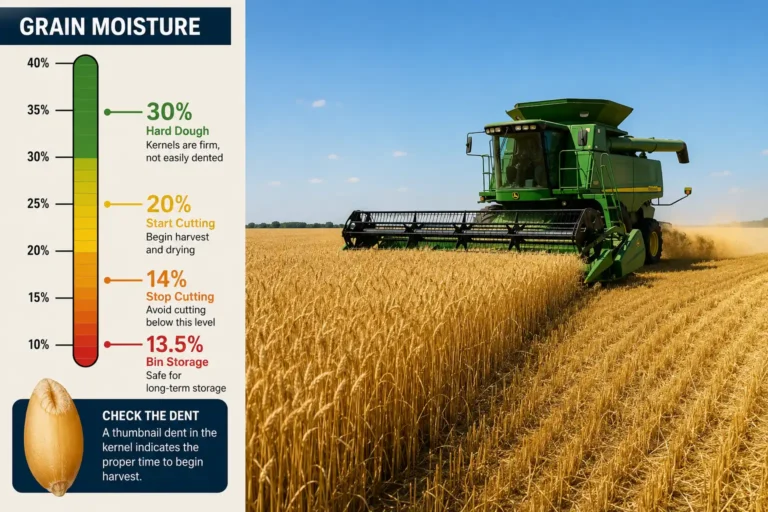
Cut wheat between 13.5 and 20 percent grain moisture. Below 13.5 percent you can bin it straight without drying.
Wheat reaches physiological maturity near 40 percent moisture, then drops about 2.5 percent per day in dry weather. So the window moves fast. The kernel test works well in the field. Bite one. At hard dough it dents but still gives. At harvest ripe it cracks.
Choose your entry point:
- 18 to 20 percent: cut early, dry mechanically, protect test weight, and open the ground for double-crop soybeans.
- 13.5 to 15 percent: the standard target, no drying cost.
- Below 12 percent: you lose weight at the scale, shatter losses climb, and cutter bar losses rise.
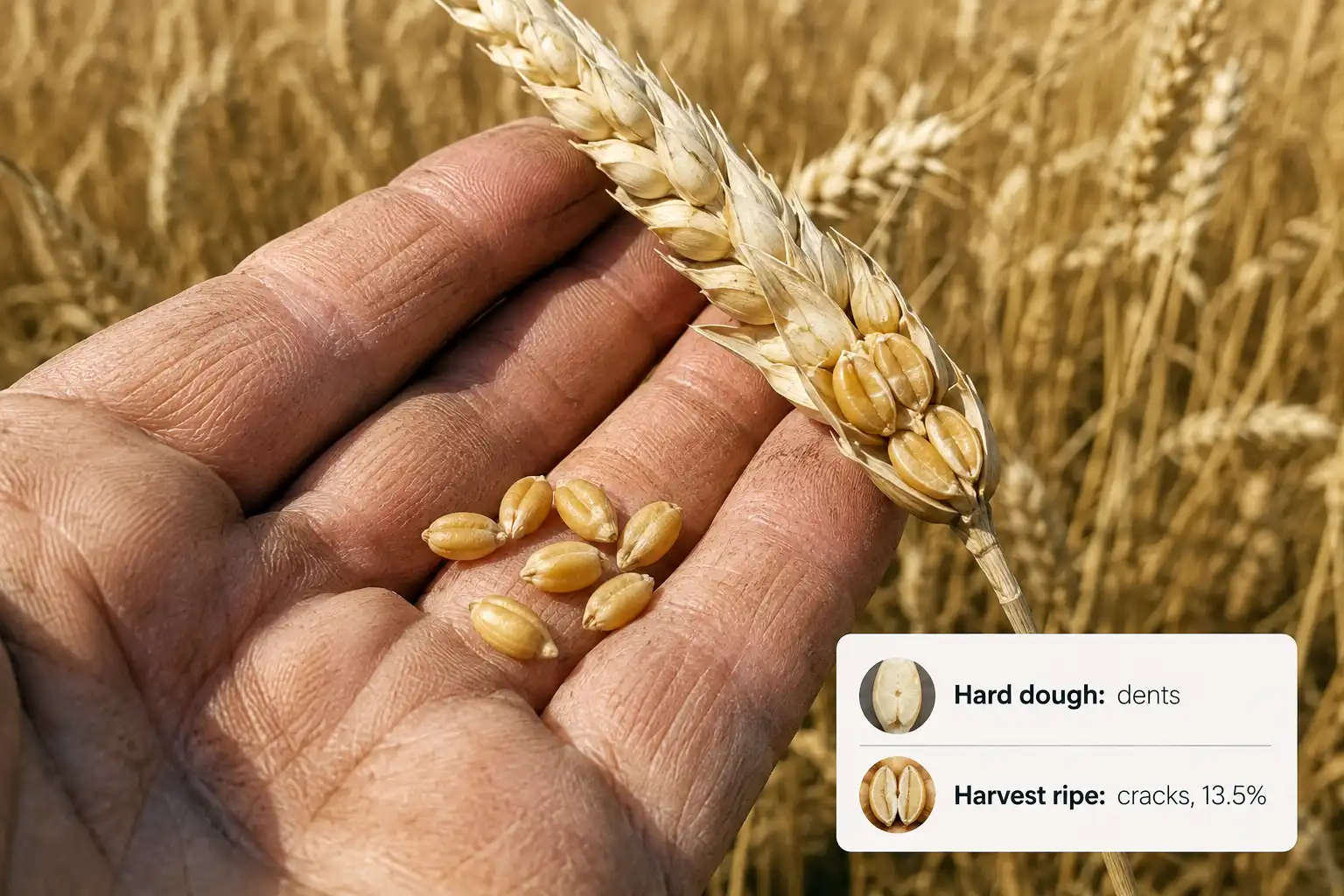
Rain on ripe wheat is the real threat. Each wetting event can knock 1 to 3 pounds off test weight. It also pushes falling numbers under 300 seconds, the sprouting threshold buyers discount for. Check moisture yourself instead of guessing. A grain moisture tester pays for itself the first time it keeps you out of a marginal morning. Ripening dates also shift between winter and spring types, so confirm the field indicators for harvesting wheat before you roll the combine.
Store at 12 to 12.5 percent for anything longer than a month. Above 13 percent, mold and stored-grain insects take over. Aerate to bring the mass down near outside air temperature, then check the bin every two weeks.
Growing Wheat From Seed in a Small Plot
A 1,000 square foot plot yields roughly a bushel, or about 60 pounds of grain. That is 40 to 70 loaves of bread. Start there before you scale up.
Follow the same agronomy at a smaller size:
- Seed: buy 0.5 pound per 100 square feet. Hard red spring for a summer harvest, hard red winter for a fall planting.
- Bed prep: strip sod, loosen 6 inches, rake level, then firm it.
- Plant: broadcast by hand, rake seed under 1 inch, tamp the surface.
- Care: water through jointing and heading, and net the plot at milk stage or the birds will take it.
- Cut: use a sickle or hedge shears at harvest ripe. A 450 square foot plot takes under an hour.
- Dry: bundle and cure under cover 1 to 2 weeks.
- Thresh: beat the heads on a tarp inside a clean trash can, or rub them between gloved hands.
- Winnow: pour between two buckets in a light breeze until the chaff blows off.
- Store: dry to 12 percent, then seal in food-grade buckets or jars.
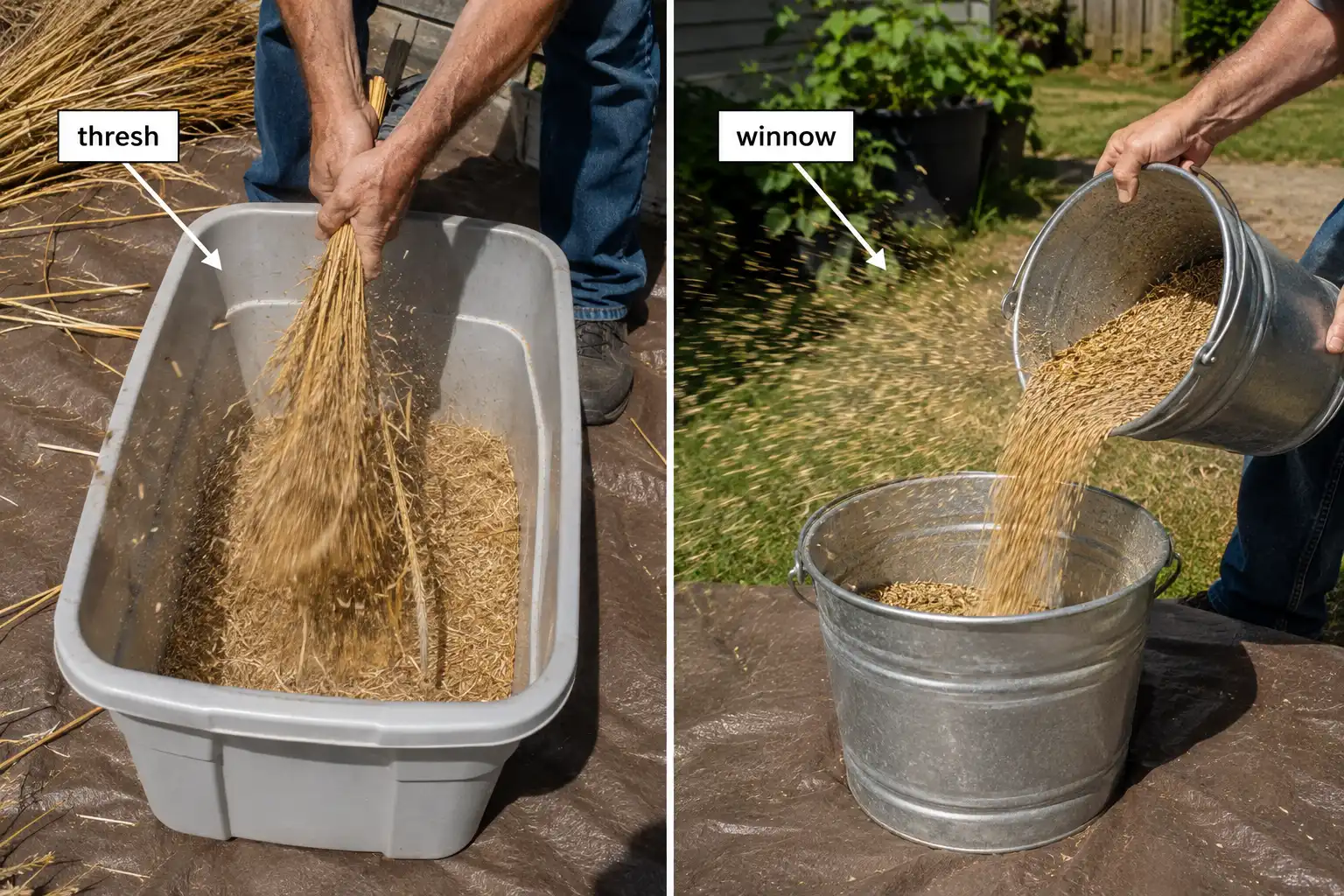
Threshing and winnowing take longer than growing the crop. Budget a full afternoon for a small plot, and pick a day with steady 5 to 10 mph wind.
Mistakes That Cost You a Stand
Most first-year wheat problems trace back to five things.
| Mistake | What it causes | The fix |
|---|---|---|
| Loose seedbed | Uneven emergence, dry seed | Cultipack before drilling |
| Planting too deep | Trapped leaves, thin stand | Hold 1 to 1.5 inches, verify in-field |
| Rating by pounds only | 30 percent population error | Use the seeds-per-pound tag |
| Late topdress nitrogen | Small heads, low protein | Apply before jointing |
| Wheat after wheat | Tan spot, take-all, fly pressure | Rotate to soybeans, corn, or fallow |
One more worth naming. Planting into dry dirt and waiting on rain works in the Great Plains, but only inside the fly-free window. Past mid-October in Kansas, dusting seed in usually costs more than it saves.
Where to Start Your First Wheat Season
Buy certified seed, pull a soil test, and firm the ground. Those three steps carry more weight than anything you do after emergence. Plant 1 to 1.5 inches deep. Hold your rate near the middle of the range for your region. Then get topdress nitrogen out before jointing. Wheat forgives a lot once it is established. It forgives almost nothing during the first two weeks.