How Long Does It Take Wheat to Sprout? Days by Soil Temp
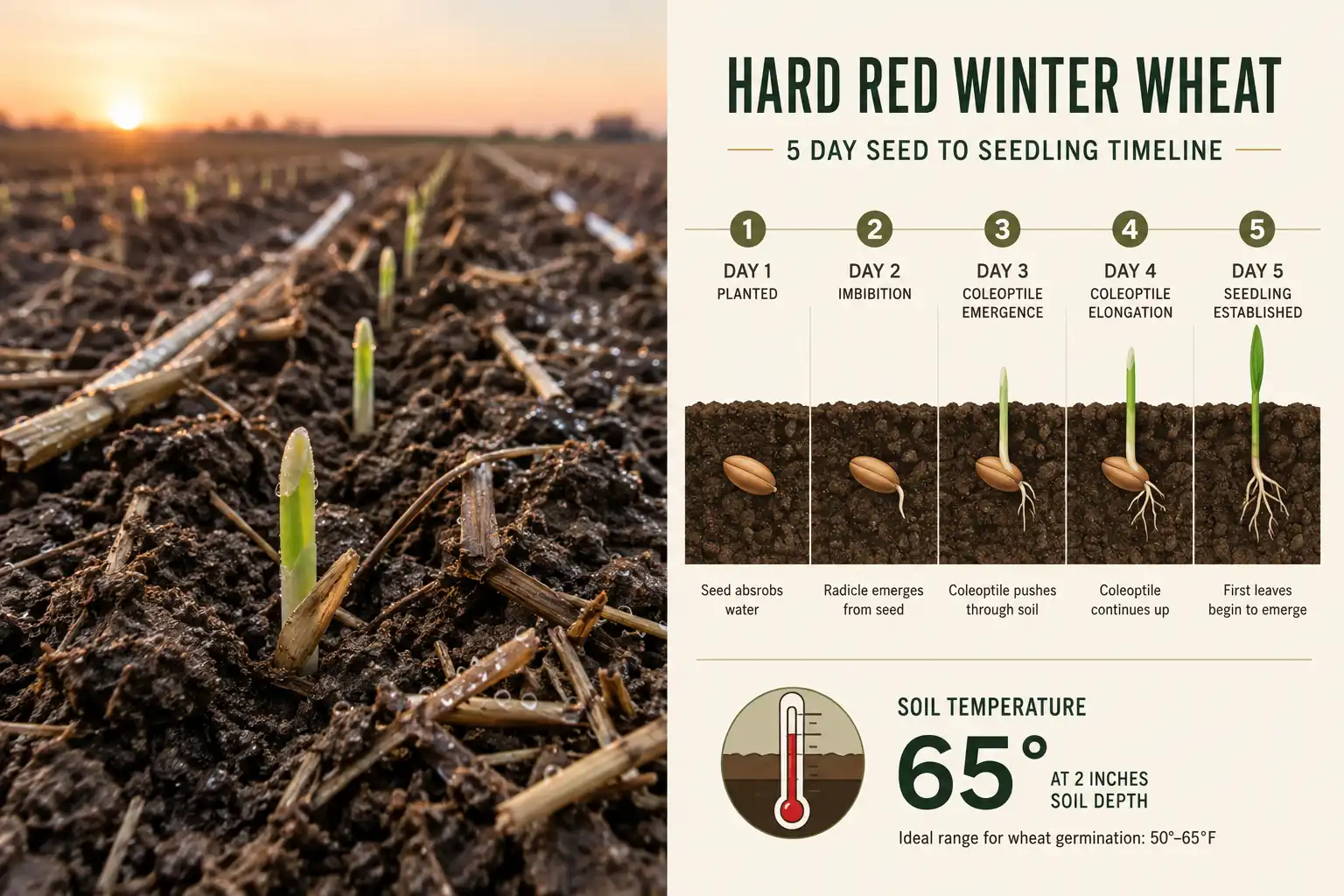
You drilled wheat a week ago and still see bare ground. That is normal. How long does it take wheat to sprout? Soil temperature, seeding depth, and moisture set the pace. Get those right and the stand shows up fast.
How long does it take wheat to sprout? Usually 5 to 7 days at soil temperatures of 54 to 77 degrees. Cool soil near 45 degrees stretches emergence to two or three weeks. Deep seeding adds more days.
How Long Does It Take Wheat to Sprout at Different Soil Temperatures?
Wheat sprouts in 5 to 7 days when the 2 inch soil temperature holds between 54 and 77 degrees. K-State Research and Extension lists that same 5 to 7 day window in its Wheat Production Handbook. Below that range, the clock slows down in a predictable way.
| 2-inch soil temp | Typical days to emergence | What you get |
|---|---|---|
| 78 to 85°F | 4 to 5 days | Fast, but heat sensitive varieties may sit and wait |
| 65 to 77°F | 5 to 7 days | Even, uniform stand |
| 55 to 64°F | 7 to 10 days | Reliable, slightly staggered |
| 45 to 54°F | 12 to 18 days | Slow, seedling disease pressure climbs |
| 40 to 44°F | 3 weeks or longer | Barely moving |
| Below 40°F | Stalls | Seed waits for warmth |
These are field numbers for seed placed 1 to 1.5 inches deep into moisture. Heavy surface residue adds another 1 to 2 days, according to NDSU. So no-till acres usually run a day or two behind worked ground planted the same morning.
Read next: Wheat GerminatIon Time
Germination and Emergence Are Not the Same Thing
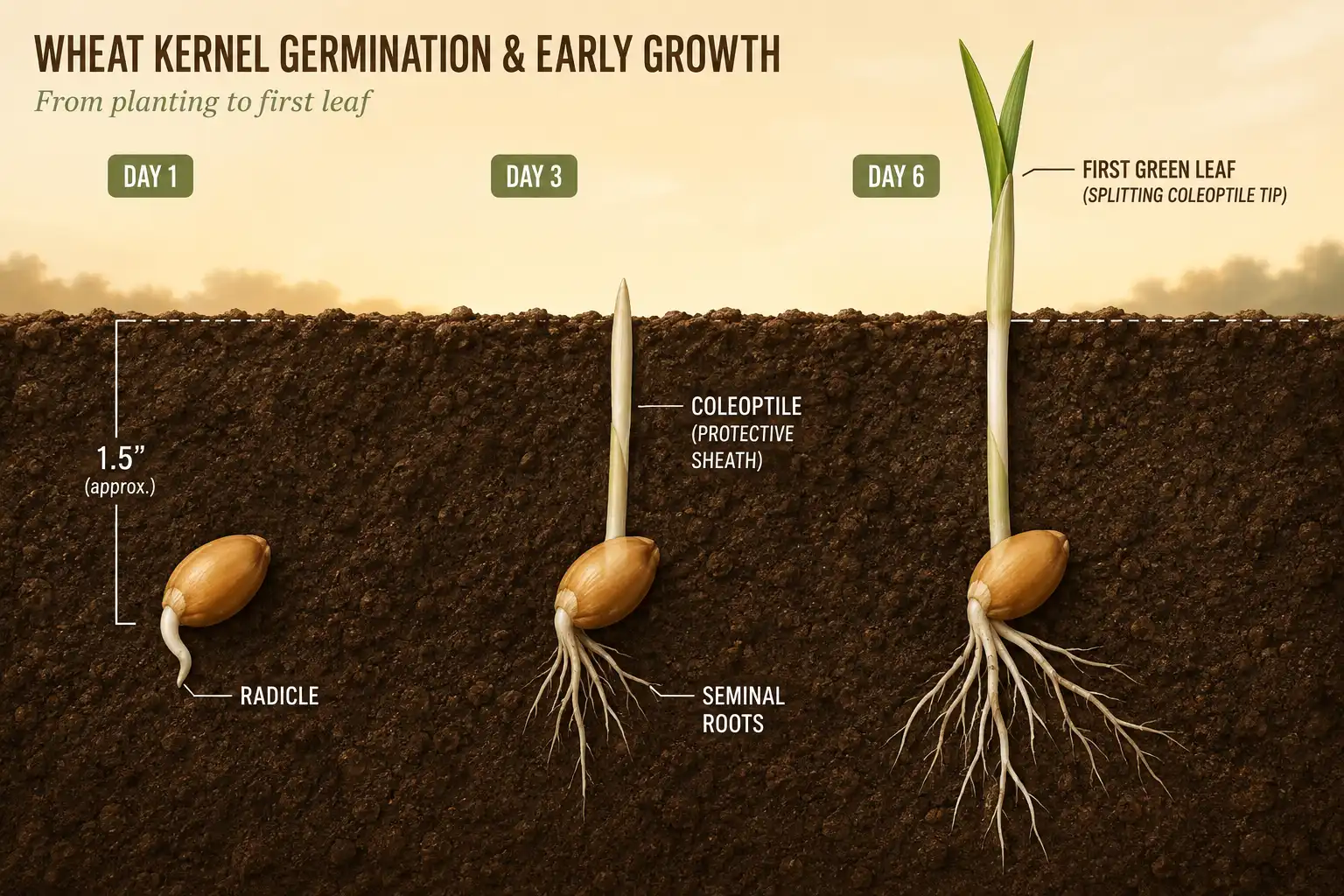
Wheat germinates several days before you see anything green. The seed has to pull in water first. Extension research puts that requirement at 35 to 45 percent of the kernel’s weight before germination starts.
Once the seed swells, the radicle breaks out and the seminal roots push down. Then the coleoptile, a stiff protective sheath, drives upward toward the surface. When it reaches sunlight it stops growing, and the first true leaf pushes out through the tip.
So a field that looks empty on day four is often already germinated. Dig a few seeds before you assume anything failed.
What Soil Temperature Does Wheat Need to Sprout?
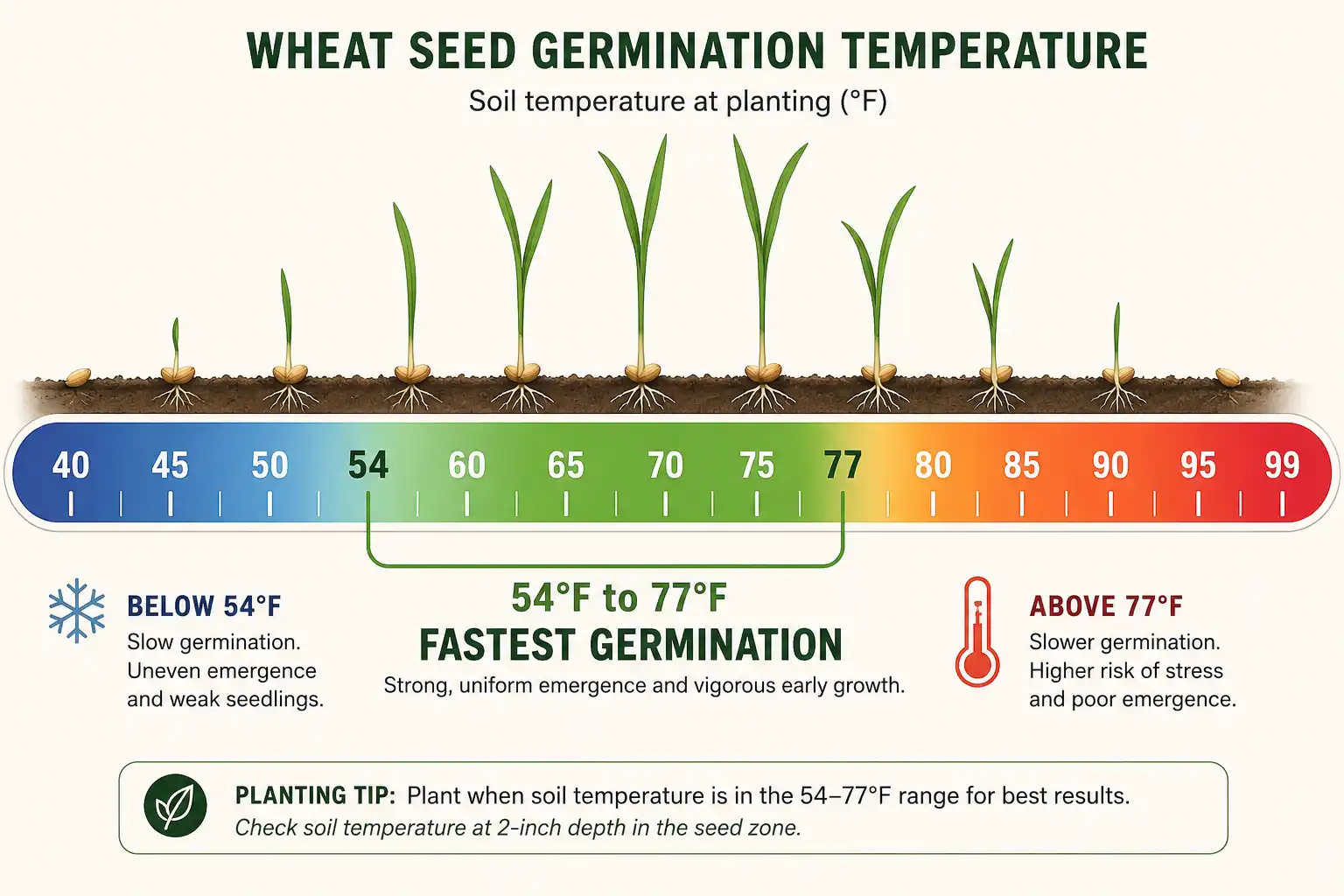
Wheat germinates anywhere from about 40 to 99 degrees, with the best results between 54 and 77 degrees. Oklahoma State University Extension uses that same range for hard red winter wheat across the Southern Great Plains.
Heat is the part most growers miss. Some varieties will not germinate at all when soil sits above 85 degrees. K-State research also shows coleoptile length shrinking by as much as 60 percent in hot soil. That trait is called high temperature germination sensitivity, and it delays sprouting rather than killing the seed.
Cold sets a floor instead. Spring wheat germinates once the 3-day average soil temperature reaches 34 to 36 degrees, though Montana State recommends waiting until the 2 inch reading passes 40 degrees. Below that, seed sits in the ground and waits.
Take the reading at 2 inches between 10 a.m. and noon with a soil thermometer made for field use, because a single cold morning tells you nothing. Two or three consistent days matter more. That temperature pattern is also why winter wheat planting dates in Kansas land in late September and early October, after the Hessian fly free date. Spring wheat planting timing works off the lower floor instead.
How Does Seeding Depth Change Sprout Time?
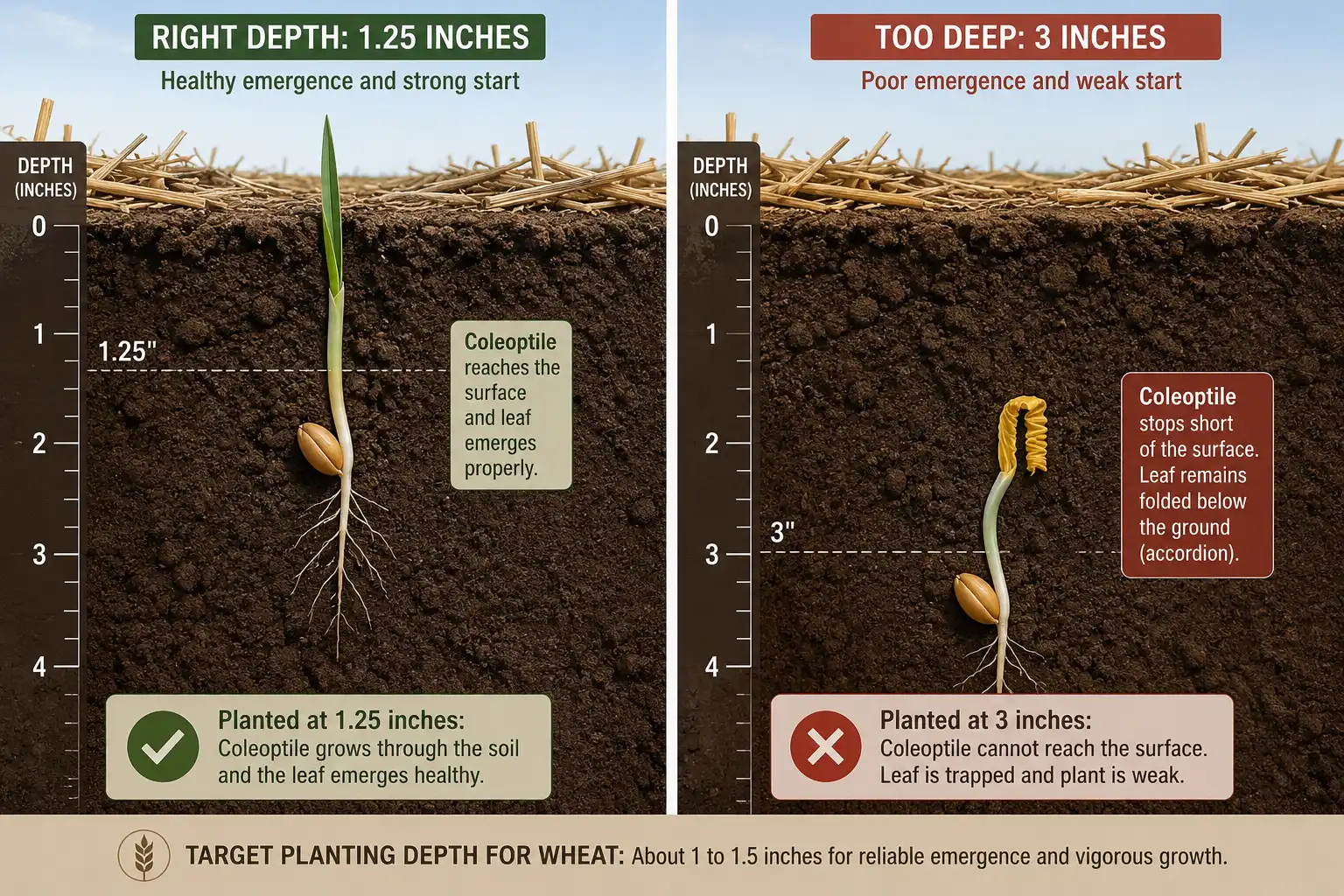
Every extra inch of depth costs the coleoptile time and energy. Seed placed at 1 to 1.5 inches emerges fastest, which is why University of Minnesota Extension recommends that depth for winter wheat.
Past 2 inches, the risk changes from slow to failed. Modern semi-dwarf varieties carry short coleoptiles. If the coleoptile runs out of length underground, it stops. The first leaf then unfurls below the surface, crinkles into an accordion shape, yellows, and dies.
K-State gives one rule without exception: never plant deeper than the coleoptile length listed for your variety. Seed guides publish that number, and it varies by several tenths of an inch between varieties.
Warm soil complicates it further. When drilling into soil above 80 degrees, go shallower, around three quarters to 1 inch, even if the top layer is dry. Dusting in shallow beats burying seed under a shortened coleoptile.
| Seeding depth | Effect on sprout time |
|---|---|
| 0.5 inch or less | Fast, but poor seed to soil contact and winterkill risk |
| 1 to 1.5 inches | Optimum, fastest reliable emergence |
| 1.5 to 2 inches | Adds 1 to 3 days |
| Over 2 inches | Uneven stands, coleoptile may never reach light |
How to Predict Wheat Emergence With Growing Degree Days
Growing degree days give you a real answer instead of a guess. NDSU’s weather network models wheat emergence at roughly 180 GDD, base 32 degrees, for seed at 1.5 inches in bare moist soil.
Here is the math. Add the daily high and low air temperature, divide by two, then subtract 32. Cap the daily high at 70 degrees before the crop reaches the two leaf stage. Add up each day after planting until you hit 180.
| Average daily air temp | GDD per day | Days to emergence |
|---|---|---|
| 70°F | 38 | About 5 |
| 65°F | 33 | About 6 |
| 60°F | 28 | About 6 to 7 |
| 55°F | 23 | About 8 |
| 50°F | 18 | About 10 |
| 45°F | 13 | About 14 |
| 40°F | 8 | About 22 |
A 78 degree high and 52 degree low gives you (70 + 52) / 2, minus 32, or 29 GDD for that day. Six days like that puts you at 174, so emergence lands right around day six or seven. For comparison, oats germinate on nearly the same schedule in the same seedbed, which helps if you stage both crops.
Why Hasn’t Your Wheat Sprouted Yet?
Wheat that misses its window almost always hits one of eight problems. K-State’s emergence troubleshooting list covers the common ones.
- Dry seedbed. Seed sitting in dust cannot reach 35 percent moisture. It waits for rain, sometimes for weeks, and then emerges unevenly.
- Planted too deep. Check depth first. Dig up seed and measure from the kernel to the surface.
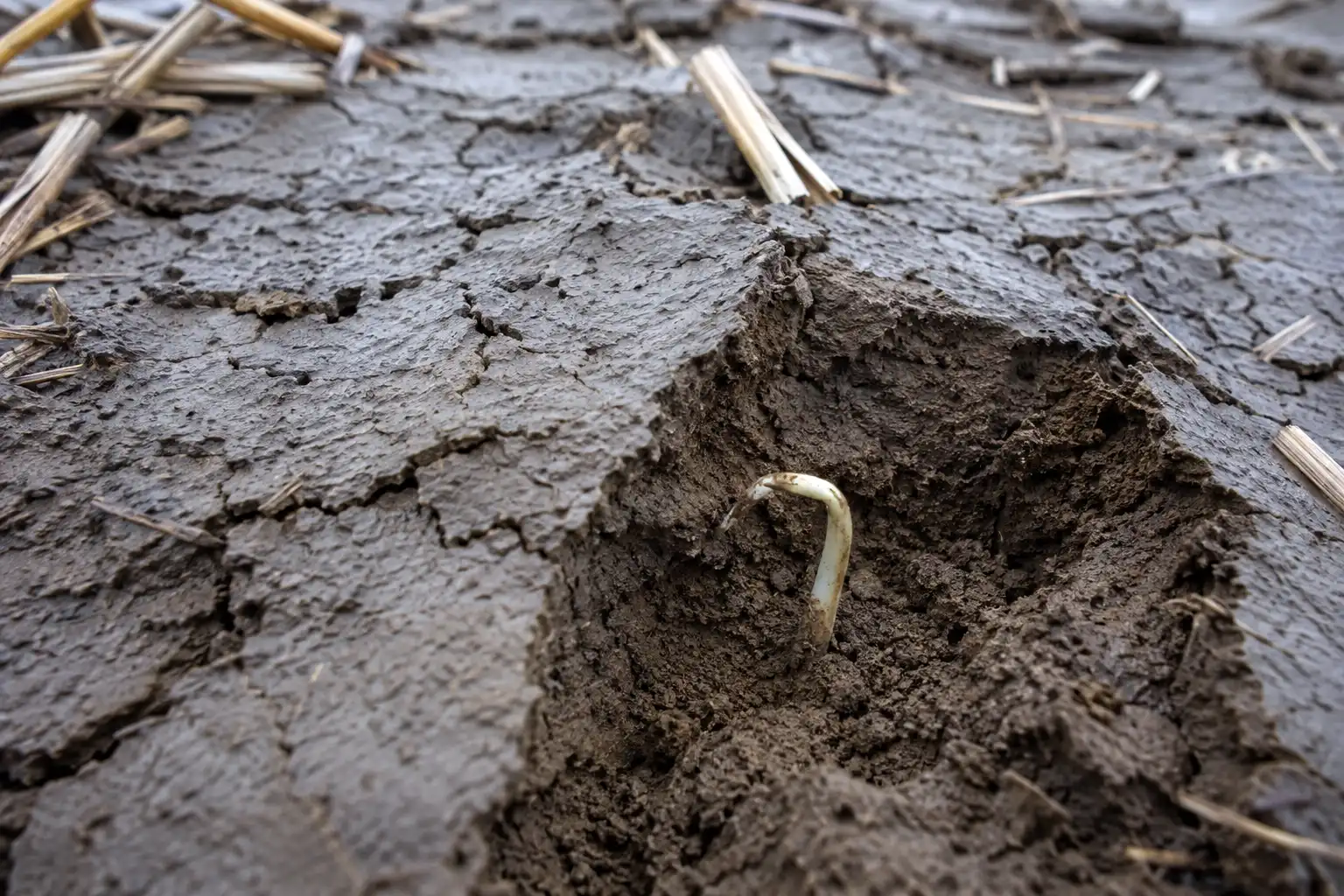
- Soil crusting. Hard rain after drilling forms a crust the coleoptile cannot break. Look for crinkled coleoptiles just under the surface.
- High temperature germination sensitivity. Freshly harvested seed drilled into hot September soil may stay dormant until the soil cools.
- Poor seed quality. Low germination lots produce thin, patchy stands. Run a germination test before planting.
- Seedling disease. Cool wet soil favors seedborne and soilborne rots that kill seedlings before emergence.
- Plugged drill. Blank rows in a repeating pattern point to equipment, not agronomy.
- Low soil pH. Aluminum toxicity in acid soils stunts roots. A soil test tells you before the crop does.
Late drilling also slows things down. Cooler soil in November means slower emergence and fewer fall tillers, which is the main reason planting winter wheat late costs yield.
How to Check If Wheat Seed Is Germinating
Dig, do not wait. Ten minutes with a trowel tells you more than another week of watching the field.
- Pick three spots per field, away from headlands and wheel tracks.
- Dig a foot of row at seed depth and sift the soil by hand.
- Count what you find. Swollen kernels with a white radicle mean germination started.
- Measure depth from the kernel to the surface with a ruler.
- Look for crinkled or accordion folded shoots, the signature of crusting or deep planting.
- Split a few seeds. Firm and white inside is alive. Soft, gray, or mushy is rotted.
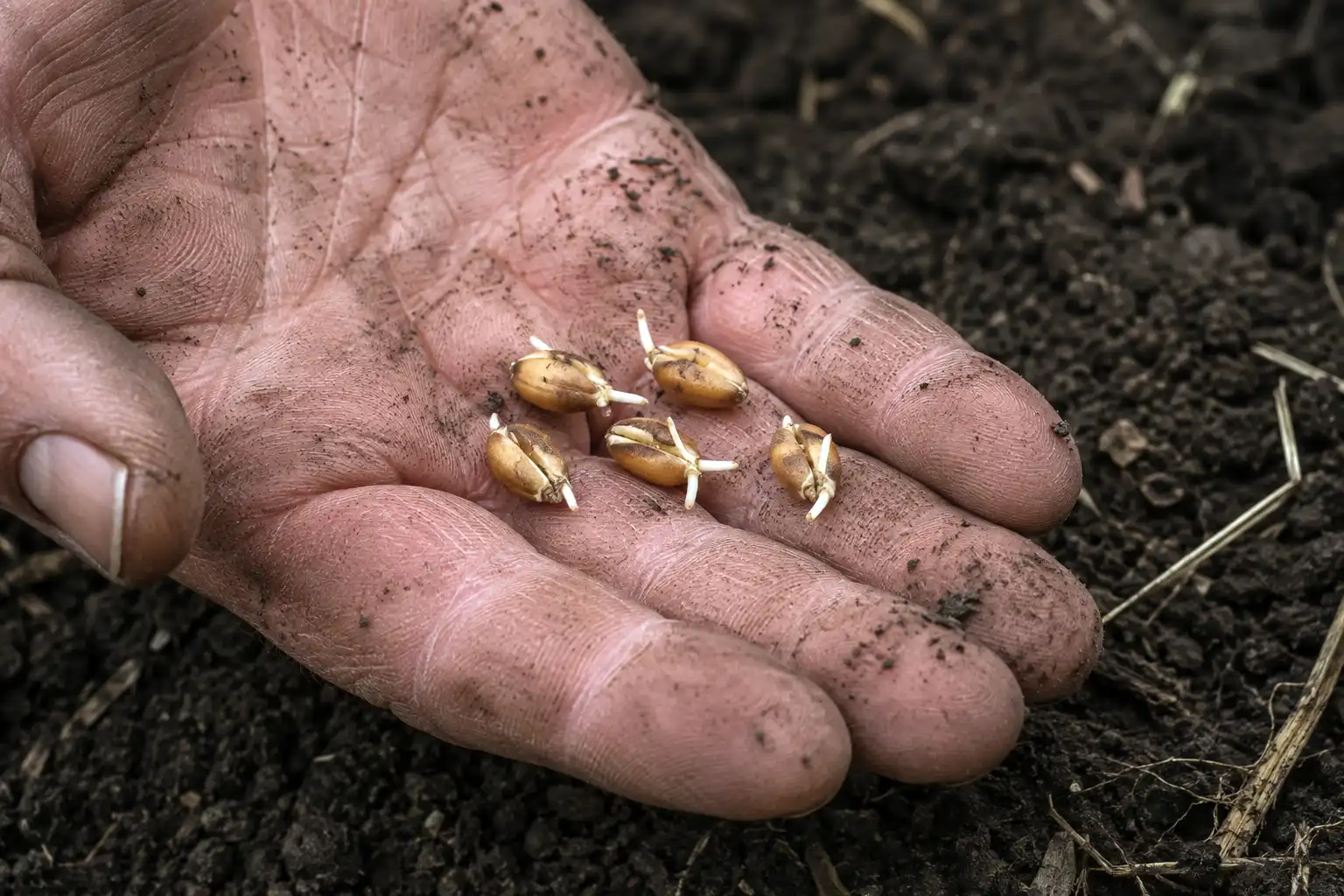
If most seed is germinated but short of the surface, give it time. If seed is firm and dry with no swelling, you are waiting on moisture, not on the seed.
How Long Do Wheat Berries Take to Sprout in a Jar?
Wheat berries sprout in 2 to 3 days in a jar on the counter. That is faster than field wheat because temperature and moisture stay steady.
- Rinse half a cup of wheat berries and pick out debris.
- Soak 6 to 12 hours in cool water.
- Drain completely, then invert the jar at an angle for air flow.
- Rinse and drain two to three times daily.
- Harvest when tiny white tails appear, usually on day two or three.
For wheatgrass, spread the sprouted berries on a tray of soil and cut at about 4 inches, roughly 7 to 10 days later. Grocery store wheat berries for planting sprout the same way, though germination rates usually run below certified seed.
What Happens in the First Weeks After Wheat Sprouts?
New leaves appear about every 4 to 5 days after emergence. University of Minnesota Extension uses that interval for staging small grains, and it holds well in Kansas fall conditions.
Tillering starts at the three leaf stage. Fall tillers matter because they set the head count you harvest next summer. Wheat that emerges in early October gets several weeks of tillering. Wheat that emerges in mid November gets almost none.
One point eases a lot of worry with late planting. Michigan State Extension confirms winter wheat does not need to emerge to vernalize. Once the seed imbibes that 35 to 45 percent moisture, the cold requirement can be satisfied underground. Late wheat yields less, but it is not lost.
Final Thoughts
Mark the planting date, then track soil temperature at 2 inches for the next week. At 60 degrees or better, expect green rows by day seven. Below 50 degrees, plan on two weeks and stop checking daily.
If day 10 passes with nothing showing in warm soil, dig. Depth and moisture explain nearly every stand failure. Fix those two and wheat comes up on schedule.