What Does a Wheat Plant Look Like? Parts, Stages, and ID Tips
Wheat is easy to mistake for barley, rye, or tall grass at a distance. Up close, a few traits settle it fast. Knowing what a wheat plant looks like helps you identify a field. The same checks work for scouting a stand or a cover crop mix.
A wheat plant looks like a knee high to waist high grass. Stems are hollow and jointed, blades narrow and blue green, and the seed head tight and upright. Short hairy auricles clasp the stem, ruling out oats and barley.
What a Wheat Plant Looks Like at a Glance
Wheat grows as an upright annual grass with one compact base and several shoots rising from it. Most modern varieties stand about waist high at maturity, since semi dwarf breeding shortened the straw to cut lodging. Older heirloom and forage types run taller.
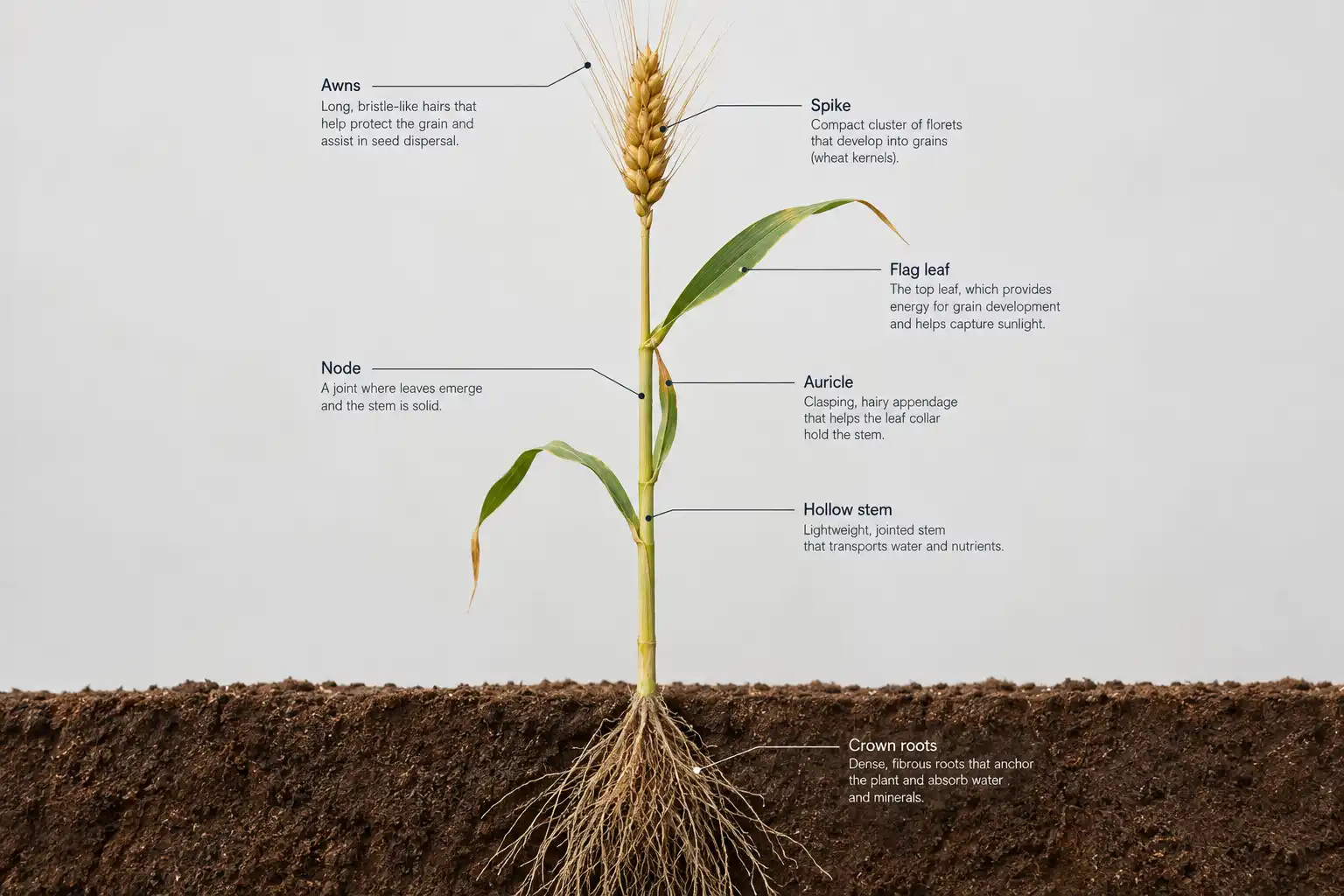
Here is the full parts list you can check in the field.
| Part | What you see |
|---|---|
| Culm (stem) | Hollow, round, smooth, pale green, broken by joints |
| Node | Solid swollen joint spaced along the stem |
| Leaf blade | Flat narrow strap, roughly 6 to 12 inches long, blue green |
| Leaf sheath | Wraps tightly around the stem below the blade |
| Ligule | Thin papery flap where blade meets sheath |
| Auricles | Short hairy claws that clasp around the stem |
| Flag leaf | Top leaf, shorter and wider, stays green longest |
| Spike (head) | Tight upright cluster of spikelets on a zigzag axis |
| Awns | Stiff bristles on bearded types, absent on beardless types |
| Kernel | Small oval grain, deep crease on one side, hairy brush at the tip |
| Roots | Fibrous mat, no taproot |
What Do Wheat Stems and Leaves Look Like?
Wheat stems are hollow, round, and split into segments by solid joints called nodes. According to University of Georgia Extension, a wheat stem normally carries six internodes. Each one runs longer than the one below it. One leaf comes off each node, so the blades alternate from side to side as they climb.
Each leaf has two parts. The sheath wraps the stem tightly. The blade then flares away as a flat narrow strap with a faint blue green or gray green cast. Run a hand along one and the edges feel slightly rough.
Leaf count tracks the length of the season. K-State Research and Extension reports about five to seven foliage leaves on spring wheat. Winter wheat, by contrast, can produce eleven to fifteen.
The Ligule and Auricles Settle It Fast
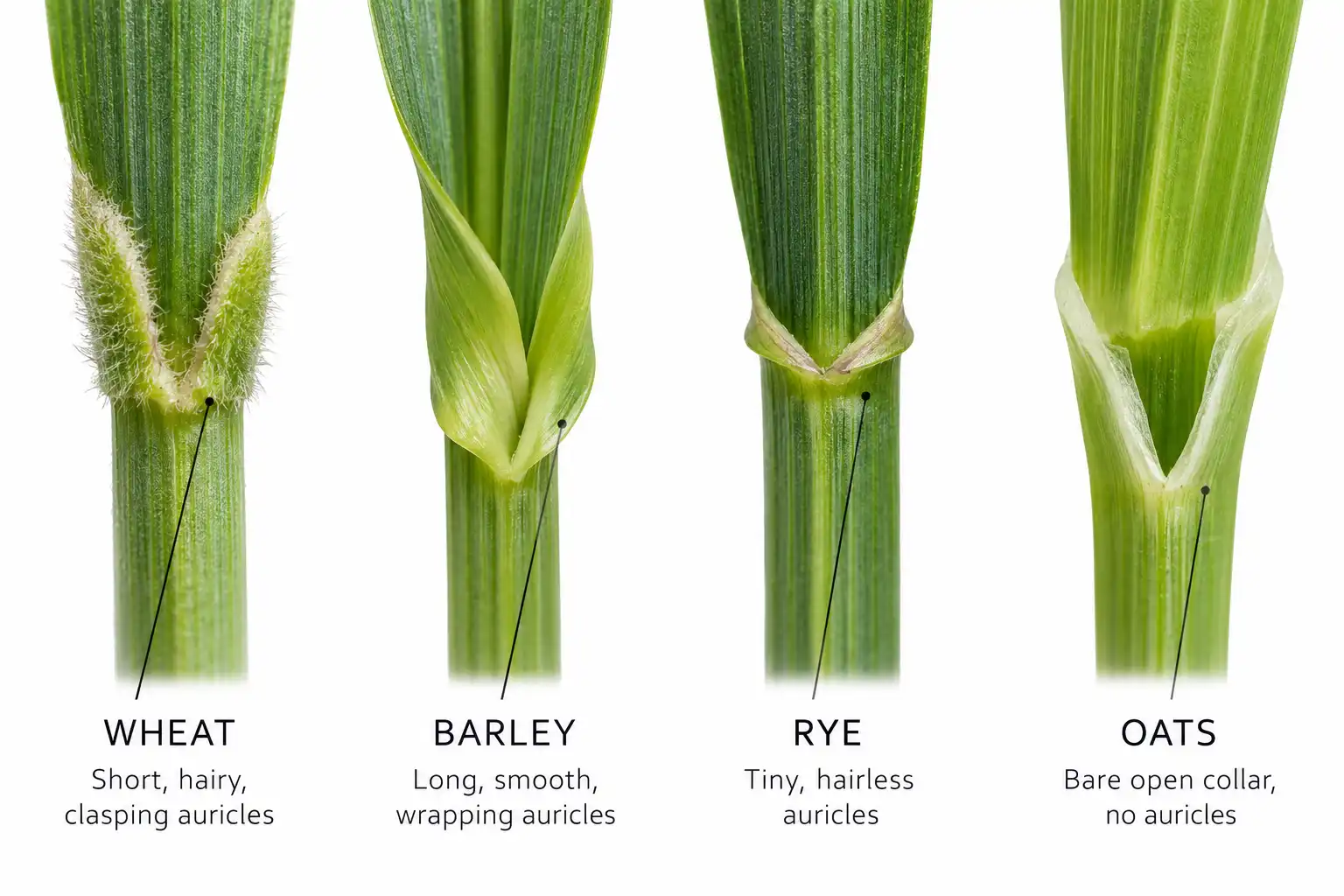
Look at the collar where the blade meets the sheath. Wheat carries a short papery ligule there, plus a pair of short hairy auricles that clasp around the stem. USDA NRCS plant identification guides treat these two structures as the primary check on small grains. Before heading, you have no head to look at.
The four crops separate cleanly at that spot. Wheat auricles stay short and fringed with fine hairs. Barley auricles run long and smooth and wrap fully around the stem. Rye auricles are tiny and hairless. Oats have none at all.
One more check works from directly above. Texas A&M AgriLife reports that wheat and barley leaf blades twist clockwise, while wild oat twists counterclockwise.
What the Flag Leaf Looks Like
The flag leaf is the last leaf to emerge, and it sits directly below the head. It looks shorter and broader than the leaves under it, and it holds its green color after lower leaves fade. SDSU Extension places flag leaf emergence at Feekes 8, with the ligule fully visible by Feekes 9. That top leaf feeds the filling grain more than any other, so growers watch it closely for disease.
What Does a Wheat Head Look Like?
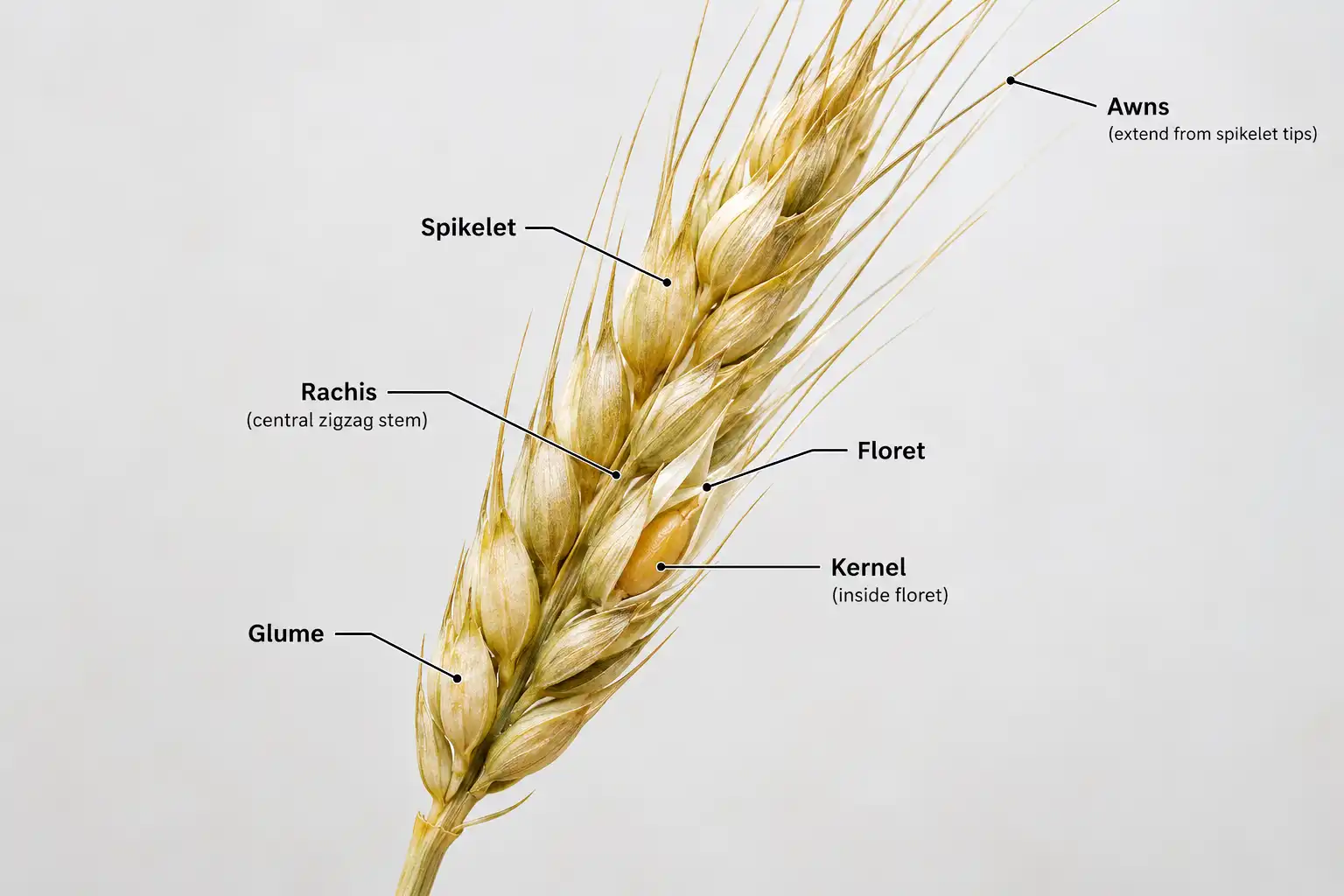
A wheat head is a tight upright spike, not a loose branching cluster. Growers also call it an ear. Spikelets sit in two opposite rows along a central zigzag axis called the rachis. From above, that gives the head a flat two sided profile.
Each spikelet holds several small flowers. University of Georgia Extension reports two to five florets per spikelet, though only two or three normally fill a kernel. Papery bracts called glumes wrap each spikelet, and a lemma and palea enclose each floret inside.
Heads usually run 2 to 4 inches long. At flowering, small anthers push out of the florets and dangle on the outside of the head. They start bright yellow, then pale toward white as they dry.
Awned and Awnless Heads Are Both Wheat
Both bearded and beardless heads are wheat. Awns are the stiff bristles that fan out from the spikelet tips. Bearded varieties carry them, so a ripe bearded field takes on a bristly shimmering look. Beardless varieties show a smooth clean head with no bristles.
USDA NRCS notes that club wheat carries no awns at all. That type grows in the Pacific Northwest and holds a short compact head. Bristle length alone therefore never identifies the crop. Wheat awns also stay shorter than barley awns, which grow long enough to droop the whole head.
What Does a Wheat Kernel Look Like?
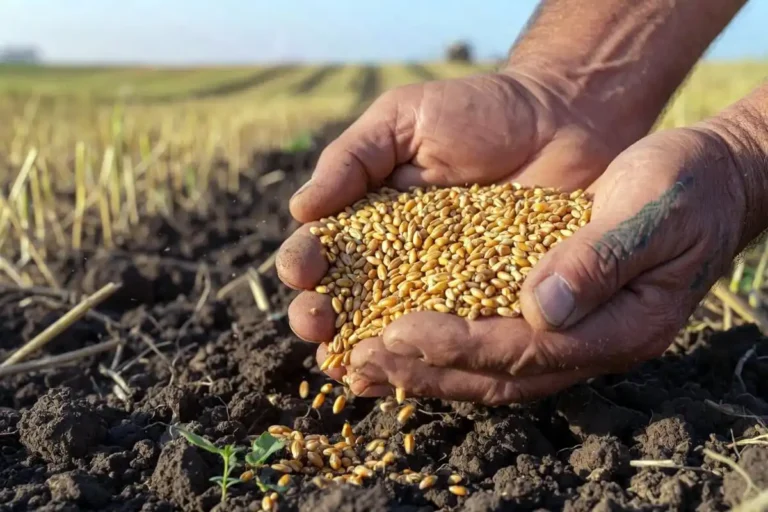
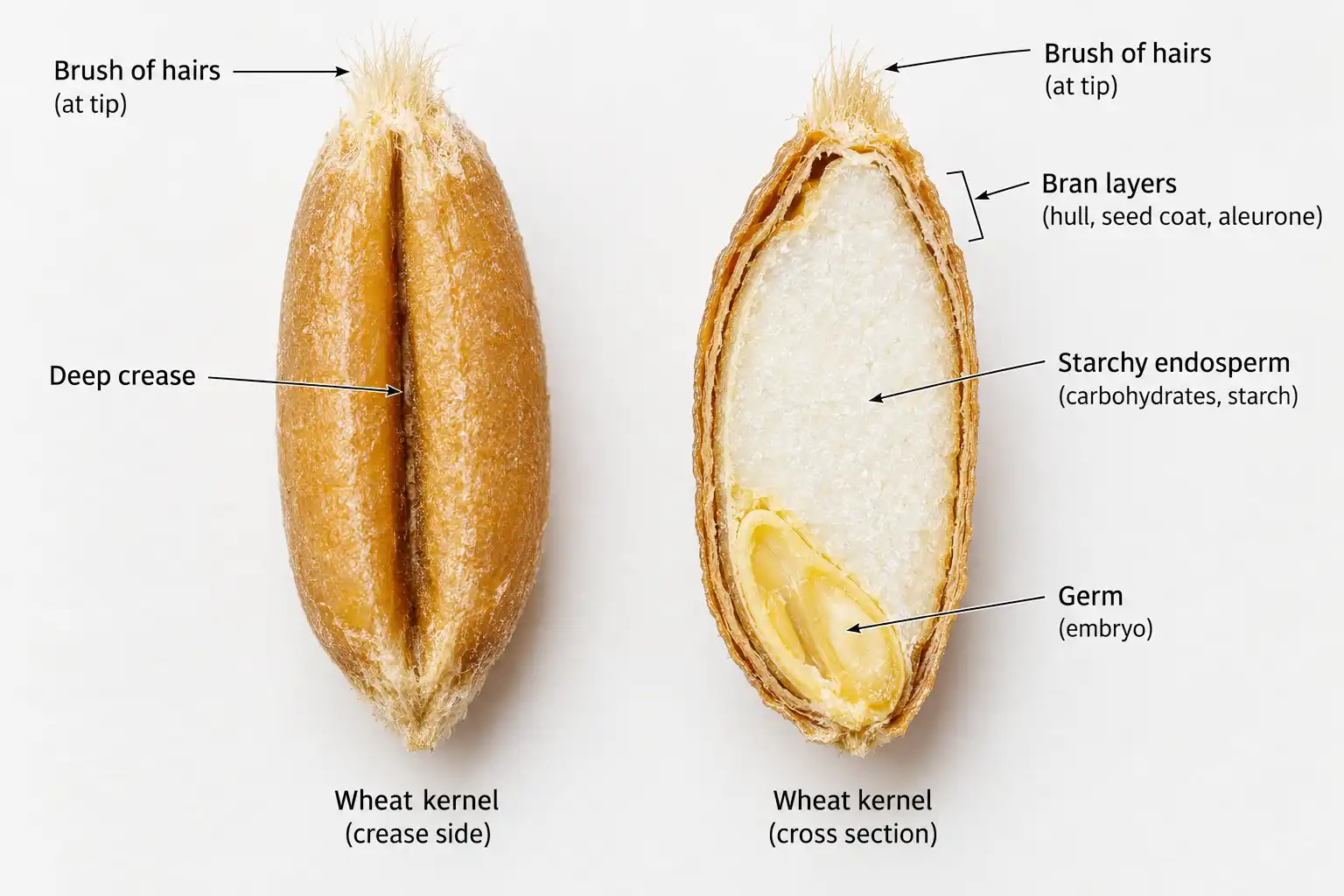
A wheat kernel is a small oval grain with a deep crease down one side. A tiny brush of fine hairs sits at the tip. The whole kernel measures roughly a quarter inch long. That crease and brush separate wheat from rye, which runs longer, slimmer, and more wedge shaped.
Color follows the class, not the ripeness. Under federal grain standards published by the USDA Agricultural Marketing Service, wheat sorts into eight classes. Red classes carry a reddish brown bran coat. White classes look pale tan or cream. Durum kernels stand out as large, hard, and amber.
| Class | Kernel appearance | Typical growing region |
|---|---|---|
| Hard red winter | Reddish brown, hard, medium size | Central and southern Plains |
| Soft red winter | Reddish brown, softer, plumper | Eastern and mid south states |
| Hard red spring | Dark reddish, hard, glassy | Northern Plains |
| Hard white | Pale tan, hard | Kansas, Colorado, California |
| Soft white | Cream colored, soft | Pacific Northwest |
| Durum | Large, amber, very hard | North Dakota, Montana, desert Southwest |
Kernels stay locked inside the glumes on the standing plant. Only after threshing frees them do you see the bare grain.
What Does the Wheat Root System Look Like?
Wheat grows a fibrous root system with no taproot. Two sets form in sequence. Seminal roots push straight out of the germinating seed and carry the seedling through its first few weeks. Crown roots then develop from the base of the shoots, near the soil surface. They handle water and nutrient uptake for the rest of the season.
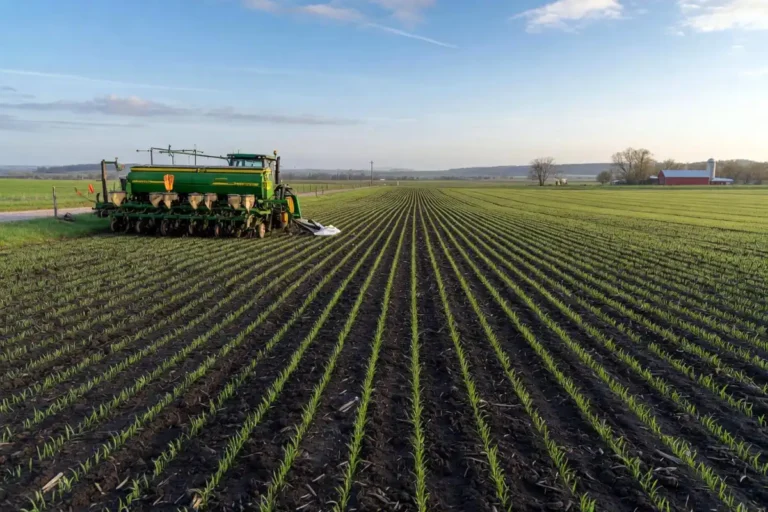
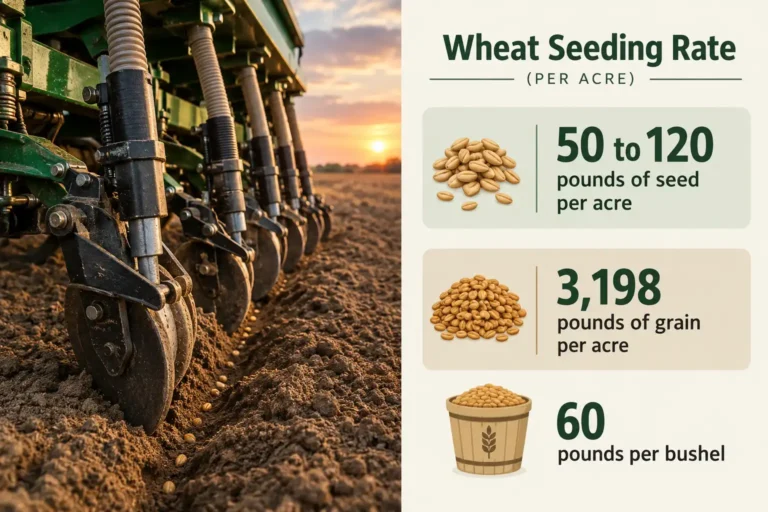
Pull a tillering plant and you see a dense white mat of threadlike roots spreading from one compact base. Because the crown sits just under the surface, correct seeding depth for wheat matters. Seed placed too deep forces the shoot to stretch farther before it reaches light, which thins the stand.
How a Wheat Plant Changes Through the Season
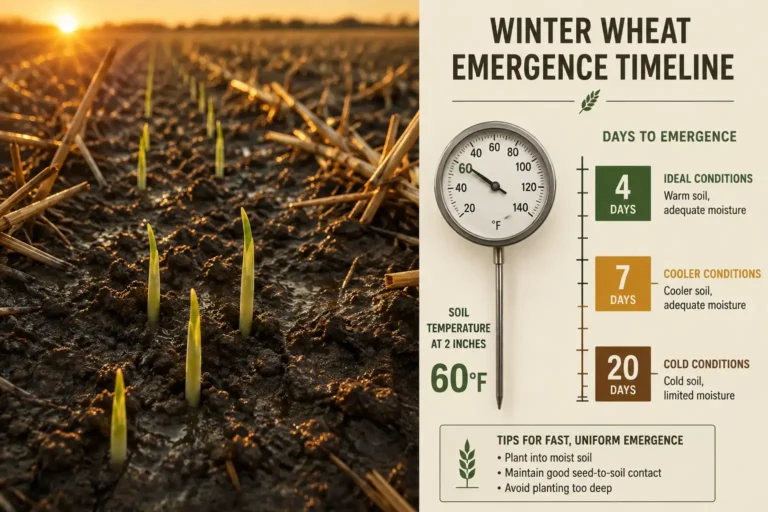
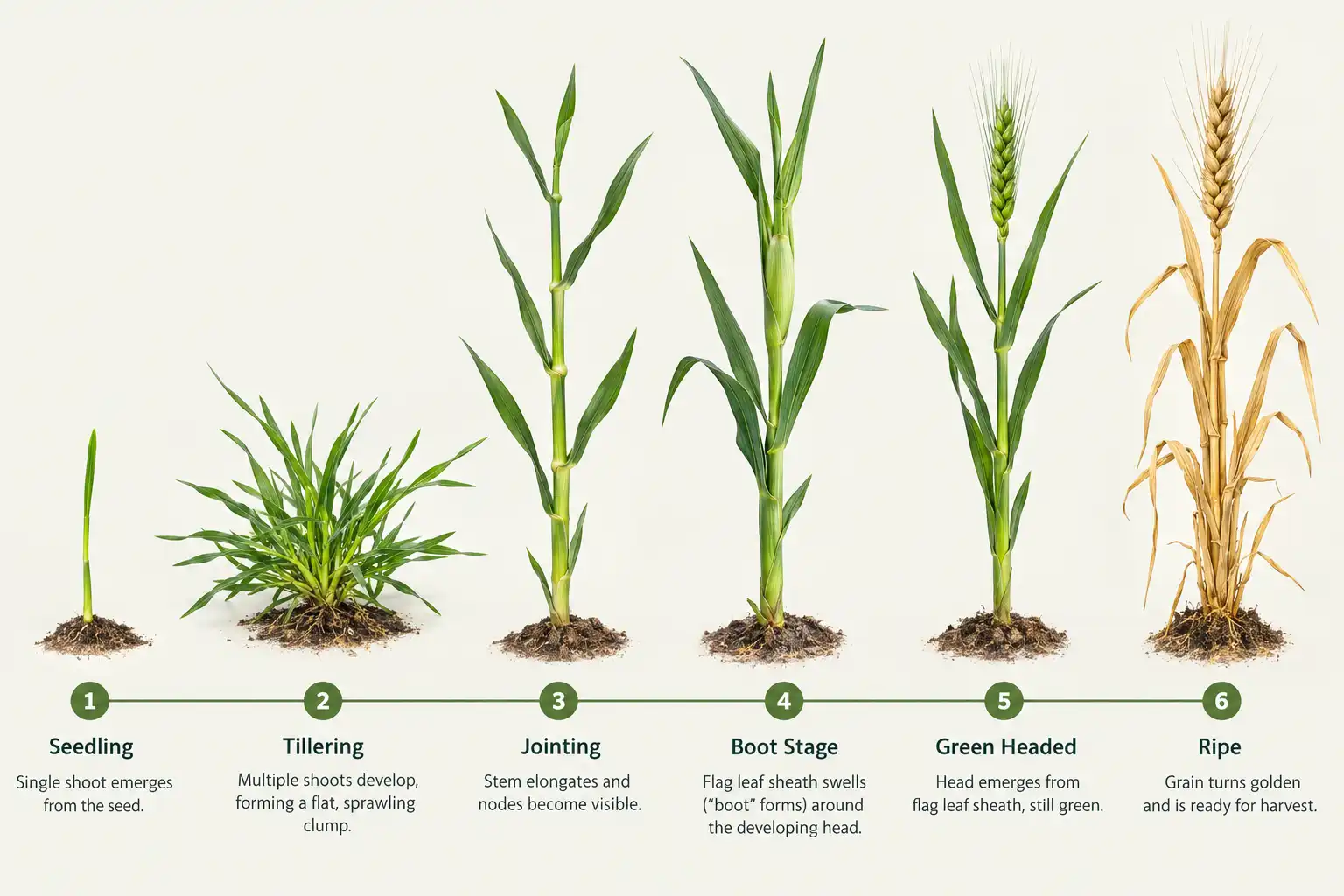
A wheat plant changes shape completely between emergence and harvest. Agronomists track those changes with the Feekes scale, and K-State Research and Extension publishes the version most US growers follow. Emergence itself is quick in warm moist soil, though how fast wheat germinates shifts with temperature and planting depth.
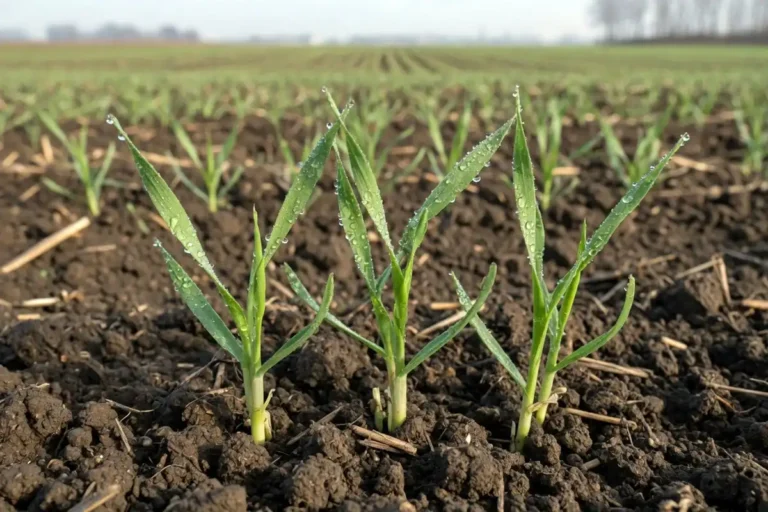
Winter wheat looks flat and grassy through fall and winter. It stands up only after spring green up. SDSU Extension notes that the plant becomes much more erect at Feekes 5, once tillering finishes. At that point the head forms below ground, out of sight.
| Stage | What the plant looks like |
|---|---|
| Emergence (Feekes 1) | One narrow spear per seed, nothing else |
| Tillering (Feekes 2 to 3) | Low clump of shoots, often sprawling flat |
| Erect growth (Feekes 4 to 5) | Clump stands up, sheaths thicken |
| Jointing (Feekes 6 to 7) | Nodes show as bumps, the plant stretches fast |
| Flag leaf (Feekes 8 to 9) | Top leaf unrolls, its collar becomes visible |
| Boot (Feekes 10) | Head swells inside the flag leaf sheath |
| Heading (Feekes 10.1 to 10.5) | Awns appear first, then the whole head pushes out |
| Flowering (Feekes 10.5.1) | Yellow anthers hang on the outside of the head |
| Ripening (Feekes 11) | Kernel turns watery, then milky, then doughy, then hard |
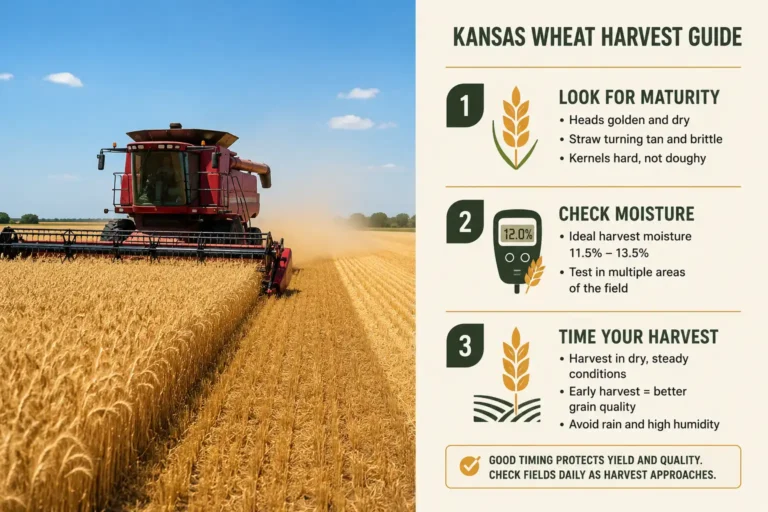
| Harvest ready (Feekes 11.4) | Straw and heads go golden, heads nod slightly |
Color tracks those stages. Stands look deep green through jointing, turn paler as heads emerge, then go gold as the crop dries down. That golden cast is the cue most people recognize. It lines up with wheat harvest timing in early to midsummer across most of the country.
How to Tell Wheat from Barley, Rye, Oats, and Triticale
Check the collar first and the head second. Those two spots settle nearly every case.
| Crop | Auricles | Head shape | Awns | Stand appearance |
|---|---|---|---|---|
| Wheat | Short, hairy, clasping | Tight two rowed spike | Short or absent | Green then gold |
| Barley | Long, smooth, wrapping | Tight spike, often six rowed | Long and flexible | Pale and light at maturity |
| Rye | Very short, hairless | Long slim spike | Long and stiff | Bluish green, taller |
| Oats | None | Open drooping panicle | Short or absent | Light airy canopy |
| Triticale | Short and hairy, like wheat | Longer spike than wheat | Usually present | Often sprawls early |
Oats are the easiest call. USDA NRCS describes the oat head as an open panicle. One or two kernels hang at the tip of each branch, so it never forms a tight spike. Oats also lack auricles entirely. For the full set of oat traits, see how oats look up close at the leaf, head, and grain.
Triticale causes the most trouble. It is a wheat and rye cross. USDA NRCS notes that wheat and triticale are hard to separate in the vegetative stage. Triticale seed runs longer and darker than wheat seed. Before heads emerge, dig a plant and check the old seed at its base.
Where People Go Wrong Identifying Wheat
Most misreads trace back to five habits.
- Trusting awns. Awned and awnless wheat both exist, so bristles prove nothing on their own.
- Judging by height. Drought, planting date, and variety all shift final height, so a short stand can still be wheat.
- Mixing up wheat and pasture grass. Tall fescue and annual ryegrass lack the clasping hairy auricles and the flat two sided spike.
- Calling a green winter field grass. Winter wheat spends months flat and grassy before it ever stands up.
- Reading head color in spring. Green heads look alike across small grains, so check the collar instead.
Frequently Asked Questions
How tall does a wheat plant get?
Does wheat have awns or not?
What does young wheat look like?
Is wheat a grass?
How many kernels are in one wheat head?
Key Points to Carry Into the Field
Three checks cover almost every wheat ID. Look at the collar for short hairy auricles that clasp the stem. Look at the head for a tight two rowed spike on a zigzag rachis. Look at the kernel for the deep crease and the brush of hairs at the tip. Height, color, and awns all shift with variety and weather, so treat them as clues rather than proof.