What to Plant After Zucchini: 7 Best Crops for Next Season
Zucchini uses a lot of nitrogen. It also leaves behind pests and disease spores that target every squash relative. Picking what to plant after zucchini decides whether that bed rebounds or repeats last season’s problems.
The best crops to plant after zucchini come from outside the squash family. Beans, peas, garlic, onions, carrots, beets, and fall greens break the pest and disease cycle. Keep cucurbits out of that bed for 3 to 4 years.
Why Zucchini Crop Rotation Matters
Zucchini belongs to the gourd family, Cucurbitaceae. Its relatives include cucumbers, pumpkins, winter squash, muskmelons, and watermelons. Because these crops share pests and diseases, rotate by plant family rather than by single crop.
Iowa State University Extension advises keeping each plant family out of the same spot for 3 to 4 years. It also suggests 5 or more years when space allows.
Nutrients follow the same pattern. According to Iowa State, gourd family crops use a lot of nitrogen, while bean family crops help add it back. As a result, a finished zucchini bed is usually low on nitrogen and full of squash-specific pests.
Penn State Extension shows how fast this builds. Squash bugs feed on every cucurbit, so cucumbers or melons planted where squash just grew face the same problems. Also, pests that find food in one place multiply, and many survive winter to return in larger numbers.
Rotation breaks that cycle by taking away the host. To apply it across the whole garden, plan a multi-year rotation that moves each plant family one bed per season.
Also know: Zucchini Companion Plants
What to Plant After Zucchini: Best Crop Groups
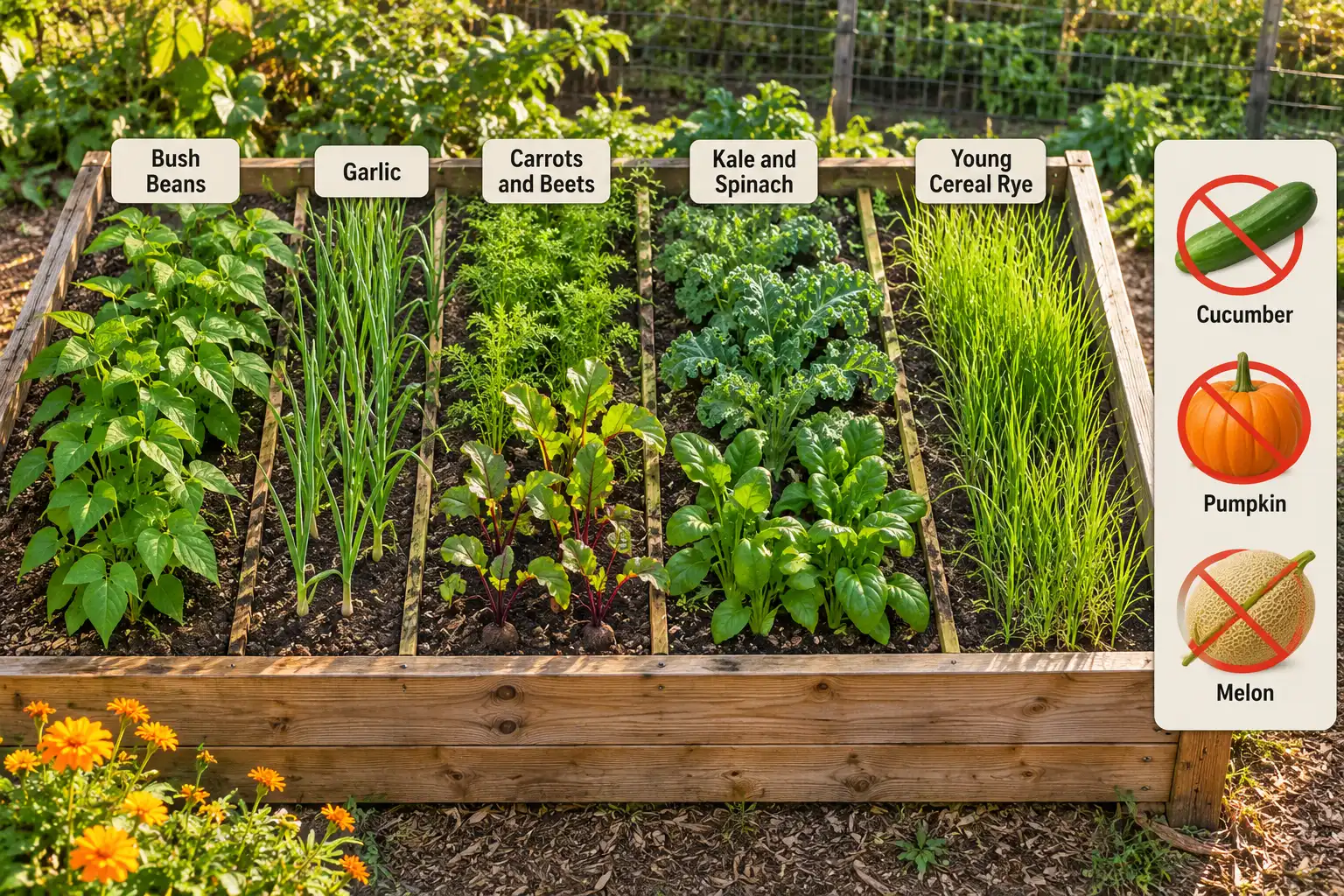
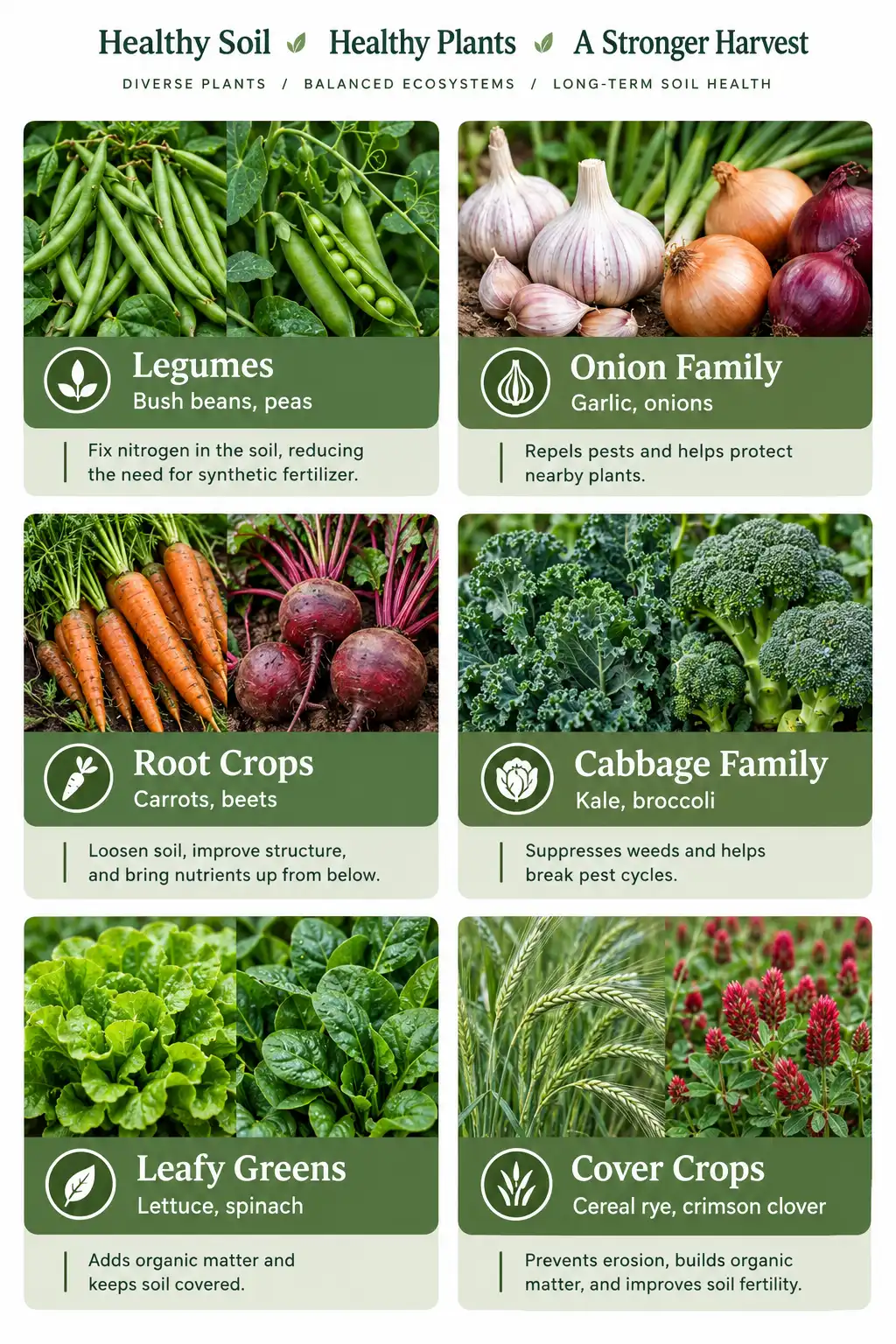
Beans, peas, garlic, onions, carrots, beets, cabbage family crops, and leafy greens all follow zucchini well. None of them belong to the gourd family, so squash pests and pathogens lose their host.
| Crop group | Examples | Why it works after zucchini | Best timing |
|---|---|---|---|
| Legumes | Bush beans, pole beans, peas | Fix their own nitrogen | Peas in fall or spring; beans next summer |
| Onion family | Garlic, onions, shallots, leeks | Different family and nutrient demand | Garlic in fall; onions in spring |
| Root crops | Carrots, beets, radishes, turnips | No shared squash pests | Late summer or spring |
| Cabbage family | Kale, broccoli, cabbage, collards | Sweeter when maturing in cool weather | Late summer transplants |
| Leafy greens | Lettuce, spinach, Swiss chard | Quick cool-season harvest | Late summer to early fall |
| Cover crops | Cereal rye, oats, crimson clover | Protect and rebuild open soil | Right after zucchini comes out |
Two details change the choice. First, beans and peas fix their own nitrogen, so they need little fertilizer in a drained bed. However, harvested pods carry much of that nitrogen away. A legume cover crop turned under before it sets seed returns more.
Second, check the bed’s disease history. Purdue Extension lists snap beans and lima beans as hosts of Phytophthora capsici, the cause of Phytophthora blight. So after a blight outbreak, plant peas, garlic, onions, carrots, or sweet corn instead. None of those appear on Purdue’s host list.
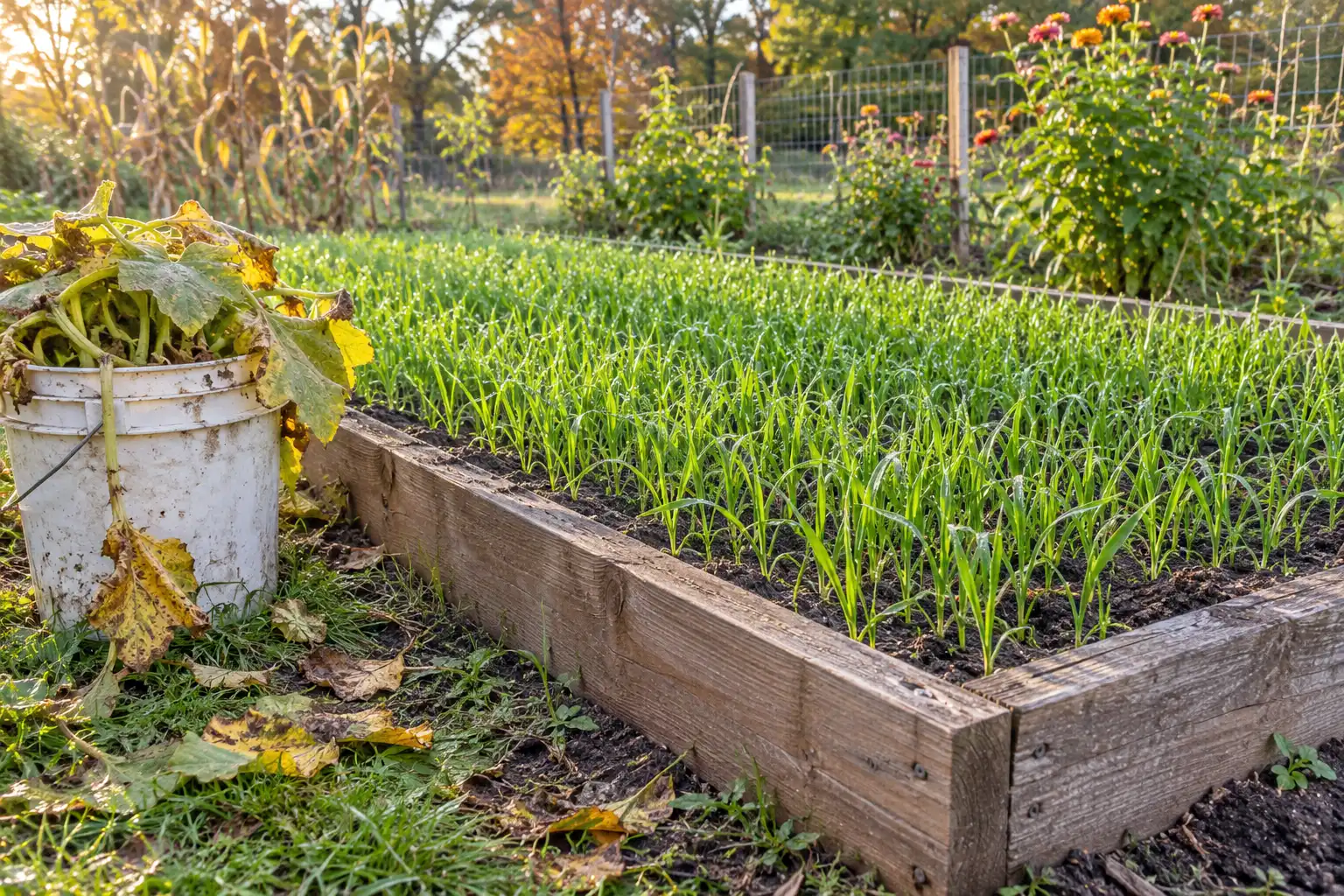
What to Plant After Harvesting Zucchini This Fall
Plant frost-tolerant vegetables, garlic, or a cover crop after harvesting zucchini. Your first fall frost date sets the deadline.
University of Nebraska-Lincoln Extension uses a simple countback formula. Add the crop’s days to harvest, its harvest period, and a 14-day Fall Factor for slower growth in short, cool days. For frost-tender crops such as bush beans, add another 14 days. Then count that total back from your average first frost.
For example, a 45-day spinach picked over 14 days needs 73 days. With an October 15 first frost, sow it by about August 3. With a November 25 frost, the deadline moves to about September 13.
Next, match the crop to your cold. UNL rates leaf lettuce, spinach, radishes, beets, and Swiss chard as semi-hardy, so they handle light frosts of 30 to 32°F. Kale, cabbage, broccoli, carrots, and turnips are hardy and keep growing until temperatures drop near 20°F.
Garlic goes in last. Penn State Extension recommends planting cloves about 3 weeks before the ground freezes. That way, roots develop while shoots stay below the surface. Check regional garlic and onion planting dates before you order seed garlic.
Cover Crops After Zucchini
A cover crop is the best use of a zucchini bed cleared too late for fall vegetables. It holds soil over winter and gives you a clean start in spring.
Cereal rye is the hardiest choice. University of Minnesota Extension research found cereal rye produces much more fall and spring growth when seeded by mid to late September. Even so, UMN notes that seeding into November remains possible.
Oats suit beds you plan to replant early. Iowa State University Extension notes that oats winter kill, so you skip spring termination.
Crimson clover and hairy vetch belong to the bean family. Once turned under before seed set, they feed nitrogen to next year’s crop.
Also, track each cover crop’s plant family. Iowa State groups oilseed radish and yellow mustard with the cabbage family, so count them as brassicas in your rotation. Meanwhile, Purdue Extension reports mixed results from mustard cover crops used as biofumigants against Phytophthora blight. Before you seed anything, decide how you will end it in spring, and review cover crop basics for seeding and termination steps.
What Not to Plant After Zucchini
Do not plant any member of the gourd family where zucchini just grew. That rules out cucumbers, pumpkins, winter squash, yellow summer squash, muskmelons, cantaloupe, watermelons, and ornamental gourds.
A blight history widens the list. Purdue Extension confirms that Phytophthora capsici attacks peppers, tomatoes, eggplant, snap beans, and lima beans, along with every cucurbit. It also infects weeds such as common purslane, jimsonweed, and nightshade.
Also, pull burcucumber. Iowa State lists this wild gourd family weed among common garden weeds. Since weeds in the same family act as alternate hosts, they keep pests and diseases alive between plantings.
Can You Plant Zucchini in the Same Spot Every Year?
No, planting zucchini in the same spot every year lets soilborne pests and diseases build up. Each new crop feeds whatever survived the last one.
Squash vine borer shows how. Michigan State University Extension reports that borer larvae leave the vines and pupate 1 to 6 inches deep in the soil. The moths then emerge the next summer. MSU also ranks zucchini among the crops most susceptible to this pest. So a repeat planting puts fresh vines right where next year’s moths come up.
Phytophthora blight is the bigger risk. Michigan State notes that its resting spores stay in soil for about 10 years without a susceptible crop. Once a bed has it, repeat zucchini plantings invite repeat losses.
Options for Small Gardens
Limited space still allows rotation. Iowa State suggests these approaches:
- Build three or four raised beds and move each family one bed per year.
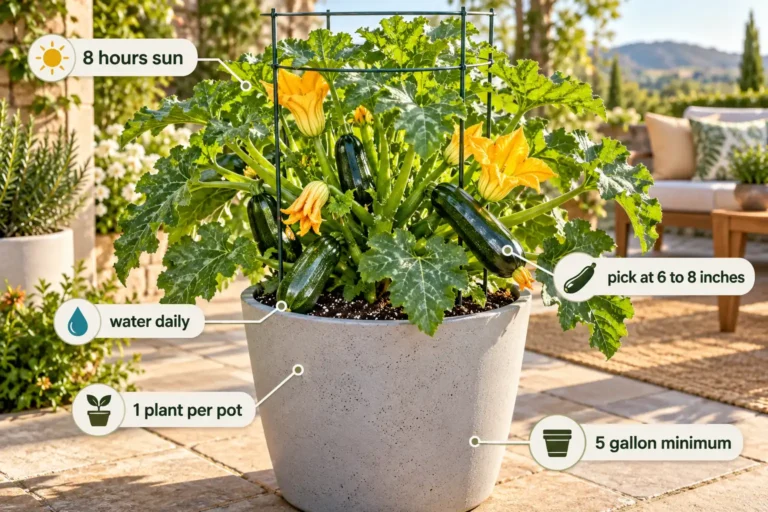
- Grow zucchini in containers for a season to rest the main bed.
- Tuck small plots into sunny corners of the yard.
- Trade plant families with a neighbor each year and share the harvest.
For the container route, use fresh potting mix each season so no old soil carries over. Then size the pot using guidelines for container-grown zucchini.
How Long to Wait Before Planting Zucchini Again
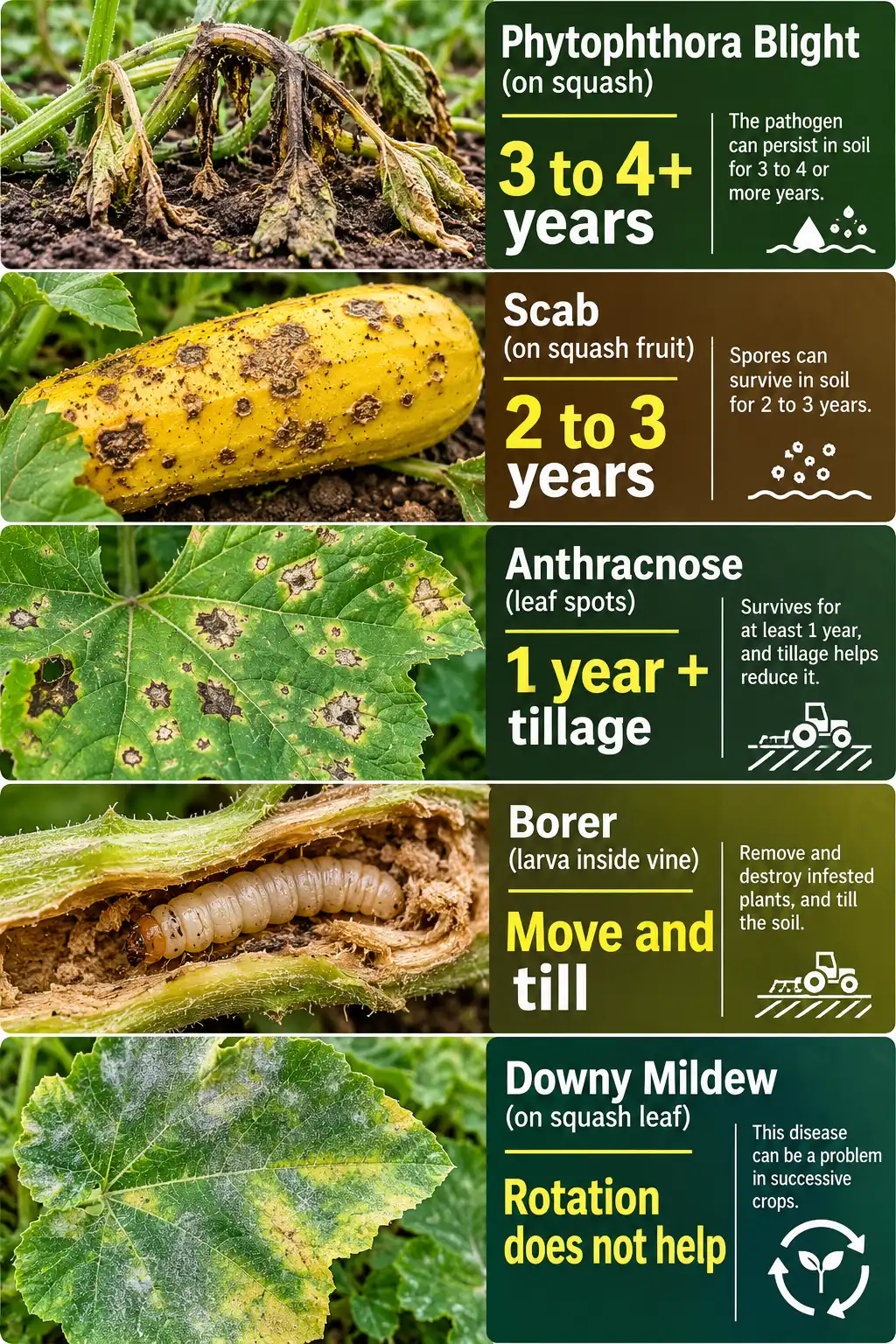
Wait at least 3 to 4 years before zucchini or any other cucurbit returns to the same bed. Still, specific problems set their own timelines.
| Problem | Where it survives | Rotation guideline |
|---|---|---|
| Phytophthora blight | Resting spores in soil, about 10 years | 3 to 4+ years away from all host crops (Michigan State, Purdue) |
| Cucurbit scab | Infected crop debris, up to 3 years | 2 to 3 years without cucurbits (Penn State) |
| Anthracnose | Infected crop residue | 1 year out of cucurbits plus deep tillage (Michigan State) |
| Squash vine borer | Pupae 1 to 6 inches deep in soil | Move the crop far away; till in fall (Michigan State, Iowa State) |
| Downy mildew | Needs a living host; blows in from southern states | Rotation does not prevent it (Michigan State) |
The 3 to 4 year window covers most of these at once. After a confirmed Phytophthora outbreak, though, Purdue Extension recommends at least 4 years without a susceptible host. Because squash vine borer moths fly, Iowa State pairs rotation with fall tilling, which disrupts and exposes overwintering pupae.
What Crops to Rotate With Zucchini: A 4-Year Plan
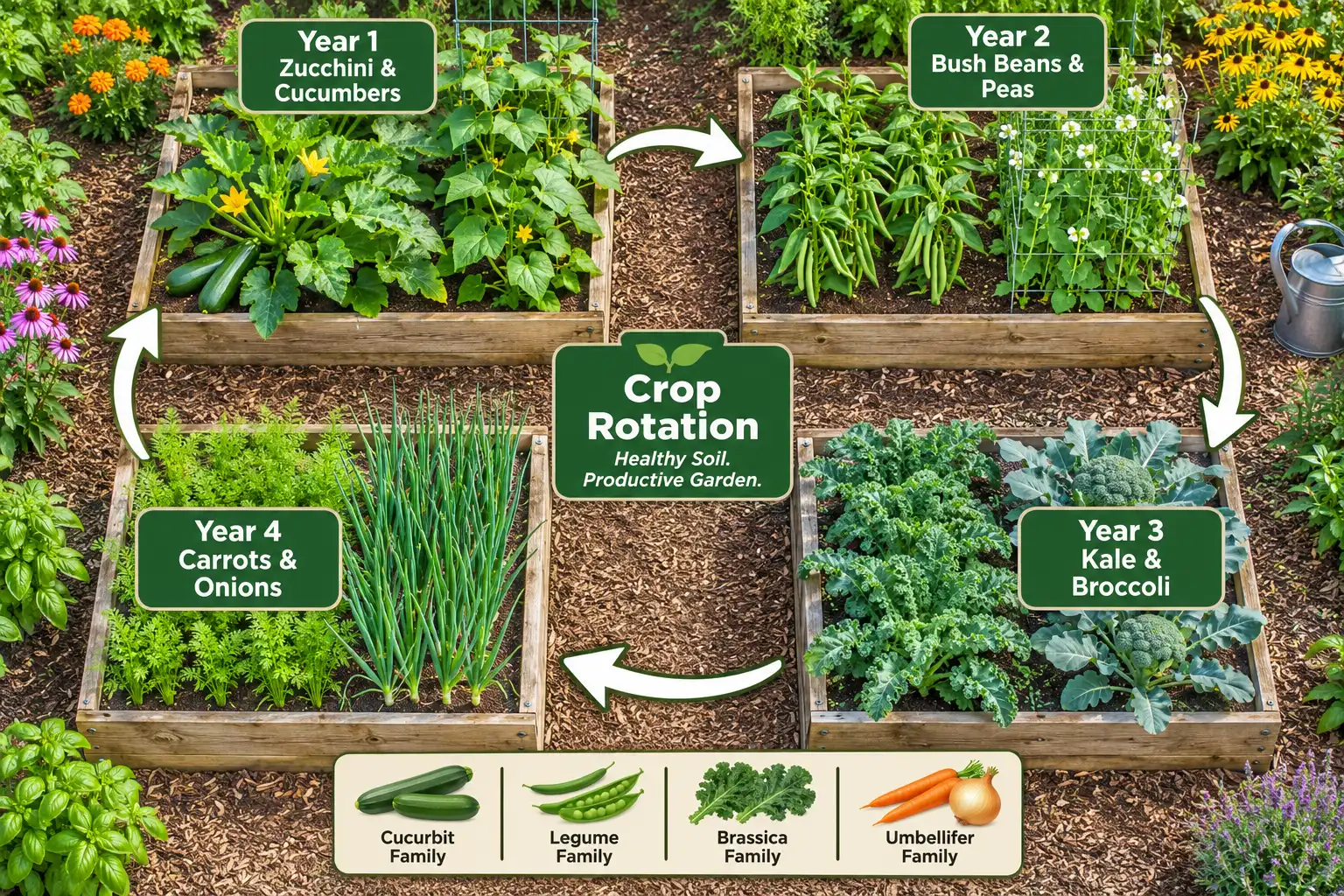
A four-bed rotation keeps zucchini away from its old spot for three full seasons. Each year, every crop group moves one bed forward.
| Year | Crop group in the old zucchini bed | Examples | Why it fits |
|---|---|---|---|
| Year 1 | Cucurbits | Zucchini, cucumbers, winter squash | Heavy nitrogen users go first |
| Fall, Year 1 | Cover crop or fall greens | Cereal rye, oats, spinach, lettuce | Protects bare soil over winter |
| Year 2 | Legumes | Bush beans, peas | Fix their own nitrogen |
| Year 3 | Cabbage family and greens | Broccoli, kale, cabbage, lettuce | New family, new pest set |
| Year 4 | Roots and onions | Carrots, beets, garlic, onions | Different nutrient demand |
| Year 5 | Cucurbits return | Zucchini | Three full years away |
Tomatoes, peppers, and eggplant need a slot too. A fifth bed works best, although Iowa State notes that several plant families share one bed well in any system. With a blight history, swap the Year 2 beans for peas. Then keep peppers and tomatoes well away from the cucurbit bed.
How to Prepare the Bed After Zucchini
A quick reset after harvest sets up the next crop. Since zucchini draws down nitrogen, start with a soil test if the bed has not had one recently.
- Clear the vines. Compost healthy plants. Bag vines with blight, scab, or borer damage for the trash.
- Rake up fruit and debris. Penn State notes cucurbit scab survives on crop debris for up to 3 years.
- Loosen the top 4 to 6 inches. UNL recommends this depth for fall beds. A fall pass also exposes squash vine borer pupae.
- Add 2 to 3 inches of compost. If the zucchini got little fertilizer, UNL suggests 1 to 2 pounds of 12-12-12 per 100 square feet.
- Plant or seed a cover crop quickly. Otherwise, weeds claim the open soil.
- Record the layout. Iowa State recommends a garden log, map, or photo each season.
Troubleshooting Common Rotation Mistakes
- Cucumbers in last year’s squash bed. Shared pests return in the first season. Move all cucurbits at least one bed away.
- Tilling the whole plot at once. Iowa State warns this mixes soil between zones and spreads overwintering pests and pathogens.
- Beans after blight. Snap and lima beans host Phytophthora capsici. Plant peas or garlic instead.
- Fall seeds that never sprout. UNL notes that lettuce, peas, and spinach germinate poorly in soil above 85°F. Shade the row with a board or light mulch until sprouts appear.
- Wilt that returns in a rotated bed. Standing water spreads Phytophthora. Purdue recommends raised beds 6 to 8 inches high and drip irrigation instead of overhead watering.
FAQs on Zucchini Crop Rotation
Can you plant tomatoes after zucchini?
Yes, tomatoes follow zucchini well in most gardens because they belong to a different plant family. Skip them for 3 to 4 years after Phytophthora blight, though, since it infects tomatoes and peppers too.
Can you plant cucumbers where zucchini grew last year?
No, cucumbers share zucchini’s plant family, so they also share its insect pests and soilborne diseases. Give that bed 3 to 4 years without any cucurbit so spores and overwintering insects lose their host.
Do beans add nitrogen after zucchini?
Partly, since beans fix their own nitrogen and need little fertilizer in a bed zucchini has drained. Harvested pods carry much of that nitrogen away, so a legume cover crop turned under before seed set returns more.
What should you plant before zucchini?
A legume or a legume cover crop makes the best lead-in to zucchini. Iowa State notes that gourd family crops use a lot of nitrogen, while bean family crops help add it back.
Should you compost zucchini vines?
Yes, compost healthy vines in a well-managed pile that heats enough to kill pathogens. Bag vines with blight, scab, or borer damage for the trash, as UNL Extension advises for heavily diseased plants.
Putting This Into Practice
Treat the old zucchini bed as off-limits to every cucurbit for 3 to 4 years. Right after harvest, fill it with garlic, fall greens, or a cover crop. Next season, plant beans or peas, or peas alone after blight. Finally, keep a simple bed map so the plan holds year after year.