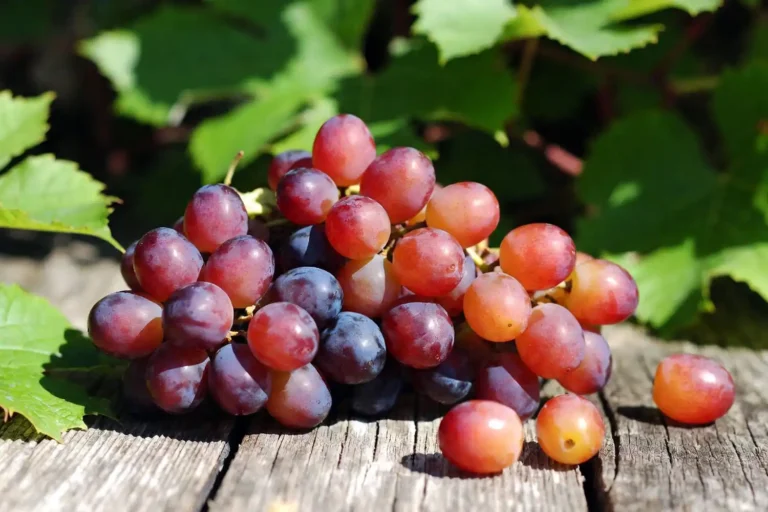
What Are Scuppernong Grapes? Cultivars, Care, Uses, and Flavor
Southern roadside stands sell bronze grapes by the bucket every September, and most signs just say scuppernong. The word gets used loosely, though. So what are scuppernong grapes, really? They are a specific bronze muscadine, and the name now covers a whole color group.
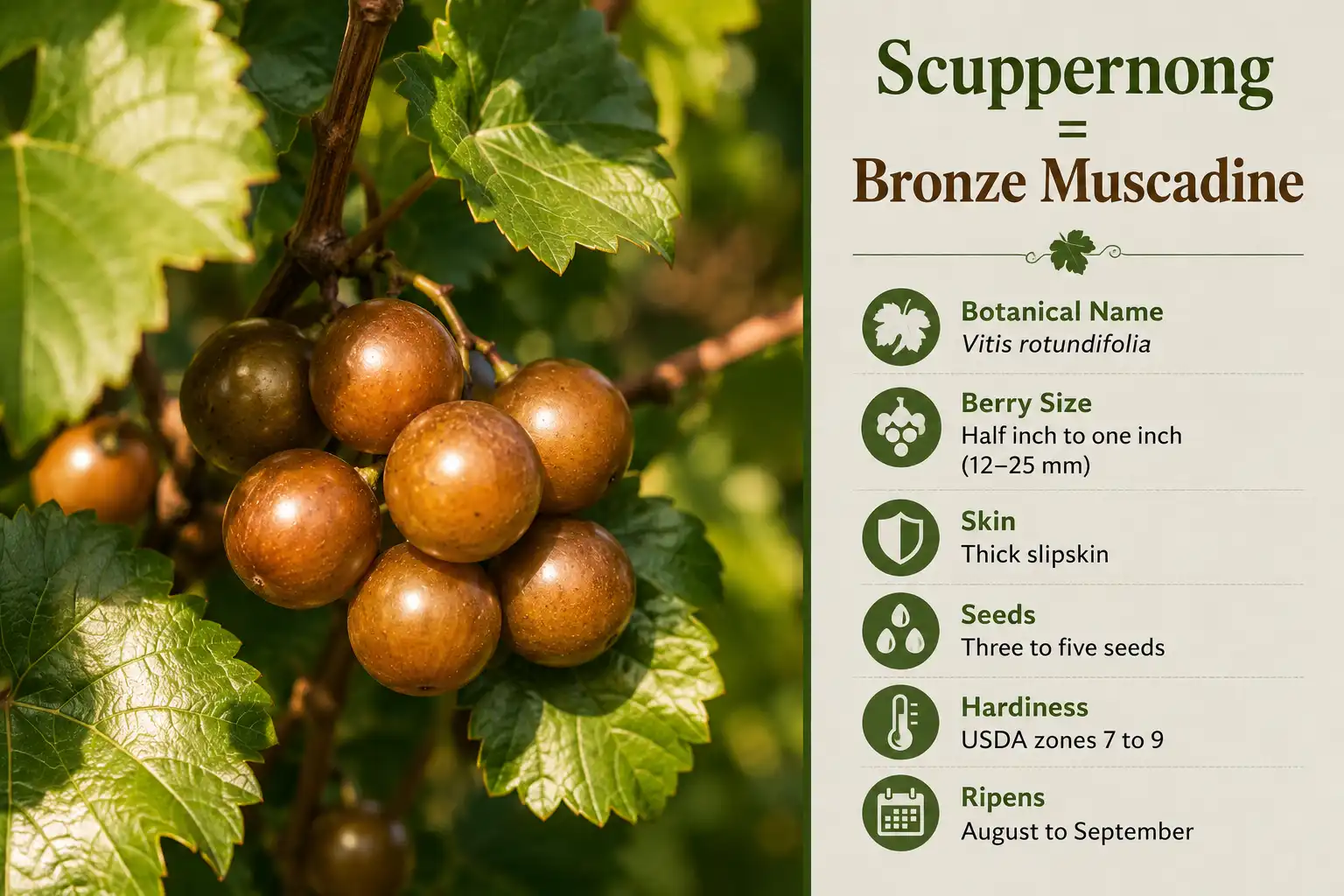
Scuppernong grapes are bronze muscadines, Vitis rotundifolia, native to the Southeast. Scuppernong names one old cultivar from North Carolina, but Southerners now call every bronze muscadine a scuppernong. Berries run large, thick skinned, seeded, and sweet.
What Are Scuppernong Grapes, Exactly?
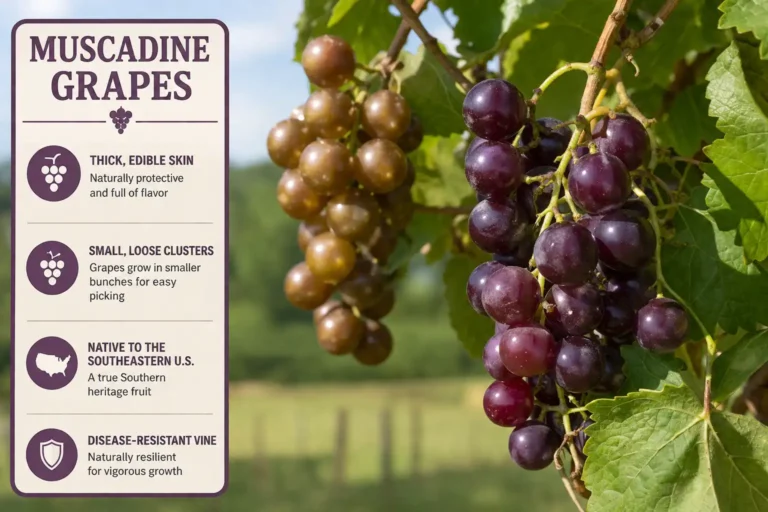
Scuppernong grapes are bronze skinned muscadines, a grape species native to the Southeastern United States. Botanists list them as Vitis rotundifolia, and some references use Muscadinia rotundifolia instead. Either way, the species sits apart from the European wine grape. It also differs from the American bunch grapes northern growers know.
The plant is a vine, but it does not behave like a bunch grape. Fruit forms in small loose groups of roughly four to ten berries rather than tight clusters. Each berry is round, thick skinned, and seeded. Skins slip off the pulp easily, which is why Southerners eat them the way they do.
Two features separate scuppernongs from the rest of the family. First, color. They are bronze, gold, or green gold instead of the usual black. Second, size. The original wild selection carried noticeably bigger berries than the vines growing around it.
Is a Scuppernong the Same as a Muscadine?
Every scuppernong is a muscadine, but not every muscadine is a scuppernong. Scuppernong started as the name of one cultivar, then spread to cover all bronze muscadines regardless of actual variety.
NC State Extension calls that usage incorrect nomenclature, and technically it is. In practice, though, the wider meaning won. Walk into a Georgia farm stand, ask for scuppernongs, and you get bronze fruit that is probably Carlos or Tara. Dark skinned muscadines picked up their own old names instead: bullis, bullace, bull grape, and bullet grape.
So read the word by context. Bronze muscadine at a market means scuppernong in everyday speech. Scuppernong in a nursery catalog means the actual 1700s cultivar. The broader muscadine grape family covers both colors and every cultivar in between.
Where the Scuppernong Name Came From
The name traces to the Scuppernong River in northeastern North Carolina. That river name came from the Algonquian word askuponong, meaning place of the askupo, or sweet bay tree. Settlers applied it to the river, to Scuppernong Lake (now Lake Phelps), and to a nearby settlement around 1811.
The grape itself turned up earlier. Isaac Alexander selected a bronze vine from the wild in Tyrrell County, North Carolina, sometime before 1760. Growers first called it the Big White Grape, and also the Roanoke grape. The Scuppernong name attached later, borrowed from the country it came out of.
That history makes it the first grape actively cultivated in the United States. Thomas Jefferson ordered a 30 gallon barrel of scuppernong juice in 1823. By the 1840s, North Carolina had a national reputation for muscadine wine. The state’s General Assembly then named the scuppernong its official state fruit in 2001.
The Mother Vine on Roanoke Island
The Mother Vine near Manteo, North Carolina, is the oldest cultivated grapevine in the country. Estimates put it past 400 years old. Its trunk measures more than two feet thick. The canopy sprawls across a large stretch of a private yard on Roanoke Island.
Nobody knows exactly who planted it. Croatoan people may have tended wild vines on that spot, or early English colonists may have set it. Either way, the vine still sets fruit, and it still ripens bronze scuppernongs every year.
What Do Scuppernong Grapes Look Like?
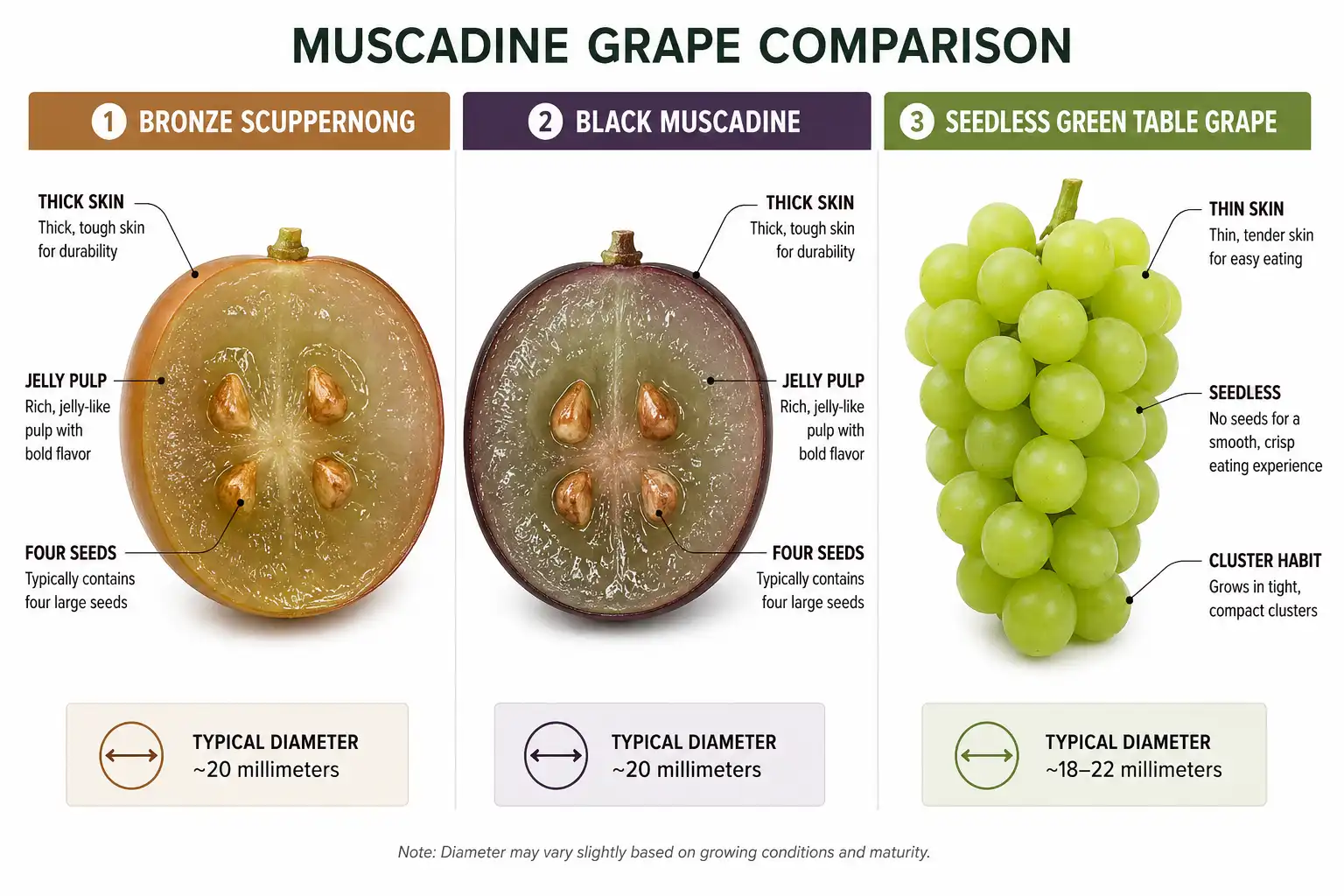
Scuppernong grapes are round bronze to green gold berries, roughly half an inch to one inch across. The skin is thick and tough. Inside, the flesh is soft and almost jelly like, and each berry usually holds three to five hard seeds.
Berries never hang in the long tapered bunches you see on table grapes. Instead, they sit in small loose groups along the shoot, and they ripen unevenly within that group. Ripe fruit drops free with a light pull.
Leaves help with identification too. Muscadine leaves are small, glossy, rounded, and coarsely toothed, often with three shallow lobes. Bark starts smooth and greenish brown on young wood, then turns dark and vertically grooved as the vine ages.
UGA trials at Tifton, Georgia, measured the true Scuppernong cultivar at about 5.1 grams per berry and 20 millimeters across. Newer bronze cultivars beat that easily. Fry averaged 12.7 grams and 27 millimeters in those same plots.
What Do Scuppernong Grapes Taste Like?
Scuppernongs taste sweet with a tart edge, carried by a strong musky, floral aroma that no table grape has. The sugar sits in the pulp. Skins hold most of the tannin, so they read tart and slightly bitter on their own.
Most people eat them one berry at a time. Put the whole grape in your mouth, then press the pulp out of the skin. Spit the seeds and decide about the skin. Some folks chew and swallow it. Others toss it. Both habits are normal across the South.
Now the honest part about the original cultivar. UGA rated Scuppernong at roughly 12.8 percent soluble solids in Tifton trials, which is low for a muscadine. Fry reached 15.3 percent in the same plots. UGA describes the old cultivar’s flavor as acidic, and it does not recommend planting it in new vineyards. Bronze fruit sold as scuppernong today usually tastes sweeter, because it is a newer cultivar wearing an old name.
Where Do Scuppernong Grapes Grow?
Scuppernongs grow across the Southeast, from Virginia and the Carolinas south through Florida and west into east Texas. The species is native to that region. It shrugs off the heat, humidity, and heavy summer rain that make European wine grapes nearly impossible to farm there.
Cold sets the northern limit. Mississippi State Extension reports vine injury at winter lows near 0°F. It also advises against planting where temperatures regularly drop below 10°F. USDA hardiness zones 7 through 9 cover the dependable range, with zone 10 workable in Florida. A few tougher cultivars push farther north. Carlos, Magnolia, and Sterling reach Virginia and the Blue Ridge foothills.
Scuppernongs are not a Kansas crop. In winter lows run past what these vines tolerate. A vine that survives one mild winter dies in the next normal one. Everything below on growing them comes from Southeastern land grant research.
When Are Scuppernongs Ready to Pick?
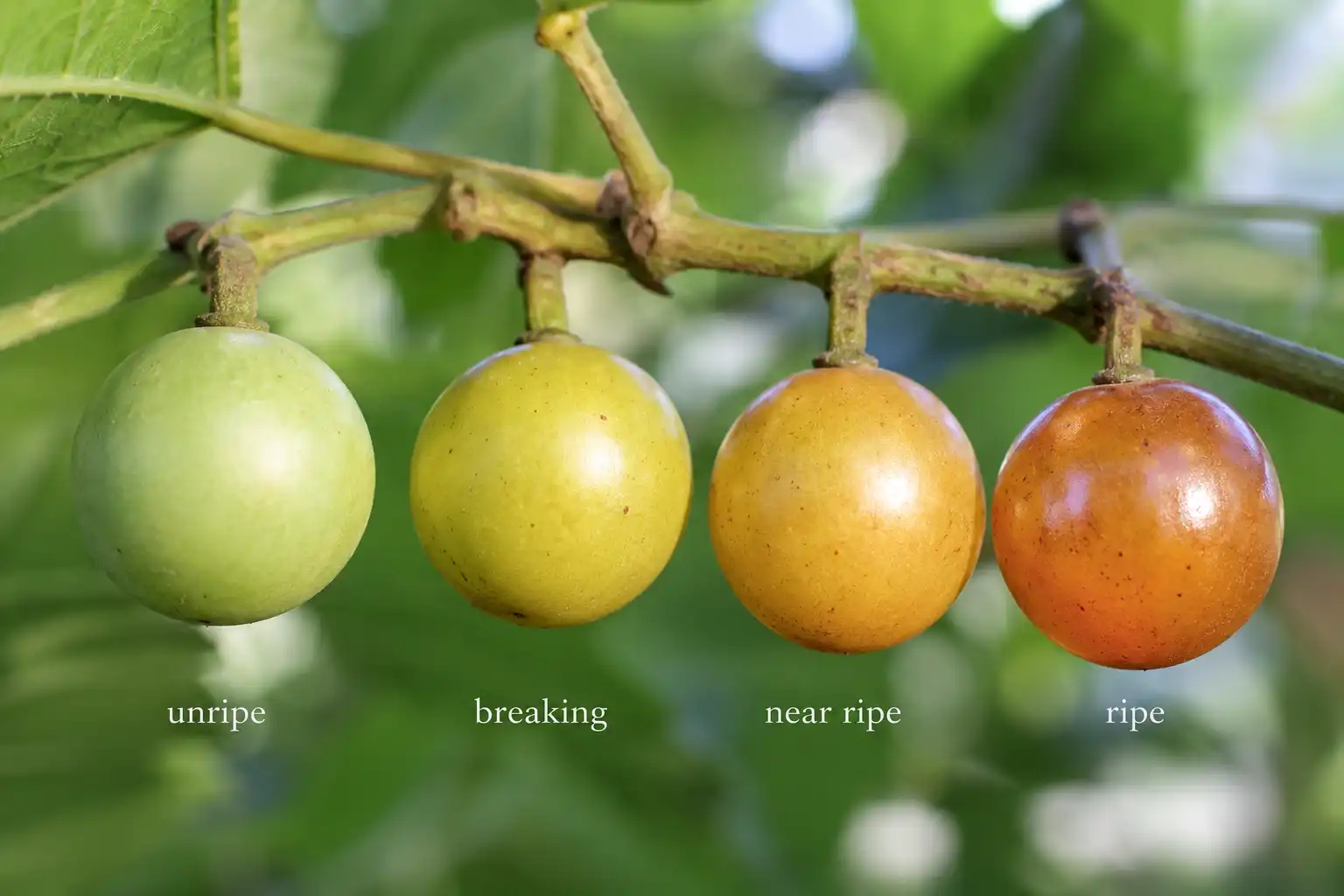
Most scuppernongs ripen from late August through September. South Georgia growers start picking the earliest cultivars in the last week of July. Late types hang into October, and any single vine ripens in waves across several weeks.
Watch color first. Bronze fruit shifts from hard green to gold, then to amber, and the berry softens slightly under thumb pressure. Taste confirms it. A ripe scuppernong tastes sweet and full with no green edge left.
Sugar gives you a hard number. Fresh market muscadines should reach at least 15 degrees Brix. A refractometer for checking Brix at harvest takes the guessing out. Remember that muscadines are non climacteric. They do not sweeten after picking, so pick them ripe or not at all.
Then pick every two to five days once the vine starts. A dry stem scar means the berry separates cleanly. That fruit holds about a week in the refrigerator at 35°F to 45°F. Wet scar fruit has to be processed fast. The full muscadine harvest window by region shifts with cultivar and weather. So track your own vines instead of a calendar.
Can You Grow Scuppernong Grapes at Home?
Yes, provided you sit in zone 7 or warmer with a long, hot growing season. Muscadine vines are actually easier than bunch grapes in the South, mostly because of built in disease resistance. This walkthrough on growing muscadine vines through harvest covers the full cycle. The points below are the ones that decide success or failure with a bronze vine.
Pollination Comes First
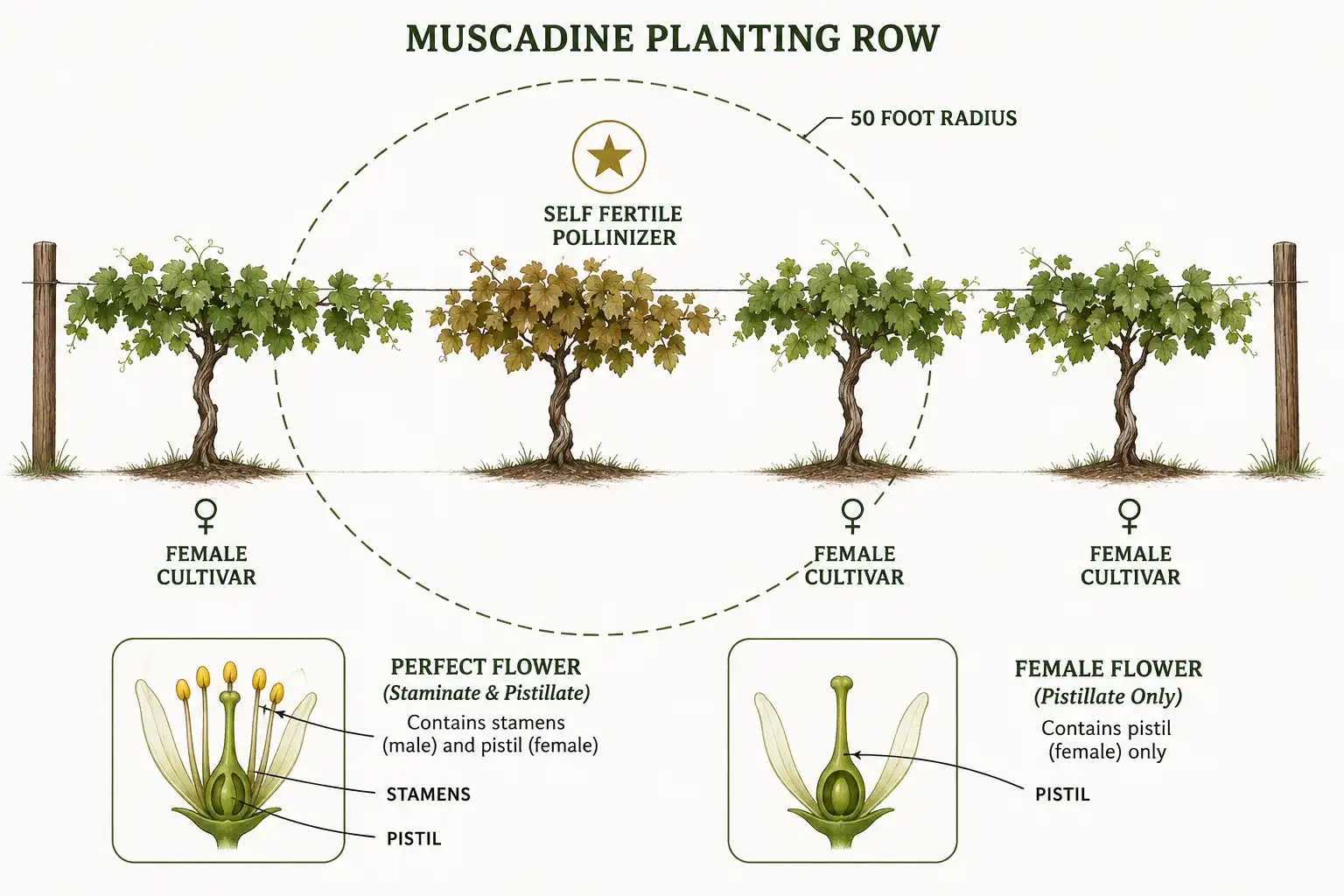
Check flower type before you buy anything. Scuppernong is a female cultivar, so it carries only female flower parts and cannot set fruit alone. It needs a perfect flowered, self fertile muscadine within about 50 feet to pollinate it.
This single detail is the top reason home vines never fruit. Somebody buys one vine labeled Scuppernong, waits four years, and gets bloom after bloom with no grapes. One self fertile vine will pollinate roughly three female vines. In a larger planting, set a pollinizer at least every third vine in every third row.
Site and Soil
Pick full sun and good internal drainage. Shade for more than a few hours a day cuts fruit set sharply. Vines fail outright where water stands after heavy rain, and hardpan sites are out.
Test the soil, then work in dolomitic lime to bring pH near 6.5 before planting. Muscadines handle a wide soil range as long as water moves down through it. Avoid ground with more than 1.5 percent organic matter, because late season growth on rich soil invites winter injury.
Spacing and Trellis
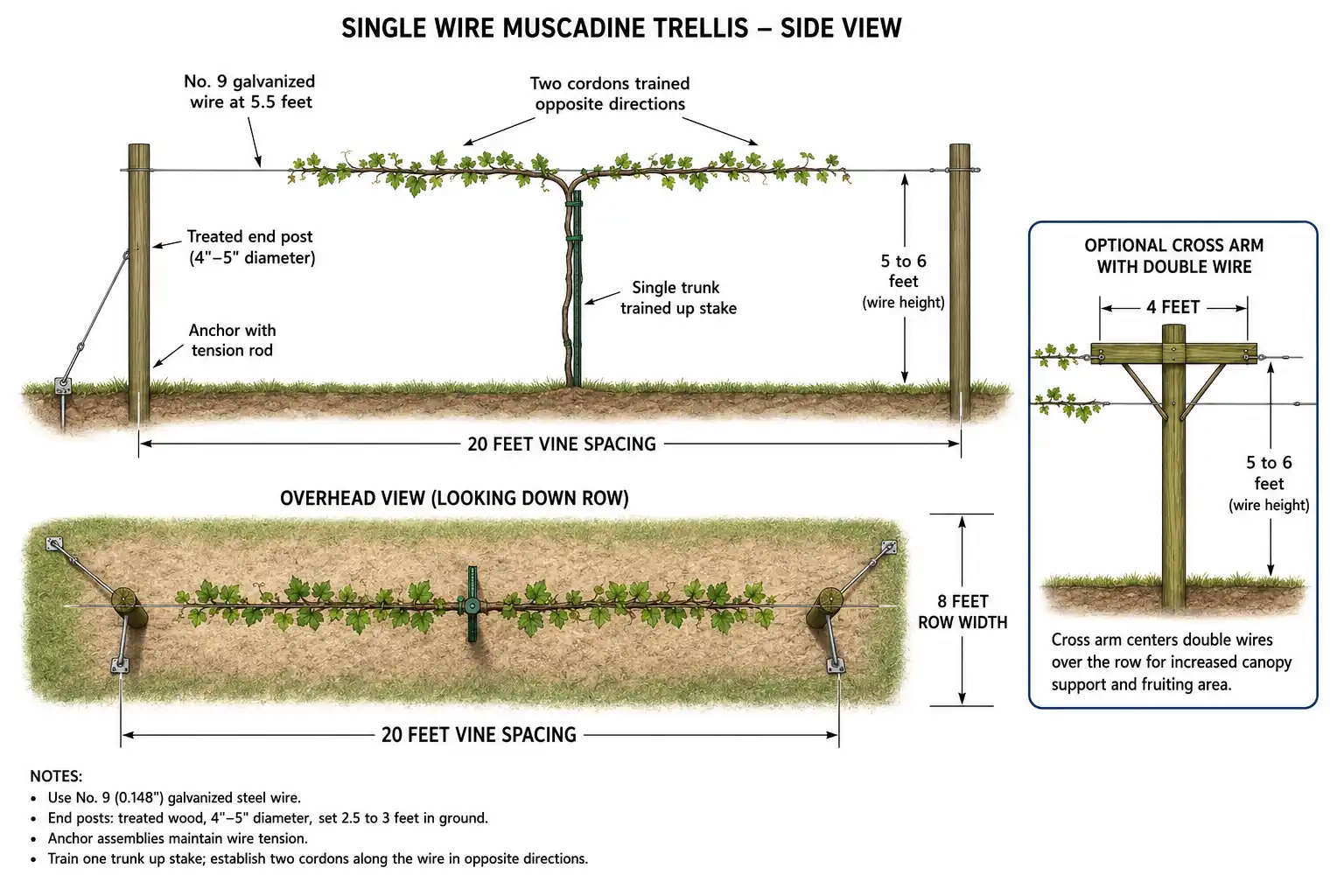
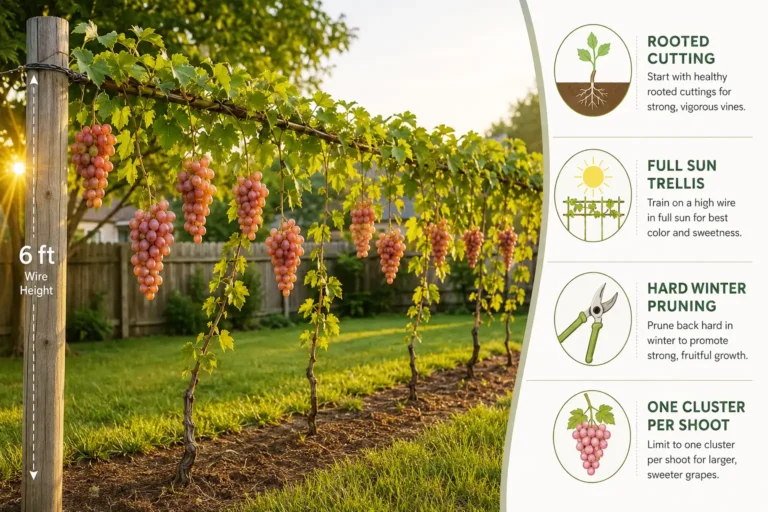
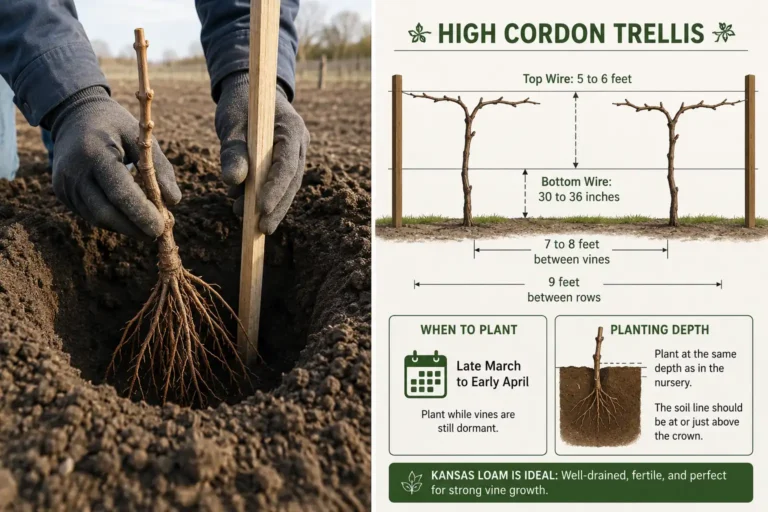
Build the trellis before the vine ever goes in the ground. NC State recommends a single No. 9 wire, 5 to 6 feet above the ground, anchored well at both ends. Add 4 foot treated cross arms for a double wire and yields climb about 30 percent.
Space vines 10 feet apart in the row at minimum, though 20 feet is better. Leave at least 8 feet between rows, or more if you mow with a tractor. Each mature vine wants a footprint near 10 feet long by 6 feet wide.
Skip woven wire fencing and decorative arbors unless you can hold the cordons at least 4 feet apart. Both look fine in year one. Both become nearly impossible to prune by year five.
Training and Pruning
Cut the new plant back to one stem with two or three buds. Then select the strongest shoot, tie it loosely to a stake, and strip side shoots weekly. Aim to reach the wire in the first season and to fill both cordons in the second.
After that, the vine runs on an annual spur schedule. Cut lateral shoots back to two or three buds every dormant season, either by hand or with a hedge trimmer. Those buds carry next year’s fruiting shoots. Muscadines follow the same general rules for when to prune grapevines each winter. Both types fruit on current season wood.
Fertilizer and Nutrients
Follow the NC State schedule for young vines. Apply a quarter pound of 10-10-10 in an 18 inch circle after planting. Then repeat every six weeks until early July. Double that rate in year two and split it across early March, May, and July. Keep granules at least 21 inches off the trunk.
Mature vines take 1 to 2 pounds of 10-10-10 scattered under the canopy in early to mid March. Add another pound in mid June. Watch average new shoot growth. If it passes 3 to 4 feet in a season, cut next year’s rate by 20 percent.
Grapes also pull heavy magnesium. Epsom salts in July prevents deficiency. Use 2 to 4 ounces per young vine, or 4 to 6 ounces per mature vine. Boron helps on sandy, high pH ground. Spread 2 tablespoons of borax over a 20 by 20 foot square every two or three years. Do not exceed that rate, because excess boron injures vines.
Pests and Diseases
Muscadines carry real resistance to Pierce’s disease, caused by Xylella fastidiosa, and to phylloxera. That resistance is exactly why the crop works across the Southeast where Vitis vinifera cannot survive. Still, resistant does not mean trouble free.
Fungal problems land anyway. Extension pathologists name six main targets. Those are angular leaf spot, black rot, bitter rot, ripe rot, macrophoma rot, and powdery mildew. Mississippi State advises starting a preventive fungicide program in the second or third year after planting. Growers who skip sprays often coast through dry seasons, then lose most of the crop in a wet one.
Animals cost more than disease in many yards. Birds, deer, raccoons, and opossums all work bronze fruit hard as sugar climbs. Japanese beetles chew foliage. Netting handles the birds, while planting away from woodland edges cuts mammal pressure considerably.
Should You Plant Scuppernong or a Newer Bronze Cultivar?
Plant a newer bronze cultivar. UGA does not recommend Scuppernong for new vineyards, and its trial data shows why. In Tifton plots, the old cultivar produced only 40 percent of a full crop. It also ripened late and unevenly, with just 60 percent dry stem scar.
The old vine does hold one advantage. Clemson Extension rates Scuppernong as very cold hardy, which matters on the northern fringe of muscadine country. On berry size, sugar, and yield, though, the modern bronzes win on every measured count.
UGA’s muscadine breeding program at Tifton started in 1909 and has released more than 30 cultivars since. Current work targets large berries on perfect flowered vines, wider harvest windows, dry stem scars, crisp flesh, and thinner skins. RubyCrisp, a Supreme by Tara cross, is one recent release built for fresh eating.
| Bronze cultivar | Flower type | Berry size | Season | Cold hardiness | Best use |
|---|---|---|---|---|---|
| Carlos | Self fertile | Small to medium | Mid | Good | Juice, wine, jelly |
| Doreen | Self fertile | Small to medium | Late | Good | Juice, wine |
| Magnolia | Self fertile | Small to medium | Mid | Good | Wine, fresh |
| Triumph | Self fertile | Medium | Early | Good | Fresh eating |
| Tara | Self fertile | Medium to large | Early to mid | Below average | Fresh eating |
| Late Fry | Self fertile | Large | Late | Very good | Fresh eating |
| Granny Val | Self fertile | Large | Late | Unrated | Fresh, pick your own |
| Hall | Self fertile | Medium to large | Early | Below average | Fresh eating |
| Fry | Female | Medium to large | Mid | Poor | Fresh market |
| Summit | Female | Large | Mid | Good | Fresh eating |
| Scuppernong | Female | Small | Late | Very good | History, novelty |
Carlos holds most of North Carolina’s commercial bronze acreage. It also doubles as a pollinizer for any female vine planted near it. That makes it a practical anchor in a small planting.
Are Scuppernong Grapes Good for You?
Scuppernongs are a solid fruit choice with no fat, cholesterol, or sodium. NC State Extension lists them as an excellent source of manganese and a good source of fiber. One serving runs about a half cup, or roughly 16 grapes.
The valuable chemistry sits in the skin and seed. Muscadine skins and seeds hold high concentrations of polyphenols, including ellagic acid, gallic acid, tannins, and flavan-3-ols. Those are precisely the parts most people spit out.
Be careful with resveratrol claims, though. Some sources credit muscadines with unusually high resveratrol. Published analyses of muscadine skin and seed extracts often find that fraction low or undetectable. Total polyphenol content is genuinely high. The specific resveratrol story is weaker than the supplement marketing suggests.
None of that makes scuppernongs medicine. Treat them as a good fruit with a strong antioxidant profile. Eat the skins when you can stand the texture.
What Do You Do With Scuppernong Grapes?
Jelly is the classic answer, and it works because muscadine skins carry natural pectin along with plenty of acid. Wine comes next. Duplin Winery in North Carolina and dozens of small Southern wineries built their business on bronze muscadine wine.
Past those two, the list runs long. Hull pies use the skins after the pulp gets cooked and strained. Juice freezes well. Preserves, syrup, and cobbler all handle the musky flavor fine. Fresh eating works if you picked a modern large berried bronze rather than the old cultivar.
Storage stays short either way. Dry scar fruit holds about a week in the refrigerator at 35°F to 45°F. Wet scar fruit needs processing within a day or two. The berries never sweeten off the vine. So sort the greenest ones out, then send them to cooked products where sugar gets added anyway. Most families hit their fresh eating limit fast. After that, there are plenty of ways to use muscadine grapes after picking.
What to Check Before You Buy a Scuppernong Vine
Three things settle it. Check your winter lows first, because anything colder than zone 7 puts these vines at risk most years. Then check flower type, since a lone female vine will bloom for a decade and never fruit. Last, decide whether you want the original cultivar or better fruit, because those are two different purchases.
For most growers the answer is a self fertile bronze such as Carlos, Triumph, or Tara. Put it on a single wire trellis and spur prune it every winter. You still get the bronze color, the musky aroma, and the September harvest that everybody means when they say scuppernong.