How to Care for a Corn Plant: A Full-Season Guide (2026)
Corn is not fussy, but it is demanding. It wants sun, water, and food on schedule, and it punishes you when any run short. Once you know how to care for a corn plant week by week, the rest is just showing up.
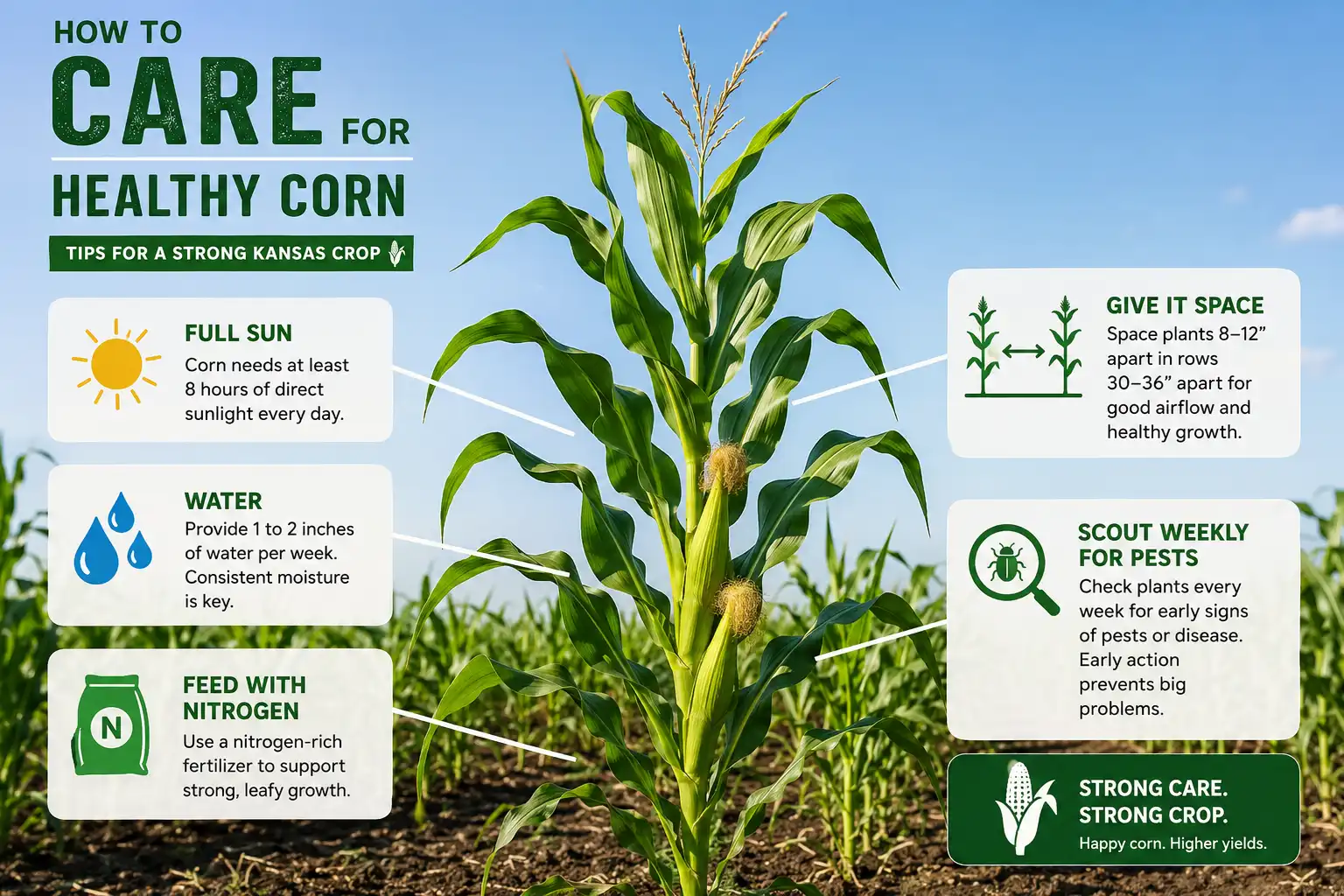
To care for a corn plant, give it full sun, steady water, and plenty of nitrogen. Space plants for airflow, weed early, scout for pests, and water hard through tasseling so every ear fills out.
What a Corn Plant Needs to Grow Well
Corn is a fast, hungry, sun-loving grass. Give it five things and it thrives. Skimp on any one and yield slips.
The short list to work from:
- Full sun, at least 6 to 8 hours a day
- Warm, loose, fertile soil that drains well
- About an inch of water a week, more at pollination
- Steady nitrogen, timed to the growth spurt
- Enough space and a clean, weed-free start
Everything below is just those five needs, handled at the right moment. The season really begins the day you get corn planted from seed to emergence. Still, what you do afterward decides the crop.
Start With Full Sun and Warm, Rich Soil
Corn will not forgive shade. It needs at least 6 hours of direct sun, and 8 or more gives you taller stalks and fuller ears. Sunlight is what the plant turns into sugar and grain. A shaded patch leaves you with thin stalks and small cobs.
Soil is the other half of a strong start. Corn roots spread wide and dig down past 18 inches, so they need loose ground that drains freely. Before planting, compost or aged manure should be turned in. That builds organic matter and holds moisture through a dry Kansas July.
Two soil numbers matter most. Keep pH between 6.0 and 6.8, because below that range phosphorus locks up where roots cannot reach it. Then wait for soil to hit 60°F before you sow, since cold ground rots seed and stalls early growth. A cheap soil test settles both questions before you spend on fertilizer.
Phosphorus is critical during corn’s first few weeks, which is why many growers apply DAP fertilizer as a starter at planting to support strong root development.
Give Every Plant Room to Grow
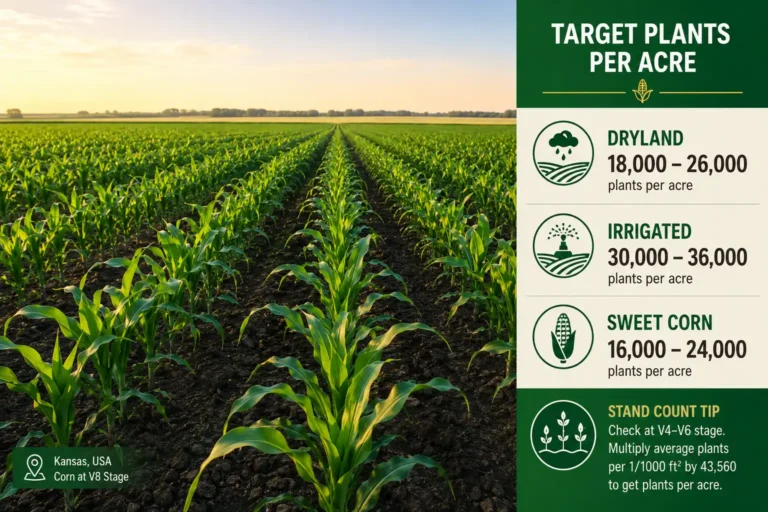
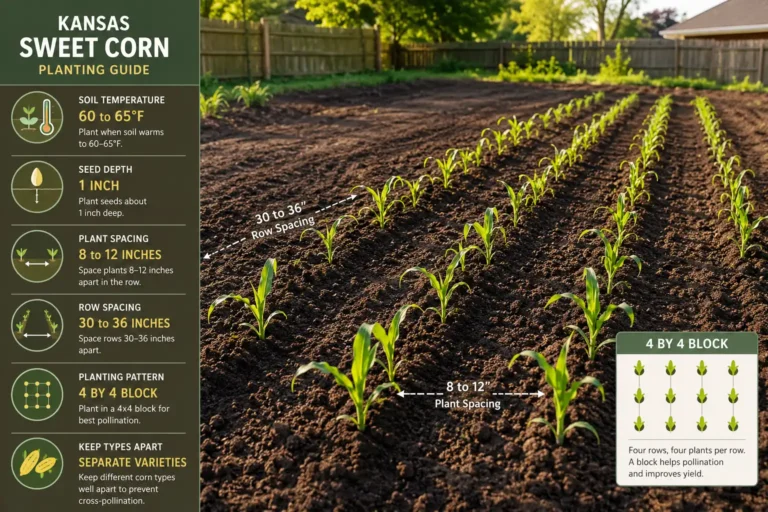
Crowded corn makes small ears. Thin or space plants 8 to 12 inches apart in the row, with rows 30 to 36 inches apart. That spacing gives each stalk room for roots, light, and airflow.
If you direct-sow, drop a few extra seeds. Then thin to the strongest once seedlings reach 4 to 6 inches tall. Pull the weak ones early so the keepers never compete. In tight gardens, plant in hills of four or five seeds about 3 feet apart. Thin to the best three per hill.
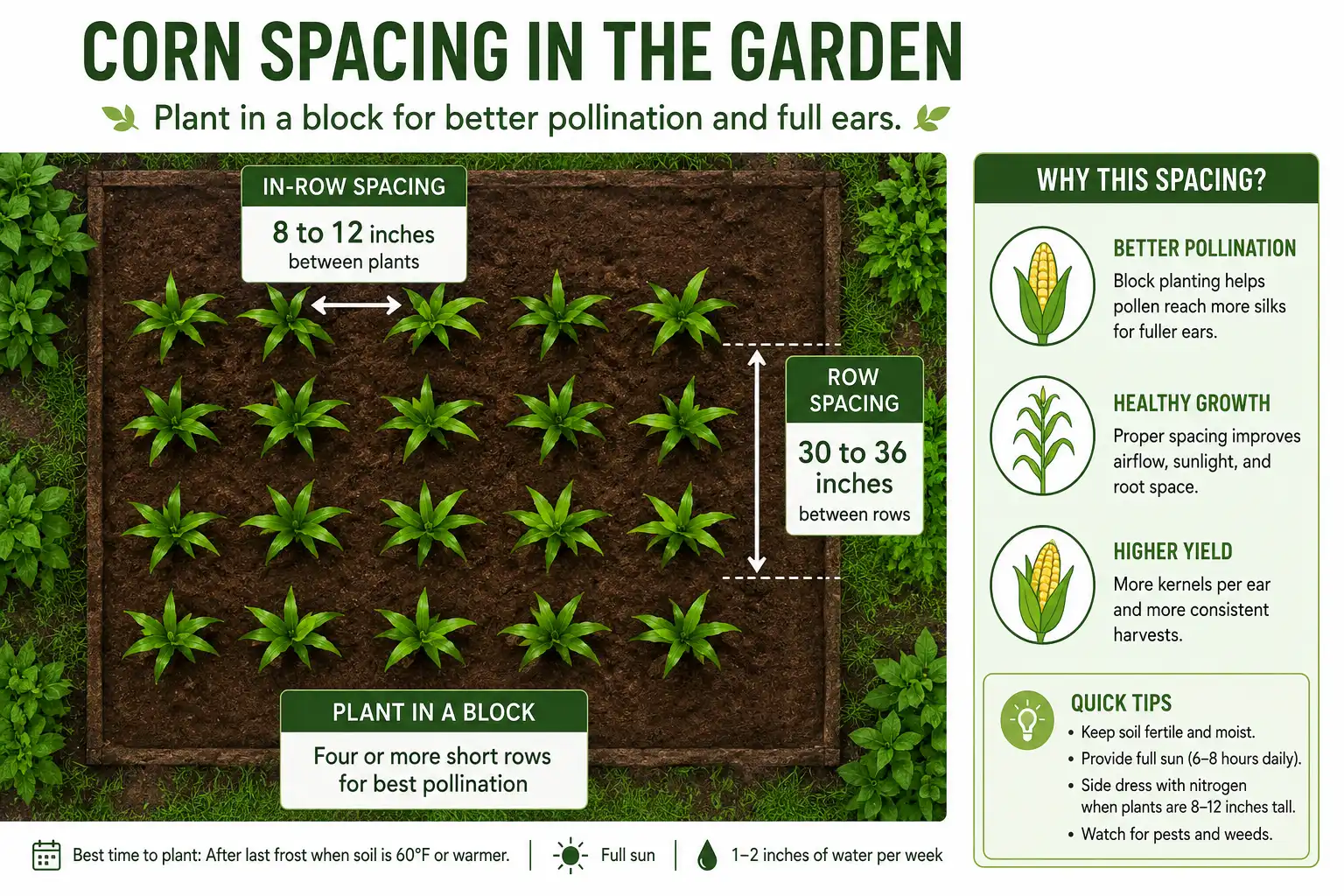
Airflow matters more than folks think. Plants packed too close trap humidity, which invites leaf disease, and they shade each other into spindly stalks. On rich, well-watered ground, the 8 to 10 inch end is favored. In thin or dry soil, 10 to 12 inches with feeding on schedule is recommended.
How Often Should You Water Corn?
Corn needs about an inch of water a week early, rising to 1.5 to 2 inches during tasseling and silking. Across a full season it drinks 22 to 30 inches, counting rain.
The amount tracks the plant’s size and stage:
- Seedling to knee-high (VE to V6): half an inch to an inch a week
- Fast growth (V6 to tassel): about 1 to 1.5 inches a week
- Tasseling and silking (VT to R1): 1.5 to 2 inches a week
- Grain fill to maturity (R2 to R6): ease off as the ears harden
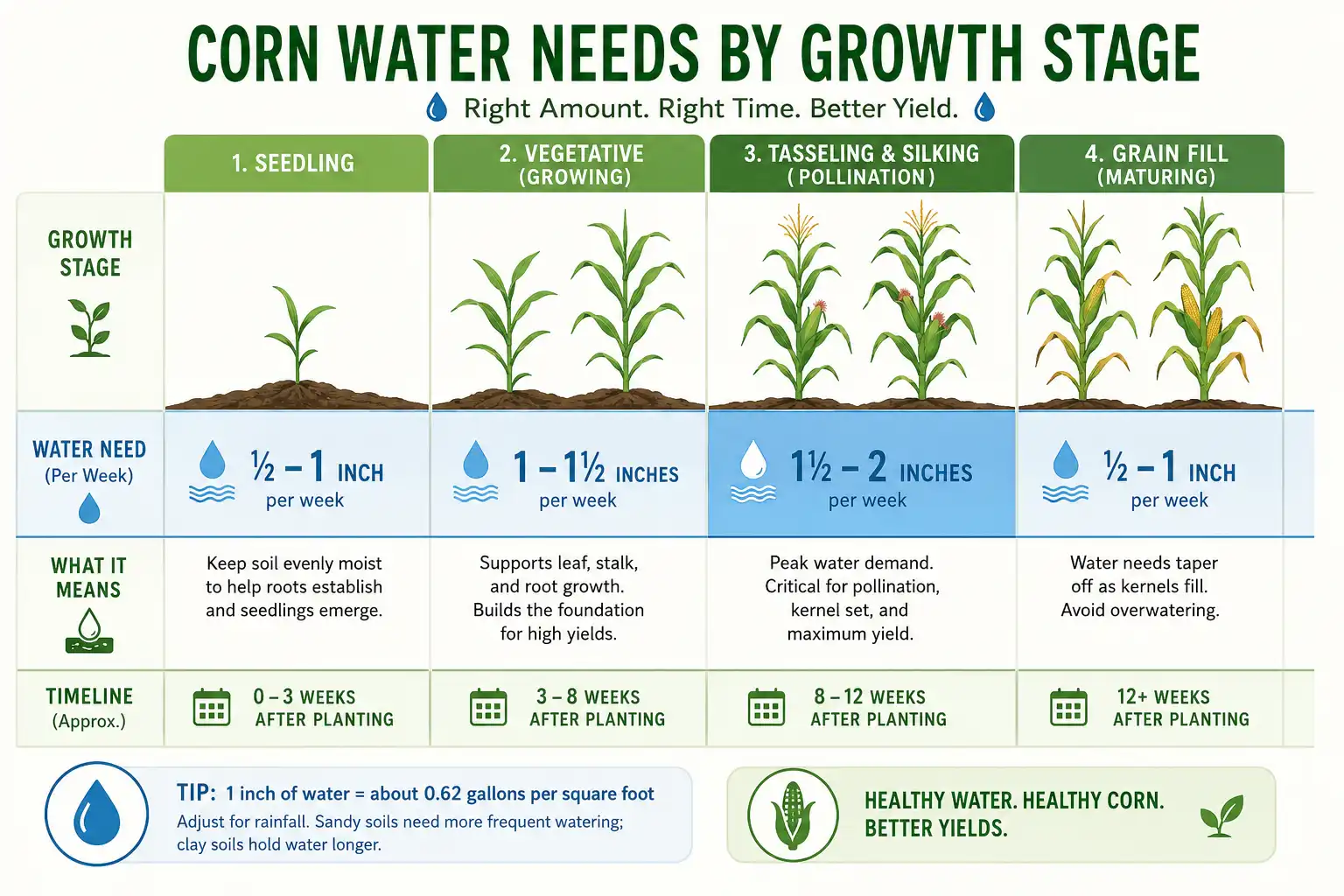
One stretch outweighs the rest: the week before tassel through about three weeks after. The plant pollinates and sets its kernels then. A few dry days can wither the silks and blank out the kernels. Because of that, keep the soil moist right through that window even when it means running the irrigation.
Water deep and less often, not light and daily. Deep soakings pull roots down where moisture lasts through heat. When leaves roll up on a hot afternoon, the plant is short on water. A quick recovery by evening means little yield lost. Check moisture 6 inches down before you decide to water.
Feeding Corn: Time the Nitrogen Right
Nitrogen is what corn wants most, backed by phosphorus and potassium. Feed it in two rounds instead of all at once, since timing decides how much the plant actually uses.
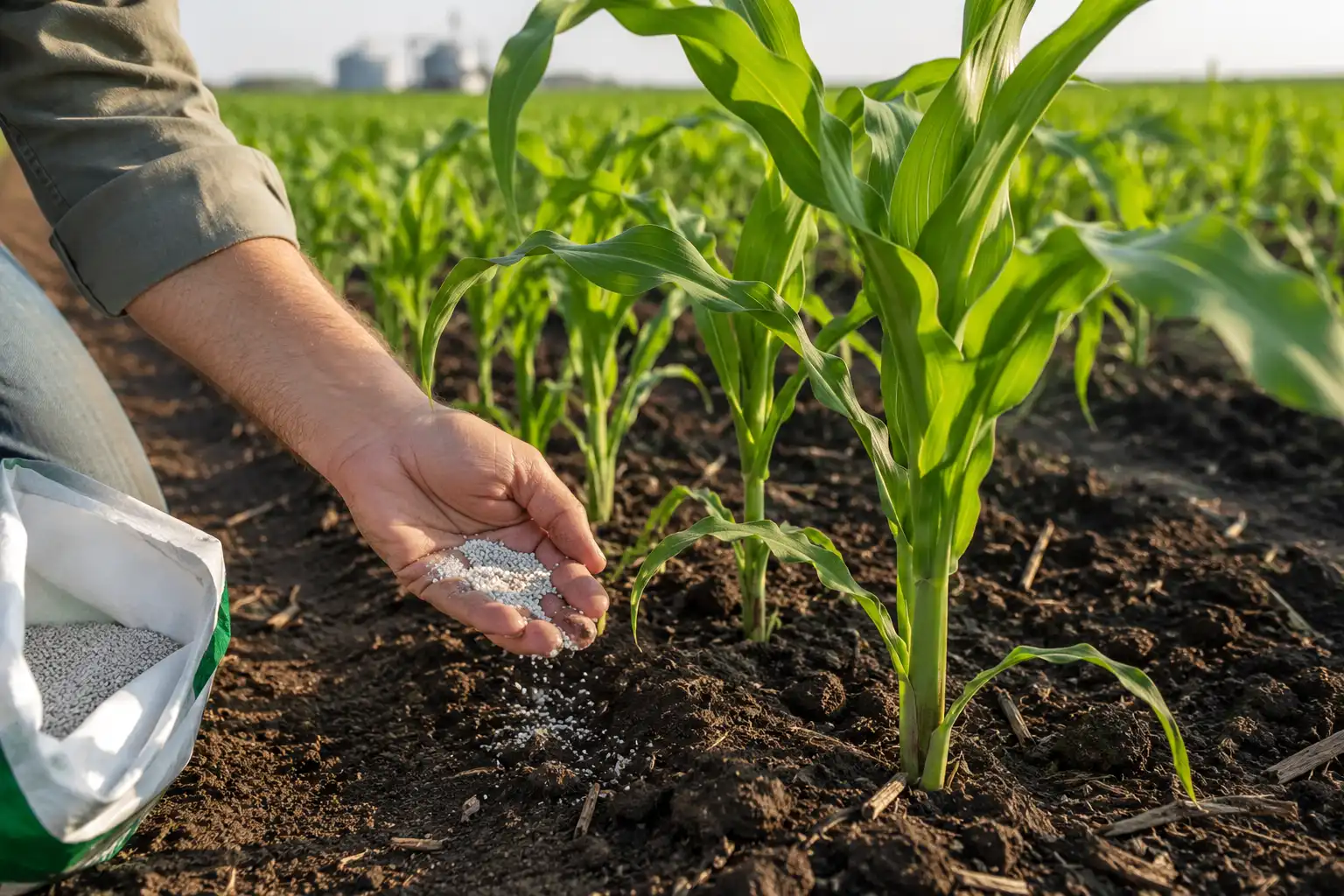
For a garden patch, work a balanced fertilizer or compost into the bed before planting. Then side-dress with a nitrogen-rich feed when plants stand about knee-high, and again as the tassels push out. Watering it in carries the nitrogen down to the roots.
The timing is not guesswork. A corn plant takes up barely a tenth of its nitrogen before the six-leaf stage. Then it grabs more than half of its total between six leaves and tasseling. Feed ahead of that surge and the plant has what it needs. Feed late and you leave yield in the field. At field scale, a little is applied at planting. Sidedress the rest by V4 to V6, leaning on anhydrous ammonia or urea.
Let the leaves guide you. Pale lower leaves with a yellow V down the midrib mean the plant is short on nitrogen. Feed it soon. For a full rate-by-rate plan, see this guide on fertilizing sweet corn.
Keep Weeds Down While Corn Is Young
Young corn loses to weeds fast, so the first six weeks are the ones that count. From emergence to about the six-leaf stage is the critical weed-free period. During it, weeds rob the water, light, and nitrogen the crop needs to build its ears. Weeds left through that window can cut yield by half.
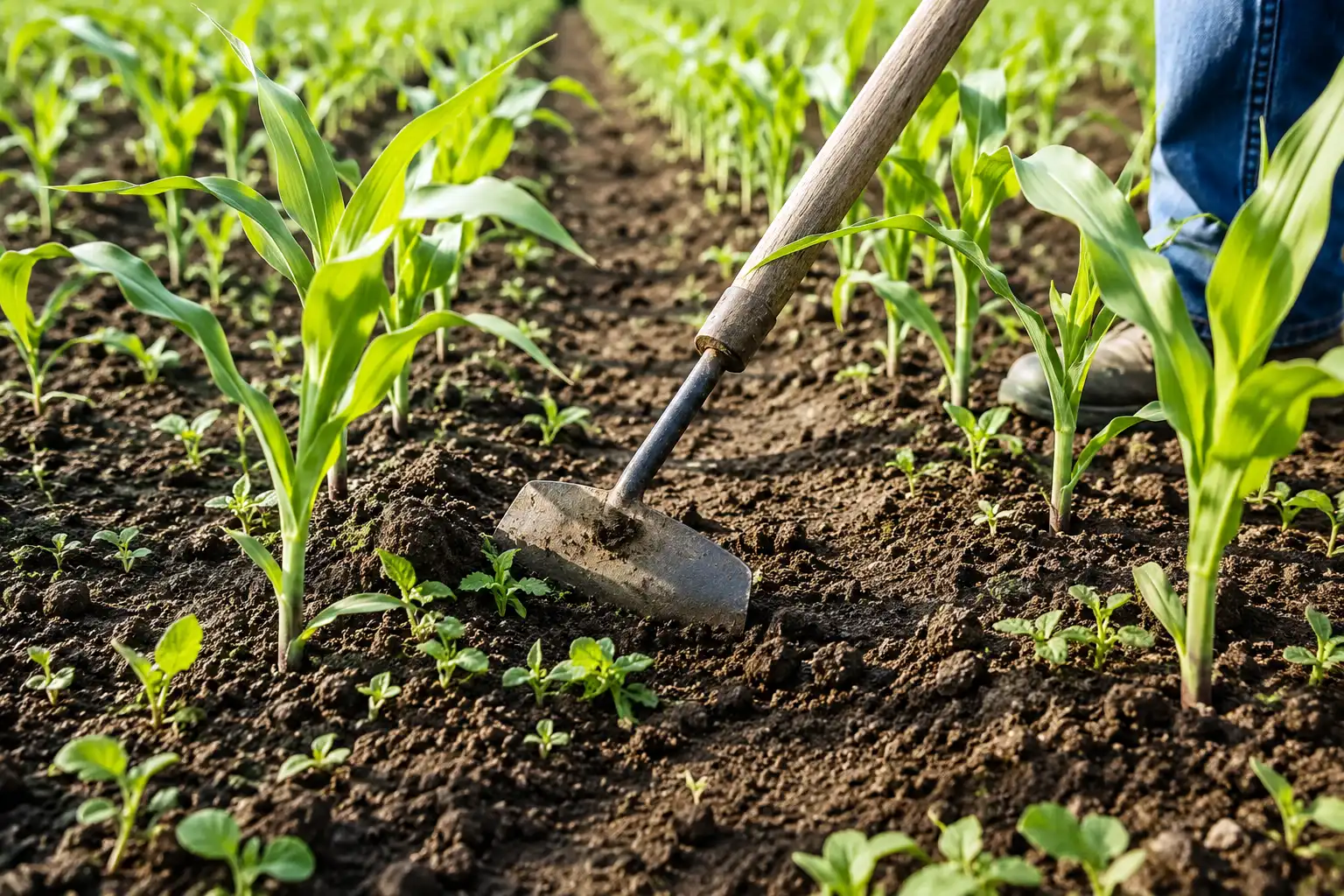
In a garden, hoe or hand-pull while weeds are still tiny. Skim the blade through only the top inch or two of soil. Corn roots ride close to the surface, and deep digging near the row shreds them. A few inches of straw mulch does double duty here, holding moisture while it smothers weed seedlings.
On acres, run a pre-emergence herbicide before weeds break ground, then a post pass if any escape. Glyphosate works on tolerant hybrids, but match the product to your seed and follow the label. Once the canopy closes and corn shades the ground, the crop wins the fight on its own. Until then, your job is to guard it.
Watch for Pests and Disease
Corn draws plenty of pests and a long list of diseases. Walk the rows once a week and check leaves, stalks, and whorls. Catching trouble early costs far less than fighting it late.
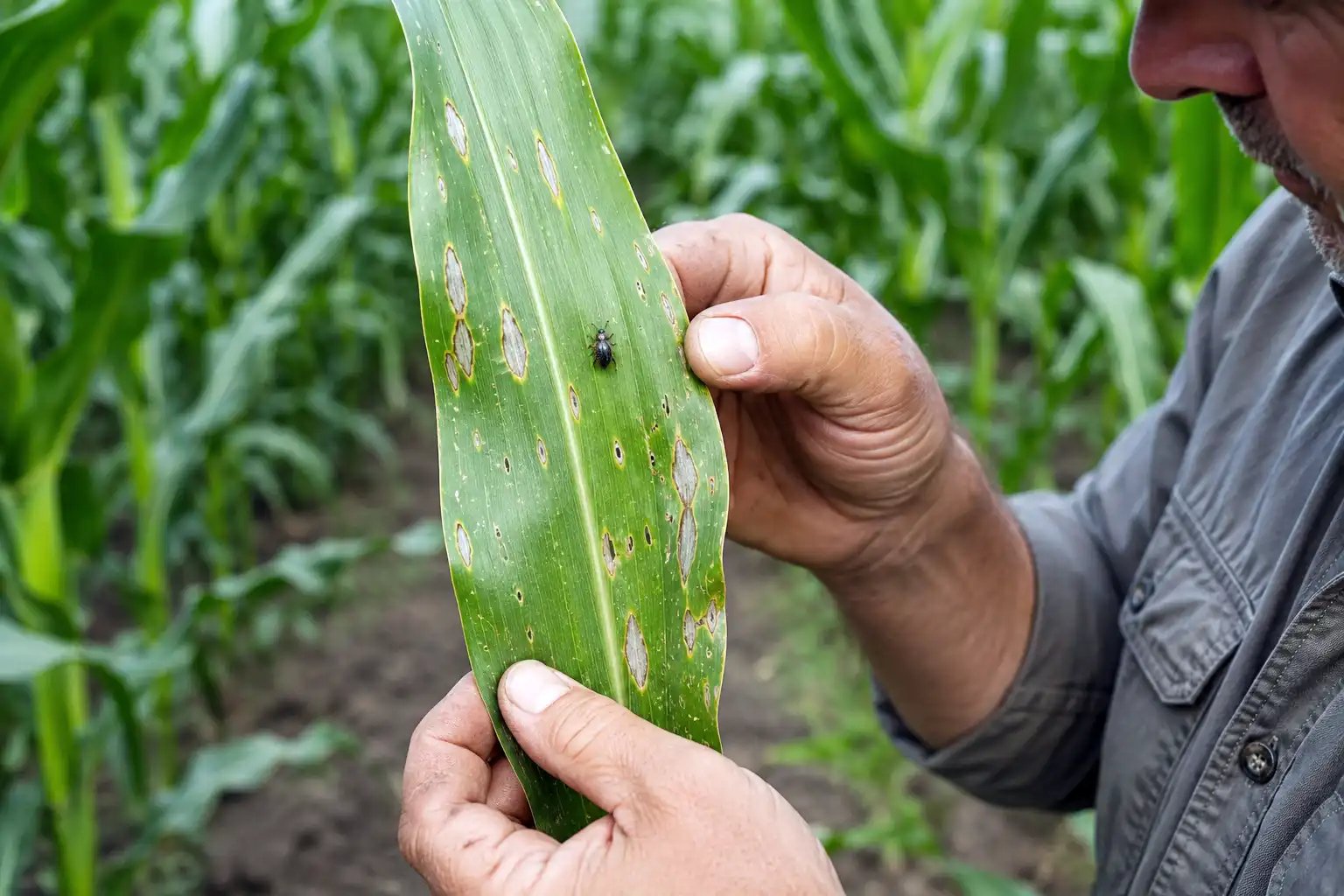
The insects to watch for most:
- Corn rootworm, whose larvae chew roots and topple plants
- European corn borer and fall armyworm, which bore into stalks and ears
- Cutworms, which sever young seedlings at the soil line
- Corn earworm, feeding down inside the ear tip
- Flea beetles and aphids, which also carry disease
On the disease side, gray leaf spot and northern corn leaf blight show as lesions along the leaves. Common rust dots them with rusty pustules. Tar spot has moved fast across the Corn Belt lately, leaving raised black specks that will not rub off. Warm, humid weather feeds all of them.
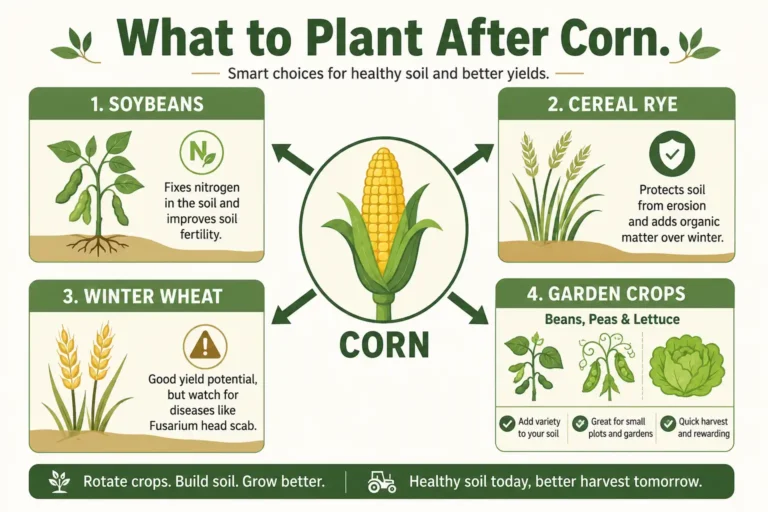
Integrated pest management is the recommended approach. Rotating corn with soybeans breaks pest cycles. Choosing hybrids bred for local disease resistance heads off the worst of it. Clearing old crop residue removes the trash where spores overwinter. After that, scouting should continue, with spraying only when pressure crosses the threshold. For a backyard plot, our notes on controlling crop pests naturally cover the low-spray basics.
Protecting Corn From Frost and Heat
Corn is a warm-season crop, and both ends of the thermometer can hurt it. There is good news early on. A young corn plant keeps its growing point below the soil until about the five to six-leaf stage. That buried growing point means a light spring frost usually burns the leaves but does not kill the plant.
After a frost, wait three to seven days before you judge the damage. If the growing point survived, fresh growth pushes up from the whorl and the plant recovers. A hard freeze near 28°F does lasting harm. So does a frost after the growing point rises above ground past V6.
Heat is the summer worry, and it bites hardest at pollination. Once temperatures climb into the mid-90s with dry air, pollen loses its viability and silks dry out. The catch is that heat alone rarely ruins a crop when the soil stays moist. Heat plus drought during silking is the real damage, which is one more reason to keep water steady through tasseling.
Do Corn Plants Need Support?
Corn rarely needs staking, but a little hilling helps it stand through storms. The plant anchors itself with deep roots and with brace roots. Those are the thick roots that grow from the lower stalk into the ground.
To back those brace roots up, pull loose soil around the base once plants reach knee-high. Hilling steadies the stalk and buries small weeds at the same time. It is quick work, and it pays off the first time a Kansas thunderstorm rolls through.
Tall stalks can still lodge, meaning they lean or fall over. Good spacing, even watering, and balanced feeding build sturdier plants that hold up. Crowding and a heavy shot of early nitrogen do the opposite, growing weak, top-heavy stalks that tip. When a plant goes down after a storm but its roots hold, leave it be. Corn often rights itself within a few days as it curves back toward the sun.
Helping Corn Set Full Ears
Full ears come down to good pollination, and good pollination comes down to how you plant. Corn is wind-pollinated. The tassel up top sheds pollen. Each silk on the ear must catch a grain to fill one kernel. Miss that and you get gaps.
Plant in a block, never a single long row. Four short rows side by side let the wind scatter pollen across every silk from all angles. Skip the one long line, because half the pollen just blows off downwind. When the air sits still, hand pollination can help. Snap a tassel and dust the silks in the morning. Alternatively, the stalks can be shaken daily while pollen is falling.
Keep water steady through this stretch too. Heat and drought at silking are the top cause of gappy, half-filled ears. For the full block layout, see this method on planting corn in blocks.
What Care Does a Corn Plant Need at Each Stage?
Care changes as corn grows, and matching the job to the stage keeps you from wasting effort. Corn runs through vegetative stages (V) and reproductive stages (R), and each phase asks for something different.
- VE to V3 (emergence): water lightly and often; guard seedlings from cutworms; keep weeds out
- V4 to V6 (knee-high): side-dress nitrogen; cultivate shallow; hill the base
- V7 to tassel (rapid growth): steady water and nitrogen; scout for leaf disease
- VT to R1 (tasseling, silking): peak water; help pollination; watch for earworm
- R2 to R4 (kernel fill): hold moisture up; protect the ears
- R5 to R6 (dent to maturity): taper the water; let ears dry down
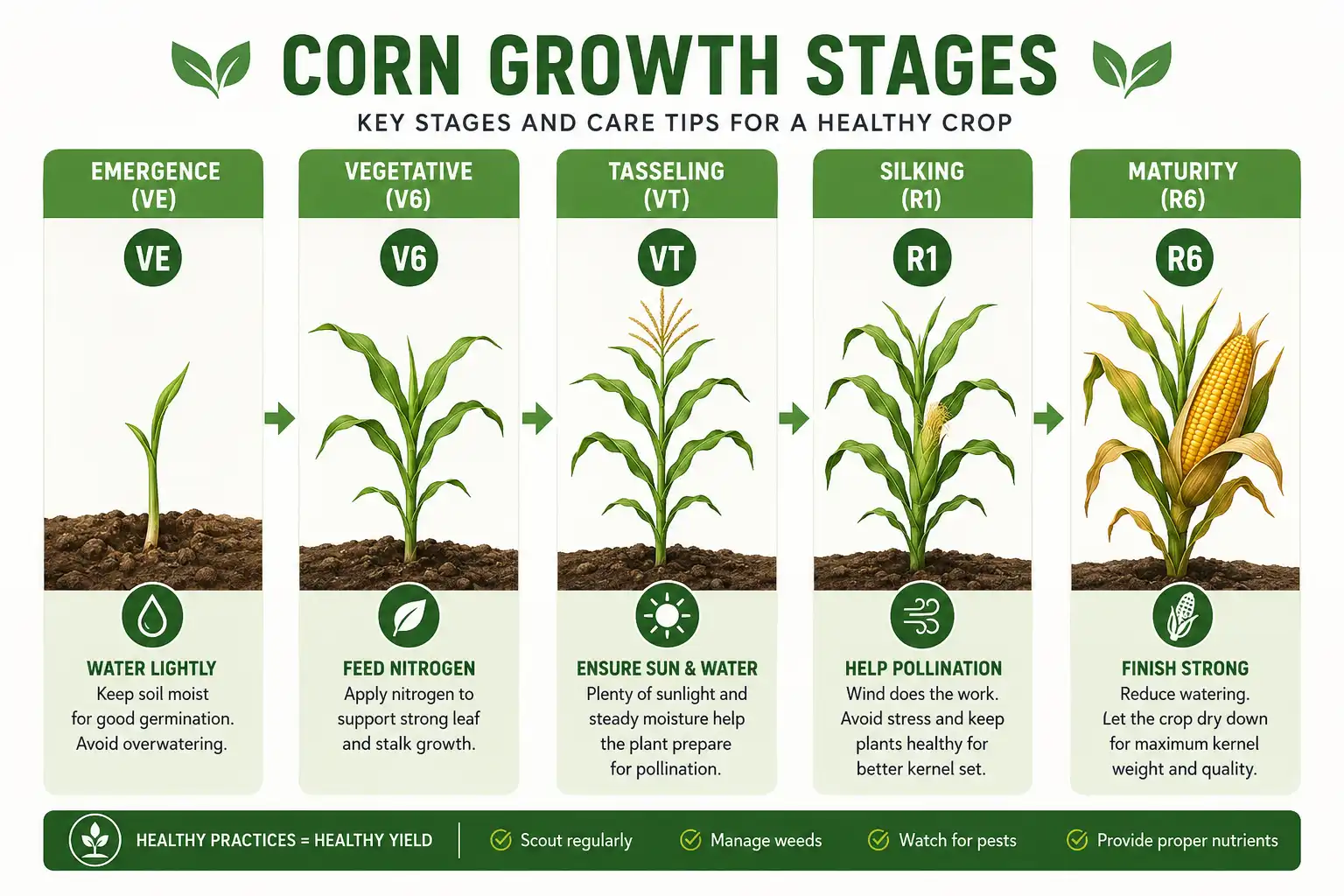
The whole run takes roughly 60 to 100 days, set by the variety and your heat units. A hot summer speeds it along, while a cool spring drags it out.
Common Corn Problems and Quick Fixes
Most corn troubles show up as a handful of clear symptoms. Read them like this:
- Pale or yellowing lower leaves: usually a nitrogen shortage. Side-dress and water it in.
- Blank or gappy ears: poor pollination, often from single-row planting or heat and drought at silking. Plant in blocks and keep water steady. Uneven kernels can trace to other causes, covered in this guide on deformed corn kernels.
- Short, spindly stalks: too little sun, crowding, or weak soil. Thin the plants and feed them.
- No tassel, or very late silks: heat or stress stalling the plant, or seed sown too late. Steady water and feeding help it catch up.
- Stalks leaning or down: lodging from wind, thin roots, or crowding. Hill the base and space wider next season.
- Leaves rolled tight at midday: water stress. If they open by evening, little is lost. If they stay rolled, irrigate.
None of these are hard to fix once you spot the cause. The real trick is catching them on your weekly walk, before a small problem costs you ears.
When Is Corn Ready to Harvest?
Corn is ready to pick when the ears fill out and the crop reaches maturity for its type. Sweet corn and field corn signal it differently, since sweet corn ripens fast and field corn takes its time.
Sweet corn is ready about 18 to 24 days after the silks first show. Look for green husks, brown dry silks, and a kernel that squirts milky juice when you press it. That milk stage is the window for sweet, tender ears, and it lasts only a few days.
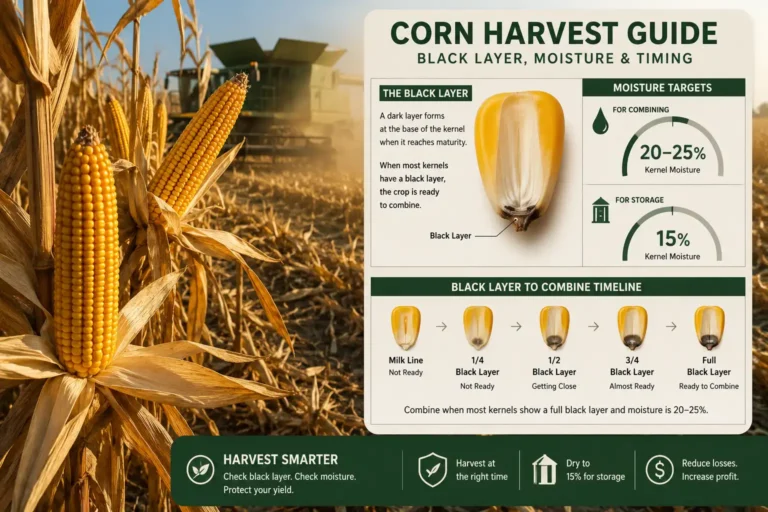
Field corn stays on the stalk far longer. It dries down until the kernels dent and a black layer forms at the kernel base. Once that black layer appears, the plant has finished filling grain. For the exact signs to check before picking, see these notes on knowing when sweet corn is ready.
Bottom Lines
Caring for corn is mostly about timing. Water deep. Feed the nitrogen just ahead of the growth spurt. Keep the rows clean early, and walk the plants every week. None of it is complicated. It just has to happen on time. Do that from the first leaf to the last dry husk. A corn plant will pay you back with heavy, well-filled ears.