How Many Kernels Are on a Cob of Corn? 400 to 600 at Harvest
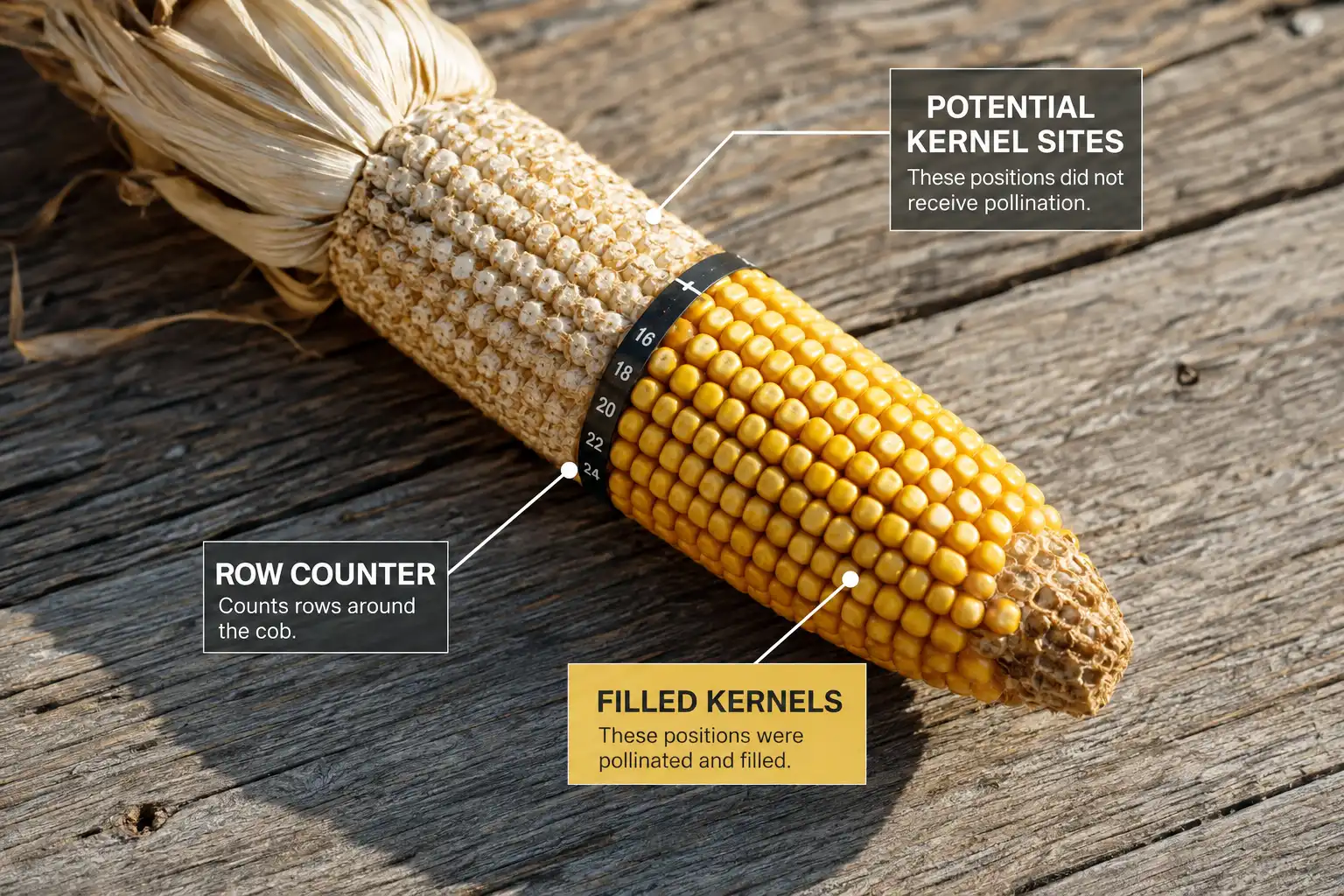
Shuck an ear and the rows look easy to count, yet the totals people quote vary wildly. How many kernels are on a cob of corn has two answers: potential kernels, and the ones that fill. Those numbers sit far apart.
The number of kernels on a cob of corn averages about 800, set in 16 rows of roughly 50. Harvested field ears usually run lower, near 400 to 600, because many ovules never fill.
What Is a Corn Kernel?
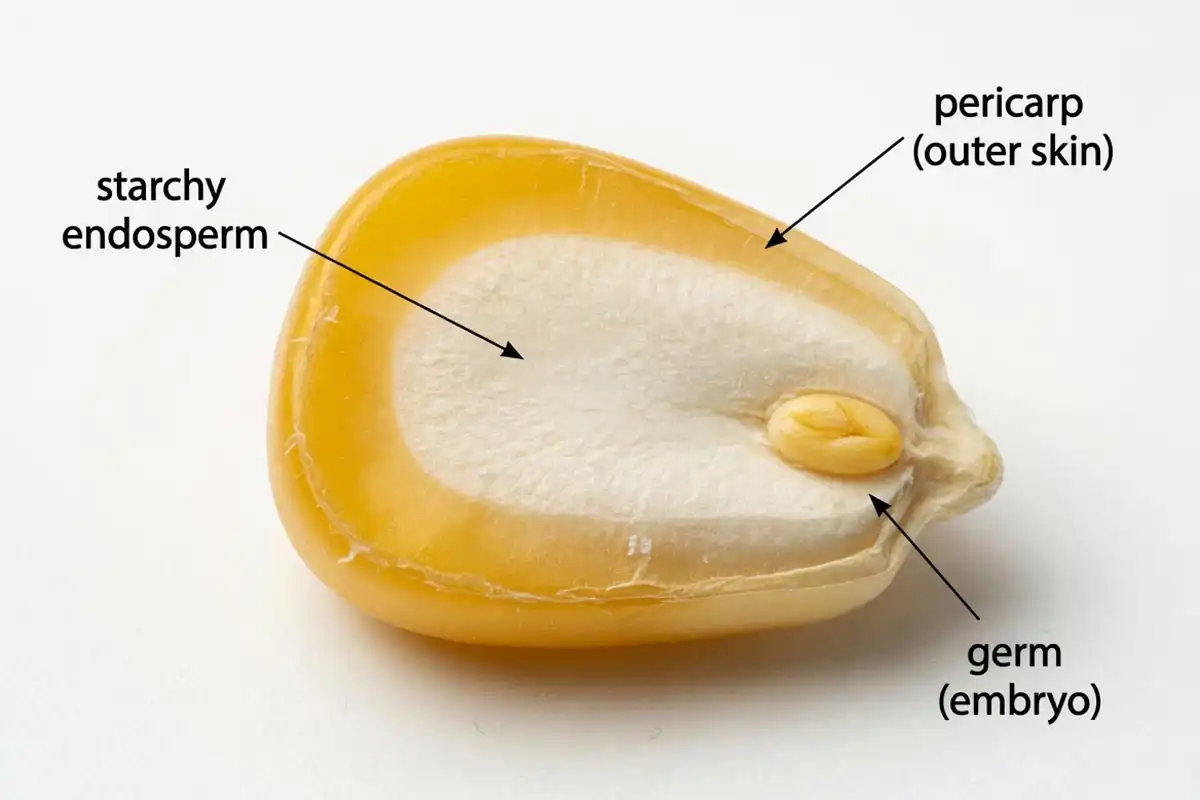
A corn kernel is a single seed on the maize plant. Each one begins as an ovule on the cob, and every ovule grows its own silk. That silk must catch a pollen grain before the ovule can turn into a kernel.
According to K-State Research and Extension, one tassel sheds 2 to 5 million pollen grains. That works out to roughly 2,000 to 5,000 grains for every silk on the ear. Pollen supply is rarely the limit. Timing is.
Each kernel has three parts:
- Pericarp. The outer skin that protects the seed.
- Endosperm. The starch store, and most of the kernel weight.
- Germ. The embryo, holding the oil and much of the protein.
Because one silk feeds one kernel, the blank spots on a poorly filled ear tell you exactly what went wrong. The ovule was there. The pollen never arrived.
How Many Kernels Are on a Cob of Corn at Harvest?
Harvested ears usually carry 400 to 600 kernels, not 800. The 800 figure that circulates everywhere describes a well-filled ear, and Purdue Extension does publish it. Still, it overstates what most fields actually produce.
K-State Research and Extension explains the gap plainly. A well-developed ear shoot carries 750 to 1,000 ovules, each with its own silk. Under good conditions, pollen reaches and fills only 400 to 600 of them. Purdue Extension agronomy data lands in the same place, putting actual harvestable kernel number per ear between 400 and 600.
| Count | Typical range | What it represents |
|---|---|---|
| Ovules per ear | 750 to 1,000 | Potential kernel sites before silking |
| Ovules per row | 50 to 60 | Sites available on each row |
| Kernels per ear at harvest | 400 to 600 | Sites that pollinated and filled |
| Kernels per row at harvest | 30 to 40 | Filled sites down one row |
So both numbers are honest. About 800 is close to what a good ear could hold. The 400 to 600 range is what usually reaches the grain cart.
Row counts run from 12 to 22 across hybrids, though 14 to 18 covers most of them. Ohio State Extension notes that girthy hybrids carry 18 or 20 rows. Long tapering hybrids settle near 14 or 16. Seed guides list this trait, so check yours before assuming 16.
Why Do Corn Kernels Grow in Even Rows?
Corn kernels grow in even rows because the first kernel initials split in two. Iowa State University Extension describes the mechanism directly. One initial divides, then forms two rows where there was one. Pair by pair, the ear builds out to 12, 14, 16, 18, or 20 rows.
That said, the rule is strong rather than absolute. Iowa State adds that rows develop in even numbers unless the plant hit stress during ear formation. Odd counts turn up rarely, and they point to a developmental problem instead of normal genetics.
How to Count Kernels on a Cob of Corn
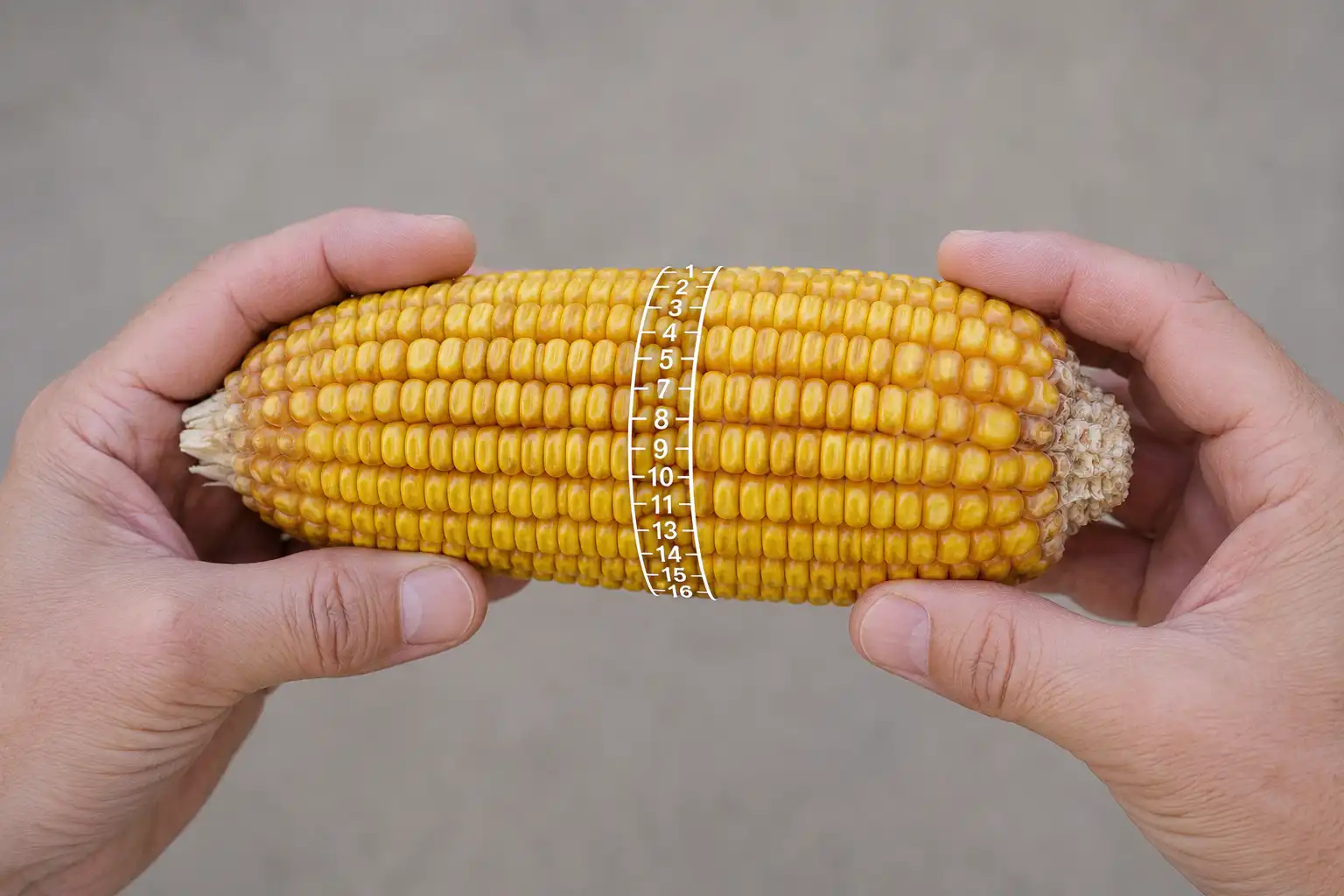
Counting kernels takes five quick steps. Use a mature, well-filled ear so the estimate reflects the crop rather than one weak plant.
- Pick a representative ear. Skip nubbins and ears with long blank tips. Sample from inside the field, since edge rows run high.
- Count the rows. Circle the cob at its middle and count each row. The total should be even.
- Count one full row. Follow a straight row from base to tip. Count every filled kernel.
- Multiply. Rows times kernels per row gives the ear total.
- Check the tip. Note missing or shriveled kernels separately, because tip-back signals a stress event worth diagnosing.
A realistic field ear works out to 16 rows times 34 kernels, or 544 kernels. The familiar 16 times 50 equals 800 math describes the ear’s potential before kernel abortion trims it.
What Factors Affect Kernel Count Per Ear?
Six conditions set the final number, and each acts during a specific window.
- Hybrid genetics. Row number is largely inherited, so it changes little year to year.
- Nitrogen supply. University of Delaware Extension found that inadequate nitrogen from V6 through V15 cuts both ear diameter and ear length.
- Heat at pollination. Michigan State University Extension reports that temperatures above 95°F with low humidity damage exposed silks and render pollen non-viable.
- Drought at silking. Purdue Extension estimates that near continual wilting during silk emergence and pollen shed can cost up to 8% of yield per day.
- Plant population. Crowded stands split light and water across more plants, which shortens ears.
- Insect feeding. Michigan State University Extension notes that corn rootworm beetles clip silks, pollen, and kernels during the critical window.
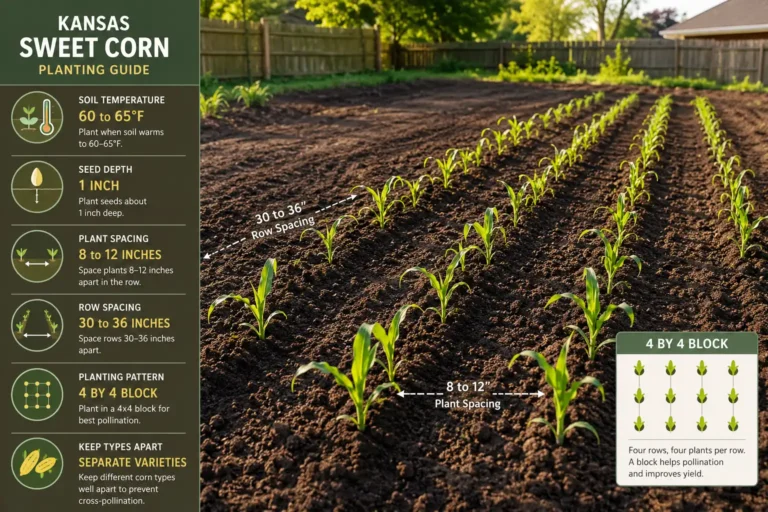
Even spacing and full pollen coverage protect kernel set more than most inputs do. In small plots, planting corn in blocks beats one long row.
When Each Kernel Number Is Locked In
Kernel count does not settle at harvest. The plant builds it in stages, so stress only matters inside the right window.
| Growth stage | What gets set | Sensitive to stress? |
|---|---|---|
| V5 to V7 | Kernel row number (ear girth) | Low, genetics dominate |
| V7 to V15 | Ovules per row (ear length) | High |
| R1 silking | Which ovules get pollinated | Very high |
| R2 to R3 | Kernel abortion, final count | High |
| R3 to R6 | Kernel weight only | Moderate |
Purdue Extension puts row number at V5 to V7 and ovules per row at V12 to V15. Once the plant sets row number, no further rows develop. After R3 milk stage, Iowa State Extension reports that abortion becomes unlikely. Later stress then trims kernel size rather than kernel count.
Field Corn vs Sweet Corn Kernel Counts
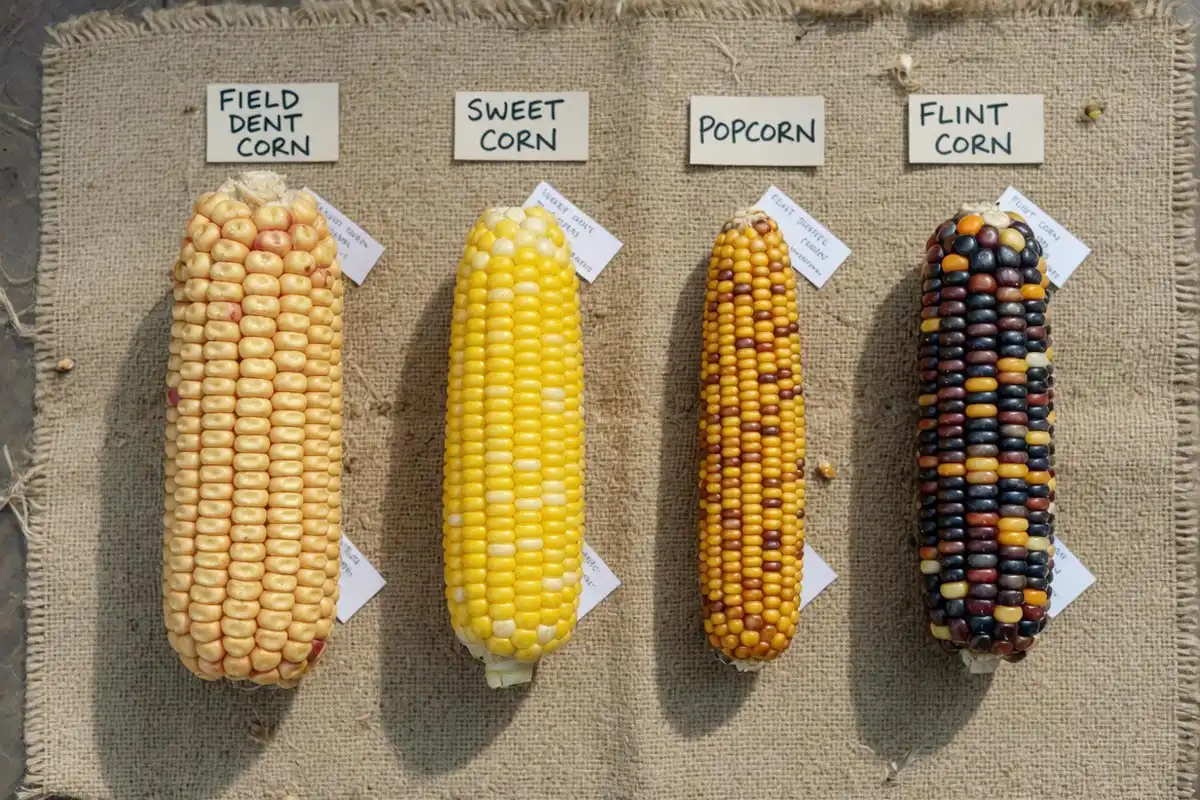
Field corn, also called dent corn, carries more kernels per ear than sweet corn does. Field ears run longer and the kernels pack deeper. Growers pick sweet corn at milk stage, when kernels hold more water and take more space per seed.
| Corn type | Typical rows per ear | Kernels per ear | What drives the count |
|---|---|---|---|
| Field (dent) corn | 14 to 18 | 400 to 700 | Long ears, deep kernels, bred for grain |
| Sweet corn | 12 to 18 | 400 to 700 | Picked at milk stage, plumper kernels |
| Popcorn | 12 to 16 | 200 to 450 | Small ears, small hard kernels |
| Flint corn | 8 to 14 | 200 to 500 | Few rows, hard rounded kernels |
Flint corn deserves a note. Northeastern eight-row flint carries exactly eight rows, which caps its total far below a grain hybrid. Type shifts ear size too, and that shows up in the weight of a single ear.
How Kernel Count Connects to Yield
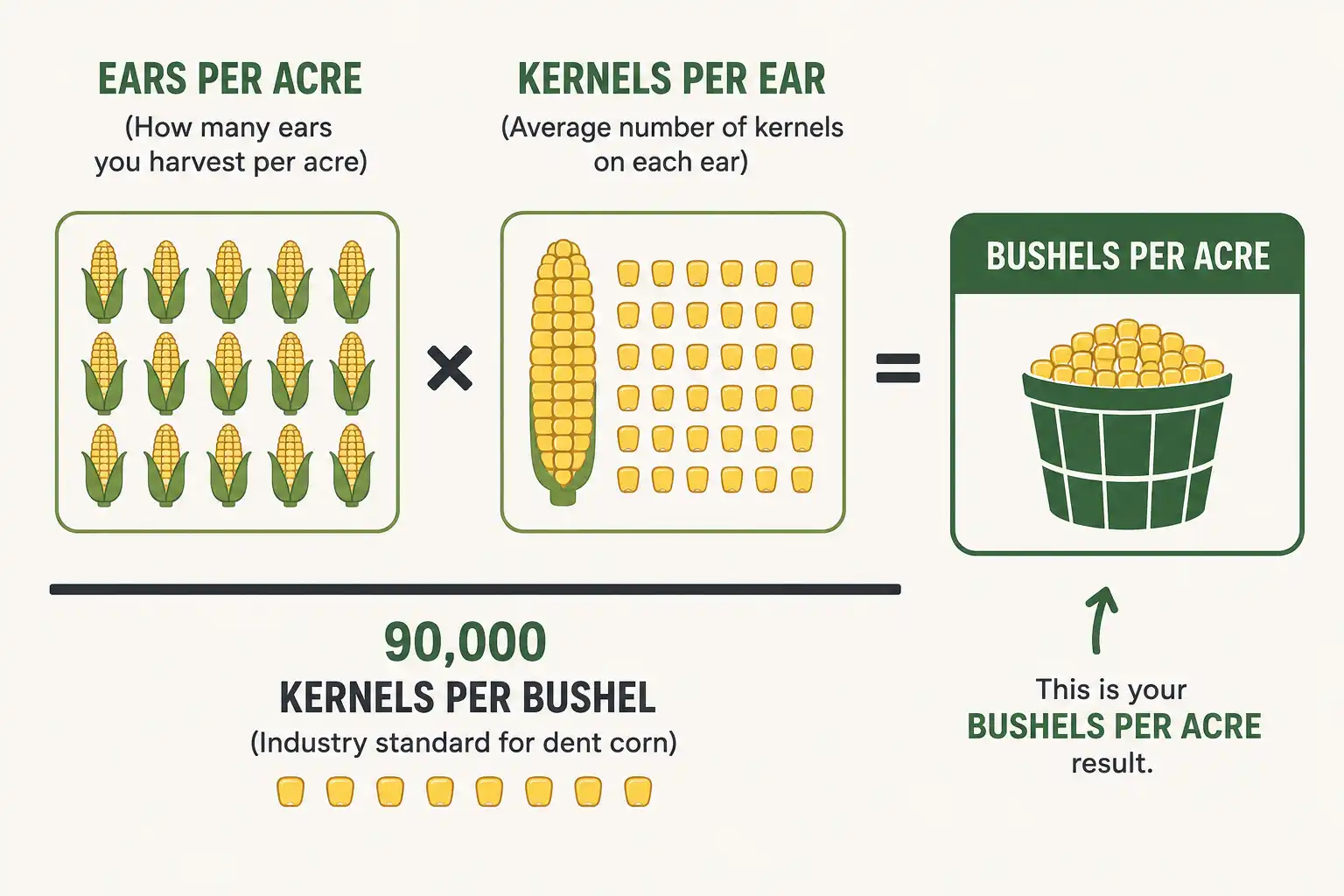
Kernel count drives yield through three numbers: ears per acre, kernels per ear, and kernel weight. Iowa State University Extension teaches the Yield Component Method. It multiplies the first two figures, then divides by an assumed kernels per bushel value.
Purdue Extension gives a useful benchmark for scale. On a 16-row ear at average plant populations, one extra kernel per row is worth roughly five bushels per acre. Four extra kernels per row moves a field by about 20 bushels.
A bushel of shelled corn weighs 56 pounds at 15.5% moisture, the market standard for No. 2 Yellow Dent. Test weight itself varies widely. Iowa State reports a practical span of 45 to 60 pounds per bushel. If you handle grain by volume, start from the bushel weight for shelled corn. The full walkthrough sits in the guide on checking corn yield by ear.
How Many Kernels Are in a Pound of Corn?
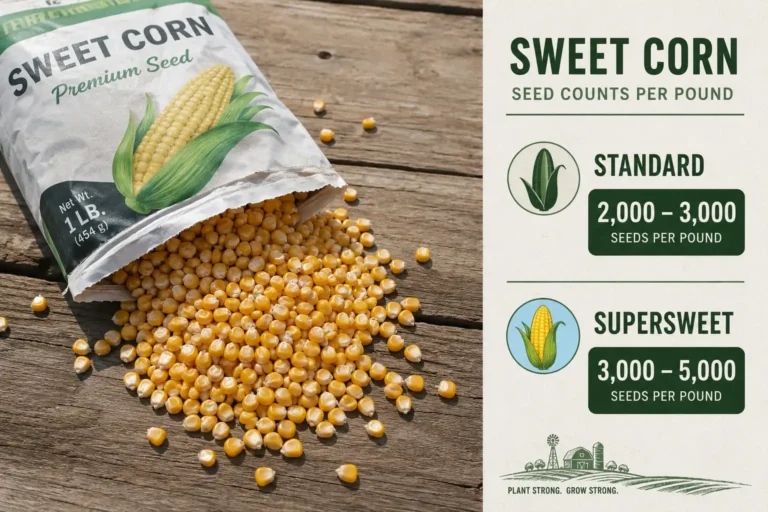
One pound of shelled field corn holds roughly 1,600 kernels. Iowa State Extension puts common kernel weight at 0.25 to 0.30 grams. That places most samples between 1,500 and 1,800 kernels per pound.
| Measure | Typical value | Working range |
|---|---|---|
| Single kernel weight | 0.28 g | 0.25 to 0.30 g |
| Kernels per pound | 1,600 | 1,500 to 1,800 |
| Kernels per 56 lb bushel | 90,000 | 65,000 to 110,000 |
Iowa State uses 90,000 kernels per bushel as the standard correction factor for yield estimates. Adjust it, though, rather than treating it as fixed. Excellent grain fill produces heavier kernels, so the count drops toward 65,000. Stressed, light grain pushes it toward 110,000.
Common Mistakes When Counting Corn Kernels
Avoid these errors for a cleaner count:
- Counting an immature ear before kernel set finishes at R3.
- Ignoring blank tips instead of recording them as a stress signal.
- Counting rows near the base, where rows twist. Use the middle.
- Sampling only field edges, which get extra light and water.
- Comparing hybrids as though they share one row range.
- Forgetting moisture, since 56 pounds per bushel only holds at 15.5%.
Blank or misshapen kernels are worth a closer look rather than a quick subtraction. Several separate causes produce deformed kernels, and each points to a different fix.
When to Count Kernels on Your Crop
Count kernels after R3 milk stage, once abortion has stopped. Iowa State Extension recommends this window for a reason. Stress after R3 trims kernel size rather than kernel number, so your count holds through harvest.
Sample at least five spots per field, and pull several ears at each stop. Variable fields need more stops. By R6 physiological maturity, the black layer forms and both count and weight go final. That is also when ears per stalk stops changing.
FAQs About Kernels on a Cob of Corn
How many rows of kernels are on an ear of corn?
Can an ear of corn have an odd number of rows?
How many kernels are in a pound of corn?
Do bigger ears always have more kernels?
How many kernels does one corn plant produce?
Key Points to Carry Into the Field
An ear can hold about 800 kernels, though only 400 to 600 usually fill. The difference is pollination and stress timing, not luck. Row number locks in by V7, ear length by V15, and final count by R3. Count after R3, sample widely, and treat blank tips as a diagnosis rather than a rounding error.