Can Onions and Peas Be Planted Together? Spacing Guide
Onions and peas both go into cold spring soil, so they land in the same bed plan. Then the onions come out undersized. So can onions and peas be planted together without one crop paying for it? Sunlight and spacing decide that, not old companion charts.
Onions and peas can be planted together, but the pairing costs onion size. Pea vines shade onions through the leaf building weeks that set bulb diameter. So keep peas three feet away, or grow both crops in sequence instead.
Can Onions and Peas Be Planted Together in One Bed?
They can share a bed, but the onions pay for it. Both crops want cool soil, and both go in during the second or third week of March in Kansas. That overlap is what makes the pairing tempting in the first place. The trouble shows up about six weeks later, once the pea vines climb high enough to throw real shade.
Onions set their size before they set a bulb. Every leaf a plant pushes out before bulbing turns into one ring in the finished onion. Nebraska Extension states it plainly: leaf growth is critical because each leaf becomes one layer in the bulb. So anything that slows leaf production in April and early May sets a hard ceiling on diameter. Nothing you do in July raises it back.
Peas, on the other hand, give up almost nothing. K-State’s planting guide lists peas at 50 to 80 days to first harvest. Bulb onions need 90 to 120. Peas carry their own nitrogen, they finish early, and light shade barely slows them. That is why this pairing runs so lopsided. One crop takes the hit while the other cruises.
Also learn: How to Plant Onions and Beans Together
Why Peas and Onions Work Against Each Other
Three forces drive it, and none of them is mysterious. Light, surface competition, and the fertilizer program. Below they run in order of how much yield they actually cost you.
Pea Vines Take the Light That Builds Onion Rings
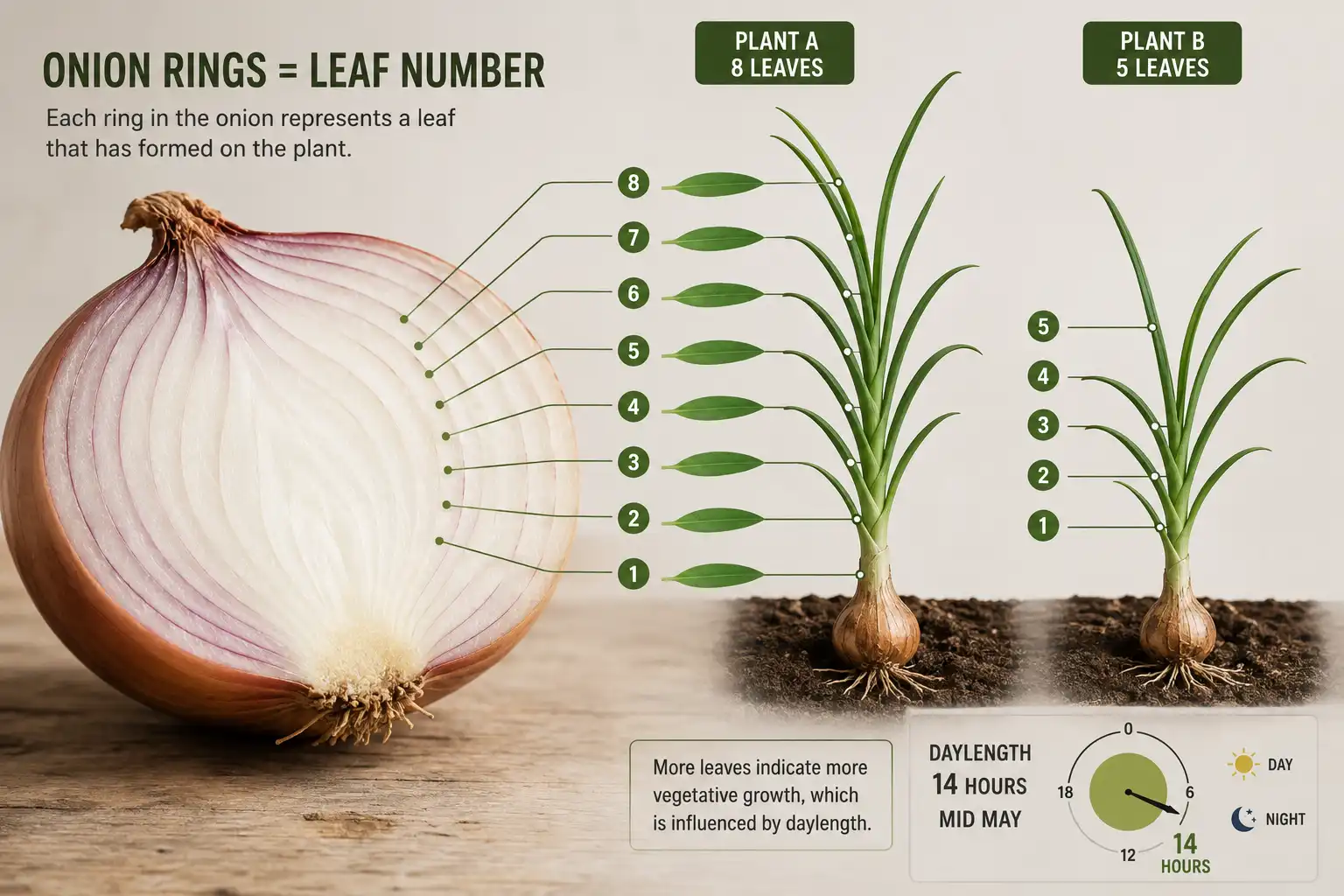
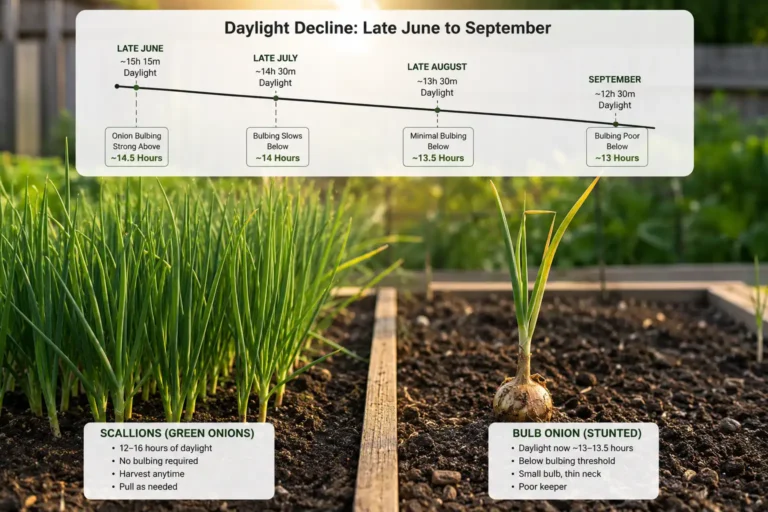
Shade costs the most, and the timing makes it worse. Onions bulb on daylength rather than age. Long day types flip when days reach 14 to 16 hours, while intermediate types flip at 12 to 14. Near Topeka, daylength crosses 14 hours around the middle of May.
So count backward from there. Onions planted in mid March get roughly eight weeks of leaf building before that switch trips. Sugar snap and other vining peas reach five or six feet inside the same window. By late April the trellis is filling in, and by mid May it stands as a wall. The pea canopy peaks during the exact weeks onions need every hour of sun they can get.
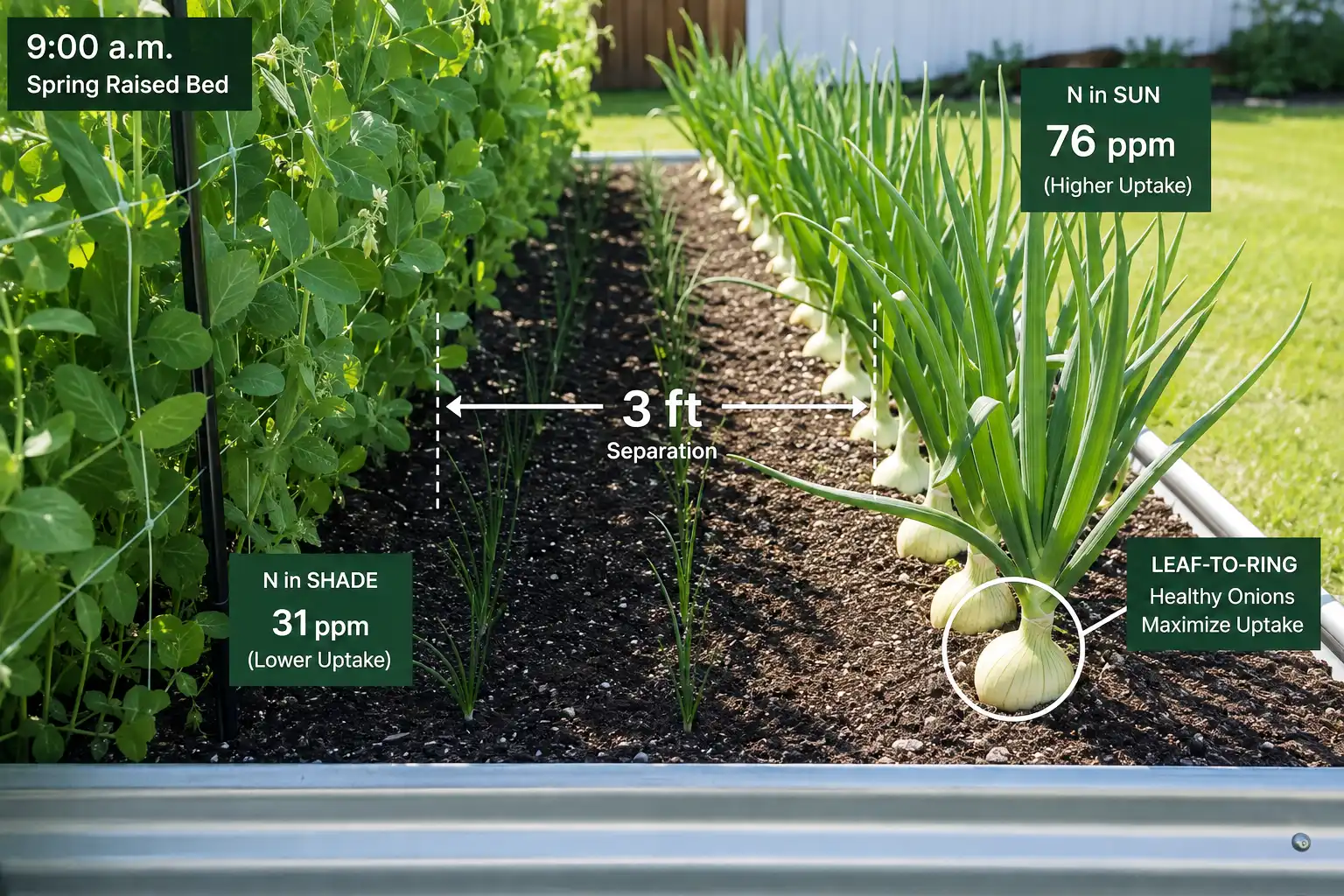
Onion rows on the shaded side of a trellis carry five or six good leaves at bulbing. Rows out in the open carry eight or nine. Those extra leaves show up later as rings, and rings are diameter.
Bush peas cause less trouble because they top out near 24 inches. Even so, a two foot canopy still shades a 12 inch onion plant for part of the day.
Onions Take No Competition at the Soil Surface
Onions rank among the weakest competitors in any garden. Their roots stay sparse and poorly branched, and water uptake sits in the top 10 inches of soil. Narrow upright leaves shade almost no ground, so onions never crowd anything out.
NC State Extension is blunt about what follows. Season long weed competition has cut seeded onion yields by as much as 96 percent in research trials. The critical weed free window runs four to six weeks after emergence. Peas are not weeds, but onion roots cannot tell the difference. Anything pulling water and nutrients out of that top layer competes.
Pea roots do run deeper, which helps some. Still, pea seedlings feed near the surface through their first month, right when onions are least able to push back. Layout matters more here than in most beds. So check onion counts per square foot spacing before you commit.
Then comes the physical side. Onions need shallow scratch cultivation, no deeper than an inch or two, because a nicked bulb invites rot. Trellis legs, sprawling vines, and fallen tendrils turn that job slow and sloppy.
The Two Fertility Programs Pull Opposite Ways
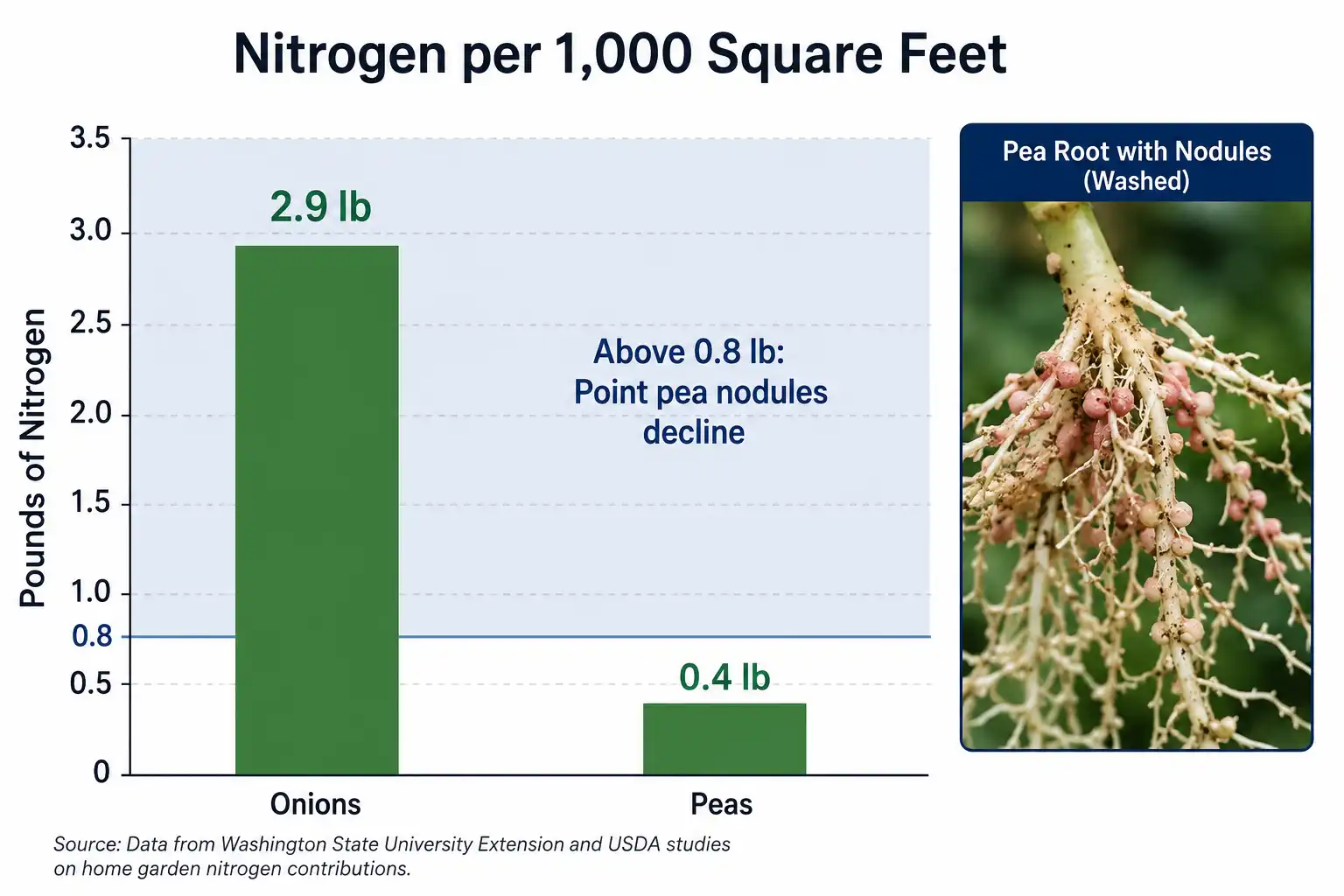
Most companion charts skip this part, and it matters more than the folklore. Onions are heavy nitrogen users. Peas want almost none. You cannot run one fertility program that serves both crops well.
NC State targets 120 to 150 pounds of nitrogen per acre for bulb onions. Most of that goes on in season. UC Davis work shows onions take up little nitrogen early, then pull hard through bulb fill. Scaled to a garden, that lands near three pounds of actual nitrogen per 1,000 square feet.
Peas sit at the far other end. University of Minnesota guidance calls for 10 to 20 pounds per acre in soil with decent organic matter. That works out under half a pound per 1,000 square feet. Push past roughly 0.8 pounds per 1,000 square feet and pea nodulation starts dropping off. Canadian field pea trials found the same break above about 36 pounds per acre.
The mechanism behind it is well documented. High soil nitrate suppresses nodule formation and shuts down nitrogen fixation in peas. The plant simply takes the easy nitrogen and quits paying rent to the bacteria. So a fertility program built for onions strips out the exact benefit you wanted from the peas.
Sidedress timing sharpens the conflict. Onions want their nitrogen through May and June. Peas flower and fill pods across those same weeks. Nitrate does its worst damage to nodules during that stretch. Your fertilizer picks for onions matter here mostly because of when they land.
Do Onions Really Stop Peas From Fixing Nitrogen?
Not the way companion charts claim. Nearly every chart lists alliums as bad neighbors for peas and beans. Most give the same reason. Sulfur compounds from onion roots supposedly kill the rhizobia peas depend on. That reason is the weakest part of otherwise reasonable advice.
What sits in the literature is thinner than the charts suggest. Lab work using garlic extract has reduced nodulation in legume seedlings, which is a real result but a narrow one. Garlic extract in a dish is not an onion root in field soil at four inch spacing. No field trial appears to show bulb onions cutting pea nodulation at normal garden spacing.
Meanwhile the nitrate effect carries decades of pea research behind it. That hands you a mechanism you can actually manage, and it points to the same practical advice from solid ground.
So treat the old charts as directionally useful. Keep peas away from onions, yes. Just do it for light, surface competition, and fertility rather than unverified root chemistry.
You can check nodulation yourself in about five minutes. Dig a pea plant at flowering, wash the roots, then slice a nodule open. Pink or red inside means it is fixing nitrogen. White or green inside means it is not. That same test tells you whether inoculant on soybeans did its job, and it reads identically on garden peas.
How Far Apart to Keep Peas and Onions
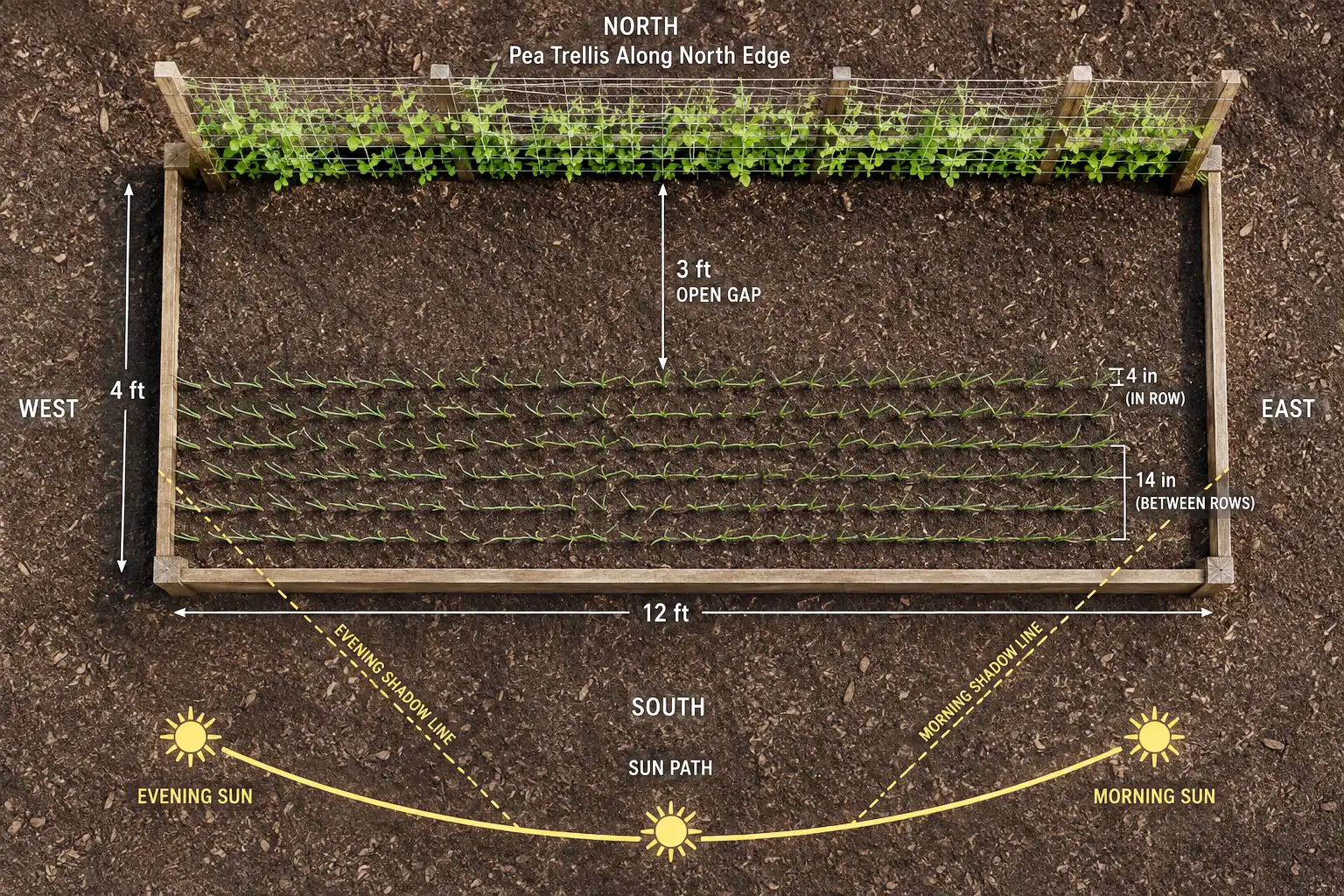
Leave three feet of open ground between the pea trellis and the first onion row. That number comes from shade geometry more than root distance.
Run the numbers yourself. A five foot trellis at 39 degrees north throws a shadow of roughly three to four feet at 9 a.m. and again at 5 p.m. in early May. Midday shade stays short. Morning and late day shade is what stacks up, and those hours count toward total light interception.
Orientation does more work than distance, though. Put the trellis along the north edge of the bed, then run onion rows south of it. The shadow falls away from the crop for most of the day. A trellis on the south side shades onions at midday instead, which is the worst case you can build.
For bush peas, two feet clears it. For six foot vining types, give the full three feet. Then walk out and check the shadow line during the second week of May, when your onions sit days from bulbing.
How to Plant Peas and Onions in One Bed
If one bed is all you have, build it to protect the onions. Here is the order it helps to follow.
- Test the soil first. You need your nitrate level before deciding how to feed either crop. Guessing usually costs the peas their nodules.
- Run the bed east to west. A long axis east to west lets you keep the trellis on the north edge where it belongs.
- Build the pea trellis on the north edge only. Never down the middle, and never along the south side.
- Leave three feet of open ground south of the trellis. Measure it rather than eyeballing it.
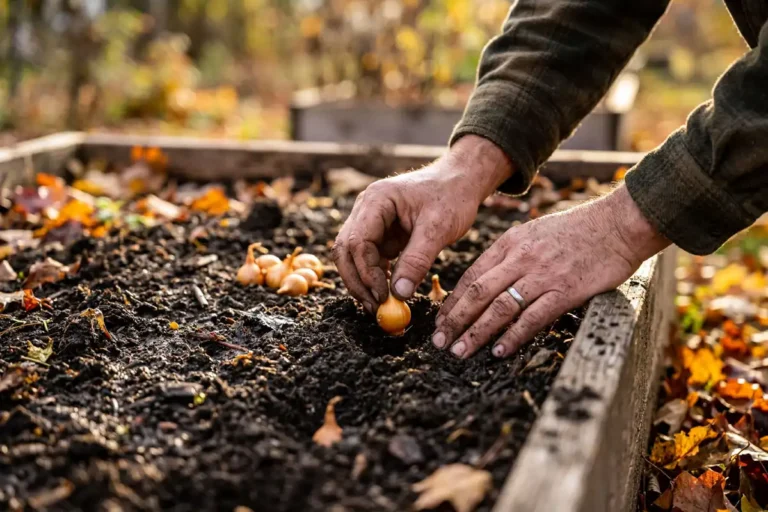
- Set onions four inches apart in rows 14 inches apart. Wider rows keep light reaching the lower leaves.
- Feed the two zones separately. Band nitrogen into the onion rows and keep it out of the pea strip. Hand applied granular beats broadcasting here.
- Inoculate the pea seed. When soil nitrate reads moderate, inoculant gives nodulation a better start.
- Cut the pea vines the week they finish. Snip them at the soil line instead of yanking. That leaves nodules behind and spares onion roots two feet away.
- Mulch the onions after pea removal. Three to four inches of straw holds moisture through bulb fill.
Do all nine and the onions still finish a size smaller than they would in clean ground. Smaller, though, is not ruined.
Green Onions Change the Answer
Bunching onions and scallions pair with peas without much trouble. They never bulb, so shade across April and May costs you almost nothing. You harvest tops and white shank instead of a sized bulb.
Timing helps too. Scallions reach pull size in 60 to 70 days. That lines up with pea harvest rather than running past it. Green onions also tolerate tighter spacing, so a band of them 12 inches off a pea row still gives a full cut.
Leeks do not get the same pass. Leeks need 100 to 120 days and a long stretch of clean light to build shank length, so treat them like bulb onions and give them the full three feet.
So when someone asks whether onions belong next to peas, the honest answer depends on which onion sits in the row. Scallions, yes. Storage onions, no.
Grow Peas First, Then Onions
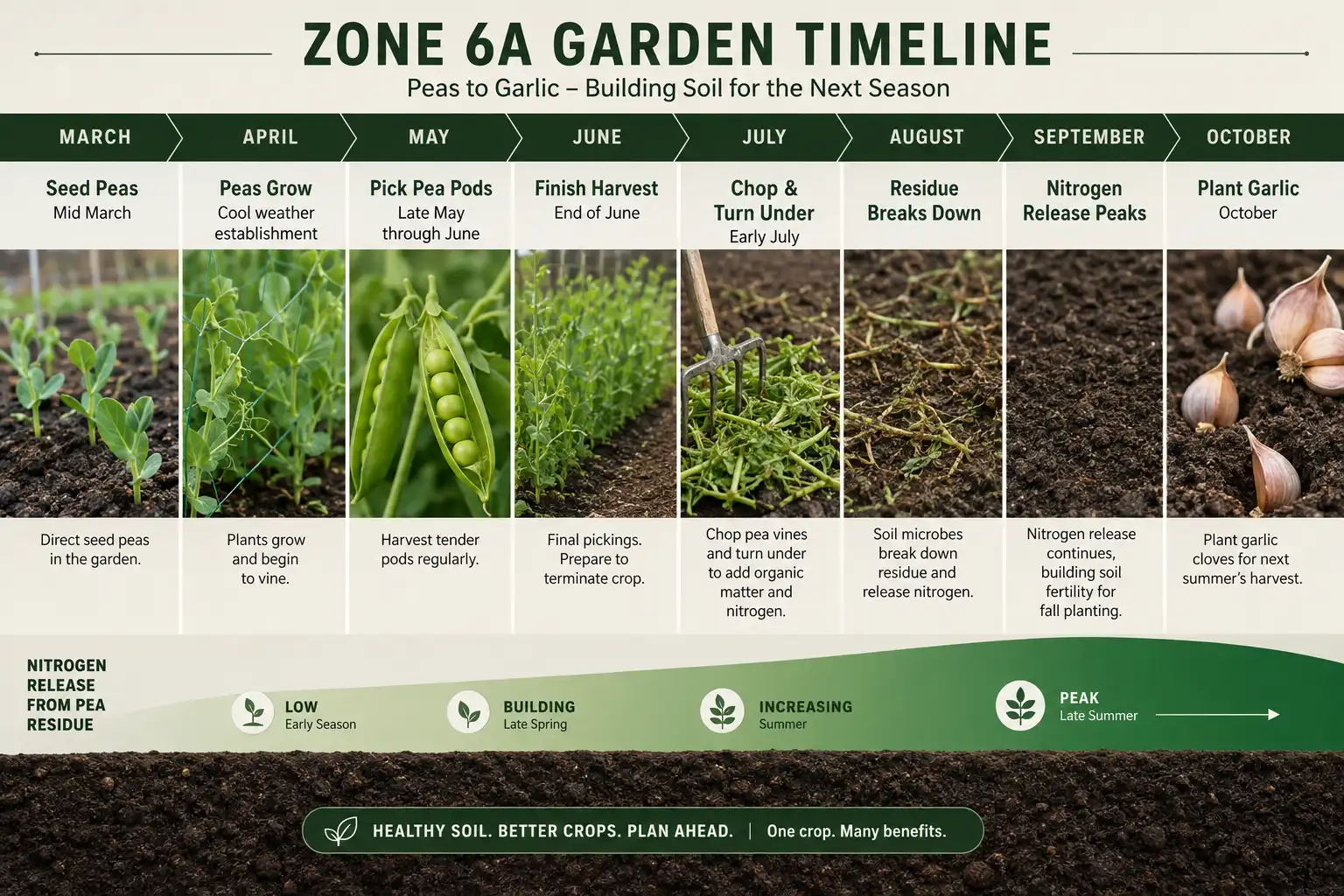
Sequence beats interplanting with these two, and the calendar cooperates in USDA hardiness zone 6a. Peas seeded in mid March finish between late May and late June. That leaves the whole back half of the season open.
The rotation side is clean as well. Peas and onions share no soil diseases. White rot, pink root, and Fusarium basal rot are allium problems. Pea root rot traces to a different set of pathogens entirely. So following one crop with the other carries no disease penalty, which beats most vegetable pairings you could name.
Nitrogen timing also works better this way. Most of what a pea crop fixes leaves the bed inside the pods you pick. What stays behind sits in vines and roots, and it releases as that residue breaks down. Cut vines at the soil line, turn them under shallow, and the release lands weeks later, which suits a fall garlic planting or next spring’s onions.
Here is a common pattern. Peas go in mid March, come out by late June, and the vines get chopped in place. Garlic follows that October. Onions go into a different bed the next March, one that grew peas the season before. A rotation plan for crops that runs legumes ahead of alliums beats squeezing both into one spring.
Better Neighbors for Each Crop
| Crop | Good neighbors | Keep apart from |
|---|---|---|
| Bulb onions | Carrots, beets, lettuce, tomatoes, cabbage family, strawberries | Peas, beans, asparagus |
| Peas | Carrots, radishes, spinach, lettuce, turnips, cucumbers | Onions, garlic, leeks, shallots, chives |
Onions earn their place next to carrots and lettuce because the growth habits actually fit. Onion leaves stand straight up and cast almost no shade, so a low leafy crop fills the ground between rows without touching the onion’s light. Setting onions beside carrot rows is one of the few pairings with decent field support behind it.
Peas want partners that finish early or root shallow. Radishes and spinach both clear out before the vines get heavy. Running peas alongside potatoes works too, as long as you keep hilling soil away from pea roots.
Skip the rest of the allium family with peas. Garlic, leeks, shallots, and chives all raise the same three issues onions do.
FAQs on Planting onions and peas together
Will peas make my onions bigger by adding nitrogen?
Can I plant onion sets between pea rows to save space?
Do onions keep aphids off peas?
What about a container or a four by four raised bed?
Final Verdict
Keep them in separate beds and one season apart. Peas go in mid March and come out by late June, and that ground then grows garlic in fall or onions the following spring. When space forces the issue, the trellis goes on the north edge, onions start three feet south, and the two strips get fed separately. Onions still finish smaller. Sequence is the better answer, and the calendar across the Great Plains gives you plenty of room to use it.