How to Store Eggplant: Fridge, Counter, and Freezer Times
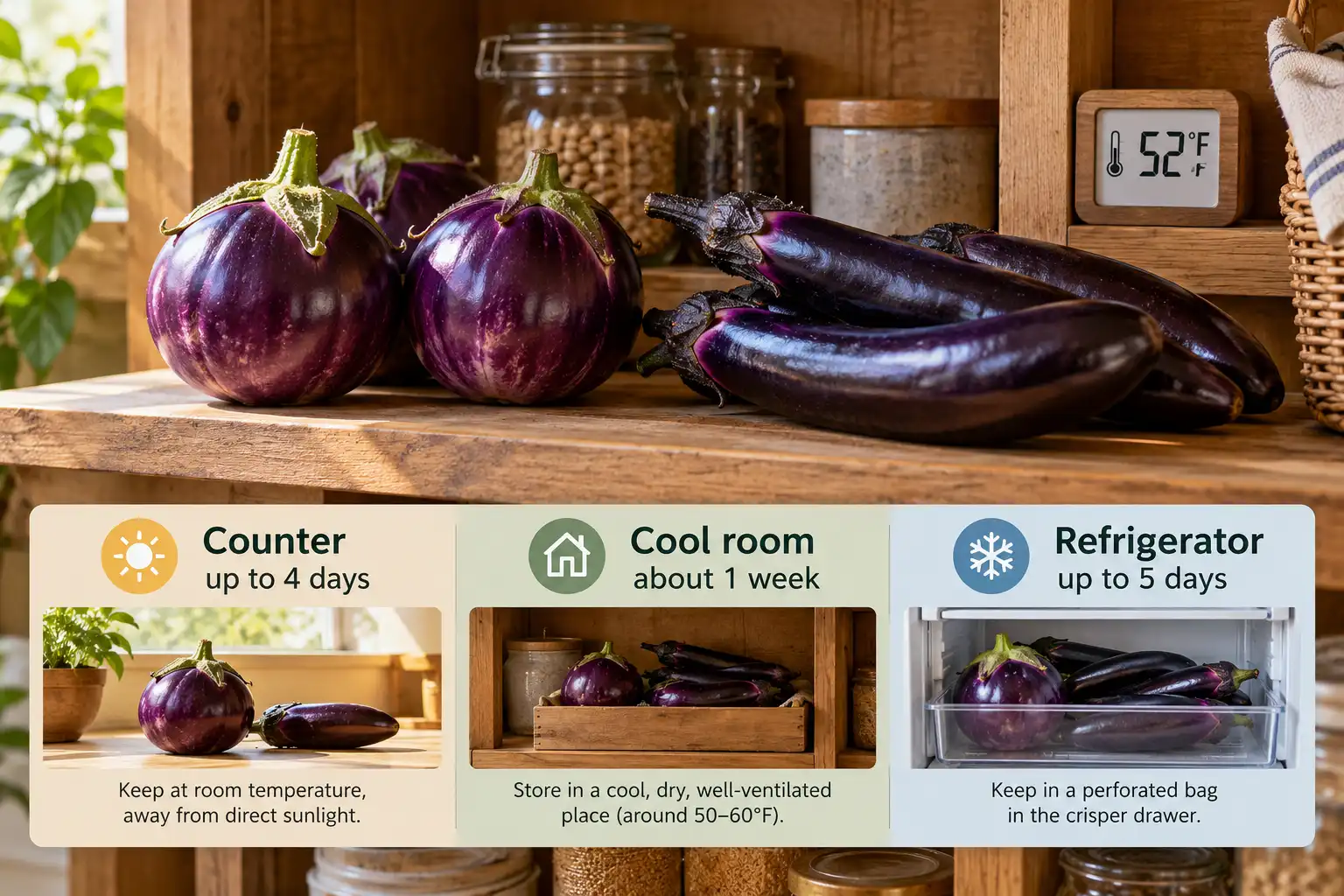
Eggplant keeps best at 50 to 54°F, a range warmer than your refrigerator and cooler than most kitchens. That narrow window makes it one of the harder crops to hold. Knowing how to store eggplant, fresh or frozen, stretches a harvest from days to months.
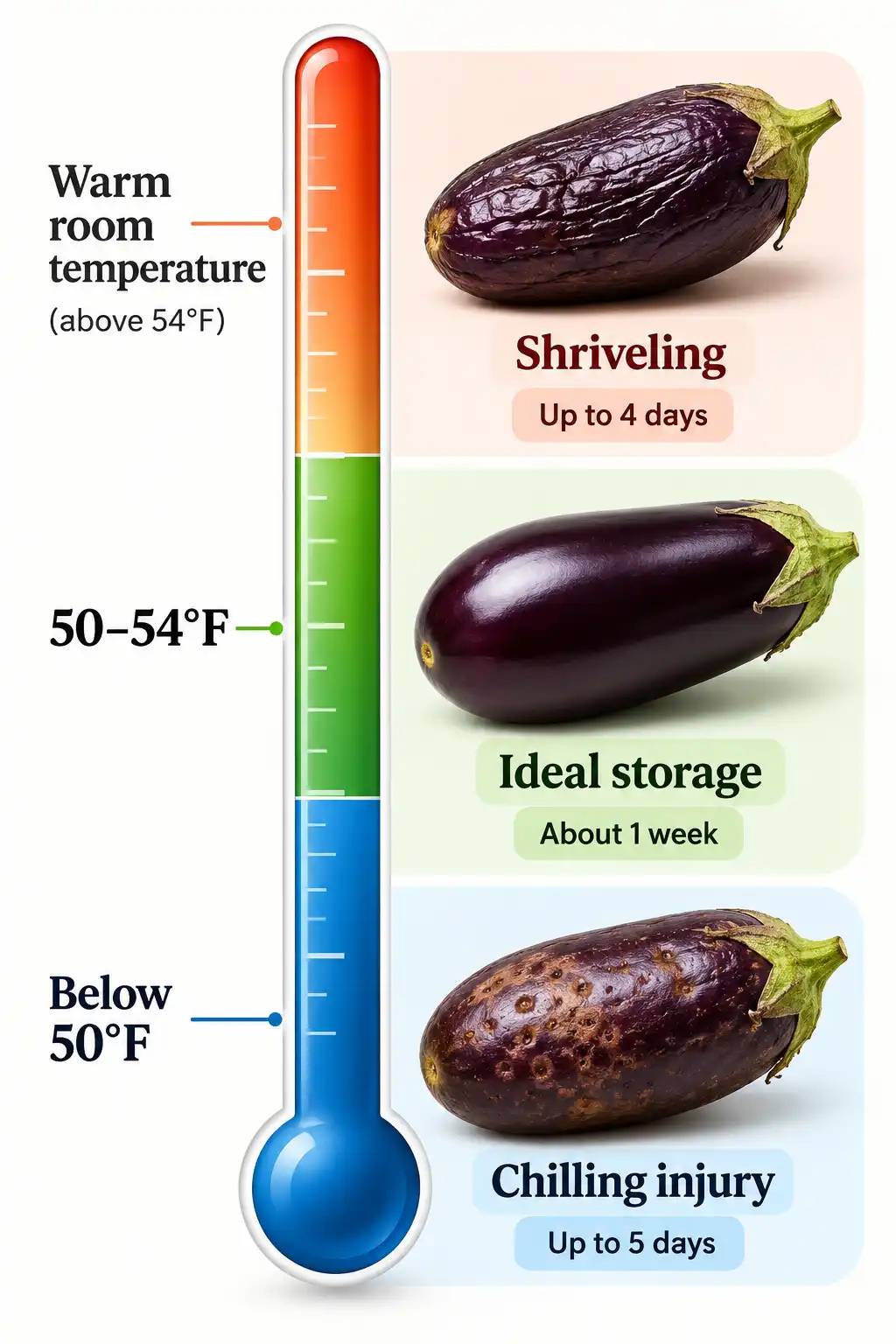
To avoid chilling injury and shriveling, store eggplant whole and unwashed at 50 to 54°F, the range UC Davis recommends. A refrigerator works for short holds if you wrap the fruit loosely and use it within about 5 days.
Why Eggplant Is Hard to Store
Storing eggplant well means managing three threats at once: cold, water loss, and ethylene. The UC Davis Postharvest Research and Extension Center puts typical storage life at under 14 days because quality fades fast. Past two weeks, decay rises.
- Cold: Eggplant suffers chilling injury below 50°F, according to UC Davis. The injury also builds over time, so cold nights in the field and days in the fridge add together.
- Water loss: The skin gives up moisture quickly, especially on slender types. According to UC Davis, Japanese eggplant loses water three times faster than American globe eggplant.
- Ethylene: Eggplant has moderate to high sensitivity to this ripening gas. UC Davis lists a dropping calyx (the green cap) and faster browning as risks once ethylene tops 1 ppm.
Should Eggplant Be Refrigerated?
Only for short holds. A home refrigerator set for food safety runs at 40°F or below, well under eggplant’s 50°F chilling threshold. As a result, each day in the fridge moves the fruit closer to visible damage.
Extension advice reflects that tradeoff. Michigan State University Extension recommends harvesting and using eggplant right away for the best flavor. For short storage, MSU advises wrapping it in plastic and refrigerating it for one to two days. NDSU Extension allows a little longer: about five days refrigerated or up to four days at room temperature.
A cool room beats both options. MSU Extension notes that eggplant holds for up to one week at 50°F. So an unheated pantry, cellar, or basement that stays near 50 to 54°F is the better spot. Check it with a thermometer first, since basement temperatures shift with the season.
How Long Does Eggplant Last in the Fridge?
Whole eggplant lasts about five days in the refrigerator, according to NDSU Extension. For the best flavor, though, MSU Extension suggests a shorter window of one to two days. Colder settings shrink that window. On American globe eggplant, UC Davis found visible chilling damage after 6 to 7 days at 41°F. At 36°F, damage showed in only 4 to 5 days.
Cut and cooked eggplant follow different rules. Cut flesh darkens quickly in air, per Penn State Extension, so slice eggplant right before cooking. For leftover raw pieces, NDSU Extension recommends an airtight container in the refrigerator. Cooked eggplant dishes keep three to four days at 40°F or below, also per NDSU.
| Eggplant form and location | How long it keeps | Source |
|---|---|---|
| Whole, kitchen counter | Up to 4 days | NDSU Extension |
| Whole, cool room at 50°F | Up to 1 week | MSU Extension |
| Whole, refrigerator | 1 to 2 days for best flavor; about 5 days at most | MSU Extension; NDSU Extension |
| Cut, raw, airtight in the refrigerator | Short term only; the flesh browns fast | NDSU Extension; Penn State Extension |
| Cooked dishes at 40°F or below | 3 to 4 days | NDSU Extension |
| Blanched slices frozen at 0°F | 8 to 12 months | National Center for Home Food Preservation |
| Dried slices, airtight, chilled or frozen | 6 to 12 months | NDSU Extension; Penn State Extension |
Chilling Damage by Eggplant Type
Eggplant types differ in cold tolerance. UC Davis tracked how many days each type took to show visible chilling injury:
| Storage temperature | American (globe) | Japanese | Chinese |
|---|---|---|---|
| 36°F | 4 to 5 days | 5 to 6 days | 5 to 6 days |
| 41°F | 6 to 7 days | 8 to 9 days | 10 to 12 days |
| 45°F | 12 days | 12 to 14 days | 15 to 16 days |
Globe cultivars such as Black Beauty show damage first. Japanese eggplant handles cold slightly better but dries out faster. Because of that, cook slender fruit first and time your Japanese eggplant harvest close to cooking day.
How to Store Eggplant Step by Step
Storage life starts with picking eggplant at the right stage: firm, glossy fruit whose seeds have not hardened. According to UC Davis, overmature fruit turns pithy and bitter. After harvest, follow these steps:
- Cut, don’t pull. Use garden shears and leave the cap attached. NDSU Extension recommends shears to prevent the damage that ripping causes.
- Cool it fast. Move fruit into shade right away. UC Davis calls rapid cooling essential and lists 50°F as the usual cooling target.
- Wait to wash. NDSU Extension advises rinsing eggplant under cool running water before you use it, so wash on cooking day.
- Wrap it loosely. A loose plastic bag cuts water loss and chilling injury, per UC Davis. Keep the skin dry, though, because wraps also raise the risk of gray mold.
- Pick the right spot. Aim for 50 to 54°F and 90 to 95% relative humidity, the targets UC Davis recommends. When the fridge is the only option, use the crisper drawer and keep the stay short.
- Keep ethylene away. Store eggplant apart from apples, bananas, and ripe tomatoes.
- Skip the pile. Lay fruit in a single layer, since UC Davis lists bruising and compression as common handling injuries.
- Watch the cap. MSU Extension advises using eggplant while the stem and cap still look green and fresh.
For bigger harvests, the same cooling logic carries over to handling produce after harvest.
How to Preserve Eggplant for Months
Freezing is the most dependable way to preserve eggplant. Penn State Extension names it the main alternative to canning. Still, it warns that high water content leaves thawed slices soft and watery. NDSU Extension adds that freezing costs quality, though blanched slices work. So plan to use frozen eggplant in soups, stews, sauces, and dips rather than dishes that need firm slices.
How to Freeze Eggplant Slices
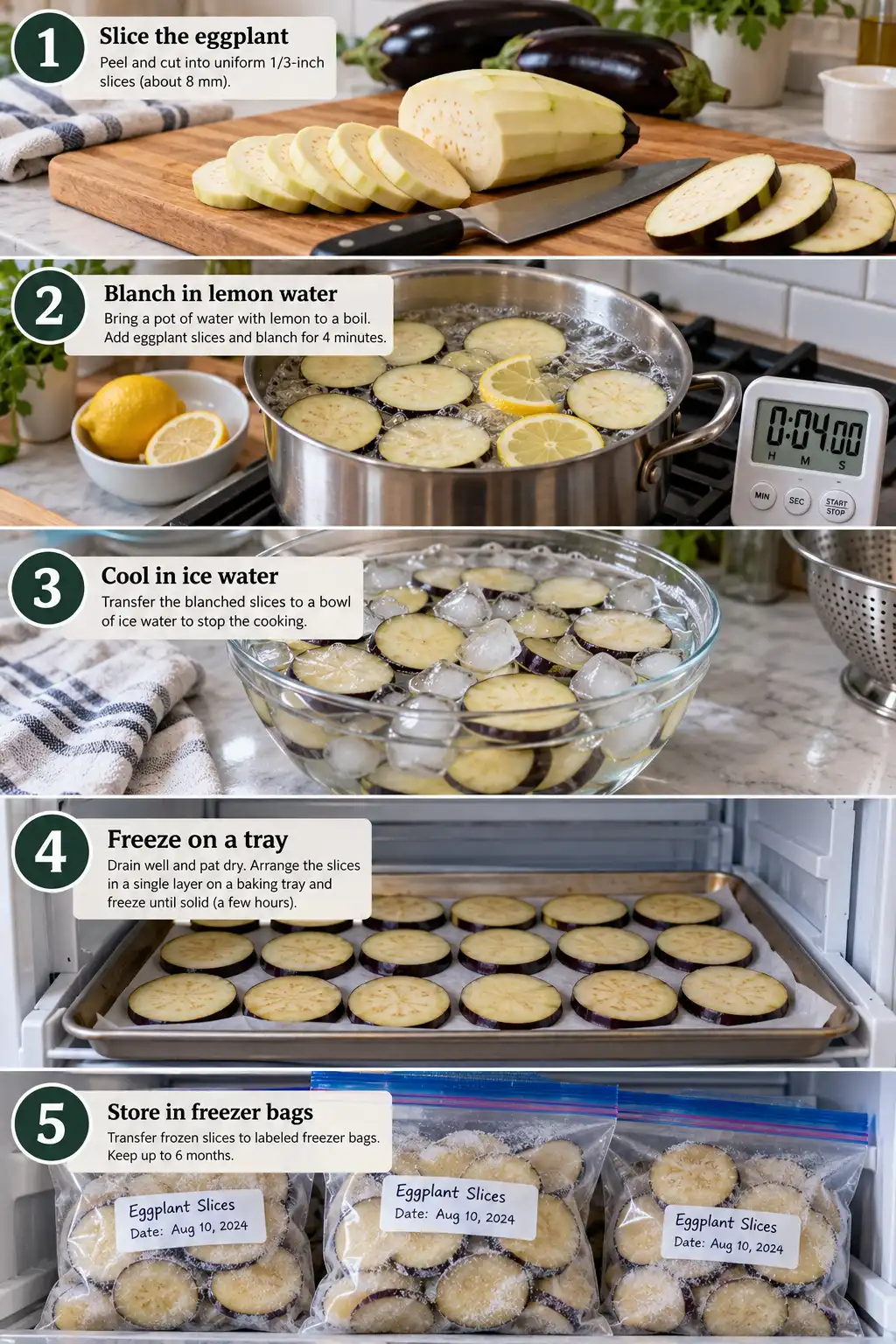
Michigan State University Extension uses this blanching method:
- Choose firm, dark fruit picked before the seeds mature.
- Wash, peel, and cut 1/3-inch slices. Prepare one batch at a time, because cut flesh darkens fast.
- For each pound of slices, bring 1 gallon of water and 1/2 cup lemon juice to a boil.
- Blanch the slices, covered, for 4 minutes. With the right batch size, the water returns to a boil within 1 minute.
- Cool the slices in ice water for 4 minutes, then drain.
- Blot them dry and freeze them in a single layer on a tray, as Penn State Extension suggests.
- Pack the frozen slices into bags or containers with 1/2-inch headspace, then label them.
The National Center for Home Food Preservation gives frozen vegetables 8 to 12 months of best quality at 0°F. Pressing air out of each bag limits freezer burn, and a vacuum sealer for frozen produce removes the most air. Cooked eggplant freezes too. For dips and sauces, Penn State Extension recommends roasting and pureeing the fruit before freezing.
How to Dry Eggplant
Drying works, but expect average results. Penn State Extension reports that the National Center for Home Food Preservation rates eggplant as poor for drying. NDSU Extension lists these steps for dried slices to add to soups and stews:
- Cut washed, trimmed eggplant into 1/4-inch slices.
- Blanch the slices in boiling water for 3 minutes.
- Dry them 12 to 14 hours in a dehydrator, until leathery to brittle.
Oven drying takes up to twice as long, per NDSU, and works only when the oven holds 140 to 145°F. Afterward, pack the slices airtight. Penn State notes that dried eggplant pulls moisture back from the air, so keep it in the refrigerator or freezer.
Can You Can Eggplant?
No. MSU Extension states plainly that it does not recommend canning eggplant. Penn State Extension explains why: eggplant is a low-acid food with a pH above 4.6. Safe canning of low-acid food requires a pressure canner hot enough to destroy Clostridium botulinum spores. However, that heat turns eggplant to mush, so no USDA process times exist for it.
The exception is a research-tested pickle recipe. Penn State notes that tested pickles, acidified with vinegar, are safe in a boiling water canner. Skip any canning recipe that lacks testing.
Troubleshooting Stored Eggplant
Most storage problems show up on the skin, the cap, or the seeds. UC Davis postharvest research ties each symptom below to its cause.
| Symptom | Likely cause | What to do |
|---|---|---|
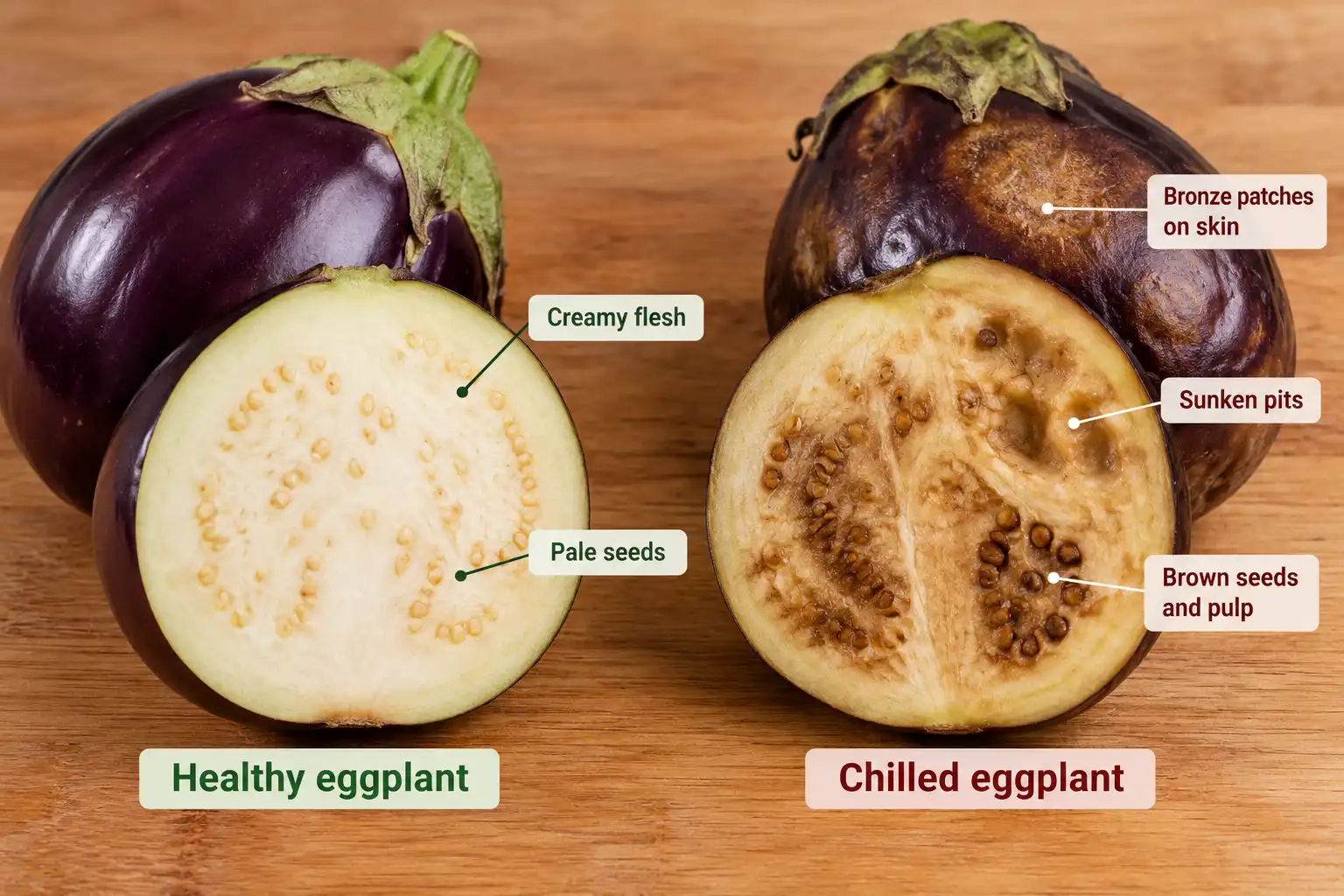
| Sunken pits, bronze patches, brown seeds and pulp | Chilling injury below 50°F | Use the fruit soon; move the rest to 50 to 54°F |
| Dull, wrinkled skin and spongy flesh | Water loss | Wrap loosely and use it first |
| Brown or loose cap | Ethylene, drying out, or chilling | Separate it from ripening fruit; check the temperature |
| Black mold on pitted spots | Alternaria rot after chilling | Discard the fruit |
| Fuzzy gray mold | Botrytis gray mold | Discard it and loosen wraps on the rest |
| Water-soaked flesh that turns brown | Freezing injury near 30.6°F | Keep fruit away from fridge vents |
| Pithy, bitter flesh | Overmature at harvest | Pick earlier; salt slices before cooking |
FAQs about Eggplant Storage
Can you store eggplant at room temperature?
Yes, for up to four days on the counter, according to NDSU Extension. A cool room near 50°F works better, holding eggplant for up to one week, per MSU Extension.
How can you tell if eggplant has gone bad?
Discard eggplant that shows mold, mushy spots, or a sour smell. Brown seeds, sunken pits, and a shriveled brown cap point to chilling injury or water loss, per UC Davis.
Can you freeze eggplant without blanching?
Yes, but unblanched slices lose quality faster in frozen storage. Per the National Center for Home Food Preservation, blanching stops enzymes that dull color, flavor, and texture in the freezer.
Do you need to peel eggplant before freezing?
Not for small, thin varieties, which usually have tender skin, per Penn State Extension. Peel larger, older fruit first, and salt seedy slices to draw out bitter juices before blanching.
Putting This Into Practice
Treat fresh eggplant as a short-hold crop. Keep it whole and dry near 50 to 54°F, and give it only a few days in the refrigerator. For anything longer, blanch and freeze slices or roast and freeze puree. Skip canning plain eggplant altogether.