When to Plant Quinoa: Early Spring in 40°F to 60°F Soil
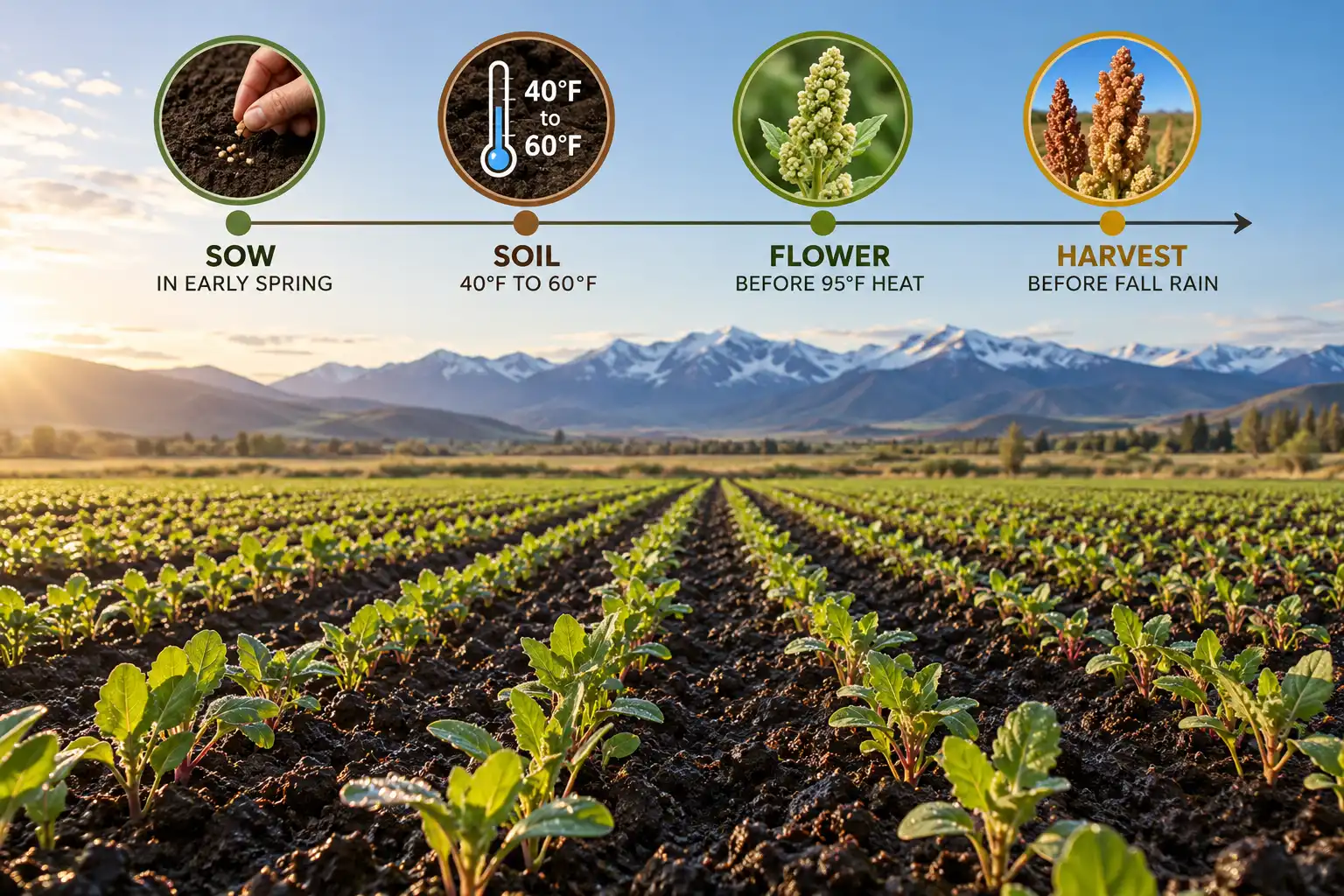
Quinoa rewards early planting and punishes late planting. The answer to when to plant quinoa rests on one goal: flowering before summer heat damages pollen. Soil temperature, frost risk, and your state’s climate set that date.
Early spring is when to plant quinoa. Sow once the soil is workable and sits between 40°F and 60°F, near your last frost date. This timing lets plants flower before 95°F heat and mature before fall rain.
When Is the Best Time to Plant Quinoa?
The best time to plant quinoa is early spring, as soon as the soil dries enough to work. Utah State University (USU) Extension advises seeding close to the average last spring frost. Most varieties tolerate light frost once they emerge. Washington State University (WSU) Extension also favors early spring, since most varieties need about 120 days to mature.
Heat sets the deadline. Because of quinoa’s Andean highland roots, the crop prefers cool summers. According to Oregon State University (OSU) Extension, many varieties fail to set seed when temperatures top 95°F during flowering and early seed set. At that stage, USU notes, heat may sterilize pollen or kill developing seed.
So your planting date has two jobs. First, it pushes flowering ahead of the hottest weeks. Second, it leaves enough season for seed to mature and dry before fall rain. Mature quinoa seed sprouts within 24 hours of getting wet, WSU reports. As a result, a late crop risks sprouting right in the seed head.
How Planting Date Shifts Flowering
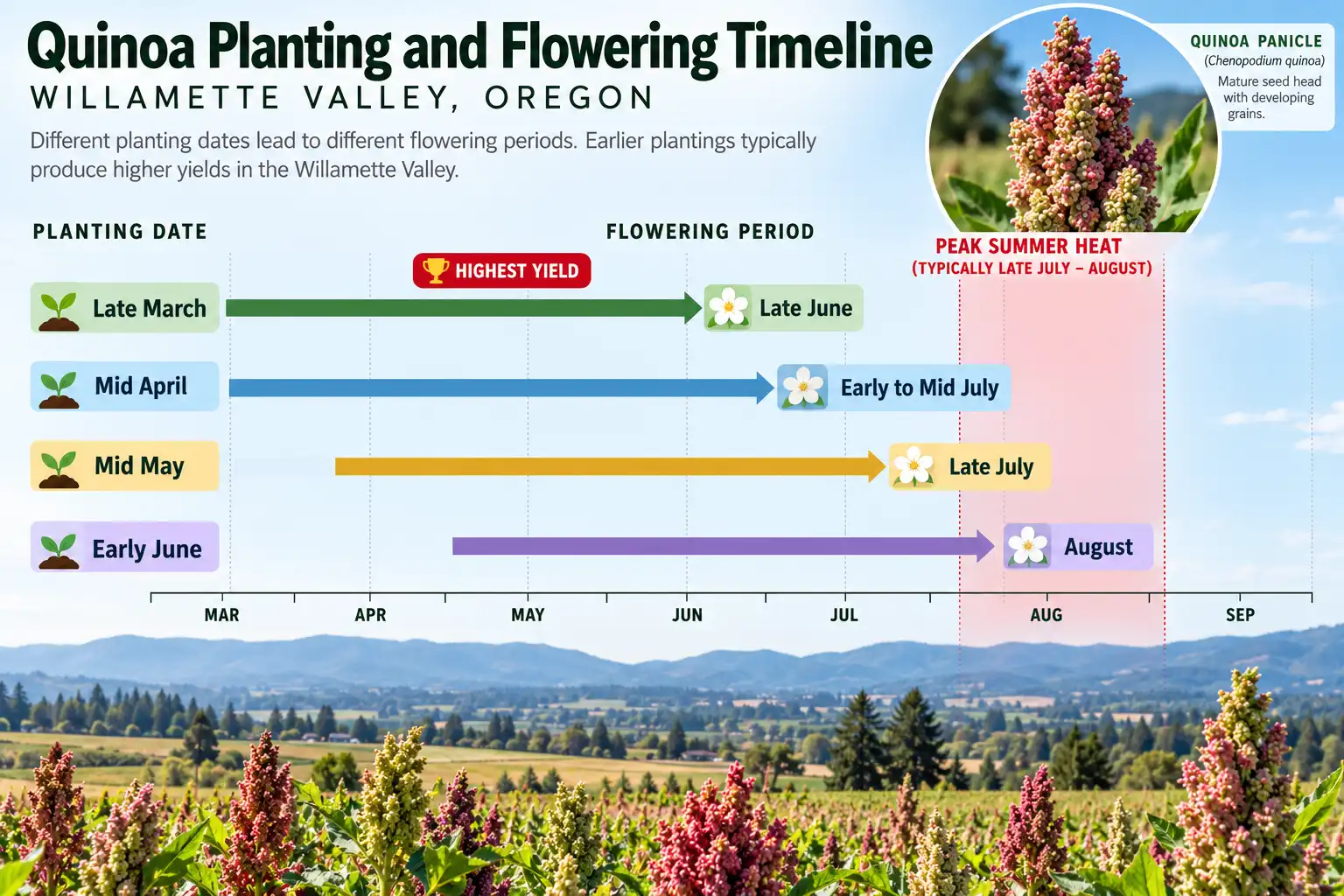
OSU Extension tested four planting dates in the Willamette Valley in 2018 and 2019. Each later date pushed flowering deeper into summer. In both years, the earliest planting produced the highest yield.
| Planting date | Flowering period | Result |
|---|---|---|
| March 22 to 31 | Mid to late June | Highest yield both years |
| April 18 to 24 | Early to mid July | Lower yield |
| May 16 to 18 | Late July | Lower yield, far less weeding |
| June 4 to 14 | Late July to August | Pulled early ahead of fall rain |
The trade-off was weeds. The March 31, 2018 planting needed about 166 hours of hand weeding per acre. In contrast, the May and June plantings needed about 41 hours. Early spring in western Oregon is often too wet for timely cultivation. So line up a stale seedbed and other weed control methods before you seed.
In Colorado, the pattern reverses. Weed competition grew with later planting, according to the Alternative Field Crops Manual (University of Minnesota and University of Wisconsin Extension). Early seeding gave quinoa a head start on late-emerging pigweed.
What Temperature Does Quinoa Need to Germinate?
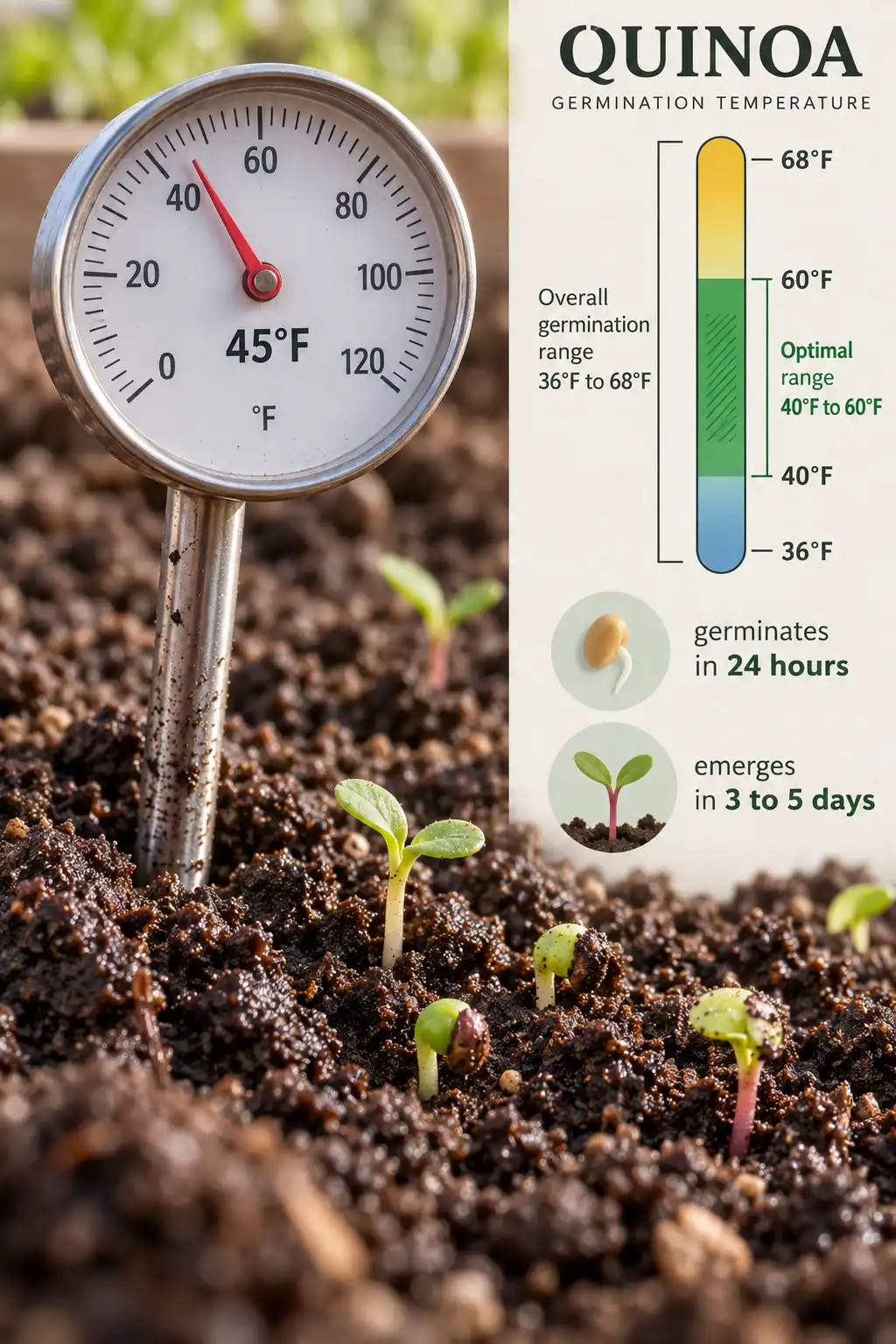
Quinoa germinates best in cool soil between 40°F and 60°F, according to WSU Extension. WSU’s home garden guide reports nearly 100% germination anywhere from 36°F to 68°F. Colder soil only slows emergence. With good moisture, seed germinates within 24 hours, and seedlings emerge in three to five days.
Warm soil is the bigger risk. The Alternative Field Crops Manual notes that quinoa, like spinach, may fail to germinate in warm conditions. So skip the habit of waiting for warm soil, as you would for corn or beans.
Moisture matters as much as temperature. The tiny seed dries out when planted too shallow and fails in waterlogged soil when planted too deep. For the best stand, sow into soil at field capacity. WSU says that point usually arrives two or three days after rain or irrigation.
How to Check Seedbed Temperature
Use a probe thermometer in the top inch of soil, where quinoa seed sits. Take readings in early morning, when soil runs coldest. Then check several spots over three or four days. Once morning readings hold near 40°F and the soil crumbles instead of smearing, the seedbed is ready.
When to Sow Quinoa Seeds Outdoors
Sow quinoa seeds outdoors as soon as the soil is dry enough to till into a fine, level seedbed. Skip fields with standing water. OSU Extension advises planting wet fields later, since quinoa does poorly in saturated soil. Waterlogging also causes stunting and damping-off in young seedlings, per WSU.
Use these seeding specs from Western extension trials:
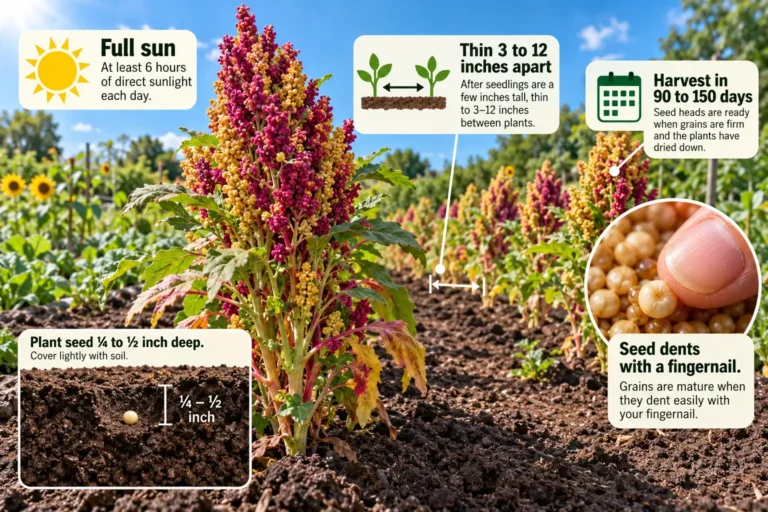
- Depth: ¼ to ½ inch (WSU, USU). Deeper seed emerges poorly.
- Row spacing: 12 to 18 inches in fields (OSU), or 8 to 24 inches in gardens (WSU).
- Seeding rate: about 8 pounds per acre (USU), or 1 to 2 teaspoons per 100 square feet in gardens (WSU).
- Thinning: 3 to 5 inches between plants, two weeks after emergence (WSU).
- Fertilizer: keep it out of direct contact with seed, which severely inhibits germination (WSU).
A stale seedbed fits quinoa’s timing well. As WSU suggests, till, let the first flush of weeds emerge, till again, and plant right away. Straight rows also help, because lambsquarters looks almost identical to quinoa as a seedling.
Starting Quinoa Transplants
Transplants give quinoa a head start where seasons run short or wet. WSU Extension suggests seeding transplants in late March or early April. Then set them in the field in late April or early May. Move plants at three to five true leaves, before roots circle the container.
The time savings are large. In a western Washington study, transplanted quinoa reached harvest an average of 23 days sooner than direct-seeded quinoa in 2016. Transplants also showed higher survival and yield in both study years. Space them 12 inches apart in rows 12 to 24 inches wide.
Still, the direct seeding versus transplanting choice comes down to labor and season length. WSU researchers see the most promise for transplants on small urban and peri-urban farms.
Can Quinoa Seedlings Survive Frost?
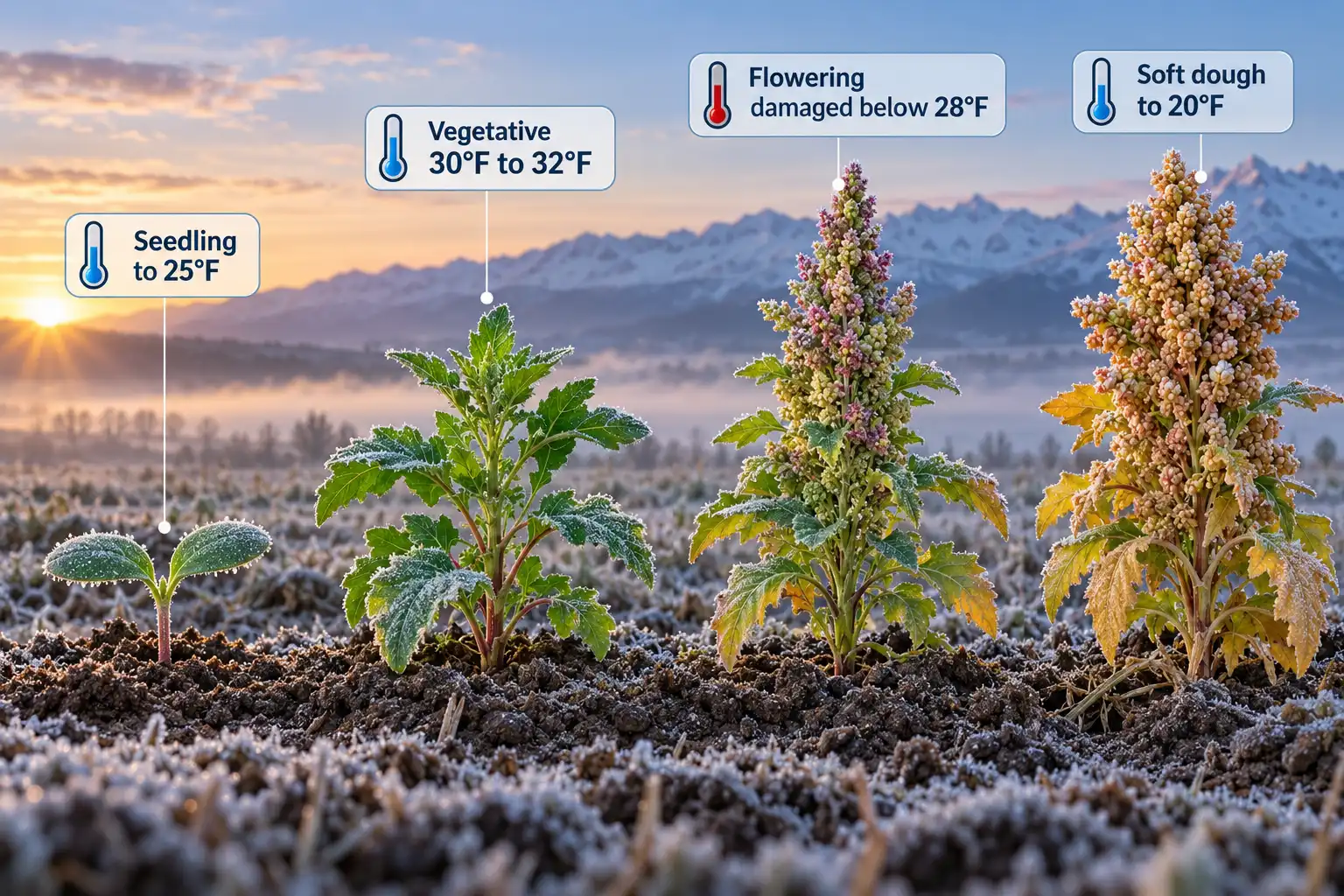
Yes, quinoa seedlings survive light frost. WSU Extension reports that young plants at the two-leaf stage withstand 25°F. That hardiness lets you sow before the last frost date passes.
Risk climbs once the crop flowers. In Colorado, temperatures below 28°F hit plants in mid-bloom in 1985. Those fields lost 70% to 80% of their yield, according to the Alternative Field Crops Manual. However, once grain reaches the soft-dough stage, plants handle temperatures down to 20°F.
| Growth stage | Cold tolerance | Risk level |
|---|---|---|
| Two-leaf seedling | Survives about 25°F | Low |
| Vegetative growth | Tolerates light frost of 30°F to 32°F | Low |
| Flowering | Heavy losses below 28°F | High |
| Soft dough and later | Tolerates about 20°F | Low |
So a light spring frost after emergence poses little risk to the stand. Frost during bloom is the threat to plan around. In high valleys where summer frosts occur, time planting so flowering avoids the coldest nights.
Can You Plant Quinoa in the Fall?
No, fall planting does not suit quinoa grain production in most of the US. None of the Western extension guides cited here recommend it. Three problems stack up against a fall-sown crop.
First, flowering runs into autumn cold, and bloom-stage temperatures below 28°F cause heavy losses. Second, mature seed sprouts within 24 hours of wetting, so fall rain ruins ripe panicles in the field. Third, warm late-summer soil may keep seed from germinating at all.
Late-summer trials back this up. At OSU’s Malheur Experiment Station near Ontario, Oregon, an August 5, 2014 planting produced no grain. A July 21, 2015 planting did yield. Even so, most plants stayed too green for a combine by November. Researchers hand-harvested on November 13, helped by a first frost about three weeks later than average.
So treat any mid-summer sowing as a small-plot experiment. For a dependable grain crop, plan on spring.
When to Plant Quinoa by State
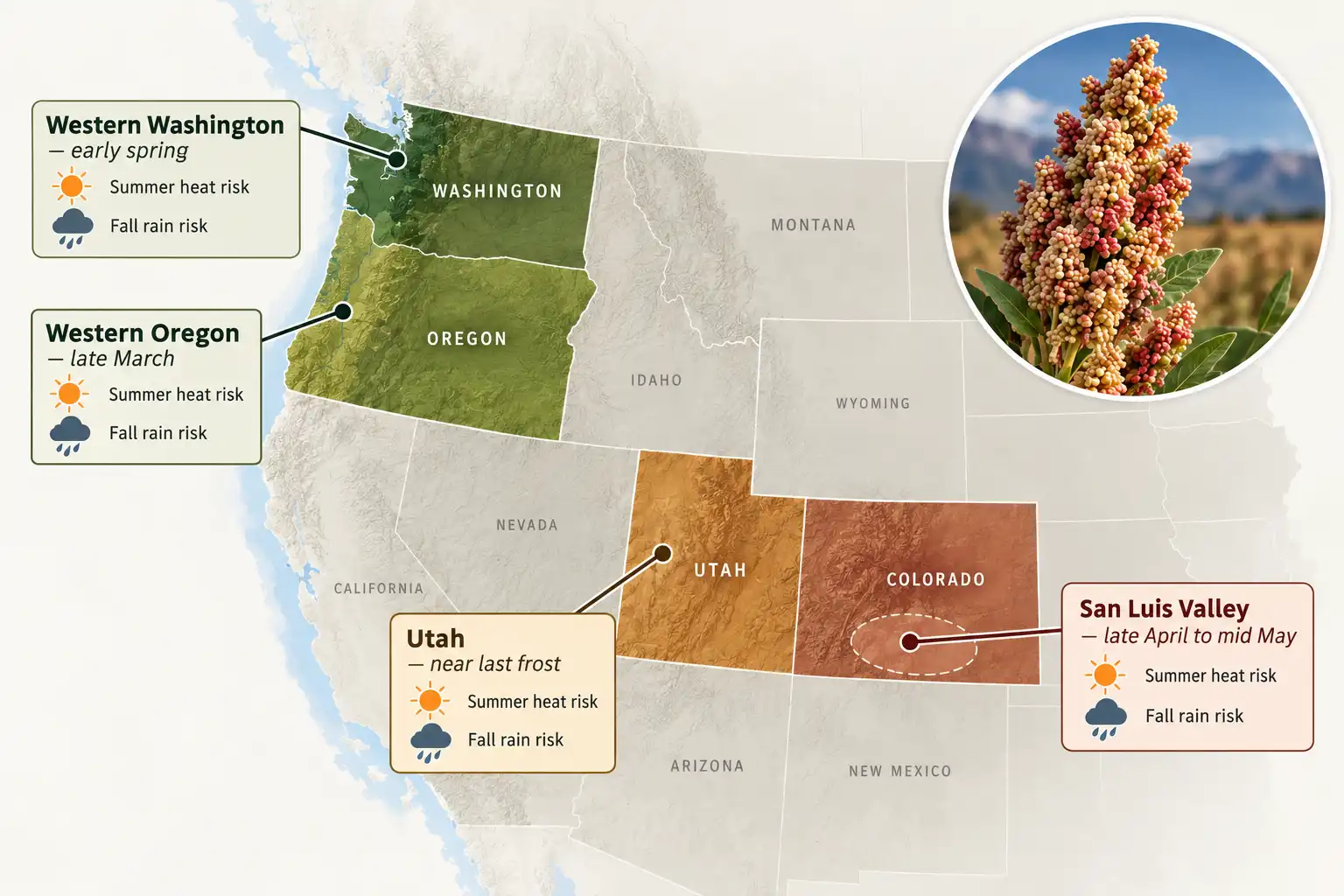
Deciding when to plant quinoa in your state comes down to two things: how early fields dry out and how hot July gets. Use this table as a starting point, then adjust to your local frost dates.
| State or region | Planting window | Main timing risk | Source |
|---|---|---|---|
| Western Oregon (Willamette Valley) | Late March, or as soon as soil dries | Spring weeds, lygus bugs, fall rain | OSU Extension |
| Eastern Oregon (Treasure Valley) | No proven window yet | Summer heat, lygus bugs | OSU Malheur Experiment Station |
| Western Washington | Early spring; transplants late April to early May | Preharvest sprouting | WSU Extension |
| Eastern Washington | Early spring, at the first workable date | Heat above 95°F at bloom | WSU Extension |
| Utah | Near the average last spring frost | Mid-July heat at flowering | USU Extension |
| Colorado (San Luis Valley) | Late April to mid-May | Short season, frost at bloom | Alternative Field Crops Manual |
Oregon: Plant as Soon as the Soil Dries
In western Oregon, plant as early in spring as the seedbed allows. OSU’s Willamette Valley trials started right after soil drying, on March 22 and March 31. Those dates outyielded every later planting. Meanwhile, later crops had to come out before fall rain, which cut yields sharply.
Two cautions apply. Wait on fields with standing water, and plan for heavy early weed pressure. Lygus bugs are the other major threat. In 2018, they damaged about 95% of seed in the trial plots. That year, Red Head, Ivory, and Kaslaea produced the largest yields.
East of the Cascades, the right date is still unsettled. At OSU’s Malheur Experiment Station, a May 2, 2015 planting produced no grain. Researchers blamed a mix of heat, lygus bugs, and poorly adapted varieties. Only the mid-July planting described earlier produced grain there.
Washington State: Early Spring, Then Beat the Rain
In western Washington, direct seed in early spring as soon as the soil is workable. Alternatively, set out transplants in late April or early May. The end of the season is the hard part. Late summer and early autumn rains cause preharvest sprouting, mold, and lodging, according to WSU Extension. So choose fast-maturing, shorter varieties described as sprout resistant. In 2018 western Washington trials, Titicaca, QQ74, Puno, and Kaslaea each topped 2,700 pounds per acre.
Eastern Washington faces heat instead. There, high summer temperatures combine with low humidity to cause pollen sterility. WSU recorded complete yield loss in dryland plots when temperatures passed 95°F during flowering. For that reason, seed at the first workable date and choose heat-tolerant varieties. Also plan irrigation through bloom, since irrigation substantially raised yields under heat stress in WSU trials.
Utah: Seed Near the Last Frost
Plant as soon as the soil is workable, ideally close to the average last spring frost, according to USU Extension. Delayed seeding cuts yield and gives weeds more time to compete. Pick a field that dries early, since late access pushes everything back.
Heat is Utah’s main obstacle. Flowering usually starts in mid-July, right as temperatures peak. In Logan, at 4,500 feet, fully irrigated quinoa still failed to set seed in two of four trial years. In contrast, a 2017 trial at Panguitch, at 6,600 feet, set seed while the same varieties in Logan did not. Cooler summer temperatures made the difference.
With about 120 days from planting to harvest, cold high-elevation valleys leave less margin at season’s end. USU lists varieties that set seed in Logan trials, including Kaslaea, Titicaca, Puno, and CO 407 Dave.
Colorado: Late April to Mid-May in the San Luis Valley
In southern Colorado, plant from late April to mid-May, according to the Alternative Field Crops Manual. That guidance draws on Colorado State University (CSU) field research in the San Luis Valley. WSU notes successful quinoa harvests there at 7,600 feet. Varieties in southern Colorado mature in 90 to 125 days.
Elevation shapes the Colorado calendar. The manual reports that quinoa flowers and sets seed between 7,000 and 10,000 feet, where summers stay cool. For example, CO407, a yellow-seeded variety released by the CSU Agricultural Experiment Station in 1987, matures in about 100 days. Spring moisture helps, too. Plantings from late April to mid-May usually needed no irrigation until mid-June when soil started near field capacity.
Lower elevations carry more heat risk. Colorado research summarized in the manual found that temperatures above 95°F tended to cause plant dormancy or pollen sterility. On the Front Range or eastern plains, sow at the first workable date and choose heat-tolerant varieties.
Common Quinoa Timing Mistakes
Most failed quinoa stands trace back to a few timing and seeding errors. Use this table to diagnose problems.
| Problem | Likely cause | Fix |
|---|---|---|
| Seed never emerges | Planted deeper than ½ inch, or soil crusted after rain | Sow ¼ to ½ inch deep into moist, fine soil |
| Tall plants with empty seed heads | Flowering hit temperatures above 95°F | Plant earlier, choose heat-tolerant varieties, irrigate through bloom |
| Seed sprouting in the head | Fall rain on mature panicles | Plant earlier, choose sprout-resistant varieties, cut and dry under cover |
| Plants mature too late | Grocery-store quinoa or a short-day variety | Buy day-neutral seed bred for your region |
| Stunted or collapsing seedlings | Waterlogged soil and damping-off | Plant on well-drained ground after fields dry |
| Weak stand along the fertilizer band | Fertilizer touching seed | Keep fertilizer away from the seed row |
| Weeds overtake seedlings | Slow growth after emergence | Stale seedbed, straight rows, early cultivation |
Slow early growth is normal. USU Extension notes that quinoa grows slowly for about 7 to 14 days after emergence while its taproot develops. So weed control during that window protects the whole stand.
Frequently Asked Questions
How late can you plant quinoa?
Aim to finish planting by mid-May in most Western regions, since later dates push flowering into peak heat. In Oregon State University trials, every planting after late March yielded less, and June crops came out early ahead of fall rain.
How long does it take quinoa seeds to germinate?
Quinoa seed germinates within about 24 hours in moist soil and emerges in three to five days. Cold soil below 40°F slows emergence, while waterlogged or crusted soil can stop it entirely, per WSU Extension.
Can you plant store-bought quinoa?
Store-bought quinoa is usually a poor choice for planting. According to WSU Extension, grocery quinoa typically comes from short-day Bolivian and Peruvian varieties that may never mature in a US growing season.
How long does quinoa take to grow?
Most quinoa varieties need 90 to 150 days from sowing to harvest, according to WSU Extension. Flowering and grain fill happen about 40 to 80 days after sowing, the stage most sensitive to heat and drought.
What to Check Before You Plant
Check three things before you sow. First, confirm the seedbed is workable, free of standing water, and near 40°F to 60°F in the morning. Next, count forward 40 to 80 days to estimate bloom, and make sure it lands before your hottest weeks. Finally, confirm a season of 90 to 150 days finishes before fall rain or hard frost. When all three line up, plant right away instead of waiting for warmer soil. Then log the date in your seasonal planting calendar to refine next year’s timing.