How to Grow Quinoa: Planting to Harvest in 90 to 150 Days
Quinoa is an Andean seed crop that thrives in cool summers and struggles in heat. Learning how to grow quinoa means picking a day-neutral variety, sowing shallow in early spring, and harvesting before fall rain.
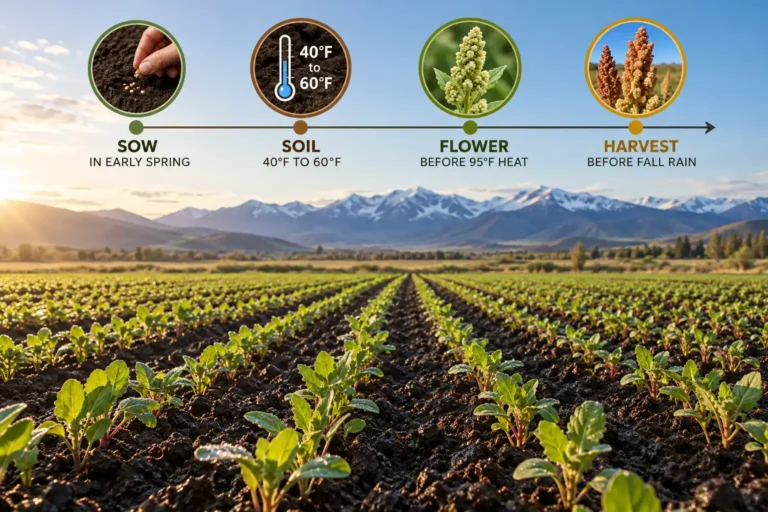
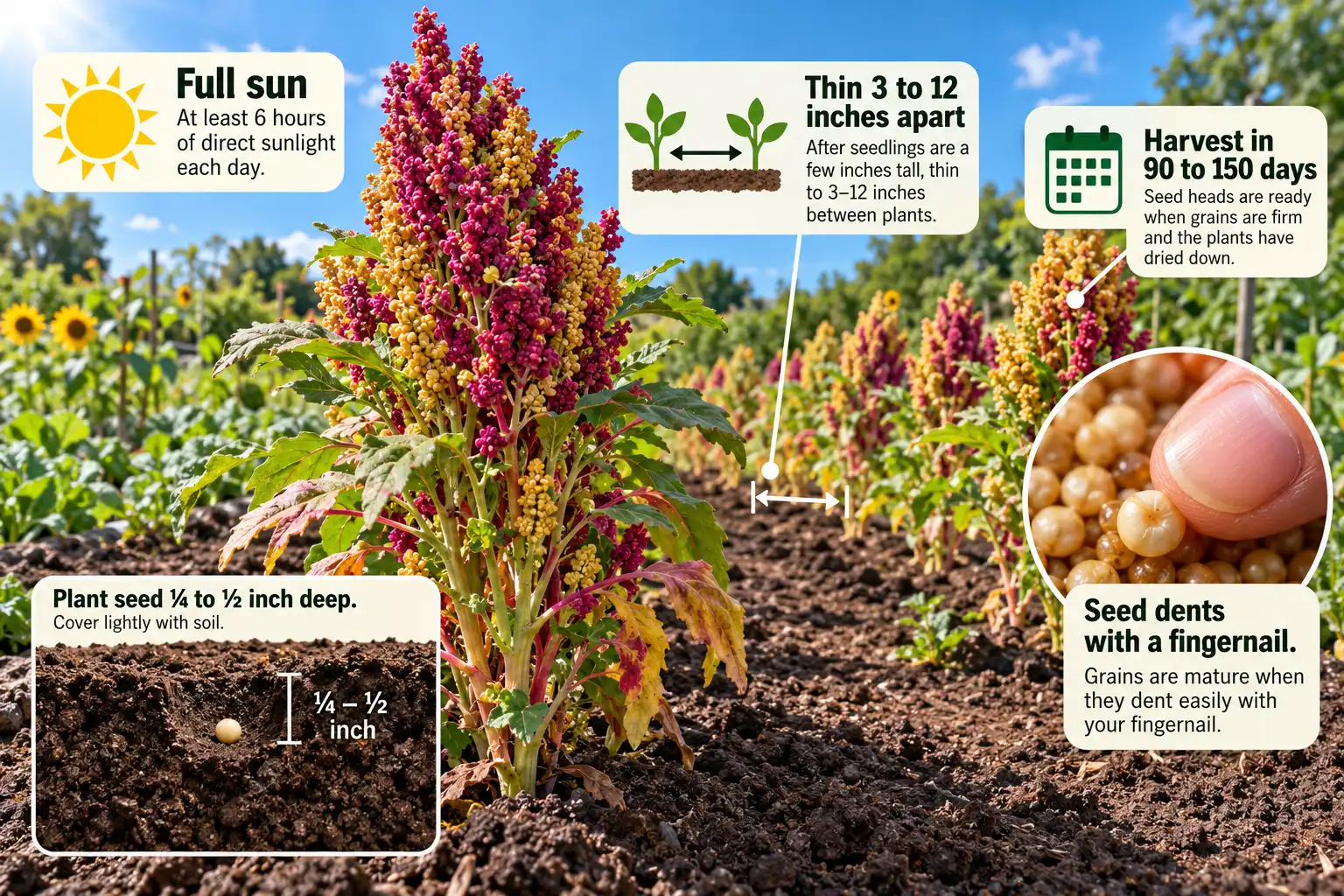
To grow quinoa, sow day-neutral seed ¼ to ½ inch deep in early spring, in full sun and well-drained soil. Thin to 3 to 12 inches apart. Harvest in 90 to 150 days, when seeds barely dent with a fingernail.
How Does Quinoa Grow?
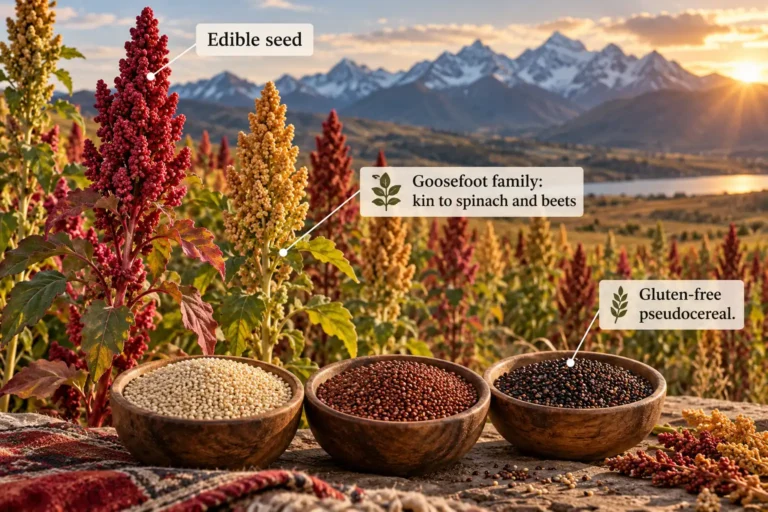
Quinoa grows as an upright broadleaf annual that sets seed in a large panicle at the top of each stem. Unlike wheat or rice, it is not a grass. Washington State University (WSU) Extension describes quinoa as a broadleaf pseudocereal in the Amaranthaceae family. Spinach, beets, and the weed lambsquarters belong to the same family.
Below ground, a taproot branches into a wide root system. That root system gives quinoa its drought tolerance, according to the Alternative Field Crops Manual from University of Minnesota Extension. The manual also notes that quinoa mostly pollinates itself. Even so, cross-pollination reaches 10 to 15%.
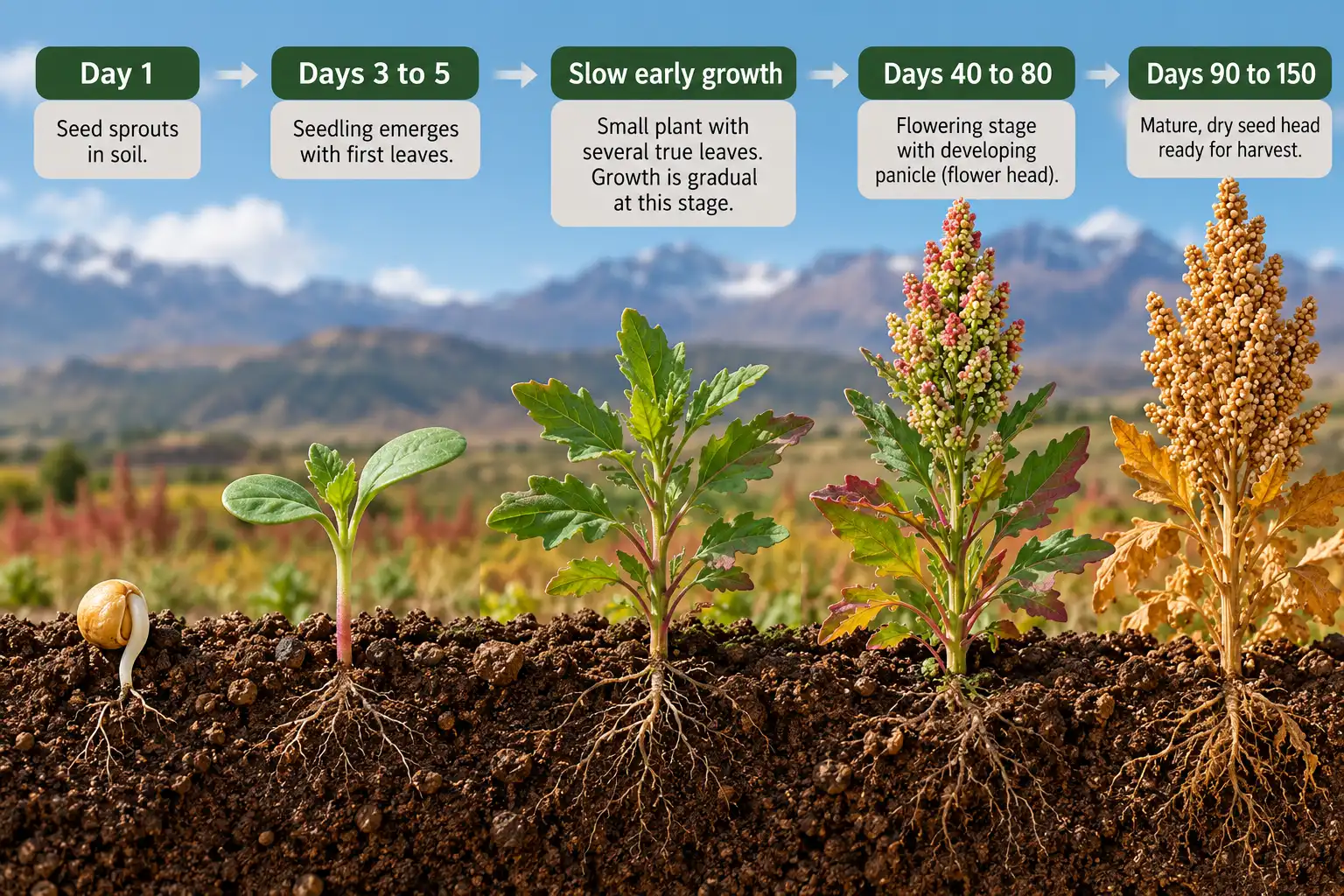
Growth then follows a clear sequence. Seed germinates within 24 hours in moist soil, and seedlings emerge in three to five days. Once true leaves appear, growth stalls for two weeks or more while roots develop, Oregon State University (OSU) Extension notes. Flowering and grain fill follow 40 to 80 days after sowing.
Quinoa Growth Stages at a Glance
| Stage | Days After Sowing | What to Do |
|---|---|---|
| Germination | 1 | Keep the seedbed surface moist |
| Emergence | 3 to 5 | Watch for soil crusting |
| Slow early growth | 2 or more weeks after emergence | Weed often and thin seedlings |
| Flowering and grain fill | 40 to 80 | Water deeply; heat above 95°F hurts seed set |
| Maturity | 90 to 150 | Harvest when seed barely dents with a fingernail |
Where Is Quinoa Grown?
Most of the world’s quinoa grows in the Andes, the crop’s native range across Bolivia, Chile, and Peru. FAO production data rank Peru first and Bolivia second worldwide. Meanwhile, the United States imports more quinoa than any other country, according to OSU Extension.
US production remains small and scattered across cool-summer regions. WSU Extension lists successful crops in Colorado’s San Luis Valley and coastal central California. Oregon’s Willamette Valley, Washington’s Olympic Peninsula, and the Canadian prairies also make the list. So does irrigated production in southeastern Idaho.
Altitude matters less than temperature. WSU Extension reports harvests at sea level on the Olympic Peninsula and at 7,600 feet in the San Luis Valley. In short, cool summers, and especially cool nights, matter most.
Can You Grow Quinoa in Your Garden?
Yes, you can grow quinoa in your garden if temperatures stay below 95°F while plants flower. Above that point, heat causes flower abortion and pollen sterility, WSU Extension explains. In eastern Washington dryland plots, flowering-time heat over 95°F caused complete yield loss.
The same pattern shows up in other states. Quinoa trials near the Twin Cities failed to set seed, likely from heat. For that reason, the Alternative Field Crops Manual recommends quinoa only on an experimental basis in Minnesota and Wisconsin. Utah State University Extension saw a similar split in 2017. A trial at 6,600 feet in Panguitch set seed, while the same trial at 4,500 feet in Logan did not.
So match the crop to your summer before you buy seed.
Regional Fit for Quinoa in the US
| Region | Fit | Main Risk |
|---|---|---|
| Coastal Pacific Northwest | Strong | Late-summer rain sprouts mature seed; downy mildew |
| High-altitude West (San Luis Valley, southern Utah) | Strong | Short season; choose early varieties |
| Eastern Washington and lower-altitude Utah valleys | Variable | Heat above 95°F at bloom; needs irrigation |
| Upper Midwest (Minnesota, Wisconsin) | Experimental | Hot summers; wet weather as seed matures |
Choose a Day-Neutral Quinoa Variety
Pick a day-neutral or long-day variety bred for North American summers. Grocery quinoa is typically a short-day type from Bolivia or Peru. As a result, it may not mature at US latitudes, WSU Extension notes. Many varieties also carry bitter saponins on the seed coat. Saponin-free “sweet” types exist, but their seed is hard to find.
Trial data point to a handful of proven choices:
| Variety | Why Growers Choose It |
|---|---|
| QQ74 | 3,385 lb per acre in WSU’s 2018 western Washington trials |
| Titicaca | 3,229 lb per acre in the same WSU trials |
| Kaslaea | High yields in both WSU and OSU trials |
| Red Head | Among the top yielders in OSU’s 2018 Willamette Valley trial |
| CO407 (Dave 407) | Short, early (about 100 days), resists seed shattering |
| Brightest Brilliant Rainbow | Multicolored heads; sold by many garden seed companies |
Still, yields swing sharply by site. In WSU trials, top varieties passed 2,700 lb per acre in western Washington. In hot eastern Washington seasons, the same varieties yielded a fraction of that.
When to Plant Quinoa
Plant quinoa in early spring, as soon as the soil dries enough to work. Early sowing pushes flowering ahead of peak summer heat. WSU Extension reports nearly 100% germination at soil temperatures from 36°F to 68°F. Late sowing adds risk, since quinoa seed may fail to germinate in warm soil, per the Alternative Field Crops Manual.
Regional dates vary. Growers in southern Colorado plant from late April to mid-May, while a Minnesota trial at Rosemount went in mid-May. In the Willamette Valley, OSU Extension found the earliest planting dates gave the highest yields in both 2018 and 2019.
Early planting carries one trade-off. In OSU’s 2018 trial, a March 31 planting needed about 166 hours of hand weeding per acre. By contrast, May and June plantings needed only 41 hours. Also skip ground with standing water, because quinoa does poorly in saturated soil.
Cold rarely threatens young stands. Seedlings at the two-leaf stage handle 25°F, WSU Extension notes. However, flowering plants exposed to 25°F or lower suffer heavy losses. Push a probe-style soil thermometer to seed depth for a quick reading before you sow.
What Soil Does Quinoa Grow Best In?
Quinoa grows best in well-drained sandy loam or loamy sand with a near-neutral pH. The Alternative Field Crops Manual names those textures as ideal. Still, the crop tolerates a lot. WSU Extension reports it grows in coarse sand through heavy clay, at pH 4.5 to 9. It also ranks among the most salt-tolerant crops.
Drainage is the one thing quinoa will not forgive. Waterlogged soil causes stunting and damping off. So prepare a level seedbed and work it 6 to 8 inches deep.
How to Fertilize Quinoa
Run a soil test before adding nutrients. WSU Extension cites research where 0.25 lb of nitrogen per 100 square feet nearly tripled yields over unfertilized plots. Aged compost or composted manure, worked in at bed prep, often covers that need.
However, more nitrogen is not better. Excess nitrogen delays maturity, grows extra leaves, and causes lodging. Also keep fertilizer away from the seed, because direct contact can severely inhibit germination.
Field growers work with a wider target. OSU Extension suggests 50 to 100 lb of nitrogen per acre is likely enough, depending on soil reserves. The Alternative Field Crops Manual cites older Colorado State research showing peak yields at 150 to 180 lb per acre.
Does Quinoa Need Full Sun?
Yes, quinoa needs full sun, according to WSU Extension. So give it the brightest spot in the garden.
Plant height shapes the layout. Mature quinoa reaches 3 to 6 feet tall. So set rows on the north side, where they will not shade shorter crops. In humid areas, also orient rows with the prevailing wind. Better airflow dries leaves faster and helps hold off downy mildew, WSU Extension advises.
Wide rows leave bare ground early in the season. For that reason, WSU Extension suggests filling the space with quick, low crops such as radish or lettuce. A living mulch like clover or medic works too.
How to Plant Quinoa From Seed
Plant quinoa seed ¼ to ½ inch deep in a fine, moist seedbed, then thin two weeks after emergence. WSU Extension’s home garden guide outlines the process:
- Plant into moisture. Sow when soil sits at field capacity, usually two to three days after rain or irrigation.
- Mark the rows. Space rows 8 to 24 inches apart, based on your bed layout.
- Measure the seed. Sow 1 to 2 teaspoons (5 to 8 grams) per 100 square feet, or about 2,000 to 3,200 seeds. A typical retail packet holds about 250 seeds.
- Sow shallow. Drop seed ¼ to ½ inch deep and cover it lightly.
- Keep the surface damp. Small seed dries out fast and struggles through crusted soil.
- Thin on schedule. Two weeks after emergence, thin to 3 to 5 inches apart, or up to 12 inches for larger plants.
Spacing changes the shape of the plant. Tight in-row spacing forces a single main stem and speeds maturity, OSU Extension reports. In contrast, wide spacing grows branched plants with several seed heads that ripen over days or weeks. In poor conditions, double the seeding rate.
How Deep to Plant Quinoa Seeds
Plant quinoa seeds ¼ to ½ inch deep, or at the shallowest depth that reaches moist soil, per WSU Extension. OSU Extension recommends ¼ inch in a fine seedbed. Deeper planting leads to poor emergence. Older guidance in the Alternative Field Crops Manual allowed up to 1 inch in dry soils. Even so, shallow sowing into moisture gives the most reliable stand.
Starting Quinoa Transplants
Transplants give quinoa a head start on weeds. Start seed indoors about a month before planting out, WSU Extension advises. Then move seedlings outside at three to five true leaves, before roots circle the cell. Set them 12 inches apart in rows 12 to 24 inches apart, ideally on a cool, cloudy morning.
The payoff can be large. In a western Washington study, transplanted quinoa reached harvest an average of 23 days sooner than direct-seeded quinoa in 2016. Wider spacing in the transplant plots also played a role.
What Do Quinoa Seedlings Look Like?
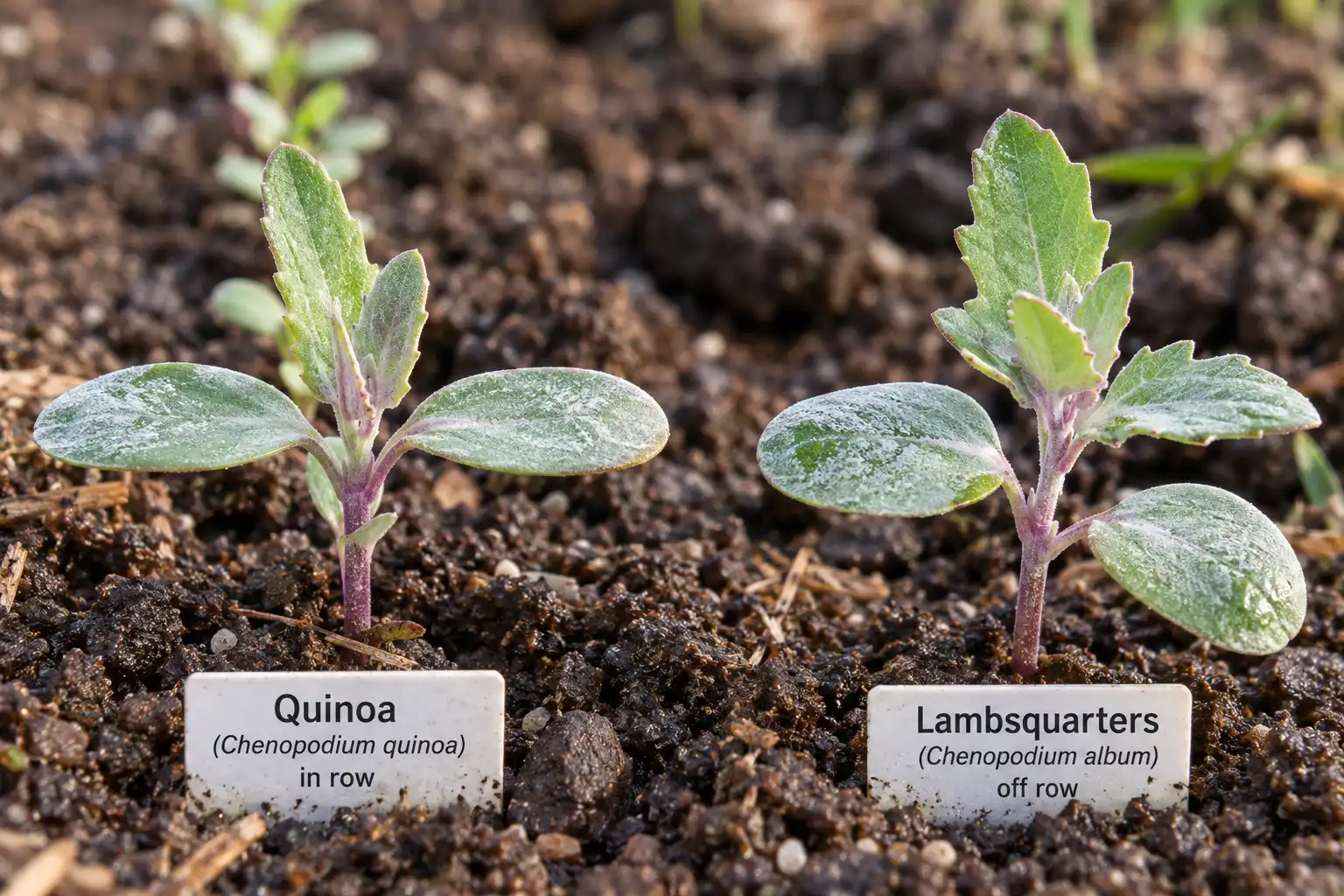
Quinoa seedlings look almost identical to lambsquarters, a common weed in the same genus. Both show succulent seed leaves with a mealy white coating, WSU Extension notes. Stems run green, tan, or purple. Later, true leaves take on a goosefoot shape.
So rely on placement, not looks. Sow in straight rows and pull any lookalike growing outside the row. Weedy plants reveal themselves later through their sprawling habit.
This matters for seed saving too. The lambsquarters species Chenopodium berlandieri can cross with quinoa. Remove it before it flowers if you plan to replant your own seed.
How to Grow Quinoa in a Raised Bed
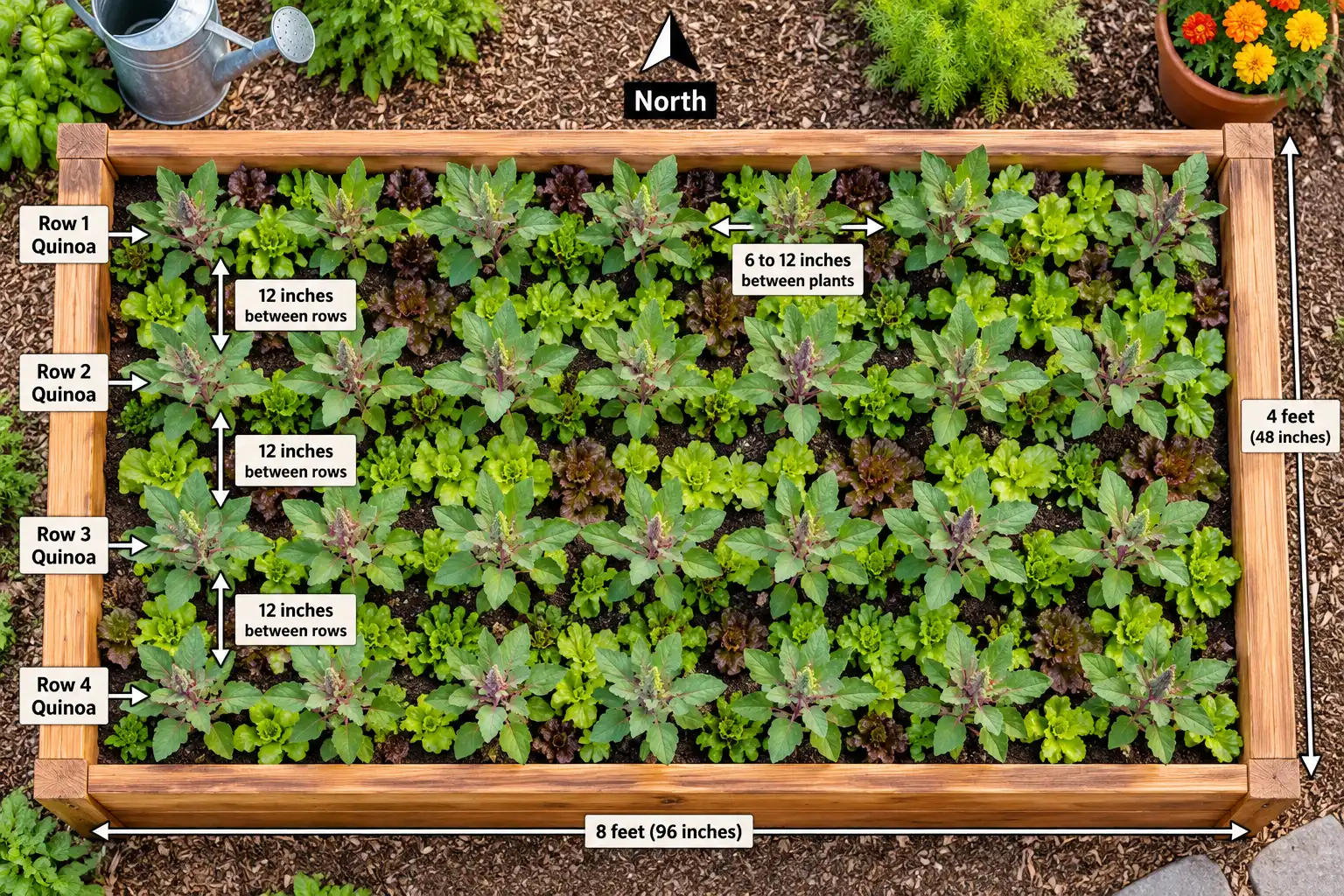
A raised bed suits quinoa because it drains fast, and waterlogged soil causes stunting and damping off. Loosen the bed 6 to 8 inches deep, the depth WSU Extension recommends for quinoa seedbeds. Then sow as early in spring as the soil allows.
In a 4-by-8-foot bed, run four rows lengthwise, 12 inches apart. Next, thin plants to 6 to 12 inches within each row. Closer plants ripen sooner and more evenly. Meanwhile, wider spacing produces branched plants with extra seed heads.
Keep compost additions moderate. Beds rich in nitrogen grow tall, leafy plants that mature late and lodge in wind.
Growing Quinoa in Containers
Quinoa grows in pots, but it needs a light hand with fertilizer. Containers lack the soil buffer that protects roots from excess fertilizer, WSU Extension warns. Its garden rate is 0.25 lb of nitrogen per 100 square feet. In a 12-inch pot, that equals about 2 teaspoons of blood meal. Signs of overfeeding include poor germination, stunting, and low yield.
How to Water Quinoa and Control Weeds
Watering
Quinoa tolerates drought, yet water during flowering decides the yield. The crop needs 10 to 15 inches of combined rain and irrigation per season, per the Alternative Field Crops Manual. Also, WSU Extension calls flowering and grain fill the most critical growth stages.
Timing beats volume. Hold off irrigating until the two- or three-leaf stage if you planted into moist soil. Too much early water causes damping off and tall, lanky plants with no yield gain. Later, during bloom, steady water pays off. In eastern Washington, drip irrigation of 0.6 inch once a week raised yields nearly five times over unirrigated plots.
Deliver water at the soil line. Overhead watering wets the foliage and invites downy mildew. For that reason, a drip line beats a sprinkler for this crop.
Weed Control
Weeds are the biggest early threat. Quinoa grows slowly for about two weeks after emergence, and no selective herbicide carries a quinoa label, OSU Extension notes. So early weed control has to be mechanical or cultural.
Start with a stale seedbed. Till, let the first flush of weeds sprout, till again, and plant right away, WSU Extension suggests. After that, hoe between rows and hand-pull within rows. Once plants establish, 2 inches or more of straw or shredded leaves suppresses new weeds.
Common Quinoa Problems and Fixes
WSU and OSU Extension trace most quinoa failures to heat, harvest rain, downy mildew, and a few insects. WSU Extension rates downy mildew as the most damaging disease in high-rainfall areas.
| Problem | Likely Cause | Fix |
|---|---|---|
| Plants flower but set no seed | Heat above 95°F at bloom | Plant earlier; water through flowering |
| Seeds sprout on the head | Rain on mature seed | Harvest promptly; dry cut plants under cover |
| Pink and yellow leaf patches with gray fuzz | Downy mildew | Widen spacing; avoid overhead watering |
| Curled leaves and sticky honeydew | Aphids | Pull weedy hosts; use a neem product labeled for grains |
| Damaged or empty seed | Lygus bugs | Stagger harvest of nearby host crops; vacuum small plots |
| Seedlings wilt and collapse | Wireworms or damping off | Avoid fresh sod ground; do not overwater |
| Stems fall over | Excess nitrogen or heavy late watering | Cut nitrogen; ease irrigation after seed fill |
Quinoa Height and Time to Maturity
How Tall Does Quinoa Grow?
Quinoa grows 3 to 6.5 feet tall, depending on variety, according to WSU Extension. Some compact types stay near 1.5 feet, per the Alternative Field Crops Manual. Water and nitrogen both push height up. For example, one Colorado study cut plant height by 50% with less water, yet yield dropped only 18%.
How Long Does Quinoa Take to Grow?
Quinoa takes 90 to 150 days from sowing to harvest, depending on variety, per WSU Extension. Most varieties in OSU’s Willamette Valley trials needed 100 to 120 days. In southern Colorado, varieties matured in 90 to 125 days, and CO407 finishes in about 100. Short-season gardeners can trim that window with transplants or dense spacing.
How to Harvest Quinoa
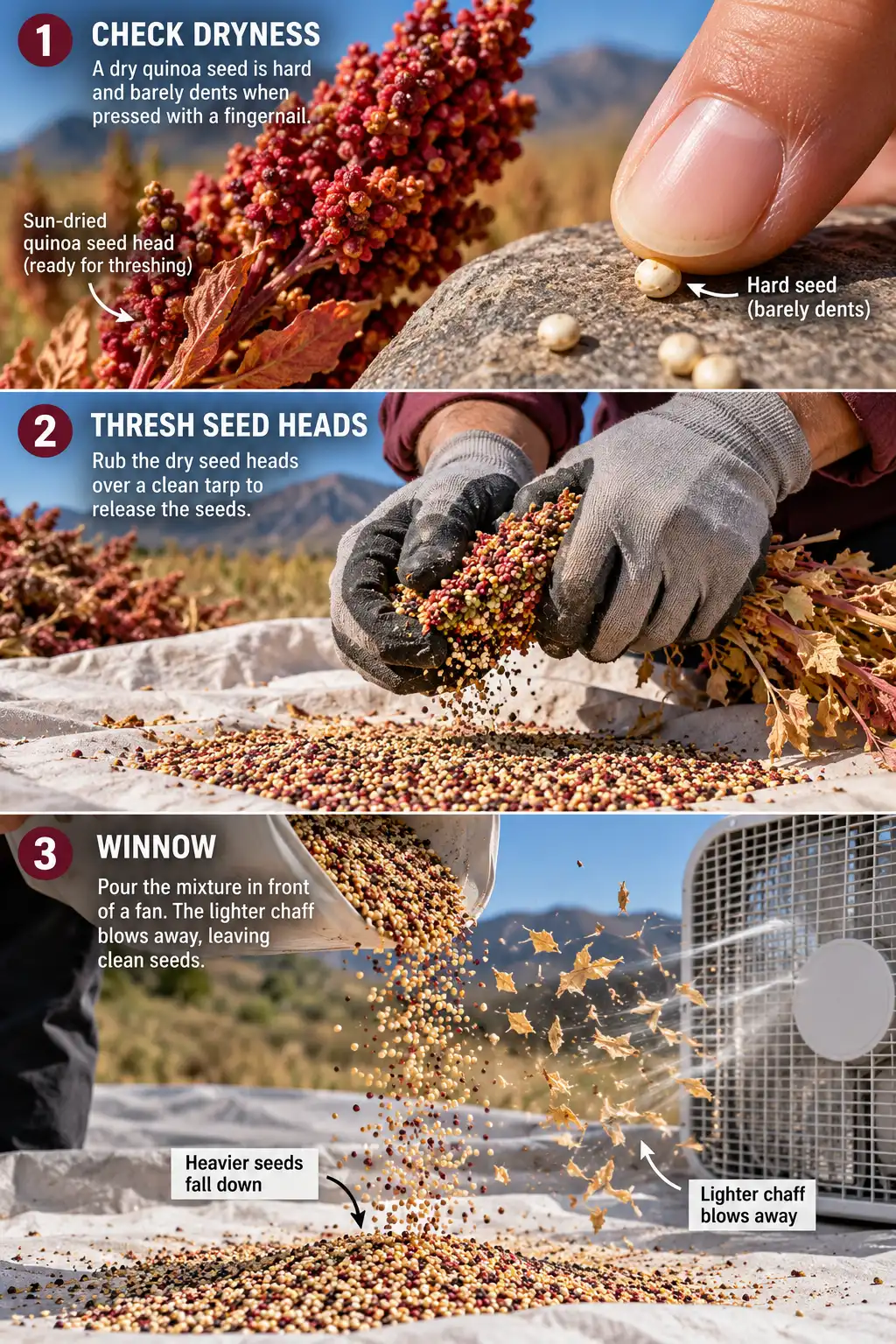
Harvest quinoa when the seed barely dents with a fingernail and most leaves have dried and dropped. First, the stalks and leaves turn yellow, orange, red, or pink. In Washington, WSU Extension says this color shift usually starts in late August to mid-September. A ripe head also releases seed easily when rubbed by hand.
Speed matters once seed matures. Mature quinoa seed germinates within 24 hours of getting wet, so one rain can ruin the crop. If rain threatens, cut the plants and finish drying them under cover.
For a garden harvest, follow these steps:
- Cut seed heads, or whole plants, once the fingernail test passes.
- Pick the leading head first on branched plants, then return for later heads.
- Dry the cuttings on tarps in a sheltered spot.
- Thresh by rubbing heads between gloved hands or beating them against a hard surface over a clean tarp.
- Winnow in front of a fan, then screen out stems and large debris.
The process follows the same idea as threshing wheat: break the seed loose, then separate it from chaff. On larger plots, growers often swath the crop so seed finishes hardening in the windrow, OSU Extension notes. In late August, a swathed field can dry within a week.
How to Clean and Store Homegrown Quinoa
Rinse homegrown quinoa until the water stops foaming, because most varieties carry bitter saponins. WSU Extension describes three home methods:
- Soak, stir, and drain repeatedly until no soapy bubbles form.
- Rinse under fast, hot running water several times.
- Run a vinegar-only washer cycle to clear detergent. Then seal seed in a pillowcase and run two or three soap-free cycles.
Afterward, taste a few seeds. A bitter flavor means saponins remain. Then spread the seed on trays or screens to dry fully.
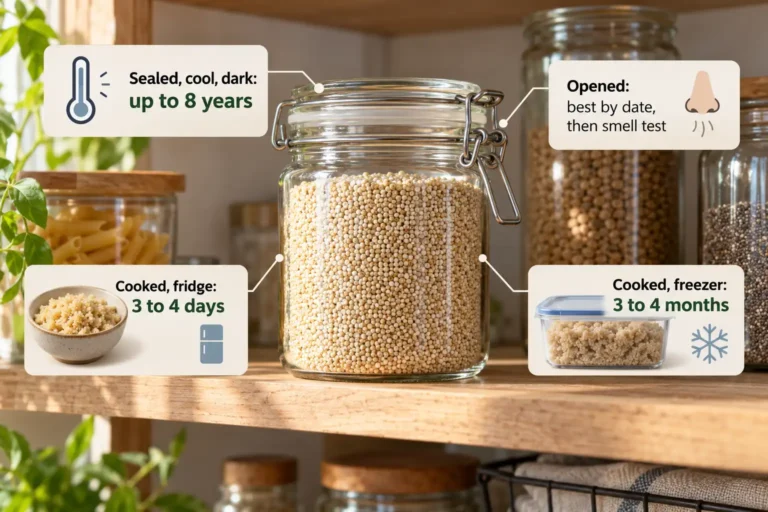
Dry seed thoroughly before storage. WSU Extension recommends about 13% moisture for seed you plan to replant. In an airtight container near 50°F and 45% humidity, quinoa seed stays viable for up to 20 years. A refrigerator works well for small batches. For kitchen stock, learn the signs of dry quinoa going stale before cooking older seed.
Does Quinoa Grow Back Every Year?
No, quinoa does not grow back every year. It is an annual that dies after setting seed, according to WSU Extension. However, seed that shatters at harvest can sprout as volunteers the next season, OSU Extension notes.
To keep a planting going, save seed from your healthiest plants. Quinoa mostly self-pollinates, but varieties can cross at rates up to 10 to 15%, per the Alternative Field Crops Manual. So grow one variety, or keep varieties well apart, if you want seed true to type.
Frequently Asked Questions
Can you plant store-bought quinoa?
Usually not, since grocery quinoa is typically a short-day Andean type that may not mature in US gardens, per WSU Extension. Buy day-neutral seed from a garden seed company instead.
Can you eat quinoa leaves?
Yes, young quinoa leaves are edible, with a crisp texture like baby spinach. WSU Extension notes that picking a few leaves is fine, but heavy leaf harvests from seed plants reduce grain yield.
How much quinoa does a garden produce?
Expect roughly 3 lb of seed per 100 square feet of garden. WSU Extension lists an average of 3.34 lb per 100 square feet, and irrigation plus fertilizer push it higher.
Can quinoa survive frost?
Young quinoa handles frost well, surviving 25°F at the two-leaf stage, per WSU Extension. Flowering plants are the weak point, and the Alternative Field Crops Manual reports 70 to 80% losses after a mid-bloom freeze below 28°F.
Is quinoa hard to grow?
Quinoa sprouts easily, but bringing it to harvest takes the right climate. Heat during bloom, weeds that mimic seedlings, and rain on mature seed are the top challenges WSU Extension lists for growers.
What to Check Before You Plant
Start with your summer weather. Quinoa needs flowering-time highs under 95°F and a dry window at harvest. Next, buy a day-neutral variety rather than grocery seed. Then sow shallow in early spring, keep rows weeded for the first month, and water through bloom. Finally, cut the crop as soon as seed passes the fingernail test, and rinse it until the foam disappears.