What Is Quinoa? The Seed That Cooks Like a Grain
Quinoa sits beside rice and oats on store shelves, yet it does not come from a grass. Knowing what quinoa is helps you cook it better and judge whether it fits your fields.
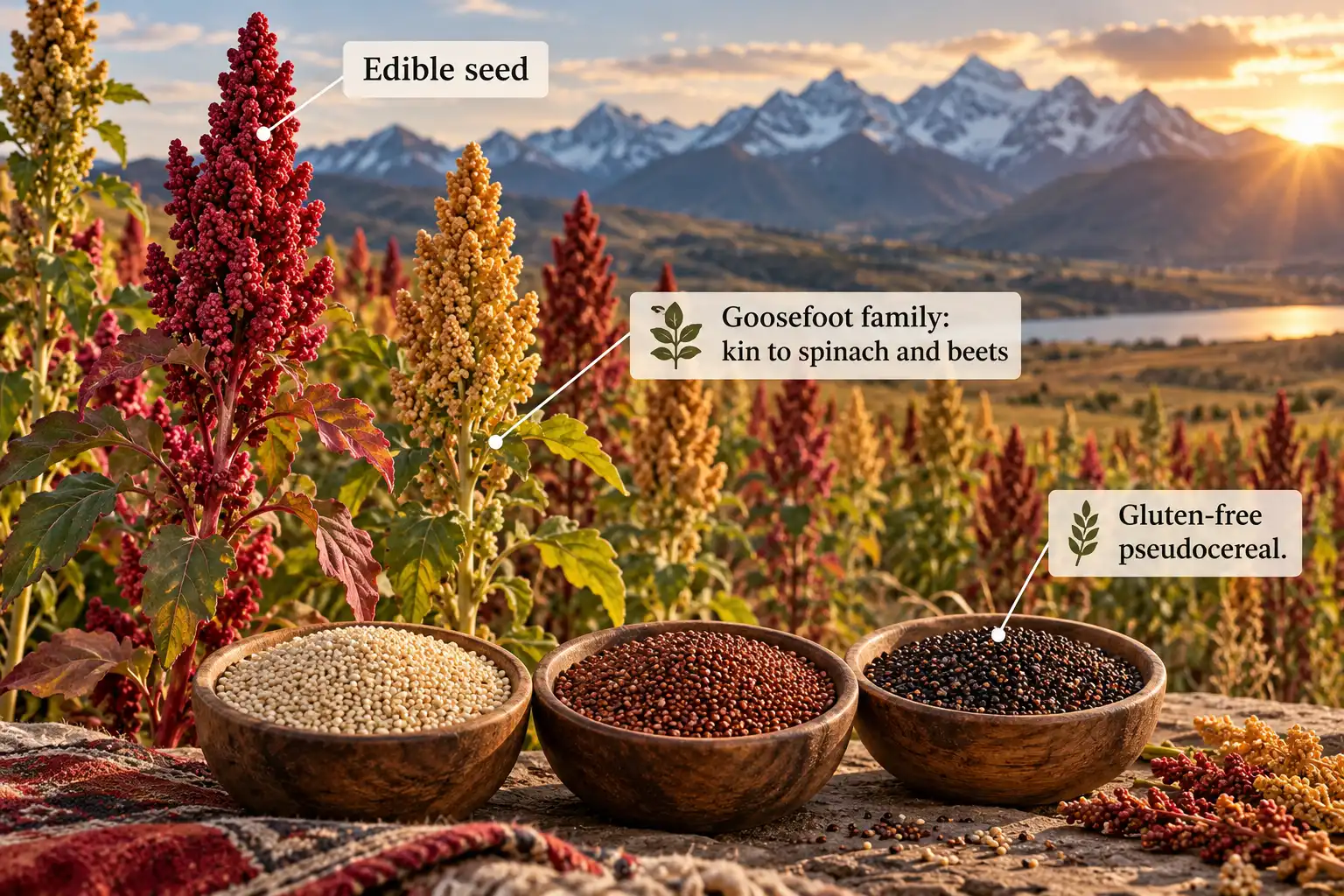
Quinoa (Chenopodium quinoa) is the edible seed of an annual Andean goosefoot plant related to spinach and beets. It is a gluten-free pseudocereal that cooks like rice and counts as a whole grain.
Where Quinoa Comes From
Quinoa is native to the Andes Mountains of Bolivia, Peru, and Chile. People there have eaten it for about 5,000 years. That figure comes from the Alternative Field Crops Manual, published by University of Minnesota and University of Wisconsin Extension. The Inca called quinoa the “mother grain,” and it remains a staple for Quechua and Aymara communities.
Botanically, quinoa belongs to the goosefoot group, which botanists now place in the amaranth family (Amaranthaceae). It is a close relative of common lambsquarters (Chenopodium album), a familiar weed in corn and soybean fields. According to the Manual, quinoa also shares a plant family with spinach, table beets, and sugar beets.
Today, most quinoa sold in the US still comes from Andean farms. In fact, Oregon State University Extension reports that the US is the world’s largest quinoa importer.
Is Quinoa a Grain?
No, quinoa is not a true grain. Botanists classify it as a pseudocereal, which is a broadleaf plant grown for grain-like seeds. True cereals, such as wheat, rice, and oats, all belong to the grass family (Poaceae). That is why oats count as a cereal grain while quinoa does not. Buckwheat and amaranth fall into the same pseudocereal group, per the Manual.
In the kitchen, however, quinoa acts like a grain. NDSU Extension explains that people cook and eat it like one, and its nutrition is similar. For that reason, nutrition educators count quinoa as a whole grain. UF/IFAS Extension also notes that it helps meet the USDA MyPlate goal of making half your grains whole.
Quinoa is naturally gluten-free, too. Gluten comes from wheat, rye, and barley, so quinoa suits people with celiac disease or a wheat allergy, per UF/IFAS. Like grain sorghum, it gives gluten-free bakers another whole-grain flour option.
What Does Quinoa Look Like?
Quinoa looks like a tall, leafy plant topped with dense seed clusters in red, gold, cream, or purple. Its seeds are tiny, flat discs about the size of millet.
The Plant
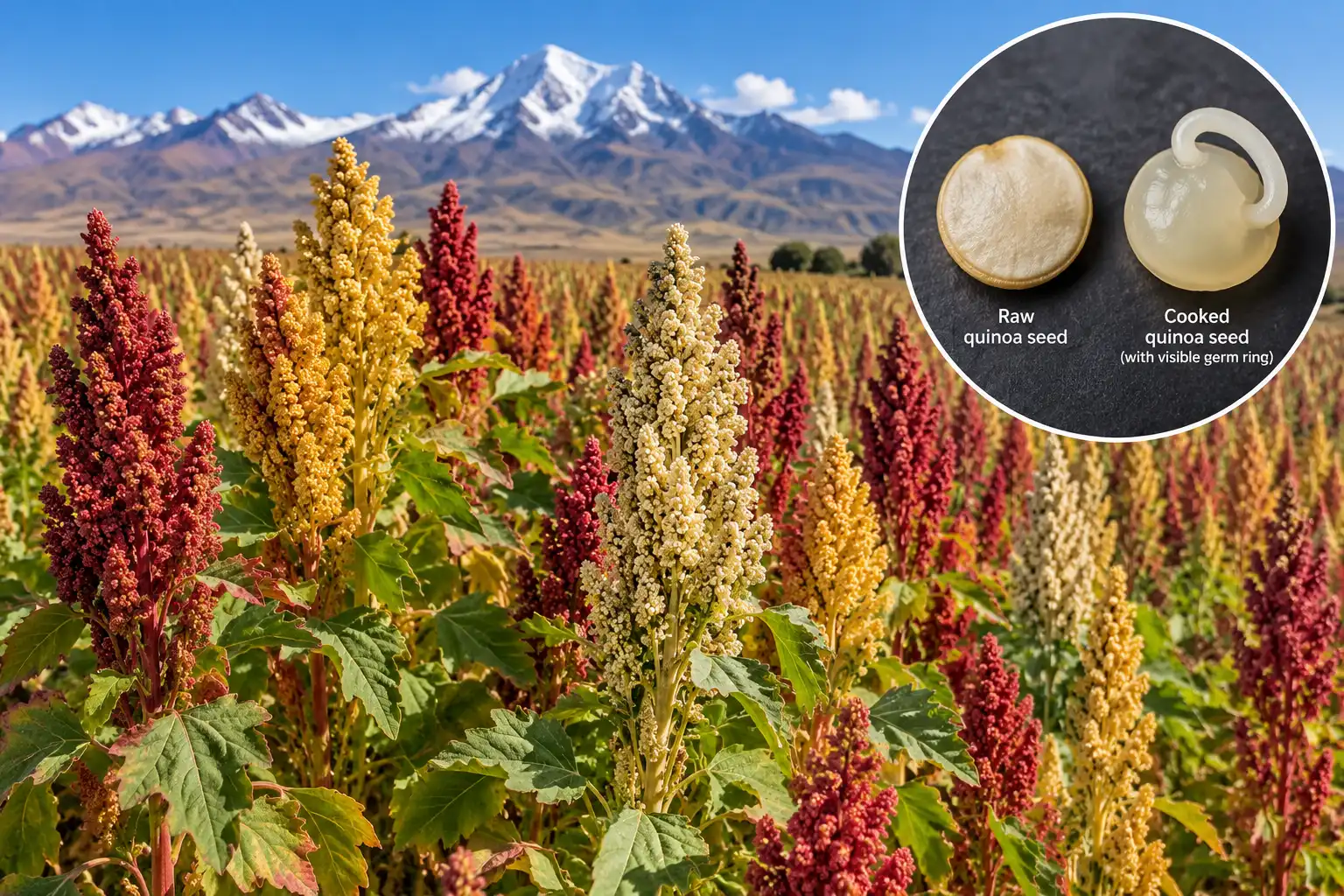
Quinoa grows 1.5 to 6.5 feet tall, according to the Manual. Its broad, toothed leaves resemble a goose’s foot, which explains the family’s common name. Below ground, a taproot branches widely, so the plant handles drought well. Seeds form in large clusters on a panicle that looks much like a sorghum head. As the crop matures, plants shift from green to yellow, red, or purple. Young quinoa also looks almost identical to lambsquarters, so mark your rows before you scout for weeds.
The Seed
Raw quinoa seeds measure roughly 1/16 inch across. Each one has two flat faces and rounded edges, much like a tiny aspirin tablet. The Manual lists seed colors as white, yellow, orange, pink, red, and black. That color sits in the seed coat, which also holds 2% to 6% saponin.
After cooking, the seeds turn slightly translucent. Meanwhile, the germ curls away from each seed as a thin white ring. NDSU Extension notes that cooked quinoa resembles short-grain rice or couscous.
Types of Quinoa: White, Red, and Black
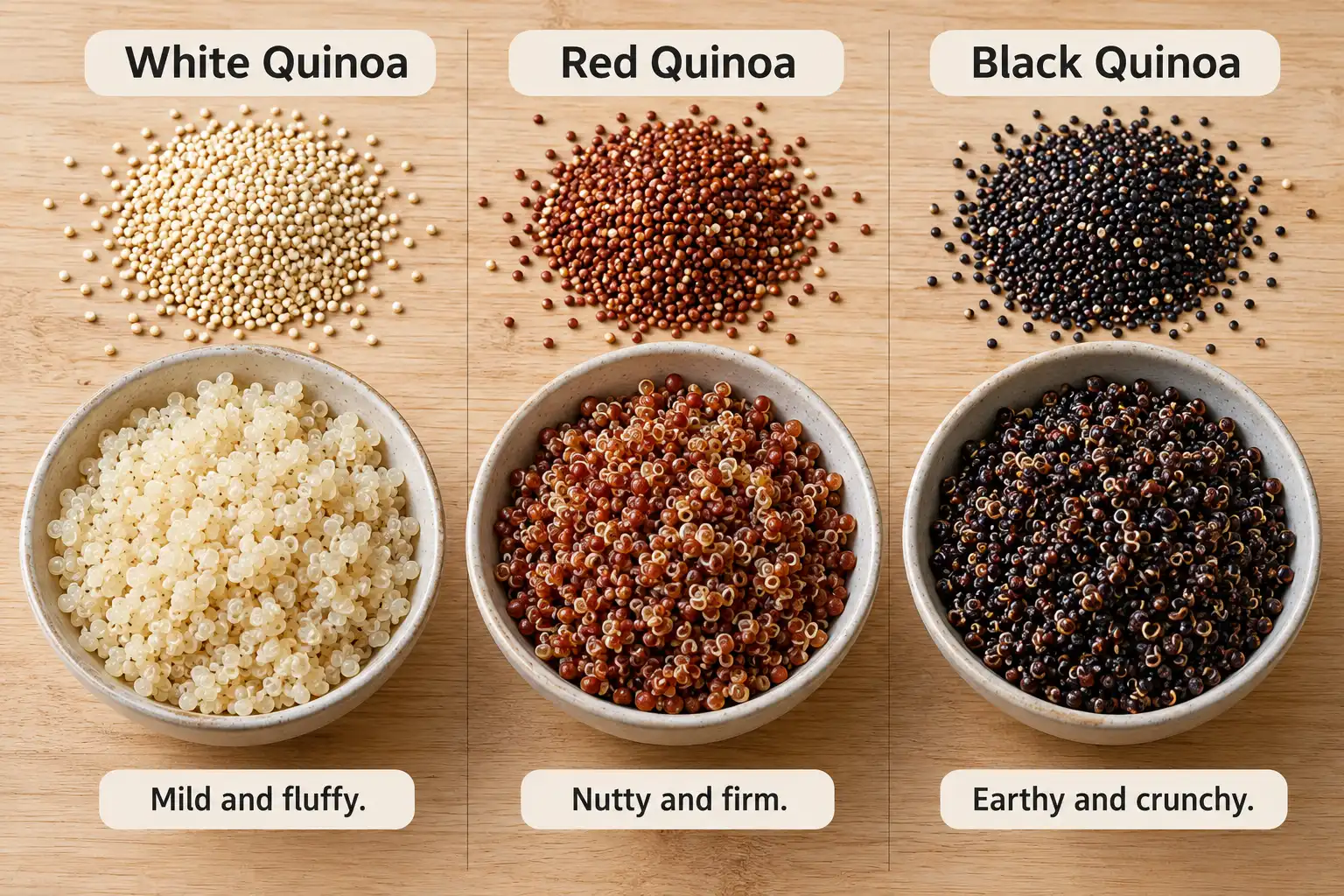
Most stores carry white, red, and black quinoa. All three come from the same species, but each color cooks and tastes a little differently.
What Is White Quinoa?
White quinoa is the most common type in US stores, often labeled ivory or yellow. It has the mildest flavor and the softest, fluffiest texture after cooking. UF/IFAS Extension notes that white quinoa works in place of red or black in any recipe. As a result, it suits side dishes, breakfast bowls, and rice swaps best.
What Is Red Quinoa?
Red quinoa is a red-seeded type with a nuttier flavor and a firmer, chewier bite than white. According to UF/IFAS, it holds its shape best after cooking. That makes it the top pick for cold salads and grain bowls. Also, the color is natural to the seed coat, not an added dye.
Colored types matter to growers, too. Oregon State University Extension reports that US buyers favor local quinoa with distinctive color and taste. As a result, these varieties often earn domestic farms more than standard white seed.
Black and Tricolor Quinoa
Black quinoa has an earthy, slightly sweet taste and keeps its dark color after cooking, per UF/IFAS. It also has the crunchiest texture of the three. Tricolor quinoa simply blends white, red, and black seeds in one bag.
| Type | Flavor | Cooked Texture | Best Uses |
|---|---|---|---|
| White (ivory) | Mild, subtle | Soft and fluffy | Side dishes, porridge, rice swaps |
| Red | Nutty | Firm, holds shape | Cold salads, grain bowls |
| Black | Earthy, slightly sweet | Crunchy, keeps color | Salads, color contrast |
| Tricolor | Blended | Mixed | All-purpose dishes |
Quinoa Nutrition Facts
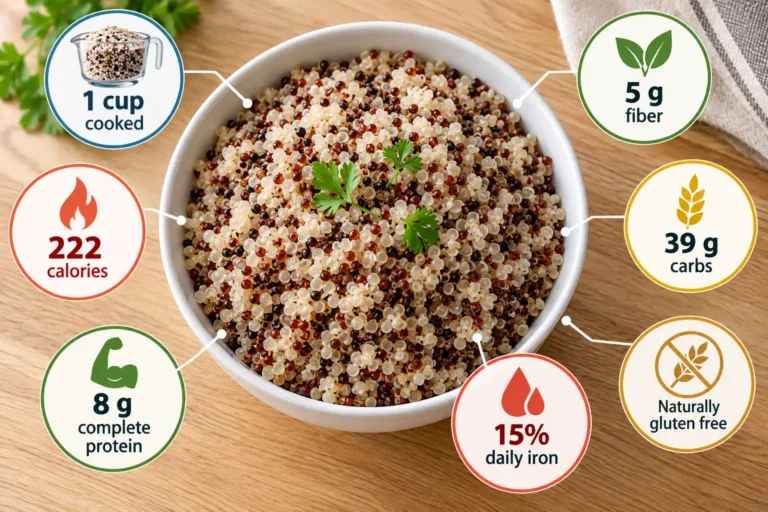
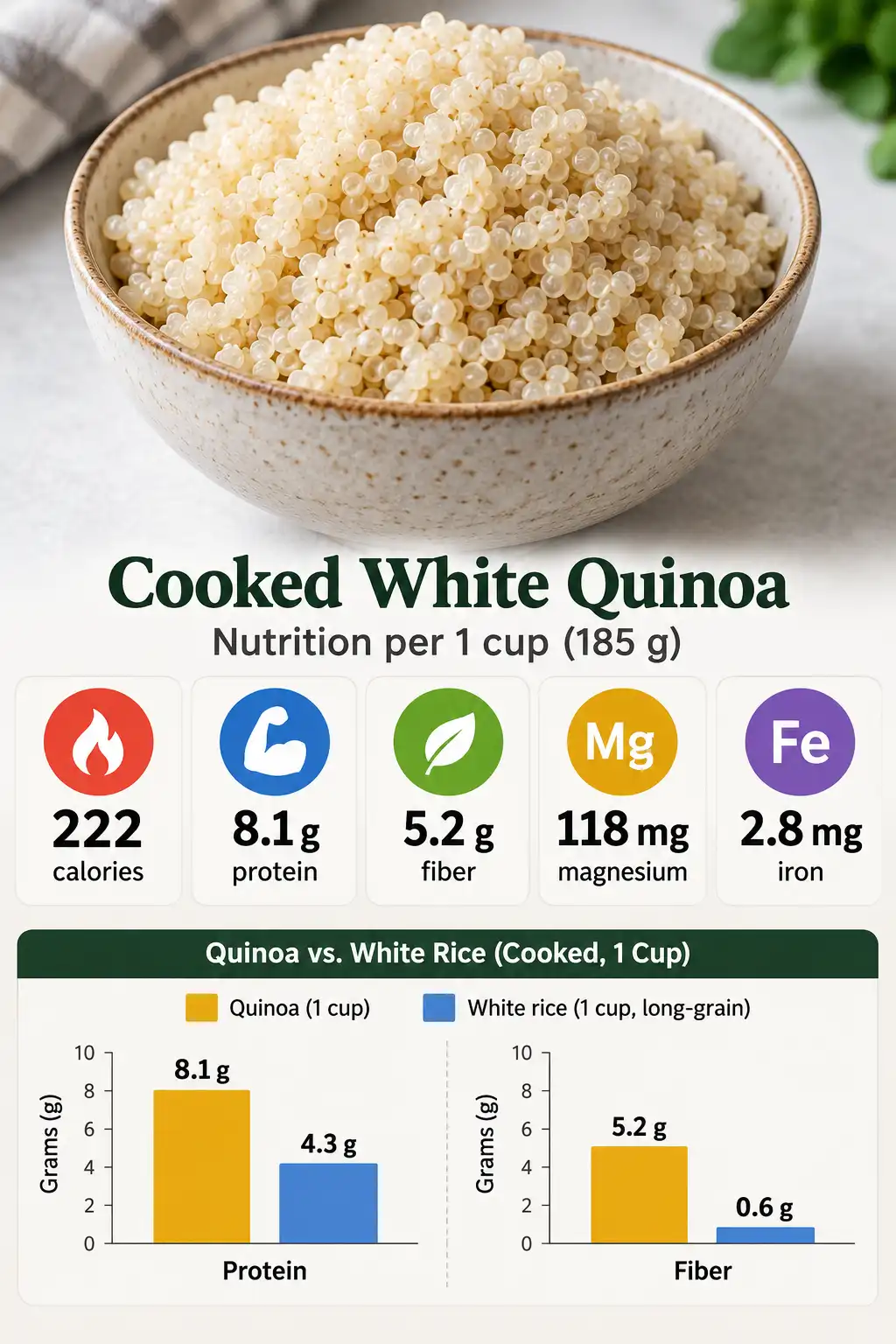
USDA FoodData Central lists one cup of cooked quinoa (185 grams) at about 222 calories and 8.1 grams of protein. It is also naturally low in sodium, at about 13 milligrams per cup.
| Nutrient (1 cup cooked) | Amount |
|---|---|
| Calories | 222 |
| Protein | 8.1 g |
| Carbohydrates | 39.4 g |
| Dietary fiber | 5.2 g |
| Fat | 3.6 g |
| Magnesium | 118 mg |
| Iron | 2.8 mg |
| Folate | 78 mcg |
Compared with long-grain white rice, quinoa offers almost twice the protein and over eight times the fiber per cooked cup. UF/IFAS Extension’s comparison of USDA data puts white rice at 4.3 grams of protein and 0.6 grams of fiber. Quinoa also carries about six times the magnesium.
Protein quality stands out as well. The Manual notes that quinoa holds more lysine than wheat, and its amino acid balance compares well with milk protein. That matters because lysine is the essential amino acid most cereal grains run short on.
What Is Quinoa Used For?
Quinoa serves mainly as a whole-grain food, eaten hot as a side dish or cereal, or cold in salads. According to UF/IFAS Extension, it replaces rice, couscous, or pasta cup for cup in most recipes.
Common uses include:
- Side dishes and bowls: a direct swap for rice under stir-fries, beans, or roasted vegetables
- Salads: red and black quinoa stay distinct when chilled
- Breakfast: cooked like oatmeal and topped with fruit, nuts, or honey
- Soups and casseroles: adds body and protein
- Flour and flakes: quinoa flour works well in gluten-free baking
- Breading: a breadcrumb substitute for baked chicken or fish
- Packaged foods: breads, crackers, energy bars, and desserts
The plant has uses beyond the seed, too. The Manual notes that people eat quinoa leaves as a leafy vegetable, much like spinach. It also lists flour, soup, breakfast cereal, and alcoholic drinks among quinoa’s food uses.
How to Prepare Quinoa
Rinse quinoa first, then simmer it in twice its volume of liquid for about 15 minutes. Rinsing clears leftover saponin, the bitter coating that likely evolved to deter birds and insects.
Most packaged quinoa arrives pre-cleaned. Oregon State University Extension explains that processors strip saponins from food-grade seed by abrasion, washing, or both. Still, NDSU Extension suggests a quick rinse in a strainer as a final step.
Use this basic method, based on UF/IFAS cooking guidance:
- Rinse 1 cup of dry quinoa in a fine-mesh strainer under cold water.
- Add it to a pot with 2 cups of water or low-sodium broth.
- Bring the pot to a vigorous boil over high heat.
- Cover, reduce the heat to low, and simmer for 15 minutes.
- Fluff with a fork before serving.
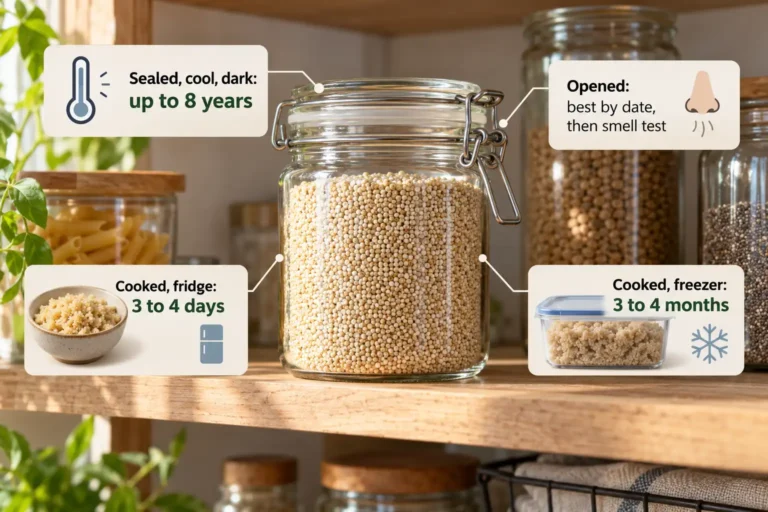
Store dry quinoa at room temperature in its original package, and use it by the best-by date. Then treat cooked leftovers the same way you treat cooked rice, per UF/IFAS.
Can You Grow Quinoa in the US?
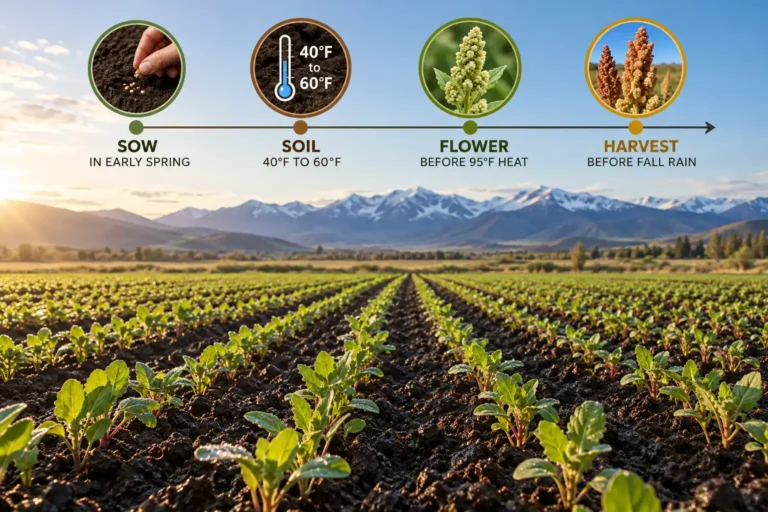
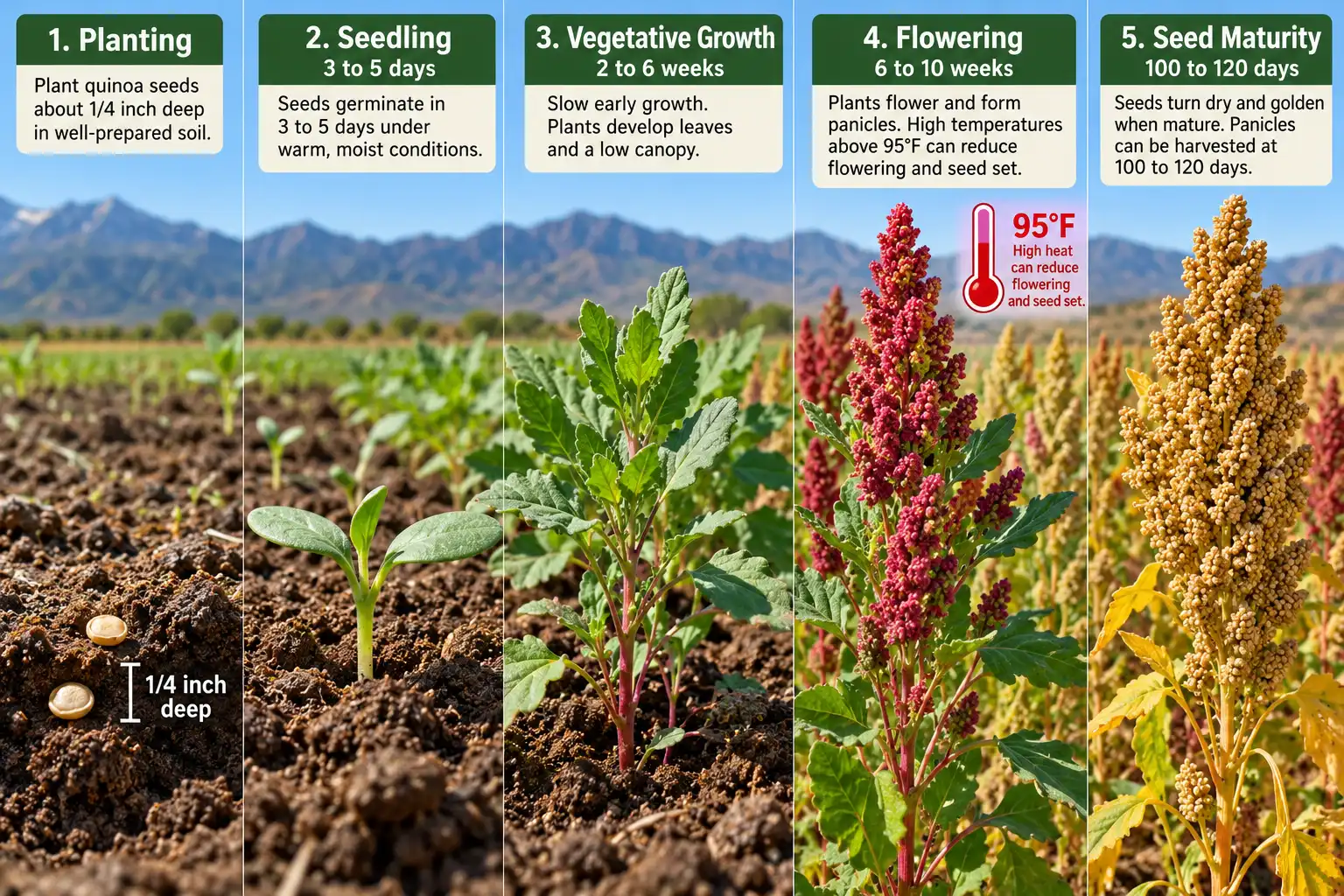
Yes, but only where summers stay cool. Quinoa is sensitive to heat while it flowers. Oregon State University Extension reports that many varieties set no seed above 95°F during flowering and early seed set. Similarly, Colorado research cited in the Manual links that heat to pollen sterility.
Where Quinoa Grows Best
Domestic production centers on the Intermountain region and parts of California, according to Oregon State. In Colorado, the Manual reports good seed set at 7,000 to 10,000 feet, where temperatures stay cool. West of Oregon’s Cascades, cooler and wetter areas such as the Willamette Valley have produced more stable yields. OSU trials there compared up to 17 varieties, including Oro de Valle and Kaslaea, across four planting dates.
By contrast, trials near Minnesota’s Twin Cities failed to set seed in several years, likely from high temperatures. According to OSU, quinoa also adds diversity to a crop rotation. Even so, the Manual advises testing small plots before planting large acreage.
Planting and Growth Timeline
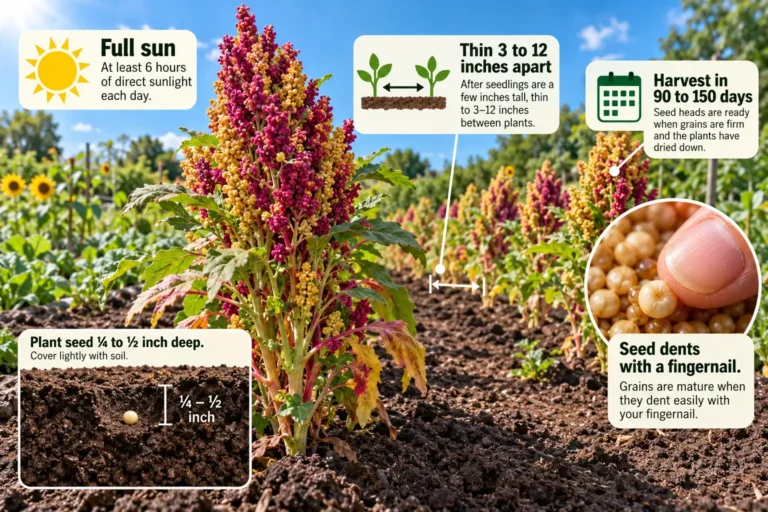
Plant into cool soil between 45°F and 50°F, per the Manual. Oregon State recommends a fine seedbed and a depth of just 1/4 inch, because deeper seed emerges poorly. Most commercial fields use 12- to 18-inch rows. OSU also notes that 50 to 100 pounds of nitrogen per acre is usually enough, depending on soil reserves. In addition, OSU reports that no selective herbicides carry a quinoa label. So build your weed control plan around cultivation and seedbed timing.
| Stage | Typical Timing | What to Watch |
|---|---|---|
| Germination | Within 24 hours in moist soil | Avoid waterlogged fields |
| Emergence | 3 to 5 days | Keep planting depth shallow and even |
| Early growth | 2+ weeks of slow canopy after first true leaves | Weeds gain ground quickly |
| Flowering and seed set | Midsummer | Heat above 95°F cuts seed set |
| Maturity | 100 to 120 days after planting | Harvest before fall rains |
Common Quinoa Growing Problems
Most quinoa crop failures trace back to heat, weeds, rain, or processing.
- No seed on healthy plants: heat during flowering likely sterilized the pollen. Shift the planting date so bloom misses peak summer heat.
- Weeds overtake the stand: early canopy growth is slow. In OSU’s 2018 trial, a March 31 planting needed about 166 hours of hand weeding per acre. May and June plantings needed only about 41 hours.
- Seed sprouts in the head: mature seed left standing through rain germinates on the plant. OSU stresses harvesting before fall rains, and western Oregon growers often swath first to speed drying.
- Bitter, unsellable seed: buyers expect saponins removed before sale. Line up a processor early, since OSU notes the nearest large ones for Oregon farms sit in Idaho and California.
FAQs
Is quinoa a vegetable?
No, quinoa seed is not a vegetable, since people cook and eat it like a grain. However, the plant’s leaves are edible greens, and cooks prepare them much like spinach.
Is quinoa the same as couscous?
No, couscous is a tiny pasta made from durum wheat semolina, so it contains gluten. Quinoa, by contrast, is a naturally gluten-free seed that only resembles couscous once it cooks.
Do you have to rinse quinoa?
Not always, since most packaged quinoa arrives pre-washed, but a quick rinse is a smart final step. NDSU Extension suggests rinsing in a strainer to clear any leftover bitter saponin.
How much cooked quinoa does 1 cup dry make?
One cup of dry quinoa makes about 3 cups cooked, enough for six half-cup servings. Cook it in 2 cups of water or broth, then simmer it covered for 15 minutes, per UF/IFAS Extension.
The Practical Takeaway
Quinoa is a seed, not a cereal, yet it earns its place among whole grains through protein, fiber, and minerals. In the kitchen, white quinoa covers most recipes, while red and black hold up better in salads. In the field, summer heat is the deciding factor. If your area stays below 95°F at flowering, start with a small trial plot and a processing plan in place.