How to Germinate Eggplant Seeds: Depth, Heat, and Timing
Eggplant seed is slow and fussy about warmth. Cold media stalls it for weeks or rots it outright. Learning how to germinate eggplant seeds comes down to three controls: media temperature, sowing depth, and steady moisture. Get those right and sprouts show up on schedule.
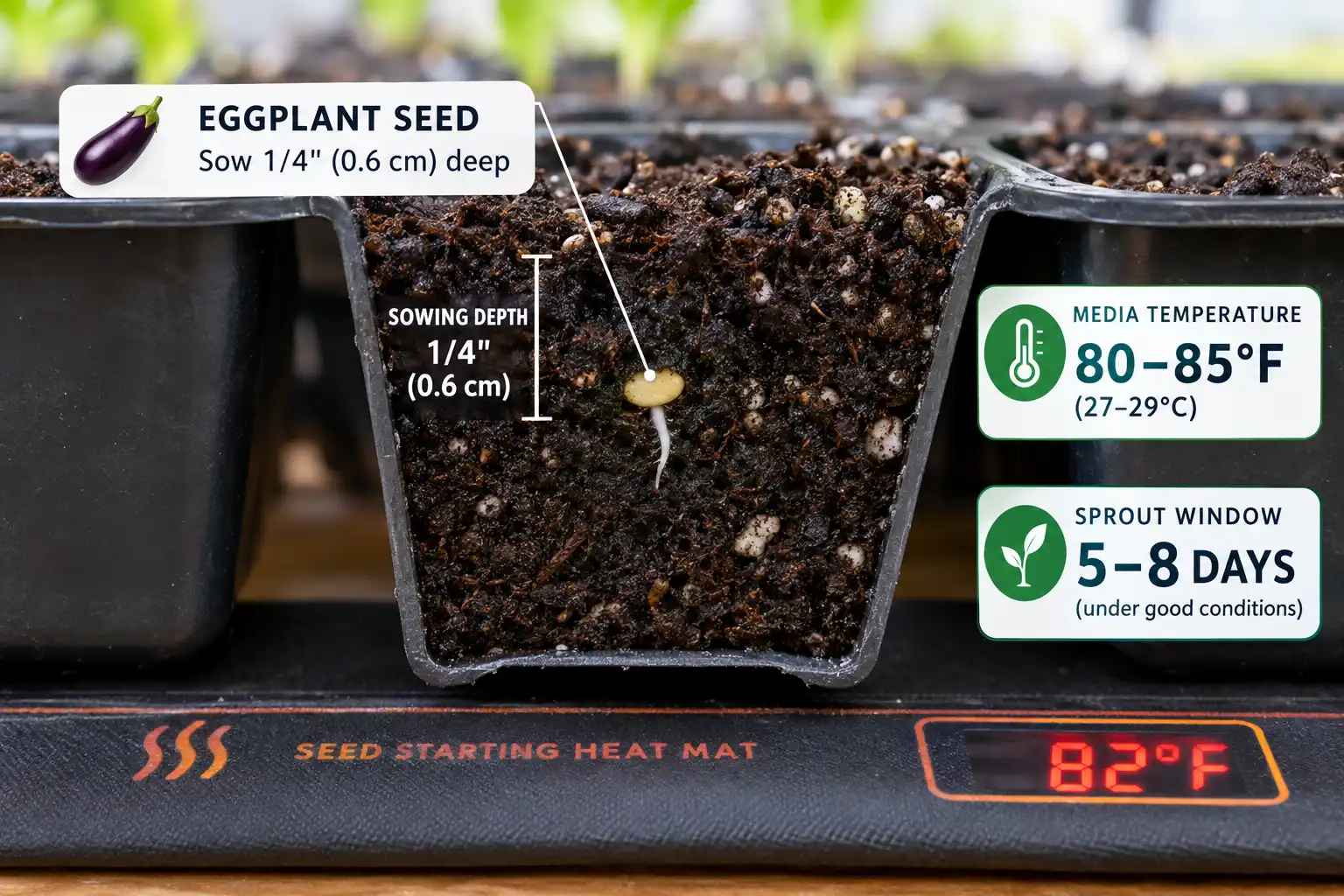
To germinate eggplant seeds, sow them a quarter inch deep in moist soilless mix. Hold the media at 80 to 85°F. Sprouts appear in five to eight days at that range. Cooler mix roughly doubles the wait.
What Soil Temperature Do Eggplant Seeds Need?
Eggplant seed needs media between 75 and 85°F to sprout on time. UC Agriculture and Natural Resources puts the minimum at 60°F and the ceiling at 95°F. The optimum range sits between 75 and 85°F. Below 60°F, almost nothing happens. Clemson Cooperative Extension gives a slightly wider working band and notes that eggplant seed germinates quickly between 70 and 90°F.
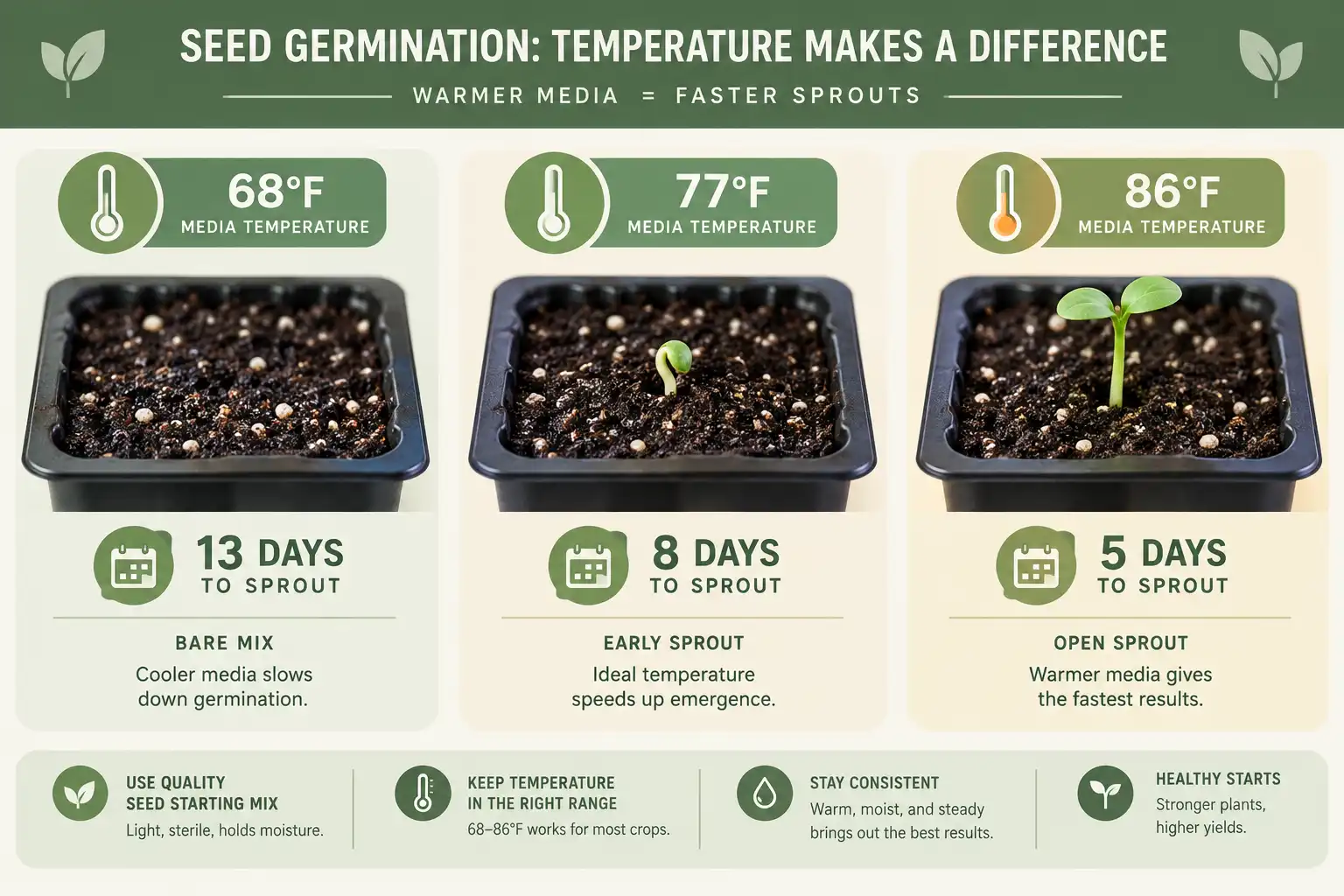
Temperature also sets the clock. UC ANR data shows how sharply the wait shortens as media warms.
| Media temperature | Days to emergence |
|---|---|
| 68°F | About 13 |
| 77°F | About 8 |
| 86°F | About 5 |
So a tray sitting on a 68°F counter takes more than twice as long as one on a warm mat. That extra week matters. Seed sitting in cool damp mix faces rot the whole time.
Room air is not the number to chase. Media temperature is. A probe thermometer pushed into a corner cell tells you what the seed actually feels.
How Deep Should You Sow Eggplant Seeds?
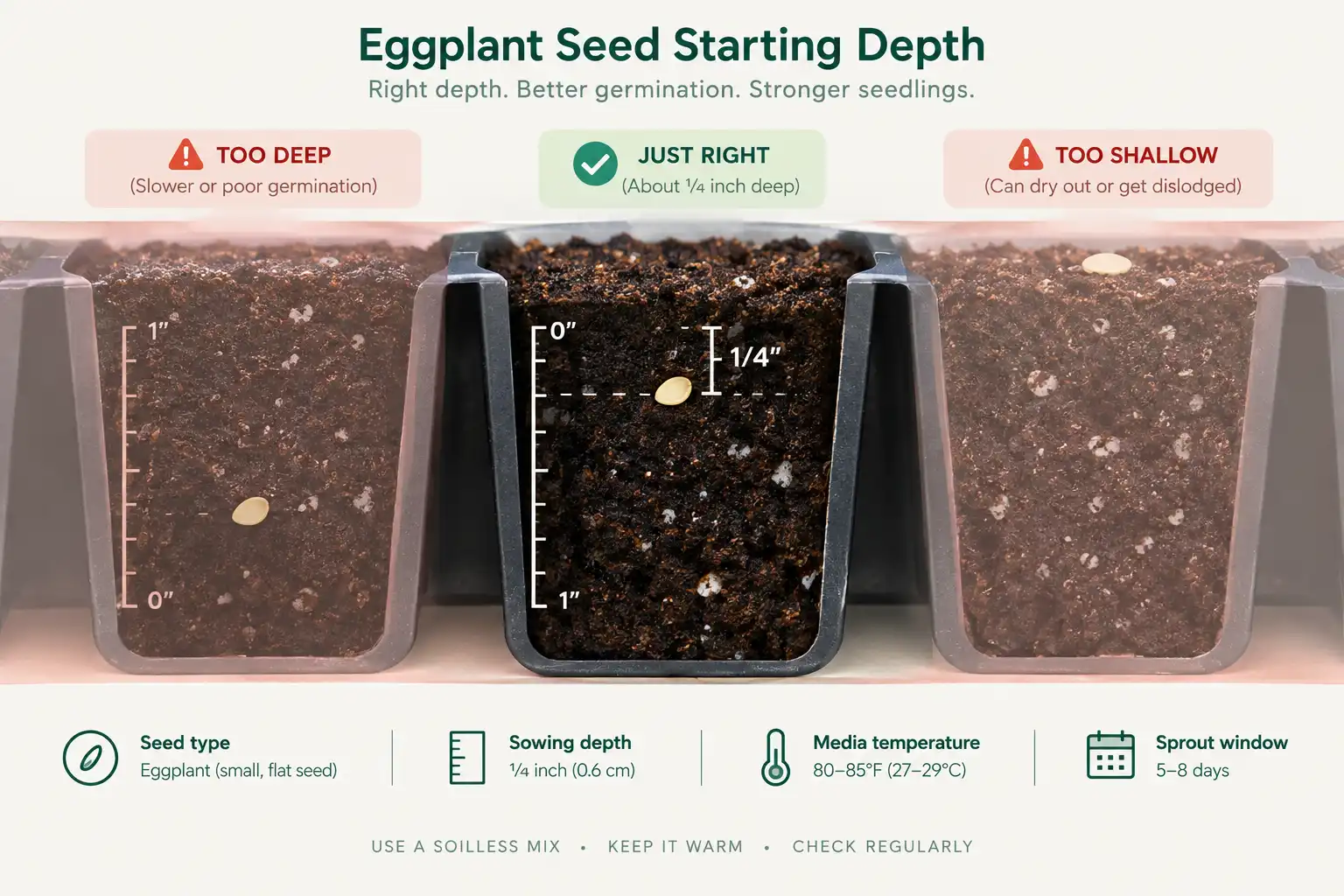
Sow eggplant seed a quarter inch deep. University of Maryland Extension sets the general rule at two to three times the seed diameter. Eggplant seed runs roughly an eighth of an inch across. That puts a quarter inch right in the window.
Depth errors cut both ways. Seed buried too deep burns through its reserves before the shoot reaches light. Seed left on the surface dries out between waterings and stalls.
Firm the mix gently over the seed after covering. Good seed to media contact matters more than most growers expect. After all, the seed pulls water only from particles touching it.
What You Need Before You Sow
Five items cover it:
- Soilless seed starting mix. Garden soil holds too much water and carries pathogens.
- Cells at least 2 inches deep with drainage holes.
- A humidity dome or clear plastic cover to hold moisture during germination.
- A seedling heat mat, which is the single most useful item on this list.
- A probe thermometer to verify media temperature rather than guess at it.
Have your light ready too. Eggplant seedlings stretch within a day or two of emerging. So pick your grow lights for seedlings before the first sprout breaks the surface. Pre-assembled seed starting kits bundle the tray, dome, and mat if you are setting up from scratch.
How to Germinate Eggplant Seeds Step by Step
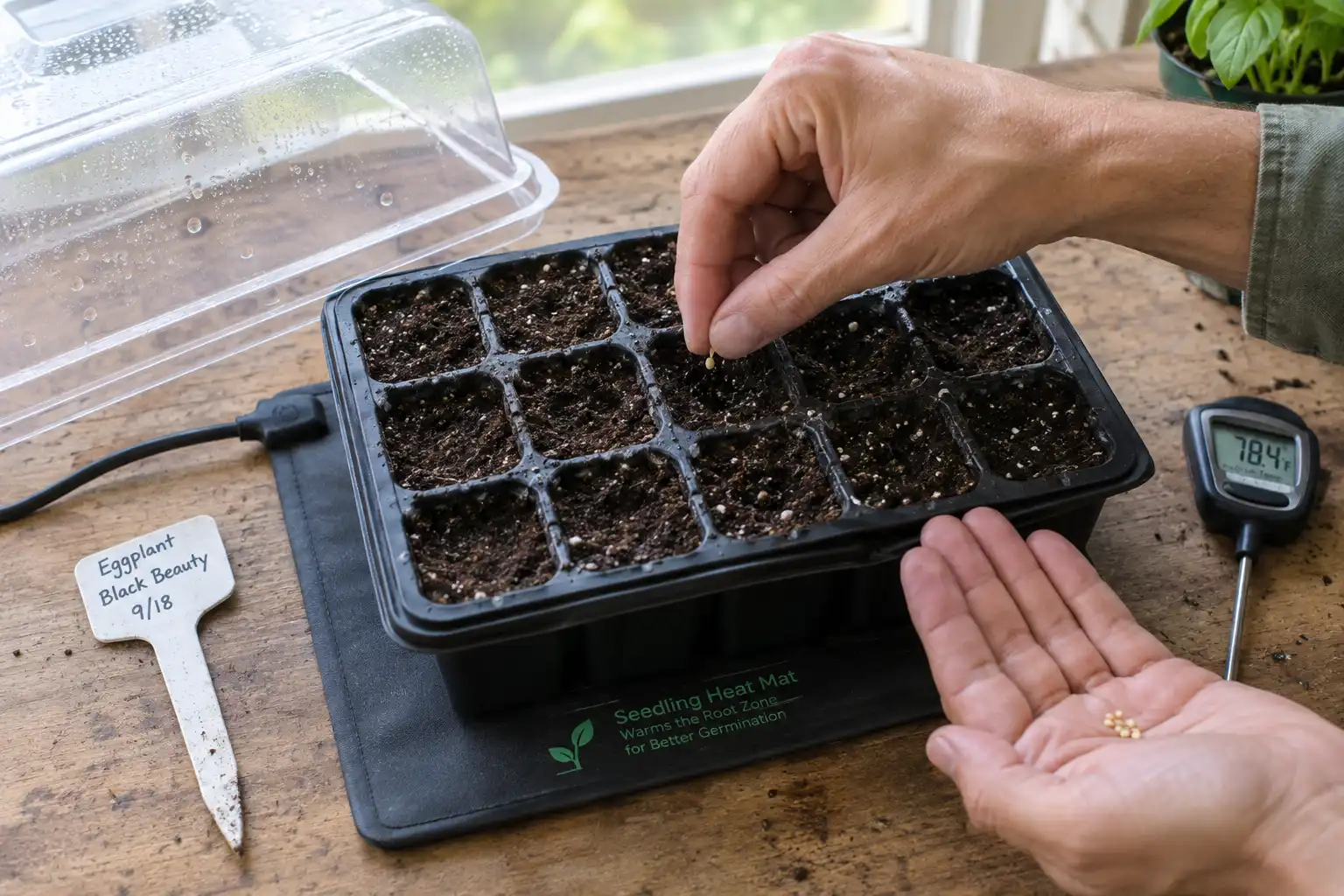
- Moisten the mix first. Work water into the media in a tub until it feels like a wrung out sponge. University of Maryland Extension notes that dry peat repels water, so wetting it after filling cells leaves dry pockets.
- Fill cells to within an inch of the rim, then firm the surface lightly and evenly.
- Sow one seed per cell. UMD Extension starts eggplant singly because the seedlings get potted up later anyway. Use two seeds per cell if your packet is a few years old.
- Cover a quarter inch and press down gently.
- Label the tray with the variety and sowing date. Eggplant and pepper seedlings look nearly identical at emergence.
- Cover with a dome. Keep the cover off the media surface so condensation drips rather than pools.
- Set the tray on a heat mat and target 80 to 85°F in the media.
- Mist daily to keep the surface damp. Never soak it. UMD Extension warns that once water uptake begins, a dry spell kills the embryo outright.
Start checking on day four. Pull the dome the moment the first sprout appears, because trapped humidity after emergence feeds disease.
When to Start Eggplant Seeds Indoors by Region
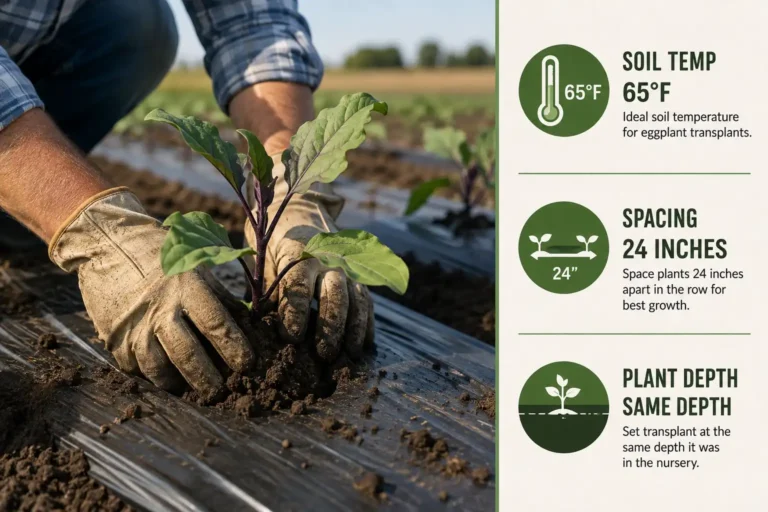
Count back 8 to 10 weeks from your transplant date, not your frost date. University of Maryland Extension puts eggplant in the 8 to 10 week group alongside pepper and onion. Eggplant then goes outside roughly two to three weeks after the last frost, once soil has genuinely warmed.
| Region | Typical transplant window | Start seed indoors |
|---|---|---|
| Gulf Coast and central Florida | Mid February to early March | Early December to early January |
| Lower South and east Texas | Early to mid April | Late January to mid February |
| Mid-Atlantic | Early May | Late February to early March |
| Corn Belt and lower Midwest | Mid to late May | Mid to late March |
| Upper Midwest and Northern Plains | Early June | Late March to mid April |
| Interior West and mountain zones | Mid June | Early to mid April |
University of Nebraska-Lincoln Extension lists mid-March as the indoor sowing date for eggplant. That matches the Corn Belt row above. For state level detail, check eggplant planting dates against your local last frost record.
Sowing too early is the more common mistake. Seedlings held indoors past their window turn tall and root-bound, and they never fully recover in the field.
Should You Soak Eggplant Seeds Before Sowing?
Soaking is optional and offers little benefit when media temperature is correct. Eggplant seed has no hard coat and no dormancy requirement. Warmth does whatever work a soak might accomplish.
The paper towel method is more useful than a plain soak. Roll seed in a damp paper towel, seal it in a vented bag, and keep it somewhere warm. University of Maryland Extension suggests checking after five to seven days. Move each seed to a cell as soon as the radicle shows.
That approach suits old seed and cold houses. It costs you a transplant step, though, and sprouted seed is easy to damage. For fresh seed on a heat mat, sow direct and skip it.
How to Test Old Eggplant Seed for Viability
Test any packet older than three years before it takes up tray space. Illinois Extension lists eggplant seed as viable for about four years under cool, dry storage. Germination rates fall well before the seed is fully dead.
University of Maryland Extension describes a simple check. Place 20 seeds on a moistened paper towel and roll it up. Then seal it in a punctured plastic bag somewhere warm. Count sprouts after 7 to 10 days. If fewer than half germinate, discard the packet.
A 60 percent result is still usable. Just sow two seeds per cell instead of one and thin to the stronger seedling.
Why Eggplant Seeds Fail to Sprout
Most failures trace back to temperature or moisture, not bad seed.
| Symptom | Likely cause | Fix |
|---|---|---|
| Nothing up after three weeks | Media below 70°F | Add bottom heat and hold 80 to 85°F |
| Patchy, uneven emergence | Dry pockets in the mix | Pre-moisten media before filling cells |
| Seed rots in the cell | Saturated mix at low temperature | Warm the tray and let the surface dry slightly |
| Sprouts topple at the soil line | Damping off | Discard the tray and restart in fresh mix |
| Seedlings stretch and flop | Light too dim or too far away | Drop lights to 2 to 6 inches, run 14 to 16 hours |
| Fewer than half sprout | Seed past four years | Run a paper towel test before sowing |
Damping off deserves extra attention. University of Maryland Extension identifies Pythium, Phytophthora, and Rhizoctonia as the water molds behind it. All three need free water to spread. Soggy media at cool temperatures is exactly the condition they want. Soak reused cells in a 1 to 10 bleach solution for one to two minutes to cut the risk. The same rules for damping off in seedlings apply to every crop you start indoors.
What to Do the Moment Seedlings Emerge
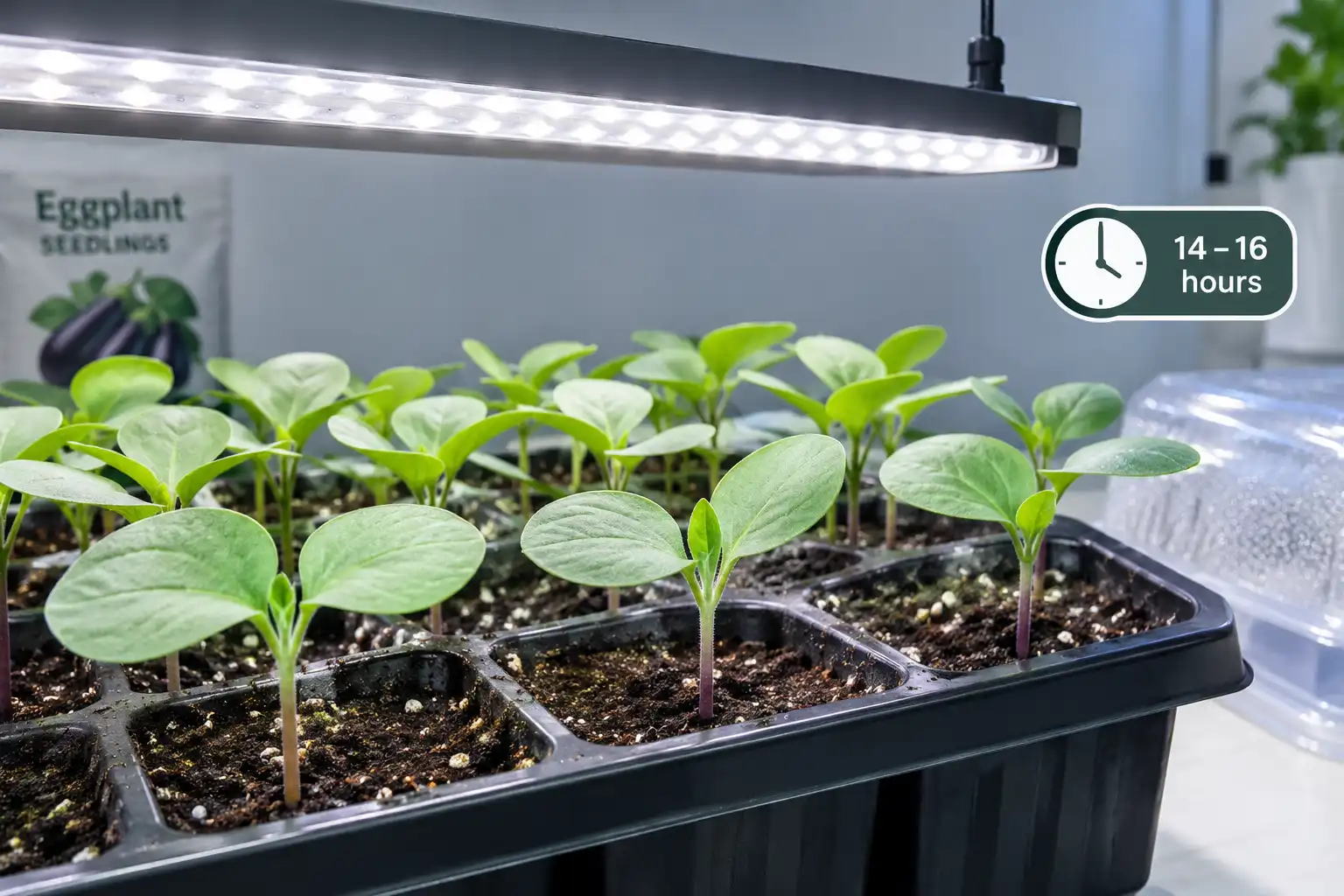
Three things change immediately once the first cotyledons open.
Pull the dome. Trapped humidity that helped germination now works against you.
Turn on the light. University of Maryland Extension recommends fixtures 2 to 6 inches above the plants. Run them 14 to 16 hours a day. Stretched, floppy stems almost always mean the fixture is too high.
Drop the temperature. UMD Extension suggests 65 to 70°F during the day and 55 to 60°F at night after germination. That cooler spell builds stocky plants instead of leggy ones.
Pot up two to three weeks later, shortly after the first true leaves appear. From there, the schedule follows the usual path for growing eggplant from seed. Hardening off and transplant come next.
FAQs about Germinate Eggplant Seeds
Do eggplant seeds need light to germinate?
Can you direct sow eggplant seeds outdoors?
Is a heat mat really necessary?
Why do eggplant seedlings sprout and then collapse?
How many eggplant seeds should you plant per cell?
Key Points to Carry Into the Seed Tray
Warmth drives everything here. Hold the media at 80 to 85°F, sow a quarter inch deep, and keep the surface damp without soaking it. Sprouts follow in five to eight days. Then get the dome off and the light on within hours of emergence. Count back 8 to 10 weeks from your transplant date. That way the seedlings hit the right size just as the soil warms.