Best Drop Spreader for 2026: Top 7 Picks for Precise Fertilizer
Broadcast spreaders throw granular fertilizer and seed everywhere. They waste product on the paths, driveways, and flower beds you never meant to feed. To drop every granule exactly where you want it, you need the best drop spreader. This guide is for gardeners, small plots, food plots, and acreage.
The Agri-Fab 45-0288 is the best drop spreader overall. This 175-pound tow-behind covers up to an acre with a 42-inch pass. For the best value, pick the At Home 75 lb. On a budget, the VEVOR 50 lb is a great model.
The 7 Best Drop Spreaders at a Glance
| Model | Best for | Hopper | Spread width | Type |
|---|---|---|---|---|
| Agri-Fab 45-0288 | Acreage, food plots | 175 lb | 42 in | Tow-behind |
| At Home 75 lb | Wide-width value | 75 lb | 32 in | Push |
| VEVOR 50 lb | Budget, small plots | 50 lb | 18 in | Push |
| EarthWay 7312 | Most growers | 75 lb | 22 in | Push |
| Spyker P70-12010 | Commercial precision | 120 lb | 18 or 36 in | Push |
| Yard Commander 60 lb | Lightweight push | 60 lb | 22 in | Push |
| SaltDogg WB400 | Salt and ice melt | 200 lb | 44 in | Push |
The 7 Best Drop Spreaders, Reviewed
Here are the seven, sorted by the job each does best.
1. Agri-Fab 45-0288 175 lb Tow-Behind Drop Spreader
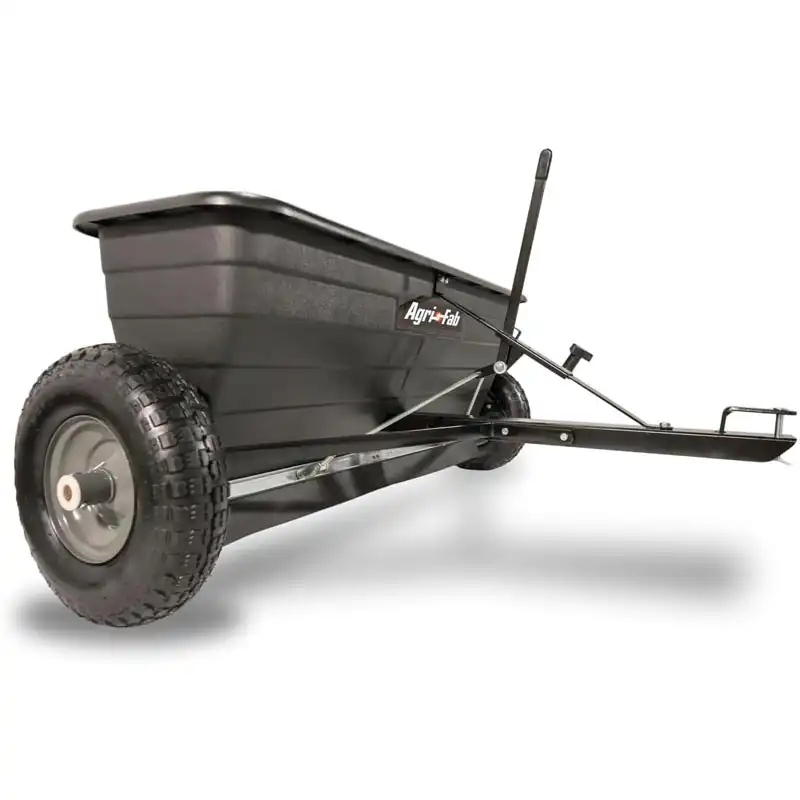
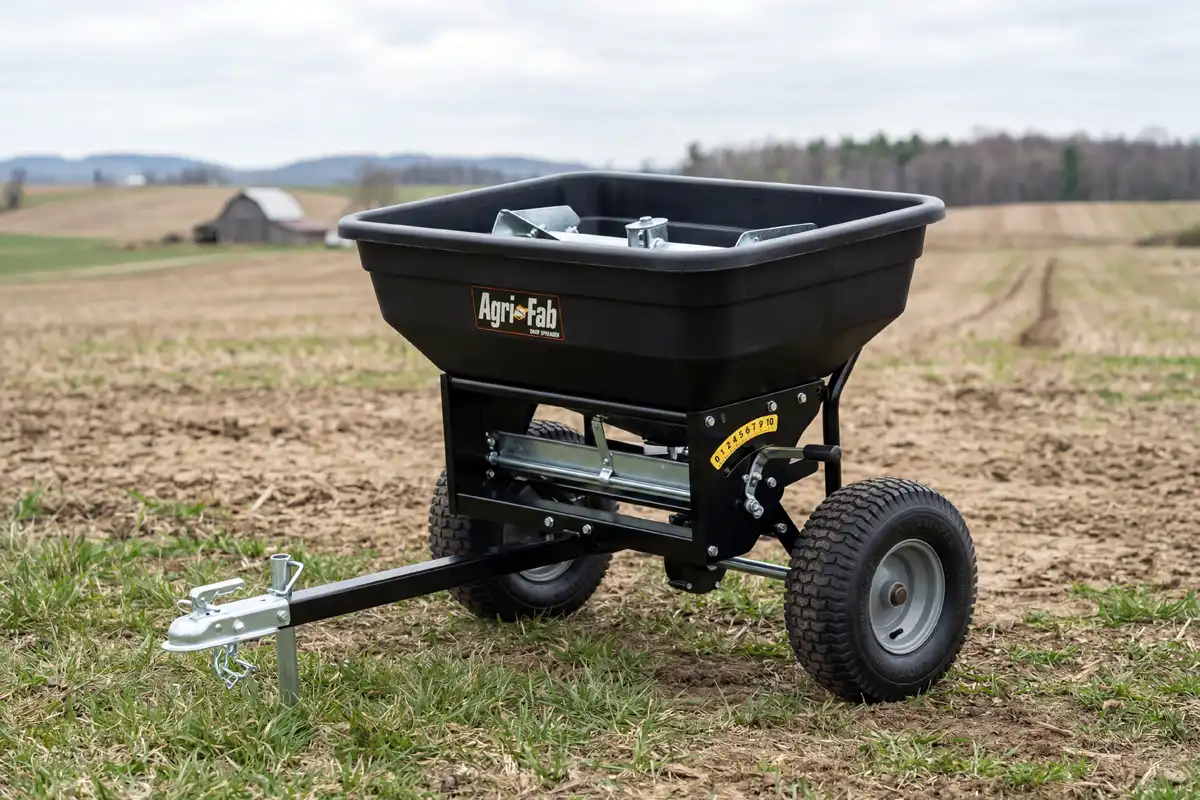
The Agri-Fab 45-0288 is a 175-pound tow-behind drop spreader, built by Agri-Fab in Sullivan, Illinois. It hitches to a garden tractor and covers up to 1 acre. The 42-inch spread width and seat-level on/off control let you feed food plots fast. So this is the pick for bigger ground.
PROS
- Covers up to 1 acre
- 42-inch spread width
- Seat-level on/off control
- Handles seed to ice melt
CONS
- Needs a tow vehicle
- Assembly takes time
Specifications:
- Rustproof 175 lb poly hopper
- Galvanized steel agitator
- 12-inch pneumatic tires
- Made in USA, 3-year warranty
2. At Home 75 lb
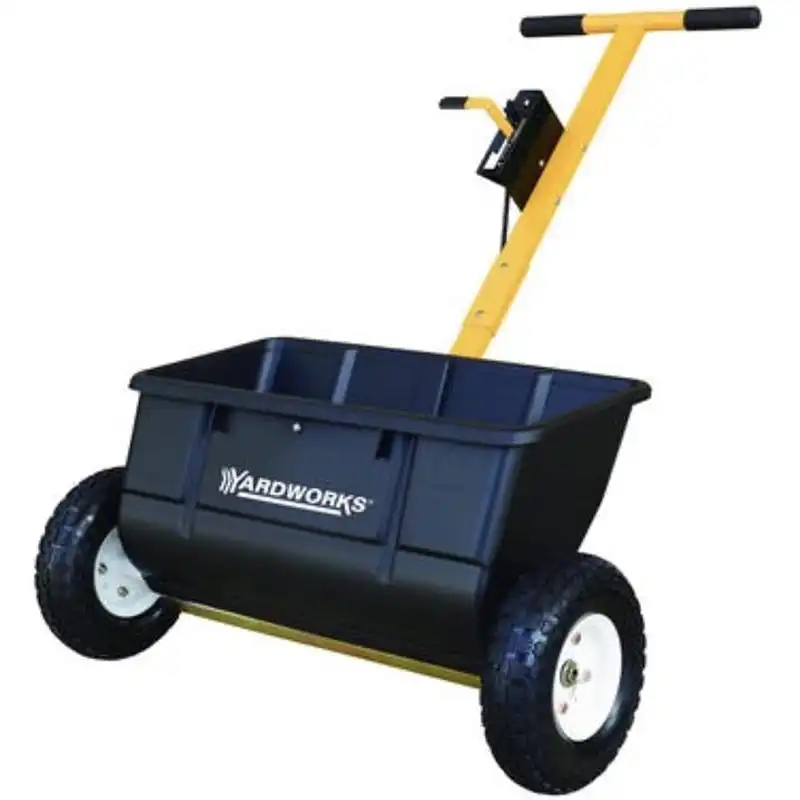
The At Home 75-pound gives you a wide 32-inch drop width for less than pro units. It covers about 10,000 square feet per fill. Galvanized steel agitators break up lumps, and never-flat tires roll over rough yards. If you want wide coverage on a budget, it delivers.
PROS
- Wide 32-inch drop width
- Covers 10,000 square feet
- Galvanized steel agitators
- Comfortable foam-padded handles
CONS
- Can rust in humidity
Specifications:
- 75 lb poly hopper
- 32-inch drop width
- Maintenance-free steel flow control
- 10-inch never-flat tires
3. VEVOR 50 lb
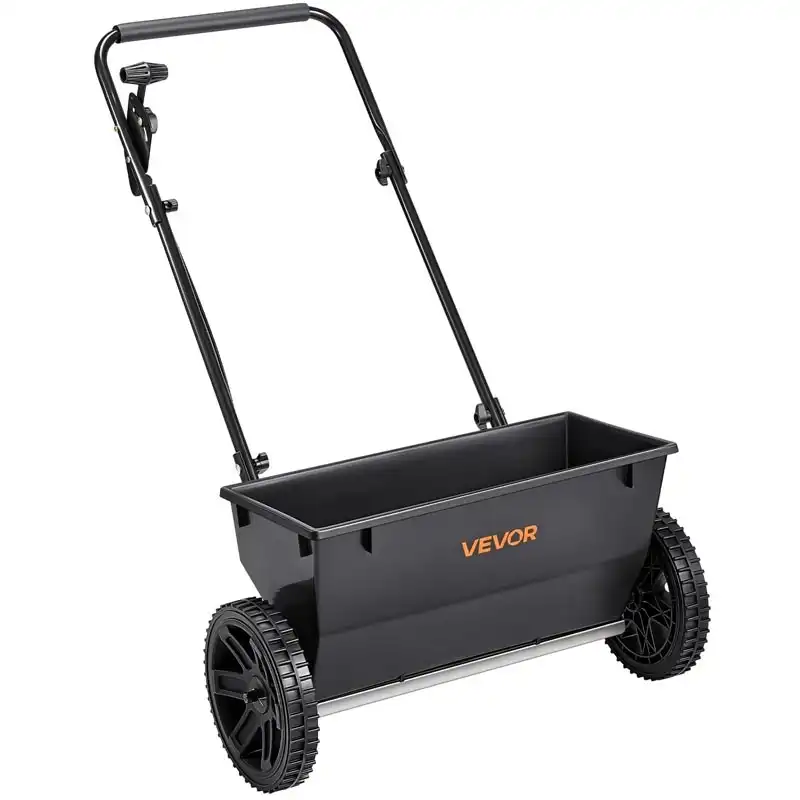
The VEVOR 50-pound is the budget choice for small yards and raised beds. The 18-inch spread width keeps seed and fertilizer in a tidy line. A powder-coated steel frame and 10-inch all-terrain wheels handle grass, gravel, even snow. When your plot is small, it is plenty of spreader.
PROS
- Easy on the budget
- 30 adjustable settings
- 5-minute, no-tool assembly
- Best for lighter use
CONS
- Not ideal for large clumps (like cow manure)
Specifications:
- 50 lb hopper
- Powder-coated steel frame
- 10-inch pneumatic wheels
- No-clog grate filter
4. EarthWay 7312 Drop Spreader
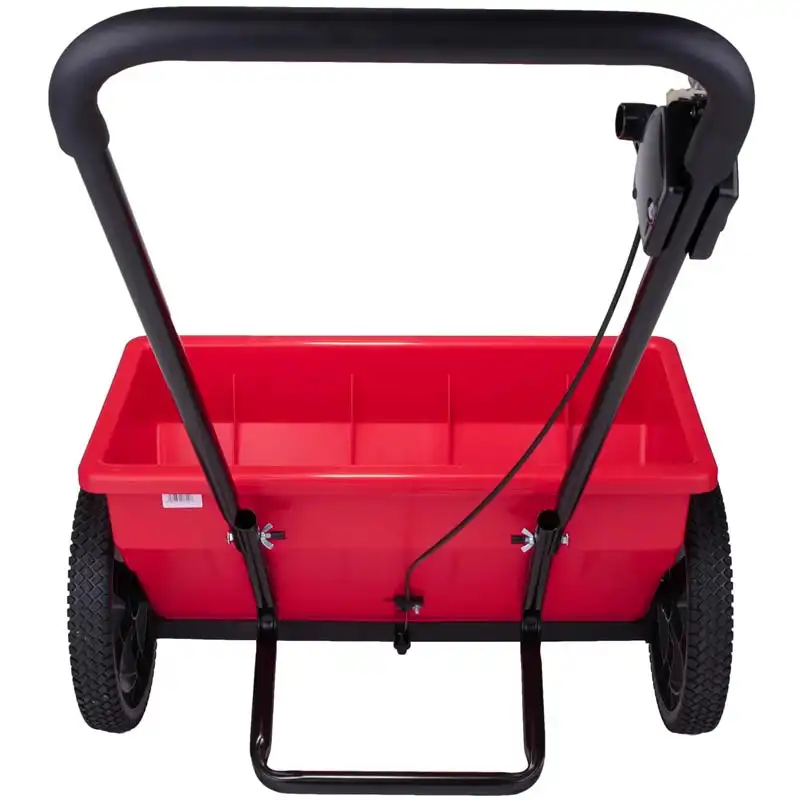
The EarthWay 7312 is a 75-pound walk-behind drop spreader built in the USA. EarthWay has made spreaders for 55-plus years, and turf pros trust them. The 22-inch drop width and adjustable flow suit grass seed, fertilizer, sand, or ice melt. So it is the pick for most growers.
PROS
- Proven American build
- Consistent, even distribution
- Adjustable flow control
- Rustproof hopper and agitator
CONS
- Slower for large areas
Specifications:
- 75 lb poly hopper
- 22-inch drop width
- Rustproof hopper and agitator
- 12-inch semi-pneumatic wheels
5. Spyker P70-12010
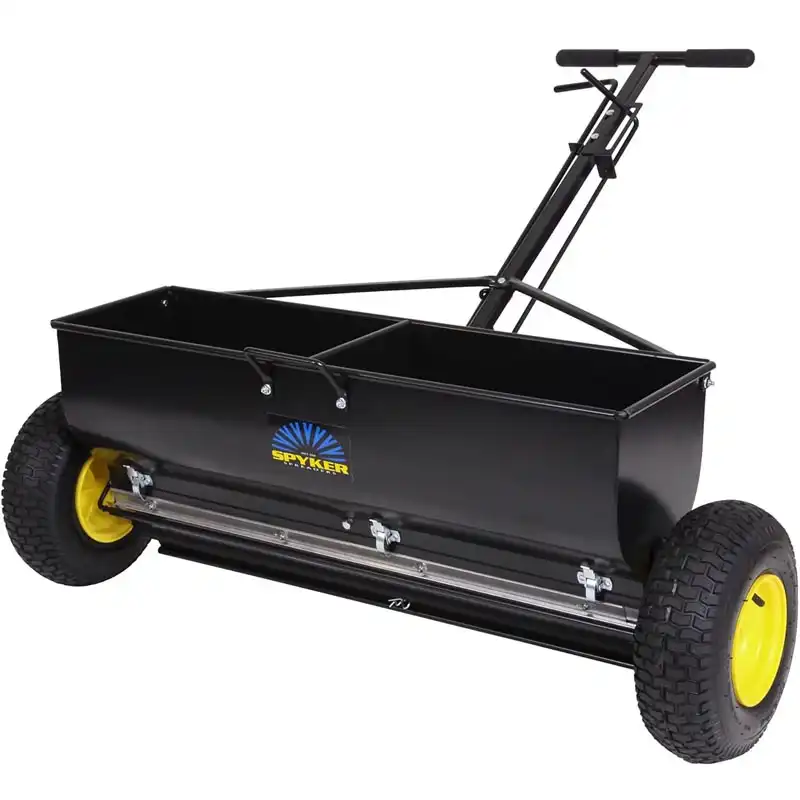
The Spyker P70-12010 is a commercial push drop spreader with a 120-pound hopper. Spyker builds these for pros. The standout is the Spyker Dial, which sets rates in 0.1 increments for tight calibration. Two hopper sections spread a full 36 inches, or 18 inches when you work around beds.
PROS
- Spyker Dial precision
- Spreads 36 or 18 inches
- Heavy-duty commercial frame
- Greaseable enclosed gears
CONS
- Pricey for home use
Specifications:
- 120 lb hopper
- Powder-coated steel frame
- Zerk-fitting enclosed gears
- 13-inch pneumatic tires
6. Yard Commander 60 lb
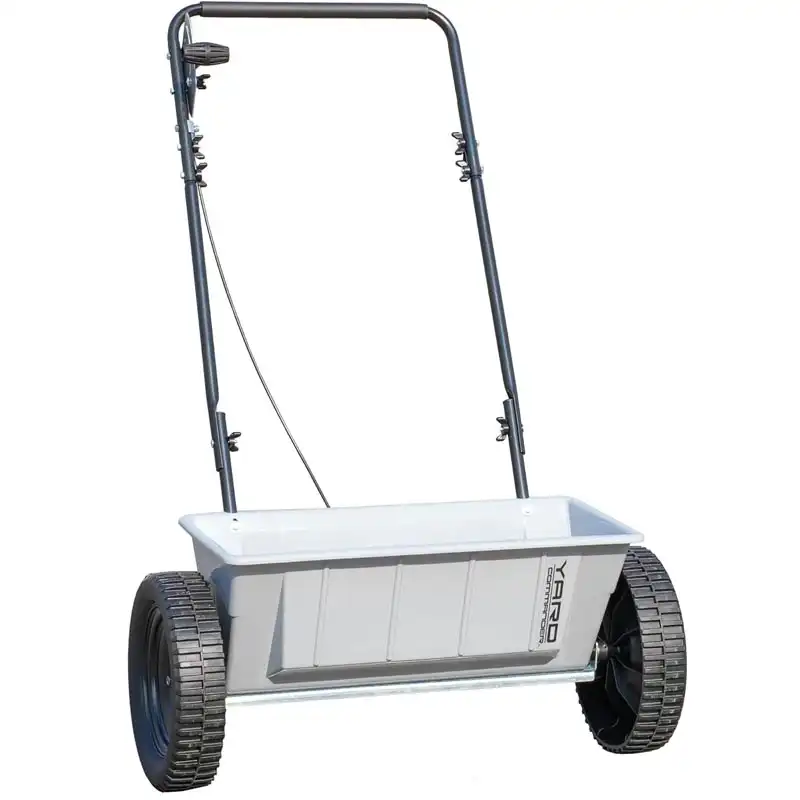
The Yard Commander 60-pound push drop spreader weighs just 13.4 pounds, so storage is easy. The composite hopper resists chemicals and cleans up fast. Its 22-inch spread pattern covers up to 15,000 square feet. It handles grass seed, fertilizer, and weed-and-feed on small lawns.
PROS
- Very light, easy storage
- Corrosion-resistant composite hopper
- Covers 15,000 square feet
- Never-flat 12-inch tires
CONS
- Not Suitable for Salt
Specifications:
- 60 lb composite hopper
- 22-inch spread width
- Powder-coated steel frame
- 12-inch never-flat tires
7. Buyers Products SaltDogg WB400
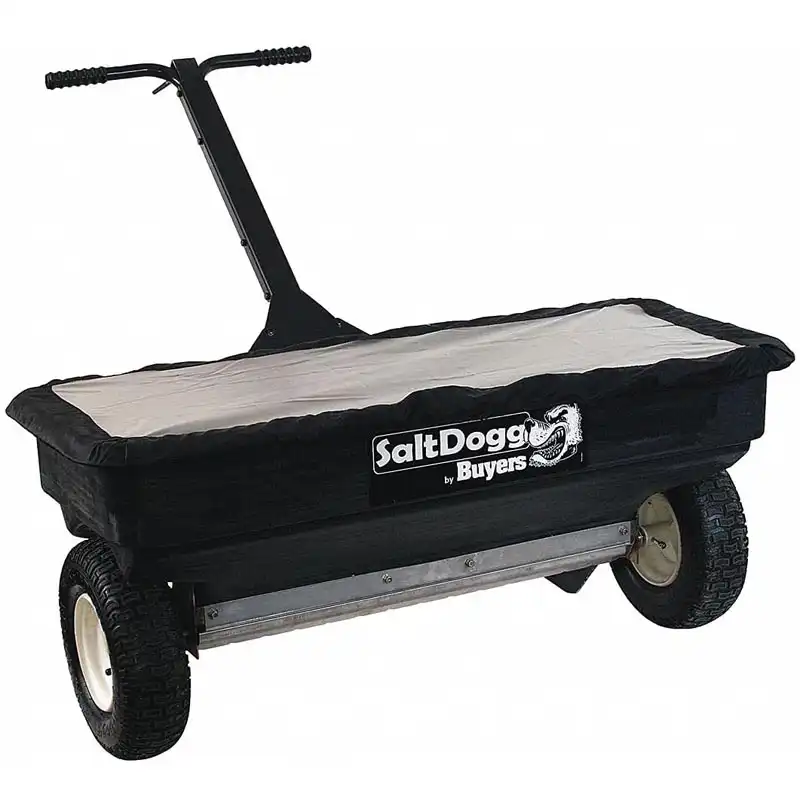
The SaltDogg WB400 from Buyers Products is a winter specialist, not a lawn spreader. Its stainless steel frame, agitator, and trough shrug off salt corrosion. The 2.5-cubic-foot poly hopper holds up to 200 pounds. The 44-inch drop clears a full sidewalk in one pass. So buy it for de-icing, but not seeding.
PROS
- Rustproof stainless steel build
- Holds 200 pounds
- 44-inch one-pass coverage
- Made in USA
CONS
- Salt and ice melt only
- Bit expensive
Specifications:
- 2.5 cu ft poly hopper
- 44-inch drop width
- Stainless frame and agitator
- 13-inch pneumatic tires
What Is a Drop Spreader and How Does It Work?
A drop spreader is a hopper on wheels. It releases granules straight down through a row of calibrated holes set between the wheels. Material lands only where the wheels roll, so placement stays exact.
A gate, worked by a flow control lever, opens and closes those holes to set the rate. Push it forward and the load, granular fertilizer or grass seed, drops in a band as wide as the hopper. Because nothing falls sideways, you keep product off driveways, beds, and water. That straight-down drop is how a drop spreader works.
Drop Spreader vs Broadcast Spreader: Which One Do You Need?
Use a drop spreader for precision and edges; use a broadcast spreader for speed on open ground. That is the short version.
A drop spreader lays a narrow band straight down, so it never throws product where you do not want it. That makes it the right tool near flower beds, fence lines, ponds, and driveways. The trade-off is a narrow spread width, usually 18 to 24 inches on a walk-behind. So you walk more passes to cover the same ground.
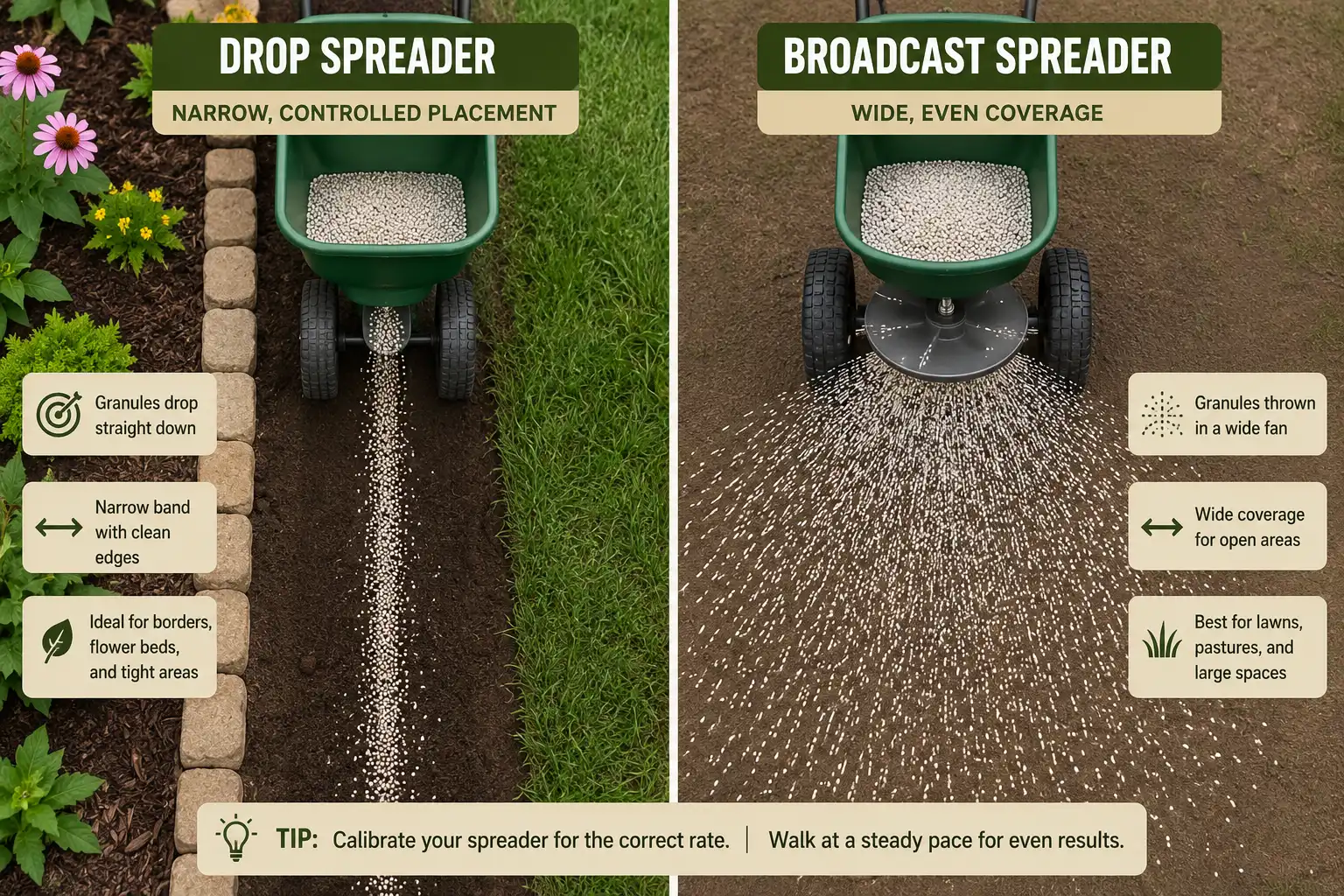
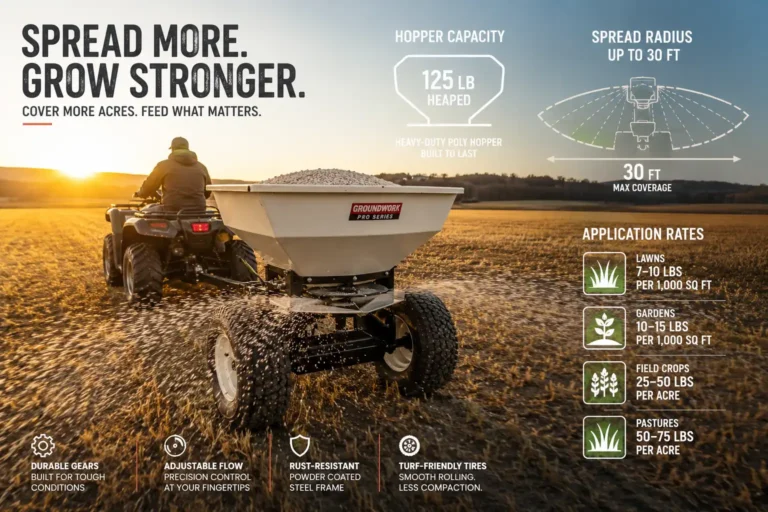
A broadcast spreader (also called a rotary spreader) flings granules from a spinning disk. One pass can cover 6 to 12 feet. It is far faster on big open fields. But the pattern tapers at the edges, so you need overlap for even coverage. Wind drift can also push light seed or fertilizer off target.
Beds and rows favor the drop; wide open acres favor the broadcast. If you are covering several acres, a heavy duty tow behind broadcast spreader saves hours over a walk-behind.
How to Choose the Best Drop Spreader
Match the spreader to your ground and to what you will load. If you only need seed dropped in tidy single rows, a garden seeder beats any spreader. For feeding and seeding across an area, weigh these specs.
Hopper Capacity and Plot Size
Match hopper capacity to how much ground you cover in one go. A 50 to 60 pound hopper suits small yards and raised beds. A 75 pound unit fits mid-size plots. For food plots or a few acres, a 130 to 175 pound tow-behind means fewer refills. Bigger hoppers weigh more when full. A heavy poly hopper is easier to push empty than a loaded steel one.
Spread Width and Passes
Spread width decides how many passes you walk. Most walk-behind drop spreaders run 18 to 24 inches wide. Commercial models reach 30 inches or more. Wider means fewer passes and less chance of skipped stripes. But a wide unit is harder to steer in tight beds.
Frame and Hopper Material
A poly hopper will not rust, which matters because granular NPK fertilizer and ice melt are corrosive. Look for a powder-coated steel frame for strength. Add a galvanized steel agitator that stirs the material so it will not bridge and clog. Cheap plastic gears strip fast under lime, so check the drive parts. Bigger tow-behind units ride on pneumatic tires that roll smoother over rough ground than hard plastic wheels.
Flow Control and Calibration
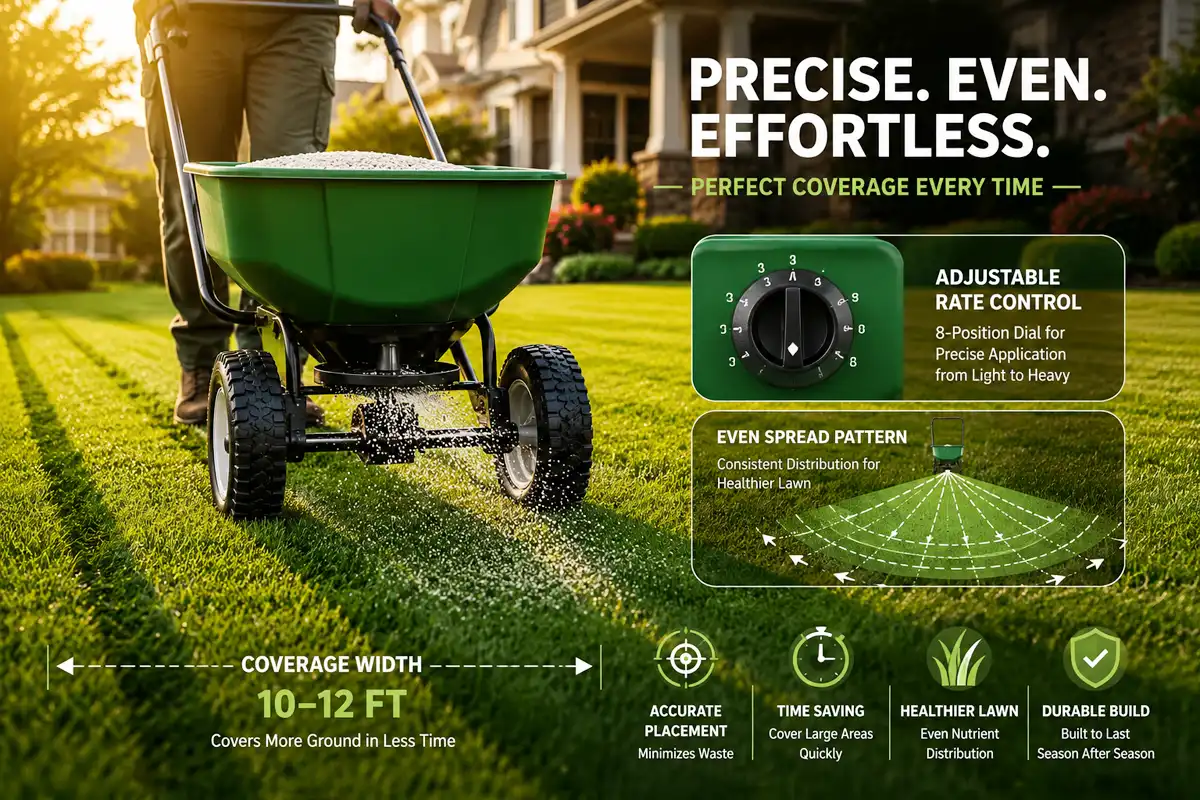
Flow control sets the gate opening to your label rate. A clear numbered dial and a smooth on-off lever make calibration easier. Factory-calibrated systems like Earthway’s Ev-N-Spred and Scotts EdgeGuard get you close. But a quick catch test confirms the true rate on your machine.
Push vs Tow-Behind
Push models give you the most control for beds, rows, and edges. Tow-behind spreaders hitch to an ATV or mower and cover acreage fast. Pick push for precision work, and a tow-behind when you are feeding several acres and want to stay seated.
What You Can Spread with a Drop Spreader
A drop spreader handles most dry, free-flowing lawn and garden products. The usual loads are:
- Granular fertilizer and weed-and-feed
- Grass seed and cover crop seed
- Pelletized lime to correct soil pH
- Granular herbicides
- Sand and ice melt in a heavy-duty unit
The material just has to flow. Coarse pellets and standard fertilizer prills drop cleanly. Very fine powders and ultra-light seed can bridge or blow around, so match your product to the drop-hole size. When planting cover crops like clover or rye, the spreader lays seed in an even band. For lime, set the rate from a soil test kit reading, not a guess.
How to Use and Calibrate a Drop Spreader
Match the dial to the product label and keep a steady pace. Then overlap your wheel tracks so you never leave a stripe. Here is the routine to follow:
- Set the flow control to the number listed on your fertilizer or seed bag.
- Fill the hopper on a hard surface, never over the lawn, so a spill will not burn the grass.
- Spread one lap around the perimeter first, then fill the middle with straight passes.
- Walk a steady pace, about 3 mph, and open the gate only while you are moving.
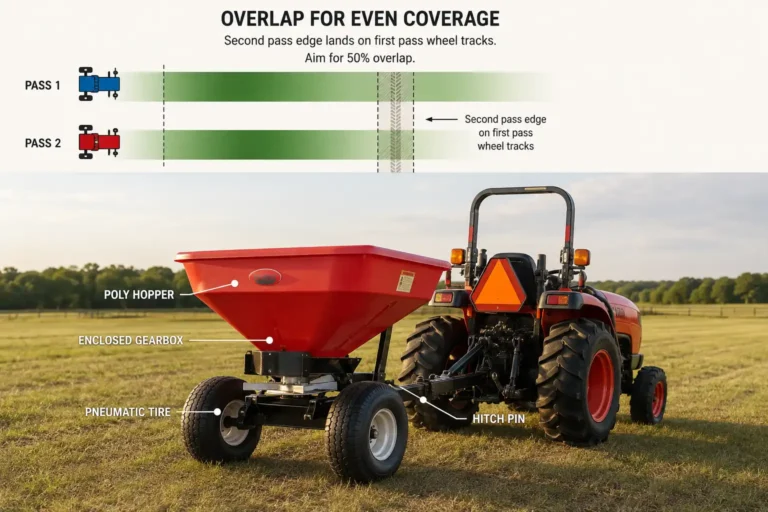
- Overlap each wheel with the edge of your last pass so no strip goes unfed.
- Run a catch test to confirm the rate before you commit to the whole area.
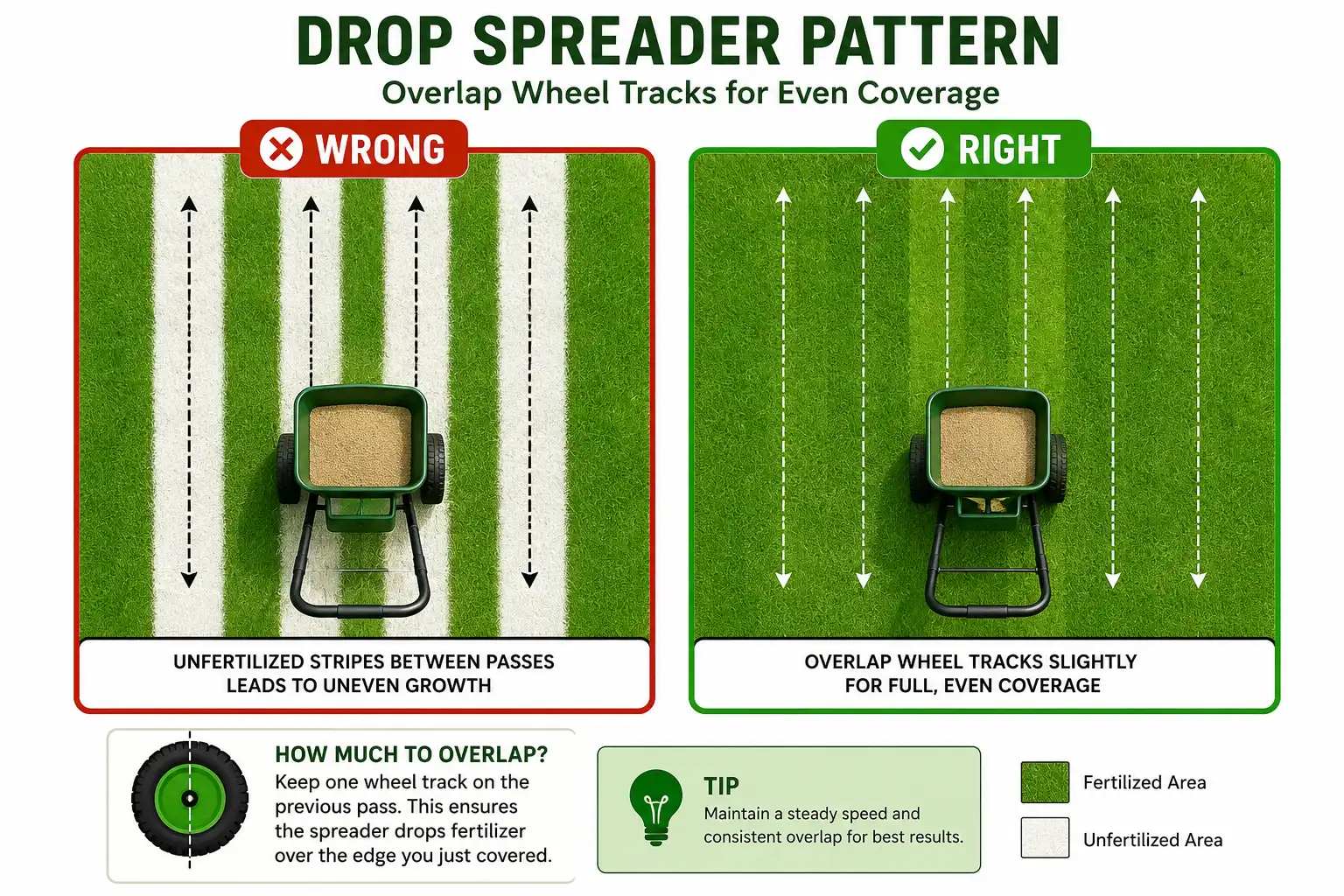
A drop spreader’s one weak spot is bare stripes between passes. So the overlap step is the one you cannot skip. For the catch test, catch what drops over a set distance and weigh it. Then work out the pounds per 1,000 square feet, or per acre on a field. K-State Research and Extension recommends calibrating this way rather than trusting the dial. Adjust and repeat until the rate matches the label.
FAQs on Drop Spreaders
Is a drop spreader better than a broadcast spreader?
What setting should I use on a drop spreader?
Can one drop spreader handle seed, fertilizer, and lime?
How do I keep a drop spreader from leaving stripes?
Should I clean my spreader after every use?
Are drop spreaders good for large lawns?
How to Pick One for your Ground
For serious acreage, the Agri-Fab 45-0288 stands out as the best drop spreader. It holds 175 pounds and covers a 42-inch swath, so you refill less and finish faster. No tractor on the place? The At Home 75 lb is a solid wide push model for less. For a few beds or a tight wallet, the VEVOR 50 lb does the job. Match the tool to the ground you actually work.