Best Tow Behind Broadcast Spreader for 2026: Top 7 Picks
Covering more than an acre by hand costs an afternoon and still leaves stripes. Fertilizer and seed get expensive at that scale, so waste shows up in the bill. That is why you need a tow behind broadcast spreader that hitches to what you already own.
The best tow behind broadcast spreader is the Agri-Fab 45-0463, because its enclosed gearbox and 13 inch tires last. The Brinly BS26BH-A adds Autoflow that stops at turns. The VEVOR TC2029A gives 30 rate settings.
Tow Behind Broadcast Spreader Picks at a Glance
- Best Overall: Agri-Fab 45-0463 130 lb
- Best Value: Brinly BS26BH-A 125 lb
- Editor Pick: VEVOR TC2029A 130 lb
- Best for ATV/UTV: VEVOR 85 lb
- Best Budget Option: Garvee 130 lb
- Best for Small Properties: Agri-Fab 45-0530 85 lb
- Best for Rough Terrain: Chapin 8622B 150 lb
The comparison table further down sets all seven side by side on capacity, tires, and gearbox type.
| Preview |
#1
Best Overall
|
#2
Best Value
|
#3
Editor Pick
|
#4
Best for ATV/UTV
|
#5
Best Budget
|
#6
Best for Small Properties
|
#7
Best for Rough Terrain
|
#8
Best Stainless Steel Spreader
|
| Title | Agri-Fab 45-0463 | Brinly BS26BH-A 125 lb | VEVOR TC2029A 130 lb | VEVOR 85 lb | Garvee 130 lb | Agri-Fab 45-0530 | Chapin 8622B 150lb | Chapin 89400C 100 lb |
| Price |
$199.99 – 05.12.2026 See Latest Price |
$280.04 – 05.12.2026 See Latest Price |
$188.99 – 05.12.2026 See Latest Price |
$255.99 – 05.12.2026 See Latest Price |
$165.99 – 05.12.2026 See Latest Price |
$124.99 – 05.12.2026 See Latest Price |
$287.00 – 05.12.2026 See Latest Price |
$341.60 – 05.12.2026 See Latest Price |
| Overall Score | ||||||||
| Capacity | 130 lb | 125 lb | 130 lb | 85 lb | 130 lb | 85 lb | 150 lb | 100 lb |
| Spread Width | 10–12 ft | 12 ft | 10 ft | 9.8 ft | 10 ft | 10 ft | 12 ft | 10 ft |
| Tires | 13″ pneumatic | Pneumatic | 13″ pneumatic | 10″ pneumatic | 10″ pneumatic | 10″ pneumatic | 14″ wide-tread | 12″ pneumatic |
| Frame / Hopper | Steel tube / Poly | Powder-coat steel / Poly | Q195 steel / Poly | Q195 steel / Poly | Powder-coat steel / Poly | Alloy steel / Poly | Powder-coat steel / Poly | Stainless steel / Poly |
| Warranty | 3-year | Limited | No | No | Limited | Standard | 2-year | 5-year |
The 7 Best Tow Behind Broadcast Spreaders: Reviews
Each pick below fits a different acreage, tow vehicle, and material budget. Specifications come from published manufacturer documentation. Where a strength or weakness rests on buyer feedback rather than a spec sheet, the text says so.
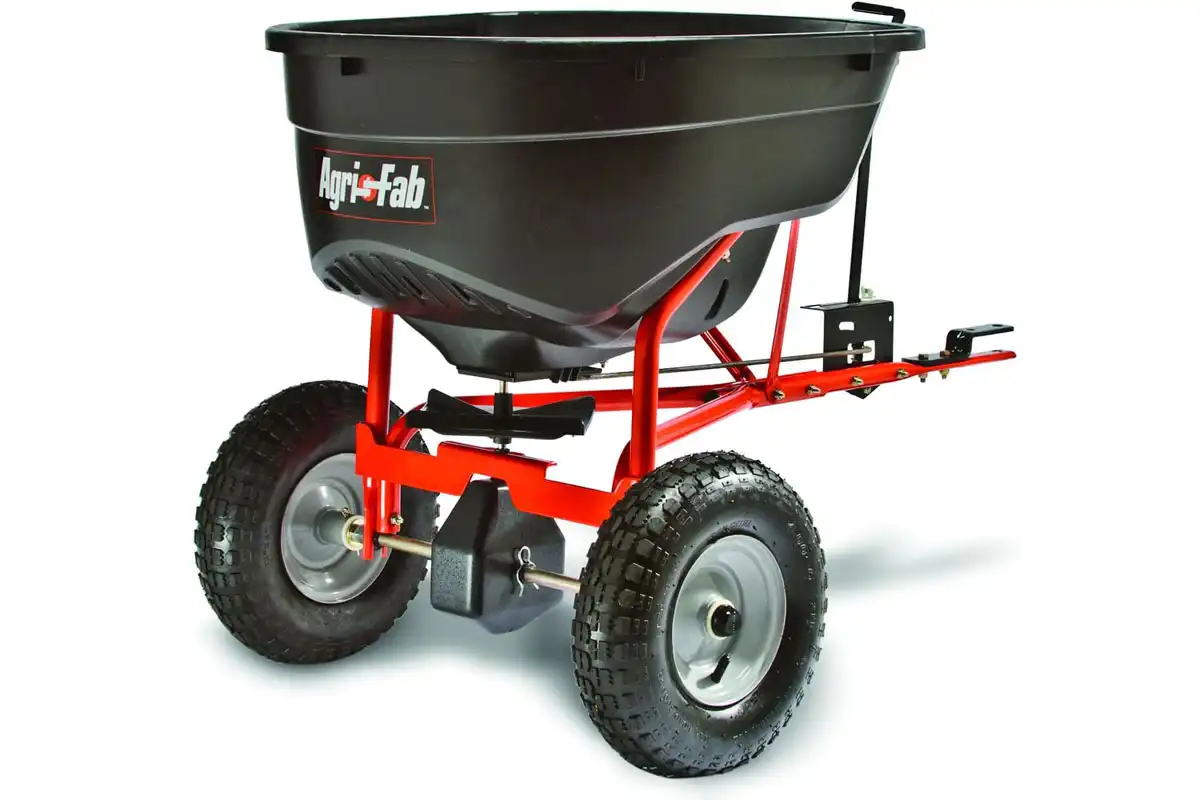
1. Agri-Fab 45-0463 130 lb. Tow-Behind Broadcast Spreader
PROS
- Made in the USA
- 3-year limited warranty
- Enclosed gearbox protects gears
- Wide 10–12 ft spread saves passes
CONS
- No rain cover included
Agri-Fab is an Illinois-based company that has been building lawn and garden attachments for decades. The 45-0463 is their flagship SmartSPREADER. Made in the USA, it sits in the middle of the tow behind market for half-acre to two-acre properties.
The 130 lb poly hopper covers up to a half acre per fill at common granular rates. The 10 to 12 ft spread width then cuts the number of passes roughly in half. The fully enclosed gearbox keeps fertilizer dust off the gear teeth. The 13 in by 4 in pneumatic tires roll over rough ground instead of skipping across it. The universal hitch fits Craftsman, Husqvarna, Cub Cadet, and most lawn tractors. A steel rod flow control reaches the tractor seat.
Specs:
- Capacity: 130 lb (about half an acre per fill)
- Spread Width: 10 to 12 ft
- Tires: 13 in by 4 in pneumatic
- Weight: 29.4 lb
- Warranty: 3-year limited
Owner reports consistently note five or more seasons of service with basic rinse-and-store maintenance. For bigger capacity, the Brinly BS36BH 175 lb is the step up in this class.
Best for the half-acre to two-acre owner who wants a reliable, USA-built broadcast spreader that lasts.
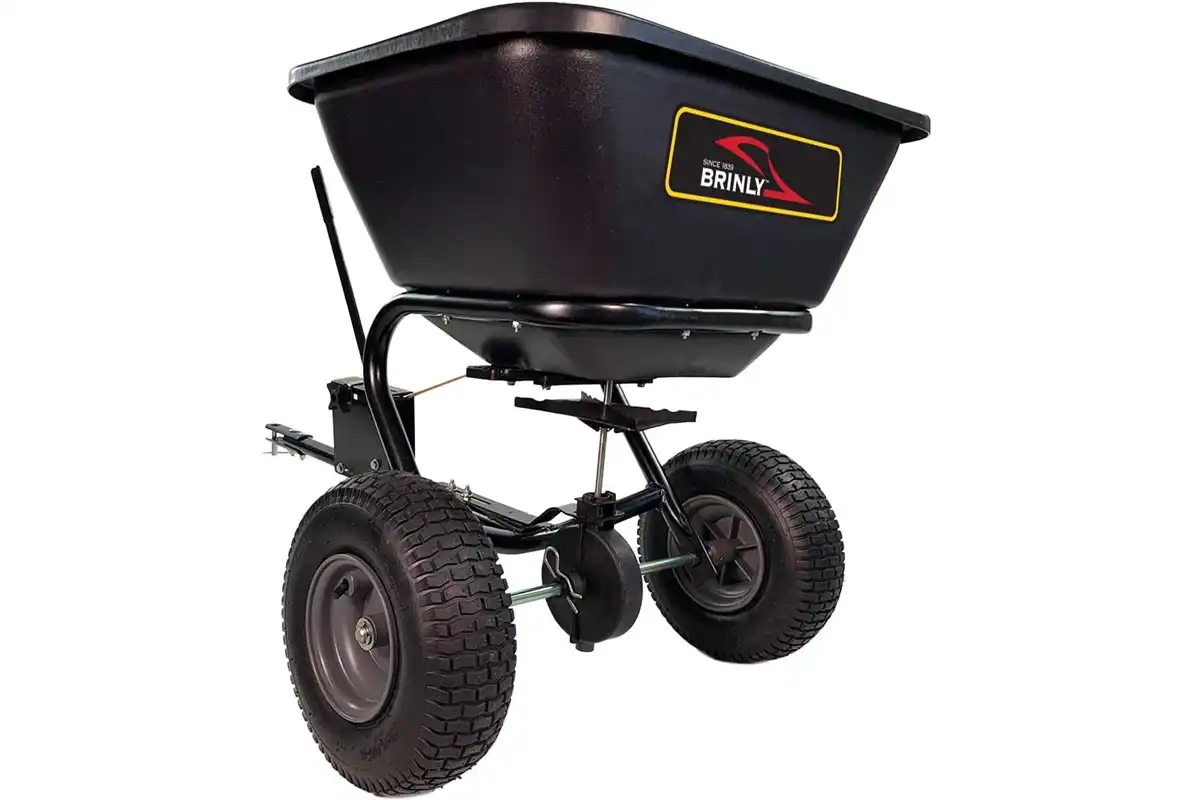
2. Brinly BS26BH-A 125 lb. Tow Behind Broadcast Spreader
PROS
- Autoflow stops waste at turns
- Directional spread pattern control
- Stainless steel agitator and shaft
- Quick 30-minute assembly
CONS
- Pricier than basic Agri-Fab
Brinly-Hardy has been making lawn equipment from Jeffersonville, Indiana. The company traces its origin to 1839, one of the oldest names in the category. The BS26BH-A is the mid-size tow behind broadcast spreader in that line, sized for properties just above the half-acre mark.
The standout is the patented Autoflow technology that stops material flow when the tractor stops. That removes the burnt patches that build up at turn points. The directional spread pattern control centers the throw. You also get a tubular steel frame with a powder-coat finish. Stainless steel hardware covers the agitator and spinner shaft. The gearbox is fully enclosed glass-filled nylon. The 125 lb hopper holds 2.5 cu ft and assembles in about 30 minutes using the pictorial manual.
Specs:
- Capacity: 125 lb (2.5 cu ft)
- Frame: Powder-coated tubular steel
- Gears: Enclosed glass-filled nylon
- Weight: 42.8 lb
- Dimensions: 43 in L by 29 in W by 30.75 in H
Autoflow earns its cost back quickly on expensive seed, since every stop otherwise dumps product in one spot. On a tighter budget, the Agri-Fab 45-0463 is the runner-up.
Best for half-acre owners who want no wasted seed and the cleanest broadcast pattern in this class.
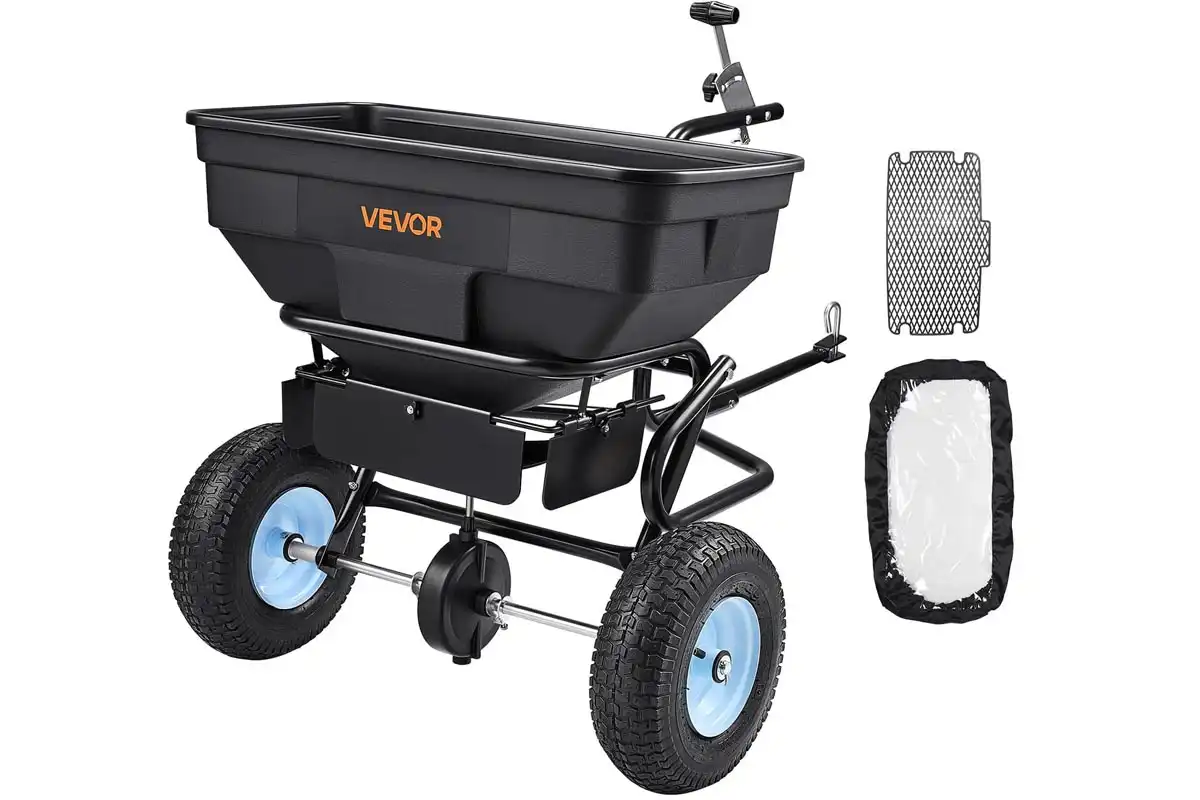
3. VEVOR 130 lb. Tow Behind Broadcast Spreader
PROS
- 30 fine-grain rate settings
- 5-minute tool-free assembly
- Sieve mesh filter included
- 13″ pneumatic tires
CONS
- No formal warranty listed
VEVOR is a global brand known for budget-priced outdoor and shop tools. The TC2029A 130 lb spreader competes directly with the Agri-Fab on capacity. It sits at a lower price point, sized for one-acre to two-acre properties.
The 130 lb hopper pairs with a 0 to 10 ft adjustable spread width. Its 30 adjustable settings give finer rate control than most competitors offer. VEVOR describes the frame as military-grade Q195 powder-coated steel. In fact Q195 is a standard low-carbon structural grade, not a military specification. Aluminum gears drive the impeller and the tires are 13 in pneumatic. A sieve mesh filter keeps clumps away from the plate. Assembly takes about 5 minutes with no tools.
Specs:
- Capacity: 130 lb
- Spread Width: 0 to 10 ft
- Tires: 13 in pneumatic
- Weight: 31.5 lb
- Settings: 30 adjustable positions
This is the budget pick. Aluminum gears do not last like enclosed metal gears, so plan on a shorter service life. For heavy spreading every season, the Agri-Fab 45-0463 will outlast it.
Best for budget-minded owners who need 130 lb capacity for occasional seasonal use.
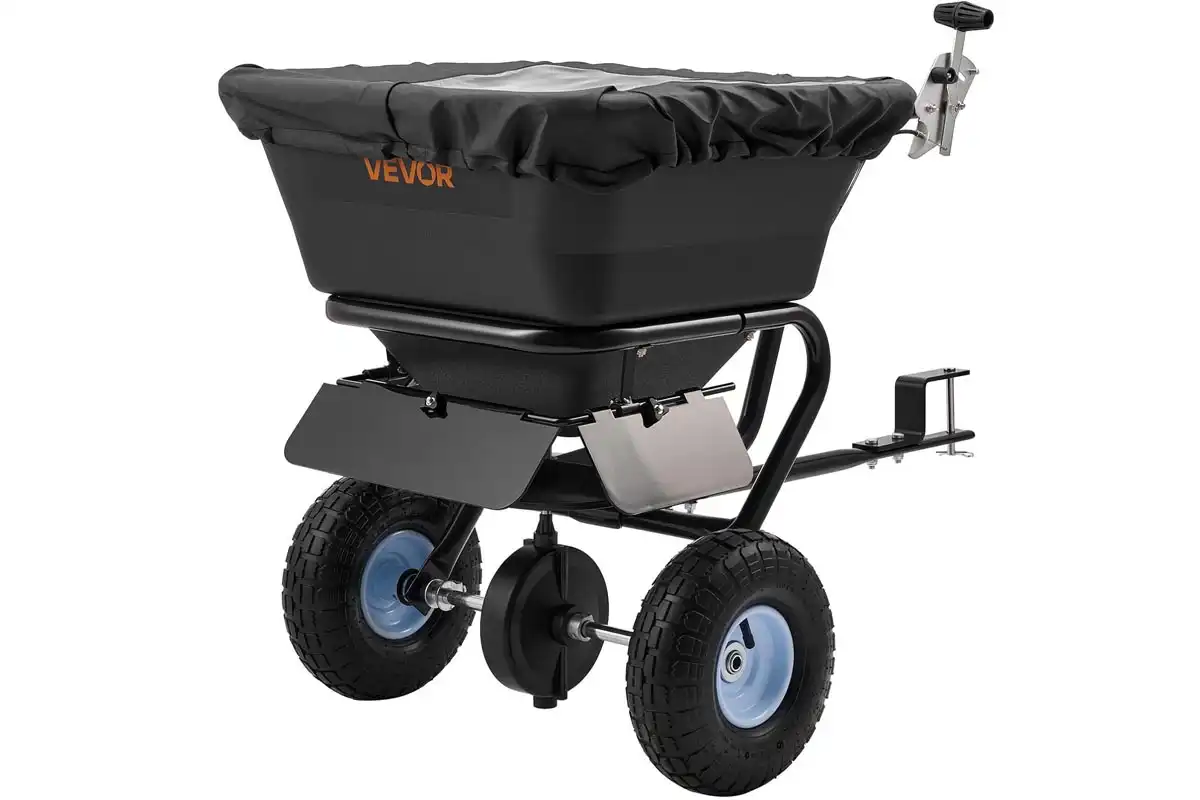
4. VEVOR 85 lb. Tow-Behind Spreader
PROS
- Rain cover included standard
- Compact for small storage
- 30 spreading levels
- Mesh screen prevents clogging
CONS
- No long-term warranty info
This is VEVOR’s smaller broadcast spreader, built for properties under an acre. Same value-priced approach as the 130 lb model in a lighter package. Unlike most competitors at this price, it ships with a rain cover.
The 85 lb poly hopper covers up to a quarter-acre per fill. You get a 9.8 ft broadcast width and 30 spreading levels for fine control. The powder-coated Q195 steel frame and aluminum gears hold weight down to 24.5 lb. You also get 10 in pneumatic all-terrain wheels, a mesh screen filter, and a rain cover included. The universal hitch fits lawn tractors, ATVs, and UTVs.
Specs:
- Capacity: 85 lb
- Spread Width: 0 to 9.8 ft
- Tires: 10 in pneumatic
- Weight: 24.5 lb
- Frame: Powder-coated Q195 steel
A solid pick for owners who want tow-behind convenience without spending big. The included rain cover is the touch most competitors skip. For better long-term durability in the same size class, the Agri-Fab 45-0530 85 lb is the USA-built alternative.
Best for small-property owners who want a budget-friendly tow behind broadcast spreader with the rain cover already included.
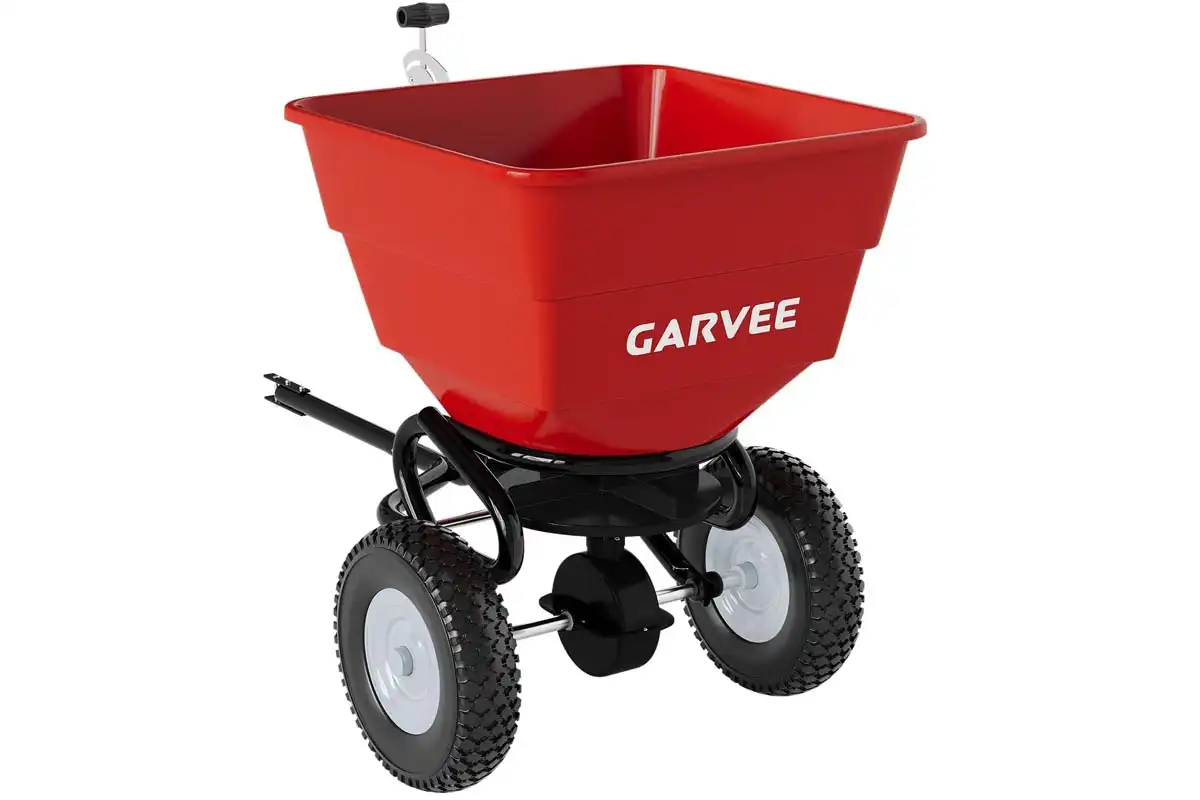
5. Garvee 130 lb. Tow-Behind Spreader
PROS
- Waterproof cover included
- Sieve filter prevents clogs
- ATV and UTV compatible
- Lightweight at 27.1 lb
CONS
- Limited warranty
Garvee is a newer name in outdoor power equipment, focused on value-priced tow-behind tools. The 130 lb spreader runs alongside VEVOR in the budget category. The included waterproof cover is its main standout feature.
The 130 lb rust-resistant poly hopper, 0 to 10 ft adjustable spread width, and powder-coated steel frame cover the basics. The 10 in all-terrain pneumatic tires handle uneven ground, and the waterproof cover and sieve filter both ship included. An adjustable flow handle controls the material rate, and the universal tow bar connects to lawn tractors, ATVs, and UTVs.
Specs:
- Capacity: 130 lb
- Spread Width: 0 to 10 ft
- Tires: 10 in pneumatic all-terrain
- Weight: 27.1 lb
- Frame: Powder-coated steel
A workable budget pick for casual use. The waterproof cover genuinely helps when clouds roll in mid-job. For heavier use or rougher ground, the Agri-Fab 45-0463 with 13 in tires handles bumps far better.
Best for budget buyers who want 130 lb capacity plus a waterproof cover without paying premium prices.
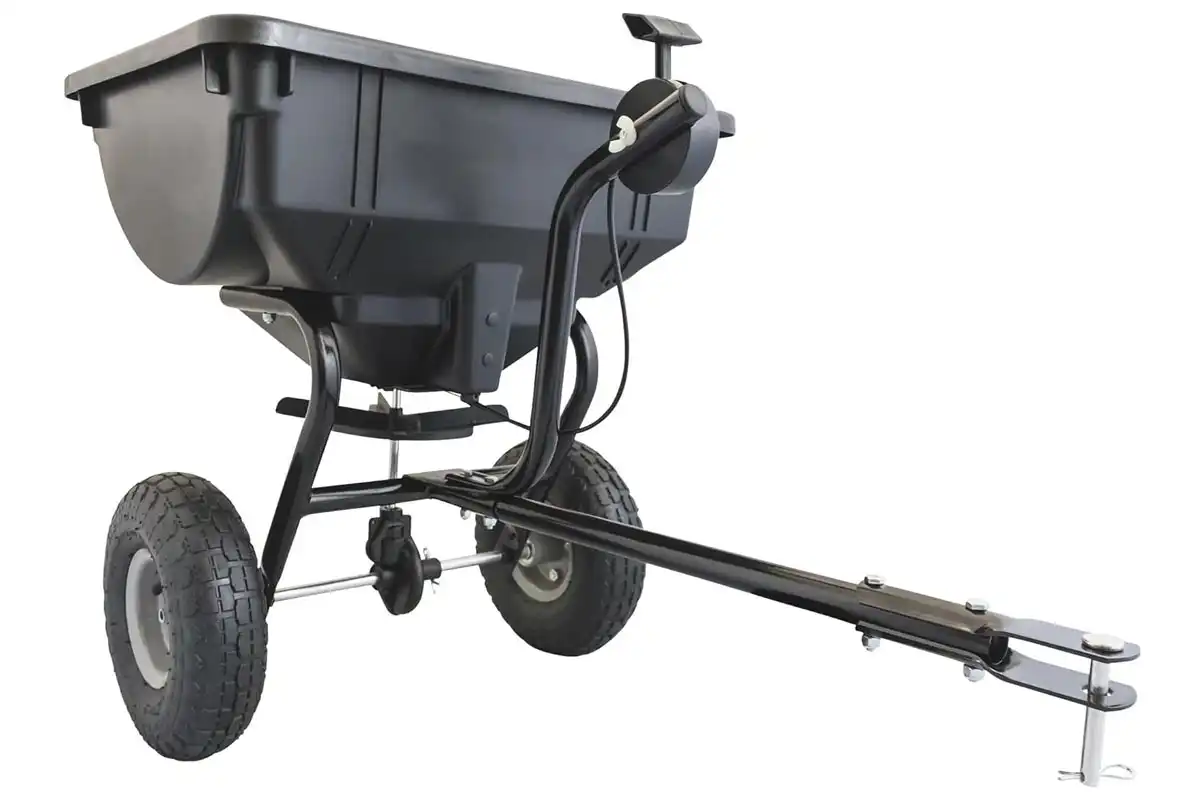
6. Agri-Fab 45-0530 85 lb. Tow-Behind Broadcast Spreader
PROS
- Made in the USA
- Enclosed gearbox for durability
- Lightweight at 17 lb
- On/off control from seat
CONS
- No rain cover standard
This is Agri-Fab’s small-capacity tow behind broadcast spreader, built in the USA for properties under an acre. The current production model is the 45-0530-131, which replaced the original 45-0530, sized for quarter-acre to half-acre lots.
The 85 lb poly hopper covers about a quarter-acre per fill. You also get up to 10 ft spread width and a fully enclosed gearbox. The build adds 10 in pneumatic tubeless tires and an alloy steel frame. Cable flow control reaches the tractor seat, and the hitch is universal. An optional hopper cover, grate, and deflector kit are sold separately.
Specs:
- Capacity: 85 lb (about a quarter-acre per fill)
- Spread Width: Up to 10 ft
- Tires: 10 in pneumatic tubeless
- Weight: 17 lb
- Dimensions: 34 in D by 22 in W by 27 in H
Owner reports from buyers who scaled down from larger spreaders back this up. It is the right size for small lots. It is light enough to handle alone and built solidly enough to last. For more acreage later, the 45-0463 130 lb is the move within the same lineup.
Best for small-property owners who want a USA-made tow behind broadcast spreader sized for under-acre lots.
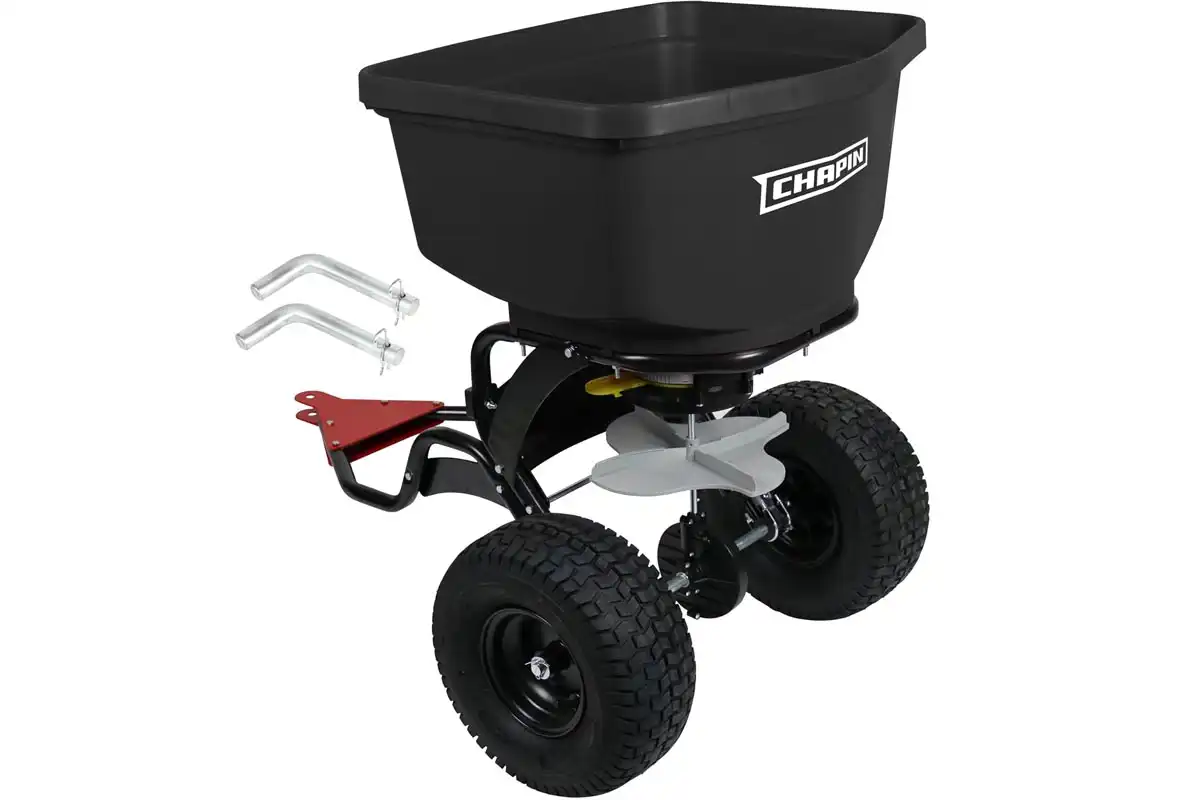
7. Chapin 8622B Tow Behind Broadcast Spreader
PROS
- Auto-stop dual impeller prevents waste
- 14″ wide-tread tires for traction
- 11 gate settings for flow control
- Enclosed Delrin bearings
CONS
- Bit expensive
Chapin International has been in business since 1884 out of Batavia, New York. The 8622B is their heavy-duty tow behind broadcast spreader, built for tough terrain and farm-grade use. The auto-stop dual impeller is what sets it apart.
The 2.2 cu ft hopper pairs with an auto-stop dual impeller. Flow halts the moment the wheels stop. Then 11 gate settings with automatic opening and closing put this one in its own category. The powder-coated steel frame and oil-impregnated bearings handle rough acreage. Its 14 in wide-tread pneumatic tires are the widest in this guide. A spiked auger and baffle hold the spread pattern even. The universal hitch fits ATV, UTV, or tractor, and two hitch pins ship in the box. Chapin builds the 8622B in the USA with global materials.
Specs:
- Capacity: 150 lb (2.2 cu ft)
- Tires: 14 in wide-tread pneumatic
- Gate Settings: 11 positions
- Frame: Powder-coated steel
- Warranty: Limited lifetime
Owner reports consistently point to the auto-stop as the reason for buying, especially where seed cost per pound is high. One hard limit applies. Chapin does not recommend the 8622B for sand, sand mixes, lime, or pelletized lime mixes. For all-season lime and salt work, the Agri-Fab 45-0463 takes those materials without complaint.
Best for growers spreading seed and fertilizer on rough terrain who want auto-stop flow control.
How to Choose a Tow Behind Broadcast Spreader
A good buy comes down to a handful of specs. They decide whether the machine lasts five seasons or fails in two.
Hopper Capacity
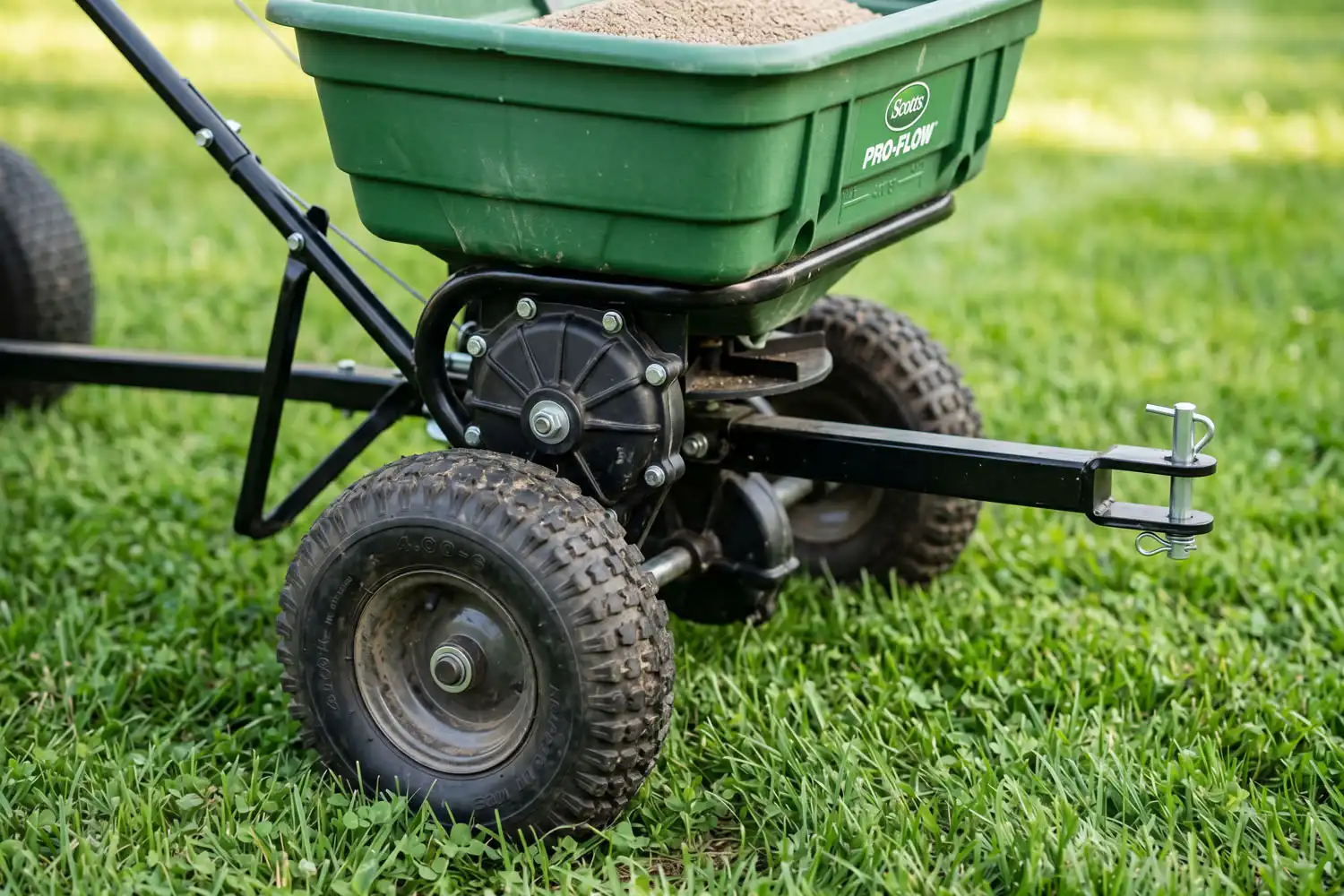
Match capacity to your application rate, not to acreage alone. Penn State Extension gives the conversion that makes this workable on farm ground. One pound per 1,000 square feet equals 43.6 pounds per acre. So a common 4 lb per 1,000 sq ft rate lands near 175 lb per acre. A heavy 8 lb rate lands near 350.
| Hopper | Coverage at 175 lb per acre | Coverage at 350 lb per acre |
|---|---|---|
| 85 lb | 0.49 acre | 0.24 acre |
| 125 lb | 0.71 acre | 0.36 acre |
| 130 lb | 0.74 acre | 0.37 acre |
| 150 lb | 0.86 acre | 0.43 acre |
| 175 lb | 1.00 acre | 0.50 acre |
Read that table before trusting any coverage claim on a box. For under 1 acre, an 80 to 100 lb hopper is plenty. For 1 to 2 acres, look at 130 lb. And for 2 acres and up, step into the 175 to 200 lb class. That way you are not refilling every twenty minutes.
Spread Width
Most tow behind broadcast spreaders throw 8 to 12 ft wide. Wider means fewer passes, which matters on open ground. Heavier granules like pelletized lime carry farther than light grass seed. So check the rated width against the material you actually run. The number on the box is the total throw, not the working width. The pass spacing section below covers that in detail.
Gearbox
Look for a fully enclosed gearbox with metal gears. Plastic gears strip under load, especially with heavy lime or salt. A sealed housing keeps fertilizer dust and grit off the gear teeth. That is the single biggest reason cheap spreaders die early.
Wheels and Tires
Pneumatic tires roll over uneven ground instead of skipping across it. Look for 13 in diameter tires and a wide wheelbase. A wide stance keeps the spreader from tipping on slopes and side-hilling. Penn State Extension also notes that low tire pressure causes uneven output. So check pressure before each fill.
Hitch Compatibility
A universal hitch pin fits most lawn tractors, zero-turns with a hitch kit, and many ATVs. For electric models on an ATV or UTV, you need a 12V power source and a receiver mount. Always check hitch height so the spreader rides level. A nose-up or nose-down hopper changes where granules strike the impeller, and that shifts the whole pattern to one side.
Frame and Hopper Material
A powder-coated tubular steel frame holds up against corrosion from fertilizer salts. Poly hoppers will not rust and shrug off urea and ammonium nitrate. Stainless steel agitators and shafts inside the hopper signal a quality build. Those parts sit in direct contact with the most corrosive material the machine handles.
Auto-Stop and Flow Control
Seat-operated rod control lets you shut the flow off without leaving the seat. Auto-stop systems go further and cut flow the moment the wheels stop turning, which prevents pile-ups at turn points. Both Brinly Autoflow and Chapin auto-stop work this way. On expensive seed, that feature alone justifies the upgrade.
Optional Add-Ons
A rain cover keeps material dry mid-job. A hopper grate breaks up clumps before they reach the impeller. That matters, because Penn State Extension warns that clumped granules should be broken apart or skipped entirely. A deflector kit narrows the pattern near driveways, garden beds, and pond banks. So product stays off ground where it does not belong.
If you are still choosing between machine types, the wider fertilizer spreader comparison covers push and tow models together.
Broadcast Spreader vs Drop Spreader: Which Should You Tow?
Tow a broadcast spreader for open ground and a drop spreader for tight work. A broadcast spreader flings material 8 to 12 ft wide using a spinning impeller plate. A drop spreader releases product straight down in a narrow band the width of the hopper. Penn State Extension puts that at 1.5 to 3 ft on most models.
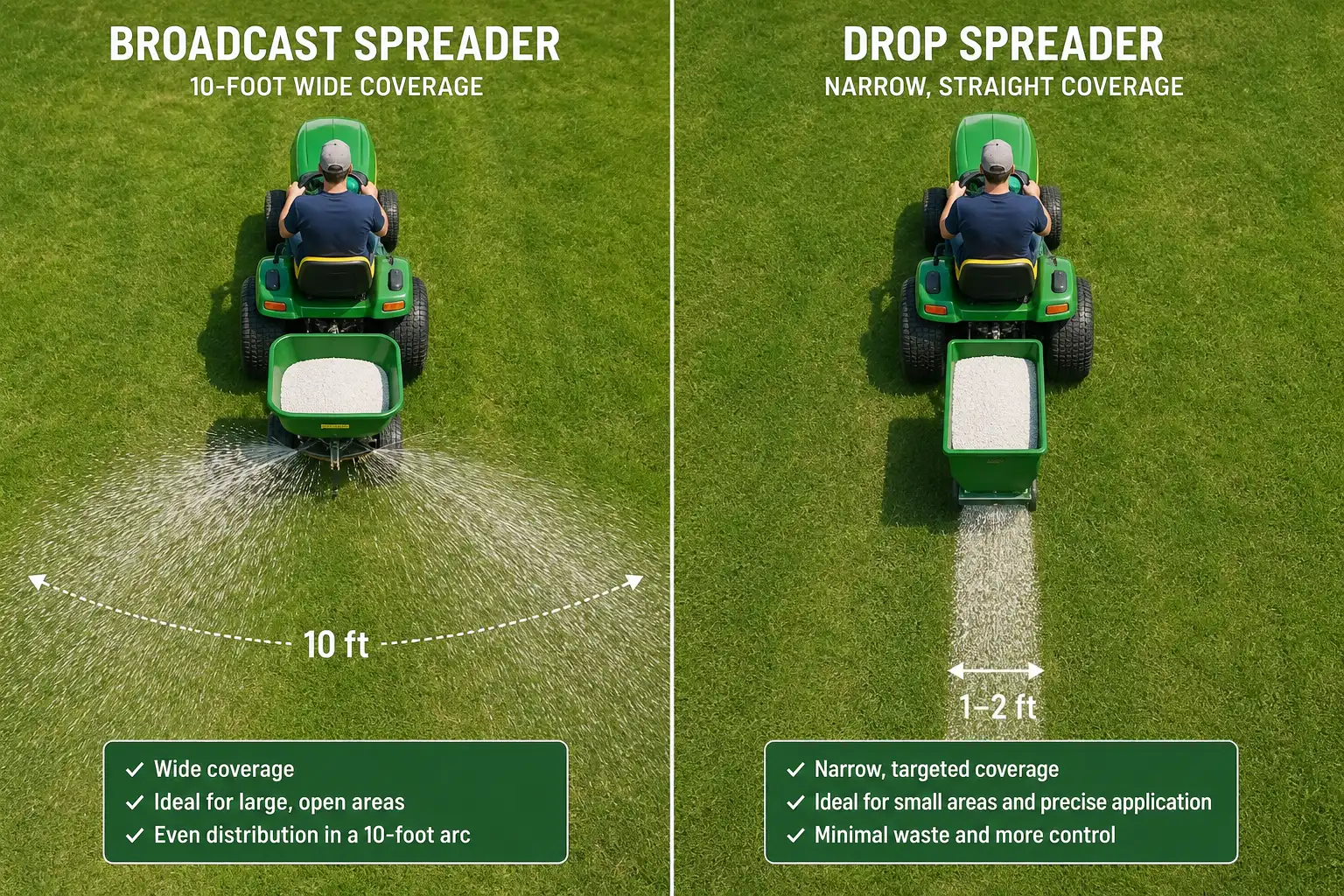
Drop spreaders apply accurately and need no overlap, but the passes have to sit exactly adjacent like strips of wallpaper. Miss by a few inches and you get a bare line. Broadcast wins for open lawns and fields where ground needs covering fast. For anything near flower beds, fences, and pond banks, the drop spreader options keep product where it belongs.
How to Calibrate a Tow Behind Broadcast Spreader
Calibration takes ten minutes and saves you from striping, burn spots, and wasted fertilizer. Penn State Extension is explicit that label settings are a starting point only. Ground speed and machine wear vary too much to trust a printed number. So calibrate for your machine, your product, and your speed.
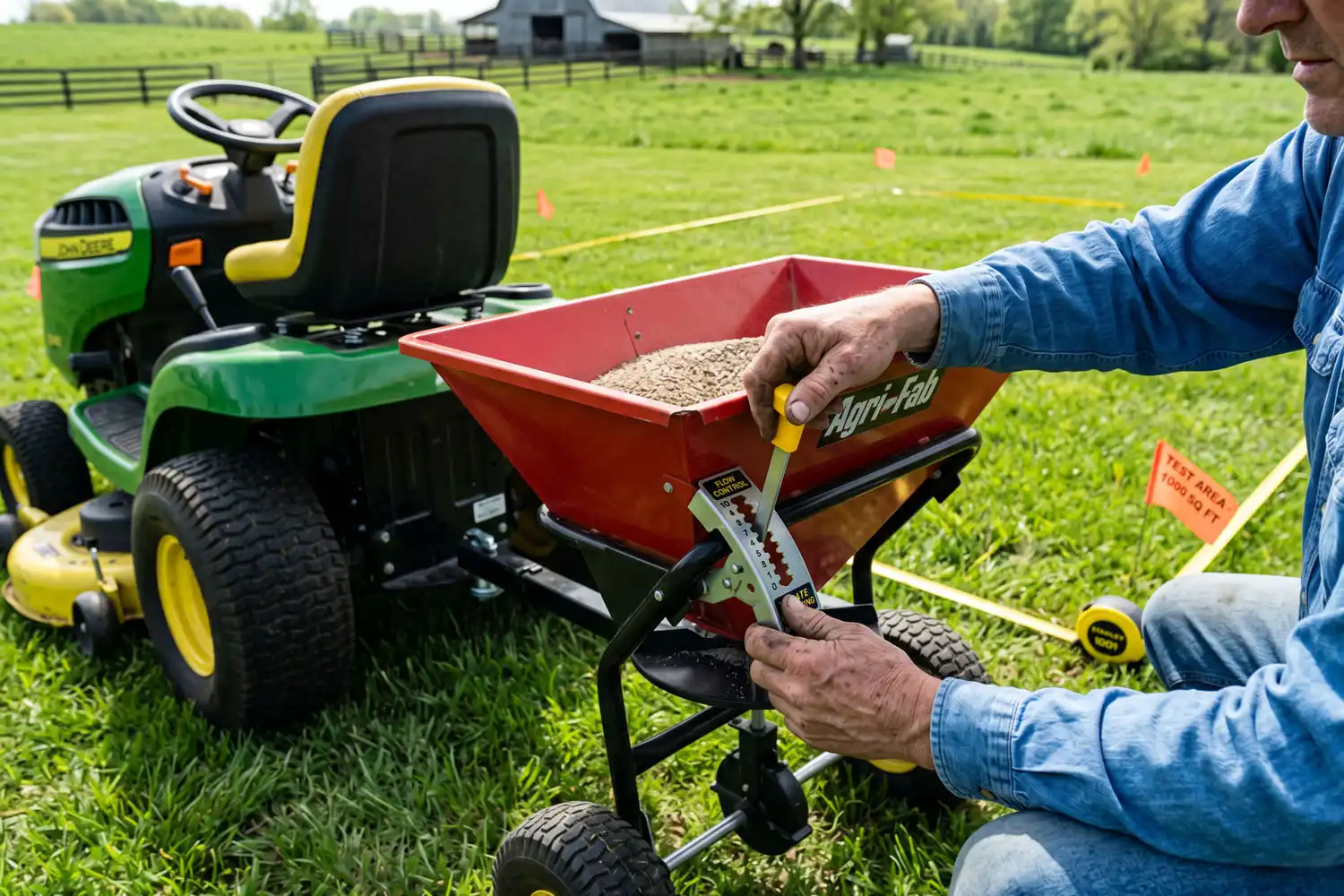
- Check the bag label. Find the recommended spreader setting and target rate per 1,000 sq ft printed on the fertilizer or seed bag. Use it as a starting position, not a final answer.
- Measure your effective swath width. The pan test in the next section gives you the real number.
- Mark a test strip. A 50 or 100 ft run works. Penn State Extension suggests using an out-of-the-way area, since a calibration pass can stripe or burn whatever it crosses.
- Weigh a known load. Put 5 to 10 lb in the hopper and write the number down.
- Make the pass at working speed. Start moving before opening the gate, hold one steady speed, and close the gate as you cross the end mark.
- Weigh what is left. The difference is what went out.
- Do the math. Multiply your target lb per 1,000 sq ft by the swath width times the strip length, then divide by 1,000. That is what should have come out.
- Adjust one notch and repeat until the delivered weight matches the target.
UMass Extension considers a spreader calibrated when output falls within 5 percent of the target rate. Outside that band, keep adjusting.
Split the Rate on Wide Applications
Both Penn State Extension and UMass Extension recommend calibrating to half the target rate and covering the ground twice. Run the second pass at right angles to the first. The resulting grid masks skips and overlaps from either pass. It costs a second trip across the field and removes most striping risk. Running a soil test before you apply tells you which rate to split in the first place.
How Far Apart Should the Passes Be?
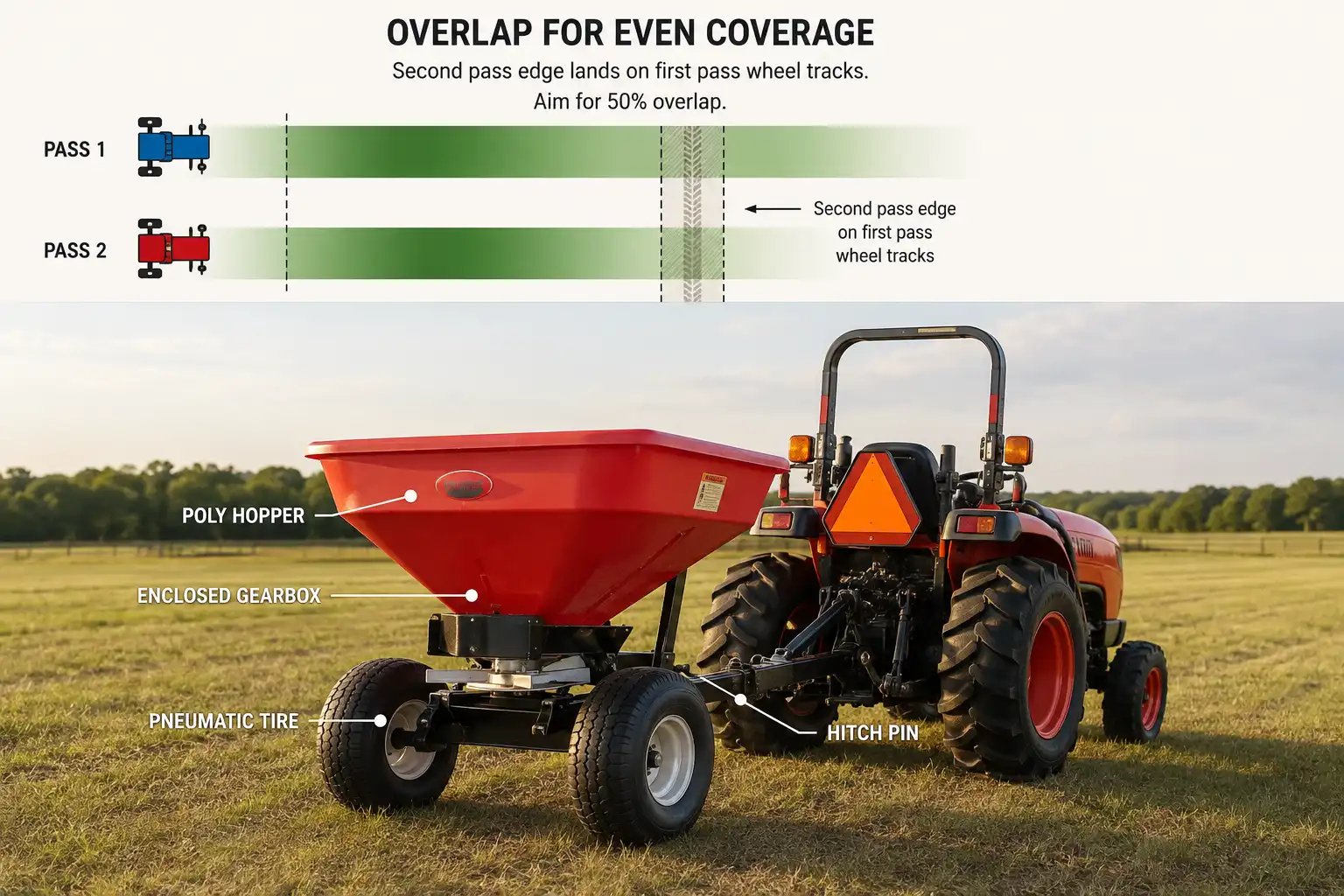
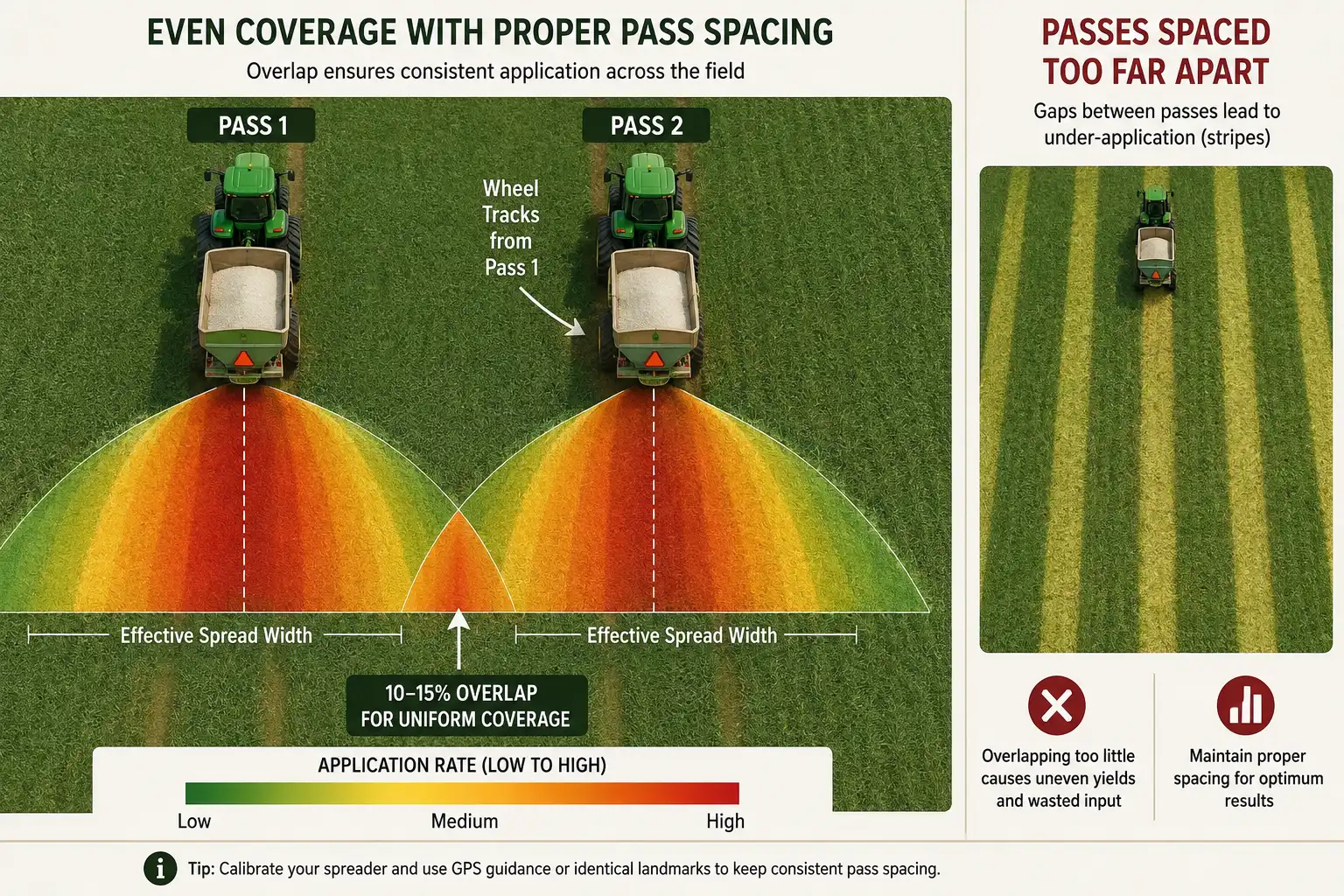
Space passes so the outer edge of the current throw lands on the previous pass’s wheel tracks. That works out to roughly 50 percent overlap. Purdue University turfgrass science checked this directly. Anything less produces striping, because a rotary spreader lays a bell-shaped pattern. Most material concentrates at the center and thins toward the edges.
Two passes spaced at the full advertised throw width leave a light seam between every set of wheel tracks. The seam only becomes visible weeks later as a stripe, long after the pass that caused it.
Finding the Effective Swath Width
Penn State Extension describes a pan test that finds the real working width. Set 1-foot square pans in a row a foot apart, wider than the expected throw. Then drive over the center pan several times and weigh what each pan caught. Find the point where the side pans hold half of what the center pan holds. That distance is your effective swath width, and that is the spacing to use.
Run the test again whenever you change products. Pelletized lime carries much farther than light grass seed. So one spreader has a different effective swath for every material it handles.
How to Use a Tow Behind Broadcast Spreader in the Field
A few habits separate clean spreading from a striped, patchy mess.
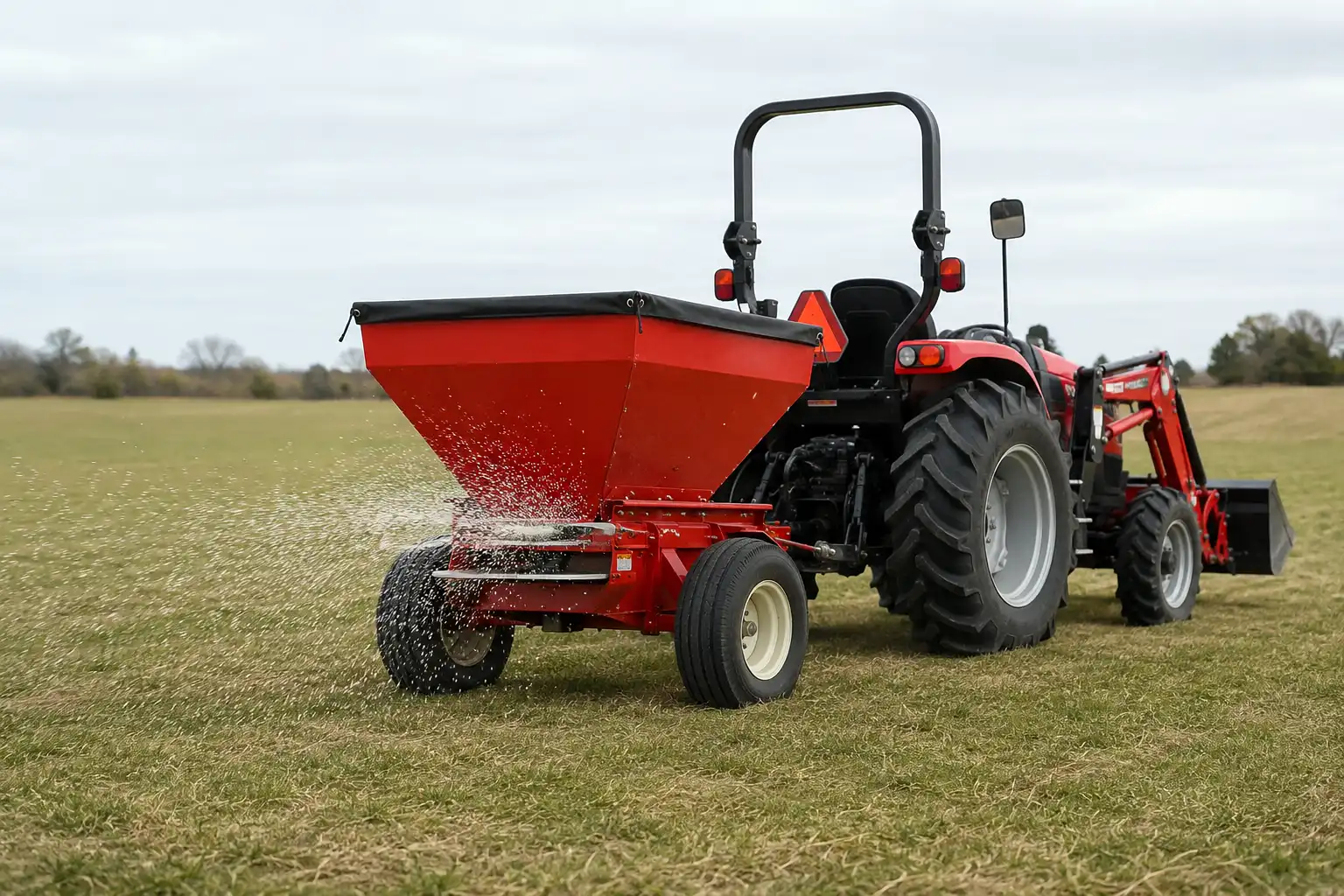
- Start moving before opening the gate. This prevents a pile and a burn spot at your starting point. Penn State Extension lists it as a standard rule.
- Close the gate before stopping. Same reason. End-of-row piles ruin grass and seedlings.
- Space passes at the effective swath width, not the advertised throw width, so each edge reaches the previous wheel tracks.
- Tow at a steady 3 to 5 mph. That is a normal mowing pace. Holding one constant speed matters more than the exact number, since output changes with ground speed.
- Never run the spreader in reverse. Penn State Extension names this specifically, because the pattern collapses.
- Do not rock or bounce a nearly empty hopper while the gate is open. Refill instead of shaking the last few pounds out.
- Use a deflector along beds, driveways, and pond banks. It cuts waste and keeps fertilizer off ground where it does not belong.
- Skip windy days. Penn State Extension advises against applying lightweight materials in wind. Light grass seed suffers worst.
- Split heavy rates into two half-rate passes run perpendicular to each other for the most even coverage on open ground.
What Can You Spread With a Tow Behind Broadcast Spreader?
Tow behind broadcast spreaders handle most dry granular materials a grower or large-property owner deals with. Anything damp, powdered, or caked will bridge at the gate and stop.
| Material | Suitable | Watch for |
|---|---|---|
| Granular fertilizer (urea, ammonium sulfate, blends) | Yes | Salts corrode steel, rinse after every use |
| Pelletized lime and gypsum | Model dependent | Chapin excludes lime on the 8622B |
| Grass seed and pasture seed | Yes | Light seed throws narrow, recalibrate |
| Cover crop seed (cereal rye, oats, clover, radish) | Yes | Mixed seed sizes separate in the hopper |
| Ice melt and rock salt | On rated models | Most corrosive material a spreader handles |
| Powdered or damp product | No | Bridges the gate and clogs the impeller |
Penn State Extension adds a point worth carrying into every job. Products with different granule sizes spread unevenly through a rotary spreader. So mismatched blends produce a poor pattern no matter how carefully the machine is set. Choosing an NPK blend by crop gets easier when granule uniformity is part of the decision.
Lime is the material most likely to be excluded. Chapin does not recommend the 8622B for sand, sand mixes, lime, or pelletized lime mixes. Check your own manual before loading lime, sand mixes, or rock salt.
Broadcasting Cover Crop Seed
Raise the rate when you broadcast rather than drill. Broadcast seed sits on the surface with poor seed-to-soil contact, so a share of it never germinates. The recommended increase varies by source and region:
- The Midwest Cover Crops Council calls for 20 to 50 percent above drilled rates.
- SDSU Extension puts the figure at 15 to 25 percent for South Dakota conditions.
- USDA NRCS generally recommends about 15 percent.
The Midwest Cover Crops Council also ties establishment to moisture. Good soil moisture at seeding, plus half an inch of rain afterward, improves the stand. Broadcasting into a dry seedbed and hoping is where most failed stands begin. Cereal rye and clover mixes take some learning, so start with beginner cover crop mixes before scaling the acreage.
Why the Spread Pattern Goes Wrong
Most spreading problems trace back to six causes, and five of them cost nothing to fix.
| Symptom | Likely cause | Fix |
|---|---|---|
| Stripes between wheel tracks | Passes spaced at full throw width | Re-space at the effective swath width |
| Heavy band on one side | Pattern skewed left or right | Adjust directional control, level the hitch |
| Burn spots at row ends | Gate open while stopped or turning | Close the gate before you stop |
| Rate falls off through the load | Low tire pressure tilting the hopper | Check pressure before each fill |
| Flow stops mid-pass | Damp or caked granules bridging | Screen the material, never spread clumps |
| Lopsided throw after a few seasons | Worn impeller plate | Replace the plate, most bolt on |
Maintenance Tips to Make Your Spreader Last
A tow behind broadcast spreader does not ask for much. But skip the basics and the gearbox seizes by year three.
- Rinse the hopper after every use. Fertilizer salts corrode steel parts and degrade poly over time. A garden hose and five minutes does it.
- Lubricate gears before storage. Penn State Extension recommends cleaning thoroughly and lubricating gears and moving parts before putting a spreader away.
- Store under cover. UV exposure cracks poly hoppers within a few seasons. A shed, barn, or simple tarp works.
- Check tire pressure before each season. Low pneumatic tires tilt the hopper and throw the pattern off.
- Replace worn impeller plates. A worn plate throws material in a lopsided pattern. Most are bolt-on swaps.
Treated properly, a quality tow behind broadcast spreader runs many seasons past its warranty term.
FAQs on Tow Behind Broadcast Spreaders
What size tow behind broadcast spreader do you need?
How wide does a tow behind broadcast spreader throw?
How far apart should spreader passes be?
Will a tow behind broadcast spreader work with an ATV or UTV?
Can one spreader handle grass seed, fertilizer, and lime?
How fast should you tow a broadcast spreader?
Should you increase the rate when broadcasting cover crop seed?
Do tow behind broadcast spreaders work on hills?
Bottom Line for Your Field
For most growers and large-property owners in 2026, the Agri-Fab 45-0463 130 lb is the top pick overall. Step up to the Brinly BS36BH-A 175 lb above two acres. Under one acre, stay with the Agri-Fab 45-0530 85 lb.
Whichever you pick, calibrate before you spread and space passes so each throw edge reaches the previous wheel tracks. Those two habits matter more than the badge on the hopper.