Does Eggplant Need Full Sun? Hours, Heat Limits, and Yield
Sun placement decides whether eggplant fills out or sulks all season. Growers ask me constantly: does eggplant need full sun, or will a half shaded bed work? Light drives fruit set on the fields far more than fertilizer does.
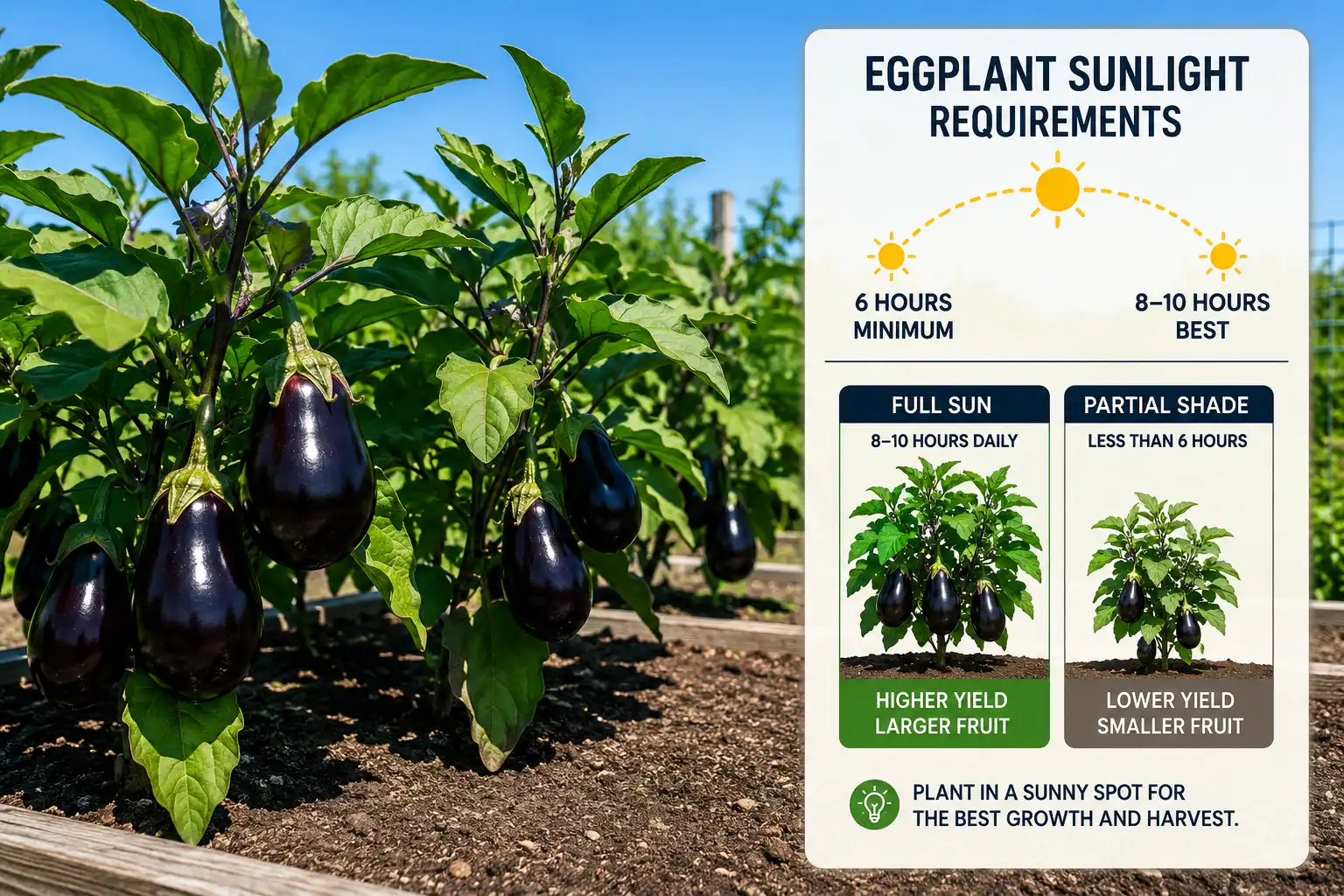
Yes, eggplant does need full sun. Plan on 6 hours of direct light minimum, though 8 to 10 hours produces the best fruit set. Below 6 hours, plants stretch, flower less, and yields fall sharply.
How Many Hours of Sun Does Eggplant Need Each Day?
Eggplant needs at least 6 hours of direct, unfiltered sun daily, and 8 to 10 hours delivers the strongest crop. University of Maryland Extension sets the floor at 6 hours and names 8 to 10 as the preferred range. Results in Topeka line up with that.
Direct sun means the plant sees the sun itself. Bright shade under a tree does not count. Neither does light filtered through a fence slat or a north facing wall bounce.
| Daily direct sun | What you get |
|---|---|
| Under 4 hours | Thin stretched stems, few flowers, almost no fruit |
| 4 to 6 hours | Plant survives, fruit stays small, harvest runs late |
| 6 to 8 hours | Reliable baseline, steady fruit set, normal size |
| 8 to 10 hours | Best yield, full size fruit, thick stems that hold weight |
| Over 10 hours | Still fine, as long as heat and soil moisture stay managed |
Solanum melongena came out of tropical Asia. That origin explains the appetite. The plant evolved under long, intense light, and it never lost the requirement.
Stem thickness tells you quickly whether the site works. A well lit eggplant carries a main stem close to pencil width by transplant and much thicker by flowering. Light hours build that stem, and that stem carries fruit that gets heavy fast.
Read next: Ideal Spacing for Eggplant Plants
What Happens When Eggplant Does Not Get Enough Sun?
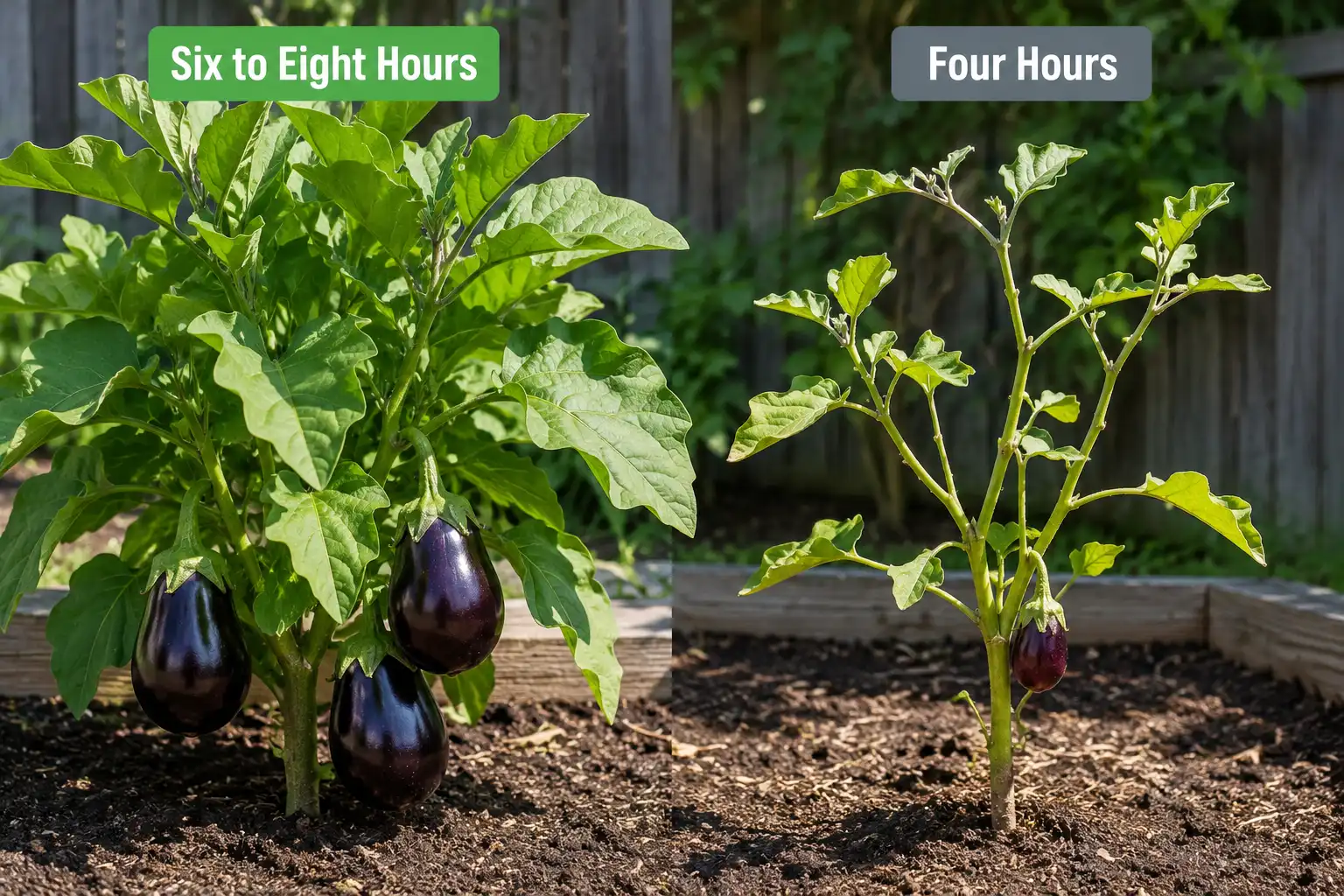
Low light shows up first in stem shape, then in flowering. The plant stretches toward the brightest gap it can find, and it stops spending energy on reproduction. Fruit is the first thing eggplant drops when resources run short.
Watch for these signs:
- Long internodes and thin, floppy stems
- Pale green leaves instead of deep, glossy green
- Few flower buds, or buds that yellow and drop before opening
- Fruit that stays undersized and finishes dull rather than glossy
- Harvest that arrives two to four weeks behind schedule
- Cooler soil in the root zone, which slows root growth on its own
- Longer leaf wetness after rain, which raises disease pressure
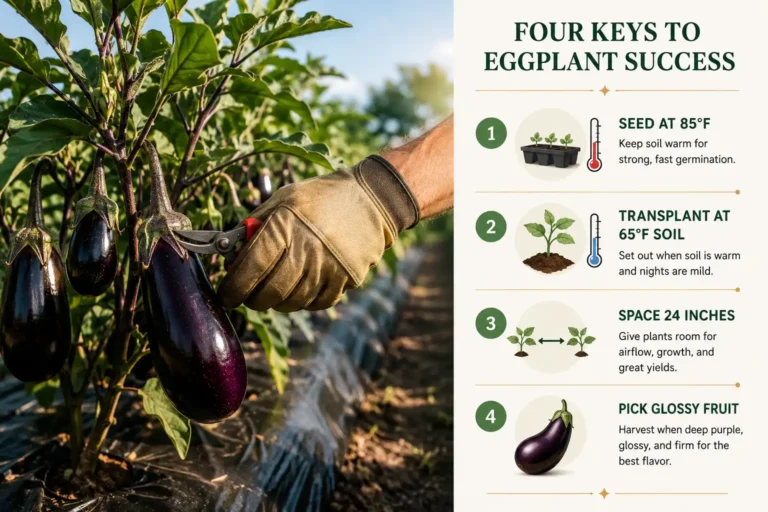
Shade also costs you soil warmth. Eggplant roots want soil above 65°F to move at a normal pace, and shaded ground rarely gets there in spring. That is why timing and site work together. Getting eggplant into warm ground matters as much as picking the right eggplant planting window, since cold soil under a shaded bed stalls plants for weeks.
Can Eggplant Grow in Partial Shade?
Eggplant grows in partial shade, but it does not produce a real crop there. At 4 to 5 hours of direct sun, you get a living plant and a handful of small fruit. Below 4 hours, most seasons end with flowers and nothing else.
Leafy crops handle low light far better, because they only need to build leaves. Fruiting crops carry a much larger energy bill. Every flower, every seed, and every pound of fruit runs on light the plant collected earlier.
So partial shade is a compromise, not a plan. If shade is all you have, shift your expectations toward one or two small fruit per plant and pick a compact variety like Morden Midget or a slender Asian type. Standard Italian types such as Black Beauty need the most consistent light of any group.
One exception matters. In the Deep South and the desert Southwest, afternoon shade during a heat wave helps rather than hurts. That is a heat management move, not a light reduction strategy, and cover it next.
Is Too Much Sun a Problem for Eggplant?
Light itself almost never damages eggplant. Heat that arrives with the light does. Those are two separate problems, and treating them as one costs growers a lot of fruit.
Pollen is the weak link. Eggplant pollen loses viability once air temperatures push past 86°F, and above 90°F fertilization fails outright. The plant keeps flowering, the flowers keep opening, then they yellow and drop within a day or two. Growers blame disease. It is usually July.
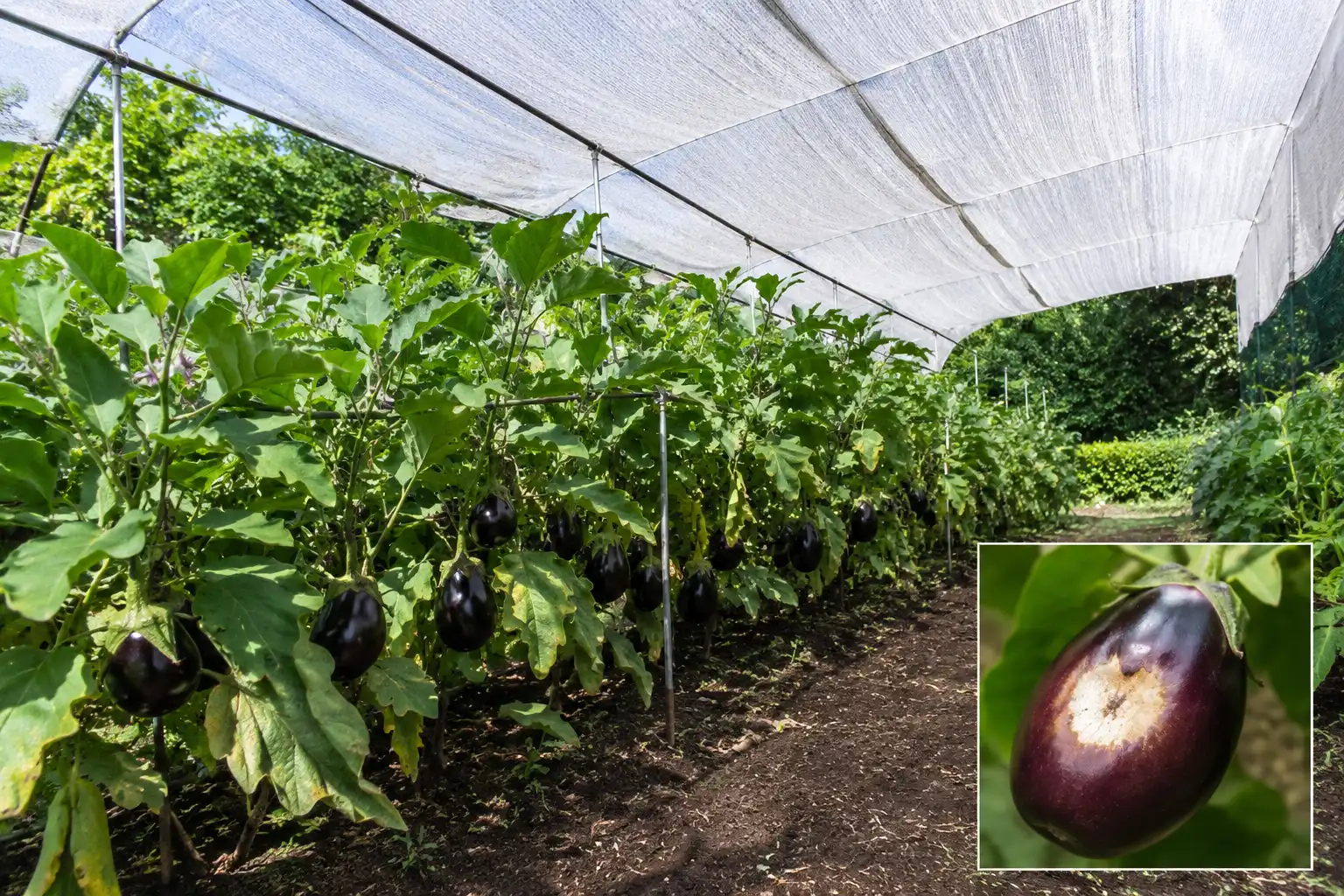
Sunscald is the second heat problem. It hits fruit that suddenly loses leaf cover, and dark skinned eggplant absorbs heat fast. South Dakota State University Extension notes that sunscald necrosis kills skin tissue outright once temperatures top 100°F, leaving pale, leathery, sunken patches.
| Temperature | What happens | What to do |
|---|---|---|
| 70 to 85°F | Ideal fruit set | Nothing |
| 86 to 90°F | Pollen viability starts falling | Water deep in early morning |
| Above 90°F | Blossom drop, fertilization fails | Add 30 to 40% shade cloth, noon to 4 p.m. |
| Above 100°F | Sunscald on exposed fruit | Keep canopy intact, harvest promptly |
Shade cloth rated 30 to 40% drops canopy temperature roughly 10 to 15°F without starving the plant of usable light. Mount it on hoops so it never rests on the foliage. Pull it once the heat spell breaks.
How Do You Find a True Full Sun Spot?
Measure the site instead of guessing, because most gardeners overestimate their sun by two hours or more. A single clear day of observation settles it. Here is the process before committing a bed to eggplant.
- Pick your candidate bed and stand at its center.
- Check it at 8 a.m., 10 a.m., noon, 2 p.m., 4 p.m., and 6 p.m. on a clear day.
- At each check, write down direct sun or shade. Partial dapple counts as shade.
- Add up the direct sun blocks. Six or more means you have a workable bed.
- Repeat the count in mid June once trees have fully leafed out.
- Note the drip line of any large tree nearby. Roots compete for water there too.
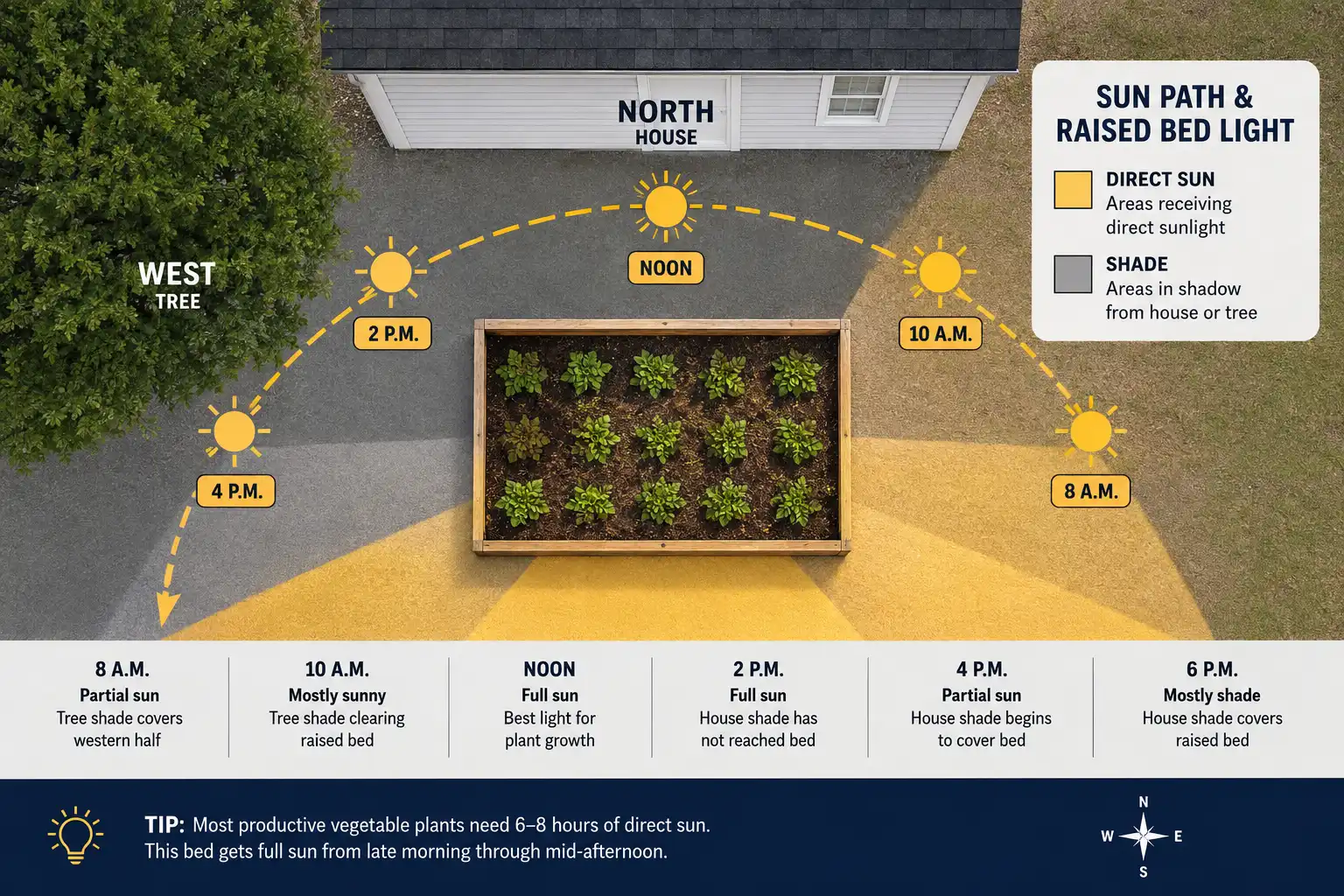
South and southwest exposure works best across the Great Plains. Run rows north to south so plants shade each other less through the day. Watch buildings, privacy fences, and grain bins, since a six foot fence on the south side can wipe out three hours of winter and shoulder season light.
Tall neighbors matter just as much. Corn, sunflowers, and pole beans will steal light from an eggplant row by August, so check your companion plants for eggplant before you finalize the layout.
How Much Light Do Eggplant Seedlings Need Indoors?
Seedlings need far more light than a windowsill provides, so plan on artificial light from day one. Purdue University research puts the target daily light integral for eggplant transplants at 15 to 20 mol per square meter per day. A bright south window in March delivers a fraction of that.
Run your lights 14 to 16 hours per day on a timer. Keep LED fixtures 2 to 4 inches above the canopy and raise them as plants grow. Stretched hypocotyls mean the light sits too far away or runs too few hours.
Practical settings that work for me:
- Germination mix held at 75 to 85°F until emergence
- 14 to 16 hours of light daily, then a dark period
- Fixture 2 to 4 inches above the leaf canopy
- Start seeds 8 to 10 weeks before your last frost date
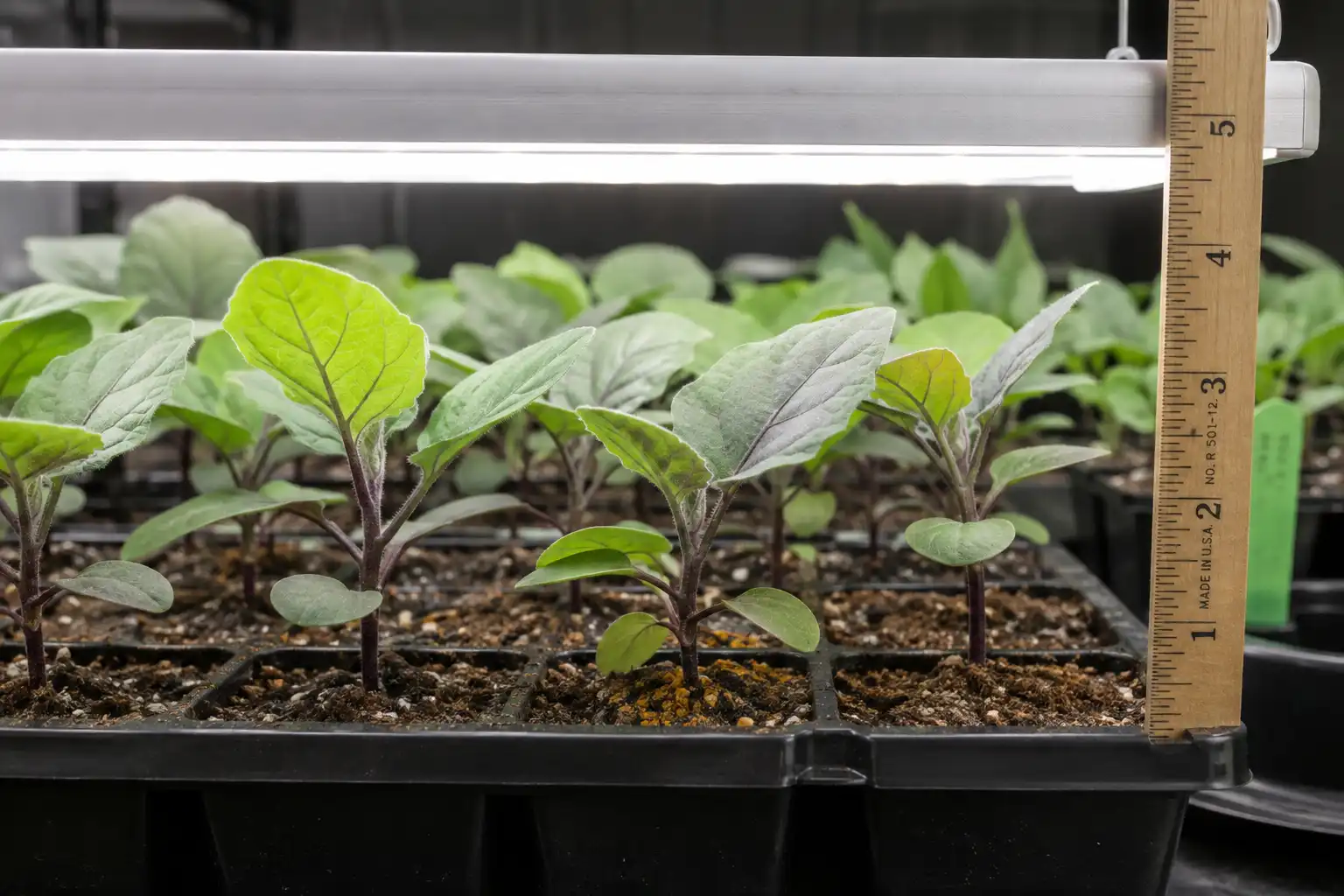
Good grow lights for starting transplants pay for themselves in stem quality alone. A stocky seedling establishes in about half the time a stretched one needs, which shortens the whole season. That difference compounds when you are starting eggplant from seed rather than buying transplants.
Harden off over 7 to 10 days before transplanting. Move plants into direct sun gradually, an hour or two more each day. Silvering or bleached patches on leaves mean you moved too fast, so back off and slow the schedule.
Does the Sun Rule Change by Region?
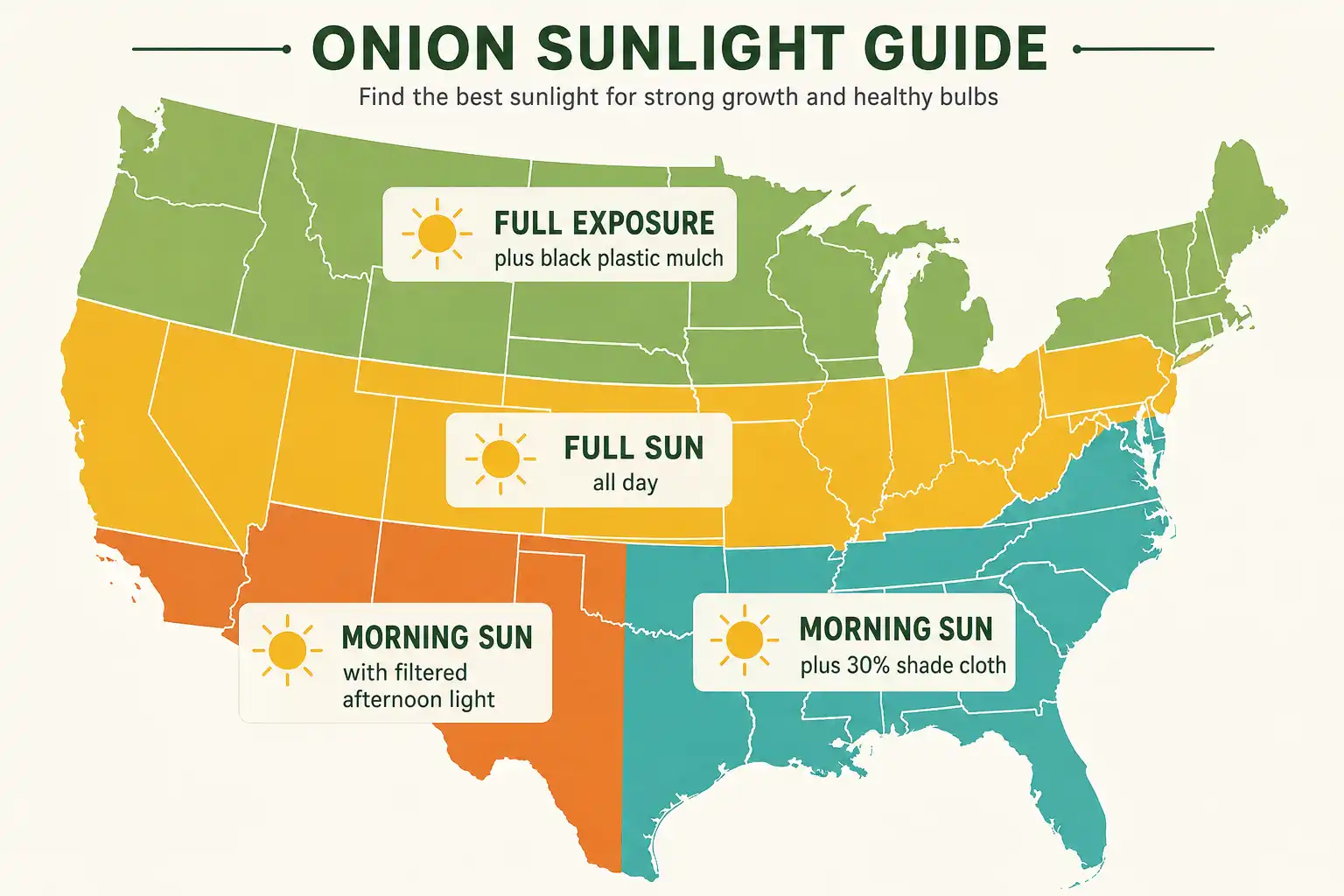
The 6 hour minimum holds everywhere, but the ideal exposure shifts as you move south. Northern growers chase every hour of light they can find. Southern growers manage heat while keeping light high.
| Region | USDA zones | Sun strategy |
|---|---|---|
| Northern tier, Upper Midwest | 3 to 5 | Full day exposure, black plastic mulch, south facing slope |
| Central Plains, Corn Belt, Mid Atlantic | 5 to 7 | Full sun all day, no shading needed most seasons |
| Southeast, Gulf Coast | 8 to 9 | Full morning sun, 30% shade cloth during July and August |
| Desert Southwest | 9 to 10 | Morning sun with filtered afternoon light from June through September |
Black plastic mulch earns its keep in cool regions. University of Maryland Extension reports earlier harvests and higher total yields with black plastic or landscape fabric, because warmer soil pushes root growth. University of Minnesota Extension has also measured yield gains in eggplant from red plastic mulch, which changes the quality of light reflected back into the canopy.
Elevation cuts both ways. Above 4,000 feet, light intensity climbs while soil stays cold longer, so row covers matter more than shade does.
How Can You Get More Sun Onto Eggplant in a Tight Spot?
Several fixes add usable light without moving your whole garden. Some raise light directly. Others raise soil temperature, which produces a similar gain in plant vigor.
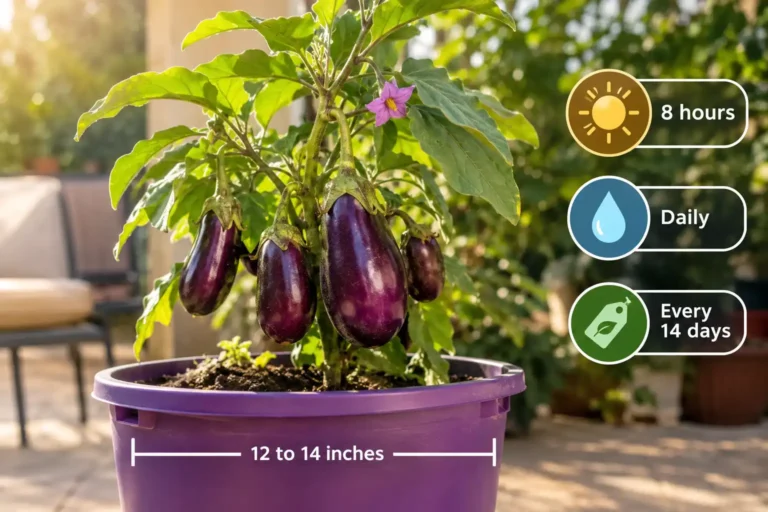
- Grow in containers. One plant per 5 gallon pot, dark colored, so it absorbs heat. Move it through the day to follow sun.
- Lay black plastic mulch. Warmer soil offsets a shortfall of one to two light hours in cool regions.
- Use raised beds. They warm faster in spring than flat ground does.
- Prune the shade source, not the plant. Limb up nearby trees instead of thinning eggplant foliage.
- Add a reflective surface. A white wall or light colored fence on the north side bounces usable light back into the row.
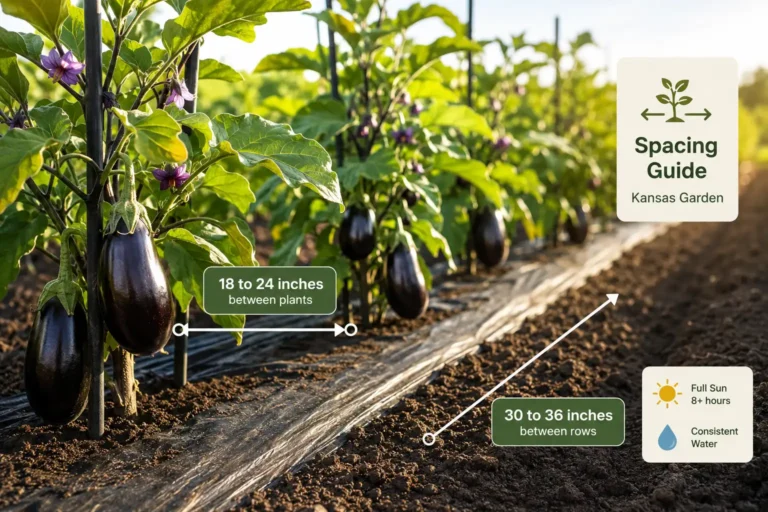
- Widen your spacing. At 18 to 24 inches in row and 30 to 36 inches between rows, plants shade each other less.
Skip heavy pruning during hot weather. Eggplant leaves are the fruit’s only sunscreen, and stripping them invites sunscald. Verify soil warmth before transplanting too, since reading soil temperature with a thermometer beats guessing by calendar date every time. Rule in Kansas: 65°F at 4 inches, held for three straight mornings.
FAQs on Eggplant Sun Requirements
Will eggplant fruit with morning sun only?
Does eggplant need more sun than tomatoes or peppers?
Can eggplant grow indoors on a windowsill?
How fast does low light show up in the plant?
Do dark skinned varieties need more sun?
Does cloudy weather ruin a season?
Final Thoughts on Full Sun for Eggplant
Eggplant goes in the brightest, warmest bed, on the south side, with nothing tall west of it. Count sun hours in June, not April, because the tree line changes everything. Six hours is the cutoff. Below that, plant something else and give eggplant the good ground.
From July 10 through mid August, run 30% shade cloth on hoops during the afternoon. Fruit set stops in that stretch otherwise. The plants often come back strong in late August, and that second flush produces a large share of the total harvest. Anyone working through eggplant growing basics should sort out light and heat first. Everything else in the crop follows from those two.