How to Plant Wheat: Seedbed, Rate, Depth, and Drill Setup
Yield gets decided during the few hours your drill is in the field. Learning how to plant wheat comes down to five calls: class, seedbed, rate, depth, and drill setup. Get those right and the stand carries the rest of the season.
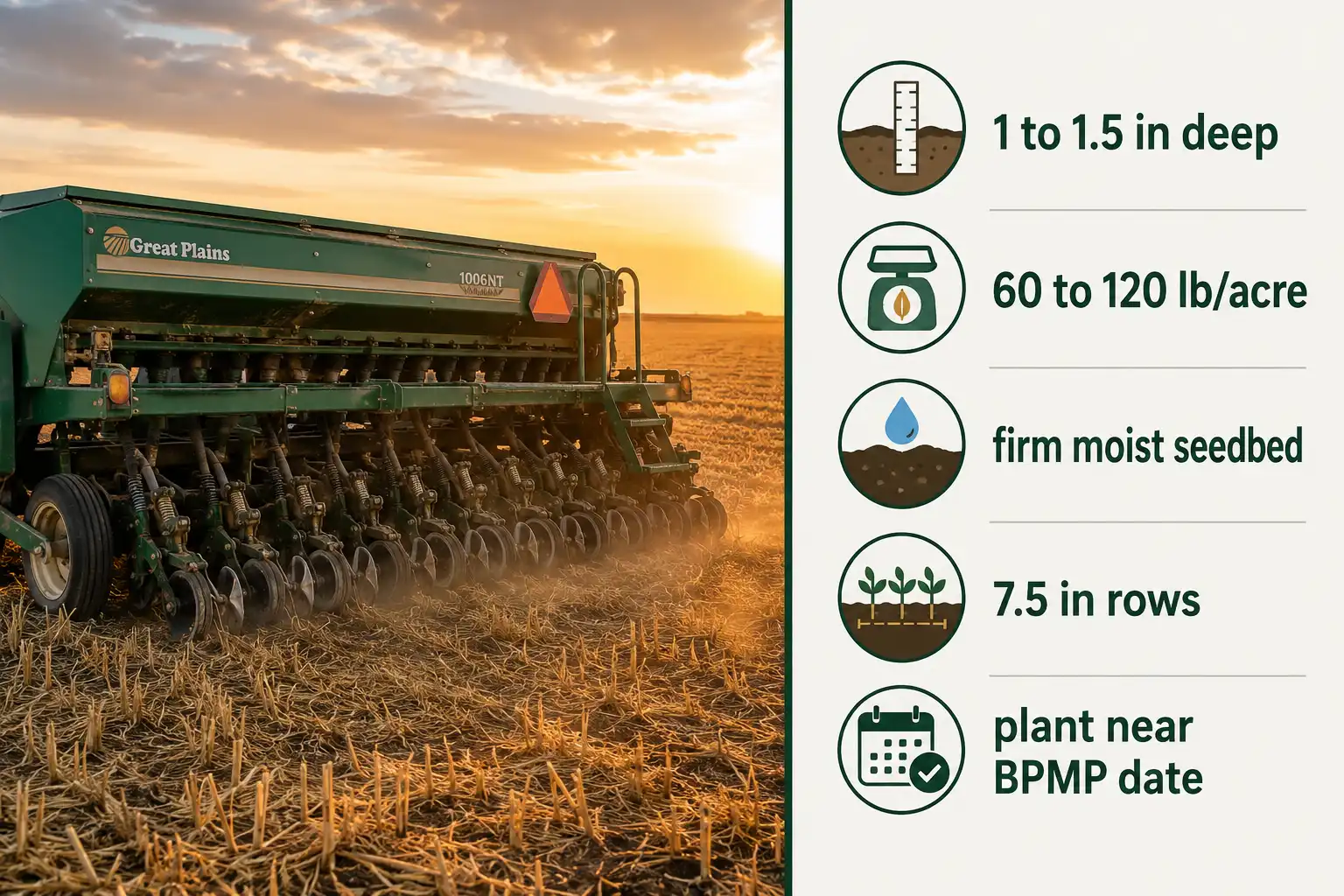
To plant wheat, drill certified seed of the right class 1 to 1.5 inches deep into a firm, moist seedbed. Time it near your best pest management date and target 60 to 120 pounds per acre.
How to Plant Wheat Step by Step
Wheat planting runs in nine steps, and every one of them happens before the seed sprouts. Here is the sequence each fall.
- Pick your class. Match hard red winter, soft red winter, or hard red spring to your region.
- Check the previous crop. Soybean stubble beats corn stubble by a wide margin.
- Soil test. Sample 6 to 8 inches deep and set your phosphorus plan.
- Burn down volunteer wheat and winter annuals. Do it at least two weeks ahead.
- Firm the seedbed and confirm residue got spread evenly last harvest.
- Calibrate the drill for that exact seed lot.
- Set depth at 1 to 1.5 inches and load the press wheels.
- Drill near your best pest management planting date.
- Count plants three weeks after emergence.
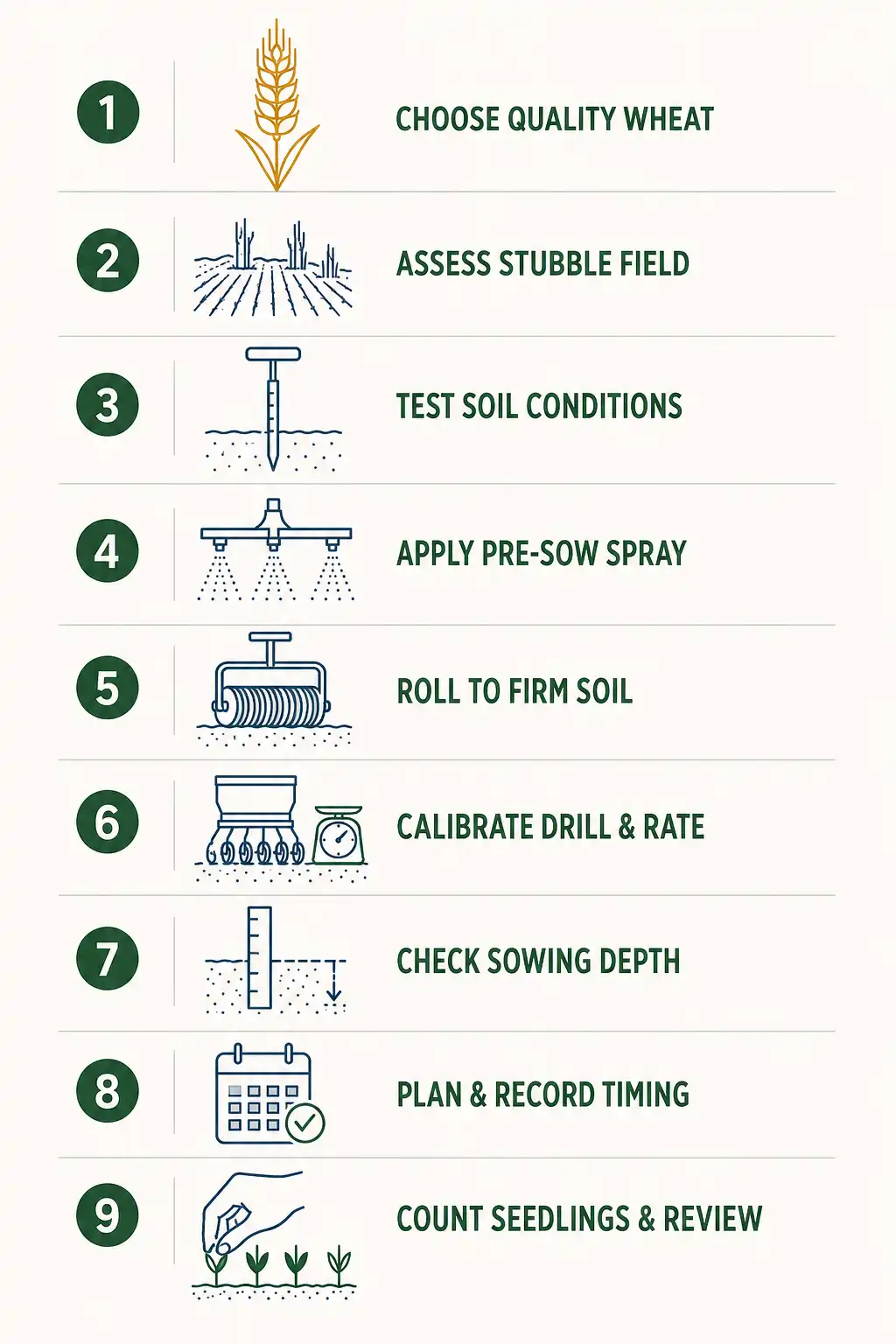
Skip step 6 and you pay in seed cost or a thin stand. That single step catches more problems than the other eight combined.
Which Class of Wheat Should You Plant?
Plant the class that fits your region, because climate and market both decide it for you. Six classes grow in the United States, and only one or two make sense on any given farm.
Hard red winter covers about 40 percent of US production and dominates the Great Plains. Kansas grows roughly 95 percent hard red winter. Soft red winter takes over east of the Mississippi. Hard red spring belongs to the Northern Plains, where winters run too hard for a fall-planted crop.
| Class | Where it grows | Season | Main market |
|---|---|---|---|
| Hard red winter | Great Plains: KS, OK, TX, NE, CO | Fall planted | Bread and all-purpose flour |
| Soft red winter | East of the Mississippi, SE Kansas, NE Texas | Fall planted | Cookies, crackers, pastry |
| Hard red spring | ND, MT, MN, SD | Spring planted | High-protein bread, bagels |
| Soft white | WA, OR, ID, NY, MI | Both | Cakes, pastry, noodles |
| Hard white | KS, CO, CA, Pacific Northwest | Both | Whole wheat, tortillas, noodles |
| Durum | ND, MT, AZ, CA | Mostly spring | Pasta and semolina |
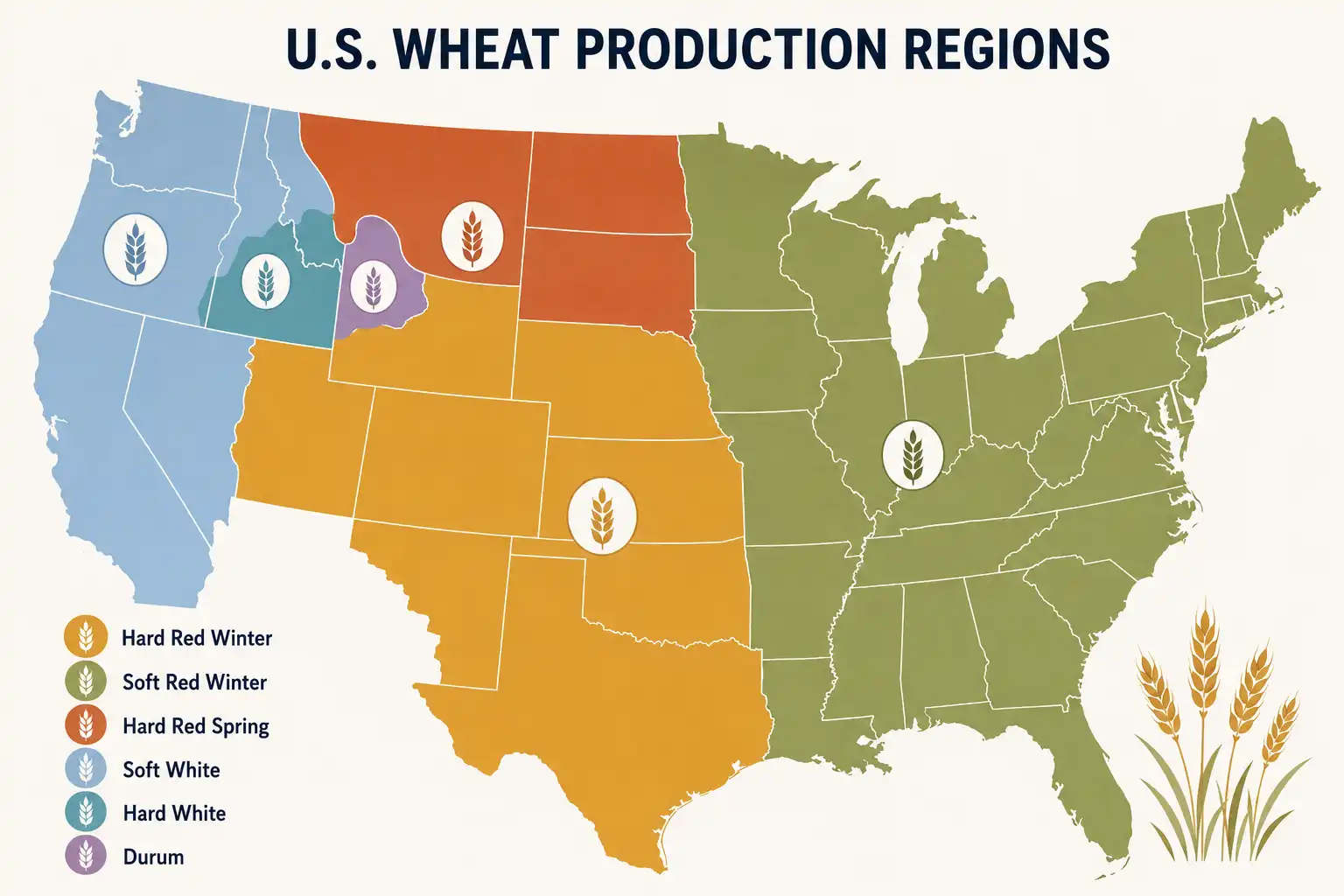
Class narrows the field. Variety choice finishes the job. Pull your state variety guide and check ratings for stripe rust, wheat streak mosaic virus, Fusarium head blight, and Hessian fly. Then weight the problems your county actually gets.
Buy certified seed when the budget allows. Certified lots list germination percentage and seeds per pound, and both numbers feed your rate math.
Running bin-run seed? Test it. Roll 100 seeds in a damp paper towel, hold it near 70 degrees F, then count sprouts on day seven.
What Should You Plant Wheat After?
Plant wheat after soybeans whenever your rotation planning allows it. Soybean stubble carries the lowest disease load and leaves nitrogen behind for the wheat crop.
Corn stubble is the problem residue. Fusarium graminearum, the fungus behind head scab, overwinters on corn stalks. Oklahoma State University cites North Dakota State data showing wheat after corn is 5 to 10 times more likely to pick up Fusarium head blight than wheat after wheat. Wheat after wheat still runs 1 to 2 times the risk of wheat after soybeans.
Yield follows the same pattern. Research published in Plant Disease found wheat following corn or wheat yielded about 15 percent less than wheat following soybeans.
Continuous wheat builds other trouble too. Take-all root rot, Hessian fly populations, and winter annual grasses like cheat and downy brome all climb when wheat follows wheat.
Previous crops for a fall wheat planting rank as follows:
- Best: soybeans, then dry beans or canola
- Workable: milo or sunflowers, with attention to residue and nitrogen
- Risky: corn, especially in no-till with heavy surface stalks
- Worst: wheat on wheat
If corn stubble is your only option, plant a variety with a decent Fusarium head blight rating. Then plan on a flowering-stage fungicide next spring and budget for it now.
How Do You Prepare a Seedbed for Wheat?
Prepare a firm seedbed with moisture near the surface. Wheat needs tight contact with soil that holds water, and loose ground cannot deliver it.
Loose, fluffy soil causes the most stand failures in fall-planted wheat. Repeated summer tillage leaves a mellow surface that feels good underfoot. Then the first hard fall rain settles it. Crowns end up too close to the surface, and winter injury follows in February.
No-till solves most of this. Standing stubble shields the surface, holds moisture, and stays firm under the openers. South Dakota State University measured soil at crown depth under stubble running 5 to 7 degrees warmer than under conventional fallow. That gap shows up in winter survival.
Residue spread matters as much as residue volume. Uneven chaff windrows from last harvest cause openers to ride up and skip. So check your combine’s chaff spreader before wheat harvest, because that setting decides your fall stand a year later.
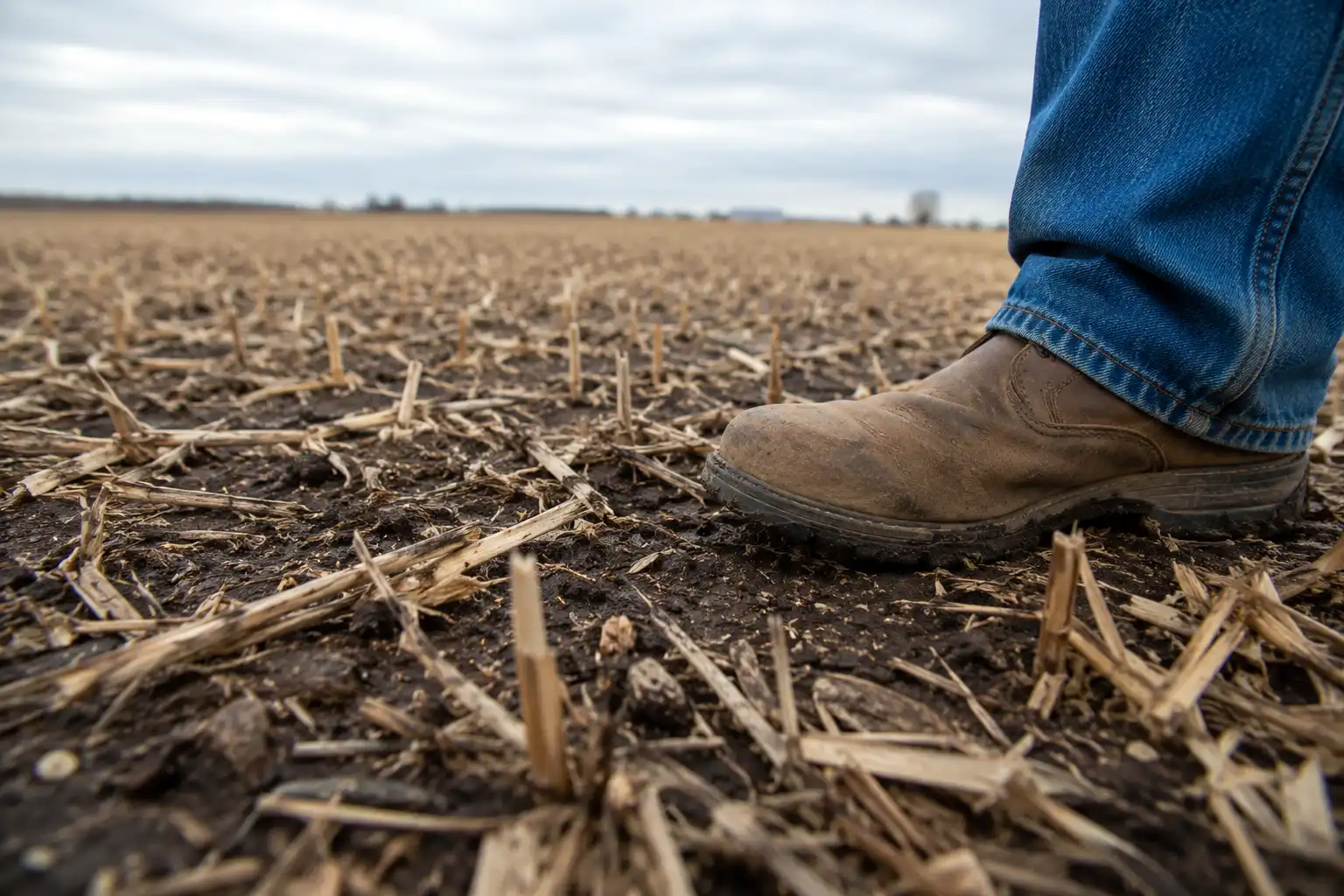
If you must till, work the ground early and let a rain settle it. Then wait. Disk openers running through freshly worked dry soil almost never produce an even stand.
Do You Need a Burndown Before Planting Wheat?
Yes, if volunteer wheat or winter annual weeds are up. Volunteer wheat is the bigger target, because it hosts wheat curl mites and Hessian fly straight through to your new crop.
Kill volunteer wheat at least two weeks before you drill. Wheat curl mites cannot live without green tissue, so that gap starves them out. Clean a half mile radius if you can, since mites drift that far on the wind.
Glyphosate handles most fall burndown work. Where marestail shows up, Ohio State University recommends pairing it with Sharpen for better control plus limited residual. Gramoxone also works on small winter annual seedlings.
Watch two label restrictions:
- Dicamba requires 10 days between application and planting for each 0.25 pound of active ingredient per acre. A half-pound rate means waiting 20 days.
- 2,4-D has no label supporting use right before wheat planting. Applying it close to seeding risks stand loss.
Fields that are already clean do not need a preplant pass. In that case, plan a postemergence treatment in early November instead. Either way, read the label before you mix, since rates and intervals shift by product and by state.
When Should You Plant Wheat?
Plant winter wheat within about a week of your county’s best pest management planting date. Older guides call it the Hessian fly-free date. Spring wheat goes in once soil at 2 inches holds above 40 degrees F.
K-State Research and Extension renamed the date because it covers more than one pest. Wheat drilled early sits exposed to Hessian fly, wheat curl mites carrying wheat streak mosaic virus, and aphids spreading barley yellow dwarf. Kansas dates run from late September in the northwest to mid-October in south central counties. Missouri growers work with October 1 in the north and October 18 in the southeast.
Planting for fall grazing changes the math. Forage acres go in two to three weeks earlier, which demands a Hessian fly resistant variety plus an insecticide seed treatment.
Spring wheat runs on soil temperature instead of a pest calendar. South Dakota State University suggests the first three weeks of April. Growers can start earlier once soil hits 34 to 36 degrees F and the 30-day forecast holds above freezing.
Late planting is workable but costly. Wheat needs 4 to 5 leaves and 1 to 2 tillers before dormancy for full cold tolerance. Miss that and winterkill risk climbs.
For state-level dates, check the winter wheat planting window breakdown and the spring wheat seeding dates guide.
How Much Wheat Seed Do You Need Per Acre?
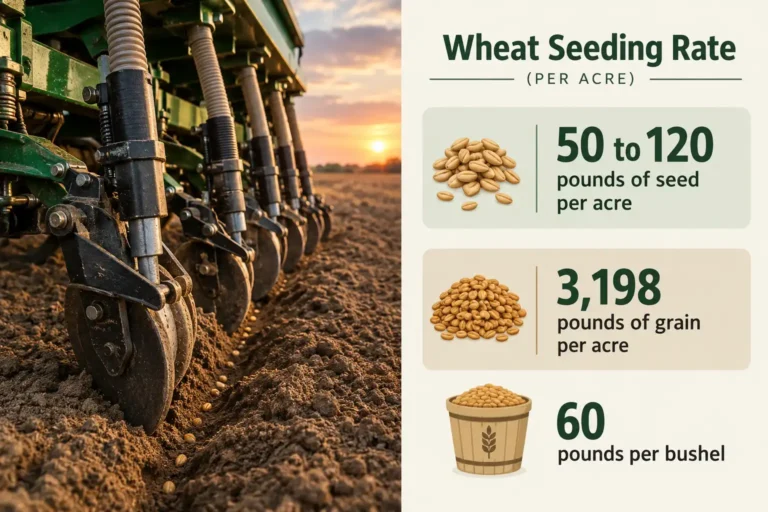
Most dryland winter wheat goes in at 40 to 90 pounds per acre, which covers 600,000 to 1,350,000 seeds. Rate climbs as you move east into higher rainfall, and it climbs again when you plant late.
Seed size swings hard between lots. One variety may run 11,000 seeds per pound while another runs 16,000. Pounds alone will not hit your target, so work in seeds per acre and convert at the end.
| Setting | Seeds per acre | Pounds per acre* |
|---|---|---|
| Western Great Plains, dryland | 600,000 to 900,000 | 40 to 60 |
| Central Kansas, dryland | 750,000 to 900,000 | 50 to 60 |
| Eastern Kansas, higher rainfall | 900,000 to 1,125,000 | 60 to 75 |
| Irrigated winter wheat | 900,000 to 1,350,000 | 60 to 90 |
| Hard red spring wheat | about 1,200,000 | about 80 |
*Based on 15,000 seeds per pound. Divide seeds per acre by your tag’s seeds-per-pound figure for an exact number.
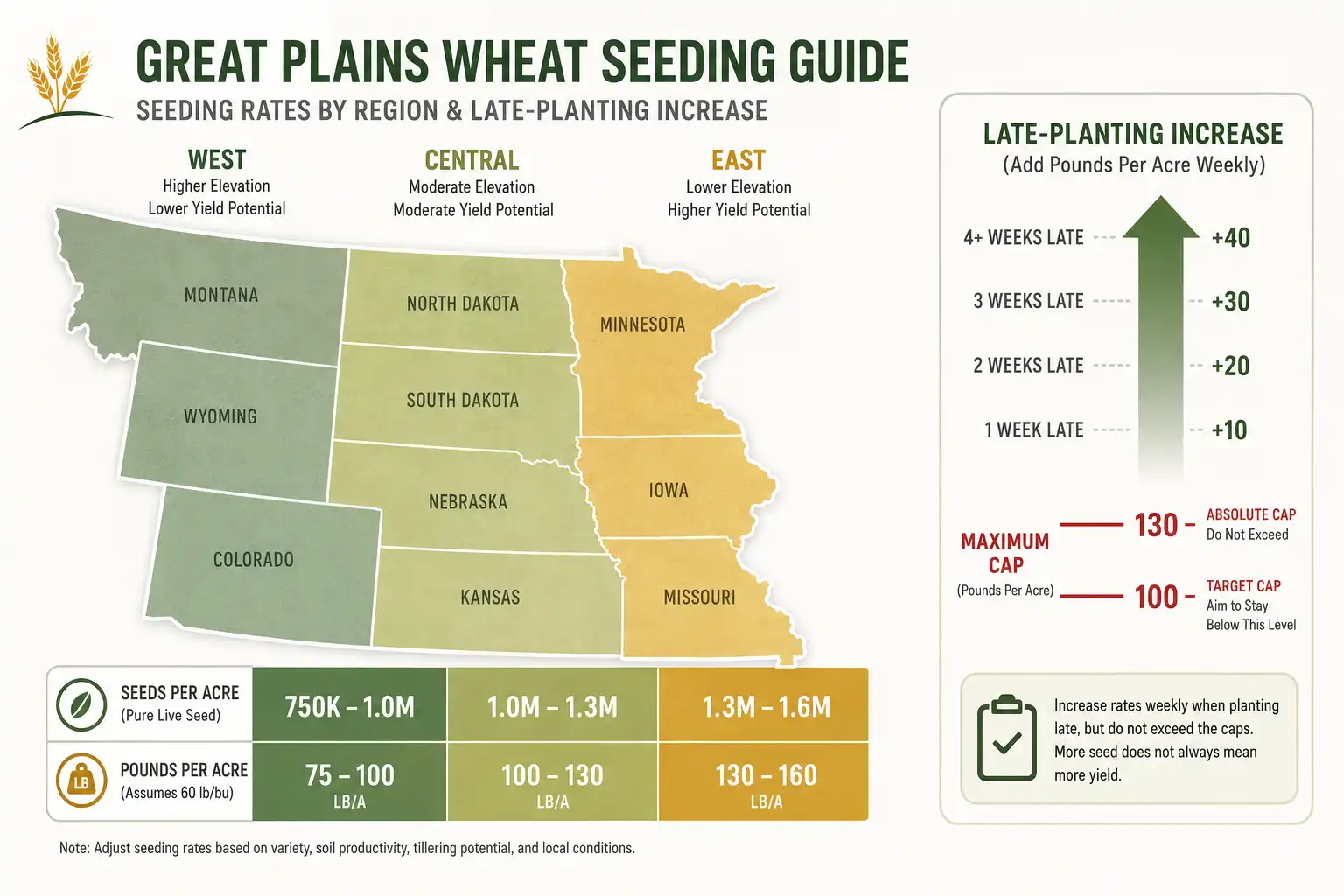
Late planting needs more seed, because fall tillers get cut short. K-State adds 150,000 to 225,000 seeds per acre for each week of delay in western Kansas. Eastern fields take 225,000 to 300,000.
Still, cap the total. Grain-only wheat stays under 90 to 100 pounds per acre in the west and 120 to 130 pounds in central and eastern Kansas. Push past that and you invite lodging plus heavy early water use.
Double-cropping behind soybeans or milo calls for a 50 to 100 percent bump over your normal rate.
What Row Spacing Works Best for Wheat?
Use 7.5-inch rows for grain wheat. Narrow spacing closes the canopy faster, shades out weeds, and yields more than wide rows in nearly every trial.
Ohio State University row-spacing work found 15-inch wheat averaged about 5 percent lower yield than 7.5-inch across several seasons. On-farm trials in Fulton County showed a steeper 15 percent gap. Michigan State University research from 2024 and 2025 measured 10-inch rows at 2.7 percent below 7.5-inch, and 15-inch rows at nearly 13 percent below.
| Row spacing | Yield vs 7.5 inch | Practical notes |
|---|---|---|
| 5 inches | Up to 6% higher | Needs a precision planter |
| 7.5 inches | Baseline standard | Best all-around drill setting |
| 10 inches | 2 to 3% lower | Acceptable if that is your drill |
| 15 inches | 5 to 15% lower | Only for equipment or intercrop reasons |
Wide rows do carry one advantage worth knowing. At 15 inches, roughly 1 million seeds per acre maximizes yield, and going higher adds nothing. So wide-row growers save on seed while giving up bushels.
Row spacing also changes canopy microclimate, which shifts disease pressure. Narrow rows dry slower after dew. Keep that in mind when you plan spring fungicide timing.
How Do You Calibrate a Grain Drill for Wheat?
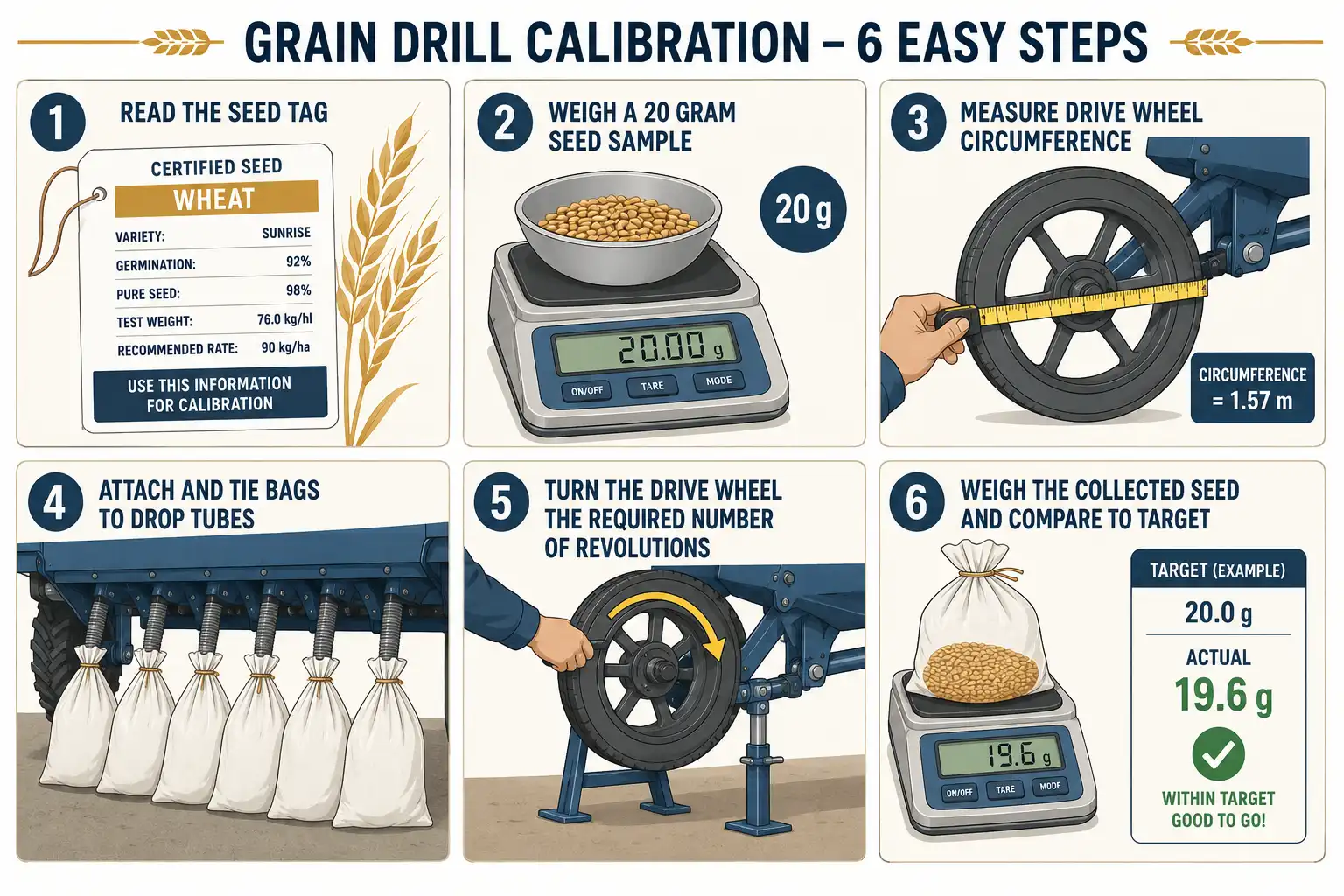
Calibrate by collecting seed from several drop tubes over a measured distance, weighing it, then comparing against target. Do this for every seed lot, not once a season.
University of Kentucky work measured metering units on single drills. Some ran more than 10 percent above or below target. That variation costs you seed or stand. Here is the routine:
- Read the tag. Note germination percent and seeds per pound. No figure listed? Weigh a 20 gram sample, count it, then multiply the count by 22.68.
- Set your target. Divide target seeds per acre by seeds per pound to get pounds per acre.
- Measure the drive wheel. Divide 600 by the tire circumference in inches. That gives revolutions per 50 feet of travel.
- Bag the tubes. Tie bags on 3 to 5 drop tubes spaced across the drill width.
- Turn and weigh. Jack the drive wheel clear, turn it your calculated revolutions, then weigh each bag separately.
- Compare and adjust. Work the metering setting until you land within 2 to 3 percent of target.
Add 10 to 15 percent to the metered rate in heavy residue. Some of that seed never reaches firm soil.
A faster field check works too. Run the drill on firm ground at planting speed, then dig up one foot of row and count.
| Row spacing | Seeds per foot of row for 900,000 seeds/acre |
|---|---|
| 6 inches | 10 |
| 7.5 inches | 13 |
| 10 inches | 17 |
| 12 inches | 21 |
How Deep Should Wheat Seed Go?
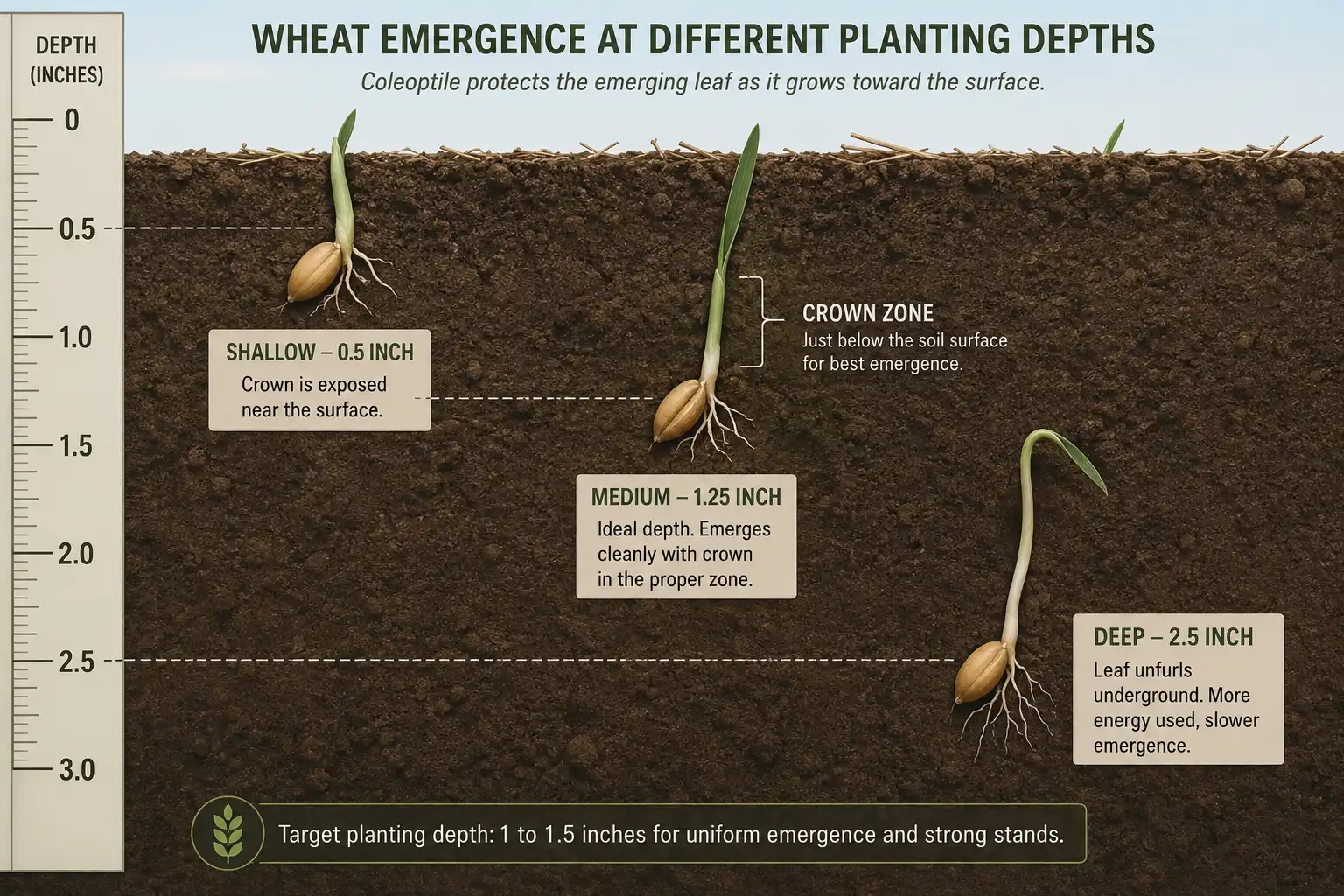
Place wheat seed 1 to 1.5 inches deep. That depth sets the crown where it survives winter and keeps the coleoptile short enough to reach daylight.
The coleoptile is the sheath that pushes the first leaf up through soil. Once it runs out of length, the leaf unfurls underground and the plant never emerges. Semi-dwarf varieties carry shorter coleoptiles than older tall types, so they punish deep planting harder. Check the coleoptile rating in your variety guide before setting the drill past 1.5 inches.
Shallow planting brings its own trouble. Seed at half an inch sits in soil that dries between rains. Worse, the crown forms near the surface and takes the full swing of winter cold.
Dry topsoil forces a decision. You can chase moisture to 2 or 2.5 inches, but only with a variety rated for it. Otherwise wait for rain, or dust the seed in shallow and accept an uneven start. Chasing moisture into the seed zone takes priority instead. A slow uniform stand beats a fast patchy one.
Spring wheat plays by tighter rules. Seed it 1 to 2 inches deep, and never past 3 inches. Spring types show almost no hypocotyl elongation, so depth mistakes cost more.
Soil type shifts the target too. Sandy ground allows the deeper end of the range, while heavy clay does not. The full wheat planting depth by soil and moisture chart lays out those adjustments.
Should You Treat Wheat Seed Before Planting?
Treat wheat seed with a fungicide in most situations, then add an insecticide only when risk calls for it. Treatment protects the stand during the two weeks when nothing else can.
Fungicide seed treatments cover common bunt, loose smut, seed and seedling rots, common root rot, Fusarium crown diseases, and Rhizoctonia. Loose smut deserves attention, because the fungus rides inside the seed. Contact products cannot reach it, so you need a systemic.
Trial yield responses often look small. Even so, agronomists at South Dakota State University still recommend treatment, since healthy roots set the ceiling for every other input you apply later.
Insecticide treatments earn their keep in three cases. First, planting ahead of the BPMP date. Second, planting a Hessian fly susceptible variety. Third, planting where barley yellow dwarf shows up often. Neonicotinoid treatments block fall Hessian fly infestation. They do nothing against spring broods, though, so resistant varieties still carry the load.
Bin-run seed changes the calculation. If you clean and plant your own wheat, run that germination test and treat the seed. Untreated bin-run seed is where most smut problems start.
How Do You Set the Drill for Good Seed to Soil Contact?
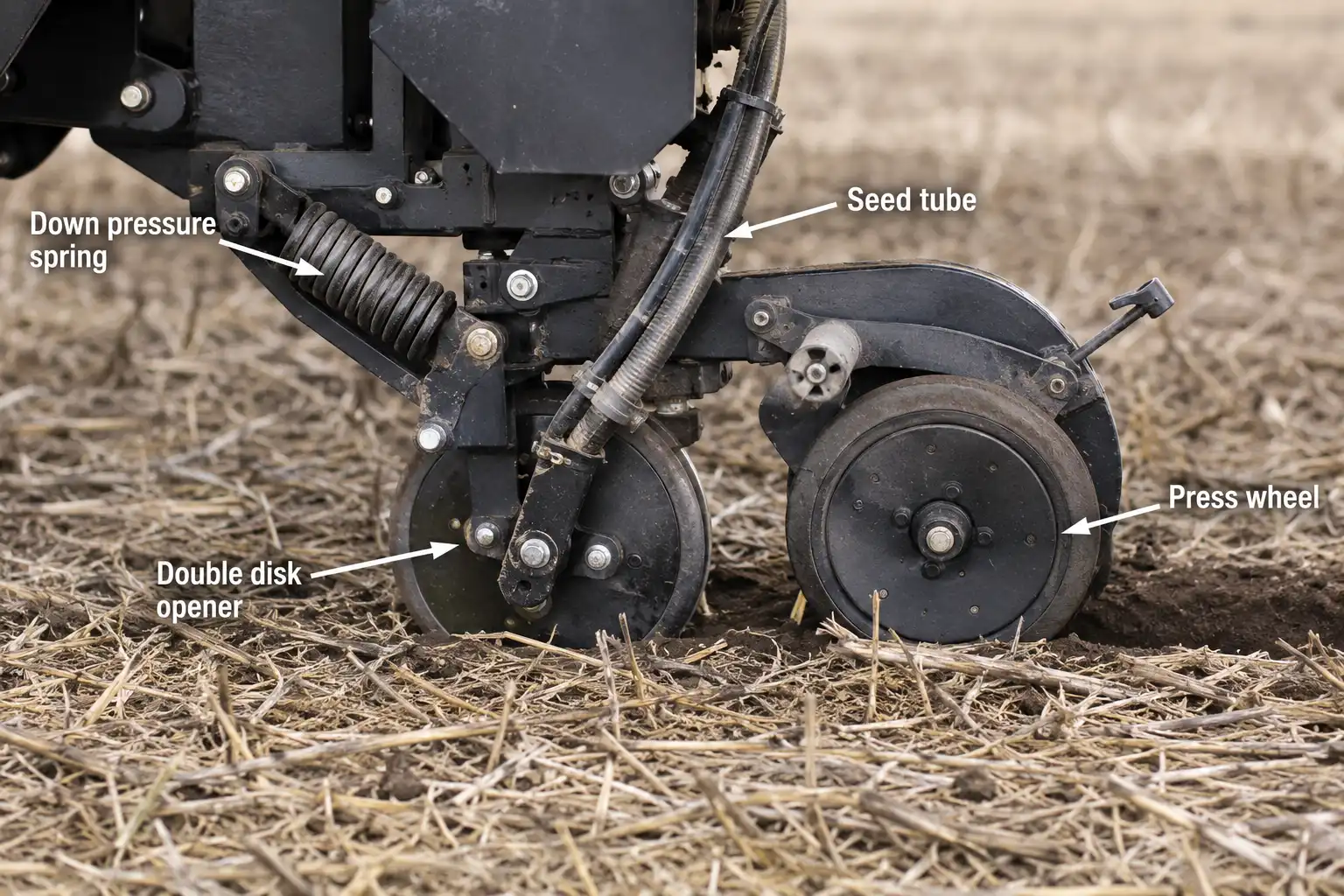
Set the drill so openers reach depth and press wheels firm soil around every seed. Down pressure, drill attitude, and ground speed control all three.
Start with down pressure. Tighten the springs until openers cut to depth in the hardest part of the field, not the softest. If springs bottom out, add weight to the drill frame. Extra weight lets the springs work through their range instead of maxing out.
Next, set drill attitude. Running the drill slightly tail down loads the press wheels and improves contact. On many machines that means raising the tractor drawbar or the hitch point. On others you rotate the rockshaft to drop the openers further.
Then slow down. University of Nebraska-Lincoln agronomists warn against disk openers in loose tilled ground, and speed makes that worse. Run 4.5 to 5 mph in stubble, not 7.
Inspect opener disks before you start. Worn double disks cannot cut a clean furrow, and seed ends up sitting in loose dirt.
Check your work in the field, not on the headland. Stop in four spots per field, dig up a foot of row, and measure with a ruler. Count the seeds while you are down there.
One last item: level the drill side to side. A drill that leans plants half its width shallow and half deep, and emergence will show it.
Can You Put Fertilizer in the Seed Row With Wheat?
Yes, and wheat responds better to seed-placed starter than most crops. Phosphorus in the furrow drives fall tillering and root growth, especially on low-testing soils.
Keep the rate under the seed safety limit. K-State caps nitrogen plus potash in direct seed contact as shown below. Keep urea, UAN, and potassium thiosulfate out of the mix.
| Row spacing | Medium to fine soils | Sandy or dry soils |
|---|---|---|
| 6 to 8 inches | 30 lb N + K2O | 21 lb |
| 10 inches | 24 lb | 17 lb |
| 15 inches | 16 lb | 11 lb |
Dry phosphate through an air seeder is the simplest route. A blend built on 11-52-0 in the seed row puts phosphorus and a little nitrogen right where roots find it. Liquid sources perform just as well agronomically.
Placement beats rate. The granule must sit within 1.5 to 2 inches of the seed. Past that distance the starter effect disappears, which is why broadcast phosphorus cannot substitute.
Late-planted wheat gains the most. University of Nebraska-Lincoln recommends 20 pounds of phosphate with the seed even where the soil test calls for none. Existing recommendations get a 20 percent bump.
Save the bulk of your nitrogen for a late-winter topdress. Fall nitrogen past about 30 pounds mostly grows leaf tissue you do not need.
How Long Does Wheat Take to Come Up?
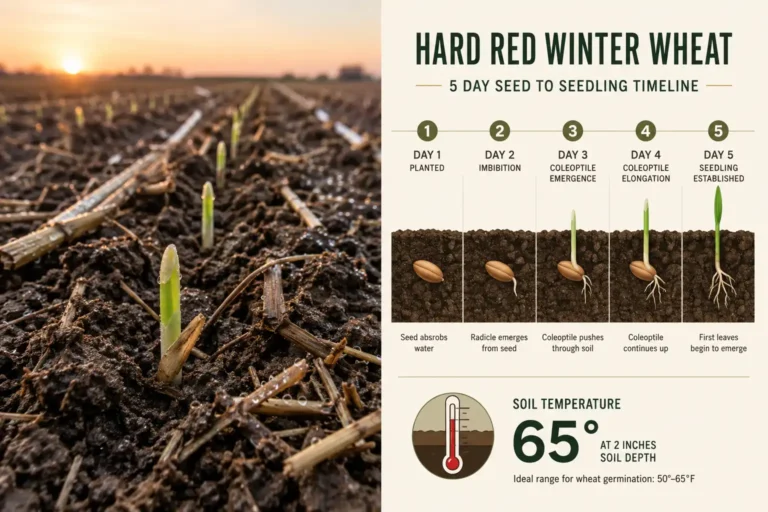
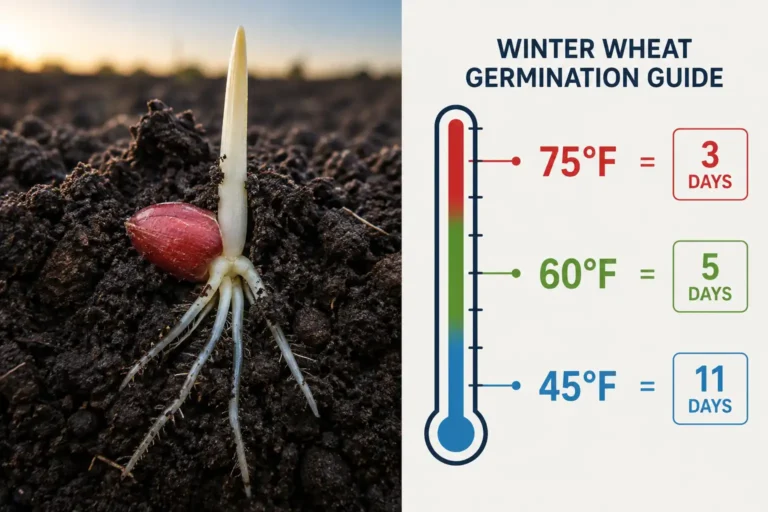
Wheat emerges in 6 to 20 days depending on soil temperature and seeding depth. Michigan State University research shows seed at 1 inch needs about 130 growing degree days to break the surface.
Depth changes that number. Seed at half an inch needs roughly 105 growing degree days, while seed at 2 inches needs about 175. So chasing moisture deep costs you emergence time on top of coleoptile risk.
| Average soil temperature | Days to emergence at 1 inch |
|---|---|
| 70°F | 6 to 7 |
| 60°F | 8 to 9 |
| 50°F | 13 to 14 |
| 45°F | 18 to 20 |
Surface residue adds another day or two, according to North Dakota State University. Cool late-October plantings in Kansas commonly take two weeks, and that is normal.
Moisture triggers the whole process. Wheat seed must take up 35 to 45 percent of its weight in water before germination starts. Dry seed simply waits, sometimes for weeks, without losing viability.
How Do You Plant Wheat in a Small Plot or Garden?
Broadcast seed by hand at 3.5 to 4 pounds per 1,000 square feet. Rake it to 1 inch, then firm the soil. Hand broadcasting spreads unevenly, so the higher rate covers thin spots.
Work the plot to a fine surface first. Rake out clods bigger than a marble, since wheat seed cannot bridge them. Then split your seed into two halves. Walk north to south with the first half and east to west with the second. That cross pattern evens the spread.
Rake lightly in two directions to bury seed about an inch. Next, firm the surface with a lawn roller, a piece of plywood, or your own feet. Firming is the step home growers skip most often, and it decides whether the seed germinates.
Water lightly if rain does not arrive within a few days. A half inch is plenty. Wheat needs enough moisture to imbibe, not saturation.
In USDA hardiness zone 6a, garden wheat goes in during the same fall window as field wheat. Plants tiller through November, go dormant, then green up in March.
How Do You Check Your Wheat Stand After Planting?
Count plants three weeks after emergence, using several 3-foot lengths of row across the field. Compare that count against your planted rate to judge emergence percentage.
Winter wheat should finish fall near 900,000 to 1,000,000 plants per acre, or 21 to 23 plants per square foot. At 7.5-inch rows, 13 plants per foot works out to roughly 21 per square foot.
Walk at least five spots. Include a headland, a hilltop, and a low draw, because each tells you something different. Thin headlands usually mean compaction. Thin hilltops point at moisture. Thin draws often mean the drill floated over wet ground.
Check leaf and tiller counts too. Wheat wants 4 to 5 leaves and 1 to 2 tillers before dormancy for full cold tolerance. Fewer than that signals late planting or poor emergence.
Redrilling rarely pays once October ends. If a stand falls below half your target and the BPMP window just passed, cross-drilling at a reduced rate can help. After that point, a thin stand usually beats a disturbed one.
Wheat Planting Mistakes That Cost You Bushels
Seven mistakes account for most thin stands in fall-planted wheat:
- Drilling into loose soil. Ground settles after rain and leaves crowns shallow.
- Planting wheat on corn stubble. Head scab risk jumps 5 to 10 times.
- Skipping calibration on a new seed lot. Seed size swings 40 percent between varieties.
- Chasing moisture past the coleoptile limit. Deep seed with a short coleoptile never emerges.
- Planting early on a susceptible variety. Hessian fly and wheat streak mosaic virus find early wheat first.
- Leaving uneven chaff from last harvest. Openers ride up on windrows and skip.
- Overloading the seed row with fertilizer. Salt burn thins stands before a leaf shows.
None of these appear on planting day. All of them appear three weeks later.
FAQs on Plant Wheat
Can you plant wheat without a drill?
How many bushels of wheat does it take to plant an acre?
Do you need to soak wheat seed before planting?
What happens if you plant wheat too early?
Can you plant wheat in the spring in a winter wheat area?
How much wheat seed do you need for a food plot?
Does wheat need to be fertilized at planting?
What to Watch For When the Drill Rolls
Wheat establishment rewards attention more than horsepower. Check depth in four spots per field. Keep speed under 5 mph in stubble. Recalibrate the drill for every new seed lot. Those three habits do more for yield than any purchased input.
If this is your first wheat crop, start with two decisions: the right class for your region, and soybean stubble instead of corn. Those two set the ceiling before the drill ever moves. From there, firm soil with moisture near the surface fixes half the problems on this page. The rest of the season, from tillering through the wheat crop from seed to the combine, gets easier when the stand starts even.