How Long Does Wheat Last in Storage? 6 Months to 30 Years
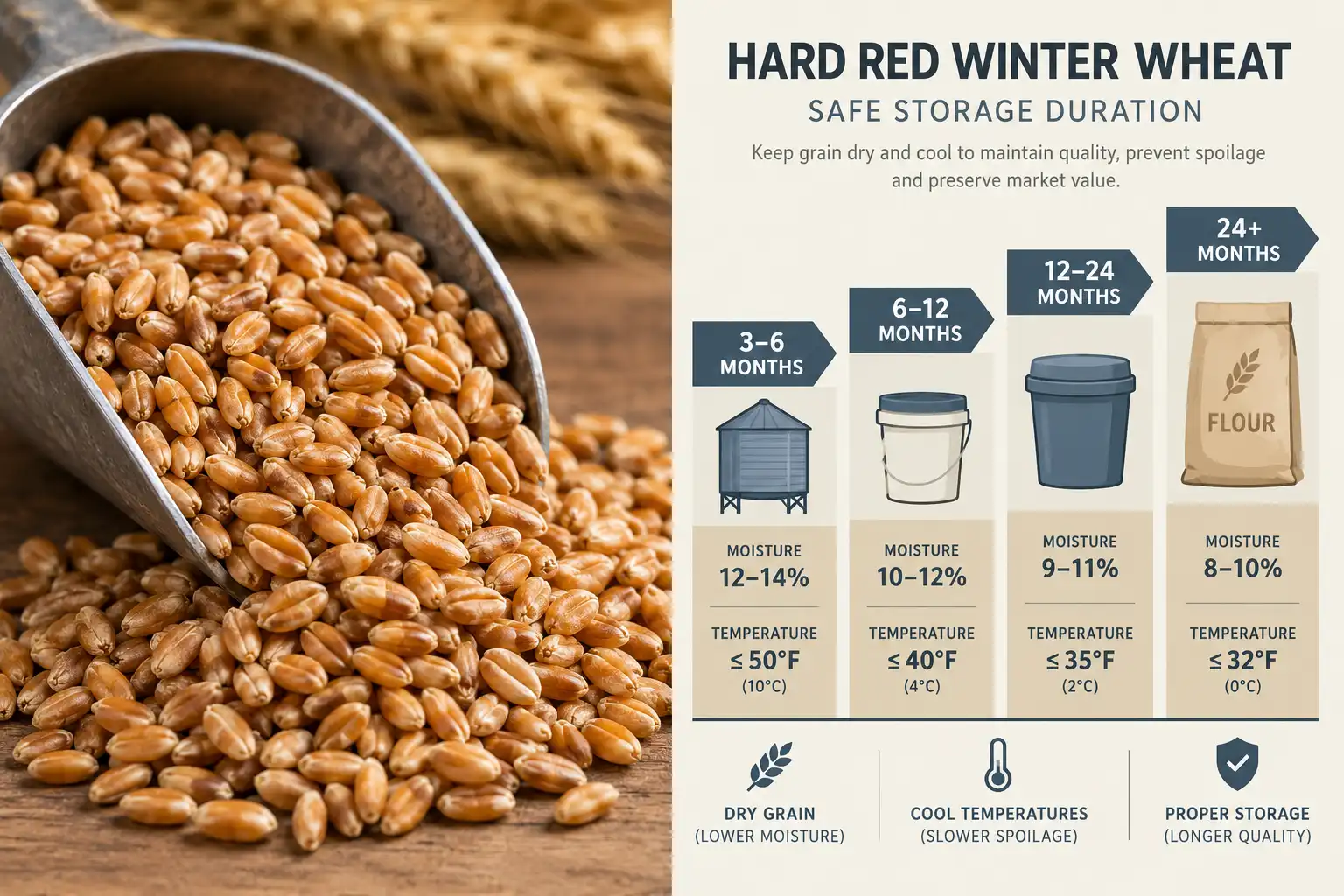
Wheat outlasts almost every other stored grain. Still, how long wheat lasts in storage runs from a few weeks to more than 30 years. Moisture content, grain temperature, and insect pressure decide where your grain lands.
Clean wheat in storage at 13 percent moisture and 40°F holds milling quality past a year. Whole berries sealed against oxygen last 25 to 30 years. Ground flour spoils within months. Warm grain and insects cut every number fast.
What Controls How Long Stored Wheat Lasts?
Three things control it: moisture, temperature, and insects. Each one works against the other two, so a weakness in any single area shortens the whole storage life.
Moisture feeds mold. K-State Research and Extension reports that mold growth slows below 14 percent moisture. Insects also struggle to develop at 12 percent or less. Temperature sets the pace. According to K-State, mold activity can double with every 10°F rise in grain temperature.
Insects are the third pressure. K-State notes that storage insects feed and breed best between 70 and 90°F. Reproduction drops sharply once grain reaches 60°F. Below 50°F, most visible insect activity stops.
One point matters more than any single number. NDSU Extension stresses that allowable storage time is cumulative. Grain held warm for two months in the fall has already spent part of its storage life. Cooling it later does not refund that time.
So storage life is a budget, not a countdown that resets. Every warm week draws it down. Cool, dry grain simply spends the budget slowly.
How Long Does Wheat Last in Storage in a Farm Bin?
Six to twelve months at typical harvest moisture, and well past a year once the grain is dried and cooled. The target moisture depends entirely on how long you plan to hold it.
Purdue Extension publishes clear maximums for clean, aerated small grain. Wheat held up to six months should not exceed 14 percent moisture. Wheat held longer than six months should come down to 13 percent. Purdue also advises dropping those figures by one full point for drought, frost, or harvest-damaged grain.
NDSU Extension gives the same summer target. Wheat carried through warm months should be dried to 13 percent before temperatures climb.
Bins without fans are a separate case. With no aeration, K-State Research and Extension recommends 10 to 11 percent moisture plus a grain protectant. Even then, K-State advises against holding that grain beyond six months.
| Storage plan | Maximum moisture | Named source |
|---|---|---|
| Sold or fed by spring, up to 6 months | 14 percent | Purdue Extension |
| Held longer than 6 months | 13 percent | Purdue Extension |
| Carried through summer heat | 13 percent | NDSU Extension |
| Bin with no aeration, 6 months maximum | 10 to 11 percent | K-State Research and Extension |
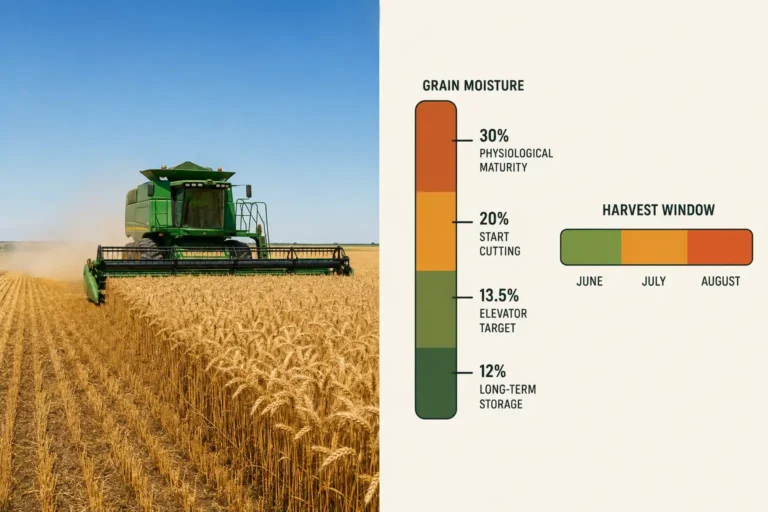
Harvest moisture drives all of this, so check the grain before the combine rolls rather than after. Correct wheat harvest timing puts grain in the bin near the target instead of several points above it.
How Grain Temperature Changes Wheat Storage Life
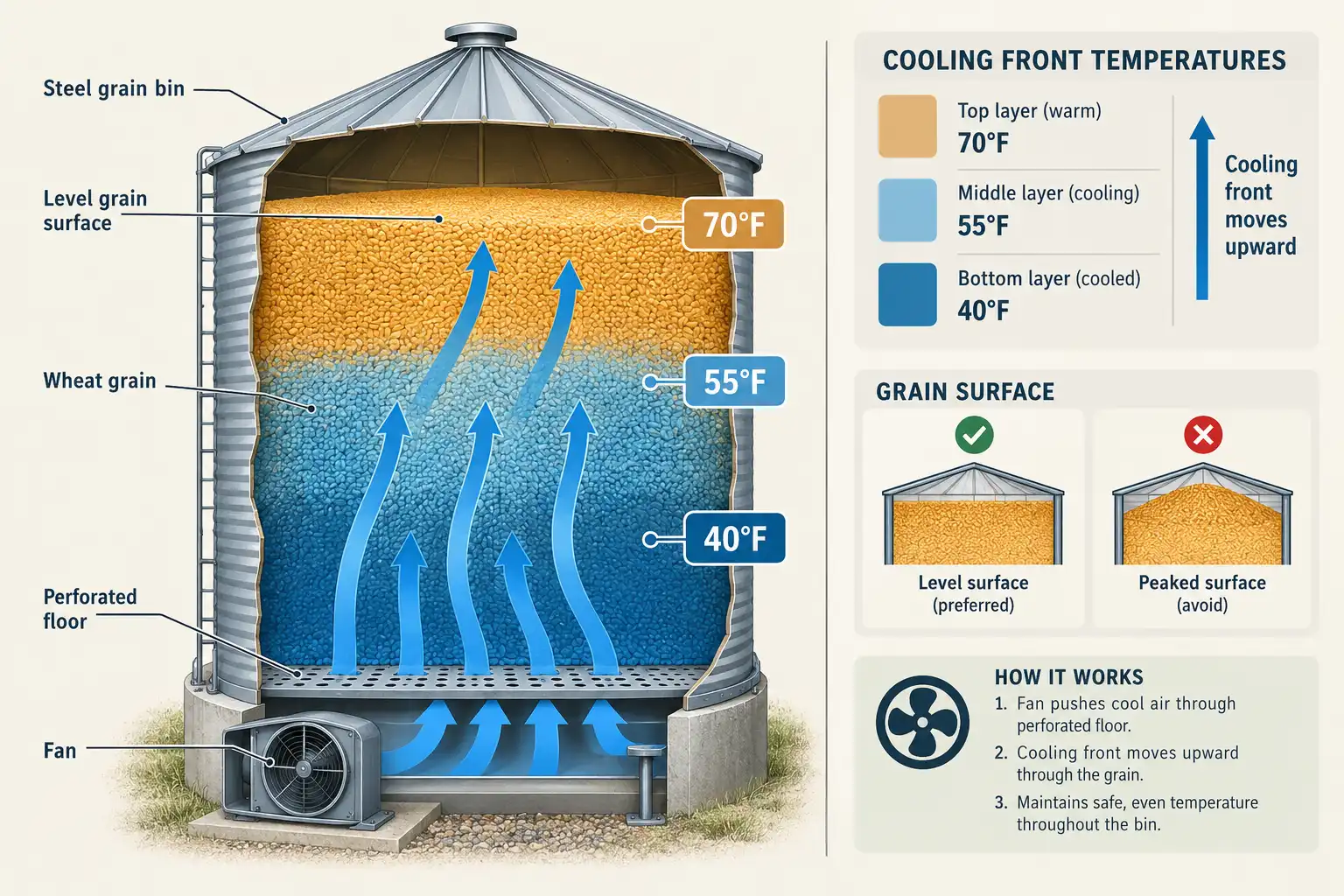
Cooling roughly doubles storage life for every 10°F you remove. NDSU Extension states the rule in reverse: a 10 degree rise cuts allowable storage time by about half.
The table below shows NDSU Extension figures for cereal grains. Read it as the number of days before quality loss is expected.
| Moisture | 40°F | 50°F | 60°F | 70°F | 80°F |
|---|---|---|---|---|---|
| 14 percent | 300+ days | 300+ days | 300+ days | 200 days | 140 days |
| 15 percent | 300+ days | 300+ days | 240 days | 125 days | 70 days |
| 16 percent | 300+ days | 230 days | 120 days | 70 days | 40 days |
| 17 percent | 280 days | 130 days | 75 days | 45 days | 20 days |
| 18 percent | 200 days | 90 days | 50 days | 30 days | 15 days |
Look at the 16 percent row. That grain holds 230 days at 50°F but only 40 days at 80°F. Nothing changed except heat.
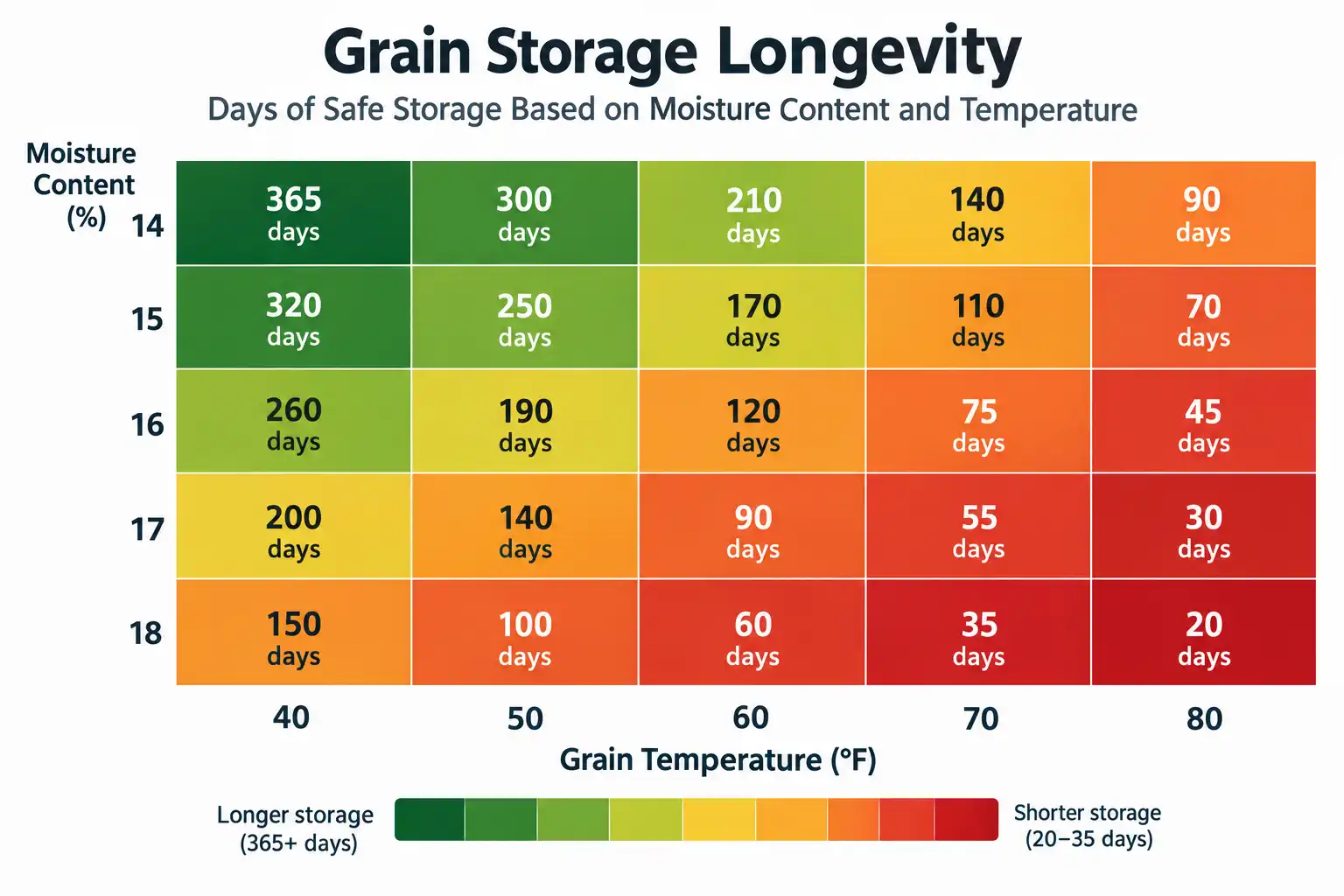
K-State Research and Extension recommends cooling stored wheat in 10 to 15 degree increments through the fall. The target is 40°F, held all winter. Wheat headed for a spring or summer sale should be warmed back to 55 to 60°F. Wheat staying longer than a year should not be warmed at all, per Oklahoma research K-State cites.
How Long Do Wheat Berries Last in Buckets, Bags, or Cans?
Decades, provided the grain is dry, cool, and sealed. Whole kernels keep far longer than anything ground, because the bran and germ stay intact.
Utah State University Extension reports that wheat kept in a cool basement held acceptable quality for about 25 years. The same wheat stored hot, in a garage or attic, lasted only about 5 years. Heat is the single largest factor in home storage.
The long end is documented. USU Extension cites a Brigham Young University study in which wheat packaged in No. 10 cans and held 32 years at ambient or cooler temperatures still produced bread that most tasters accepted. Notably, headspace oxygen level made no difference to that outcome.
USU Extension still recommends a working rotation so that no stored lot passes 5 years. That keeps quality high and keeps you familiar with the grain.
Packaging and Conditions That Hold Quality
Practical conditions from USU Extension:
- Store at 40 to 60°F where possible. Freezing does not harm dry grain.
- Keep moisture under 12 percent. Above that, grain respires and degrades.
- Use Mylar-type bags, No. 10 cans, or food-grade buckets. Rodents chew through plastic bags.
- Pack in roughly 10 pound units so one contaminated lot does not spoil the rest.
- Keep containers off concrete floors, which wick moisture upward.
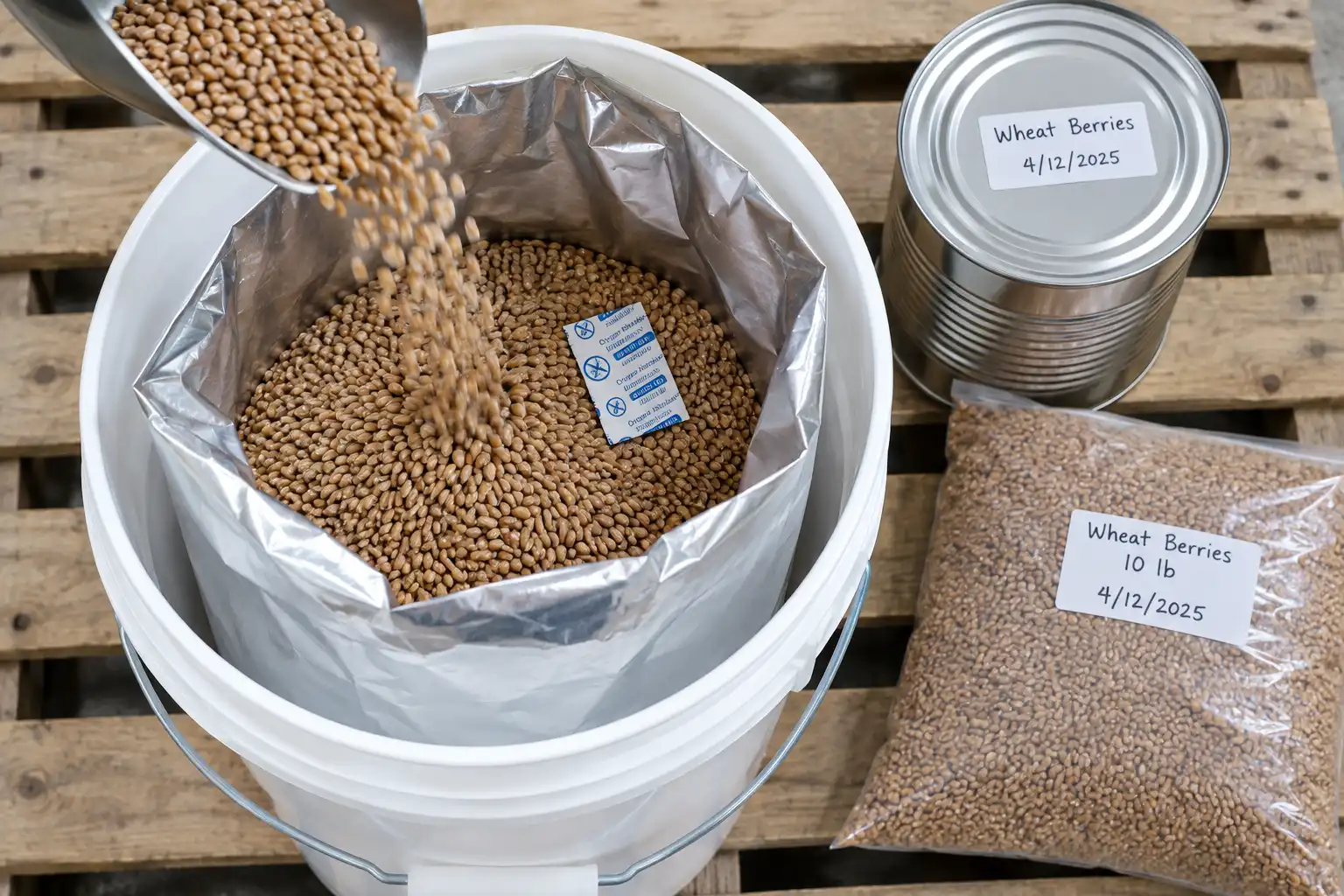
One limitation deserves attention. USU Extension warns that polyethylene bags and 5 gallon buckets do not hold an oxygen-free atmosphere over time. Oxygen creeps back in, and surviving larvae can mature into an infestation. Mylar bags and sealed cans hold the seal far better. The same sealing logic applies to long term oat storage, though oats carry more oil and fade sooner.
Do You Need Oxygen Absorbers to Store Wheat?
Only when insects are a concern. USU Extension states plainly that an oxygen-free atmosphere is not required for wheat unless pests are present.
Oxygen absorbers do solve the pest problem cleanly. Sealed in Mylar bags or No. 10 cans, they kill adult insects and prevent larvae from surviving. Dry ice works too. USU Extension describes a dry ice method for 5 gallon buckets. Put 2 to 3 ounces of crushed dry ice under 3 to 4 inches of grain. Fill the bucket, rest the lid askew, then seal it tight after 30 minutes.
Freezing is the simplest home method. USU Extension recommends freezing 1 to 15 pound bags for 2 to 3 days. Let them warm 24 hours afterward. Freezing kills live insects but not eggs, so repeat cycles may be needed.
Three popular methods do not work at all. USU Extension lists bay leaves, nails, and salt as having no effect whatsoever on insects or insect eggs. Home heating and household insecticides are also ruled out as unsafe or unreliable.
How Long Does Wheat Flour Last Compared to Whole Grain?
Months, not years. Milling breaks the bran layer and exposes oils in the germ, and those oils turn rancid on their own schedule.
University of Georgia Extension gives the working numbers. White flour keeps 6 to 12 months in an airtight container in a cool, dry spot. Refrigerated at 40°F, all-purpose and bread flour hold up to two years. Whole wheat flour keeps only 1 to 3 months at room temperature. Refrigerated, it holds about 6 months, and frozen, up to 12.
Texas A&M AgriLife Extension puts flours and meals at roughly 3 months in a cool pantry or 6 months frozen. The same source lists hard grains stored whole at 10 to 12 years.
| Form | Cool pantry | Refrigerator | Freezer |
|---|---|---|---|
| White flour | 6 to 12 months | Up to 2 years | Very long |
| Whole wheat flour | 1 to 3 months | About 6 months | Up to 12 months |
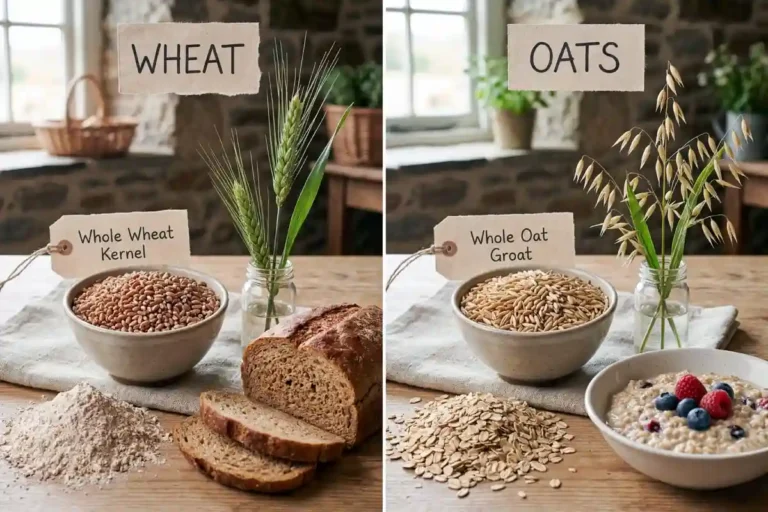
| Whole wheat berries | Years | Years | Years |
The lesson is simple. Store whole kernels and grind what you need. That single change turns a three month shelf life into a multi-decade one.
What Shortens Wheat Storage Life Most?
Moisture migration, warm spots, and insect carryover cause most losses. Each one is preventable with routine management.
Moisture migration. Purdue Extension calls uncontrolled grain temperature the leading reason dried grain goes out of condition. Warm grain in the center of a cold bin drives convection currents that deposit moisture at the top center. Crusting follows, then spoilage. NDSU Extension notes that migration starts once grain runs about 20 degrees off the average outdoor temperature.
Spring solar gain. NDSU Extension reports that a bin’s south wall picks up more than twice the spring solar heat gain it sees in summer. Grain warms unevenly, and allowable storage time drains faster than the calendar suggests.
Old grain underneath new. K-State Research and Extension warns never to add fresh wheat on top of stored grain. A small hidden infestation spreads through the whole bin before it surfaces.
Fines and peaks. Broken kernels and chaff collect in the center core. Purdue Extension explains that air flows around those pockets rather than through them, so they cool last and heat first.
Dirty equipment. K-State recommends discarding the first few bushels augered through each machine at harvest. That flush carries out last season’s residue, which is where the insects overwinter.
How to Store Wheat So It Lasts
Follow the sequence below. Skipping a step early costs storage life you cannot recover later.
- Clean everything first. Sweep bin walls, floors, ledges, and the area beneath perforated floors. Clear spilled grain outside the bin. K-State recommends applying labeled bin sprays three to four weeks before filling.
- Dry to your holding target. Use 14 percent for six months or less, 13 percent for longer. A calibrated meter beats a guess, and moisture testers built for grain read whole kernels rather than surface dampness.
- Level the surface and pull the core. Peaked grain aerates poorly. Draw down the center soon after filling to remove fines and open airflow.
- Cool in stages. Start a cycle when average outdoor temperature runs 10 to 15 degrees below the grain. K-State advises stepping down in 10 to 15 degree increments until wheat holds at 40°F.
- Finish every cycle. Purdue Extension warns that stopping a cooling front midway leaves a moist band inside the grain mass. At roughly 1/10 cfm per bushel, one fall cycle runs about 150 hours.
- Cover the fan when idle. That blocks natural draft, condensation, and rodent entry.
- Check on a schedule. K-State suggests monthly inspection, moving to twice monthly through summer and early fall.
How Can You Tell If Stored Wheat Has Gone Bad?
Smell it first, then feel it. A musty or sour odor from the fan exhaust is the earliest reliable warning. It usually shows up before anything looks wrong.
Purdue Extension lists the signs worth acting on:
- Musty or spoiled odor in the exhaust air
- A hard crust or caked layer at the top center
- Warm grain a foot below the surface
- Wet, slimy, or frozen-together kernels
- Condensation or frost under the roof on cold mornings
- White dust rising whenever grain is stirred
- Cooling cycles taking far longer than usual
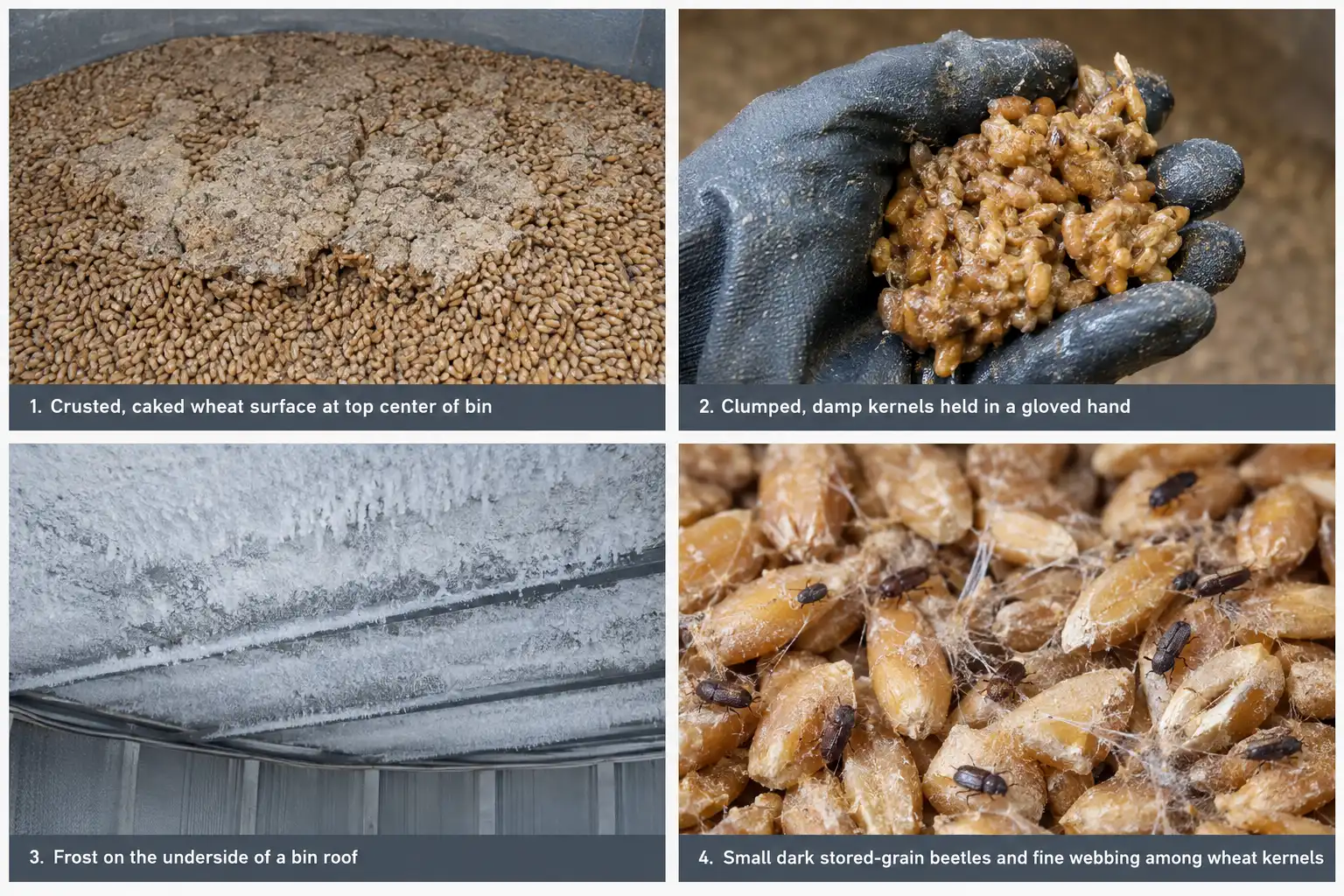
Insect evidence is separate. Look for live beetles in probe samples, fine webbing near the surface, and kernels that feel light or hollow. K-State recommends sifting probe samples over a 10 to 12 mesh screen. Target any area reading above 65°F.
Act on what you find. Minor crusting calls for stirring the surface and running the fan. Severe crusting means removing the spoiled layer with a dust-rated respirator on, then reassessing the grain below. Purdue Extension is direct about the worst case: selling grain with a minor problem beats letting a whole bin go out of condition. Storage triage follows the same logic across other crops, whether you are managing soybean storage life or small grains.
Will Stored Wheat Still Germinate?
Not as reliably as it keeps its food value. Seed viability fades faster than baking quality, and heat drives that decline.
USU Extension reports that storage above 60°F causes a more rapid loss of germination than it does loss of food value. In other words, wheat that still bakes fine may no longer sprout well. NDSU Extension makes a related point: standard storage time charts track commercial grade, while germination is typically lost sooner than those charts imply.
Two practical rules follow. Run a germination test on any stored lot before planting wheat berries you have held more than a season. And never buy treated seed wheat for food storage, since USU Extension warns those lots may carry toxic chemical treatments.
FAQs about Wheat Storage Shelf Life
Can wheat really last 30 years?
What is the best temperature for storing wheat?
Does wheat need to be frozen for long-term storage?
How often should stored wheat be checked?
Is it safe to eat wheat with insects in it?
Key Points to Carry Into the Bin
Storage life is bought with dry grain and cold grain, in that order. Hold wheat at 13 percent moisture and 40°F and it will carry past a year in good condition. Sealed whole berries in a cool room stretch that to decades. Flour never will, so grind small batches instead. Check the bin monthly, smell the exhaust air, and act on the first musty note rather than the first crust. The same moisture-then-temperature sequence governs storage methods for other crops as well.