How to Grow Einkorn Wheat: Seeding Rates, Nitrogen, and Dehulling
Einkorn is the oldest domesticated wheat, and it does not behave like the crop in the next field. Seed stays inside its hull. Straw grows tall and leans. Learning how to grow einkorn wheat is mostly about restraint: less nitrogen, thinner stands, cleaner ground.
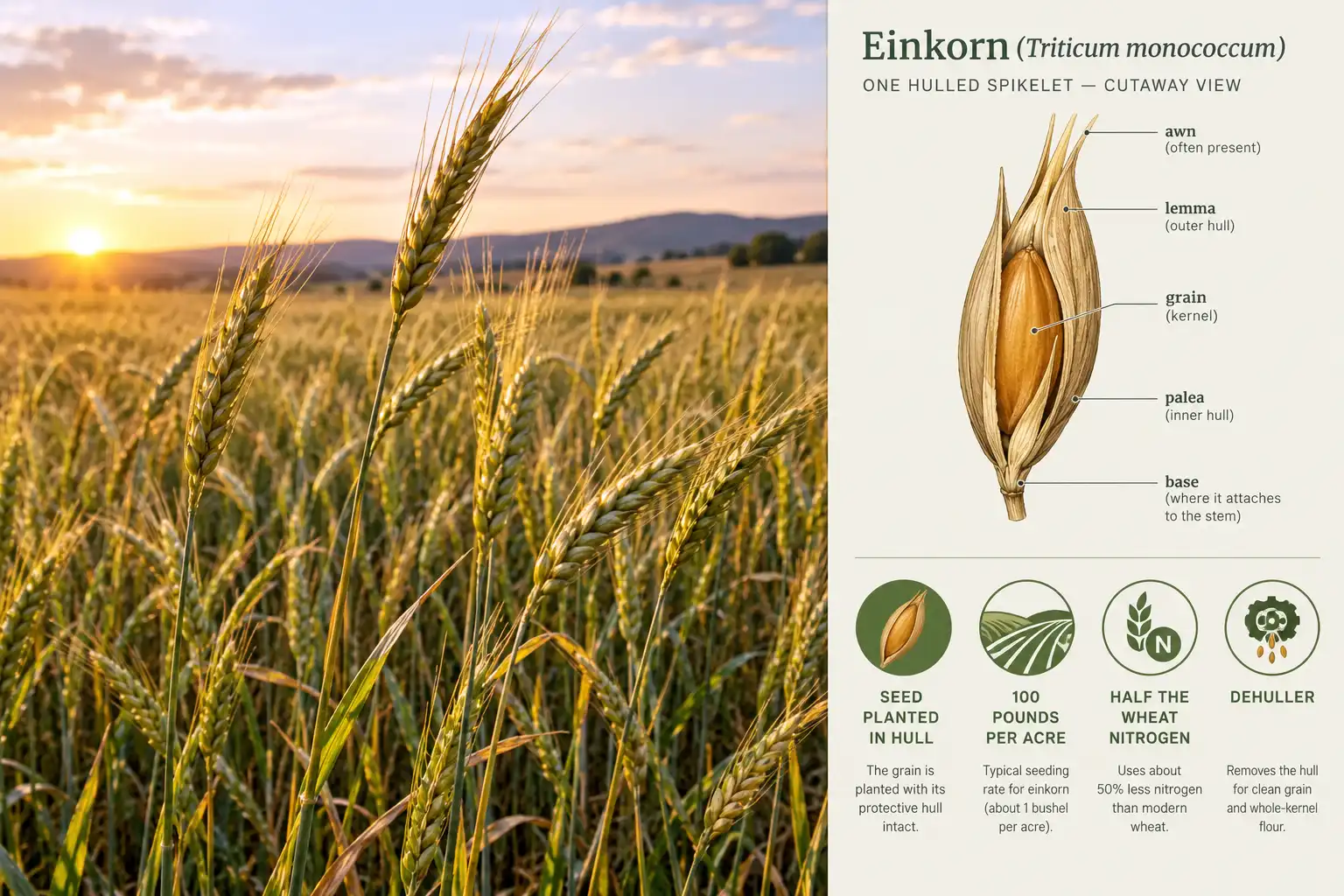
Einkorn wheat needs seed planted in the hull, at roughly 100 pounds per acre. Hold nitrogen to half the modern wheat rate. Dehull after harvest. Expect 700 to 2,000 pounds per acre.
What Makes Einkorn Different From Modern Wheat?
Einkorn, or Triticum monococcum, is a diploid wheat carrying 14 chromosomes. Modern bread wheat carries 42. Penn State’s Department of Plant Science dates its cultivation to roughly 8000 BC. That makes it the first wheat humans farmed, and the simple genome drives almost every field decision below.
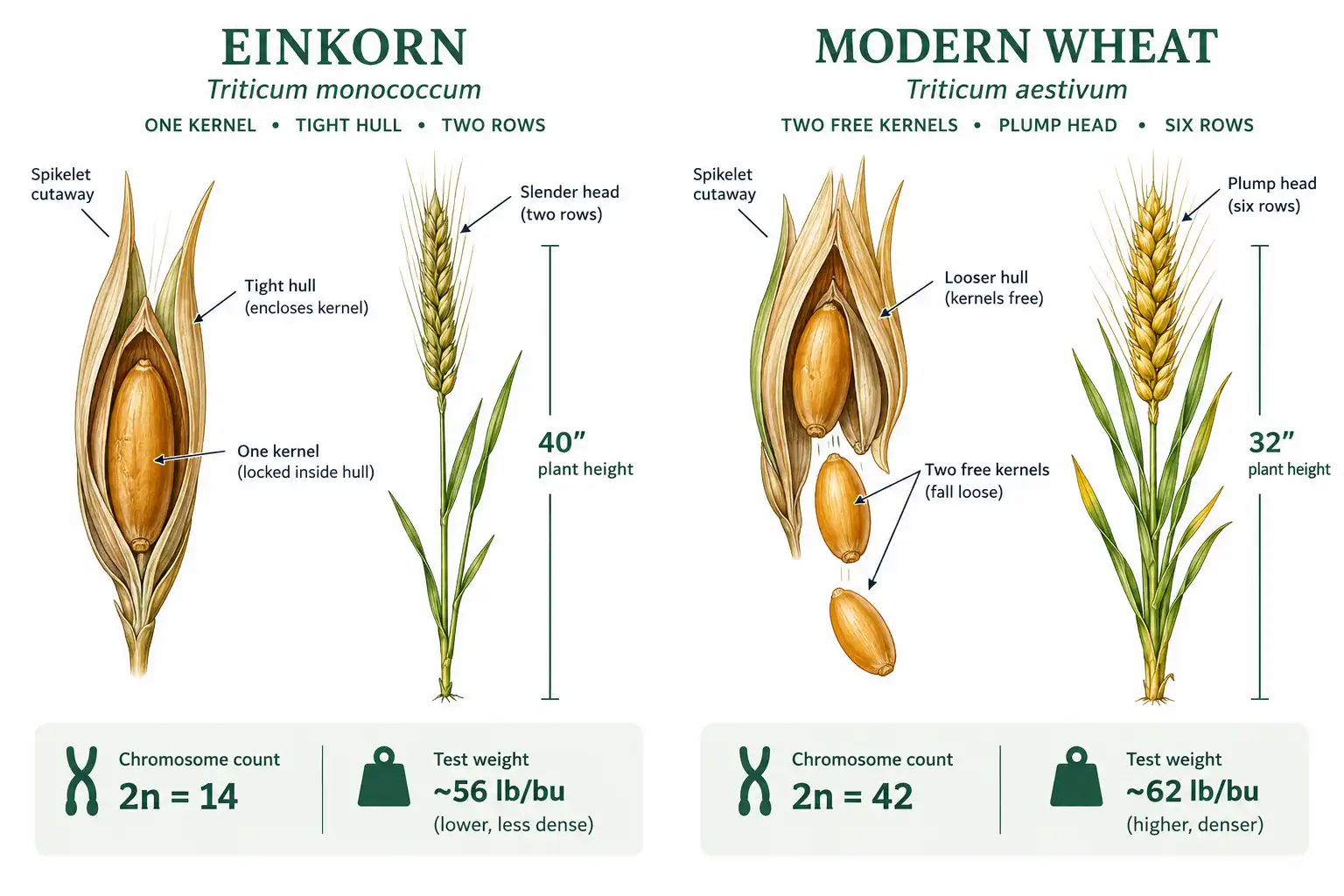
Three traits change how you handle the crop.
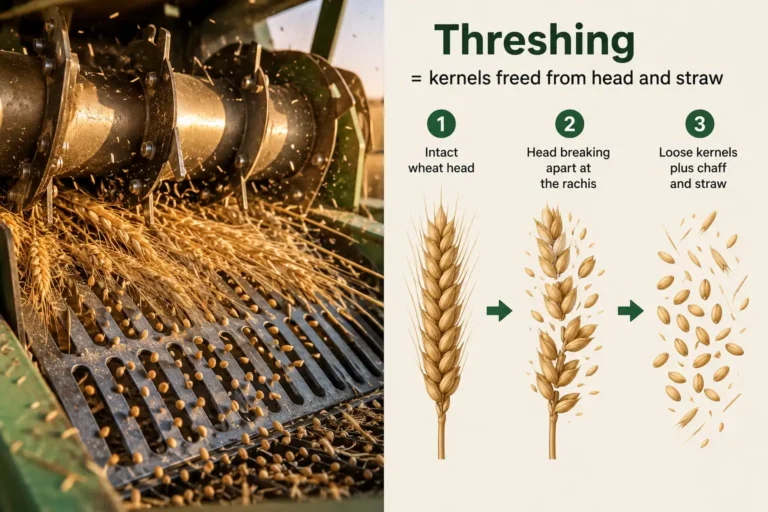
- The grain stays in the hull. Combining will not thresh it free, so dehulling becomes a separate job.
- The straw runs tall and weak. Penn State trials measured plants near 40 inches with moderate lodging scores.
- Everything happens slowly. Germination, canopy growth, and maturity all lag behind modern wheat.
| Trait | Einkorn | Modern bread wheat |
|---|---|---|
| Chromosomes | 14, diploid | 42, hexaploid |
| Threshes free of hull | No | Yes |
| Typical height | Near 40 inches | 30 to 36 inches |
| Seeding rate | 80 to 100 lb per acre, in hull | 90 to 120 lb per acre |
| Nitrogen need | 50 to 75 percent of wheat rate | Full rate |
| Test weight in hull | About 32 lb per bushel | 58 to 60 lb per bushel |
| Grains per spikelet | One | Two to three |
Where Does Einkorn Grow Best in the US?
Einkorn performs best where summers run dry and harvest weather holds. North Dakota has given the strongest results so far. Penn State summarized multi state trials of spring einkorn. The NDSU site averaged 3,256 pounds per acre. Rock Springs, Pennsylvania managed 668.
Humid eastern ground is harder. eOrganic, part of the Extension Foundation, tracked those eastern sites. Spring einkorn and emmer there hit 35 to 93 percent of modern spring wheat yields. North Dakota trials sometimes beat modern spring wheat outright.
Dry western valleys also work, though late maturity creates a catch. Colorado State University Extension staff worked on the Rocky Mountain Heritage Grain Trials. They flagged einkorn as very late maturing. In southwest Colorado, that pushed harvest into monsoon season.
When Should You Plant Einkorn?
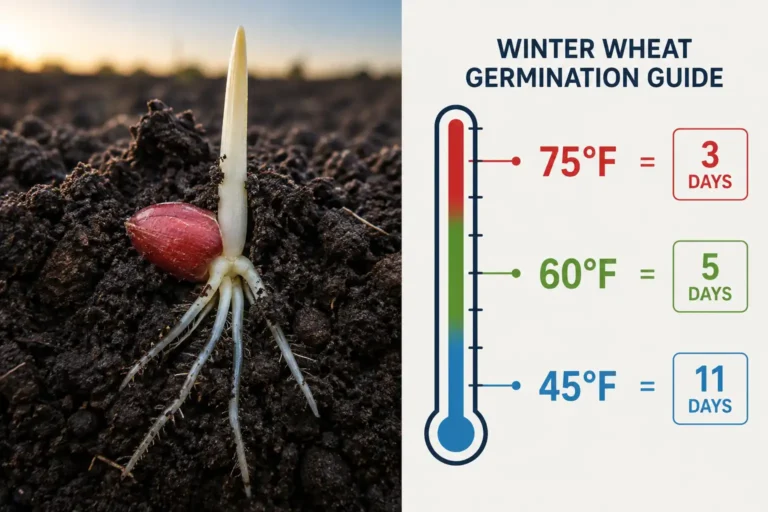
Plant spring einkorn as early as the ground allows, and plant winter einkorn in fall with your other small grains. Both types exist. Confirm which one your seed lot is before building a rotation around it.
Spring einkorn
Penn State seeded spring einkorn plots in early April at Rock Springs. Heads emerged in late June. Grain was ready in early August. That is a long run for a spring small grain, so early seeding matters.
Winter einkorn
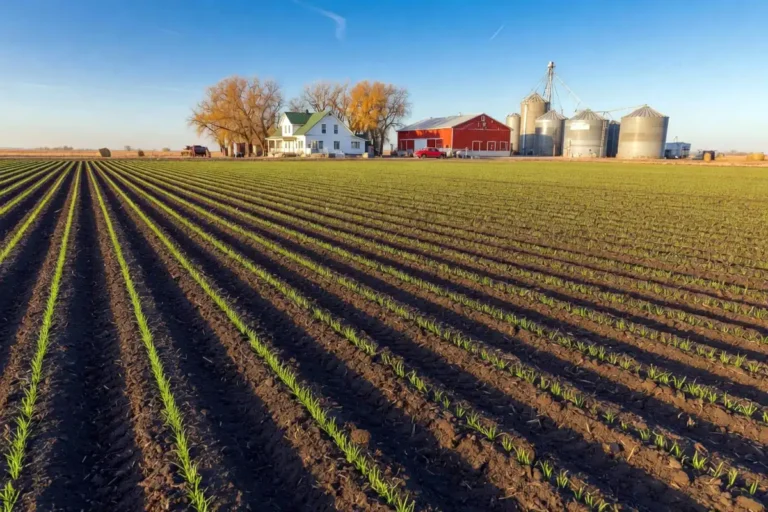
Winter types follow the same calendar as other fall seeded small grains. Fall seeding also buys a weed advantage, since the stand establishes before spring flushes begin. Once you know your local winter wheat planting window, start there. Then adjust for your seed source.
How to Grow Einkorn Wheat: Field and Seedbed Prep
Pick your cleanest field. Weed pressure is the biggest reason einkorn crops fail, because the crop covers ground so slowly. Penn State noted that weeds cut yields in its Pennsylvania plots. Following a well managed previous crop is the fix.
Then handle fertility with numbers instead of guesses. Pull a soil test and read phosphorus and potassium first. Einkorn tolerates thin, stony soils. Still, it needs adequate P and K to fill grain.
Work the seedbed fine and firm. Hulled seed is bulky and irregular, so it seats poorly in cloddy ground. Target the same seedbed you would want for a small seeded forage.
How Much Einkorn Seed Per Acre, and How Deep?
Seed spring einkorn at about 100 pounds per acre. Winter einkorn goes lower, at 80 pounds or less. Those figures come from eOrganic guidance under the USDA NIFA Value Added Grains project. The low rates are deliberate, since thick stands lodge.
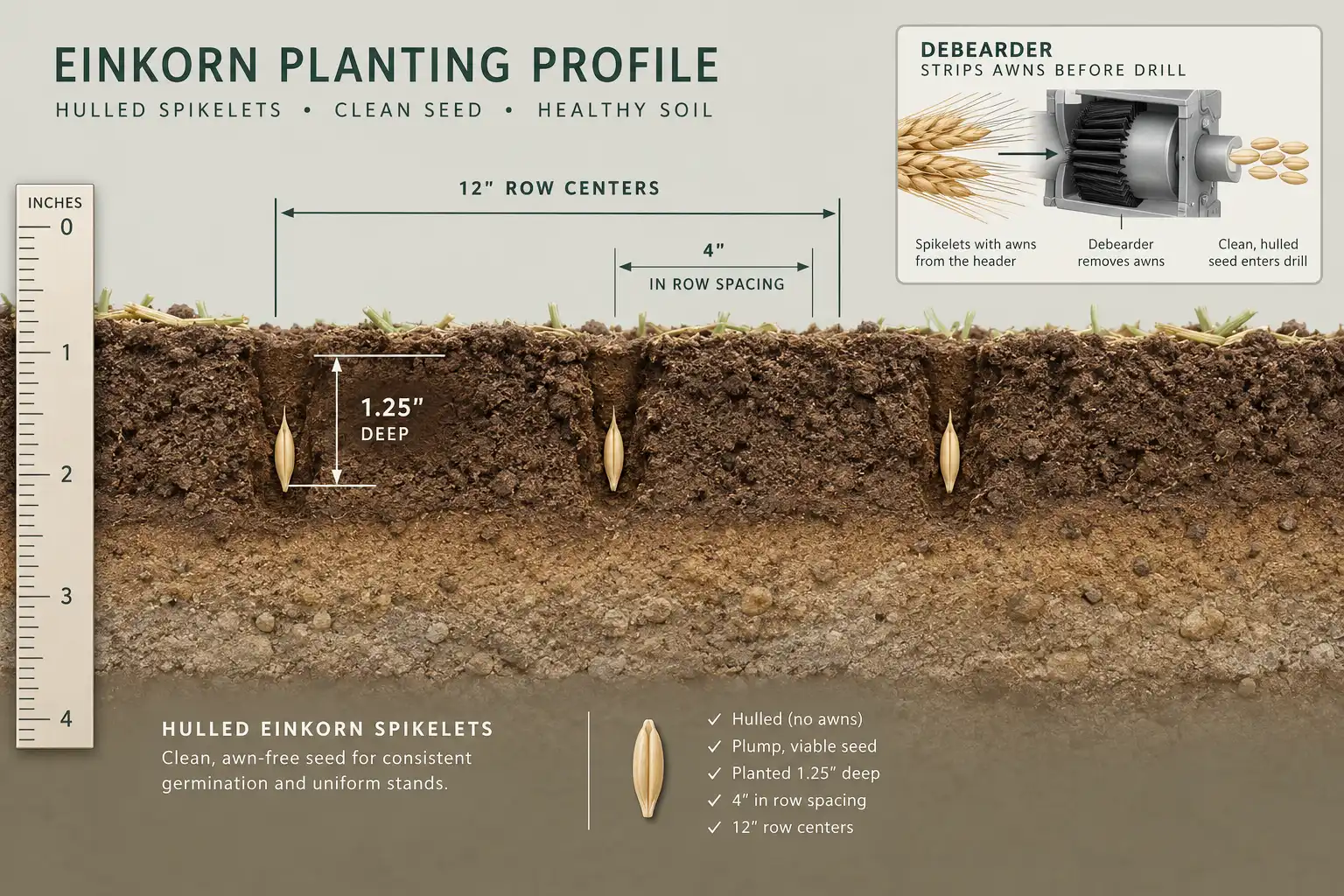
Two planting rules carry no exceptions.
- Plant the seed in its hull. eOrganic reports that einkorn and emmer need an intact hull for adequate germination. Dehulling damages the seed.
- Debeard the seed first. Awns and hairs bridge inside the drill and cause skips. A debearder strips them and breaks up doubles.
Set depth around 1 to 1.5 inches, matching normal seeding depth for wheat. Go shallower in heavy soil. If the drill still plugs, broadcast and harrow instead.
How Much Nitrogen Does Einkorn Need?
Cut nitrogen hard. eOrganic recommends no more than 50 to 75 percent of your modern wheat nitrogen rate. High fertility drives lodging in hulled wheats. Penn State topdressed spring einkorn with pelletized poultry manure at 70 pounds of nitrogen per acre. Plants still reached 40 inches with moderate lodging.
Work from these targets.
- Take your local wheat nitrogen recommendation, then apply half to three quarters of it
- Skip the spring topdress that modern winter wheat would normally get
- Subtract manure and legume credits before you add anything
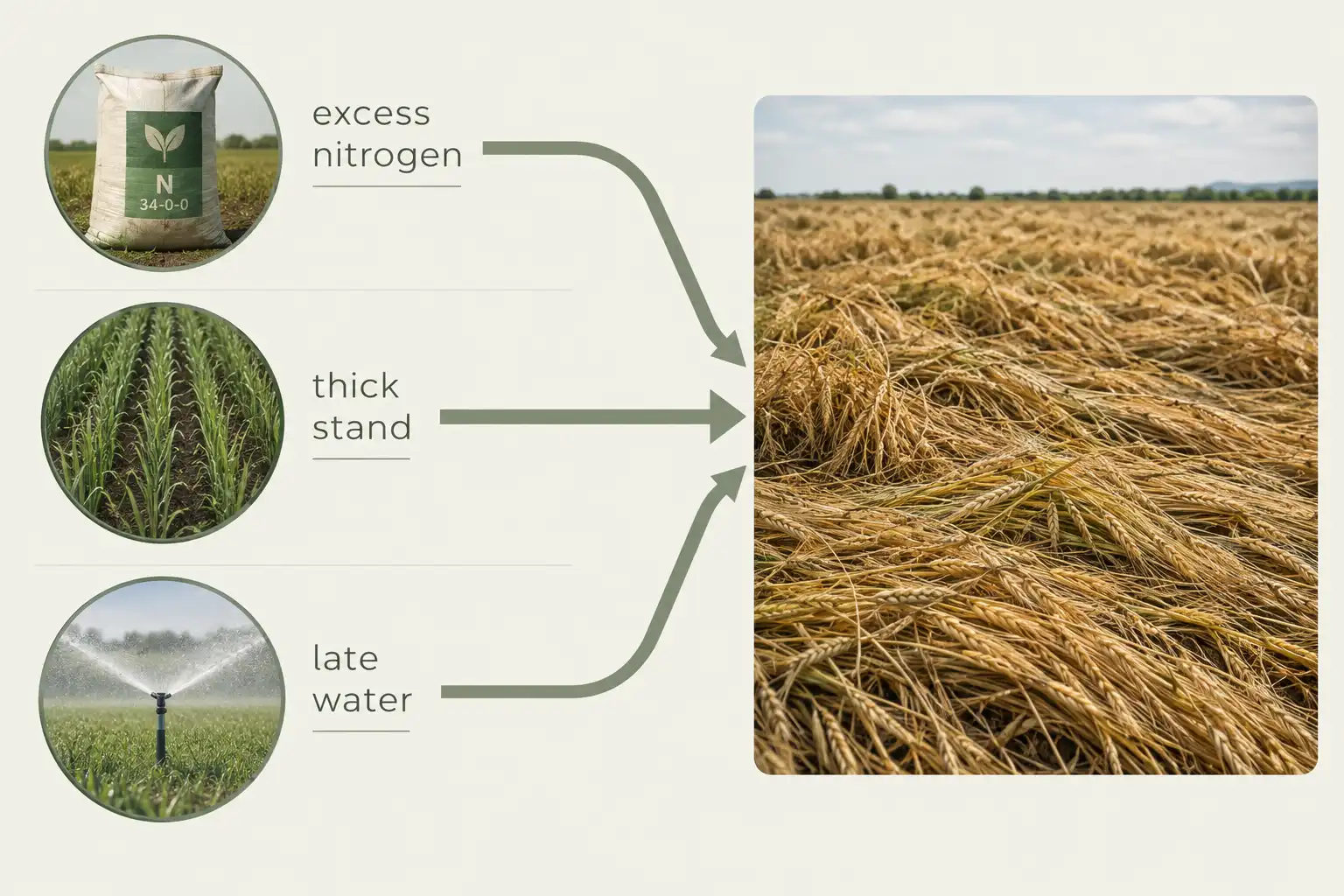
Watch how nitrogen stacks with seeding rate and water. Growers in the Rocky Mountain trials traced flattened einkorn to three stacked causes. Those were tight seeding, heavy manure residue, and long irrigation runs. Any single factor may be survivable. Combined, they lay the crop down.
How Do You Control Weeds in Einkorn?
Start clean and stay ahead early, because einkorn cannot outgrow competition. The crop germinates slowly and builds canopy slowly. Weeds get a head start you will not recover.
Three tactics carry the most weight.
- Rotation. Follow a crop that left the field clean. Sod ground and old pasture are the worst choices.
- Fall seeding. Winter einkorn establishes ahead of the spring weed flush.
- Early cultivation. Blind harrowing and inter row cultivation work while the crop is short. Past about 20 inches, mechanical options close.
Growers in the Colorado trials lost a winter einkorn plot outright to weeds. They pointed to slow crop growth as the cause. Wider rows help. Those trials used 4 inch in row spacing on 12 inch centers so a cultivator could pass. Your normal weed control decisions still apply, but the window is tighter than with modern wheat.
What Diseases and Pests Affect Einkorn?
Einkorn brings real genetic resistance, especially to rusts. Reports in the journal Plant Disease document stem rust resistance genes from cultivated einkorn. Those include Sr21, Sr22, Sr35, and Sr60, plus leaf rust resistance from Lr63. Breeders have moved several into bread wheat.
That pedigree is not a guarantee in your field. Resistance varies by accession, and commercial seed lots are rarely uniform. Scout exactly as you would scout wheat.
Pests matter more at small scale. Grasshoppers fed on einkorn and emmer in Colorado trial plots, and rabbits singled out einkorn. Birds also work uneven, late ripening heads.
The hull does help. It shields the kernel from insects and surface contamination while the crop ripens. That is one reason hulled wheats suit organic systems.
When Is Einkorn Ready to Harvest?
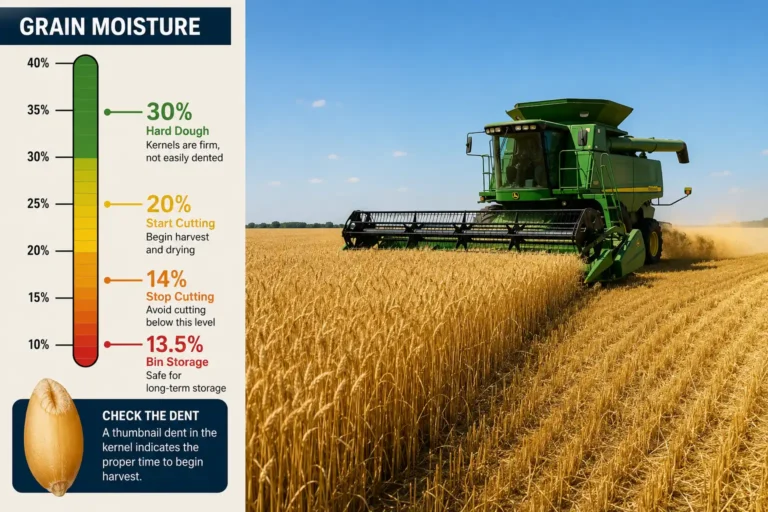
Harvest when heads turn straw colored and kernels are hard, then confirm with a moisture reading. Einkorn ripens unevenly, so the call is harder than with modern wheat. Growers in the Rocky Mountain trials reported real trouble picking a date.
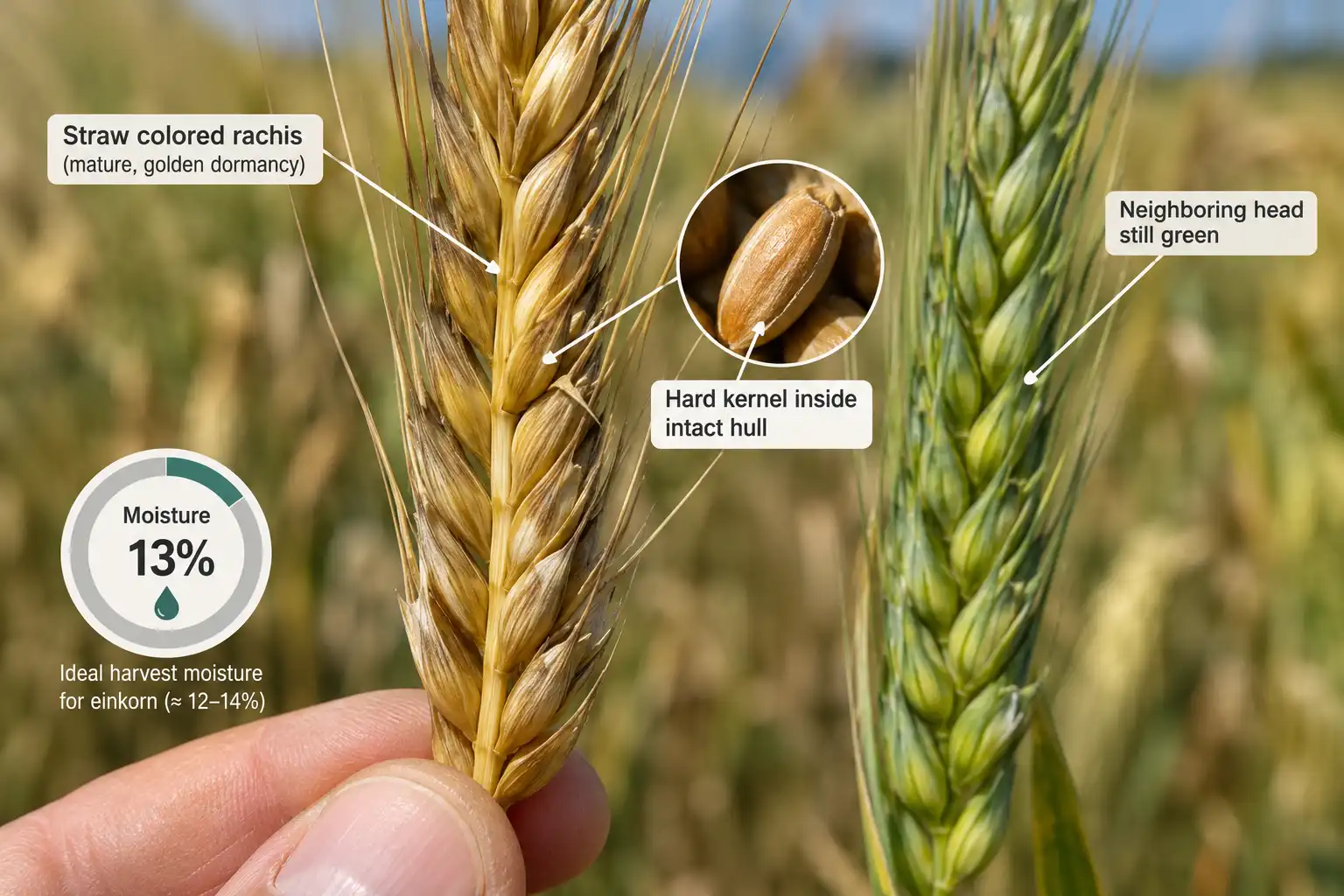
Timing notes worth keeping.
- Penn State’s Rock Springs plots headed in late June and came off in early August
- Late maturity raises risk anywhere late summer rain is common
- Sprouting in the head becomes possible if wet weather sits on a ripe crop
Combine settings need attention too. Slow the cylinder and open the concave, since you are moving spikelets rather than free kernels. Careful combining also knocks off most awns. That pays you back at planting next season.
How Do You Dry and Store Einkorn?
Dry to 13 or 14 percent moisture before storage. University of Minnesota Extension advises 14 percent or less for wheat held under six months. Past nine months, drop to 13 percent or less. Apply the same targets to einkorn.
Dry grain earns its keep twice here. Well dried grain at low humidity is also what makes dehulling efficient. Drying is a processing step, not only a preservation step. Standard grain storage practice covers the rest. Clean bins before filling, pull out fines, and track bin temperature for hot spots.
How Do You Dehull Einkorn Wheat?
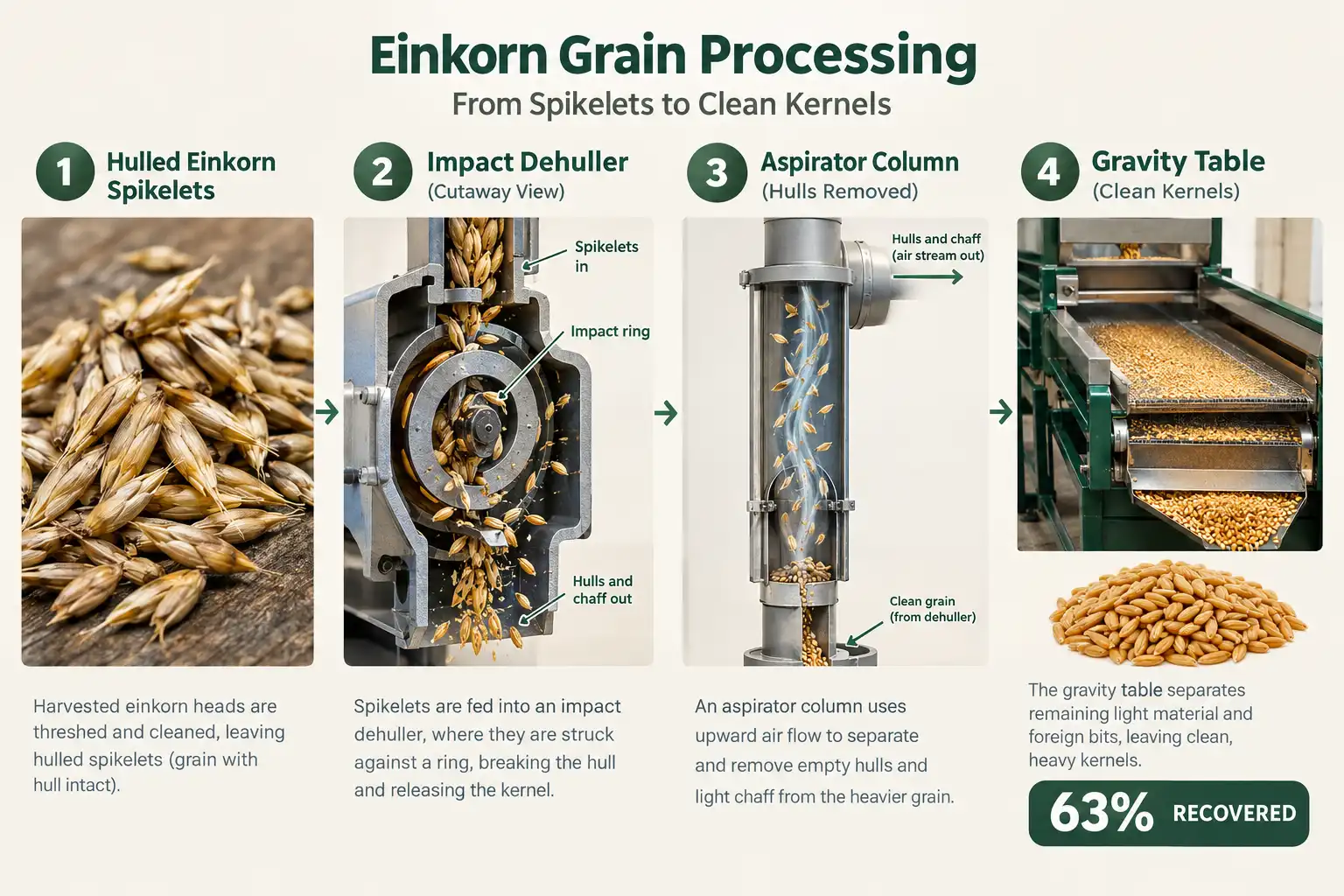
Run harvested einkorn through a dehuller, then an aspirator, then a separator. The combine frees some kernels, but most stay hulled. Skip this step and you have feed grain and bedding rather than food grain.
eOrganic describes two dehuller families.
- Impact dehullers throw grain at speed against a hard ring, and the kernel breaks free on contact.
- Friction dehullers rub the kernel loose against rubber, rasp bars, or a mesh screen. Some growers build low cost versions by swapping one burr mill plate for a rubber disk.
Then clean the output. An aspirator blows off empty hulls. A separator such as a gravity table then sorts finished kernels from those still hulled. You need both to sell food grade grain.
Budget for real loss. eOrganic puts typical dehulled weight near 63 percent of hulled weight. Ideal conditions reach 70 percent. A conservative planning figure is 50 percent. Einkorn is tougher to dehull than spelt, so plan toward the low end.
What Yield Can You Expect From Einkorn?
Plan on 700 to 2,000 pounds per acre in the hull, with wide swings by site. Penn State’s spring einkorn trials from 2012 through 2015 averaged 1,600 pounds per acre across six locations. Site means ran from 668 pounds in Pennsylvania to 3,256 pounds at the NDSU station.
| Trial site | Spring einkorn yield in hull, lb per acre |
|---|---|
| NDSU station, North Dakota | 3,256 |
| Cathay, North Dakota | 2,116 |
| Robinson, North Dakota | 1,784 |
| Freeville, New York | 892 |
| Willsboro, New York | 876 |
| Rock Springs, Pennsylvania | 668 |
| Six site mean | 1,600 |
Then subtract for dehulling. At 63 percent recovery, a 1,600 pound crop leaves roughly 1,000 pounds of food grade grain. Test weight in the hull averaged 32.5 pounds per bushel in those trials. Clean wheat runs 58 to 60 pounds.
Variety choice moves the needle. TM23 and WB Alpine ranked highest across locations in the Penn State summary, at 1,760 and 1,532 pounds per acre.
Einkorn Growth Timeline at a Glance
| Stage | Spring einkorn timing | What to do |
|---|---|---|
| Seeding | Early April | Seed in hull, debearded, 1 to 1.5 inches deep |
| Emergence | 1 to 3 weeks after seeding | Expect slower emergence than wheat |
| Tillering | Mid spring | Cultivate now, before canopy closes |
| Jointing | Late spring | Last practical chance for mechanical weeding |
| Heading | Late June | Scout rust, judge lodging risk |
| Grain fill | July | Shut off irrigation to limit lodging |
| Harvest | Early August | Slow cylinder, open concave |
| Dehulling | After drying | Dry to 13 percent first, then dehull |
Dates track Penn State’s Rock Springs plots. Shift them for your own latitude and elevation.
How Does Einkorn Flour Behave in Baking?
Einkorn flour carries plenty of protein but weak gluten. Geisslitz and colleagues published a five species comparison in the journal Foods in 2019. Across 300 samples, einkorn ran higher in total protein and gluten than common wheat, but lower in glutenin. Glutenin predicts loaf volume, so einkorn dough turns slack and extensible rather than elastic.
Here is what that means at the bench.
- Reduce water compared with a bread wheat recipe
- Mix less, and shorten bulk fermentation
- Expect flatter, denser loaves from 100 percent einkorn formulas
- Blend with bread flour when you want lift
The flour bakes golden rather than white, since einkorn carries more carotenoid pigment. Bakers in the Rocky Mountain kitchen trials described the crumb as sour and nutty. Texture ran dense to airy depending on hydration.
One safety point outranks all of that. Einkorn is wheat, and it contains gluten. Beyond Celiac states plainly that einkorn is not gluten free. It is unsafe for anyone with celiac disease, non celiac gluten sensitivity, or a wheat allergy.
Growing Einkorn in a Garden or Small Plot
Small plots work fine, but hand dehulling becomes the bottleneck. A 10 by 10 foot patch will produce usable grain. Getting that grain out of the hull without equipment is slow, tedious work.
Scale down along these lines.
- Sow rows 12 inches apart with seeds about 4 inches apart in the row, matching the Rocky Mountain trial layout
- Thresh heads by hand, or hand feed a small plot combine
- Soak grain briefly so swelling kernels split the hull, which is the traditional method
- Or share a dehuller with other small growers nearby
Seed access is the other real limit. The USDA National Small Grains Collection in Aberdeen, Idaho holds einkorn accessions. Regional seed networks also circulate small quantities.
Common Einkorn Problems and Fixes
| Problem | Likely cause | Fix |
|---|---|---|
| Skips and gaps in rows | Awns bridging inside the drill | Debeard seed, or broadcast and harrow |
| Poor germination | Seed was dehulled before planting | Buy and plant seed still in the hull |
| Crop flattened before harvest | Excess nitrogen, thick stand, late water | Cut nitrogen, drop seeding rate, stop irrigating at grain fill |
| Weeds over the top of the crop | Slow early growth on dirty ground | Follow a clean crop, seed in fall, cultivate early |
| Heads ripening at different times | Normal for einkorn | Target average moisture, accept some field loss |
| Dehuller leaves grain in the hull | Grain too wet, or humidity too high | Dry further, then run a second pass |
| Loaves flat and gummy | Weak gluten plus too much water | Reduce hydration, shorten mixing time |
FAQs on Growing Einkorn Wheat
Is einkorn hard to grow?
Can you plant einkorn without dehulling the seed first?
Does einkorn need irrigation?
Is einkorn safe for people avoiding gluten?
What test weight should einkorn hit?
Should you plant spring or winter einkorn?
Key Points to Carry Into the Field
Einkorn rewards restraint and clean ground. Seed it in the hull, at a lower rate than wheat, into a field the previous crop left weed free. Hold nitrogen to half or three quarters of your normal wheat rate. Then budget for drying and dehulling before you count a single pound as food grade grain.