How Long Does It Take for Wheat to Germinate? Days by Soil Temperature
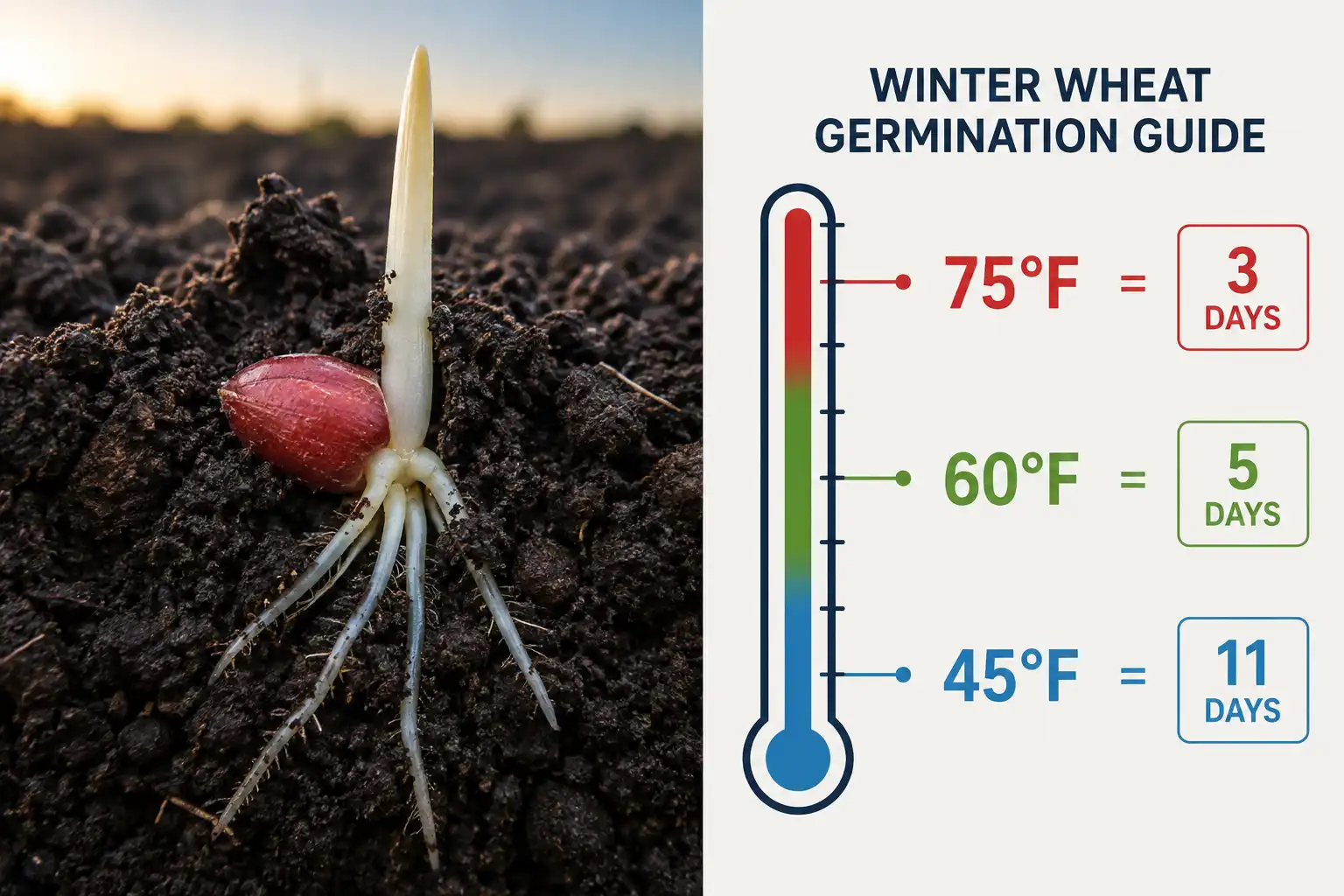
Wheat seed does not sprout on a calendar. Soil temperature and seeding depth set the pace. So how long does it take for wheat to germinate? Three days in warm ground, closer to two weeks in cold ground.
Wheat germinates in 3 to 7 days when soil sits between 54°F and 77°F. Cold soil near 45°F stretches that past 11 days. Emergence runs longer, because the coleoptile still has to reach the surface.
How Long Does It Take for Wheat to Germinate at Different Soil Temperatures?
Wheat germinates in 3 to 7 days when soil at seed depth holds between 54°F and 77°F. K-State Research and Extension treats that band as ideal for stand establishment. Below it, the clock stretches fast.
Wheat runs on heat, not days. Agronomists count growing degree days instead. Wheat needs roughly 80 GDD (Celsius scale, base 0) before the radicle breaks the seed coat. Emergence from a 1-inch seeding takes about 130 GDD, according to Michigan State University Extension. Divide the heat requirement by the daily average, and you get your date.
| Avg soil temp at seed depth | Days to germinate | Days to emerge from 1 inch |
|---|---|---|
| 45°F | 11 | 18 |
| 50°F | 8 | 13 |
| 55°F | 6 | 10 |
| 60°F | 5 | 8 |
| 65°F | 4 | 7 |
| 70°F | 4 | 6 |
| 75°F | 3 | 5 |
| 80°F | 3 | 5 |
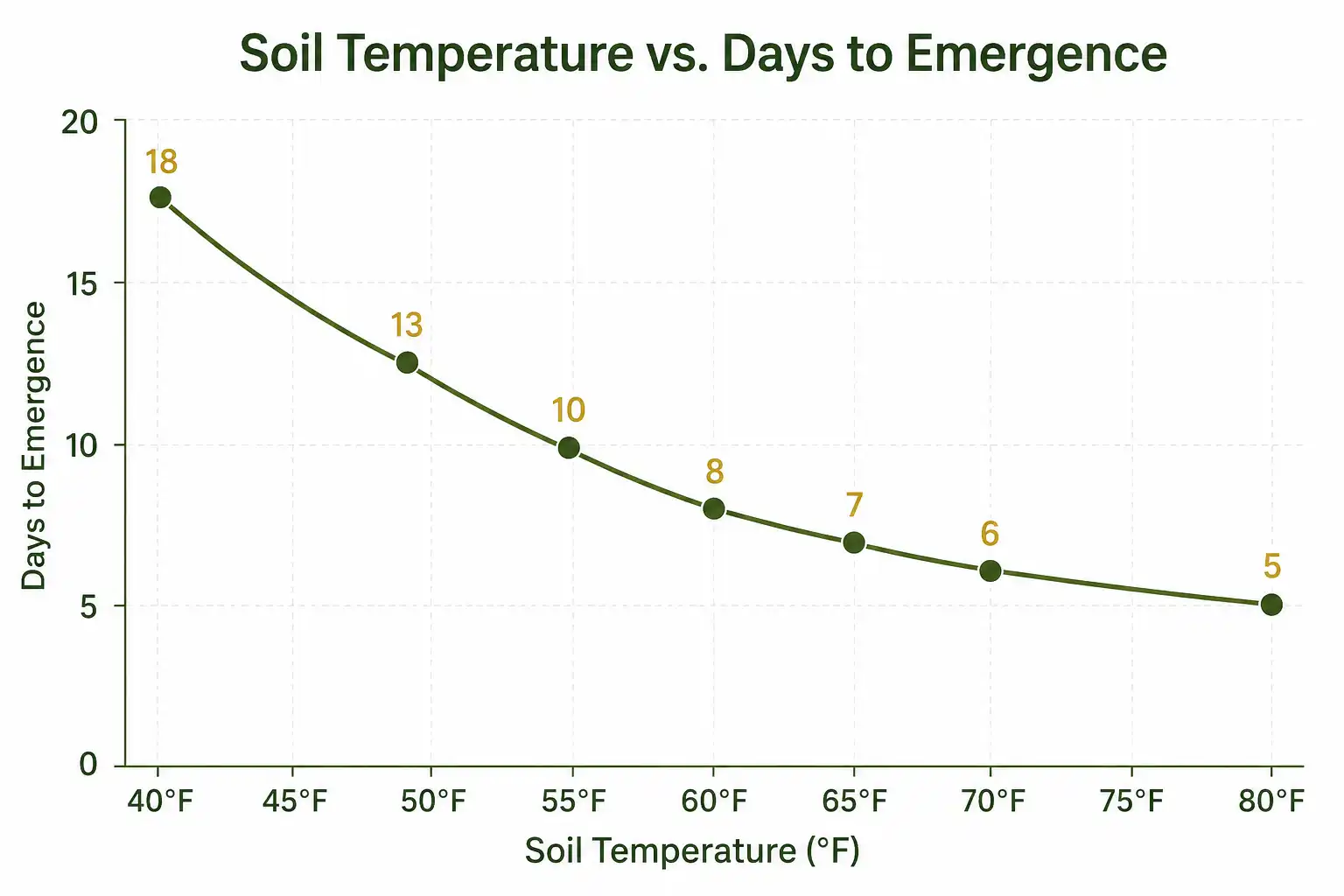
Notice how the bottom of the table barely moves while the top explodes. From 70°F down to 60°F you lose two days. From 55°F down to 45°F you lose eight. That curve explains a lot. Mid-October wheat in Kansas pops in a week. Mid-November wheat can sit for three. Before set the drill, take a reading two inches down. Checking soil temps with a thermometer beats trusting an air forecast.
Germination and Emergence Run on Two Different Clocks
Germination happens underground and you cannot see it. Emergence is the green you count from the pickup. Confusing the two is why farmers panic early.
Oklahoma State University breaks the underground stage into three phases:
- Water absorption. The seed pulls in moisture and swells.
- Activation. Enzymes fire and the seed coat splits.
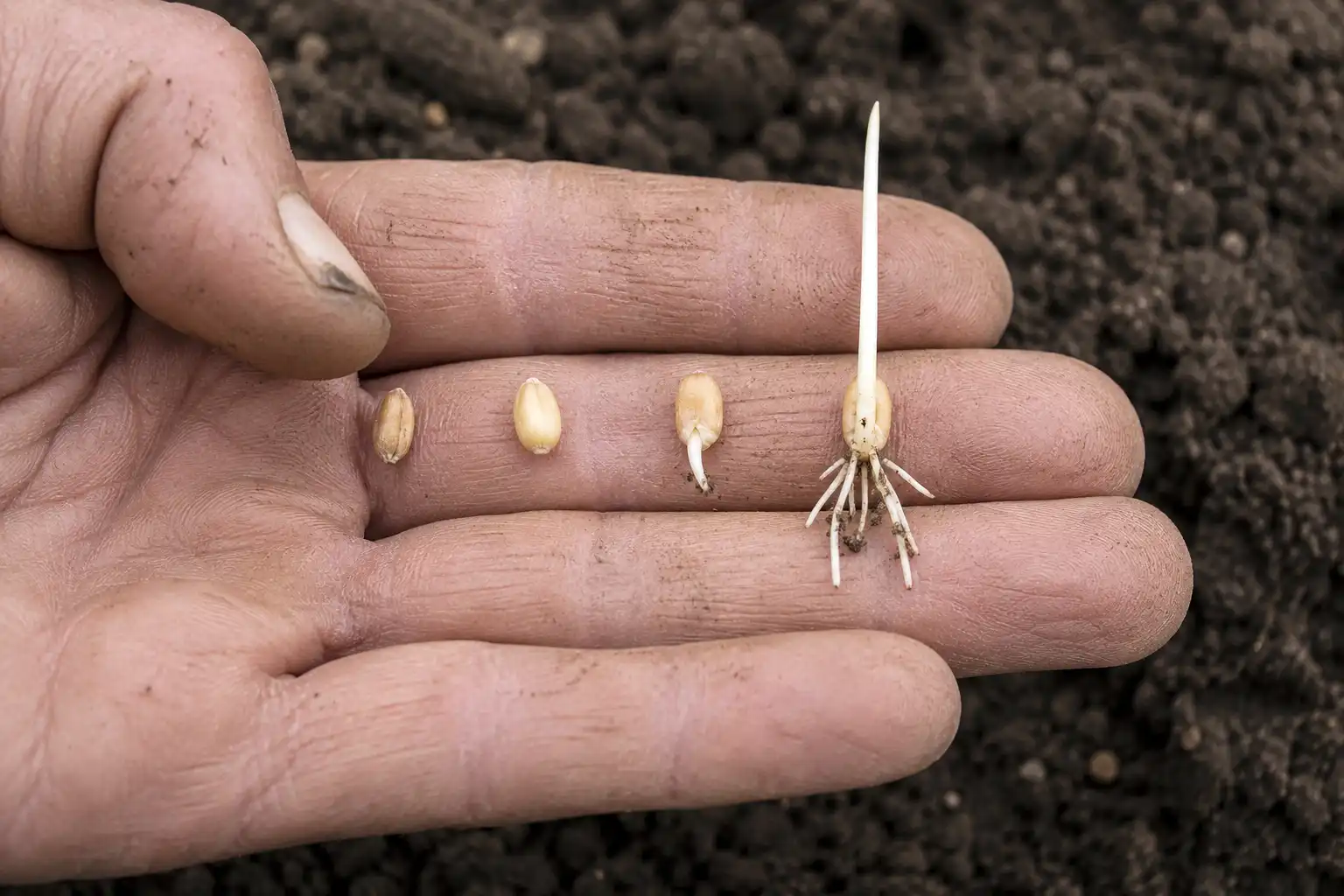
- Visible germination. The radicle pushes out, then seminal roots, then the coleoptile.
Only after phase three does the coleoptile start its climb. That climb is the part seeding depth controls. So a field can be fully germinated on day 4 and still show nothing on day 9.
Dig before you judge. Walk 30 feet down a row, scrape back an inch or two, and pull ten seeds. Swollen seeds with white root tips mean the crop is working. Hard, dry, unchanged seeds mean nothing has started yet.
How Much Does Seeding Depth Add to the Wait?
Every extra inch of depth adds roughly 45 growing degree days, which costs one to three days depending on temperature. Depth does not change germination speed at all. It only changes how long the coleoptile climbs afterward.
| Seeding depth | Days to emerge at 60°F | Days to emerge at 75°F |
|---|---|---|
| 0.5 inch | 7 | 4 |
| 1 inch | 8 | 5 |
| 1.5 inches | 10 | 6 |
| 2 inches | 11 | 7 |
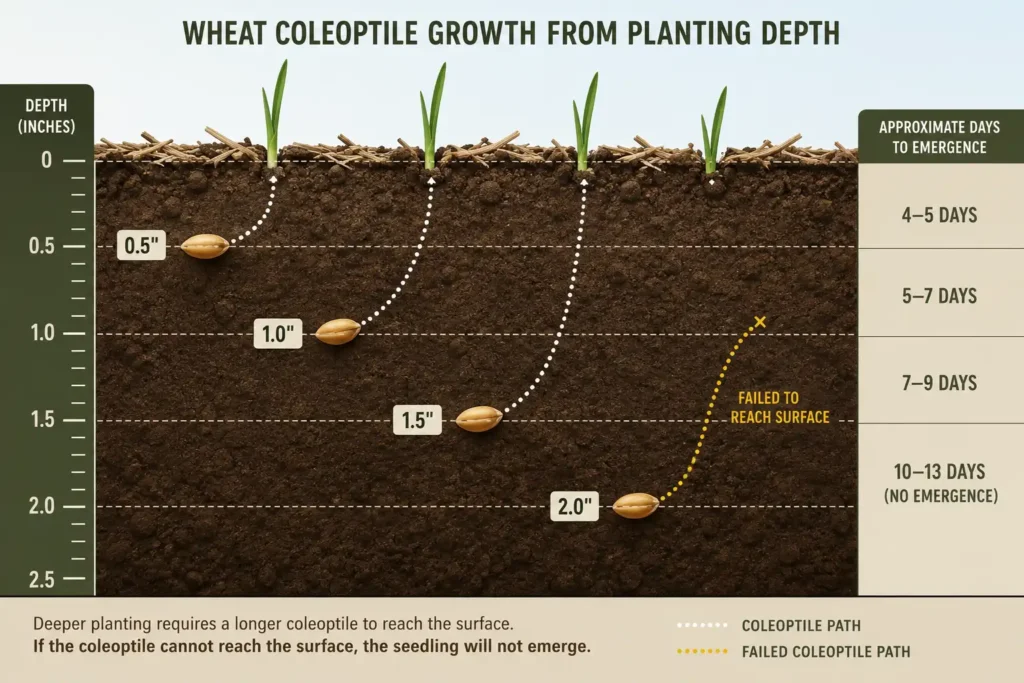
Deeper is not automatically worse. In dryland western Kansas, growers dust seed in deep to reach stored subsoil moisture, and that trade is often correct. But wheat should never go deeper than the coleoptile length of the variety. Once the coleoptile stops short, the first true leaf accordions underground, yellows, and dies.
K-State publishes measured coleoptile lengths by variety in MF3612. That 2025 edition is still the reference going into 2026. Semi-dwarf lines run shorter than tall types. Check yours before you drill deep.
Residue matters too. NDSU notes that heavy residue delays emergence by one to two days. Trash keeps the seedbed cooler. Under no-till, add two days to every estimate in that table.
How Much Moisture Does Wheat Seed Need to Start?
Wheat seed must take up 35% to 45% of its own weight in water before germination begins. That threshold comes from Michigan State University Extension, and it explains a lot of stalled fields. Dry topsoil does not kill seed. It simply pauses the process.
Germination stops and restarts with moisture. If the soil dries out before the radicle appears, the seed holds and waits. Oklahoma State reports that seed stays viable through that pause. The danger window opens about 4 to 5 days after germination starts. Once roots and coleoptile have pushed out, drying soil kills those tissues and you lose the plant.
So the practical rule is simple. Dust-in wheat sitting in dry dirt is fine. Half-germinated wheat in drying dirt is a stand loss in progress.
Before drilling into marginal moisture, pull a core and check seed-zone moisture rather than surface color. A moisture meter reading at two inches tells me more than a fistful of crumbly topsoil.
Why Does Hot Soil Slow Wheat Down Instead of Speeding It Up?
Above roughly 85°F, some winter wheat varieties refuse to germinate at all. High-temperature germination sensitivity varies by variety, and Oklahoma State keeps ratings on it. Warm soil also shortens the coleoptile, which is the second penalty.
K-State measured the drop. A variety with a 2 7/8-inch coleoptile at 60°F soil can fall to 1 5/8 inches at 80°F. That is a 60% reduction. Now that same seed at 2 inches deep cannot reach daylight.
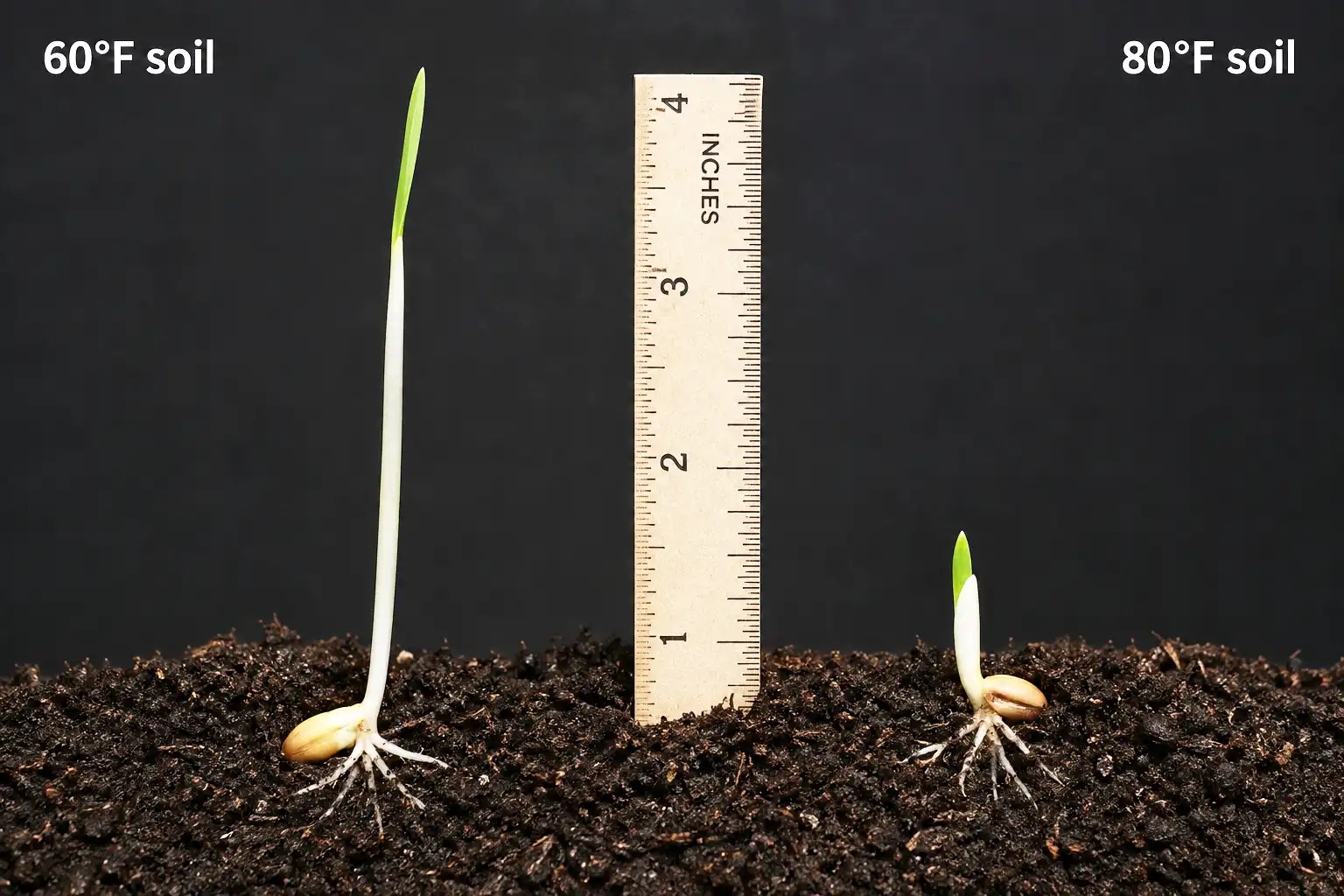
Early September drilling for fall grazing runs straight into this. Soil temps in the Great Plains often stay above 85°F into mid-September. K-State’s answer is direct. Plant shallow into warm soil, 3/4 to 1 inch, even when the top layer is dry. Wait for the rain rather than chase moisture downward.
Soil generally cools past the danger point around September 20 in this region. Sensitive varieties belong after that date. Tolerant types can go earlier. Either way, your winter wheat planting date should track soil temperature and the Hessian fly-free date. The calendar alone is not enough.
How Do You Test Wheat Germination Before You Drill?
Run a rag doll test seven days before planting. It costs nothing and takes five minutes of setup.
- Pull a representative sample from several spots in the bin or bag. Do not hand-pick good-looking kernels.
- Count out exactly 100 seeds.
- Lay them in rows on a damp paper towel, leaving space between kernels.
- Roll the towel into a loose tube and slide it into a plastic bag. Leave the bag open a crack for air.
- Hold it at 65°F to 75°F, out of direct sun. Room temperature works.
- Count sprouted seeds on day 4, then again on day 7. Remove each one as you count.
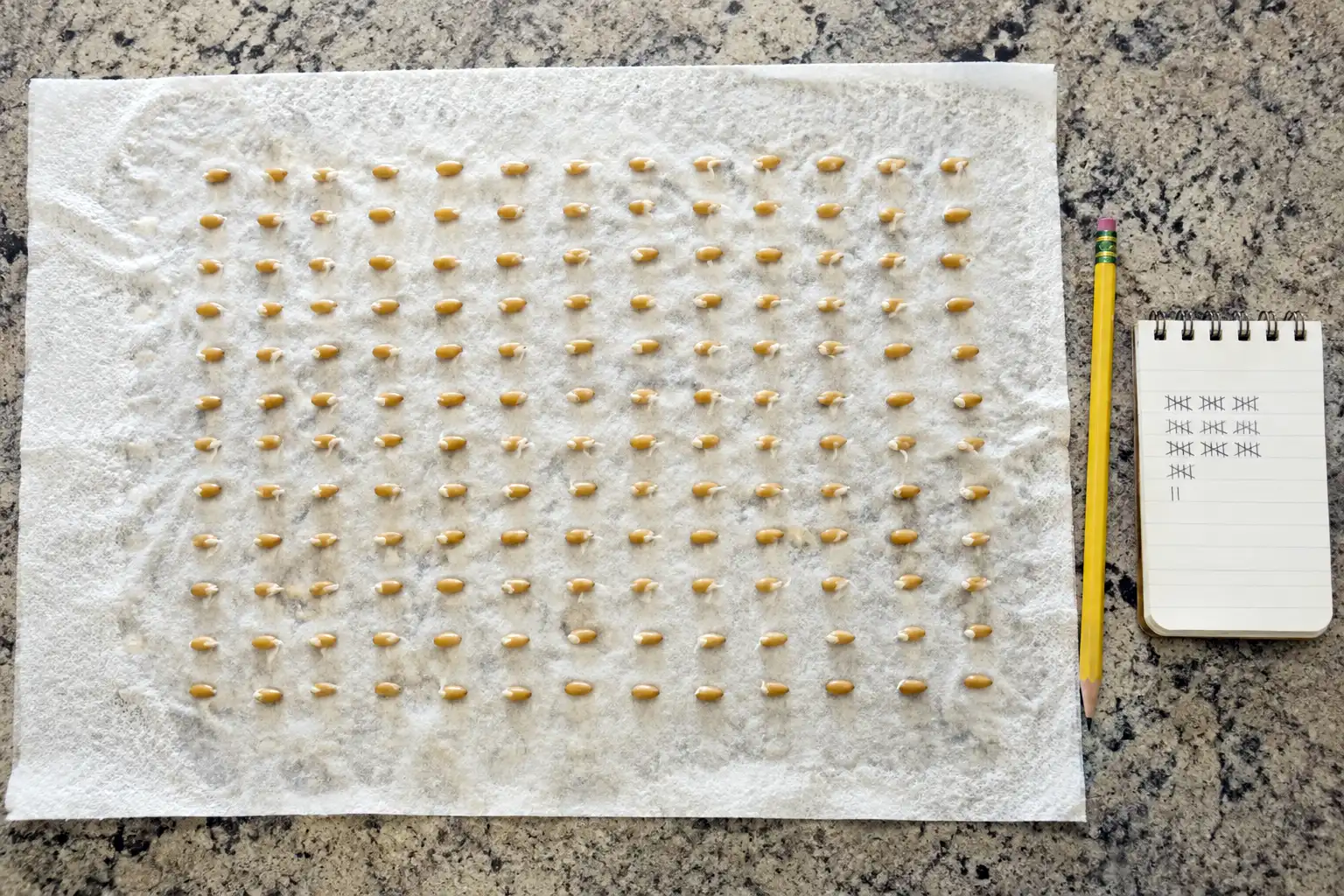
The day-7 total is your germination percentage. Certified seed should clear 90%. Bin-run seed after a wet harvest often does not.
Adjust your rate to the result. Seed at 85% germination needs about 18% more pounds per acre to hit the same stand. Below 80%, buy new seed. Vigor matters too. Seed that needs all seven days to reach its total will struggle in cold soil. The final number can still look fine.
What Should You Check When Wheat Has Not Emerged on Time?
Dig first, diagnose second, and only then decide about replanting. The seed itself tells you which problem you have.
| What you find | Likely cause | What to do |
|---|---|---|
| Seed hard, dry, unchanged | Never reached 35% moisture uptake | Leave it. Seed stays viable and waits for rain |
| Seed swollen, short white root, no shoot | Germinated but cold soil is slowing it | Add up the GDD and give it more days |
| Coleoptile bent or accordion shaped underground | Crust formed after hard rain | Run a rotary hoe to break the crust |
| Yellow shoot that quit below the surface | Drilled deeper than coleoptile length | Count the stand and decide on replant |
| Seed soft, brown, mushy | Seedling rot in cold wet ground | Switch to fungicide-treated seed |
| Kernel hollowed out | False wireworm feeding | Scout, then plan a seed treatment next season |
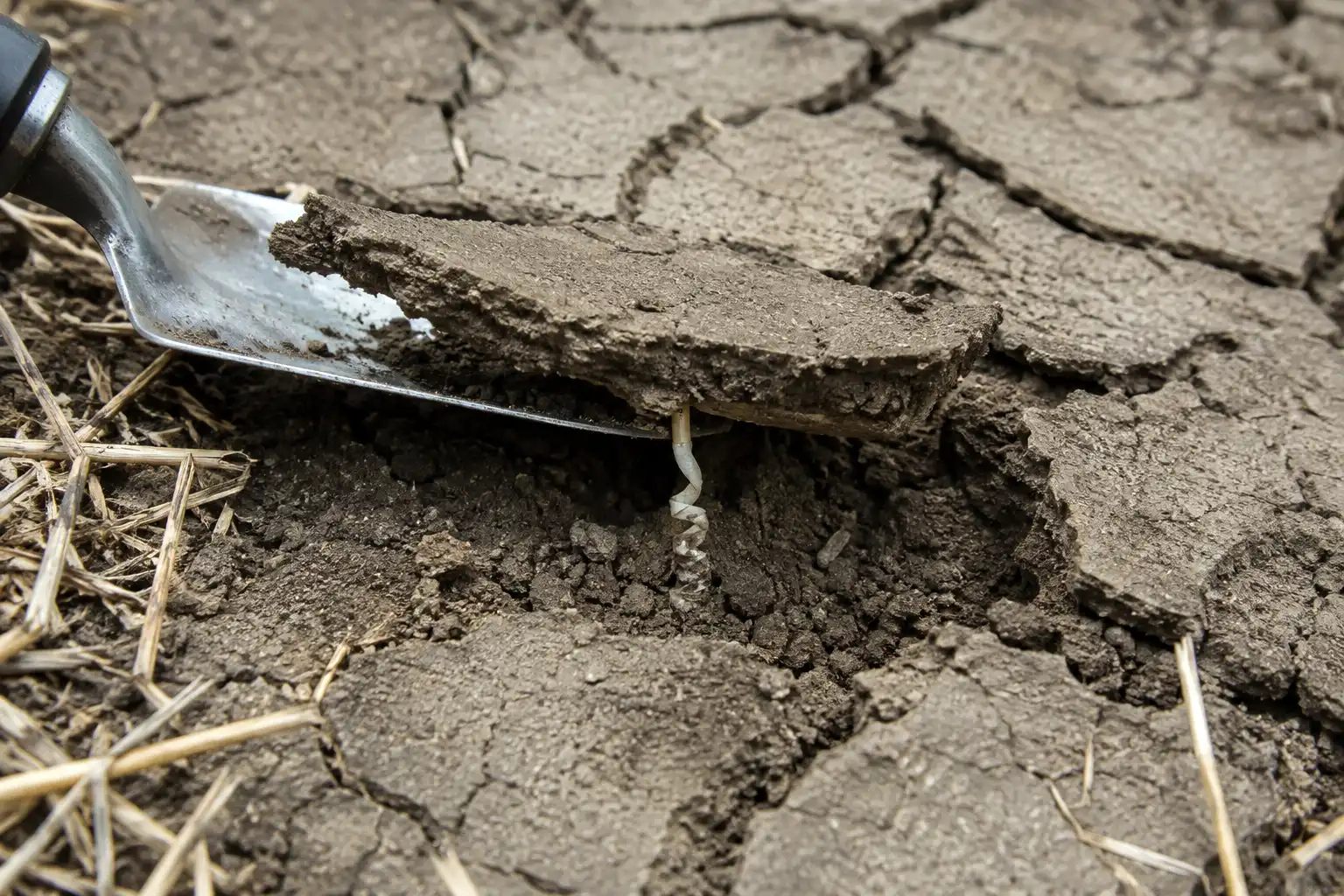
Count before you replant. K-State wants 4 to 5 leaves and 1 to 2 tillers going into dormancy for full cold tolerance. A thin but healthy stand usually beats a late replant. If the calendar has run out, weigh the yield cost of late winter wheat planting against drilling twice.
Does Spring Wheat Germinate Faster Than Winter Wheat?
The seed physiology is identical. Only the soil temperature differs, and that is why spring wheat almost always takes longer to show.
Spring wheat goes in when 3-day average soil temperature reaches 34°F to 40°F, per SDSU and Montana State guidance. At those temps you are looking at three weeks or more to emergence. Winter wheat drilled into 70°F September soil emerges in under a week.
Neither number reflects seed quality. Both reflect heat accumulation. So do not compare a slow April stand to a fast October stand. The seed is probably fine.
Spring wheat planting timing still favors going early. Yield potential drops with delay, so most Northern Plains growers accept the slow emergence rather than wait for warmth. Other small grains behave the same way. The time for oats to germinate follows a similar curve, with a slightly higher floor.
Final Verdict
Germination speed comes down to three numbers: soil temperature at seed depth, seeding depth, and moisture in the seed zone. Get those right and wheat rarely surprises you.
Routine is short. Probe soil temp two inches down. Look up the expected day count, add two days for residue, then mark the shop calendar. Little happens above the surface before that date. Digging down is the only way to confirm progress underneath. When the date passes with no green, pull ten seeds and read them against the table above.
Much of the wheat labeled as failed in Kansas has not actually failed. It was cold, deep, or dry, and it was still coming.