How Many Pounds of Wheat Per Acre? Seed Rates and Yields
Seed bags and grain tickets both use pounds, so pounds of wheat per acre splits into two very different answers. One covers seed going into the drill. The other covers grain coming off the combine.
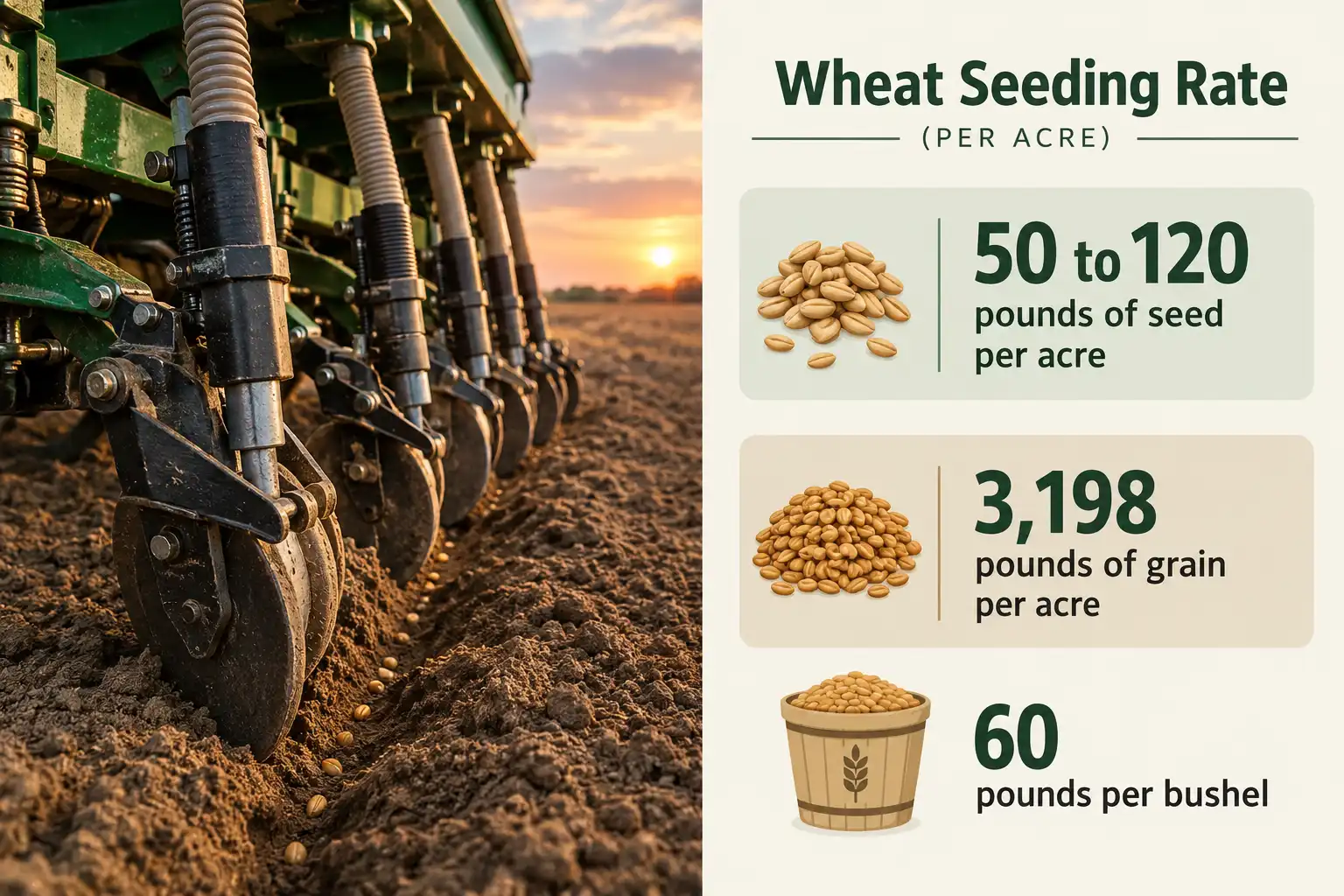
Wheat seed goes in at 50 to 120 pounds per acre, set by region and planting date. An average acre then returns about 3,200 pounds of grain, since USDA counts each wheat bushel as 60 pounds.
Seed or Grain: Which Number You Need
Two very different figures answer the same phrasing. Seed rates run in the double digits. Harvest weights run in the thousands.
Seeding rate decides how much certified seed to buy and how to set the drill. Yield decides what the acre pays. Both matter. But they answer different questions at different points in the season.
| Measurement | Typical range per acre | What it drives |
|---|---|---|
| Wheat seed planted | 50 to 140 pounds | Seed cost, stand density, drill setting |
| Wheat grain harvested | 1,700 to 5,300 pounds | Revenue, storage volume, hauling loads |
Seed rates come first below, since that decision comes first.
How Many Pounds of Wheat Seed Per Acre?
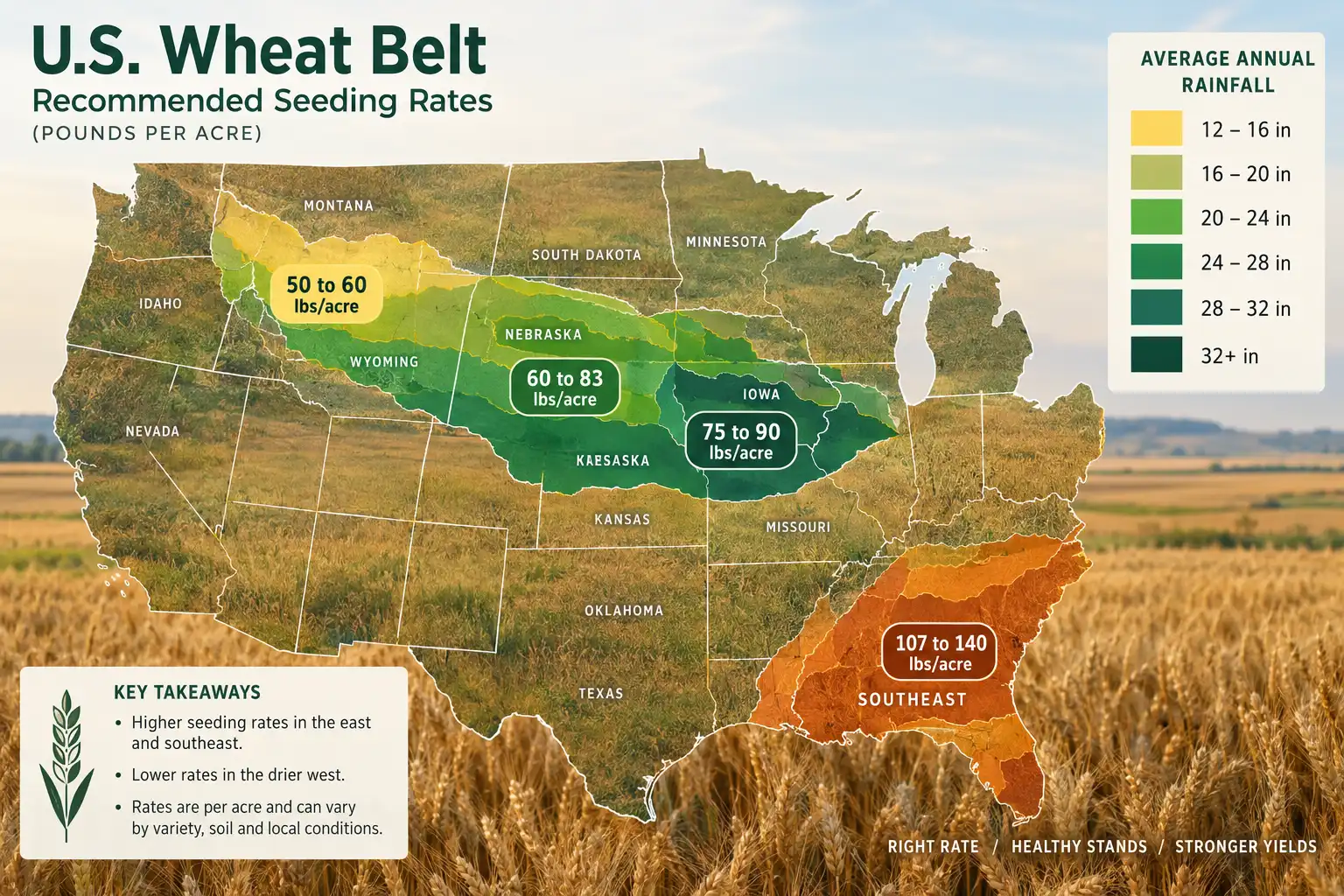
Plan on 50 to 90 pounds per acre across most of the Great Plains. Humid Southeast fields take up to 140 pounds. Rainfall drives the spread, because drier ground supports fewer heads and needs less seed.
K-State Research and Extension sets Kansas rates by precipitation zone, rising from west to east. Nebraska and the Northern Plains follow similar logic. Soft red winter wheat country runs much higher, since those fields carry far more moisture.
| Region or class | Target seeds per acre | Pounds per acre* | Source |
|---|---|---|---|
| Western Kansas, under 20 inches rain | 750,000 to 900,000 | 50 to 60 | K-State Research and Extension |
| Central Kansas, 20 to 30 inches rain | 900,000 to 1,250,000 | 60 to 83 | K-State Research and Extension |
| Eastern Kansas, over 30 inches, or irrigated | 1,125,000 to 1,350,000 | 75 to 90 | K-State Research and Extension |
| Nebraska irrigated, optimum date | 1,350,000 | 90 | Nebraska Extension |
| Nebraska rainfed, upper limit | 1,800,000 | 120 | Nebraska Extension |
| Northern Plains hard red spring | 1,440,000 to 1,560,000 | 96 to 104 | NDSU Extension |
| Southeast soft red winter, drilled | 1,600,000 to 2,100,000 | 107 to 140 | NC State Extension |
*Pounds calculated at 15,000 seeds per pound. Spring wheat seed figures reflect the NDSU harvest stand target of 1.3 to 1.4 million plants plus 10 percent stand loss.
Upper Limits on Wheat Seeding Rate
K-State also sets a ceiling. For grain-only fields, stay under 90 to 100 pounds per acre in western Kansas. Central and eastern Kansas cap out near 120 to 130 pounds. Past that, lodging risk climbs and heavy fall growth burns spring moisture. K-State calls that failure “haying off,” and it hit hard during the 2023 to 2024 season.
Why Seeds Per Acre Beats Pounds Per Acre
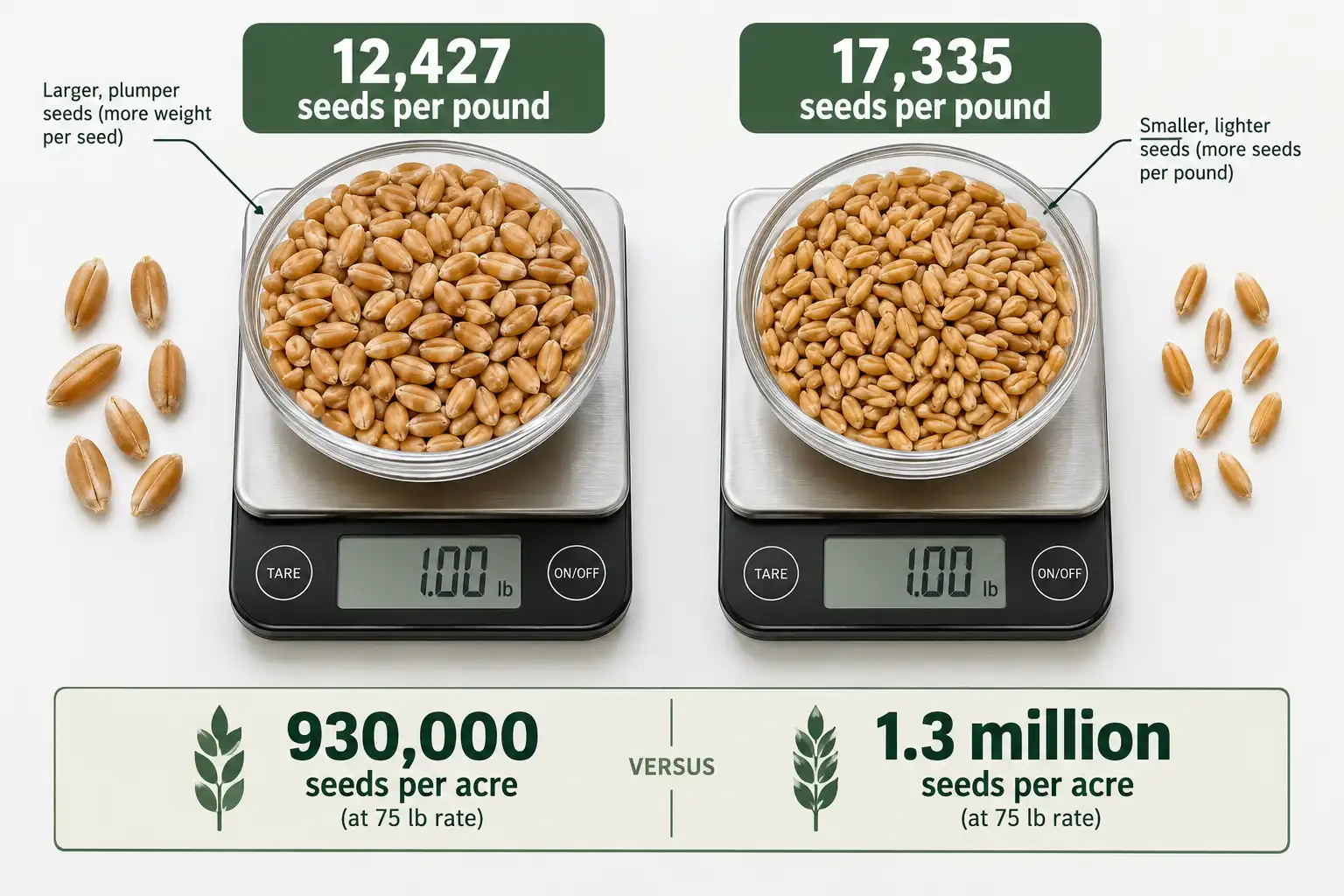
Pounds are a poor unit for wheat because kernel size swings widely. Seed lots run from about 10,000 to more than 18,000 seeds per pound. Most fall between 14,000 and 16,000.
That variation wrecks a fixed pound rate. K-State research measured 12,427 seeds per pound in one top-gravity lot. An uncleaned lot of another variety hit 17,335. Drill both at 75 pounds per acre and the results split. One field gets 930,000 seeds, the other 1.3 million. Same drill setting, a 40 percent gap in stand.
So read the seed tag. Certified and germination-tested lots list seeds per pound, and that number lets you hit a real population target. The same logic applies to oat seeding rates and other small grains.
Two more reasons to think in seeds:
- Large kernels emerge better from deep furrows, so trimming rate on a big-seeded lot backfires
- Tillering ability shifts the optimum, and NDSU trials found variety optimums from 600,000 to 2 million seeds per acre
How to Calculate Your Own Seeding Rate
Use the standard extension formula. NDSU Extension and other land-grant programs publish this version.
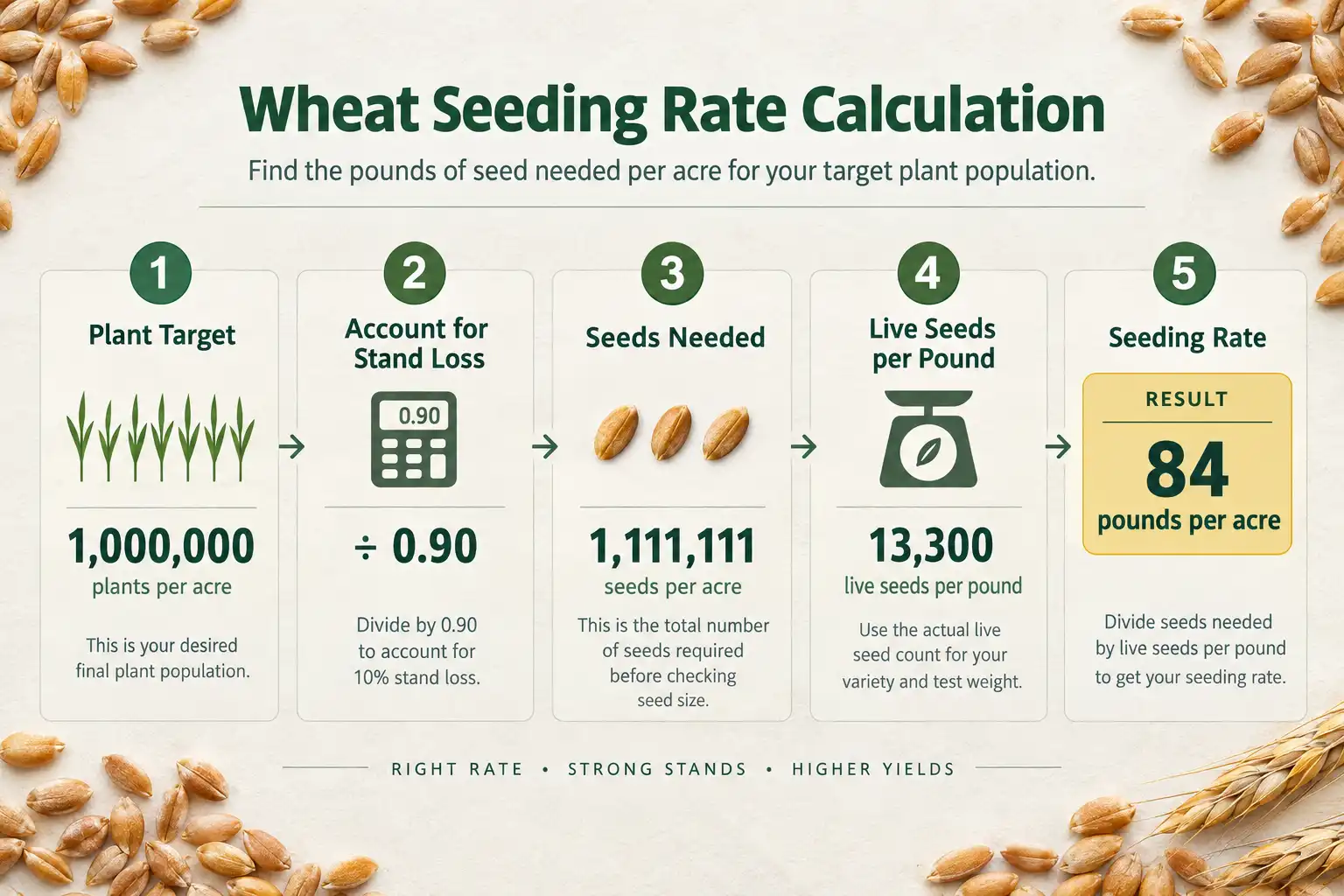
Seeding rate in pounds per acre = [desired stand ÷ (1 minus expected stand loss)] ÷ [(seeds per pound) × (percent germination)]
Work a winter wheat example.
- Desired stand: 1,000,000 plants per acre
- Expected stand loss: 10 percent, so divide by 0.90
- Seeds needed: 1,111,111 per acre
- Seed lot: 14,000 seeds per pound at 95 percent germination, or 13,300 live seeds per pound
- Result: 1,111,111 ÷ 13,300 = about 84 pounds per acre
NDSU puts expected stand loss at 10 to 20 percent even in a good seedbed. Poor depth control pushes it higher. So verify wheat seeding depth before you trust any calculated rate. Then calibrate the drill on every seed lot.
Spring wheat targets a denser stand. NDSU aims for 1.3 to 1.4 million plants per acre at harvest, which lands near 100 pounds of seed. Winter wheat gets away with less, because it tillers through early spring.
How Planting Date Changes the Rate
Every week of delay calls for more seed. Late wheat makes fewer fall tillers. Fall tillers carry more yield than spring tillers, so extra plants must rebuild the head count.
In western Kansas, K-State recommends adding 150,000 to 225,000 seeds per acre per week of delay. That equals roughly 10 to 15 pounds. In eastern Kansas the bump runs 225,000 to 300,000 seeds, or 15 to 20 pounds. University of Nebraska-Lincoln Extension uses a similar 10 to 15 pound step on rainfed fields. Irrigated ground takes 30 pounds per week, capped at 180 pounds.
Spring-planted small grains follow a daily rule instead. NDSU Extension advises raising the rate 1 percent per day of delay, up to 1.6 million seeds per acre. Check the spring wheat planting window for your latitude before setting that adjustment.
Higher rates recover some yield but not all. K-State data from Garden City tracked the cost of delay. Moving sowing from October 1 to November 1 pushed heading back six days and cut yield 23 percent. Extra seed narrows that gap without closing it, which is worth weighing before planting winter wheat late.
Drilled Versus Broadcast Wheat Seeding Rates
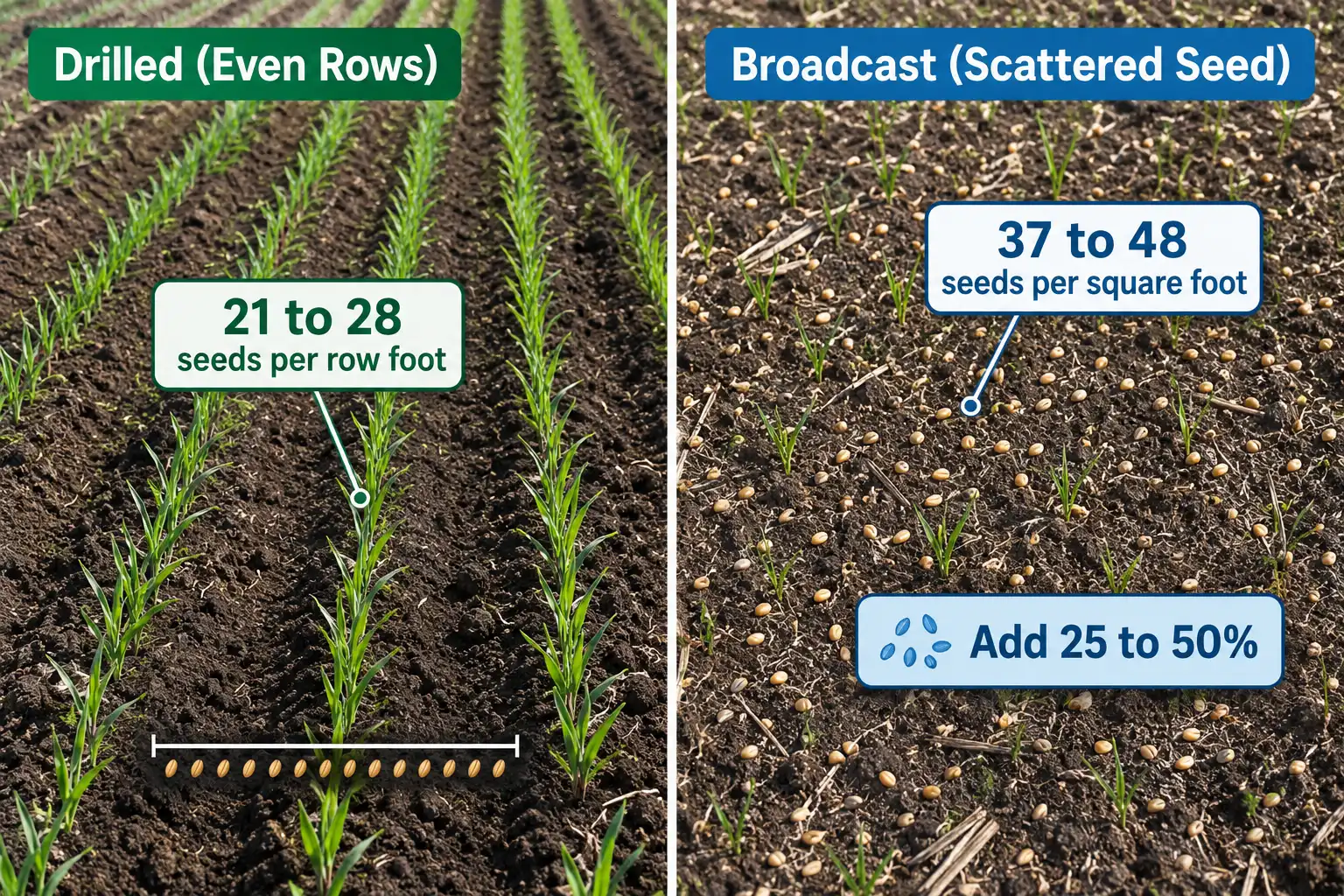
Broadcast seeding needs 25 to 50 percent more seed than a drill. Scattered seed lands at random depth, so emergence drops and stands come out uneven.
NC State Extension puts drilled soft red winter wheat at 21 to 28 seeds per row foot. The broadcast equivalent runs 37 to 48 seeds per square foot. NC State also suggests splitting the broadcast rate in half and covering the field in two directions. Where time or equipment rules that out, a light tillage pass improves seed to soil contact.
Residue changes the math too. Nebraska Extension notes that no-till drilling into row crop stubble often takes up to 50 percent more seed. Drills struggle to hold depth through old rows.
| Method | Seed placement | Rate adjustment |
|---|---|---|
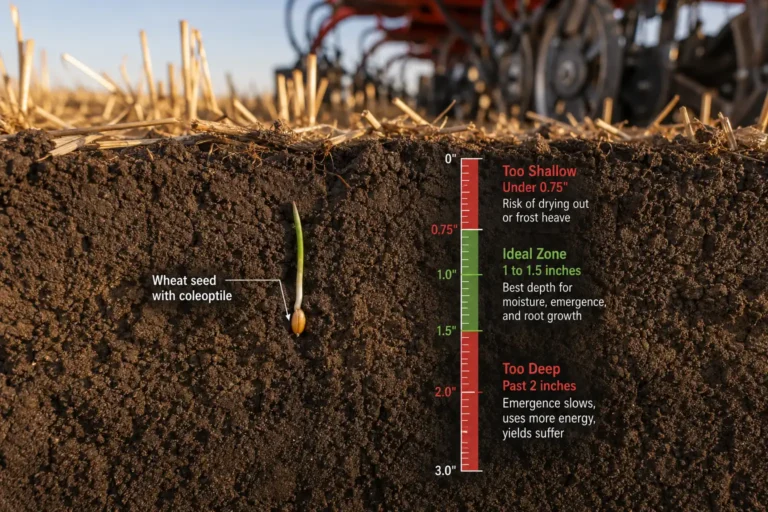
| Grain drill, clean seedbed | 1 to 1.5 inches | Baseline |
| No-till drill, heavy residue | Variable depth | Add up to 50 percent |
| Broadcast plus incorporation | Shallow, uneven | Add 25 to 50 percent |
| Broadcast, no incorporation | Surface | Poor stands, not advised |
Row spacing matters as well. Wider units leave gaps, so many growers seed twice at half rate on an angle. Still, solid wheat planting steps beat any rate correction.
How Many Pounds of Wheat Per Acre Do You Harvest?
An average US acre produced 3,198 pounds of wheat in 2025. USDA NASS estimated the all-wheat yield at a record 53.3 bushels per acre. A wheat bushel counts as 60 pounds.
Class and geography move that figure hard. Illinois soft red winter wheat cleared 5,000 pounds. Dryland Montana spring wheat came in under 1,800.
| 2025 crop, USDA NASS | Bushels per acre | Pounds per acre |
|---|---|---|
| All wheat, United States | 53.3 | 3,198 |
| Winter wheat, United States | 54.9 | 3,294 |
| Other spring wheat, United States | 51.7 | 3,102 |
| Durum, United States | 40.6 | 2,436 |
| Illinois winter wheat | 88.0 | 5,280 |
| Kansas winter wheat | 51.0 | 3,060 |
| Minnesota spring wheat | 69.0 | 4,140 |
| North Dakota spring wheat | 55.0 | 3,300 |
| Montana spring wheat | 29.0 | 1,740 |
Expect a lower number this year. USDA NASS forecast the 2026 all-wheat yield at 47.8 bushels per acre in its August report, or about 2,868 pounds. Winter wheat sits at 47.0 bushels, near 2,820 pounds, after a hard red winter season that ran short.
Converting Bushels to Pounds Correctly
Multiply bushels by 60. USDA assigned wheat a 60 pound bushel weight for trade, so that one step converts any yield or load into pounds.
Test weight is a separate measurement. USDA Agricultural Marketing Service grade standards set a 60.0 pound minimum test weight for US No. 1 wheat in most classes, and 58.0 pounds for No. 2. Hard red spring and white club wheat carry lower minimums at 58.0 and 57.0.
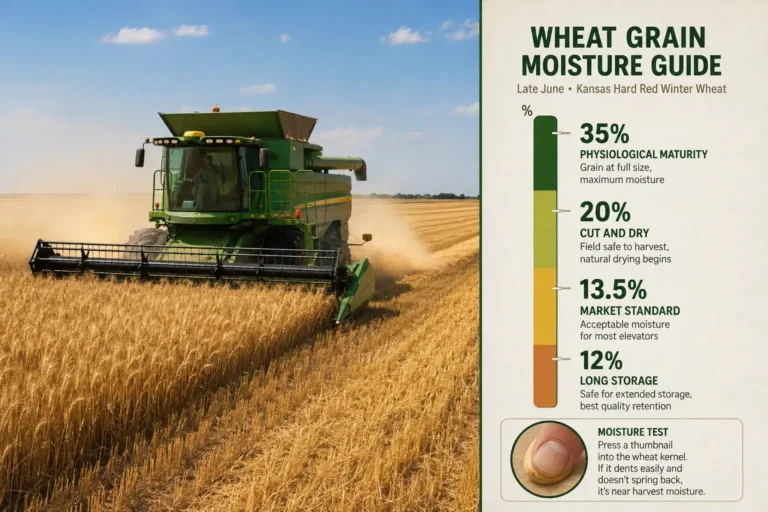
So a load still converts at 60 pounds per bushel even when test weight reads 57.5. Grade and price shift, but bushel accounting does not. Moisture matters too, since elevators dock wet grain and adjust settled weight.
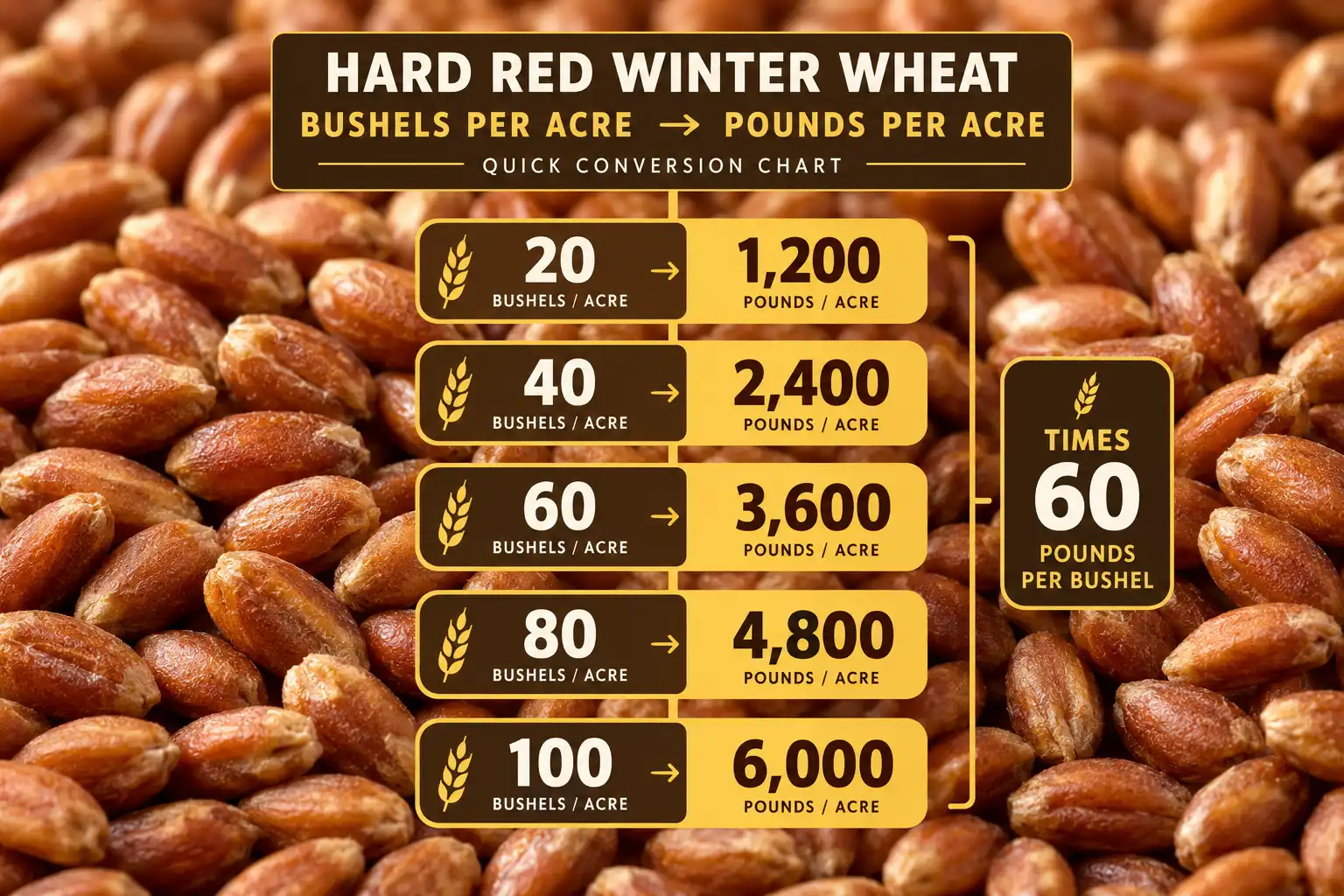
Quick reference:
- 20 bushels per acre = 1,200 pounds
- 40 bushels per acre = 2,400 pounds
- 60 bushels per acre = 3,600 pounds
- 80 bushels per acre = 4,800 pounds
- 100 bushels per acre = 6,000 pounds
What Limits Pounds Per Acre
Yield comes down to heads per acre, kernels per head, and kernel weight. Most shortfalls trace to one of those three.
Thin stands. Poor depth control and dry seedbeds cut emergence. Nebraska Extension notes stand losses climb sharply when drills cannot hold depth in stubble.
Overseeding. Too many plants raise lodging risk and pull spring moisture early. That is the haying off pattern K-State documented.
Nitrogen shortfall. Protein and kernel fill both need adequate nitrogen through jointing. Soil testing sets the rate, never a fixed recipe.
Late planting. Fewer fall tillers means fewer productive heads, even at a corrected seeding rate.
Disease pressure. Fusarium head blight and stripe rust shrink kernels and drop test weight. Pounds fall while paper bushel counts hold.
Harvest loss. Header setting and ground speed leave grain in the field. Correct wheat harvest timing protects the pounds already made.
Frequently Asked Questions
How many pounds of wheat seed do I need for one acre?
How many pounds of wheat are in a bushel?
How many bushels of wheat come off one acre?
Is 100 pounds of wheat seed per acre too much?
How many seeds are in a pound of wheat?
Do I need more seed for broadcast wheat?
Does seeding rate change wheat protein?
Key Numbers to Carry Into the Field
Two figures answer this question. Seed goes in at 50 to 140 pounds per acre, set by rainfall, class, and calendar date. Grain comes off at roughly 1,700 to 5,300 pounds, with a 2025 national average of 3,198 pounds.
Set the drill on seeds per acre, not pounds. Read the seed tag, adjust for stand loss and germination, then add seed for every week you plant late.