When to Cut Oats for Hay: Boot vs Soft Dough Timing
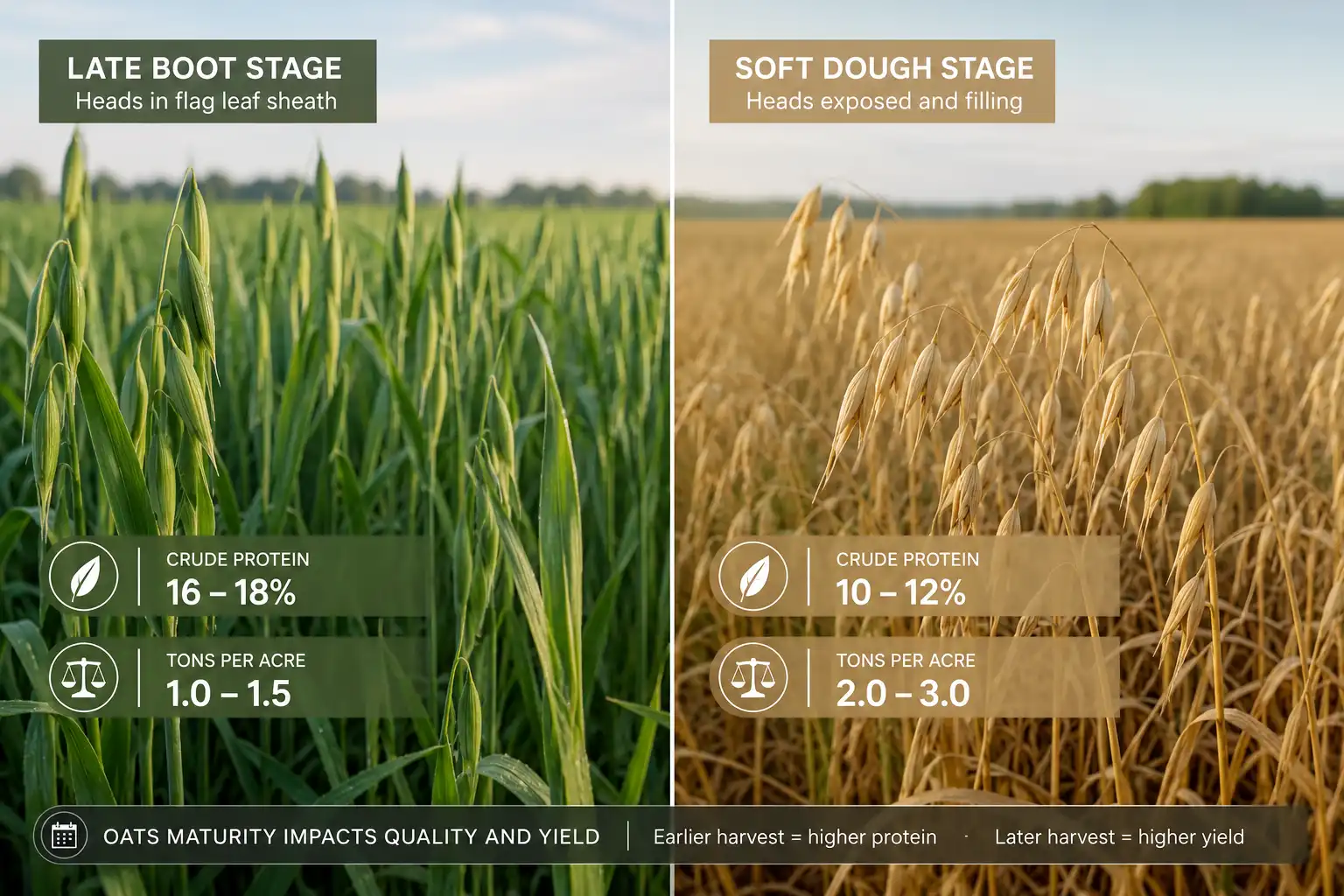
Oat hay loses feed value fast once the crop starts filling grain. So the cutting decision hinges on which animals eat the bales. Knowing when to cut oats for hay means matching growth stage to herd, then baling dry.
The right cutting stage depends on the herd. Late boot to early heading suits dairy cows and young stock. Milk to soft dough adds tonnage for mature cows and horses. Herd class settles when to cut oats for hay.
What Is Oat Hay?
Oat hay is the whole oat plant cut, cured, and baled for livestock feed before grain fully matures. Producers feed it to horses, beef cattle, dairy heifers, sheep, and goats. Cut at the right stage, oat hay carries moderate crude protein, soft fiber, and high palatability.
Which Growth Stage Gives the Best Oat Hay?
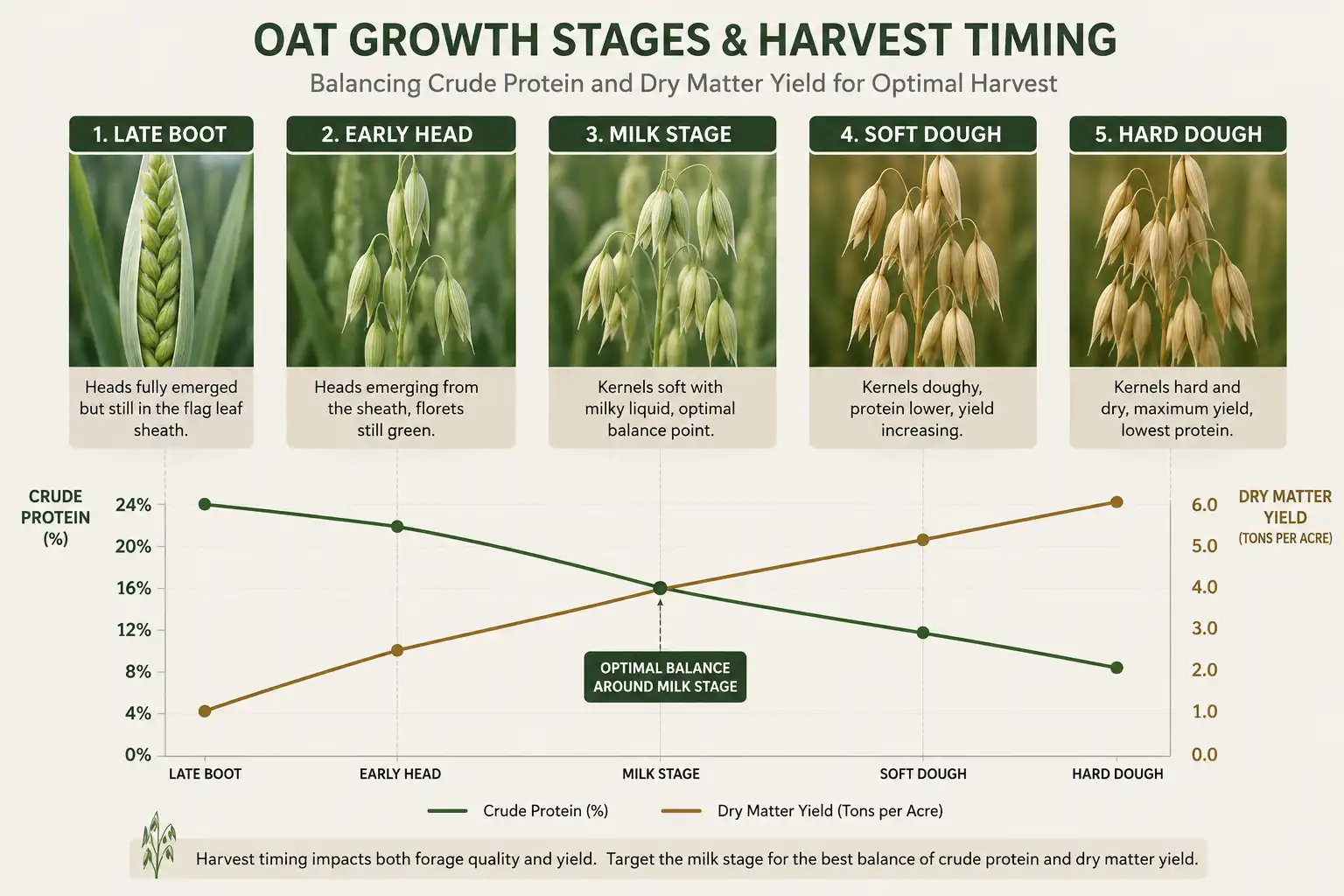
No single stage wins, because protein and tonnage move in opposite directions. Kansas State University Research and Extension puts the balanced hay window at late boot to early heading. University of Nebraska-Lincoln Extension trials track the slide. Crude protein falls from about 18 percent at boot to near 10 percent by dough stage. Dry matter climbs the whole way.
University of Wisconsin Extension measured that trade in tons. Late boot cutting returns roughly 1.5 to 2.5 tons of dry matter per acre. Milk and dough cutting pushes 3.0 to 4.0 tons. So a later cut can nearly double the pile while cutting protein almost in half.
| Growth stage | Field check | Crude protein | Dry matter yield | Best fit |
|---|---|---|---|---|
| Late boot | Head still swollen inside the flag leaf sheath | About 16 to 18% | 1.5 to 2.5 tons per acre | Lactating dairy cows, dairy heifers, growing calves |
| Early heading | First heads pushing clear of the sheath | About 13 to 16% | 10 to 20% above late boot | Young growing cattle, horses needing soft hay |
| Milk | Squeezed kernel releases thin white liquid | About 11 to 13% | 3.0 to 4.0 tons per acre | Dry cows, beef cow herds, mature horses |
| Soft dough | Kernel presses to paste with no free liquid | About 9 to 11% | 3.0 to 4.0 tons per acre | Gestating beef cows, top tonnage per acre |
| Hard dough | Kernel resists a thumbnail, heads turning yellow | Below 9% | Flat or falling | Straw or bedding rather than quality hay |
Late Boot to Early Heading
Cut here when feed quality outranks volume. The head sits swollen inside the flag leaf sheath, stems stay soft, and leaf-to-stem ratio peaks. Boot-cut small grain forage runs 16 to 20 percent crude protein depending on variety, per University of Wisconsin Extension. Nebraska Extension data also show dry matter rising 10 to 20 percent from boot to early heading. So waiting for the first heads costs almost no quality.
Milk Stage
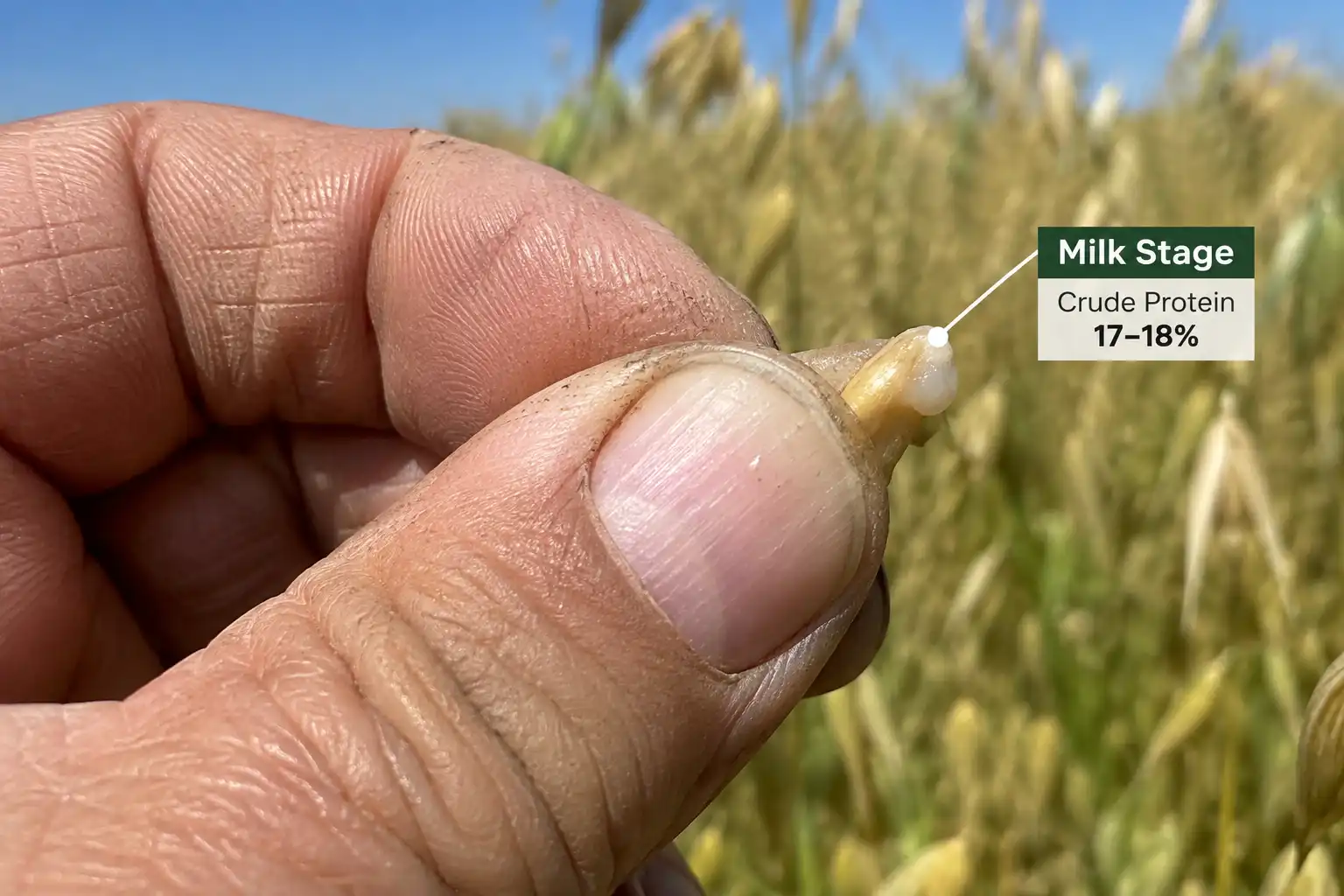
Milk stage marks the practical middle. Squeeze a kernel and thin white liquid runs out. Tonnage has already reached the 3-ton range on decent ground, yet stems still bend rather than snap. Most beef cow hay and horse hay lands here.
Soft Dough
Soft dough delivers maximum tonnage with acceptable quality for mature animals. Kernels press into a paste with no free liquid. Kansas State Research and Extension reports dough-stage oat hay near 56 percent TDN and 10 percent protein. Those numbers feed a dry cow well and fall short for a milking one.
Hard Dough and Later
Stop before this point. Oklahoma State University Extension notes what happens past early flowering. Once grain fill starts, forage yield adds little while quality keeps dropping. Ripe heads also shatter during raking, and Oklahoma State warns that stored hay carrying grain draws rodents and insects. At that stage the crop belongs in the grain plan. So check oat grain harvest timing instead of baling it.
When to Cut Oats for Hay by Livestock Class
Match the cutting stage to the animal, because a single field can serve either goal. Nebraska Extension states the rule plainly. Cut at boot or shortly after heading for young growing cattle that need protein. Then delay to dough stage for mature cows and feedlot animals.
- Lactating dairy cows: late boot, cut as the first heads appear
- Dairy heifers and growing calves: late boot to early heading
- Horses: early heading to milk, since soft stems and low dust matter most
- Beef cow herds and dry cows: milk to soft dough
- Gestating beef cows and low-cost wintering: soft dough for volume
That single decision drives every step after it, including drying time and safe baling moisture.
How Do You Tell Which Oat Stage You Are In?
Pull heads from several spots and test them by hand. One pass across the field beats any calendar date. Sample the middle of the field along with the headlands, because thin ground matures first.
Run these four checks:
- Sheath check. Feel for a swollen head still trapped inside the flag leaf. That means boot.
- Kernel squeeze. Thin white liquid means milk. Paste with no liquid means soft dough. Resistance to a thumbnail means hard dough.
- Lower stem color. Green and flexible stems cure well. Hollow brown stems signal a late cut.
- Leaf condition. Supple leaves hold feed value. Papery lower leaves point to lost quality already.
Regional Cutting Windows for Oat Hay
Cutting dates swing by more than two months across the country. So treat state extension calendars as the starting point. Spring seeding date sets most of that spread. That makes planting oats for hay as important as the cut itself. Penn State Extension reports oats reaching milk stage 55 to 65 days after germination. Spring-seeded forages generally come off about 75 days after seeding.
| Region | Typical spring seeding | Usual hay cutting window |
|---|---|---|
| Southern Plains (Oklahoma, north Texas) | Late winter into early spring | April into early May |
| Central Plains (Nebraska, Kansas) | Late March into early April | Mid to late June |
| Upper Midwest (Wisconsin, Iowa, Minnesota) | Early to mid April | Mid June into early July |
| Northeast (Pennsylvania, New York) | Mid April into early May | Late June into July |
Oklahoma State University Extension puts the state’s window at boot to early heading. That falls in April into early May. Nebraska Extension puts small grain hay harvest around the third week of June. University of Wisconsin variety trials cut oats at late boot between June 16 and July 1.
How Long Does Oat Hay Take to Dry?
Plan on three to five clear days, and longer for a boot-stage cut. Standing oats hold roughly 70 to 80 percent moisture at cutting. So the crop sheds most of its weight in water before baling. Oat stems are thick and hollow, which makes them slower than grass hay.
Four setup choices control that timeline:
- Conditioner. Roller or flail conditioning cracks the stems so water escapes instead of sitting inside them.
- Swath width. Lay the crop wide across the stubble rather than in a rope. More sun on more surface dries faster.
- Stubble height. Cut at 3 to 4 inches. Tall stubble lifts the windrow off wet soil and lets air move underneath.
- Tedding. Ted only while the crop is still well above baling moisture. Late tedding shatters leaves and heads.
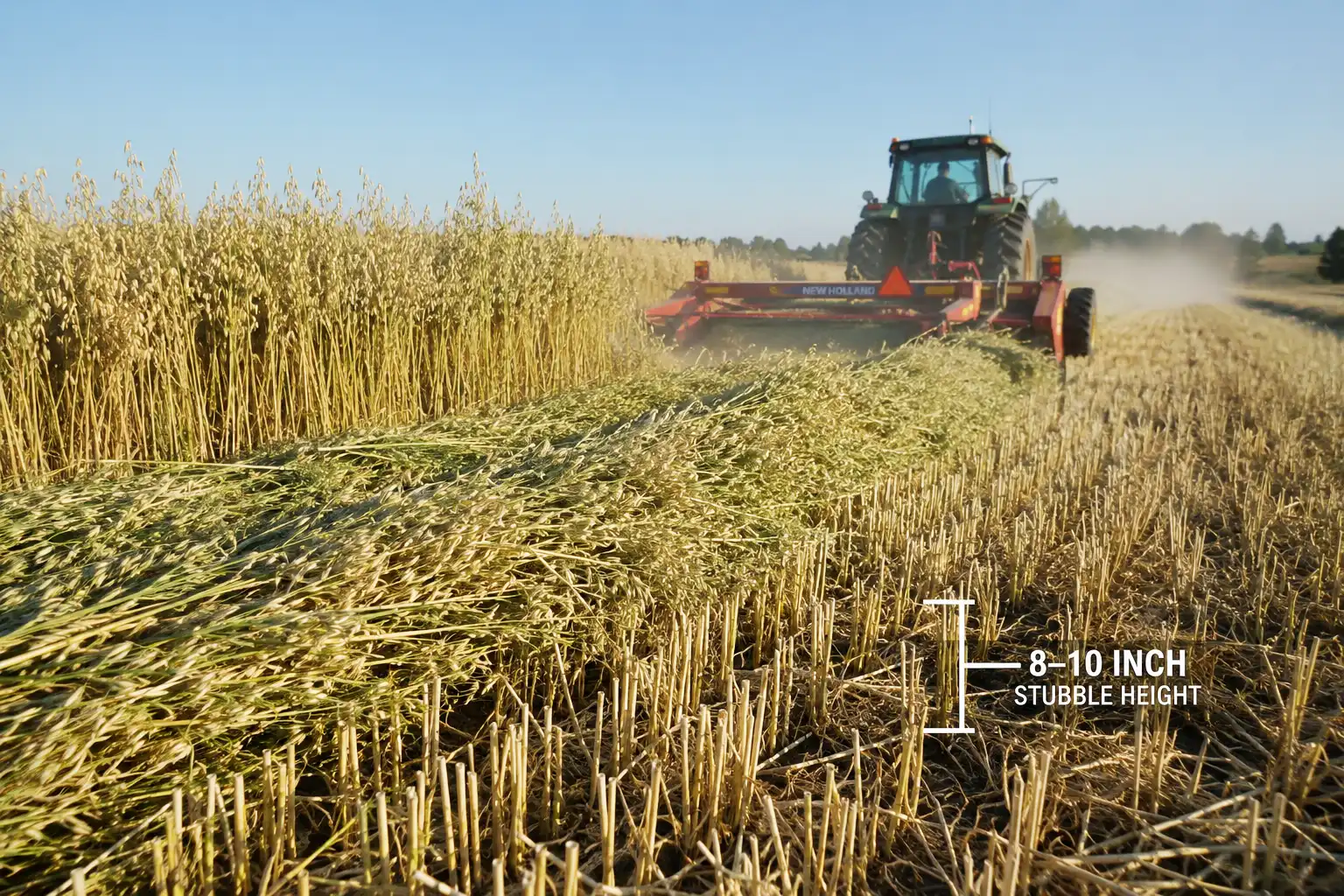
Rake into the final windrow while the material still bends instead of snapping. Once stems crack under a twist, most leaf loss happens at the rake and baler.
Safe Baling Moisture for Oat Hay
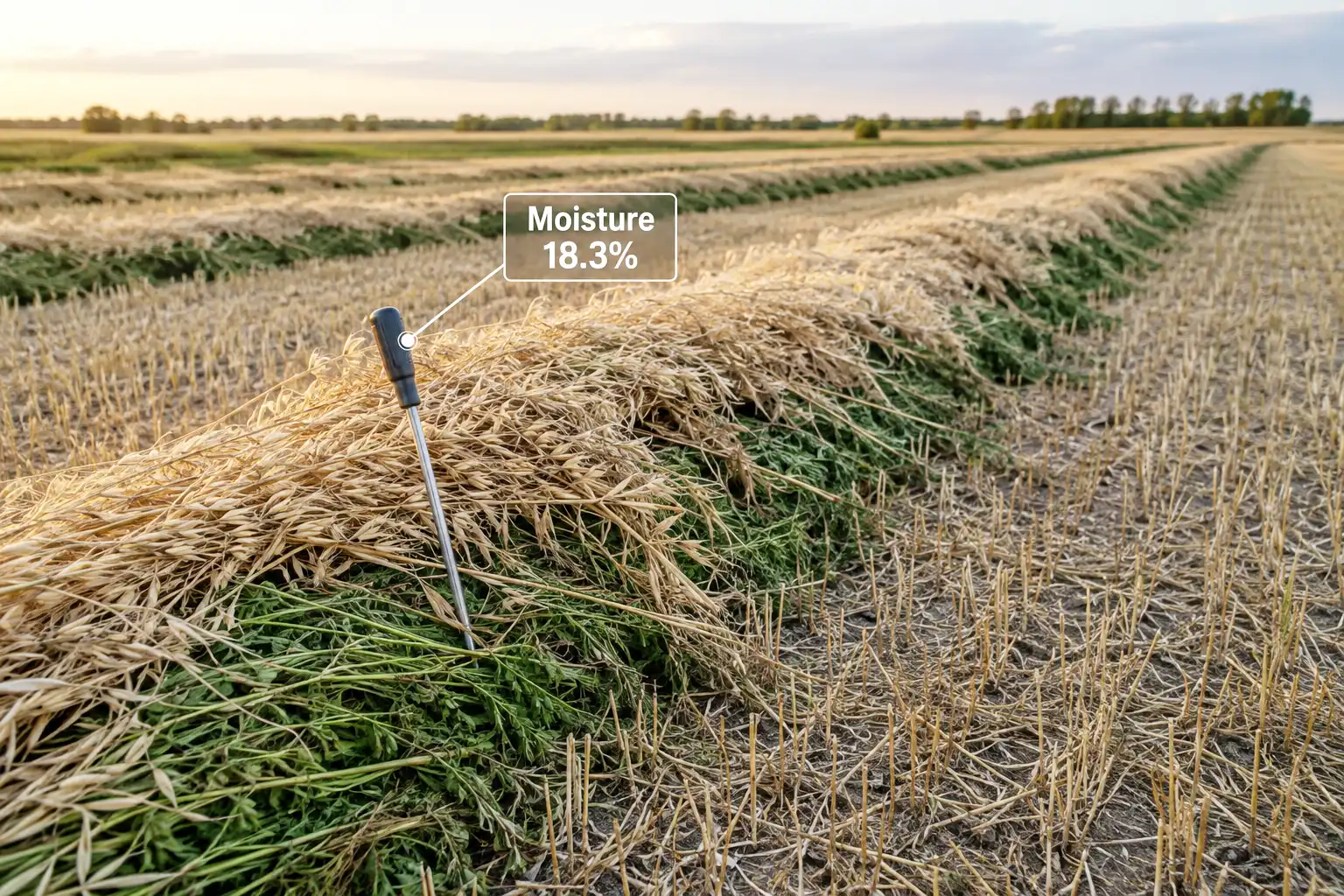
Bale small squares at 20 percent moisture or less, and large packages drier still. NDSU Extension advises 20 percent or below for small squares, then 16 to 18 percent for large packages. Density drives that gap, because a dense core holds heat far longer than a loose 50-pound bale.
| Bale package | Target moisture at baling | Reason |
|---|---|---|
| Small square, 40 to 60 lb | 20% or less | Loose density lets heat escape |
| Large round, 4 to 6 ft | 16 to 18% | Dense core traps heat much longer |
| Large square | 14 to 16% | Highest density, slowest heat release |
Guessing by feel costs more than the tool. Probe several windrows with a hay and grain moisture tester. A handful test misses wet spots, especially in low field corners.
NDSU Extension also notes that heating severity tracks baling moisture directly. At the same moisture, large dense bales run hotter. Heat damage binds protein into a form animals cannot use. So a hot bale tests lower than the field promised. Probe stacks for the first six weeks after baling. Rising internal heat, a caramel or scorched smell, or visible steam all mean trouble. Pull the stack apart and spread it. Call the fire department before opening a stack that hot, since fresh air feeds it.
Nitrate Risk Rises When Oats Are Cut Young
Cutting stage changes nitrate risk, and young oats carry the most. Nitrate concentrates in lower stems. Levels run highest from vegetative growth through boot, then decline through milk and dough. Drought, frost, hail, and heavy nitrogen all push those levels up.
NDSU Extension reports that oats, barley, and corn account for most nitrate poisoning cases in North Dakota. Its thresholds are specific. Nitrate nitrogen below 1,000 ppm is safe for pregnant cows and heifers. Below 1,500 ppm is safe for other cattle classes. Oat hay testing 1,500 to 3,500 ppm needs dilution with low-nitrate feed.
Three steps follow from that. First, test any hay cut off drought-stressed or heavily fertilized ground. Second, wait several days after a drought-ending rain, since nitrate spikes once moisture returns. Third, raise the cutting height, because the stem base holds the highest concentration. Warm-season forages carry the same risk, which is why sorghum sudan cutting stage follows similar rules.
Nitrate levels do not fall in storage. Testing is the only way to know.
Does Variety Choice Move the Cutting Date?
Yes, and by more than a week. University of Wisconsin variety trials show early types like Dane reaching late boot around June 16. The late forage variety ForagePlus hit that stage on July 1. ForagePlus yielded 3.4 tons of dry matter per acre. Early grain types managed 1.8 to 2.3 tons at the same stage.
That extra tonnage carries a cost. Wisconsin data put ForagePlus crude protein 1 to 3 points below standard oat varieties. Cutting it at early boot recovers quality, but yield drops. Late forage types also mature about a week behind late grain varieties, which matters when a double crop follows. Stand density feeds the same decision. So set your oat seeding rate per acre with the cutting stage in mind.
What Goes Wrong With Oat Hay Timing
| What you see | Likely cause | Fix for next time |
|---|---|---|
| Bales feel warm and smell sweet a week later | Baled above the moisture target | Probe several windrows, not one, and hold off a few hours |
| Grain sifts out during raking and baling | Cut past soft dough | Move the cut back to milk stage |
| Forage test returns near 9% protein | Cut at dough for animals that needed more | Cut at late boot for dairy or young stock |
| Windrow bottoms stay green after four days | Narrow windrow, no conditioning | Widen the swath and set conditioner rolls tighter |
| Rodent damage in stored bales | Ripe grain left in the hay | Cut before hard dough |
| Cattle off feed with labored breathing | Nitrate in drought-stressed hay | Test before feeding, then dilute or discard |
FAQs About Cutting Oats for Hay
How many days after planting can you cut oats for hay?
Can you cut oats for hay after they head out?
Do oats regrow after cutting for hay?
Is oat hay good for horses?
Should you cut oat hay in the morning or afternoon?
What to Check Before You Mow
Decide who eats the hay first, then let that set the stage. Dairy cows and growing stock earn a late boot cut. Mature cows and horses justify waiting for milk or soft dough and the extra ton of dry matter. Walk the field and squeeze kernels rather than trusting a date. Watch for a three to five day dry stretch. Then probe windrows before the baler starts. If the crop grew through drought, test for nitrate before a single bale reaches the feed bunk.