Sugarcane Mosaic Virus in St. Augustine Grass: Causes and Fixes
Sugarcane mosaic virus in St. Augustine grass is the main reason a healthy Floratam lawn turns thin and patchy across the South. The disease hits hardest in Florida, Texas, and the Gulf states. Here is what causes it and how to manage it correctly in 2026.
Sugarcane mosaic virus in St. Augustine grass is a Potyvirus that causes yellow mottling, thinning, and slow decline, especially in Floratam. There is no cure. Manage it by sanitizing equipment and replacing infected sod with a resistant cultivar like CitraBlue or Palmetto.
What Sugarcane Mosaic Virus Actually Is
Sugarcane mosaic virus (SCMV) is a plant virus in the Potyvirus genus, family Potyviridae. It was first studied in the sugarcane crop, where it still cuts yield every year. The same virus moved into St. Augustinegrass (Stenotaphrum secundatum) decades ago and now infects lawns across the southern United States.
The virus lives inside the plant. It hijacks leaf cells to make copies of itself, which is why symptoms show up in the blades. Once a plant is infected, it stays infected for life. No spray, soil drench, or fertilizer program will cure it.
How to Identify Sugarcane Mosaic Virus Symptoms
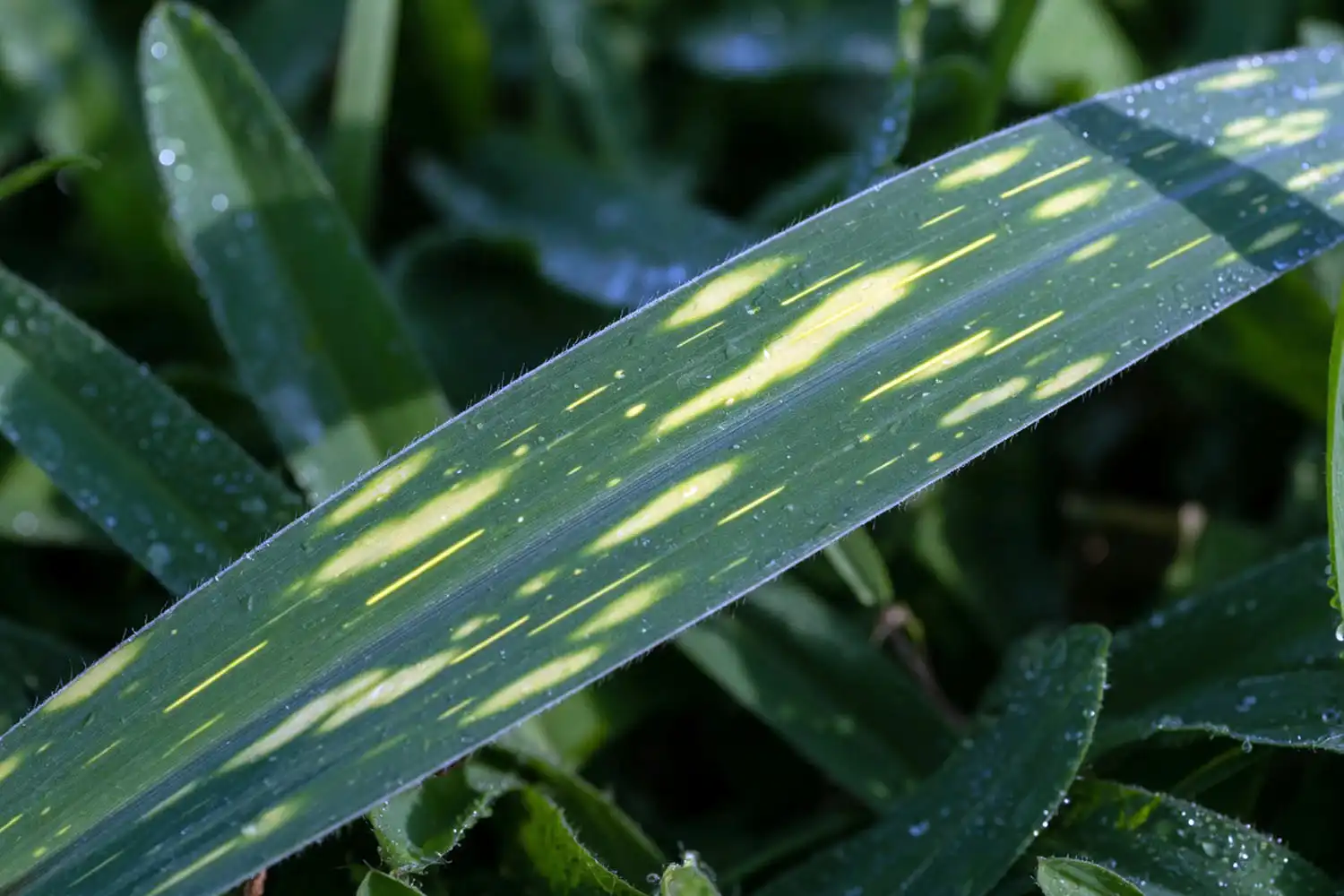
The clearest sign of sugarcane mosaic virus is a light and dark green mottled pattern on the leaf blades, often with short yellow streaks running along the blade length. Symptoms show up strongest in spring and early summer when growth is most active.
Other signs to watch for:
- Pale yellow stippling that does not match a typical nutrient deficiency pattern.
- Slow recovery after mowing.
- Thinning patches that expand year over year.
- Loss of color even in well-fertilized turf.
The damage builds gradually. A Floratam lawn can take two to four growing seasons to decline from full coverage to bare ground. Then the bare spots get taken over by weeds, which is usually when the homeowner finally calls the extension office.
Why Symptoms Get Confused With Other Problems
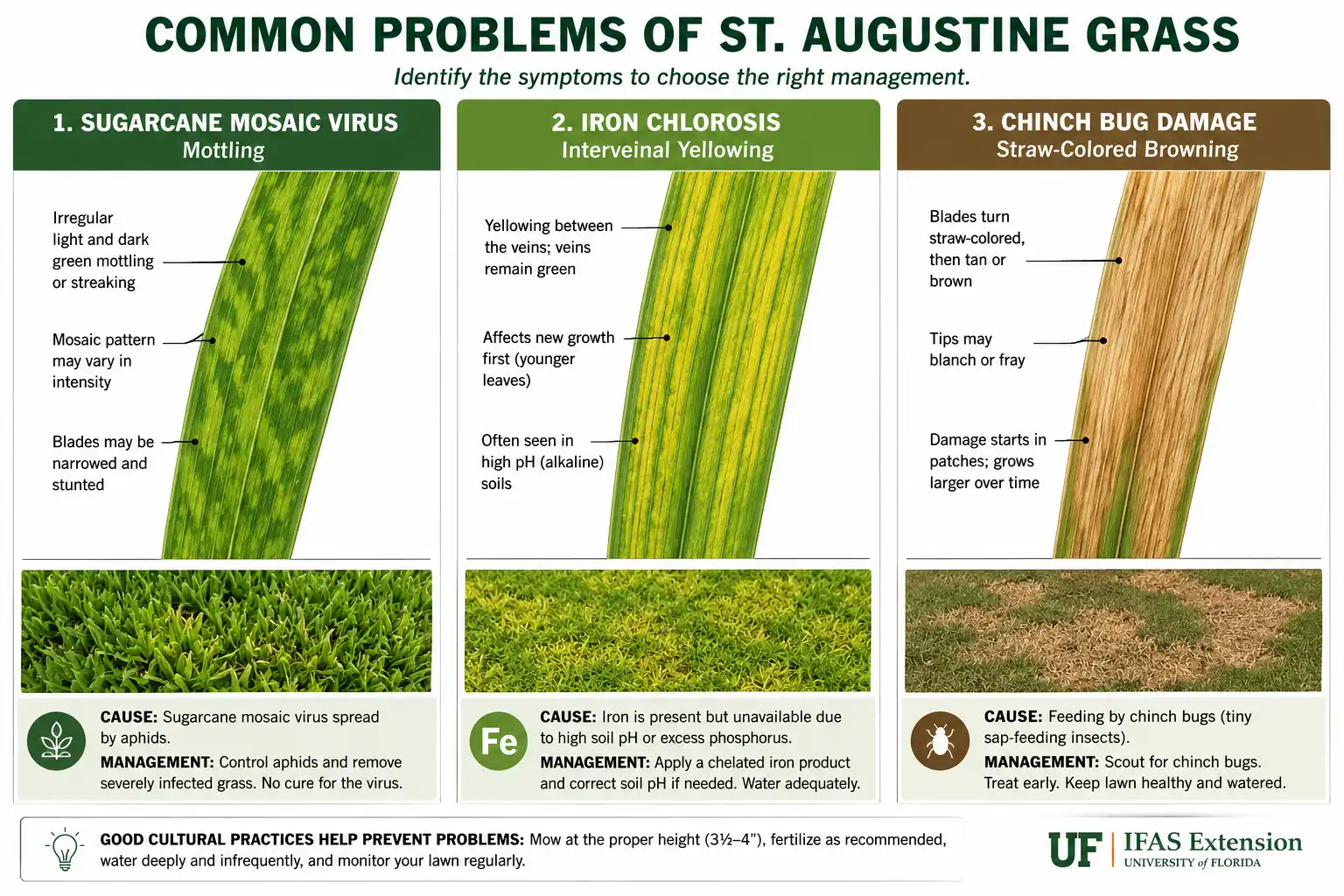
Mosaic virus symptoms look a lot like iron chlorosis, drought stress, or early chinch bug damage. That mix-up is why so many homeowners spend money on fertilizer or insecticide when the real issue is viral.
Iron deficiency shows up as uniform yellowing between the veins, not mottling. Drought causes folding and a blue-gray tint. Chinch bug damage shows straw-colored dead patches that expand in hot, dry weather. SCMV gives you that scattered yellow-green pattern that fits none of those.
What Causes the Virus to Spread
Sugarcane mosaic virus spreads three ways in St. Augustine lawns.
Mechanical contact is the biggest route. When a mower blade cuts an infected plant and then cuts a healthy plant, the sap carries the virus across. Edgers, string trimmers, and even foot traffic move it the same way.
Aphids are the second route. Several aphid species pick up the virus while feeding on infected grass and pass it to clean grass nearby. Aphid transmission is less efficient in turfgrass than it is in sugarcane fields, but it still happens regularly.
The third route is the most common in new installs: infected sod. The virus arrives on the property because it was already inside the sod pallet. Once it is in the ground, the first mowing finishes the job.
Why Floratam Is So Vulnerable
Floratam was released in 1972 by UF/IFAS and Texas A&M AgriLife Extension as a chinch bug resistant cultivar. It became the dominant St. Augustine grass across the South for fifty years. The problem now is that Floratam’s SCMV resistance broke down as new virus strains spread, and millions of lawns sit on one of the most susceptible cultivars on the market.
If your lawn is Floratam and it borders other Floratam lawns, infection risk is high.
How to Manage Sugarcane Mosaic Virus in Your Lawn
There is no chemical that kills sugarcane mosaic virus inside the plant. Management is cultural, and the long-term fix is replacement with a resistant cultivar. Follow these steps in order.
Step 1: Confirm the Diagnosis
Send a sample to your county extension office or a university plant diagnostic lab. UF/IFAS, Texas A&M AgriLife Extension, and LSU AgCenter all run ELISA or PCR tests for SCMV. Confirmation matters because the treatment for chinch bugs or iron deficiency is completely different.
Step 2: Sanitize Mowing Equipment
Clean mower blades, edgers, and trimmers between lawns and between sections of the same lawn. Wipe blades with a 10% bleach solution or 70% isopropyl alcohol and let them air dry. If you hire a lawn service, ask what they sanitize between properties. This one step slows lawn-to-lawn spread more than anything else.
Step 3: Mow Infected Areas Last
Cut healthy areas first, then move to patches showing symptoms. Bag the clippings from infected zones and dispose of them off-site. Do not mulch them back into the lawn.
Step 4: Maintain Steady Fertility and Watering
Healthy grass tolerates infection longer. Follow extension-based fertility practices, keep irrigation steady at about one inch per week, and avoid drought stress. This does not cure the virus, but it pushes back the visible decline by a season or two.
Step 5: Replant With a Resistant Cultivar
When the lawn declines past acceptable, strip out the infected St. Augustine grass and replant. Skip Floratam. Use a cultivar bred for SCMV resistance. The same logic in any integrated pest management plan applies here: stop fighting the symptom and remove the susceptible host.
Resistant St. Augustine Grass Cultivars Worth Planting
The market has caught up. Several modern cultivars hold up well against current SCMV strains.
- CitraBlue: Released by UF/IFAS in 2019. Blue-green color, dense growth, good shade tolerance, and currently the strongest SCMV resistance in commercial sod.
- Palmetto: Holds up well against SCMV in most field trials, more cold tolerant than Floratam, common across the Gulf Coast.
- ProVista: A genetically modified cultivar with herbicide tolerance and slow vertical growth. Field reports show solid resistance.
- DeltaShade: A shade-tolerant option with moderate SCMV tolerance.
Talk to your local sod supplier about which is available and field-tested in your county. Availability changes year to year.

Mistakes to Avoid
Three common errors make the virus problem worse.
- First, fertilizing harder when symptoms appear. Extra nitrogen does not cure mosaic virus and can encourage aphid populations.
- Second, mowing wet, infected grass. Wet sap spreads virus faster across blades.
- Third, replacing with more Floratam. This restarts the same cycle, sometimes within a single season.
Some folks also reach for a fungicide. SCMV is a virus, not a fungus. Fungicides do nothing here. The same rule applies to many other lawn and crop diseases: match the chemistry to the pathogen, or do not bother spraying.
Is the Virus a Risk to Other Crops?
Sugarcane mosaic virus has a wide host range. It can infect corn, sorghum, sugarcane, and several wild grasses. In a turf setting, the practical concern is grass-to-grass spread within the same lawn or between neighbors. It is not a food safety issue and does not affect pets or people.
For commercial sugarcane growers, SCMV is a much bigger deal because it cuts yield directly. Turf is a different battle, but the virus is the same one.
For research-grade detail and current cultivar trial data, the University of Florida IFAS Extension is the strongest authority source on St. Augustinegrass diseases in the South.
What This Looks Like on Lawns Across the South
If your Floratam lawn is starting to mottle and thin, the smart move is straightforward. Confirm SCMV with a lab test. Tighten up sanitation on every piece of cutting equipment. Start planning to replace the worst sections with CitraBlue or Palmetto. There is no spray that will save it, and waiting only spreads the virus further. The sooner the cultivar switch happens, the sooner you stop fighting a battle you cannot win with chemistry.