Where Is Rice Grown in California? 95% Comes From One Valley
Rice in California has a tight geographic footprint, and once you understand the climate and soils involved, the answer to where is rice grown in California gets simple. The vast majority comes from a small handful of counties in one valley up north.
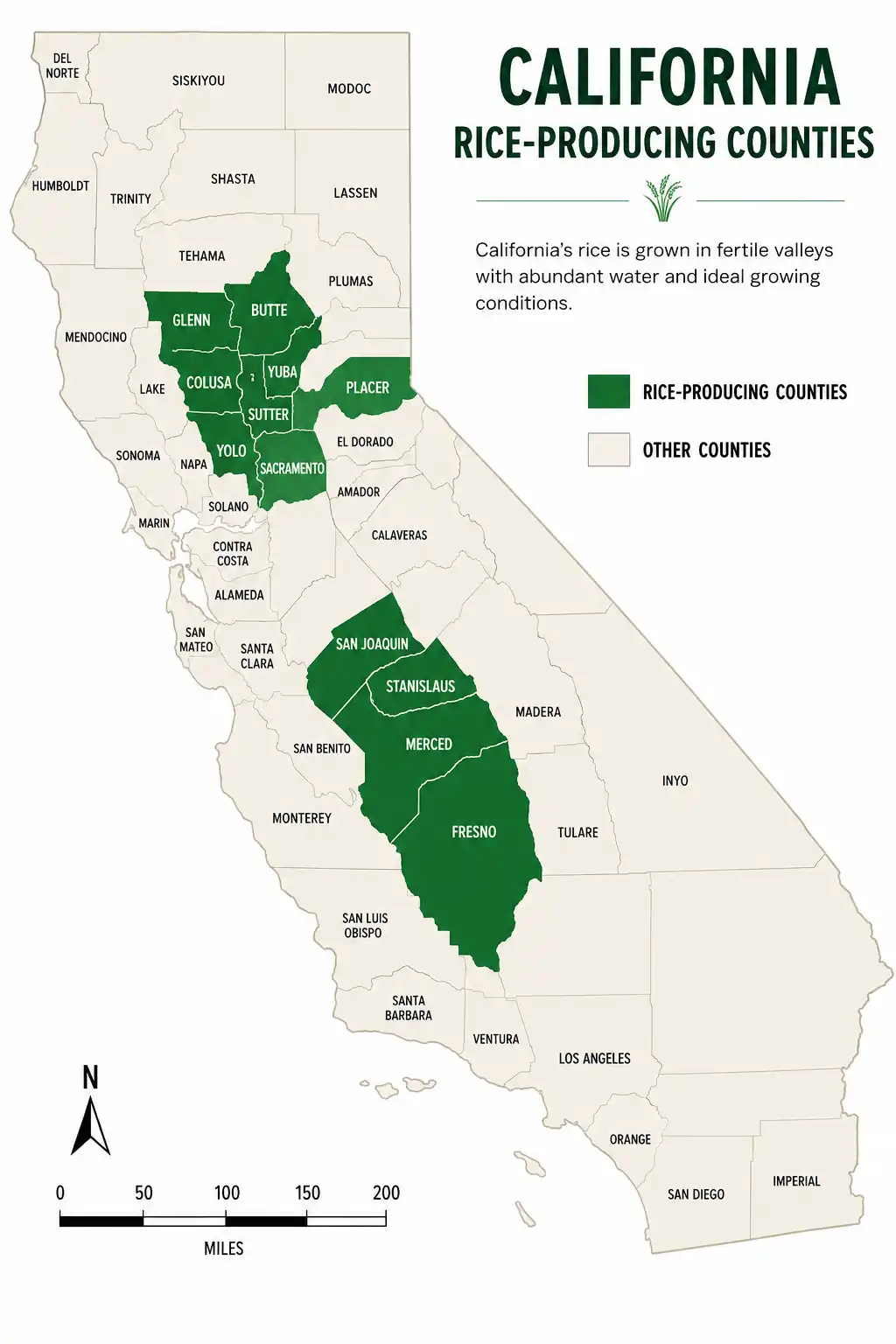
Rice in California is grown almost entirely in the Sacramento Valley, where about 95% of the crop is produced. Colusa, Butte, Sutter, and Glenn counties lead. The rest comes from a few northern San Joaquin Valley counties.
The Sacramento Valley Is California’s Rice Country
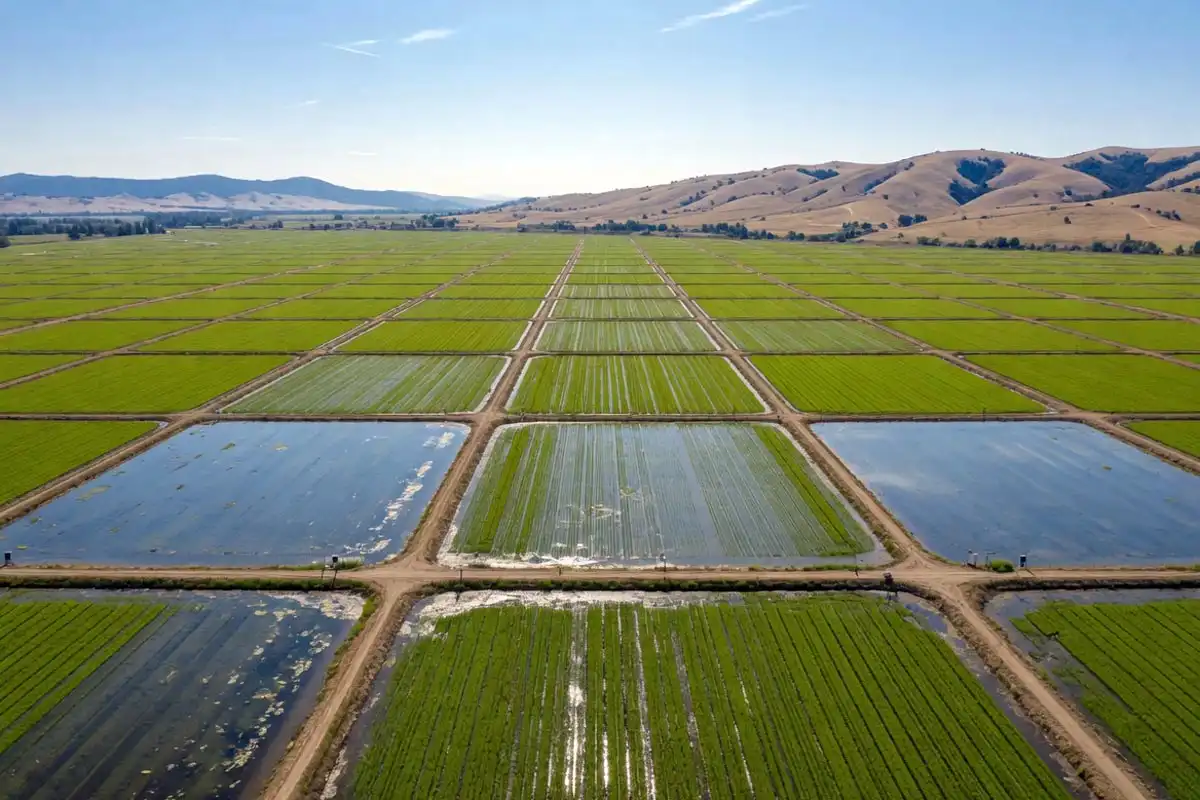
The Sacramento Valley produces roughly 95% of California’s rice and has since commercial production took off in the early 1900s. This is the flat stretch north of Sacramento, bordered by the Coast Range to the west, the Sierra Nevada foothills to the east, and Mount Shasta country far to the north.
The valley earned its rice reputation thanks to three things working together. First, clay-heavy soils that hold water like a bowl. Second, hot summer days paired with cool nights. Third, a steady water supply from Sierra Nevada snowmelt delivered through a large surface water canal network. That combination is rare in the U.S., and it is the reason short and medium grain japonica rice does so well here.
Top Rice-Producing Counties in California
Four counties carry most of the state’s rice acreage.
Colusa County
Colusa County is the top rice-producing county in California. It typically grows between 100,000 and 134,000 acres of rice in a normal water year, anchored by deep clay soils that hold water exceptionally well. Most operations in Colusa are continuous rice monocrop systems with very little rotation.
Butte County
Butte County is where commercial rice production in California started in 1912. The county still ranks in the top four for total planted acres, helped by warm valley temperatures and access to Feather River water. Biggs and Richvale, both in Butte, are historic centers of California rice.
Sutter County
Sutter County sits between the Feather and Sacramento Rivers and plants tens of thousands of rice acres each year. The Sutter Buttes break up the skyline, but the surrounding plains are flat clay basin land. That is exactly what flooded rice culture needs.
Glenn County
Glenn County rounds out the big four. Its fields sit on the west side of the valley and are some of the most drought-exposed in the state. In 2022, Glenn lost about 75% of its planted rice acres because of water cuts, and Colusa lost roughly 84% the same year.
Other Sacramento Valley Counties That Grow Rice
Placer, Sacramento, Yolo, and Yuba counties also grow meaningful rice acreage. Together they account for somewhere between 80,000 and 93,000 acres in a typical year. Yolo and Sutter tend to allow a bit more crop rotation than the heavier-clay northern counties.
Rice in California’s San Joaquin Valley
The northern San Joaquin Valley accounts for roughly 5% of state rice acres. The producing counties there are San Joaquin, Stanislaus, Merced, and Fresno, and together they plant around 15,000 acres. The Delta region (Yolo, Sacramento, and San Joaquin counties) adds another 35,000 to 45,000 acres in many years.
Acres are lower in the San Joaquin Valley for two clear reasons. The soils are more fertile, so growers plant higher-value crops like tomatoes, almonds, and stone fruit. Water access is also more restricted than in the Sacramento Valley, which puts pressure on lower-margin crops like rice.
Why These Specific Regions Grow Rice
Rice needs flat ground that can be flooded and drained on a schedule, soil that holds water, and a reliable irrigation supply. The Sacramento Valley checks every box. The clay-rich or claypan soils have very low percolation rates, so flooded paddies stay flooded with manageable inflow. The Mediterranean climate of dry summers means farmers can control water depth precisely without rainfall throwing off the schedule. For anyone wondering why rice paddies stay flooded in the first place, the short version is weed suppression, temperature buffering, and a stable growing environment for the plant.
You will not find rice in most of the rest of California for a reason. Coastal counties are too cool. Sandy parts of the Central Valley drain too fast. The Sierra foothills are too steep. Rice production lives where the geography forces it to live.
What Varieties Are Grown in California
More than 90% of California rice acreage is planted in medium grain varieties, with smaller plantings of short and long grain. Calrose is the medium grain name most consumers recognize, but growers plant a wide range of japonica varieties bred specifically for the climate by UC Davis and the California Rice Commission. Short grain is essentially a California crop in the U.S., and it is the rice used for sushi, paella, and risotto.
This is one of the biggest differences between California rice and rice grown in Arkansas, Louisiana, Mississippi, Missouri, and Texas. Those southern states focus on long grain, which has totally different cooking properties. If you compare California rice to rice farming in Mexico, the climate priorities and production scale look different again.
How California Rice Stacks Up Nationally
California is the second-largest rice-producing state, behind Arkansas. The state plants around 500,000 acres in a normal year, and yields routinely exceed 10,000 pounds per acre, roughly 20% above the U.S. average. That high yield comes from the climate, the clay soil, and decades of variety breeding. For deeper agronomic background, the UC Davis Rice Agronomy program publishes detailed public information on the state’s rice systems.
California rice also handles its environmental story differently than the South. Winter-flooded rice fields in the Sacramento Valley support millions of waterfowl on the Pacific Flyway, and replacing that habitat with natural wetlands would cost billions of dollars in capital outlay and ongoing maintenance.
How Water and Drought Shape Where Rice Is Grown
Rice acres in California swing hard with water availability. In 2022, drought cut state rice plantings roughly in half. Even strong rice ground in the western Sacramento Valley sits idle when surface water deliveries are reduced. Growers either fallow fields or plant a less water-intensive crop for that year.
This is part of why some California growers are now looking at lower-input systems, including regenerative rice practices that aim to cut water use and chemical inputs while keeping yield steady. The separate question of whether rice has to be organic to be considered sustainable is a related conversation in California rice country right now.
A Note on Wild Rice in California
Wild rice (a different species, Zizania) is also grown commercially in some Northern California paddies, particularly in parts of the upper Sacramento Valley and certain higher elevation basins. Acres are small compared to cultivated white rice, but it is a real segment of the state’s rice economy. Our guide covers growing wild rice in more detail in a separate article.
Where California Rice Country Actually Sits
California rice country sits in a rough oval north of Sacramento that covers Colusa, Butte, Sutter, Glenn, and the surrounding counties. The small San Joaquin Valley acreage sits at the edge of that core. Clay soil, Mediterranean climate, and a reliable canal-fed water supply have kept rice in those exact counties for over a hundred years.